If you Host a Wind Turbine, You’re Part of the Problem! Stop the Wind Scam!

Wind Turbines: The Evil Seed

They came in like a soft silent breeze
Hushing the naïve
Speaking with forked tongues
Proclaiming black is green
Maiming thinkers with corrupt words
Casting a thick cloud of concern
Residing with hidden evils
Leaving a trail of trash
Forever scarred
The stench you see
Smells of decay

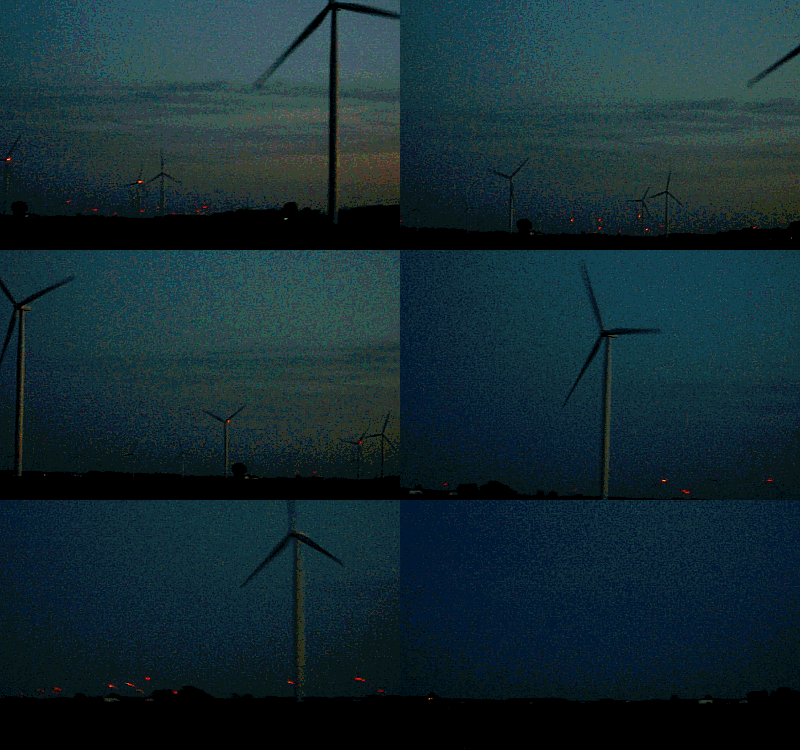
What appears above and below is a plea from Michigan. The author quite rightly sees the roll out of giant industrial wind turbines akin to an evil seed – that, like an errant tumour, takes root, multiplies and ends up totally consuming once productive, healthy and happy rural communities.

It all starts with a host – no host, no turbines.

That host may start with good intentions, hoping to be ‘green’, and accepting what they have been told. But the reality is so profoundly different. Many hosts are gagged by the slick and cunning lawyers and can not share their suffering – but some can and do:

SA Farmers Paid 1 Million to host 19 turbines tell Senate they would never do it again due to unbearable sleep destroying noise 

Turbine hosts lament: Hammered by wind power outfits, hated by former friends, relatives, and neighbours

David Mortimer, Turbine Host: An “Inconvenient” Wind Industry Fact

Once turbines are allowed in a community, it becomes easier for the system to bring in more – chasing the stream of subsidies that have caused this perversion in the first place.

This story comes from Tuscola County, in Michigan, in the US, where with no more than a week of notice, the first turbines were approved.

This area, called the Thumb (the shape of the State resembles a mitten protruding into the Great Lakes of North America) is considered the third most fertile agricultural land on earth – the naturally blackened dirt fields are ‘bars of gold’ for farming.

thumb

****

It intersects key bird migration pathways.

flyway

****

Now turbines are everywhere. The views of the Northern lights are replaced with an industrialised red light district.

Red lights

****

And the community is ruined. Community cohesion is gone. All those years of built community friendships are gone.

But the aggressive cancer of turbines progresses unabated. A further 2,700 turbines are planned for the area, with a new transmission line now completed. That number is more than twice the total number of wind turbines in Australia.

And it all starts with a host, who signs away so much, for a tiny sack of silver.

Don’t let the evil seed settle where you live. Please stop these things before they start.

tuscola2

Tom Harris Speaks Out About Remarks Made by the Pope, and Why it Was Wrong to Make Them!

Tom Harris has used the situation with my son, Joey, to show that the way the climate alarmists are going about pushing senseless solutions, (for problems they can’t prove will ever occur), is harming people here, and now.  This is obscene, and has to stop!   Please read this article, and share!

http://pjmedia.com/blog/the-popes-climate-letter-urges-dialogue-with-everyone-so-why-did-vatican-single-out-and-harass-us/?singlepage=true

Government Wants Our Land. We Must Fight Back!!!

Why is US Senator Harry Reid so concerned with a local Nevada rancher?

I live in Las Vegas. I live and breath Nevada politics. Something is very wrong. Something smells rotten in the Nevada desert. And Senator Harry Reid’s fingerprints are all over it.

I am of course referring to the Bundy Ranch siege. This was a dispute between a Nevada ranching family with rights to the land in question for 140 years and the BLM (Bureayu of Land Management).

The government claims they haven’t paid grazing fees for 20 years. The result was a government assault on the ranch- including snipers with assault rifles, SUV’s, helicopters, airplanes and over 200 heavily armed troops. No matter whether you come down on the side of the government or the ranch family, I think all of us can agree this was excessive force.

[pullquote]

But forget all that. I believe the more important question is, why is this case so important to United States Senate Majority Leader Harry Reid? And what was his involvement in this controversial assault?

Let’s start with Harry Reid’s obsession with the case. Just on Monday evening heweighed in again, promising, “This isn’t over.”

Doesn’t it strike anyone as strange that the U.S. Senate Majority Leader is so obsessed with a small rancher who hasn’t paid grazing fees? Does New York Senator Chuck Schumer get involved publicly when a New York company is late paying rent to the U.S. government?

Doesn’t the Senate Majority Leader have anything more important to think about?

There are almost 100 million working-age Americans no longer working. More Americans are today on entitlements than working in the private sector. More Americans are on food stamps than the number of women working in America. Iran is building a nuclear bomb. Russian jet fighters are threatening American ships. Yet Harry Reid obsesses about a rancher late on his rent? Something smells fishy folks.

There are other questions raised about Reid’s involvement. Why did this assault become the #1 priority of government only days after a senior political advisor to Nevada Senator Harry Reid took over BLM? Coincidence?

Government appeared completely uninterested in backing down for days on end…and completely unconcerned with instigating a deadly confrontation like Waco or Ruby Ridge. Then suddenly Senator Reid’s involvement was brought up by conservative web sites across the Internet. INSTANTLY, out of the blue, within hours of Reid’s name being attached to the raid, the BLM decided to back down, pack up and walk away. Don’t you think that this timing was a tad too coincidental?

It has been pointed out by journalists intent on covering for Reid that a $5 billion Chinese solar project backed by Reid was recently shelved. But what they forgot to mention is Reid’s involvement in multiple solar and wind projects across the Nevada desert. Only days ago, Senator Reid was featured in a photo at a groundbreaking ceremony for a new solar project. Where is that project located?Just 35 miles from the Bundy ranch in Bunkerville, Nevada.

Senator Reid’s fingers are in virtually every solar and wind project in the Nevada desert. Green energy is his obsession. Green energy is his baby. His vision is turning the Nevada desert into the “Green Energy Capital of America.”

Who benefits from that vision? Democratic donors who run green energy companies. Who stands in the way of that vision- Nevada’s ranchers, farmers and property owners- almost all of whom are diehard Tea Party conservatives and patriots who despise Reid.

Reid and the BLM needed a “cover story” to take the land away from the ranchers. So they claim it’s about protecting the “endangered” desert tortoise.

But if the protection of the desert tortoise was so important to the BLM, why did the same BLM kill hundreds of desert tortoises last fall?

If protecting the tortoises was so important, why has the BLM constantly waived rules protecting the desert tortoise for multiple solar and wind projects? If cattle are a danger to tortoises, why are solar panels and wind turbines not a danger?

There’s much more to this story folks. My educated guess is that someone in the government already has big plans lined up for the Bundy Ranch. Someone is going to make a financial killing with this forceful land grab. Someone powerful in government wants the Bundy family off their land (after 140 years).

What’s good for the goose is good for the gander. It was U.S. Senator Harry Reid who famously made a guess about Mitt Romney’s taxes. He guessed wrong. No one seemed to mind. So now it’s time for all of us to ask questions about Senator Reid’s involvement in this scandal and government land grab. It’s time for the media to investigate.

I’m only guessing…but something smells very rotten in Nevada.

Wind Turbines Bring Down Value of Surrounding Property~!

Government’s Energy Insanity Has People Looking For Better Solutions….

Power move: ‘It’s going to change the world, and some parts of the world aren’t going to like it,’ King says of energy independence bill

AUTHOR:David Carkhuff

Strange bedfellows, indeed, but when it comes to power policy, politicians sometimes cross traditional party lines.

And sometimes they even take issue with traditional power lines.

Here’s a timely example: U.S. Sen. Angus King, I-Maine, who came under political fire from Republicans for his involvement with wind energy prior to his election, now counts Tea Party activists among his supporters when it comes to a piece of legislation that King is championing that would allow “individual power generation.”

The senator says the bill promotes individual sovereignty, and it doesn’t get a lot more Tea Party than that.

King contends that his Free Market Energy Act of 2015, introduced just last month, “would help foster the movement toward personal energy independence by protecting the right of consumers to connect their distributed resources to the larger electric grid without having to pay an exorbitant fee to the utilities.”

During a May 26 tour, King promoted the bill against the backdrop of the new Cumberland-based campus for the Friends School of Portland, a Quaker day school. The 15,000-square-foot building, when completed this fall, will attain “passive house” certification, the highest international standard for energy efficiency.

The new school will not rely on traditional fuels – such as oil, gas, coal or wood – but instead use distributed energy technologies, like solar electric panels from Portland’s ReVision Energy, to help produce as much energy as it uses, King noted.

The tour also pointed out more mundane but highly efficient construction methods.

Naomi Beal, chair of the building committee, explained that the school features air tightness and ventilation, with 6 inches of cellulose and exterior rigid insulation.

“It’s not super, super high tech. … Actually, the simpler system worked well for us,” she said.

Crews painstakingly taped every crease around doors.

“It’s very important that we seal every draft for passive house standards,” said Dave Merrill, Warren Construction project manager.

“We’ve got ERVs, energy recovery ventilators, throughout the building which take in exhaust air, extract the heat out of that, extract the cold air out and bring the heat in, so it’s actually transferring energy that’s already in the building and reusing that,” Merrill said.

“The ‘passive house’ standard is .6 ACH (air changes per hour), and we in our first try did it at .34, so we were almost half the value we needed to be and with only the skin of the building at that point in time,” he added.

King used the Friends School tour to underscore his argument that anyone should be allowed to create their own power plant.

“Right here in Maine, Friends School of Portland is deploying innovative technologies that will help it operate almost entirely independent of the electric grid. My legislation would ensure that people can do what FSP has done: take their energy future into their own hands,” he said in a statement.

King pivoted from the tour to a question-and-answer session with some of the nearly 100 pre-K through eighth grade students who attend the day school.

“We’re trying to make energy more democratic, with a small D, for people who make their own energy not only at their schools but at their houses. More and more people are doing that,” King told the students.

But King acknowledged resistance to his legislation. Oil, gas and coal producers will push back, he predicted.

“It’s going to change the world, and some parts of the world aren’t going to like it,” he said.

“Where there’s going to be a comprehensive energy bill this summer, I’m working really hard to see that this is part of it, but we have some very powerful opponents,” King said.

“What we’re proposing to do is leave the details to the state of how it would be implemented, but it would establish a right to self-generate, and for the fees that the utilities charge to be reasonable,” he explained.

“It’s stirred up quite a hornet’s nest,” King said.

Disruptions such as cyber attacks or ice storms would no longer threaten widespread outages under a decentralized power system, King said. The model flies in the face of American electrification.

“You have a big central place that makes electricity and sends it through the wires to the house, and you just take it. That’s the way energy has worked forever,” King said. “Now what we’re talking about, the big change is, you’re going to make your own energy at your own house, and maybe when you don’t need it, you’ll send it back, to everybody else. It’s like instead of one central plant, you’ll have a million plants.”

Excellent Open Letter From Virginia Stewart Love, to Dr. Eric Hoskins, Re: Wind Victims

June 14,2015

Honorable Dr. Eric Hoskins

Minister of Health and Long Term Care

10th Floor, Hepburn Block

80 Grosvenor Street

Toronto, Ontario M7A 2C4

Dear Dr. Eric Hoskins,

It was with little to no enthusiasm that I read your response dated June 8th 2015, to the package and letter that I provided you with on September 16th, 2014 in Grey Highlands at the announcement of the New Markdakle Hospital. In fact the letter was not even penned by you but by J. Dhamrait in your Correspondence Services. After waiting 9 months for a reply I received a boilerplate letter that does not address any of the concerns of which I presented to you.

Mention of the Ontario Chief Medical Officer of Health, Arleen King’s report shows just how out of touch your Ministry is when citing a report that is 5 years old while ignoring the growing body of evidence which I included in my first letter to you; “Systematic Review 2013: Association between Wind Turbines and Human Distress” in which it was demonstrated “the presence of reasonable evidence that an association exists between wind turbines and distress in humans” as well as “A summary of some of the peer reviewed articles and conference papers, abstracts and other citations, regarding impairment of health in general and relating to industrial wind turbines. Industrial Wind Turbines and Health: Wind Turbines Can Harm Humans if too close to Residents”

Reference to the Health Canada Study, although positive did not address the Summary of Results of November 6, 2015 determined by objective and subjective measures which states “The following was found to be statistically associated with increasing levels of WTN:

  • annoyance towards several wind turbine features (i.e. noise, shadow flicker, blinking lights, vibrations, and visual impacts).”
  • A statistically significant increase in annoyance was found when WTN levels exceeded 35 dBA.”

In Ontario, the predicted noise models are 40 dBA but the allowable noise level imposed on people is up to 51 dBA with increased wind speed. As the Minister of Health, the finding of Health Canada at 35 dBA should be of concern to you. Health Canada and WHO acknowledge annoyance is an adverse health effect.

Further no mention was made of the findings dated April 9 2015 of the Council of Canadian Academies that the “Expert Panel finds that annoyance can be caused by wind turbine noise — a clear adverse health effect.”

Your response suggests that I might wish to share my concerns with the MOECC or the Ministry of Energy. It is because of years of doing exactly that with the result of boilerplate responses such as yours that I turned to your Ministry for help. I have filed 68 complaints with the MOECC since April 17, 2012 with no remedy or mitigation provided. Out of sheer frustration and growing cynicism I have now given up filing complaints but continue to document my adverse effects in a journal that has entries dating over 3 years. The Ministries mentioned above only serve to administer the GEA and are mandated to support more IWTs, at any cost, including imposing health risks on the rural population.

Are you aware that when you search the term “health” in association with affects of IWTs, the only hits relate to the impossible test imposed during ERT appeals – causality of serious harm? Most of the rural population and many in urban areas know this test cannot be met.

This is a health issue and I believed that as a Minister of Health and a physician, the principle of “do no harm” would be paramount and respected. My physician conducted a series of tests to get at the root cause of my symptoms. I included in my package to you a copy of a letter from him in which he had determined that “the main factor contributing to her symptoms is her proximity to the wind turbines.” Obviously his findings are not sufficient for invoking any mitigation and had you read the letter you would no doubt have not felt the need to council me to consult him as you would have been aware that I had already done so.

In a subsequent letter written to you on October 17, 2014 I wrote “As a physician I would hope that your political ideology as Minister of Health and Long Term Care would not override your moral conscience. Rural Ontarians deserve the same justice and humanitarian rights as those whom you advocate on behalf of in other parts of the world. The public interest should never take precedence over the human rights of others.”

The response from you to my plight and that of so many other people in rural Ontario has created a loss of trust and credibility especially when the public seems more informed than the Ministry of Health. That you can only respond with dated information when the evidence is clear, then one has to wonder how long this harmful policy will continue to be sustained.

This is an open letter, it will be shared along with your response attached with the very public that has lost all faith in the government of which you hold office.

Sincerely,

Virginia Stewart Love

Cc: Prime Minister Stephen Harper

Rona Ambrose, Federal Minister of Health

Premier Kathleen Wynne

Deputy Premier Deb Mathews

The Absolute Futility of Wind Turbines for Electricity! Unreliable, Unaffordable, Unnecessary!

SA – Australia’s ‘Wind Power Capital’ – Pays the World’s Highest Power Prices and Wonders Why it’s an Economic Basket Case

tom playford-anzac-parade

****

Once upon a time, in a land far, far away there was a veritable manufacturing and industrial nirvana. Post WWII, its population grew at a phenomenal rate; and so too did the level of prosperity enjoyed by thousands of migrants fleeing to it from war ravaged Europe – cheap and abundant food, decent, affordable housing, motor cars, televisions – all within reach for the first time for this aspiring class of people; it soon became a paradise for the working class: it was called South Australia.

And it got that way through the efforts of a legendary political performer, Sir Tom Playford.

In the 1940s, Playford (Premier for 26 years from 1938 to 1965) had a gift in the form of vast untapped reserves of brown coal located at Leigh Creek, about 260 km north of Port Augusta which sits at the top of the Spencer Gulf.

Through Tom’s tireless efforts he coupled that resource with his own creation, the Electricity Trust of South Australia (ETSA), which went on to provide cheap reliable power to almost every home, farm and business in very short order: from 1946 to 1965, the proportion of South Australians connected to electricity increased from 70% to 96%.

Port Augusta Power Station

***

Central to his efforts to populate and industrialise South Australia, was the power station at Port Augusta – for a detailed rundown on Tom Playford’s pragmatic political genius see our essay here:

ETSA: Sir Tom Playford’s Ghost

News last week that Alinta Energy will shut down the Port Augusta power station (which carries Tom Playford’s name), was greeted by the economics lightweights that write for The Australian (and others) with seemingly jubilant headlines such as “Jobs blown away as turbines kill coal”. We’ll return to the nonsense contained in that type of infantile journalistic hubris in a moment.

We have no doubt that the closure of the Port Augusta power station will have Sir Tom turning in his grave.

Kicking off in a big way from 2009, South Australia led Australia’s ludicrous “wind rush”: it currently has over 40% of the installed wind power capacity connected to the Eastern Grid (1,477MW out of the 3,669MW total).

Since then, power prices have skyrocketed – and its unemployment rate with it. Last week, South Australia received the dubious honour of having the highest unemployment rate in the Nation: at 7.6% and rising, it’s even worse than moribund Tasmania, which usually tops that list with ease.

Now, those with some sense of economics – like STT Champion, Danny Price – have chimed in to warn that South Australia’s dismal economic situation can only get worse from here –  given that the closure of the Port Augusta power station can only “drive up [power] prices”.

Coal shutdown ‘will drive up power price’
The Australian
Michael Owen, Meredith Booth
13 June 2015

The federal government and economic forecasters are warning South Australia that the closure of coal-fired power stations by April will push up power prices in the state, which has the highest electricity bills in the nation.

South Australia has pursued the rise of green energy since 2002 and generates 37 per cent of its power through solar and wind.

Frontier Economics managing director Danny Price yesterday said it was unusual “so much wind is going into such a market”.

This was raising prices and ­reducing demand for coal power.

“There’s no doubt in my mind that the closure of Alinta’s plant will drive up prices,” he said.

“In the last 10 years, new coal-fired power stations (globally) outstrip new renewable generation by five times,” he said.

He said the Alinta power stations at Port Augusta, 310km north of Adelaide, that were slated for closure supplied 16 per cent of the state’s power and their loss would leave it short of cheap base­load electricity.

On Thursday Alinta Energy announced its two power stations, one already mothballed, and an associated coalmine at Leigh Creek, 260km north of Port Augusta, would close 12 years early because they were unviable. Alinta blamed the rise in renewable power, much of it government subsidised.

Federal Liberal MP Rowan Ramsey, whose seat of Grey takes in Port Augusta and Leigh Creek, yesterday called on Alinta Energy to delay closure until at least 2018.

“Their absence will create a lot of issues about baseline power supply and will lead to price rises across South Australia and difficulties for businesses and other parts of the community,” he said.

Experts say the cheapest solution for the state to deal with a shortage of baseload power was to enlarge the interconnector between South Australia, NSW and Victoria, allowing the state to tap into an excess national supply.

The Australian Energy Regulator last year approved funding to upgrade the interconnector linking South Australia and Victoria, with the $47 million project expected to be commissioned by July next year.

State Treasurer Tom Koutsantonis insisted electricity prices would not rise.

He said coalmining was a dying industry and suggested workers affected by Alinta’s closure were highly skilled and would either take redundancies or find work elsewhere.

South Australia posted its worst unemployment figures in 14 years on Thursday, the rate rising to 7.6 per cent last month, up from 7.2 per cent in April. It was the worst result since July 2001.

Mr Koutsantonis said Thursday’s state budget “would be focused on creating jobs”.

University of Adelaide workforce academic John Spoehr warned the state faced a return to double-digit unemployment.

“Unless we can fill the void, unemployment will rise to 10 per cent over the next two years,” Associate Professor Spoehr said.

“We need to boost infrastructure and the capacity of the public sector with a combination of debt and direct-funded infrastructure. Let’s not be deficit fetishists.”

Alinta chief executive Jeff Dimery said South Australia would have no problems with securing baseload electricity supply.

Additional reporting: Verity Edwards
The Australian

Now, we promised earlier that we would skewer the naive nonsense about wind power “killing coal”.

STT just loves it when a case can be made simply – and even more so when it can be done in pictures.

Aneroid Energy (formerly windfarmperformance.info) tosses up the facts that the wind industry loves to hate; on a daily basis. It’s the very stuff that scotches wind industry bunkum – such as, “the wind is always blowing somewhere”; and “if you build enough turbines and spread them out far enough you’ll have baseload wind power coming out of your ears”:

Wind Power Myths BUSTED

We’ll start with a quick look at Australia’s wind power May-hem. Here’s the chaos delivered by all of the Australian wind farms connected to the Eastern Grid (which covers the ACT, Tasmania, South Australia, Victoria, NSW and Queensland) for the month of May (oh, and if the graphs appear fuzzy, click on them and they’ll pop up crystal clear in a new window).

May 2015 National

Looking a bit like the meanderings of a drunken spider that had dipped one leg in the ink-well and staggered over the page, that’s the nonsense that wind farms can deliver power as an “alternative” to on-demand power generation sources such as hydro, gas and coal belted, yet again.

With 31 ‘chances’ to make a meaningful contribution to lighting up the 1.4 million homes said by wind power outfits to be ‘powered’ by their wind farms – output collapses 7 times to less than 250MW – or less than 6.8% of the total installed capacity of 3,669MW.

Now, let’s have a look at what SA’s 1,477MW of installed capacity was up (or, rather down) to during May.

May 2015 SA

Hmmm …

Instead of ‘blowing coal away’ as the wind industry, its parasites and spruikers would have us believe, wind power managed to produce 5 complete ‘doughnuts’ during May – ie complete collapses in wind power output. So much for the pitch about ‘powering’ all those homes with ‘wonderful, FREE wind energy’ …

And – on 7 other occasions – collapsed to less than 200MW – or less than 13.5% of SA’s the total installed capacity of 1,477MW.

Those inconvenient pics and numbers are more than enough to skewer the typical line spread by fawning and gullible journos, about the contribution from wind power – such as the drivel in the piece above where it gushes that SA “generates 37 per cent of its power through solar and wind”. No it doesn’t.

ICU Respiratory_therapist

****

The demand for power is a ‘here and now kind’ of thing; and from the graphs above (and below), with wind power it’s a case of here for a few hours today; and gone for the day, tomorrow.

But, STT, never afraid to kick a wind industry myth when it’s down, thinks it’s worth drilling a little deeper into the numbers for this month.

Here’s the total output from all wind farms on the Eastern Grid for 2 June 2015.

2 June 2015 National

Thumping stuff – if chaos is your thing: a whopping collapse of 380MW – from 450MW to 70MW in less than 6 hours; with 70MW being around 1.9% of the total installed capacity of 3,669MW.

Now, let’s have a look at SA alone.

2 June 2015 SA

Another phenomenal effort – a 250MW collapse – taking less than 6 hours to bottom out with a big fat ZERO. And struggling to top 20MW (or 1.3% of capacity) for 4 hours – 1pm to 5pm – right at the point when demand hits its straps.

Sure, everyone is entitled to a little down time, so let’s have a look at the situation on the Eastern Grid on 5 June 2015, to see if wind power was able to benefit from its unscheduled R&R two days earlier.

5 June 2015 National

No, apparently the rest didn’t help much. From 10am to midnight total output bubbles along between 200-400MW (or between 5% and 10% of capacity) – with more than 90% of Australia’s wind power capacity taking most of the day off (yet, again).

And, to see if SA’s wind farms were pulling any of what little weight was being pulled by wind power, here’s the numbers from the same day for SA.

5 June 2015 SA

Looking more like the profile of a Swiss ski run, another coal ‘crushing’ effort there from SA’s finest.

Over the day, there’s an almost total collapse of 1,200MW or 81% of capacity going missing. By lunchtime, wind power is off for a well-earned siesta, with output sliding from 200MW (or 13.5% of capacity) to less than 50MW (or less than 3% of capacity) – a whole lot less than the 37% contribution to SA’s power output touted by the gullible young pups from The Australian (solar’s contribution to total output in SA is a pittance, and is, of course, ZERO when the sun sets).

Wind power hasn’t ‘killed coal’ in SA – it hasn’t anywhere.

On the dozens of occasions outlined above – where wind power output struggled to top 10% of its capacity – the balance of the power being chewed up in SA (and elsewhere on the Eastern Grid) ALL came from conventional, on-demand generation sources, predominantly coal, gas and hydro – in that order.

When SA’s wind watts go AWOL for hours – and even days at a time – South Australia imports huge volumes of cheap coal-fired power from Victoria’s La Trobe Valley and NSW, using the Heywood and Murraylink Interconnectors (with a combined notional capacity of 680 MW).

It also has 1,280MW of gas-steam capacity with AGL’s Torrens Island plant near Port Adelaide (see this article).

And – when demand outstrips those base-load sources – SA has a fleet of highly inefficient (and therefore costly to run) Open Cycle Gas Turbines and diesel generators to cover the shortfall.

Peaking power at Hallett

****

The cost of providing power using OCGTs and diesel generators to provide back-up for unpredictable but inevitable wind power collapses is astronomical: the dispatch price has to hit $300 per MWh before OCGT owners even begin to think about firing them up.

In this Wattclarity post on 9 June (on a typically cold SA winter evening) as wind power output collapsed (again) – heading in the opposite direction to demand – OCGTs were cranked into gear, as were diesel generators (referred to as liquid fuel generators in the Wattclarity article). The cost of wind power’s disappearance and the use of OCGTs and diesel generators to meet demand saw the dispatch price zoom from its usual $30-40 per MWh mark to $589.50 per MWh in order to keep the grid up and lights burning (see the NEM data here).

On plenty of other similar occasions the dispatch price in SA hits or gets close to the regulated cap of $12,500 per MWh (see our posts here andhere).

South Australians are already lamenting the fact that they pay the highest power prices in the world:

Why South Australians Pay the World’s Highest Power Prices

And that there are 50,000 homes (in a state with a population of around 1.6 million) that have no electricity whatsoever – and thousands more having their power cut every year – simply because they can no longer afford it:

Casualties of South Australia’s Wind Power Debacle Mount: Thousands Can’t Afford Power

What Danny Price points out is that – with the closure of the cheapest generator in the State – the Port Augusta power station – things can only get worse from here.

The furphy that ‘turbines kill coal’ is covered by the pictures above – how on earth could SA’s wind power be ‘killing’ anything on 2 and 5 June – and on 5 occasions in May – when it was struggling to produce anything at all, let alone enough to boil a kettle?

In truth, what led to Alinta Energy’s decision to ditch its Port Augusta plant is the monstrous market distortion generated by the Large-Scale Renewable Energy Target – a Federally mandated $50 billion wind industry subsidy scheme paid for by all Australian power consumers as a hidden tax on retail power bills (see our post here).

On the rare occasions when wind power is able to deliver meaningful output to the grid – which is usually at night-time – wind power outfits are more than happy for the dispatch price (the price paid by the grid operator to generators) to hit zero – and often pay the grid operator to take their output.

The LRET effectively forces retailers to take wind power output ahead of every other generation source. Failure to take wind power and the Renewable Energy Certificates (RECs) that go with it, leaves the retailer liable to pay a fine (the “shortfall charge”) of $65 for each MW/h the retailer falls short of the LRET’s mandated target.

The REC that is issued to wind power generators for each MWh of wind power dispatched (currently worth around $50) forms part of the bargain struck under the Power Purchase Agreements wind power generators hold with retailers, containing fixed and guaranteed minimum prices of between $90-120 per MW/h (3-4 times the cost of conventional power). The wind power outfit collects the REC, which passes to the retailer who then surrenders it to the Clean Energy Regulator, thereby, avoiding the “shortfall charge”. The price fixed by the PPA is tied to the expected value of the REC, the wind power outfit gets the price fixed by the PPA, irrespective of the dispatch price; and the power consumer pays the price fixed by the PPA, plus a retail margin on top.

As a result of the above, when they’re delivering to the grid, wind power outfits are happy to watch the dispatch price plummet, punishing base-load generators – like Alinta Energy, while having no impact on their own returns. It’s what’s called “predatory pricing”:

Perverse Renewables Policy turns Wind Power into Super-Predator

What SA’s turbines have ‘killed’ is meaningful employment.

While the article talks of unemployment at 7.6%, that masks the pockets of regional and youth unemployment: Adelaide’s northern suburbs, like Elizabeth have youth unemployment rates in the order of 40% – and, with the imminent closure of big employers, like motor manufacturer, General Motors Holden (with another 1,300 jobs on the chopping block) SA can only look forward to a generation of even more despair (see this Advertiser article).

And that brings us to another well-worn wind industry myth: the yarn about wind power creating thousands of ‘groovy-green’ jobs – lately used by wind industry spruikers to garner support for the retention of the LRET.

SA has more wind turbines per head than any other state – its great ‘wind rush’ took off in earnest in 2010. Since then, its power prices have surged to be among the highest in the world (with the closure of the Port Augusta power station they’re about to rocket again). Over the same time scale, its unemployment rate has jumped to be the worst in the Nation; and – with escalating power prices – can only worsen from here.

Unemployment-Rate-SA-line-2fromGFC

So, with $billions ‘invested’ in wind power in SA, STT puts the poser: what happened to all of the lasting, well-paid jobs promised by wind power outfits during their nauseating community ‘consultations’?  Maybe the answer is found by taking a look at Germany, which, like SA, was beguiled with the self-same same pitch:

Germany’s Unsustainable “Green” Jobs “Miracle” Collapses

Will the last South Australian to leave, please turn out the lights – if anyone can still afford to keep them going, that is?

studying candle

Solar…..Another Faux-green Way to Suck Money Out of Taxpayers!

If startups are bears, thermal solar startups are large bears.

The $2.2 billion Ivanpah solar plant is about 40% of design after 15 months.From Market Watch, High-tech solar projects fail to deliver

The plant is struggling to overcome some design/engineering glitches:

  • More cloud cover than anticipated
  • More water (steam) required than anticipated
  • 4 times the natural gas than anticipated for morning startups
  • steam leaks from flex tubes due to turbine vibrations
  • Has only achieved 40% of design output
  • ~3,500 birds per year incinerated

All startups need a shake down period to find design and construction problems. Most of these are caught in the commissioning phase.  New technologies have more problems than existing technologies.  Is this a poor design abetted by a rush for the “free” green money?  It certainly is beginning to look like the poster child for not doing thermal solar.  How many more of these green boondoggles are out there?

The Gag is Off, and This Wind Turbine Host, Tells the True Story!

SA Farmers Paid $1 Million to Host 19 Turbines Tell Senate they “Would Never Do it Again” due to “Unbearable” Sleep-Destroying Noise

gare2

****

Clive and Trina Gare are cattle graziers from South Australia’s Mid-North with their home property situated between Hallett and Jamestown.

Since October 2010, the Gares have played host to 19, 2.1MW Suzlon s88 turbines, which sit on a range of hills to the West of their stately homestead. Under their contract with AGL they receive around $200,000 a year; and have pocketed over $1 million since the deal began.

In a truly noble and remarkable move, the Gares gave evidence to the Senate Inquiry into the great wind power fraud during its Adelaide hearing, last week. Here’s their tragic story.

COMMONWEALTH OF AUSTRALIA
Proof Committee Hansard
SENATE
SENATE SELECT COMMITTEE ON WIND TURBINES
WEDNESDAY, 10 JUNE 2015

Mr Gare: Thank you for inviting me to present my submission today.

My submission deals with the impact on my health and lifestyle living in close proximity to a wind farm. Let me say from the outset that we were excited about the prospect of being part of the renewable electricity industry. I am a host to wind towers on my property, the nearest being about 800 metres away with three towers within approximately one to 1.5 kilometres away.

We were not made aware of the impacts of noise on our health or lifestyle. Fortunately, we had heard from others that they were quite noisy. Luckily, in our contracts we inserted clauses about the need for noise mitigation.

I do wonder why though the wind tower operators inserted the following clause in all the hosts’ contracts section 77C, which is on the memorandum of lease which I will table:

‘The landlord acknowledges and agrees that it is adequately compensated for any noise or inconvenience caused as a result of the permitted use of the site or the land and that it will not seek any further compensation from the tenant in relation to such matters.’

If the wind tower operators were confident of their impact studies, that clause would not be necessary.

After a short period of living with an operating wind farm, we had these products installed. I find that, because I work and reside in close proximity to the wind farm, I suffer sleep interruption, mild headaches, agitation and a general feeling of unease; however, this occurs only when the towers are turning, depending on the wind direction and wind strength.

My occupation requires that I work amongst the wind towers during the day which means I suffer the full impacts of noise for days at a time without relief. The impacts are that we are not able to open our windows because of the noise at night and we are not able to entertain outside because of the noise.

In conclusion, if we did not have soundproof batts in VLam Hush windows, our house would not be habitable. In my opinion, towers should not be within five kilometres of residences, and I would personally not buy a house within 20 kilometres of a wind farm. Thank you.

Mrs Gare: Good afternoon Senators, and ladies and gentlemen. Thank you for letting me speak to the committee today. I would like to open my statement with the following: developers and construction. In the beginning, I was excited about the wind farm and of course the financial security for our property and family.

The process began with high-pressure consultations, negotiations for weeks on end, numerous phone calls and face-to-face meetings with the developers. We seemed to be under constant pressure to agree to their wishes and, if we wanted any changes, it took a lot of negotiation.

We had to try and foresee any problems that may impact on our lifestyle for the next 25 years plus. With little or no previous information to go on, this was a very taxing time. Having gone through this, I would like to see that a person or persons – probably with a legal background and well-schooled in wind turbine information – be contactable for future wind farm hosts for advice and even to help with negotiations with the development companies.

Construction was also a very stressful and challenging time. The landowners are up against not only the power company but also all the big contractors and civil works companies. Any meetings with the above parties had to be attended by both of us with me taking notes so that we had some kind of record of what was said and what matters needed to be addressed at the time.

We had a lot of erosion problems from the pads and roadways, which we had to chase up with the power company to get them to address. During construction there were lots of problems with gates left open, boxing up mobs of cattle which then took a full day of redrafting and settling back into their paddocks.

We also had gates opening onto public roadways. We have a main bitumen road that goes past our property. This caused great angst as far as public liability is concerned, if our stock got out into the roads. We also had lots of rubbish scattered around the property. We witnessed one of our cattle eating a one metre by one metre piece of plastic sheeting.

Living with wind turbines.

Our house is solid sandstone, built for the late Charles Hawker in the 1920s, with concrete internal walls and a steel roof. The house is surrounded by a lot of vegetation and trees. I have brought some photos to show the Senate.

In the months after the towers started in October 2010, the noise was unbearable, especially when two towers became in sync. A loud thumping would radiate throughout the house. Even watching TV in the furthermost room from the towers, you could hear them. Sleeping was most difficult. I use, and still do, an earpiece radio every night, which helps block out the noise to a certain degree. If they are really going I have to up the volume.

After some time, due to a very slow installer, the house was finally insulated: sonobatts in the ceiling cavity; all our outside air vents blocked; a special American glass called Vlam Hush, which is two sheets of glass with a special gel between, were installed in every door and window of the house. This has improved the situation for me considerably, but at times the noise still penetrates into the house.

Ongoing issues.

Due to the house being sealed we have refrigerated air conditioning, because we cannot open windows because of the noise. A separate meter was installed on the wind farm operator’s advice, so that they could pay the cost of the air conditioning usage. That went in over 12 months ago and we are still chasing payment.

Another issue is the increase in our emergency services levy. The value of our property has increased by double, which has had a major increase in the levy. The power company pay council rates on the land that they lease, and we pay rates on the rest. We brought up the issue of the increased ESL with the power company, but they have not addressed it. We feel they should be responsible due to the increase in our land value. I have the value difference here: I think it is about $1.6 million increase. I quote from the contract, 6.1, rates and taxes, section B:

However, during each year of this lease the tenant must pay any increase in rates and taxes above the rates and taxes that were payable immediately before the start of the agreement to lease, if the increase is directly attributable to the works or the use of the site for the permitted use.

We also have ongoing problems with the cables which run across our property and connect into the individual towers to transport the power to a substation. There seem to be constant cable breakages, which have to be dug up and fixed. This, of course, happens all over the property. Having 19 towers, it has quite a big impact. Quite a large area is disturbed and then has to be recovered with sand or soil.

We have asked for compensation concerning this, as we have numerous cable breaks on the property with disturbance to our pastures, which interferes with our stock grazing. This was discussed at a meeting back in August 2014. We are still waiting for compensation, which is agreed by the wind operators. As you can see, they are not fast movers.

The land owners need to know their rights in regard to their property and how it is treated during and after construction of towers. Land owners with residences close to towers need to be made aware of the noise impact and there should be discussion of how close towers should be permitted to their premises. In my opinion, towers should not be any closer than five kilometres to a dwelling. If we had to buy another property, it would not be within a 20-kilometre distance to a wind farm. I think that says it all.

We have a son who will come home in a couple of years, and I have concerns for him and a family that he might have in the future, with regard to any health problems that may arise. Having lived with towers now for five years, in my opinion future hosts should glean as much information as they can and find out their rights so they can fully understand what they are taking on.

Senator XENOPHON: I would just like to ask some questions to Mr and Mrs Gare. I think the fact that you are hosts of wind turbines and you are giving evidence is significant. How many turbines are there on your property?

Mr Gare: Nineteen.

Senator XENOPHON: How long have you had them there?

Mr Gare: Five years.

Senator XENOPHON: And when did your start complaining about the turbines in terms of the adverse impacts?

Mr Gare: Straightaway.

Senator XENOPHON: Is it AGL that you are dealing with?

Mr Gare: Yes.

Senator XENOPHON: You may want to provide us with any documents in respect of this. How did they deal with the process? Once you raised the issue, what happened?

Mr Gare: We had it in our contract that if we found there was a problem they would put in noise mitigation products. We said: ‘You will have to do it. We cannot bear it.’ Because it was in the contract they went along with it, but I am sure, Nick, that they would not have if they did not have to.

Senator XENOPHON: It is a contractual relationship so it is under the terms of the contract. Are you able to say – and you may not want to – what level of payment have you been getting? If you do not feel comfortable saying how much you are being paid for the 19 turbines on an annual basis, you do not have to.

Mr Gare: All up, in total, about $200,000, so there is not a lot of advantage for us in coming here today.

Senator XENOPHON: When you experienced the noise, could you stay in the property or did you have to move out?

Mr Gare: If we did not have the noise mitigation products put in, we would have moved out.

Senator XENOPHON: Prior to the noise mitigation products being put in, how did it affect your sleep? Did you spend more time away from home?

Mr Gare: Fortunately, we have eastern rangeland country where I could go to get away from it. As I said in my submission, I am there 24 hours a day in amongst it. I had to go away to wind down. What was your question, sorry?

Senator XENOPHON: What period of time was it from the time the noise affected you until the time you had the noise mitigation – several weeks or several months? How long was it?

Mrs Gare: I reckon it took about 15 months or more. We had a very slow installer of the batts and things.

Senator XENOPHON: You are protected by parliamentary privilege when speaking out here today. Did AGL say to you: ‘Sometimes this happens. It is just one of those things’? Did they give an explanation as to the level of disruption? Did they say, ‘This has not happened before’?

Mr Gare: No. It was all glossed over right from the start. We were given no information.

One of their little tricks is to take people right up to the towers and say, ‘This is how noisy they are.’ But that is not so.

The further you get away from the tower the noisier they are. That is a funny thing, to a point I guess. When you are right underneath them and they are 80 metres up in the air there is very little noise. There is just a bit of wind noise. As you go away one or two kilometres it actually gets worse.

Senator XENOPHON: Before the noise attenuation or noise suppression in your home what was your quality of life like?

Mr Gare: Crap, to put it honestly.

Senator XENOPHON: You got a bit of sleep each night, didn’t you?

Mr Gare: With earplugs, yes. I wore earplugs constantly – only while they are turning, mind you, and providing they are in the right direction and have the right wind strength. Frosty nights are the worst because the sound tends to travel so much clearer and further on a frosty night. But earplugs.

Senator XENOPHON: Anything else, Mrs Gare?

Mrs Gare: No. Pretty much what Clive has said.

Senator XENOPHON: Do you sleep okay now?

Mrs Gare: No, they were waking me up on the weekend. You wake up to the thumping. This is with all the soundproofing in the house. As I said, I sleep with the radio on every night. If they are really cranked up I have to turn the volume up, so I will probably just go slowly deaf.

Senator DAY: I just want to clarify something. Frosty nights are normally not very windy.

Mr Gare: That is a funny thing. Our country is very hilly, and they put wind farms on top of hills. It can be blowing an absolute gale on the top of the hills and you can have frost in the valley.

Senator DAY: It is just that we have heard evidence that, even when the blades are not turning, they do have a similar infrasound impact on people because of the effect of the wind across the blades, across the aerofoil.

Mr Gare: Yes, but if there is that much wind the blades are turning, aren’t they?

Senator DAY: That is right.

Senator LEYONHJELM: If you had your time over again, would you host a wind farm?

Mr Gare: No, absolutely not. If I were a rich man, I would not have a wind farm on my property.

Senator LEYONHJELM: And you said it was $200,000 over five years approximately?

Mr Gare: No, 12 months.

Senator LEYONHJELM: Per year.

Mr Gare: Yes.

Senator LEYONHJELM: That is a fairly healthy income.

Mr Gare: Absolutely.

Senator LEYONHJELM: In spite of that, you would say that you would not have them.

Mr Gare: Absolutely, if I were a rich man, but unfortunately I am a farmer and there are not many rich farmers around.

Senator LEYONHJELM: What sort of farming?

Mr Gare: We are grazing, we can be cropping but we –

Senator LEYONHJELM: Sheep or cattle?

Mr Gare: Mostly cattle.

Senator LEYONHJELM: Has there been any effect on your cattle from the wind farms?

Mr Gare: No.

Senator LEYONHJELM: Okay, thank you.

Hansard, 10 June 2015

The evidence given by Gares will have ramifications for the wind industry, in Australia and beyond. To call it a major development in the ‘debate’ about the impact of incessant turbine generated low-frequency noise and infrasound on human health, is mastery in understatement.

You see, the shills that run propaganda for the wind industry – including a former tobacco advertising guru – run the story that it’s only “jealous” wind farm neighbours who complain about wind turbine noise, “jealous” because they’re not getting paid; and that those who get paid to host them never, ever complain (see this piece of cooked-up propaganda piffle here).

The Gares pocket $200,000 a year for the ‘pleasure’ of hosting 19 of these things; and, yet, make it very clear that it was the worst decision of their lives.

To describe the noise from turbines as “unbearable”; requiring earplugs and the noise from the radio to help them get to sleep at night; and the situation when the turbines first started operating in October 2010 as “Crap, to put it honestly” – is entirely consistent with the types of complaints made routinely by wind farm neighbours who don’t get paid, in Australia and around the world.

The Gare’s evidence is also entirely consistent with the experience of David and Alida Mortimer, also paid to host turbines for Infigen at Lake Bonney, near Millicent in SA’s South-East (see our post here).

Despite AGL spending tens of thousands on noise “mitigation” measures, the noise from turbines continues to ruin their ability to sleep in their own home, as Trina Gare put it:

No, they were waking me up on the weekend. You wake up to the thumping. This is with all the soundproofing in the house. As I said, I sleep with the radio on every night. If they are really cranked up I have to turn the volume up, so I will probably just go slowly deaf.

With the aid of their pets at the NHMRC, the wind industry continues the fluff about there being no evidence of adverse health impacts caused by wind turbines (see our post here). However, the evidence given by the Gares – as to the routine sleep disturbance caused by turbine noise – is, in and of itself, conclusive proof of adverse health effects.

The World Health Organisation has viewed “noise-induced sleep disturbance … as a health problem in itself” for over 60 years – its Night-time Noise Guidelines for Europe – the Executive Summary at XI to XII which covers the point – says:

NOISE, SLEEP AND HEALTH

There is plenty of evidence that sleep is a biological necessity, and disturbed sleep is associated with a number of health problems. Studies of sleep disturbance in children and in shift workers clearly show the adverse effects.

Noise disturbs sleep by a number of direct and indirect pathways. Even at very low levels physiological reactions (increase in heart rate, body movements and arousals) can be reliably measured. Also, it was shown that awakening reactions are relatively rare, occurring at a much higher level than the physiological reactions.

The review of available evidence leads to the following conclusions.

  • Sleep is a biological necessity and disturbed sleep is associated with a number of adverse impacts on health.
  • There is sufficient evidence for biological effects of noise during sleep: increase in heart rate, arousals, sleep stage changes and awakening.
  • There is sufficient evidence that night noise exposure causes self-reported sleep disturbance, increase in medicine use, increase in body movements and (environmental) insomnia.
  • While noise-induced sleep disturbance is viewed as a health problem in itself (environmental insomnia), it also leads to further consequences for health and well-being.
  • There is limited evidence that disturbed sleep causes fatigue, accidents and reduced performance.
  • There is limited evidence that noise at night causes hormone level changes and clinical conditions such as cardiovascular illness, depression and other mental illness. It should be stressed that a plausible biological model is available with sufficient evidence for the elements of the causal chain.

STT tends to think the World Health Organization – after more than 60 years of studying the problem – might just know a thing or two about night-time noise, sleep and health. And, after more than 5 years of suffering, so do Clive and Trina Gare.

Notwithstanding a $200,000 annual pay-cheque, and thousands spent on noise ‘mitigation’, the Gares still can’t sleep properly; or otherwise enjoy their own home – their suffering continues.

Against that backdrop, it’s to be noticed that the lunatics that pass for our political betters keep advocating for ever decreasing set-backs for turbines from residential homes: in South Australia, it’s currently a derisory 1,000m; in Victoria, it’s just been cut by the recently installed Labor government to 1,000m, too – although their wind industry masters are pushing to cut that measly distance even further.

So, it is more than just significant to hear from people who’ve had to live up close and personal with these things for over five years, especially when over that period they’ve pocketed over $1 million for doing so – Trina Gare observing, in the same terms as Clive, that:

In my opinion, towers should not be any closer than five kilometres to a dwelling. If we had to buy another property, it would not be within a 20-kilometre distance to a wind farm. I think that says it all.

The other point that arises loud and clear is the developer’s use of bullying, lies and deceit in order to get the Gares into their contract in the first place – starting with lies about the impact of turbine noise, Clive pointing out:

One of their little tricks is to take people right up to the towers and say, ‘This is how noisy they are.’ But that is not so.

The further you get away from the tower the noisier they are. That is a funny thing, to a point I guess. When you are right underneath them and they are 80 metres up in the air there is very little noise. There is just a bit of wind noise. As you go away one or two kilometres it actually gets worse.

And that type of skulduggery was being pulled amidst the usual inordinate pressure applied to unwitting farmers by developers, described by Trina as a process that:

began with high-pressure consultations, negotiations for weeks on end, numerous phone calls and face-to-face meetings with the developers. We seemed to be under constant pressure to agree to their wishes and, if we wanted any changes, it took a lot of negotiation.

All tricks; all traps; and all to the developer’s advantage.

Standard tricks, like telling the potential hosts – on a one-on-one basis – the very same story: “that all of their neighbours had already signed up”. Words usually uttered at a point in time when the developer had not signed ANY contracts in relation to its proposed development at all. Pressure often being added by telling the targets that they needed to sign up quickly, because if they didn’t they would be holding up hundreds of $millions in investment, hundreds of jobs etc, etc.

Working on the adage of “loose lips sink ships”, on each occasion, the farmers being targeted were told that they mustn’t breathe a word about the contract being offered to any living soul: so much easier to perpetuate a lie when it can’t be tested by your target with a quick phone call to their neighbours.

In order to add a little more pressure to their targets – and to get their monikers on the contract being offered – the developer’s goons would tell the target farming family that, because everyone else had signed up, they would end up with turbines right up to the boundaries of their properties (sometimes within a few hundred metres of their homes); so they “may as well sign up anyway”, because that way they would at least get paid for hosting some turbines on their own property.

The thrust of the developer’s pitch being that: your life is going to be ruined by dozens of turbines on your neighbour’s property, so you may as well receive a few grand a year for your pending troubles.

The same set of lies would be told repeatedly; until such time as ink appeared on all of the contracts needed to get the wind farm project off the ground, and on its way to a dodgy-development approval. The ruse has been used in numerous cases in Australia, in the USA and elsewhere:

Turbine Hosts’ Lament: Hammered by Wind Power Outfits; Hated by Former Friends, Relatives & Neighbours

On the strength of what the Gares have told Australia’s Senate, STT can only offer this advice to any farmer considering entering a landholder agreement with a wind power outfit: DON’T.

And, if you’re in a contract, do whatever you can to get out of it NOW. We suggest you obtain competent, independent legal advice on avoiding the kind of suffering thrust upon the Gares.

No matter how much you get paid, your home, along with those of your neighbours, will become practically uninhabitable. Moreover, you are unlikely to remain friends with your neighbours.

The Gares got into their contract at a time when nobody in South Australia knew about how noisy and disruptive giant industrial wind turbines could be in quiet rural environments  But, that’s all changed now. Plenty of rural communities are now suffering in precisely the same manner described by the Gares.

The Gares – along with plenty of others in the same position – were played by wind power outfits for dupes; as their evidence attests.

Admitting to a mistake takes honesty and personal integrity; admitting to a colossal mistake, even more so. However, to not only do so in public, but to your Parliament, exhibits moral decency – especially given the potential of that admission to operate as a sobering warning to others who have made, or who are likely to make, the very same error.

STT hears from its operatives at the hearing, that the Gares were warmly thanked for telling their story publicly. One who did so was STT Champion, Marina Teusner, from SA’s iconic Barossa Valley; and a voice of reason for the solid local group dedicated to killing off Pac Hydro’s threat of turbine terror for Keyneton (see our post here). Marina, in tears, embraced Trina Gare and gave her heartfelt thanks for what the Gares had just done.

As we said above, what the Gares have done is both remarkable and noble: these fine and decent people deserve the gratitude and sympathy of all; from those in their community, and well-beyond.

What they also deserve is that our political betters admit their mistakes; and immediately correct the errors that have led to the single greatest policy disaster in the history of the Commonwealth. After what the Gares have done, anything less is a monstrous insult.

abbottcover

Frauds, Crooks and Criminals

Demonstrating daily that diversity is not strength!

Family Hype

All Things Related To The Family

DeFrock

defrock.org's principal concern is the environmental and human damage of industrial wind turbines on rural communities

Gerold's Blog

The truth shall set you free but first it will make you miserable

Politisite

Breaking Political News, Election Results, Commentary and Analysis

Canadian Common Sense

Canadian Common Sense - A Unique Perspective from Grassroots Canadians

Falmouth's Firetower Wind

a wind energy debacle

The Law is my Oyster

The Law and its Place in Society

Illinois Leaks

Edgar County Watchdogs

stubbornlyme.

My thoughts...my life...my own way.

Oppose! Swanton Wind

Proposed Wind Project on Rocky Ridge

Climate Audit

by Steve McIntyre

4TimesAYear's Blog

Trying to stop climate change is like trying to stop the seasons from changing. We don't control the climate; IT controls US.

Wolsten

Wandering Words

Patti Kellar

WIND WARRIOR

John Coleman's Blog

Global Warming/Climate Change is not a problem