Friend to Wind Turbine Victims, French Senator Jean Germain, Dies Mysterious Death

10

‘SUICIDE’ OF FRENCH SENATOR JEAN GERMAIN, FRIEND OF WINDFARM VICTIMS

Written by Mark Duchamp, World Council for Nature on 10 Apr 2015

French Senator Jean Germain, a friend of windfarm victims, has been found dead in what appears to be a suicide. He had made increasingly effective political opposition against ‘Big Green’ interests in recent times. His death may be considered suspicious. Jean Germain As UK national newspaper, The Guardiannoted:

“He is a martyr of the republic. He has been thrown to the dogs” said his lawyer (1).
Recently, Jean Germain had convinced his fellow Senators to propose an amendment doubling the setback between wind turbines and habitations to 1,000 meters. The French government, house of representatives and  wind industry are opposed to it.
In a country like France, a 1,000-meter buffer zone would make relatively few wind projects possible. But the majority of Senators thought the health of their constituents was more important.
Other French politicians who, according to the authorities, committed suicide:
 
 Pierre Bérégovoy in 1993, who “shot himself” – yet it turned out later that he had two bullets in his head (sic)  (2)
– Robert Boulin, who was found in a pond in 1979, with clear evidence of blows to the face – in other words, this Minister would have commited suicide by beating himself up (3).
– There may be more examples…
We are not implying that the death of Jean Germain is suspicious. We are just remembering that, in these matters, it may take years before the whole truth is known. Prudently, a number of media have been titling: French senator found dead in apparent suicide (4).
If you read French, see the moving letter from Pascale Hoffmeyer, WCFN’s Coordinator for Switzerland: “… the distress of giant turbines’ neighbours …” (5).
Contact:
Mark Duchamp      +34 693 643 736
Chairman
www.wcfn.org

Cape Bridgewater Wind Facility- Acoustic Engineering Investigation

Acoustic Engineering Investigation at Cape Bridgewater Wind Facility

Acoustic Engineering Investigation into Airborne and Ground-Borne Pressure Pulses from Pacific Hydro’s Wind Turbines at Cape Bridgewater

Waubra Foundation Definitive Document
1 February, 2015

A Simplified Explanation of the Findings, Previous Research, and the Consequences

1. Background

  • Turbines create “waste energy” in the form of airborne pressure waves (sound) and ground-borne pressure waves (vibration).
  • Noise is that part of the sound frequency spectrum which is audible, but “noise” is also defined by psychoacousticians as “unwanted sound”.
  • The strength (sometimes expressed as a loudness in the case of noise) of the sound is measured in decibels (“dB”).
  • The wavelength of individual sound waves is a measure of the distance between the peaks of the pressure waves. The speed of sound divided by the wavelength gives the frequency of the sound and is expressed in hertz (Hz).
  • Where the frequency of the sound waves is below 20 Hz, the distance between the waves is relatively long, and the general term for this portion of the frequency spectrum is known as infrasound. Infrasound is only audible at very high levels (dB). However it can be damaging to the human body at levels well below audibility.
  • Impulsive infrasound from a variety of industrial sources has long been known to have the potential to be harmful to humans, especially with chronic exposure. For example, human and animal studies have shown infrasound directly causes both physiological stress, and collagen thickening in a variety of tissues including cardiac valves, arteries, and pericardium which themselves lead to a variety of cardiovascular diseases.
  • Infrasound persists for much greater distances than audible sound and, unlike audible sound, penetrates well insulated building structures (including double glazing) with ease; and often increases the impact by resonating within the house, like a drum. This occurs, regardless of the source of sound & vibration energy. Penetration of buildings and amplification via resonance can also occur from sound and vibration from natural sources such as earthquakes and thunder.
  • Standards for wind turbine noise pollution in Australia are set in audible decibels (“dBA”) outside houses. Use of dBA excludes accurate measurement of frequencies below 200 Hz, including both infrasound (0 – 20 Hz) and low frequency noise (20 – 200 Hz). These Standards do not require infrasound (either within or outside homes) to be predicted in planning submissions nor to be measured in the required compliance testing to the planning permit noise conditions. Most jurisdictions do not require wind turbine generated low frequency noise to be predicted or measured either (unlike other sources of industrial noise). In fact most noise measuring instruments and microphones are unable to measure accurately in the infrasound range, especially below 8 Hz., and some Standards explicitly specify the use of equipment which cannot measure infrasound.
  • Wind turbines produce infrasound along with audible noise. The more powerful the wind turbine the greater the proportion of infrasound and low frequency noise emitted, which then increases significantly if the turbines are sited too close together, now common practice in Australia. Most newer wind turbines are now 3 MW or 3.5 MW, compared to2MW at Cape Bridgewater.
  • By the use of different sound meters and microphones, and in narrow (frequency) bands it is quite possible to identify and measure infrasound specifically from wind turbines, in the field. This unique “wind turbine signature” has now been demonstrated by the acoustic consultants involved in the Health Canada Study, and by Professor Colin Hansen’s team at Waterloo, in addition to Mr Cooper’s measurements at a number of locations in Australia prior to, and including, the Cape Bridgewater Acoustic Investigation.
  • Increasing numbers of residents living within 10km of wind turbines have suffered, and are still suffering, severe adverse health impacts since the wind turbines started operating. Many have left their homes repeatedly, and eventually permanently, to live in greatly diminished financial circumstances, as their homes are no longer habitable or saleable. Some residents become too unwell to work. Wind turbines are not the only source of impulsive infrasound and low frequency noise causing severe health damage. The same pattern of identical serious adverse health effects, sleep deprivation and home abandonments, sometimes out to similar distances are being reported by neighbours to other known sources of infrasound and low frequency noise, at open cut coal mining (e.g. Hunter Valley in New South Wales), underground mines with large extractor fans (eg Lithgow, in New South Wales), gas turbine power stations (e.g. Uranquinty, in New South Wales, Port Campbell in Victoria) and numerous other sources (eg Tara gas field in Queensland).
  • Wind power projects and other energy generating noise polluting industrial developments involve very large sums of money in construction, in revenues and in the case of industrial wind turbines — public subsidies. It is not uncommon to find companies with large investments and large cash flows going to great and improper lengths to maintain their cash flows.
  • The wind industry has never been asked to prove that their machines are safe, unlike other products on the market. When queries are raised about impacts on neighbours, the industry and its supporters trigger the “Four Ds” of denial, dissemble, delay and destroy the messenger, despite the wind industry being well aware of the seminal research by Dr Neil Kelley and NASA which established direct causation of symptoms from impulsive infrasound and low frequency noise from wind turbines and other sources in the 1980s, by both field and laboratory research.

2. The Purpose of the Cape Bridgewater Acoustic Investigation

The purpose of the investigation was simply to find out what was causing the symptoms and sensations, resulting in sleep disturbance and health damage, reported to Pacific Hydro between 2009 and 2014 by the residents of three homes sited between 600 – 1600 metres from wind turbines sited at the Cape Bridgewater Wind Project in Victoria, Australia.

3. What Are the Key Findings of the Cooper Acoustic Investigation?

The findings include:

  • By using sound meters and microphones that can accurately measure infrasound and recording the infrasound levels in narrow frequency bands (rather than dBA or 1/3 octave bands) it was clear that infrasound generated specifically by the wind turbines was present in the three homes.
  • Wind turbines emit a recognisable and repeatable sound “signature” (or profile), being the relationship between the blade pass frequency and multiple harmonics of that frequency. At times the acoustic signature included audible characteristics and modulation across the full frequency spectrum. Further, this signature, whilst it contains significant energy in the infrasound range, is in no way comparable to other sources of infrasound such as waves on the beach, other fast rotating machinery, i.e. refrigerators, trains, road traffic, as claimed by wind industry “experts” and supporters.

This discovered profile ”wind turbine signature” does not need further research, and has been independently documented by other acousticians and researchers around the world.

  • Wind turbine infrasound is present inside each of the three homes investigated (when the turbines are operating), at levels known thirty years ago to directly cause the same symptoms and sensations including sleep disturbance and body vibrations. The intensity of the infrasound levels inside the houses varied between and within rooms (probably due to resonances and different outlooks to the wind farm).

A potentially causative energy problem was identified in each of the three houses.

  • It was determined from early testing by Steven Cooper and the residents that recording of impacts solely by the previously used parameters of noise and vibration was not enough. A third impact being “sensation” was added to cover, as it transpired, the reaction of the body to infrasound.

Diaries used by the SA EPA at the Waterloo project were not designed to investigate the reported impacts from “sensations”. The SA EPA’s conclusions in that study were wrong, and are therefore now irrelevant.

  • The residents’ impact diaries (based on the South Australian EPA Waterloo Acoustic Survey diary format) were substantially modified to improve their ease of use, reliability and differentiation between perceptions of noise, vibration (external to the body), and “sensations” (determined in this study to be reactions to infrasound).

The form of these diaries must be the minimum standard for future multidisciplinary investigations.

  • Since measurements and predictive noise models for wind turbines being expressed in dBA exclude accurate measurement of infrasound and low frequency noise, it follows that dBA is useless as a proxy for predicting damage to neighbours, or for setting Standards to protect them from harm. Even before Steven Cooper’s investigation, the wind turbine noise Standards were known to be dangerously inadequate. Responsible authorities should have altered the Standards to include sound as a whole and infrasound in particular, especially after Dr Neil Kelley’s work establishing direct causation from infrasound and low frequency noise resurfaced in mid 2013. Steven Cooper’s work at Cape Bridgewater reinforces the need for urgent revision of existing Australian standards and regulations, and to develop a standard for “sensation”.

These current Standards are now known to be dangerous, clearly do not protect people, and must not ever be used again.

  • Methods of measuring sound must: utilise instruments able to monitor the whole spectrum of sound; be conducted inside as well as outside homes; produce results in narrow bands not one third octaves or dBA as is currently standard, and must continue over sufficient periods of time, to cover most if not all environmental conditions (wind speed and direction etc.).

No other acoustic investigations have been so inclusive of a range of environmental conditions, apart from Dr Neil Kelley and NASA’s work, funded by the US Department of Energy in the 1980’s which originally identified the direct causal relationship between symptoms and sensations and impulsive ILFN from the various sound sources which included wind turbines, gas turbines and military aircraft.

  • Changes in wind speed, wind direction, turbine start up, and operating at near shutdown speed coincided with sensations being at the highest level (characterised as equivalent to a compulsive need to flee the house).

Causality of intolerable symptoms and sensations from infrasound has been established, repeatedly and predictably. This means it is now indefensible for any public authority or official to rely on the nocebo nonsense to explain residents’ symptoms and sensations.

  • Without any argument the investigation showed that the six residents in the three houses were regularly subject to wind turbine derived infrasound, inside their homes particularly in the 4 to 5 hertz range of infrasound frequencies, at levels known thirty years ago to be dangerous to health. The residents’ own diaries and personal health histories demonstrate that all of the residents have been severely impacted.

4. Commentary

With better instruments, more reliable and useful diaries, plus eight weeks of data and the opportunity to measure sound and vibration when the turbines were shut down, this thorough acoustic investigation by a highly regarded, ethical acoustic engineer was established to find the truth whatever it may be.

A number of lesser studies previously conducted by other acousticians, show signs of intellectual corruption and/or ineptitude, and of being designed to find no problems; thereby shielding the flow of cash to wind project owners; whilst holding off the liability for supposedly expert but incorrect opinions delivered by a group of acousticians on behalf of project operators and of companies seeking planning permits.

Predictably, the wind turbine product defence team are still trying to fault the Cooper investigation.

A guide to understanding the key claims follows.

a) Misrepresenting an Engineering Investigation as an all embracing academic research project, and then criticizing it because it was not.

The brief was very specific — to determine whether certain wind speeds and certain sound levels related to disturbances related to specific local residents. This was a thorough, independent, acoustic investigation into why these three houses were virtually uninhabitable. The answer was found and the cause established. Evidence of court quality has been established. It was not a generously funded academic research project.

b) No Peer Review

It is correct that this report was not peer reviewed prior to public release.

Pacific Hydro did not allow peer review to occur, prior to its publication. However, peer reviews by acoustic consultants are occurring now, and preliminary peer reviews from acousticians with first hand knowledge of the reported health problems and the challenges of conducting research inside the homes of impacted residents have acknowledged the quality and usefulness of this acoustic investigation.

Engineers seek a repeatable result. The way a repeatable result is sought includes checking the suitability and location of the instruments, then painstakingly calibrating them before measurements start. The calibration and measurement processes are repeated ad nauseumuntil it is clear, without out any doubt, that the results are repeatable. This is precisely what Steven Cooper has done. It is also of great value that the methodology of the study, and the problems he encountered, have been so clearly described in detail in the report, for the benefit of future researchers.

c) No Control Group

Some non epidemiologists and wind industry employees and supporters who have commented publicly on this research have said it is meaningless because there is no “control” group for comparison. The brief from Pacific Hydro prohibited a separate control group of separate non exposed “controls”. In fact, the residents were their own controls in this acoustic investigation, which in epidemiological terms is a “prospective case (series) crossover” design, also used in pharmacological research to assess the individual responses to differing doses of drugs over time.

In other words this particular study design gives detailed information about a number of individuals’ responses to specific doses (in this instance “exposure doses at specific sound frequencies”) over time, and also the human responses when no drug (wind turbine infrasound) is present. Prospective case (series) crossover studies are well known to epidemiologists as a powerful epidemiological study design, and help to establish causation, as well as therapeutic and safety thresholds, depending on those varied individual responses.

d) Small Sample Size

This was a detailed investigation into three houses, over eight weeks, with six residents who had reported serious adverse health impacts for many years. The sample size limits were established by Pacific Hydro, who commissioned the study, and are to be commended for doing so. This level of detailed direct investigation of acoustic exposures and human impacts has not been seen for thirty years, since the US Department of Energy funded acoustic field research conducted by Dr Neil Kelley and NASA in 1985.

The results are consistent with Kelley’s research, which established direct causation between infrasound and low frequency noise emissions and reported sensations. Predictably the wind industry and its supporters have denied the current relevance of the Kelley research, despite it being instrumental in forcing a significant design change of wind turbines to reduce the generation of impulsive infrasound and low frequency noise, in order to prevent health damage.

e) Can the Results be Extrapolated to Other Locations?

To answer this question it is necessary to consider probabilities. The relevant inputs are:

  • modern wind turbines produce impulsive infrasound, in increasing proportions as the turbine power increases;
  • impulsive infrasound can and does cause serious impacts on humans, known for thirty years;
  • impulsive infrasound from wind turbines penetrates homes, and the characteristic symptoms are being reported by residents at distances of at least 8km –10km from wind turbines, and correlate directly with exposure to operating wind turbines;
  • multiple home abandonments at multiple wind projects have taken place because the owners are suffering symptoms associated with turbine proximity, and their medical practitioners are increasingly advising them to move, in order to prevent further serious health damage;
  • in Australia nearly every wind project with turbines of 1.5MW or more has generated public complaints from residents who live nearby, unless those residents have been silenced with non disclosure clauses in various agreements – the use of which have been denied by the industry despite documented evidence to the contrary.

The answer to the question posed is:

“where there are or have been multiple complaints of the characteristic symptoms and “sensations” by residents, there is a very high probability of infrasound at health damaging levels being present inside those homes, and that being the cause of the complaints and serious adverse health effects reported by residents.”

The research protocol and tools developed by Steven Cooper and the residents are easily reproducible at other locations where similar adverse health impacts are being reported, regardless of the source of the sound and vibration.

This study can be easily extended to include concurrent physiological data collection with the full spectrum acoustic measurements inside and outside homes. There is no reason why information about specific indicators of health status cannot also be collected from study participants, such as those used by Dr Bob Thorne , Dr Daniel Shepherd and Dr Michael Nissenbaum in their respective studies, which have established adverse health effects in different wind turbine noise affected study populations previously.

The realization that this acoustic investigation study design is also a prospective case (series) cross over design increases the power of this specific study design to provide important answers as to causation and safety thresholds, when replicated at any site where these characteristic symptom and sensation complaints have been reported by residents living within ten km. As one of the acoustic peer reviewers said, “may the medical testing begin”.

5. Finally – the Consequences

The operator at Cape Bridgewater and the responsible authorities now have to deal fairly and equitably with these three families.

More broadly, the various public authorities involved in regulating the wind industry (and indeed noise pollution regulation in Australia from any source) need to take notice.

Steven Cooper’s study design can now be used to investigate the acoustic impacts at any wind power or other noise emitting development where the characteristic health problems have been reported by nearby residents. When combined with the concurrent physiological data collection (e.g. heart rate, sleep EEG, non invasive blood pressure, and stress hormones) the results will demonstrate both direct causation of the physiological impacts the residents are clearly describing, and also reliable and consistent thresholds of perception for those chronically exposed, from which new and much safer “noise” pollution guidelines can be implemented and properly enforced, to prevent further serious harm to physical and mental health.

The relevant politicians, public authorities and officials need to ensure that the requisite research is adequately funded, and properly conducted, as a matter of urgency. Research directly investigating the sound frequencies inside people’s homes was recommended “as a priority” in June 2011, by the Senate Committee Report into the Social and Economic Impacts of Rural Wind Farms, chaired by Greens Senator Rachel Siewert and has since been endorsed by both houses of Australian Federal Parliament. This multidisciplinary research was also a pre election promise of the current Federal Government.

The conduct of such research must be undertaken in a transparent manner adhering to the highest ethical standards and must involve the community in such investigations and vetting the investigation team. It cannot be conducted in laboratories but must use operational wind farms and existing residents (for both affected and control groups). The wind development operators and owners must be required to provide all necessary operational data, and to cooperate without restriction with “on off testing”.

If this Cape Bridgewater research, commissioned by a wind developer, conducted by an ethical independent acoustician with the cooperation of both the wind developer and the affected residents, is not acted upon immediately to prevent further harm, the public authorities and politicians who choose not to act are then in a position of knowingly allowing the serious damage to physical and mental health from impulsive infrasound and low frequency noise from wind turbines to continue.

Given that the most serious and common complaint around the world from neighbours to industrial wind turbines and other sources of impulsive infrasound and low frequency noise is repeatedly disturbed and interrupted sleep, (resulting in prolonged and chronic sleep deprivation, which itself is acknowledged as a method of torture by the UN Committee against Torture ), the individual public officials are risking future charges against them of either committing or acquiescing to torture, which if proven could lead to custodial sentences. The maximum penalty under the Criminal Code Act 1995 as amended in 2010 for torture or acquiescence to torture is a twenty year jail sentence.

Immediate action is required from public officials at every level of government who are responsible for the current situation. This is not only to prevent further serious damage to human health, but also to reduce officials’ personal risk of future successful prosecution against them by severely impacted rural residents, for torture or acquiescence to torture, or for ignoring ongoing cruel, inhuman and degrading treatment, about which officials have been repeatedly personally advised.

—————————————-

[i] For example the 1985 study from the University of Toronto by Nussbaum and Reinishttps://www.wind-watch.org/documents/some-individual-differences-in-human-response-to-infrasound/ , the Chinese study from 2004 http://waubrafoundation.org.au/resources/an-investigation-physiological-and-psychological-effects-infrasound-persons/ , the work cited in the National Institute of Environmental Health Sciences Literature Review in 2001http://waubrafoundation.org.au/resources/infrasound-brief-review-toxicological-literature/

[ii] the extensive body of work by the Portuguese research team into Vibroacoustic disease and collagen thickening is summarised in this review article:http://waubrafoundation.org.au/resources/vibroacoustic-disease-biological-effects-infrasound-alves-periera-castelo-branco/

[iii] see for example the Falmouth acoustic survey by Rand and Ambrose, December 2012http://waubrafoundation.org.au/resources/bruce-mcpherson-infrasound-low-frequency-noise-study/

[iv] Also Mr William Palmer’s research measuring infrasound from wind turbines inside rural farmhouses in Ontario https://www.wind-watch.org/documents/wind-turbine-annoyance-a-clue-from-acoustic-room-modes/

[v] for a discussion about the origins of the various Australian Standards by two acousticians who helped write the South Australian Wind Turbine Noise guidelines see Chris Turnbull and Jason Turner’s paper delivered in Denver, Colorado in 2013http://waubrafoundation.org.au/resources/turnbull-c-turner-j-recent-developments-wind-farm-noise-australia/

[vi] The Danish research which established this was by Professors Moller and Pedersen in 2011http://waubrafoundation.org.au/resources/moller-pedersen-low-frequency-noise-from-large-wind-turbines/

[vii] see the exchanges between Dr Malcolm Swinbanks and Mr Les Huson about the distances between wind turbines at AGL’s Macarthur Wind Development in Western Victoria, at the end of the Waubra Foundation submission to the RET reviewhttp://waubrafoundation.org.au/resources/renewable-energy-target-review-waubra-foundation-submission-2014/

[viii] MG Acoustics, Ottowa and Ontario, Canada, “Wind Turbine Noise Propagation” report for Health Canada Study, 2014, Figure 3 https://www.wind-watch.org/documents/wind-turbine-noise-propagation-below-100-hz/

[ix] https://www.wind-watch.org/documents/comparison-of-the-noise-levels-measured-in-the-vicinity-of-a-wind-farm-for-shutdown-and-operational-conditions/

[x] Please see the noise impact surveys on the Waubra Foundation website for further details of the systematically gathered data by Morris (2012, Waterloo, South Australia), Schneider (2012 &2013, Cullerin, New South Wales) and Schafer (2013, Macarthur, Victoria) which concur with what the Waubra Foundation has been told directly by individuals living near wind developments in Australia, out to distances of ten km and in some locations even further under some weather (temperature inversion) and wind (downwind) conditions:http://waubrafoundation.org.au/library/community-noise-impact-surveys/

[xi] For adverse health effects confirmed in residents at Waubra and Cape Bridgewater wind developments, see Dr Bob Thorne’s study from 2012, reissued in 2014http://waubrafoundation.org.au/resources/thorne-r-victorian-wind-farm-review-updated-june-2014/

[xii] For other details see the references at the bottom of the document “Environmental Noise, Sleep Deprivation, and Torture” http://waubrafoundation.org.au/resources/environmental-noise-sleep-deprivation-torture-september-2014/

[xiii] Dr Neil Kelley’s research is summarised in the Waubra Foundation’s Explicit Warning Notice, November 2013. http://waubrafoundation.org.au/2013/explicit-warning-notice/

[xiv] the Cape Bridgewater Acoustic Survey can be accessed on the Pacific Hydro website:http://www.pacifichydro.com.au/english/our-communities/communities/cape-bridgewater-acoustic-study-report/?language=en and the resident’s statement can be found here:http://waubrafoundation.org.au/2015/steven-coopers-cape-bridgewater-acoustic-research-commissioned-by-pacific-hydro-released/

[xv] Further information about the SA EPA Acoustic survey is here:http://waubrafoundation.org.au/resources/open-letter-premier-south-australia-clean-energy-regulator-concerning-sa-epa-acoustic-survey-2/ and Professor Colin Hansen’s team’s report of their acoustic survey (concurrent with the SA EPA is here:http://waubrafoundation.org.au/resources/hansen-zajamsek-hansen-noise-monitoring-waterloo-wind-farm/

[xvi] The pro forma of the diaries used by the residents can be downloaded here (scroll down to the bottom of the webpage): http://waubrafoundation.org.au/information/residents/journals/

[xvii] The research in the USA into military aircraft noise perception by Harvey Hubbard in 1982 is here: http://waubrafoundation.org.au/resources/hubbard-h-1982-noise-induced-house-vibrations-human-perception/ , and the early research into gas and wind turbines from 1982 is here:http://waubrafoundation.org.au/resources/kelley-et-al-methodology-for-assessment-wind-turbine-noise-generation-1982/

[xviii] For a simple explanation of a case cross over designed study, see this description:https://onlinecourses.science.psu.edu/stat507/node/51 and for an example of how it can be used in pharmaceutical and clinical epidemiological research please seehttp://smm.sagepub.com/content/18/1/53.abstract

[xix] The 1985 Kelley / NASA acoustic field research report:http://waubrafoundation.org.au/resources/kelley-et-al-1985-acoustic-noise-associated-with-mod-1-wind-turbine/

[xx] Senator Chris Back’s speech to Federal Parliament in October 2012 contains extracts from a number of contracts which contain non disclosure clauses (also known as “gag” clauses)http://waubrafoundation.org.au/resources/senator-back-reveals-gag-clauses-wind-developer-contracts/

[xxi] Thorne’s research at Cape Bridgewater and Waubra in Victoria, Australia, first submitted to the Senate Inquiry in 2012, and reissued in 2014 :http://waubrafoundation.org.au/resources/thorne-r-victorian-wind-farm-review-updated-june-2014/

[xxii] Shepherd et al’s research at Makara in New Zealand, published in Noise and Health in 2011http://waubrafoundation.org.au/resources/evaluating-impact-wind-turbine-noise-health-related-quality-life/

[xiii] Nissenbaum et al’s research at Maine and Vinalhaven, USA, published in Noise and Health in October 2012 http://waubrafoundation.org.au/resources/effects-industrial-wind-turbine-noise-sleep-and-health/

[xxiv] Mr Rob Rand, acoustician from the USA http://waubrafoundation.org.au/resources/rand-r-congratulations-cape-bridgewater-acoustic-study-report/

[xxv] other acoustic peer reviewers include Mr Steven Ambrosehttp://waubrafoundation.org.au/resources/ambrose-se-congratulations-steven-cooper-cape-bridgewater-report/ and Dr Bob Thorne http://waubrafoundation.org.au/resources/thorne-r-congratulation-cape-bridgewater-investigation/

[xxvi] Justice Muse, in Falmouth USA issued an injunction in December 2013 to prevent wind turbines operating at night time in order to “prevent irreparable harm to physical and psychological health” http://waubrafoundation.org.au/resources/falmouth-mass-judge-muse-decision-shut-down-wind-turbines-causing-irreparable-harm/

[xxvii] The Australian Senate inquiry recommendations from 2011 are here:http://waubrafoundation.org.au/resources/australian-federal-senate-inquiry-into-wind-farms-health-report/

[xxviii] the text of the UN Convention, and the words of the UN Committee Against Torture concerning sleep deprivation are here: http://waubrafoundation.org.au/resources/un-convention-against-torture/

[xxix] More detailed information about “Environmental Noise, Sleep Deprivation and Torture” is here: http://waubrafoundation.org.au/resources/environmental-noise-sleep-deprivation-torture-september-2014/ , and the risks for public officials who acquiesce to acts of torture is here:http://waubrafoundation.org.au/resources/public-officials-at-risk-criminal-charges-for-torture-public-statement/

Download the Definitive Document, including all references →

Funny that Wind Proponents refuse to Study REAL PEOPLE! Obvious they know the truth!

FOR IMMEDIATE RELEASE  

                                                                                                                          April 8, 2015

Toronto ON/ On April 9 the Council of Canadian Academies (CCA) will release a report in Canada evaluating the literature on the impacts of wind turbine noise on human health called Understanding the Evidence: Wind Turbine Noise.

The group Canadians for Radiation Emissions Enforcement (CFREE) wants the endless reviewing of the literature on wind turbines and health to cease.

“The people of rural Canada don’t want any more expert reviewers reviewing other expert reviewers year after year”, says Shawn Drennan spokesperson for CFREE. “We are at a crossroads with the wind industry. We want action. The government of Ontario is plowing ahead with the planned 6000 industrial scale wind turbines while communities are desperate to be heard and protected.  Why is the Radiation Emitting Devices Act – a Law created to protect Canadians from acoustical waves such as those emitted by wind turbines – being ignored?”

“How many people in rural Canada need to complain and suffer from the operation of wind turbines before justice takes hold?” Drennan added.

“Added to this is the fact that the CCA panel of experts, supported by the federal government and including a member of the wind industry lobby, has no mandate to  investigate any individuals reporting health effects for this report. Where do we the public fit in?” adds Drennan.

It is prescribed in the REDA that if an importer or operator of a device such as a wind turbine is made aware of risk of personal injury or  impairment of health they must “forthwith notify the Minister” [of Health for Canada]. CFREE asks why wind developers did not follow this law seven years ago when people first reported problems to them about the impacts of the noise emitted from turbines operating in their vicinity.

“If developers had complied with the law and reported the complaints to Health Canada, investigations would have been carried out back then before the Green Energy Act. This could have advanced the understanding a long time ago and avoided risk of harm to those living close to these facilities” said Joan Morris, an epidemiologist and Chair of CFREE.

Drennan adds, “So here we are seven years later- more reviews of the reviews while the problems have not gone away but have become more grievous for the people suffering in rural Canada.”

For more information:

Joan Morris

Oxford County ON

519 851-2092   morrisj99@gmail.com

Shawn Drennan

Ashfield-Colborne-Wawanosh Township in Huron County

www.CFREE.info

Stop Blowing Our Money Into the Wind!

PSST! Want to Kill Prosperous Economies & Crush the Poorest? Then Keep Throwing $Billions at Wind Power

Josef Stalin

***

The so-called “Greens” are not just delusional, they’re dangerous. Full of hate for human beings, especially the poorest of them, their “policies” – if they can be called that? – are more like malign manifestos, of the kind that would have made the Generalissimo proud.

In a brilliant essay, first published in the Wall Street Journal, Matt Ridley lays “green” ideology to waste; and gives the nonsense of wind power special attention, observing that:

Wind power, for all the public money spent on its expansion, has inched up to — wait for it — 1 per cent of world energy consumption in 2013. Solar, for all the hype, has not even managed that: If we round to the nearest whole number, it accounts for 0 per cent of world energy consumption.

Matt goes on to dissect the greens’ favourite myth that economies can, somehow, rely on “hope and promises”; and ditch fossil fuels altogether.

Fossil fuels are here to stay
The Wall Street Journal
Matt Ridley
23 March 2015

THE environmental movement has advanced three arguments in recent years for giving up fossil fuels: (1) that we will soon run out of them anyway; (2) that alternative sources of energy will price them out of the marketplace; and (3) that we cannot afford the climate consequences of burning them.

These days, not one of the three arguments is looking very healthy. In fact, a more realistic assessment of our energy and environmental situation suggests that, for decades to come, we will continue to rely overwhelmingly on the fossil fuels that have contributed so dramatically to the world’s prosperity and progress.

In 2013, about 87 per cent of the energy that the world consumed came from fossil fuels, a figure that — remarkably — was unchanged from 10 years before. This roughly divides into three categories of fuel and three categories of use: oil used mainly for transport, gas used mainly for heating, and coal used mainly for electricity.

Over this period, the overall volume of fossil-fuel consumption has increased dramatically, but with an encouraging environmental trend: a diminishing amount of carbon-dioxide emissions per unit of energy produced. The biggest contribution to decarbonising the system has been the switch from high-carbon coal to lower-carbon gas in electricity generation.

On a global level, renewable energy sources such as wind and solar have contributed hardly at all to the drop in carbon emissions, and their modest growth has merely made up for a decline in the fortunes of zero-carbon nuclear energy. (The reader should know that I have an indirect interest in coal through the ownership of land in Northern England on which it is mined, but I nonetheless applaud the displacement of coal by gas in recent years.)

The argument that fossil fuels will soon run out is dead, at least for a while. The collapse of the price of oil over the past six months is the result of abundance: an inevitable consequence of the high oil prices of recent years, which stimulated innovation in hydraulic fracturing, horizontal drilling, seismology and information technology. The US — the country with the oldest and most developed hydrocarbon fields — has found itself once again, surprisingly, at the top of the energy-producing league, rivalling Saudi Arabia in oil and Russia in gas.

The shale genie is now out of the bottle. Even if the current low price drives out some high-cost oil producers — in the North Sea, Canada, Russia, Iran and offshore, as well as in America — shale drillers can step back in whenever the price rebounds. As Mark Hill of Allegro Development Corporation argued last week, the frackers are currently experiencing their own version of Moore’s law: a rapid fall in the cost and time it takes to drill a well, along with a rapid rise in the volume of hydrocarbons they are able to extract.

And the shale revolution has yet to go global. When it does, oil and gas in tight rock formations will give the world ample supplies of hydrocarbons for decades, if not centuries. Lurking in the wings for later technological breakthroughs is methane hydrate, a sea floor source of gas that exceeds in quantity all the world’s coal, oil and gas put together.

So those who predict the imminent exhaustion of fossil fuels are merely repeating the mistakes of the US presidential commission that opined in 1922 that “already the output of gas has begun to wane. Production of oil cannot long maintain its present rate.” Or president Jimmy Carter when he announced on television in 1977 that “we could use up all the proven reserves of oil in the entire world by the end of the next decade.”

That fossil fuels are finite is a red herring. The Atlantic Ocean is finite, but that does not mean that you risk bumping into France if you row out of a harbour in Maine. The buffalo of the American West were infinite, in the sense that they could breed, yet they came close to extinction. It is an ironic truth that no non-renewable resource has ever run dry, while renewable resources — whales, cod, forests, passenger pigeons — have frequently done so.

The second argument for giving up fossil fuels is that new rivals will shortly price them out of the market. But it is not happening. The great hope has long been nuclear energy, but even if there is a rush to build new nuclear power stations over the next few years, most will simply replace old ones due to close.

The world’s nuclear output is down from 6 per cent of world energy consumption in 2003 to 4 per cent today. It is forecast to inch back up to just 6.7 per cent by 2035, according the Energy Information Administration.

Nuclear’s problem is cost. In meeting the safety concerns of environmentalists, politicians and regulators added requirements for extra concrete, steel and pipework, and even more for extra lawyers, paperwork and time.

The effect was to make nuclear plants into huge boondoggles with no competition or experimentation to drive down costs. Nuclear is now able to compete with fossil fuels only when it is subsidised.

As for renewable energy, hydro-electric is the biggest and cheapest supplier, but it has the least capacity for expansion. Technologies that tap the energy of waves and tides remain unaffordable and impractical.

Geothermal is a minor player for now. And bioenergy — that is, wood, ethanol made from corn or sugar cane, or diesel made from palm oil — is proving an ecological disaster: It encourages deforestation and food-price hikes that cause devastation among the world’s poor, and per unit of energy produced, it creates even more carbon dioxide than coal.

Wind power, for all the public money spent on its expansion, has inched up to — wait for it — 1 per cent of world energy consumption in 2013. Solar, for all the hype, has not even managed that: If we round to the nearest whole number, it accounts for 0 per cent of world energy consumption.

Both wind and solar are entirely reliant on subsidies for such economic viability as they have. Worldwide, the subsidies given to renewable energy currently amount to roughly $10 per gigajoule: These sums are paid by consumers to producers, so they tend to go from the poor to the rich, often to landowners.

It is true that some countries subsidise the use of fossil fuels, but they do so at a much lower rate — the world average is about $1.20 per gigajoule — and these are mostly subsidies for consumers (not producers), so they tend to help the poor, for whom energy costs are a disproportionate share of spending.

The costs of renewable energy are coming down, especially in the case of solar. But even if solar panels were free, the power they produce would still struggle to compete with fossil fuel — except in some very sunny locations — because of all the capital equipment required to concentrate and deliver the energy.

This is to say nothing of the great expanses of land on which solar facilities must be built and the cost of retaining sufficient conventional generator capacity to guarantee supply on a dark, cold, windless evening.

The two fundamental problems that renewables face are that they take up too much space and produce too little energy.

To run the US economy entirely on wind would require a wind farm the size of Texas, California and New Mexico combined — backed up by gas on windless days. To power it on wood would require a forest covering two-thirds of the U.S., heavily and continually harvested.

John Constable, who will head a new Energy Institute at the University of Buckingham in Britain, points out that the trickle of energy that human beings managed to extract from wind, water and wood before the Industrial Revolution placed a great limit on development and progress.

The incessant toil of farm labourers generated so little surplus energy in the form of food for men and draft animals that the accumulation of capital, such as machinery, was painfully slow. Even as late as the 18th century, this energy-deprived economy was sufficient to enrich daily life for only a fraction of the population.

Our old enemy, the second law of thermodynamics, is the problem here. As a teenager’s bedroom generally illustrates, left to its own devices, everything in the world becomes less ordered, more chaotic, tending toward “entropy,” or thermodynamic equilibrium. To reverse this tendency and make something complex, ordered and functional requires work. It requires energy.

The more energy you have, the more intricate, powerful and complex you can make a system. Just as human bodies need energy to be ordered and functional, so do societies. In that sense, fossil fuels were a unique advance because they allowed human beings to create extraordinary patterns of order and complexity — machines and buildings — with which to improve their lives.

The result of this great boost in energy is what economic historian and philosopher Deirdre McCloskey calls the Great Enrichment. In the case of the US, there has been a roughly 9000 per cent increase in the value of goods and services available to the average American since 1800, almost all of which are made with, made of, powered by or propelled by fossil fuels.

Still, more than a billion people on the planet have yet to get access to electricity and to experience the leap in living standards that abundant energy brings. This is not just an inconvenience for them: Indoor air pollution from wood fires kills four million people a year. The next time that somebody at a rally against fossil fuels lectures you about her concern for the fate of her grandchildren, show her a picture of an African child dying today from inhaling the dense muck of a smoky fire.

Notice, too, the ways in which fossil fuels have contributed to preserving the planet. As the American author and fossil-fuels advocate Alex Epstein points out in a bravely unfashionable book, The Moral Case for Fossil Fuels, the use of coal halted and then reversed the deforestation of Europe and North America.

The turn to oil halted the slaughter of the world’s whales and seals for their blubber. Fertiliser manufactured with gas halved the amount of land needed to produce a given amount of food, thus feeding a growing population while sparing land for wild nature.

To throw away these immense economic, environmental and moral benefits, you would have to have a very good reason. The one most often invoked today is that we are wrecking the planet’s climate. But are we?

Although the world has certainly warmed since the 19th century, the rate of warming has been slow and erratic. There has been no increase in the frequency or severity of storms or droughts, no acceleration of sea-level rise. Arctic sea ice has decreased, but Antarctic sea ice has increased.

At the same time, scientists are agreed that the extra carbon dioxide in the air has contributed to an improvement in crop yields and a roughly 14 per cent increase in the amount of all types of green vegetation on the planet since 1980.

That carbon-dioxide emissions should cause warming is not a new idea. In 1938, the British scientist Guy Callender thought that he could already detect warming as a result of carbon-dioxide emissions. He reckoned, however, that this was “likely to prove beneficial to mankind” by shifting northward the climate where cultivation was possible.

Only in the 1970s and 80s did scientists begin to say that the mild warming expected as a direct result of burning fossil fuels — roughly a degree Celsius per doubling of carbon-dioxide concentrations in the atmosphere — might be greatly amplified by water vapour and result in dangerous warming of two to four degrees a century or more.

That “feedback” assumption of high “sensitivity” remains in virtually all of the mathematical models used to this day by the UN Intergovernmental Panel on Climate Change, or IPCC.

And yet it is increasingly possible that it is wrong. As Patrick Michaels of the libertarian Cato Institute has written, since 2000, 14 peer-reviewed papers, published by 42 authors, many of whom are key contributors to the reports of the IPCC, have concluded that climate sensitivity is low because net feedbacks are modest.

They arrive at this conclusion based on observed temperature changes, ocean-heat uptake and the balance between warming and cooling emissions (mainly sulfate aerosols). On average, they find sensitivity to be 40 per cent lower than the models on which the IPCC relies.

If these conclusions are right, they would explain the failure of the Earth’s surface to warm nearly as fast as predicted over the past 35 years, a time when — despite carbon-dioxide levels rising faster than expected — the warming rate has never reached even two-tenths of a degree per decade and has slowed down to virtually nothing in the past 15 to 20 years. This is one reason the latest IPCC report did not give a “best estimate” of sensitivity and why it lowered its estimate of near-term warming.

Most climate scientists remain reluctant to abandon the models and take the view that the current “hiatus” has merely delayed rapid warming. A turning point to dangerously rapid warming could be around the corner, even though it should have shown up by now. So it would be wise to do something to cut our emissions, so long as that something does not hurt the poor and those struggling to reach a modern standard of living.

We should encourage the switch from coal to gas in the generation of electricity, provide incentives for energy efficiency, get nuclear power back on track and keep developing solar power and electricity storage. We should also invest in research on ways to absorb carbon dioxide from the air, by fertilising the ocean or fixing it through carbon capture and storage. Those measures all make sense. And there is every reason to promote open-ended research to find some unexpected new energy technology.

The one thing that will not work is the one thing that the environmental movement insists upon: subsidising wealthy crony capitalists to build low-density, low-output, capital-intensive, land-hungry renewable energy schemes, while telling the poor to give up the dream of getting richer through fossil fuels.

Matt Ridley is the author of The Rational Optimist: How Prosperity Evolves, and a member of the British House of Lords.
The Wall Street Journal

Matt Ridley

Australian “Unknown Soldier’s Gravesite” Receives No Respect From Wind Industry, in France!

The Wind Industry Knows No Shame: Turbines to Desecrate the Unknown Graves of Thousands of Australian Soldiers in France

13thBattalionAIF_Le_Verguier

****

This coming Anzac Day, 25 April 2015, looms large in Australia’s history, and collective consciousness, marking the Centenary of Australia’s bloody entry to the War to end all Wars, on the beaches of Gallipoli.

Not so much a celebration, as a reflection on the honour, courage and spirit of Australia’s fighting men and women, Anzac Day causes even the hardest heart to melt in awe at the extreme sacrifice offered, and made, by the finest young men this country had to offer.

Consider a country, remote from the rest of the world, barely a “Nation”, with a little over 4 million people, largely clinging to the south-eastern cities and coasts of its wide brown land, that saw some 420,000 men, from all over it, and from all walks of life – farmers, bankers, lawyers, doctors, teachers, Aboriginal stockmen, and everything in between – enlist for service in the First World War; representing 38.7 per cent of the male population aged between 18 and 44. The whole country missed them all at the time; and far too many of them were missed forever after.

Of that number, some 330,000 joined the Australian Imperial Force (AIF) and saw action overseas: at Gallipoli, in the Middle East, Belgium and France.

In France, the AIF often saw the thickest of the fighting; took the most ground, artillery and prisoners; and suffered more than their fair share of casualties: by 1918, Lieut.-General Sir John Monash had honed his skills as a commander, and those of his troops, to be without equal.

Of the more than 295,000 members of the AIF who served in France and Belgium – at places like Fromelles, the Somme, Bullecourt, Messines, Passchendaele and Villers-Bretonneux – over 46,000 lost their lives, and 132,000 were wounded. Of those who were killed in action, some 11,000 have no known grave.

villers_bretonneux_main-L

****

For Australians, that ground is our most hallowed. The contribution made by these men was Second to None: in valour, life and limb.

In the fearless recapture of towns like Villers-Bretonneux – an action involving a counter-attack at night, without artillery support – described by those that witnessed it as “the Most Brilliant Feat of Arms in the War” – the AIF earned the enduring respect of an embattled French people who, as this sign above the playground in their school declares, will never forget what was done by so many fine young men, so far from home.

Ecole Villers Brittenaux

Not only did Australian Diggers save many a French Town and Village, as they waited for the scarce shipping needed to bring them home after the Armistice on 11 November 1918, many remained in France and helped to rebuild their schools; and, on their return, rallied and raised funds back home to help with that fine and noble task.

vb school

The deep ancestral connection between many Australians and those who fought to save the French, and who endured indescribable suffering in doing so, brings with it a mixture of pride in the sacrifices made, and a sense of collective grief for the tragic loss of so many promising young lives; lives of precisely the kind needed to fulfill the hopes of a young Nation.

One of those is Peter Norton, whose great uncle, Private Alfred William King, from Port Melbourne, was killed on 12 May 1917 at the second battle of Bullecourt. In two battles, the AIF suffered horrendous casualties: more than 10,000 killed, wounded or captured (for a moving understanding of what these men suffered see this article).

peter norton

****

Peter Norton, is rightly incensed at plans to spear wind turbines all over the Bullecourt battlefield; an act which can only be described as a monstrous affront to both the Australians who fought and died there; and to the French people, who still honour them on that sacred ground.

If we didn’t know the wind industry better, STT would be shocked. But these people know no bounds, moral decency or shame. To STT, this outrage is just the latest example of their callous disregard for their human victims; whether trying to live peaceful prosperous lives; or, having made the supreme sacrifice, to rest in peace.

Here’s the Sydney Morning Herald on the wind industry’s latest disgrace.

Battle to stop wind turbines being built on WWI battlefield
Bridie Smith
Sydney Morning Herald
22 March 2015

The Australian government has been asked to intervene to stop wind turbines being built on a former World War I battlefield in northern France, where 10,000 Australians became casualties of the Great War.

Six wind turbines have been proposed for the former Bullecourt battlefield, including two on the German trench lines where intense fighting took place during two battles in 1917.

Now farming land abutting the French towns of Bullecourt and Riencourt, the flat clay soil was the site of a flashpoint between the Germans attempting to move south and the Australians pushing north in their attempt to break through the Hindenburg Line.

Peter Norton, a battlefield guide of seven years, has written to Veterans’ Affairs Minister Michael Ronaldson asking for the government to “protest and prevent the desecration” of the former battlefield.

Mr Norton argues that, while the former battlefield has long been worked for farming, the ploughs used did not go further than 300 millimetres deep. They did not disturb graves because the German army had a minimum grave depth of 600 millimetres. It meant many remains of Australian and German soldiers had been left untouched for almost a century. They were now at risk, he said.

“Now we are talking heavy engineering, not just a farmer’s plough,” he said.

Mr Norton said the foundations for each of the six proposed turbines would go deep underground. Existing farmers’ tracks would need to be widened to support heavy haulage equipment and the cable runs connecting the turbines underground would involve digging trenches more than a metre underground.

Of greatest concern, he said, were turbines number one and two. They are planned for one of the most sensitive parts of the battlefield, where there was heavy fighting in April and May 1917.

“I’m in no doubt that there are quite a number of Australian dead still lying in and around turbine number one … it was a hot spot of the battlefield,” he said.

At the end of the second battle in May 1917, the Australians did what no one else had managed to do, breaking and holding the Hindenburg Line.

Breaking the German defences and capturing the village of Bullecourt, while a significant strategic advantage, came at a cost. The two battles resulted in 10,000 Australian casualties.

Among them was Mr Norton’s great uncle, Alfred William King. Private King, from Port Melbourne, was killed on May 12 when a shell landed near the foxhole he was sheltering in with five others. All were killed and buried nearby, but the location was lost in the chaos of war. The grave was re-located in 1955, and Private King and Charles Edgar Strachan from Albert Park were the only ones identified.

Mr Norton said his concerns were echoed by French locals, particularly in Riencourt, 2.5 kilometres east of Bullecourt, where they had formed a lobby group to stop the turbines being built.

“There is a hardcore number of locals who say we must never forget … that the Australians must never be forgotten,” he said.

The wind turbine project proposed by French group Maia Eolis is now before the local government, which will decide if it can go ahead.

A spokesman for the group said the proposed wind farm was part of a French government commitment for 23% of energy to be renewable by 2020, and that the Riencourt area had been defined as favourable for windfarms. He said the project was at feasibility stage, and there were ongoing landscape, heritage, ecological and acoustic studies.

“We know the past of this territory and we will be very vigilant on this issue. Thus, the necessary precautions will be taken to ensure an implantation respectful of the site of Bullecourt,” the spokesman said.

A spokesman for Veterans’ Affairs Minister Michael Ronaldson said the government was keen for the project to be handled appropriately.

He noted French authorities had well established protocols to ensure any disturbed remains were recovered and reinterred within a Commonwealth War Graves cemetery.

The response failed to impress Mr Norton.

“I’ve called on the Australian government to be active and what they’ve come back and said is that we’re going to stand by and watch. I’m not happy about that. I am extremely concerned.”
Sydney Morning Herald

STT notes the plea made to Michael Ronaldson to intervene on behalf of those Australians who hold the memory of what was achieved, and what was lost, in those French fields.

The Victorian Senator is one of very few Liberals who has thrown any kind of public support behind the disgrace that is the wind industry in Australia – a position based more on mercenary opportunism, and family ties, than on anything worthy of note or merit (see our post here). So, his pathetic response is of no surprise.

How decent Australians respond will be another matter.

Now “Ronno” can count among the victims of his wind industry mates, the final resting places of thousands of young men who perished at Bullecourt; and those who, like Peter Norton, live to keep the memory of their timeless sacrifice alive.

uncle WW1

Wind Industry claims Wind Turbines are Safe….Facts Show Otherwise!

Wind Turbine Blade Throw: Senate Inquiry Gives Chance to Hammer Insanely Dangerous Setback Rules: Submissions Extended to 4 May

goldfinger

****

The number of cases involving collapsing turbines and flying blades (aka “component liberation”) has become so common that, if we were a tad cynical, we would go so far to suggest the possibility of some kind of pattern, along the lines proffered by Mr Bond’s nemesis, Goldfinger: “Once is happenstance. Twice is coincidence. Three times it’s enemy action”.

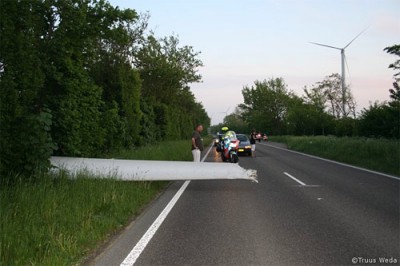
Turbines have been crashing back to earth in frightening numbers – from Brazilto KansasPennsylvaniaGermany and ScotlandDevon and everywhere in between: Ireland has been ‘luckier’ than most (see our posts here and here).

Then there’s the wild habit of these little ‘eco-friendlies’ unshackling their 10 tonne blades, and chucking them for miles in all directions – as seen in the video below – and see our posts here and here and here and here.

****
****

In one serious scientific study into the distances blades are likely to travel during “component liberation” – covering over 37 “component liberation” events – blade throw distances of up to 1,600 m were recorded: that study was completed in 2007 – there have been many more bids for blade “freedom” since then (up to 2014 there have been 309 ‘incidents’, as detailed below).

In Australia, for “planning” purposes, the various states have a variety of “set-back” distances between wind turbines and residential homes – said (laughably) to avoid noise impacts: in South Australia it’s 1km.

For a few years the Victorians set it at 2km – but, before 2007 there was no set-back required and plenty of homes ended up with turbines within 600m. However, there is no such limit placed on the distance between roads and turbines.

turbinedutchbladeaccident

****

The eco-fascist nutjobs – that have just taken charge in Victoria – haveslashed the set-back distances to 1km – further demonstrating their naked stupidity and rancid hatred of country people. Under Victoria’s new ‘rules’, residential homes are now well within the throw zone; with no set-back from roads at all, road-users are sitting ducks.

With whole (50m) blades travelling up to 200m, bigger heavier chunks likely to travel well over 300m and the smaller pieces (referred to in the study linked above as “10% blade fragments”) flying out to distances of up to 1,600m (for a 10% blade fragment – think 5m long blade chunks weighing a tonne or so) – the current setback rule in South Australia – and what the eco-fascists just gave Victoria – places wind farm neighbours well and truly within the “throw zone”.

And with those numbers in mind, think about whole blades – or substantial chunks of them – being flung around with gay abandon the next time you drive past the turbines at Cullerin and Macarthur, some of which are less than 300m from the road you’re on.

Fortunately, when it comes to the risks posed by flying turbine blades, it’s the complete disregard paid to health and safety by planning departments and the risible “rules” written for them by their wind industry Overlords – that is squarely in the sights of the Senate Select Committee, its terms of reference including the following:

(1) That a select committee, to be known as the Select Committee on Wind Turbines be established to inquire into and report on the application of regulatory governance and economic impact of wind turbines by 24 June 2015, with particular reference to:

(d) the implementation of planning processes in relation to wind farms, including the level of information available to prospective wind farm hosts;

(e) the adequacy of monitoring and compliance governance of wind farms;

(f) the application and integrity of national wind farm guidelines;

(i) any related matter.

For those living in, or driving through, the wind turbine blade “throw zone” now is you chance to hammer the so-called ‘standards’ and planning ‘controls’ that have (or will) put you in it.

Why not drop a submission to the Senate Inquiry along those lines?  Note that the opportunity to make submissions to the Committee ends on 4 May 2015. See the link here.

To help with your submissions, we’ve popped up a fine piece of work put together by the Caithness Windfarm Information Forum below. Consider, be afraid and let your Senators know just how insanely dangerous this eco-fascist driven nightmare has all become.

Summary of Wind Turbine Accident data to 31 December 2014 (Download as a PDF)

These accident statistics are copyright Caithness Windfarm Information Forum 2014.  The data may be used or referred to by groups or individuals, provided that the source (Caithness Windfarm Information Forum) is acknowledged and our URL www.caithnesswindfarms.co.uk quoted at the same time.Caithness Windfarm Information Forum is not responsible for the accuracy of Third Party material or references.

The detailed table includes all documented cases of wind turbine related accidents and incidents which could be found and confirmed through press reports or official information releases up to 31 December 2014. CWIF believe that this compendium of accident information may be the most comprehensive available anywhere.

Data in the detailed table is by no means fully comprehensive – CWIF believe that it may only be the “tip of the iceberg” in terms of numbers of accidents and their frequency. Indeed on 11 December 2011 the Daily Telegraph reported that RenewableUK confirmed that there had been 1500 wind turbine accidents and incidents in the UK alone in the previous 5 years. Data here reports only 142UK accidents from 2006-2010 and so the figures here may only represent 9% of actual accidents.

The data does however give an excellent cross-section of the types of accidents which can and do occur, and their consequences.With few exceptions, before about 1997 only data on fatal accidents has been found.

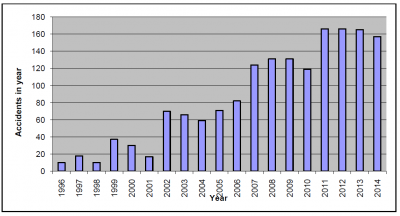
The trend is as expected – as more turbines are built, more accidents occur. Numbers of recorded accidents reflect this, with an average of16 accidents per year from 1995-99 inclusive; 48 accidents per year from 2000-2004 inclusive; 108 accidents per year from 2005-09 inclusive, and 155 accidents per year from 2010-14 inclusive.

accidents per year

This general trend upward in accident numbers is predicted to continue to escalate unless HSE make some significant changes – in particular to protect the public by declaring a minimum safe distance between new turbine developments and occupied housing and buildings.

In the UK, the HSE do not currently have a database of wind turbine failures on which they can base judgements on the reliabilityand risk assessments for wind turbines. Please refer to http://www.hse.gov.uk/research/rrpdf/rr968.pdf.

This is because the wind industry “guarantees confidentiality” of incidents reported see  http://www.renewableuk.com/en/our-work/health-and-safety/incidents–alerts.cfm. No other energy industry works with such secrecy regarding incidents. The wind industry should be no different, and the sooner RenewableUK makes its database available to the HSE and public, the better. The truth is out there, however RenewableUK don’t like to admit it.

Some countries are finally accepting that industrial wind turbines can pose a significant public health and safety risk. The Scottish government has proposed increasing the separation distance between wind farms and local communities from 2km to 2.5km (http://www.bbc.co.uk/news/uk-scotland-scotland-politics-26579733) though in reality the current 2km separation distance is often shamefully ignored during the planning process.

Our data clearly shows that blade failure is the most common accident with wind turbines, closely followed by fire. This is in agreement with a recent survey by GCube, the largest provider of insurance to renewable energy schemes. Their recent survey reported that the most common type of accident is indeed blade failure, and that the two most common causes of accidents are fire and poor maintenance.  http://www.gcube-insurance.com/press/gcube-top-5-us-wind-energy-insurance-claims- report/

Data on the detailed list is presented chronologically.  It can be broken down as follows:

Number of accidents

Total number of accidents: 1662

By year:

accident table

Number of fatal accidents: 110

Fatal accidents

By year:

fatalities

Of the 151 fatalities:Please note: There are more fatalities than accidents as some accidents have caused multiple fatalities.

  • 90 were wind industry and direct support workers (divers, construction, maintenance, engineers, etc), or small turbine owner /operators.
  • 62 were public fatalities, including workers not directly dependent on the wind industry (e.g. transport workers). 17 bus passengers were killed in one single incident in Brazil in March 2012; 4 members of the public were killed in an aircraft crash in May 2014.

Human injury

130 accidents regarding human injury are documented.

By year:

human injury

107 accidents involved wind industry or construction/maintenance workers, and a further 23 involved members of the public or workers not directly dependent on the wind industry (e.g. firefighters, transport workers). Six of these injuries to members of the public were in the UK.

Human health

Since 2012, 52 incidents of wind turbines impacting upon human health are recorded.

By year:

human health

Since 2012, human health incidents and adverse impact upon human health have been included.

These were previously filed under “miscellaneous” but CWIF believe that they deserve a category of their own. Incidents include reports of ill-heath and effects due to turbine noise, shadow flicker, etc. Such reports are predicted to increase significantly as turbines are increasingly approved and built in unsuitable locations, close to people’s homes.

Blade failure

By far the biggest number of incidents found was due to blade failure. “Blade failure” can arise from a number of possible sources, and results in either whole blades or pieces of blade being thrown from the turbine. A total of 309 separate incidences were found:

By year:

blade failure

Pieces of blade are documented as travelling up to one mile. In Germany, blade pieces have gone through the roofs and walls of nearby buildings. This is why CWIF believe that there should be a minimum distance of at least 2km between turbines and occupied housing, in order to adequately address public safety and other issues including noise and shadow flicker.

Fire

Fire is the second most common accident cause in incidents found. Fire can arise from a number of sources – and some turbine types seem more prone to fire than others. A total of 242 fire incidents were found.

By year:

fire

The biggest problem with turbine fires is that, because of the turbine height, the fire brigade can do little but watch it burn itself out. While this may be acceptable in reasonably still conditions, in a storm it means burning debris being scattered over a wide area, with obvious consequences. In dry weather there is obviously a wider-area fire risk, especially for those constructed in or close to forest areas and/or close to housing. Three fire accidents have badly burned wind industry workers.

Structural failure

From the data obtained, this is the third most common accident cause, with 157 instances found.

“Structural failure” is assumed to be major component failure under conditions which components should be designed to withstand. This mainly concerns storm damage to turbines and tower collapse. However, poor quality control, lack of maintenance and component failure can also be responsible.

By year:

structure

While structural failure is far more damaging (and more expensive) than blade failure, the accident consequences and risks to human health are most likely lower, as risks are confined to within a relatively short distance from the turbine. However, as smaller turbines are now being placed on and around buildings including schools, the accident frequency is expected to rise.

Ice throw

35 reports of ice throw were found. Some are multiple incidents. These are listed here unless they have caused human injury, in which case they are included under “human injury” above.

By year:

ice throw

These are indeed only a very small fraction of actual incidences – a report* published in 2003 reported 880 icing events between 1990 and 2003 in Germany alone. 33% of these were in the lowlands and on the coastline.Ice throw has been reported to 140m. Some Canadian turbine sites have warning signs posted asking people to stay at least 305m from turbines during icy conditions.

Additionally one report listed for 2005 includes 94 separate incidences of ice throw and two reports from 2006 include a further 27 such incidences. The 2014 entry refers to multiple YouTube videos and confirmation that ice sensors do not work.

Transport

There have been 137 reported accidents – including a 45m turbine section ramming through a house while being transported, a transporter knocking a utility pole through a restaurant, and various turbine parts falling off and blocking major highways. Transport fatalities and human injuries are included separately. Most accidents involve turbine sections falling from transporters, though turbine sections have also been lost at sea, along with a £50M barge. Transport is the single biggest cause of public fatalities.

By year:

transport

Environmental damage (including bird deaths)

162 cases of environmental damage have been reported – the majority since 2007. This is perhaps due to a change in legislation or new reporting requirement. All involved damage to the site itself, or reported damage to or death of wildlife. 57 instances reported here include confirmed deaths of protected species of bird.Deaths, however, are known to be far higher. At the AltamontPass windfarm alone, 2400 protected golden eagles have been killed in 20 years, and about 10,000 protected raptors (Dr Smallwood, 2004). In Germany, 32 protected white tailed eagles were found dead, killed by wind turbines (BrandenburgState records). In Australia, 22 critically endangered Tasmanian eagles were killed by a single windfarm (Woolnorth). Further detailed information can be found at:  www.iberica2000.org/Es/Articulo.asp?Id=3071 and at:  www.iberica2000.org/Es/Articulo.asp?Id=1875

  • 600,000 bats were estimated to be killed by US wind turbines in 2012 alone.
  • 1,500 birds are estimated to be killed per year by the MacArthur wind farm in Australia, 500 of which are raptors.

By year:

environment

Other (miscellaneous)

328 miscellaneous accidents are also present in the data. Component failure has been reported here if there has been no consequential structural damage. Also included are lack of maintenance, electrical failure (not led to fire or electrocution), etc. Construction and construction support accidents are also included, also lightning strikes when a strike has not resulted in blade damage or fire. A separate 1996 report** quotes 393 reports of lightning strikes from 1992 to 1995 in Germany alone, 124 of those direct to the turbine, the rest are to electrical distribution network.

By year:

other

Caithness Windfarm Information Forum 31 December 2014

* (“A Statistical Evaluation of Icing Failures in Germany‟s „250 MW Wind‟ Programme – Update 2003, M Durstwitz, BOREAS VI 9-11 April 2003 Pyhätunturi, Finland. )

** (Data from WMEP database: taken from report “External Conditions for Wind Turbine Operation – Results from the German „250 MW Wind‟ Programme”, M Durstewitz, et al, European Union Wind Energy Conference, Goeteborg, May 20-24, 1996)

Tip of the iceberg

Do NOT Invest in Wind, (Unless You Want to Lose Money)!

Community Wind Farm Investors Losing their Shirts

webHepburn_SimonHolm_39802b

****

As the wind industry Ponzi scheme unravels around the globe, it’s so-called “community wind farms” that are taking a pounding.

In the US, a bunch of farmers got fleeced for $millions as a wind power outfit running two small wind farms went belly up on the prairie (see our post here).

STT has also had a go at unpicking the scale and scope of the financial precariousness at the BIG end of town in our posts:

The Wind Industry: You Know It’s a ‘Ponzi’ Scheme When its Targets Include Schools & Councils

Pacific Hydro’s Ponzi Scheme Implodes: Wind Power Outfit Loses $700 Million of Mum & Dad Retirement Savings

In the first of the above, we pointed to the efforts of Simon Holmes a Court to build an “empire” around 2 clapped out Suzlon/REPower 2MW turbines speared into Leonard’s Hill, using money siphoned from 1,900 gullible, greentard ‘investors’. That community calamity (see our post here) kicked off in 2011, but has yet to return a single cent to investors in that time.

For a little more background, here’s some work done by Bon (as it appeared in comments to the earlier post) on the question of Simon’s rollicking, commercial ‘success’:

In Hepburn Wind’s annual report for the year ended June 2013 the Notes to the Financial Statements, we find:

18 Dividends
There were no dividends declared or paid in the current or previous financial year.”

The annual report for the year ended June 2014 does not appear to refer to payment or non-payment of dividends although there could be a reference buried somewhere in the report.

To which, Hepburn Results in the Wind popped back:

Thanks Bon. I also checked the more recent Hep W 2014 Annual report. Nice green photos, and HaC is smiling in this one.

But board is clearly worried. They clearly cut back their own ‘community bribe’ so as to tinker with their bottom line loss so it did not look worse than the year before to their shareholders. It would logically be consistent therefore for the Feds to follow suit and to cut the REC bribe don’t you think, so as to tinker with their own negative balance sheet? You know, to follow the example set by Hep W.

Perhaps STT could do a forensic analysis? The Hep W’s also seem a wee bit concerned re maintenance costs and “mechanical issues” now the turbines are out of warranty. And I thought turbines were oh so reliable and the wind was free!

And thanks for the warning STT.

Ever helpful, Bon chimed in again, reporting:

Yes “Hepburn Results in Wind” and why wouldn’t Simon Holmes a Court and his mates be more than a little worried about being on their own in maintaining their two REpower 2.05MW wind turbines. REpower was rebadged after numerous turbines bearing its former name Suzlon started chucking their blades off, sorry I mean started liberating components.

I note that REpower has recently taken on another name, the new moniker is Senvion?

Compounding questions over the dubious ancestry of Hepburn Wind’s REpower turbines is recent research showing that the useful life of wind turbines in general falls well short of the 20 plus years claimed by manufacturers.

But I suspect the long suffering locals of once peaceful Leonards Hill might see any early demise of Hepburn Wind’s two noisy monsters as simply a matter of karma.

Karma, indeed!

STT’s said it before, and we’ll keep saying it: if you have so much as a nickel anywhere near a wind power outfit – whatever the size of it – grab it, and get out NOW.

As to Hepburn Results in the Wind’s request for a ‘forensic analysis’ of Hepburn Wind’s blistering results, it’s pretty hard to turn pages full of year-after-year, profit ‘doughnuts’ into figures of meaning, so, we’ll pass on that score.

However, in a TV cooking show “here’s one we’ve prepared earlier” moment, we’ll cross to Germany.

German Wind Turbine Investors Dissolve Operating Company After 13 Years Of Poor Returns, Technical Failures
No Tricks Zone
19 July 2014

There are lots of claims on how successful Germany’s renewable energy program has been. Feed-in tariffs mandated by the government guaranteed profits for windpark investors and operators. You couldn’t lose. So it seemed at first.

Unfortunately outputs promised by wind turbine manufacturers and proponents have fallen short of expectations. Moreover, high maintenance costs have in many cases eliminated profits and resulted in losses for investors. As generous as the subsidies may be, profit from wind can be elusive.

So it comes as no surprise when we here how a group of 60 limited partners near Ettenheim southwest Germany have decided to dissolve the wind turbine operating company they had set up in December, 2000. Story in German at www.windwahn.de here. It lost money.

The 60 limited partners unanimously voted on Wednesday to shut down and liquidate the Windpark Ettenheim GmbH & Co. According to Windwahn, the wind turbine had been supplied by Nordex and “did not yield the expected performance“, so says managing director Andreas Markowsky.

Windwahn writes:

It stood still for years, and finally it was taken down in the summer of 2013. In the meantime the concrete pad has also been removed. After the liquidation is completed, the area where the turbine stood will be re-naturalized under the supervision of forest authorities. …The wind turbine did not pay off.”

Windwahn writes that the turbine had been supplied by Nordex and came with a 5-year maintenance contract. But in the end, the turbine remained plagued by technical problems and the 60 partners all had to take a moderate loss on the investment: a bit more than 1000 euros per 2500 euro share.

Markowsky says that the turbine had serious technical problems from the start. For example when winds were strong during stormy weather, the turbine stood still instead of producing maximum output. The limited partners even had to take Nordex to court in bid to be awarded compensation in the amount of 1.8 million euros. Windwahn writes that the case dragged on for 5 years, during which the turbine remained idle and did not deliver any power. Finally, the court awarded the limited partners 1.4 million euros in compensation.

The limited partners had the chance to reduce their losses by taking advantage of the re-powering bonus offered by the German government. Under the scheme turbine operators are paid a bonus to trade up their old turbines for newer, more efficient ones. However, the bonus has been scrapped by the German government, effective August 1, and the offer ultimately was passed up.

The 60 limited partners have had enough of the wind energy business.
No Tricks Zone

empty-wallet1

Proponents of Wind Turbines, Beware! Reality Bites…..HARD!

Conscience Bites Commissioner for Approving Wind Farm & Causing Hatred & Division

Ashamed head-in-hands

****

As the world wakes up to the scale and scope of the great wind power fraud – its inordinate cost to power consumers and taxpayers – the state-sponsored, malfeasance of the wind power outfits that ride the subsidy gravy train, and roughshod over hard-working rural people – and the bitter community division and hatred its roll-out brings – those who have aided and abetted it, have a choice: either pop their consciences into a lead-lined box (so as to avoid any pangs of personal guilt); or front-up to the better Angels of their natures; and seek redemption, and forgiveness, for the unnecessary damage that they’ve caused.

Jane Harper has, to her credit, plumped for the latter. Here’s her story.

Tipton County Indiana Commissioner voted for “wind farms”, now lives with regrets
Jane Harper
Huntington County Concerned Citizens
19 March 2015

Dear Howard County Commissioners and Council Members,

I am writing to you all as a former commissioner colleague who aided in the negotiations and agreements with E.ON Climate Renewables with Tipton County in 2011.

From the onset, I was open to windfarm development in a small section of Tipton County because the commissioners had received no opposition and I felt that the landowners wanted it.

My own family was offered an opportunity to lease land to E.ON and we declined because my husband did not care to farm around the towers, and I just didn’t want to look at them. I set my own personal views aside and made decisions based on what I felt the majority of the public wanted. I was outspoken enough, however, to say that I would never support a plan to cover a large portion of the county with wind turbines.

As it turned out, the problem was that when the decisions were being made to build “Wildcat I”, the commissioners were not hearing from the “majority”. People really did not know this was happening, or if they did, they did not perceive it to be as “invasive” as it was. As you know, public notices are small and often overlooked in the newspaper, so not much resistance was present … until the towers went up, and people saw how enormous and intrusive they were. The red blinking lights even disturb my own summer evenings and my home is 6 miles from the closest tower!!!

You don’t have the time to read  all that I could tell you, so in a nutshell, I just want to say that I wish I had the knowledge then that I have now.

However, what I can do, is to try to pass some of what I know, onto the elected officials in the neighboring county, so that perhaps you can gain some wisdom from what I learned in the school of hard knocks.

In Tipton County … my 83 year old mother is mad at me (since I signed the agreements) because she no longer has colorful birds coming to her feeders … my brother’s view from his family dining room table used to be a vast expanse of crops and natural habitat … now that pristine ‘vista’ is forever marred by giant metal structures … neighbors hate each other … back and forth letters to the editor have been selling papers for over a year now … families are torn apart, and because the physical presence of the towers will be there for 30 years, these relationships will never be repaired. In short … this has become an issue that has divided our community like no other.

It has torn our county apart. The May, 2014 primary election is evidence that the majority of the voters supported candidates openly opposed to wind farm development and an incumbent commissioner was voted out of office due to his unwillingness to listen to the majority on any issue, including wind.

If I had this to do over, I would NEVER enter into an agreement with any wind company now that I know what it has done to my home community.

I am not proud that my name is on those documents.

The wind company has breached many parts of the agreement, but insist that their failures are “minor”. Their field representative is arrogant and cavalier in his attitude toward the people who are suffering with the effects of the noise and flicker.

You can’t lose something you never had … so you are not “losing” the supposed ‘windfall’ of money that the project purportedly brings in.

What you WILL lose however, cannot be measured in dollars.

You will lose the rural landscape as you know it and you will lose the closeness of “community spirit” because people will hate each other over this and the presence of the towers will always be a constant reminder of the rift … thus the wounds will never heal.

Please consider this: What do you think of a company that KNOWS it has fierce opposition from a segment of the Howard County citizenry, but would STILL want to build in your county?

It is akin to forcing themselves onto you when they KNOW they are not wanted by those in the project area who would be affected by their presence and are receiving no compensation for the change in their environment. How much of a “community partner” would they be when they really don’t care about the wishes of the people?

I don’t know anything about which “facts” are true and which “facts” are false with regard to property values and personal health issues.

But what I DO know as fact is this: Any issue that has become so contentious that it has caused large groups of people to assemble and vehemently oppose it … and which has caused so much heartache and angst among the citizenry …  just cannot be good for the whole. I do not feel that Tipton County will ever wholly heal from the deep personal wounds incurred by many from the placement of wind turbines in our county.

I will leave you with this last piece of wisdom from someone who has “been there, done that”.

As an elected official/public servant … if you must go forward with approvals that allow wind farm development … and thus you become the reason a wind farm was built in Howard County … it will be a decision you will regret the rest of your life.

You will join me.

Jane Harper
Tipton County Commissioner 2009-2012.
Illinois Leaks

She's had a few

Wind Turbines, and Their Proponents, Ruin Lives With Impunity!

Eric Jelinski
Eric Jelinski 1:43pm Mar 21
Hydro One takes whatever hydro is generated and distributes the hydro plus adding their own costs. However, a major part of the high costs of Hydro is the wind turbines and the line upgrades for the wind turbines that are added to the cost of hydro.

The costs of hydro is not just in dollars but in human lives ruined becuase people have to abandon their homes due to the noise or stray voltage that impacts them and cattle on the farms. The government is ignoring the impacts even though there are many testimonials by affected people including testimonials from medical doctors and noise experts.

One of our friends who was forced to move out of her house due to wind turbine noise has composed this e-mail to the MPP’s. It is intended to share this and everybody to please also forward this to their provincial MP. Maybe the Wynne liberals can be shamed into a moratorium on wind turbines.
http://ogra.sclivelearningcenter.com/index.aspx?PID=11355&SID=206932

Date: Thu, Mar 19, 2015 at 12:36 PM
Subject: Wind turbines, Ontario and Health Canada

To: lalbanese.mpp@liberal.ola.org, ganderson.mpp.co@liberal.ola.org,tarmstrong-qp@ndp.on.ca, ted.arnott@pc.ola.org, bob.baileyco@pc.ola.org,ybaker.mpp.co@liberal.ola.org, Bas Balkissoon <bbalkissoon.mpp.co@liberal.ola.org>, cballard.mpp.co@liberal.ola.org, toby.barrettco@pc.ola.org,lberardinetti.mpp.co@liberal.ola.org, gbisson@ndp.on.ca,jbradley.mpp.co@liberal.ola.org, scmpp@ndp.on.ca, MPPChan <mchan.mpp.co@liberal.ola.org>, Minister Bob Chiarelli <bchiarelli.mpp.co@liberal.ola.org>, steve.clark@pc.ola.org, Mike Colle <mcolle.mpp@liberal.ola.org>, mcoteau.mpp@liberal.ola.org,gcrack.mpp@liberal.ola.org, ddamerla.mpp@liberal.ola.org,bdelaney.mpp@liberal.ola.org, sdelduca.mpp.co@liberal.ola.org, Vic Dhillon <vdhillon.mpp.co@liberal.ola.org>, jdickson.mpp@liberal.ola.org, dinovoc-qp@ndp.on.ca, hdong.mpp.co@liberal.ola.org, BradDuguid <bduguid.mpp.co@liberal.ola.org>, garfield.dunlop@pc.ola.org,christine.elliott@pc.ola.org, vic.fedeli@pc.ola.org, cfife-qp@ndp.on.ca,kflynn.mpp@liberal.ola.org, cforster-qp@ndp.on.ca, John Fraser Ottawa South <Jfraser.mpp.co@liberal.ola.org>, JFrench-QP@ndp.on.ca, wgates-qp@ndp.on.ca, fgelinas-qp@ndp.on.ca, mgravelle.mpp.co@liberal.ola.org,LGretzky-CO@ndp.on.ca, ernie.hardeman@pc.ola.org,michael.harrisqp@pc.ola.org, PHatfield-QP@ndp.on.ca,randy.hillierco@pc.ola.org, ahoggarth.mpp.co@liberal.ola.org, ahorwath-qp@ndp.on.ca, ehoskins.mpp@liberal.ola.org, tim.hudakco@pc.ola.org, “Mitzie Hunter, MPP” <mhunter.mpp.co@liberal.ola.org>,hjaczek.mpp.co@liberal.ola.org, “Jones-co, Sylvia” <sylvia.jonesco@pc.ola.org>, skiwala.mpp.co@liberal.ola.org,mkwinter.mpp@liberal.ola.org, Marie-France Lalonde <mflalonde.mpp.co@liberal.ola.org>, jleal.mpp.co@liberal.ola.org,dlevac.mpp.co@liberal.ola.org, TracyMacCharles <tmaccharles.mpp.co@liberal.ola.org>, jack.maclaren@pc.ola.org, Lisa MacLeod <lisa.macleod@pc.ola.org>,hmalhi.mpp.co@liberal.ola.org, amangat.mpp.co@liberal.ola.org, mmantha-qp@ndp.on.ca, Cristina Martins <cmartins.mpp.co@liberal.ola.org>,gila.martow@pc.ola.org, dmatthews.mpp@liberal.ola.org, BillMauroTBayAtik <bmauro.mpp.co@liberal.ola.org>, jim.mcdonellco@pc.ola.org, Kathryn McGarry <kmcgarry.mpp.co@liberal.ola.org>, emcmahon.mpp.co@liberal.ola.org, tmcmeekin.mpp.co@liberal.ola.org, “Monte McNaughton, MPP” <monte.mcnaughton@pc.ola.org>, mmeilleur.mpp@liberal.ola.org,Pmilczyn.mpp.co@liberal.ola.org, norm.miller@pc.ola.org, pmiller-co@ndp.on.ca, rmoridi.mpp@liberal.ola.org, julia.munro@pc.ola.org, Minister Glen Murray <gmurray.mpp@liberal.ola.org>, inaidoo-harris.mpp.co@liberal.ola.org, ynaqvi.mpp@liberal.ola.org, tnatyshak-qp@ndp.on.ca,rick.nicholls@pc.ola.org, dorazietti.mpp@liberal.ola.org,randy.pettapiece@pc.ola.org, apotts.mpp.co@liberal.ola.org,sqaadri.mpp.co@liberal.ola.org, lrinaldi.mpp.co@liberal.ola.org, Liz Sandals <lsandals.mpp@liberal.ola.org>, Psattler-co@ndp.on.ca,laurie.scottco@pc.ola.org, msergio.mpp@liberal.ola.org, jsingh-co@ndp.on.ca,todd.smith@pc.ola.org, csousa.mpp@liberal.ola.org, tabunsp-qp@ndp.on.ca,htakhar.mpp@liberal.ola.org, mtaylor-qp@ndp.on.ca, Lisa Thompson <lisa.thompson@pc.ola.org>, jvanthof-qp@ndp.on.ca, Daiene Vernile <dvernile.mpp.co@liberal.ola.org>, “Bill Walker, MPP” <bill.walker@pc.ola.org>, Jim WilsonMPP <jim.wilson@pc.ola.org>,swong.mpp.co@liberal.ola.org, Kathleen Wynne <kwynne.mpp@liberal.ola.org>, john.yakabuski@pc.ola.org, Jeff Yurek <jeff.yurek@pc.ola.org>, dzimmer.mpp@liberal.ola.org, Prime Minister Stephen Harper <pm@pm.gc.ca>, mcu@justice.gc.ca, minister_ministre@hc-sc.gc.ca, David Michaud <david.michaud@hc-sc.gc.ca>, katya.feder@hc-sc.gc.ca, tara.bower@hc-sc.gc.ca, brooks@phac-aspc.gc.ca,Shirley.Bryan@statcan.gc.ca, Allison Denning <allison.denning@hc-sc.gc.ca>,Paul.Dockrill@nrcan-rncan.gc.ca, Christopher.Duddek@statcan.gc.ca,Ken_LCDC_johnson@phac-aspc.gc.ca, stephen.keith@hc-sc.gc.ca,Antoine.Lacroix@nrcan-rncan.gc.ca, eric.lavigne@phac-aspc.gc.ca,Serge.Legault@statcan.gc.ca, tony.leroux@umontreal.ca, leonora.marro@hc-sc.gc.ca, darcy.mcguire@hc-sc.gc.ca, mbrian.murray@sunnybrook.ca,Denis.Poulin@statcan.gc.ca, wricharz@echologics.com, Jason.Tsang@otc-cta.gc.ca, paul.villeneuve@carleton.ca, Stacey.Wan@statcan.gc.ca,shelly.weiss@sickkids.ca, lbertrand@toh.on.ca, r.h.bakker@med.umcg.nl,nbroner@skm.com.au, tachiban@biol.sci.kobe-u.ac.jp,fvdberfvdberg@ggd.amsterdam.nl, tilson.D@parl.gc.ca

Ontario Good Roads Association, Rural Ontario Municipal Association

http://ogra.sclivelearningcenter.com/index.aspx?PID=11355&SID=206932

I request that you to listen to the audio on the Green Energy in Ontario portion of the OGRA/ROMA Conference. February 24, 2015

Listen as Mayor Randy Hope, the first presenter, trivializes the health complaints from residents living in wind projects to a single item; growing obesity.
For your information, when Mayor Hope states he presented at the Standing Committee on Bill 150, so did multiple families who were being impacted at that time, in fact 6 of those families had to leave their homes permanently. That was in 2009 and nothing has changed.

19:30 “…I’ve dealt with the people complaining that the wind turbine has created obesity……
Even the Health Canada study….done, completed, no issue.”

Listen also to the third presenter, Ted Cowan, President of the Ontario Federation of Agriculture, as he shamefully and openly mocks the families in rural Ontario who have been experiencing adverse health impacts, many who are trapped and many who have been displaced.

46:52 “….so every time you hear somebody complain about the health effects of a wind tower, cough at em ”

47:50 “ Health effects…the federal government completed their health study the middle of this past year, they found no health problems from wind, no dead people, no people in hospital, no people sick, no evidence of days off of work from wind related health problems.
They did find that it contributes to some sleep problems and irritation and there is a fix. I believe that where there are homes where there are significant problems they should either be bought or they should be substantially insulated so that the problem goes away or is greatly reduced, but, the evidence on this is in, further debate on it is a waste of time and hiring 30 or 40 incredibly good medical researchers to look at ‘this kind of problem’ is a waste of talent that we cannot afford.”

1:04:09 “ The studies, the evidence is in on health, no health impacts but some? and no general property value harm, but irritation, sleep problems no question.

This disgusting and offensive display is a direct result of the federal and provincial government’s alliance with the wind industry to systematically ignore the adverse health impacts being experienced in industrial wind turbine developments.
The damage that the Health Canada preliminary release alone has done to the citizens of this province is a disgrace.

There has been no opportunity for victims to talk with authorities or speak at these types of meetings and conferences to give evidence of and question some of these statements that audiences are receiving.
It is incredible that in Canada, in 2015, the victims continue to be blamed, ridiculed and their complaints rejected.

My comment:
To the comment on sleep problems and irritation, I don’t believe Mr. Cowan understands the health impacts of sleep disturbance and deprivation, or “irritation” for that matter. The frustration and stress alone at not being able to shut off the noise and vibration when trying to sleep is tremendous.
Trying to get by on 4 out of 7 night’s sleep is not OK. In fact, it is dangerous.
Furthermore, loud audible noise and low frequency noise and vibration penetrates walls and glass, regardless of insulation level. Mr. Cowan’s knowledge of the cause of and remedy for the impacts is minimal.

Attached is some testimony from impacted residents that needs to be reviewed and not deleted.
It represents the tip of the iceberg. Every single wind project started has resulted in more people sick.

The following 2 links have videos of impacted residents who want you to listen to them.
Please be respectful and give them your time as they gave theirs under some very trying situations and at the expense of being mocked by the likes of those above, to educate us.
Some of them are from the Chatham area.
http://windvictimsontario.com/videos—recent-videos.html
http://windvictimsontario.com/videos—page-2.html

New Movie, Kingsman: The Secret Service – about the Elitist, Narcissistic Nature of Climate Alarmists!

Kingsman: the most subversive anti-AGW movie

Anthony Cox

Some movies are unintentionally anti-AGW because they are so pretentious like Atavaror just plain stupid like Noah.

Some are subtle and sly in their critique of AGW like Interstellar, a great movie orCaptain America: The Winter Soldier another great piece of cinema.

But there is nothing subtle or sly about Kingsman: The Secret Service; this movie presents in Technicolour the awful nature of alarmists; they are elitist, narcissistic and misanthropic. And riddled in hypocrisy.

The villain is Valentine, played by Samuel Jackson. Valentine is another tech billionaire who despises his fellow man for causing AGW. His solution is to kill off 99.9% of the human population.

His sales pitch to the rich and famous is classic alarmist agigprop. Valentine tells them that humans are a virus raising the temperature of the living Earth. If the virus isn’t destroyed the planet’s fever will worsen and either the planet will fight back and kill the disease of the disease will kill the planet.

The idea that humans are a disease or parasite has underpinned the AGW narrative and is espoused by all the leading AGW scientists and particularly AGW’s many rich supporters like Bill Gates.

In Kingsman Valentine is seen convincing Obama of his vision which is ironic since Obama’s chief scientist, John Holdren, is an avid supporter of forced reduction of humanity. In real life Obama would have taking no convincing.

Valentine, as the archetypal rich supporter of AGW,  has a tenuous hold on real life. He thinks he is living in a movie and can’t stand the sight of blood even though he is prepared to kill billions.

Valentine is the perfect portrayal of the elitist loon who supports AGW. He has made his vast wealth from his society and now as a matter of vanity will destroy that society. The thought that his lifestyle will cease when the society is destroyed doesn’t enter his thinking. This is cognitive dissonance on a grand scale.

Valentine implants chips in the chosen ones so they can resist the doomsday device he has perfected.

In a delicious twist all the elistists, including Obama (and Prince Charles) literally lose their heads when the device backfires.

The movie wittily portrays the religious nature of AGW belief when Valentine tests his device on a bible bashing Southern Baptist church. The message is plain: when religion claims to be fact trouble is inevitable. This is what has happened with AGW: it is religion masquerading as fact. Armed with the pseudoscience of AGW rich crackpots like Valentine can live out their dreams. At the end Valentine can’t tell reality from his ego generated bubble of fantasy.

The movie offers no formal solution to the blight of public corruption by the AGW scam and relies on a steadfast and very aggressive secret organisation to violently eradicate the AGW zealots and hypocrites.

We should be so lucky in the real world.

DEBUNKING THE SCAM….

CO2 is a “trace gas” in air, insignificant by definition. It absorbs 1/7th as much IR, heat energy, from sunlight as water vapor which has 188 times as many molecules capturing 1200 times as much heat making 99.8% of all “global warming.” CO2 does only 0.2% of it. For this we should destroy our economy?

There is no possible “greenhouse effect” in an atmosphere. A greenhouse has a solid, clear cover that traps heat. The atmosphere does not trap heat as gas molecules cannot form surfaces as required for greenhouses. Molecules have to be in contact, as in liquids and solids like water and glass, to form surfaces.

The Medieval Warming from 800 AD to 1300 AD Micheal Mann erased to make his “hockey stick” was several degrees warmer than anything “global warmers” fear. It was the longest time, 500 years, of peace with great abundance for all.

Vostock Ice Core data analysis show CO2 increases follow temperature increases by 800 years 19 times in 450,000 years. That means temperature change is cause and CO2 change effect; not the other way around. This alone refutes the anthropogenic global warming concept.

Methane is called “a greenhouse gas 20 to 500 times more potent than CO2,” depending on who is raving, but it is not per the on-line absorption chart at the American Meteorological Society. It has an absorption profile very similar to nitrogen which is classified “transparent” to IR, heat waves and is only present to 18 ppm. “Green vegans” blame cow flatulence for global warming in their war against eating meat.

Carbon combustion generates 80% of our energy. Control and taxing of carbon would give the elected ruling class more power and money than anything since the Magna Carta of 1215 AD.

Most scientists and science educators work for tax supported institutions. They are eager to help government raise more money for them and they love being seen as “saving the planet.”

Google “Two Minute Conservative,” and you will be applauded when you speak truth at your next dinner party, barbecue or church picnic.