Climate “Fiction -“They are no longer Climate Scientists…they are Fiction writers….

151 Degrees Of Fudging…Energy Physicist Unveils NOAA’s “Massive Rewrite” Of Maine Climate History

Fellow New Englander, engineering physicist and energy expert, Mike Brakey has sent a summary analysis of NOAA past temperature “adjustments” for Lewiston-Auburn, Maine.
=====================================

Black Swan Climate Theory
By Mike Brakey

Here in the U.S. I have documented manipulations similar to those in Switzerland and other locations worldwide that NTZ wrote about yesterday.

Over the last months I have discovered that between 2013 and 2015 some government bureaucrats have rewritten Maine climate history between 2013 and 2015 (and New England’s and of the U.S.). This statement is not based on my opinion, but on facts drawn from NOAA 2013 climate data vs NOAA 2015 climate data after when they re-wrote it.

We need only compare the data. They cooked their own books (see numbers below).

Brakey_1

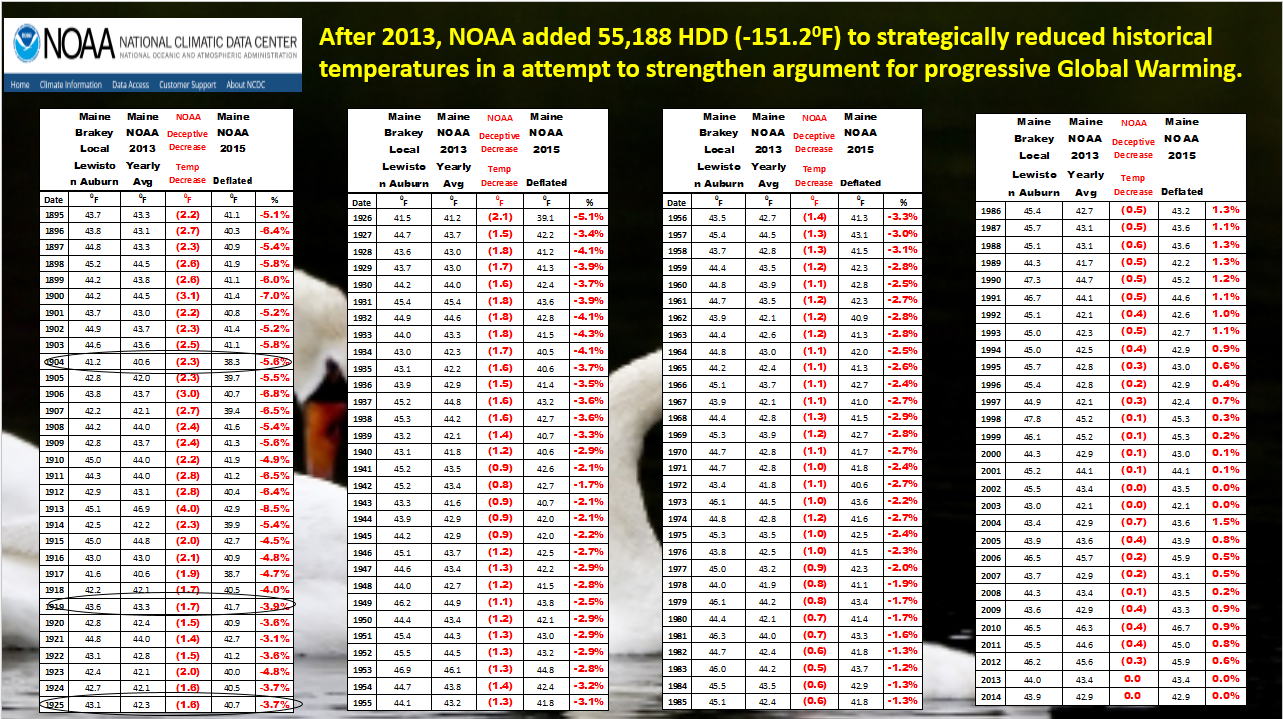
NOAA cooled the years of Lewiston-Auburn Maine’s past by an accumulated 151°F! (55,188 heating degree day units).

The last four months have been some of the coldest you might ever recall in our lifetime. So far 2015 is the fourth coldest in Maine’s history over the last 120 years. Data from 2013 confirm that so far – from January 1 to April 29 – 2015 has required 4249 heating degree days.

That rivals 1904, 1918 and 1923 over the last 120 years.

But when I recently looked at NOAA’s revised 2015 data, these last four months now would not even put us in the top twenty of coldest months. The federal government went into the historical data and lowered those earlier years – and other years in the earlier decades – so that they can keep spending $27 billion a year on pushing global warming.

They assumed no one would archive temperature data. But I did. My research indicated they used the same algorithm across the United States at the same time. Fortunately I had archived their data from 2013 for Maine and recently compared it to their 2015 data (see above table).

As an engineering physicist and heat transfer specialist, I have worked with heating and cooling degree days for forty years. It is alarming when one discovers multi-million dollar websites have been corrupted with bogus data because the facts do not match up with agendas.

It tremendously harms the industry you and I both work in. Worse, it harms the public. If the public knew the climate data facts indicated it was not getting warmer locally, and that it might actually be getting cooler, it would have all the more reason to insulate and become more energy-efficient in their homes.

I have put together a Maine history of climate temperatures in a narrated PowerPoint Presentation placed on YouTube titled, Black Swan Climate Theory.

Below is a brief sampling of my findings:

Brakey_3

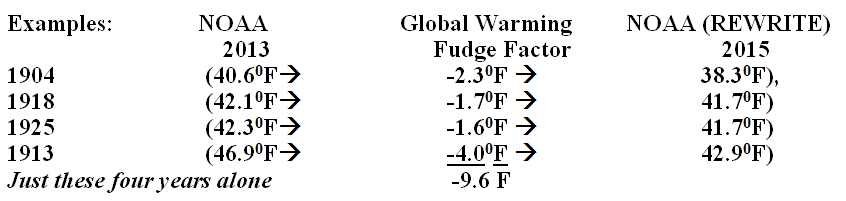
So far 2015 Maine temperatures, as of April, are running neck-and-neck with the coldest years in Maine’s history: 1904 (40.6°F), 1918 (42.1°F) and 1925 (42.3°F). These temperatures cited come right from the federal government’s own NOAA climate data (from 2013). I archived them on my computer for future reference.

2015 so far among coldest on record

A BLACK SWAN event is forming in 2015 (see chart to right). Based on the first four months of 2015, there is an excellent chance 2015 Maine temperature might average, on an annual basis, well under 43.0°F. Not only have Maine temperatures been on a decline since 1998, we are now seeing temperatures reminiscent of the bitter turn of the early 1900s.

Massive rewrite

It appears NOAA panicked and did a massive rewrite of Maine temperature history (they used the same algorithm for U.S. in general). The new official temperatures from Maine between 1895 and present were LOWERED by an accumulated 151.2°F between 1895 and 2012.

“Out-and-out fraud”

In my opinion, this is out-and-out fraud. Why did they corrupt national climate data? Global warming is a $27 billion business on an annual basis in the U.S alone.

Brakey_4

Now NOAA data revised in 2015 indicate that 1904, 1919 and 1925 in Maine were much colder than anything we experience today. (See the scorecard above comparing the NOAA data that are 18 months apart). Note how for 1913 the NOAA lowered the annual temperature a whole 4°F!

For the balance of the years, as they get closer to the present, the NOAA tweaks less and less. They have corrupted Maine climate data between 1895 and present by a whopping accumulated 151.2°F.

Unfortunately NOAA is remaining true to that old saying, “Figures don’t lie but liars figure.”

A multi-million dollar website has been corrupted. I can no longer rely on the tax-payer funded NOAA for clean, unfiltered, climate data for my ongoing research.

Conclusion

I can no longer trust the climate data and energy information ultimately drawn from the U.S. government. Locally, I now have to determine if they got their data from NOAA.

This makes research a lot tougher.

Mike Brakey

– See more at: http://notrickszone.com/2015/05/02/151-degrees-of-fudging-energy-physicist-unveils-noaas-massive-rewrite-of-maine-climate-history/#sthash.BBzJYpeL.gdGB9urs.dpuf

Windweasels Live Up to Their Reputation as….. Gangsters!

Noose Tightens on Spain’s Wind Farm Fraudsters: Tax Inspectors Uncover €110 million Paid as Bribes & Backhanders

clint863

The wind industry seems to attract a particular class of bloke, in much the same way that the Prohibition era drew lots of heavy-set Italians to the Mob.

Maybe that seemingly endless stream of massive subsidies filched from taxpayers and power consumers generates the same allure as festering dung does for swarms of flies?

Whatever it is, the whiff that surrounds the wind industry has attracted (and continues to attract) a class that has no hesitation lying, cheating, stealing and even bonking their way to the easy loot on offer.

The Italian Mob were in on the wind power fraud from the get-go: applying their considerable (and perfectly applicable) skills – leading the European wind power fraud, with what economists call “first-mover-advantage” (see our post here).

We’ve reported on just how rotten the wind industry is – from top to bottom – and whether it’s bribery and fraud; vote rigging scandals; tax fraud; investor fraud or REC fraud – wind weasels set a uniform standard that would make most businessmen blush.

The crooks involved – and the corruption, lies thuggery and deceit that follow them – are uniform across the globe.

Wind power outfits in Taiwan – faced with a pesky community backlash – sent the muscle in and beat the protesters to a bloody pulp (see our posts here and here).

The Thais aren’t much better.

In Australia, Thai outfit RATCH has been lying to, bullying and threatening communities far and wide for years (see our posts here and here andhere).

In previous posts we’ve looked at how the goons that work for RATCH didn’t hesitate to invent a character – Frank Bestic – in a half-cunning attempt to infiltrate their opponents at Collector and elsewhere – see our posts here and here and here.

RATCH also teamed up with one of Queensland’s property developer, “white-shoe-brigade“, John Morris – in a joint plan to destroy the Atherton Tablelands, by spearing 60 odd turbines into a patch of pristine, tropical wilderness on top of Mt Emerald – a move, quite rightly, opposed by 92% of locals (see our post here).

Morris is a five-star resort owner, who generously wined, dined and otherwise accommodated his mate, LNP pollie, David Kempton. Kempton got rolled at the last election, but while in power, held a rabid interest in getting the project approved, despite the fact that his own electorate was miles away, and pulled out all stops to ‘smooth’ the way to development approval (see our post here).

RATCH and Morris have shown all the care and restraint we’ve come to expect from the wind industry and its parasites: an “industry” that has absolutely no interest in producing meaningful power or “saving” the planet. Take away the promise of $50 billion in subsidies from the REC Tax on power consumers (see our post here) and this lot will disappear in a heartbeat (see our post here).

RATCH shares its Thai roots with another Thai wind power outfit that owes its existence to the Thai Military Junta – “Wind Energy Holdings”.

Wind Energy Holdings hit the news a while back when its hitherto-hot-shot head, Nopporn Suppipat was caught with his fingers in the till. Having been caught – he acted with all the honour we’ve come to expect from wind weasels, wherever they ply their trade: he bolted! (see our post here)

Now, it’s the turn of Spanish Wind Conquistadors to feel the heat.

That the wind industry is the product of institutional corruption – fuelled by back-slaps, and $millions in back-handers to planning officers, local councils and others in charge of the rubber stamps needed to start and keep the wind power fraud rolling – is no secret.

However, as these boys have bought the sanction of governments, rooting out the recipients of that crooked cash – when it’s sprinkled all the way to the top – presents investigators with more than the usual forensic challenges. Here’s Spain’s El País on España’s errant wind fraudsters’ trail.

Regional officials and businessmen may have received €110 million, say auditors
El País
F.Garea; R. Méndez
20 April 2015

Private renewable energy firms may have paid more than €110 million in commissions to government officials and local businessmen in Castilla y León to help them obtain licenses and push through paperwork to install wind farms across the region between 2004 and 2007, tax inspectors said.

In a December 30 report obtained by EL PAÍS, seven transactions detail how energy firms paid local businessmen and people connected to the regional Popular Party (PP) government either directly or through stocks in companies created to build and operate wind farms.

The Spanish AEAT tax agency has turned over the 94-page report to anti-corruption prosecutors to investigate if money laundering or other crimes may have been committed.

Those suspected of taking part in the commission deals are public officials in Castilla y León; go-betweens who negotiated on behalf of the energy firms and were able to obtain administrative approvals; and companies belonging to local businessmen who, “without any valid economic motives, received the transfer of funds and stock for an amount superior to €110 million,” inspectors said.

In some cases, the firms transferred stock in the businesses set up in such a way so as to multiply the initial capital invested by hundreds, even thousands, of times.

Among those who may have benefited from this alleged scheme were officials from Castilla y León’s economy department, which authorized the wind farms.

EL PAÍS was unable to reach Rafael Delgado Núñez, who was the deputy chief of the economy department at the time and the official responsible for signing the administrative permits.

In some cases, the firms multiplied the initial capital invested by hundreds, even thousands, of times

Along with other officials, Delgado Núñez was called in to give a statement before tax inspectors. According to his testimony, which was included in the audit, he said the procedure in the region was “very efficient” because there was hardly any legal framework supporting these operations at the time and the government wanted to ensure that “the companies that applied had regional interests.”

One of the main figures in the report is Alberto Esgueva, who until 2006 was CEO of Excal – a public entity formed by the Castilla y León government to promote regional exports. His own firm, according to inspectors, received the most commissions from the operations. Since September Esgueva has been living in Poland, where he runs a real estate business.

He declined to be interviewed for this article despite various attempts to contact him through his secretary.

A spokesman for the region’s economy department said he had no knowledge about the report but added that all the transactions were legally carried out and there was no evidence that commissions were paid.

Tomás Villanueva, who has headed up Castilla y León’s economy department since 2003 and is considered a close aide to PP regional premier Juan Vicente Herrera, on Monday stated that, after carrying out a “first check,” the paperwork authorizing the wind farms under question by the Tax Agency “was correct and in line with the law.”

Villanueva’s name surfaces in one part of the audit where tax inspectors mentioned that Delgado Núñez “played an important role” in both the economic and education departments.

In their report, inspectors alleged that numerous payments helped pave the way for the regional government to make quick decisions about the installation of wind farms. In one case, the money helped overcome the bureaucracy that had been blocking the project for six years.

Utility companies that wanted to install wind farms allegedly set up joint venture vehicles with local businesses and officials who had government ties to the region, the report said.

The association with the local businessman or government official would allegedly help push through the paperwork and, once the electric companies had received authorization to build the wind farm, they would pay back the investors more than what they had initially put into the joint venture.

One of the renewable energy companies that paid out a large amount to install a wind farm was Preneal, owned by Eduardo Merigó, the former president of Visa in Spain and an ex-secretary of state in former Spanish Prime Minister Adolfo Suarez’s Union of the Democratic Centre (UCD) administration (1977-1982). He told tax inspectors that he “felt like a victim of the system.”

Merigó also declined to speak to EL PAÍS for this article.

Preneal paid €6 million to San Cayetano Wind, which belonged to Esgueva, without “any obligation or compensation,” the report states.

Another €7 million was paid to Cronos Global, which was half owned by Esgueva. Last December, a Preneal representative told tax inspectors that Cronos had nothing to do with obtaining permits or building wind farms.

The projects have still not been approved, but Cronos Global received €7 million after putting down a €1.5 million initial investment.

Tax inspectors have also discovered suspicious bank transfers by Cronos Global at the beginning of the recession of up to €100 million to Poland and the United States while around €38 million was transferred to Spain.

The other partners in Cronos Global was Luis María García Clerigó and his family.

Clerigó is the president of the now-defunct Parqueolid, a construction firm in Valladolid. When contacted by EL PAÍS, Clerigó said he had difficulty remembering anything because he suffered a stroke seven years ago.

Parqueolid is under investigation in another case for allegedly receiving €50 million from the Castilla y León regional government to build new offices for the economic department. A judge investigating this case has targeted Delgado Núñez, who served as deputy chief of the regional economy department for eight years, and is also sifting through his bank accounts.
El País

good, bad ugly

Father of Green Communities Act, Convicted Under the RICO Act! Who’s Next?

Falmouth Wind Turbines – RICO Act

Prior to Wind Turbine Installations Falmouth had the Octave Band Data / Sound performance for the V82 turbine

Falmouth Wind Turbines & RICO Act

Did the Town of Falmouth violate the RICO Act ? They all knew the turbines would break state noise laws !

The Commonwealth of Massachusetts
Department of Environmental Protection (DEP)
Noise Control Regulation  310 CMR 7.10

310 CMR 7.10 Noise
(1) No person owning, leasing, or controlling a source of sound shall willfully, negligently, or through failure to provide necessary equipment, service, or maintenance or to take necessary precautions cause, suffer, allow, or permit unnecessary emissions from said source of sound that may cause noise.

Prior to the installations of the Falmouth wind turbines it appears Vestas Wind Company forewarned the Town of Falmouth, Town of Falmouth contract engineers and construction contractors. The manufacturer ( Vestas )also needs confirmation that the Town of

Falmouth understands they are fully responsible for the site selection of the turbine and bear all responsibilities to address any mitigation needs of the neighbors.

The turbines operated full time until May of 2012. State officials shut down the wind turbine in Falmouth after measurements showed the machine generating more than 10 decibels above ordinary background noise.

The turbines operate 12 hours a day during daylight now and are shut off on Sunday

Passed in 1970, the Racketeer Influenced and Corrupt Organizations Act (RICO) is a federal law designed to combat organized crime in the United States. It allows prosecution and civil penalties for racketeering activity performed as part of an ongoing criminal enterprise.

To convict a defendant under RICO, the government must prove that the defendant engaged in two or more instances of racketeering activity and that the defendant directly invested in, maintained an interest in, or participated in a criminal enterprise affecting interstate or foreign commerce.

Political Corruption

Politicians :
. UNITED STATES V. CIANCI
Providence Rhode Island
For twenty-one years, from 1975-1984 and from 1991-2002, Vincent A. “Buddy” Cianci was the mayor of Providence, Rhode Island.

Ultimately, Cianci was only convicted of one RICO conspiracy count.
The First Circuit notes—for a RICO conspiracy conviction, a defendant simply “must intend to further an endeavor which, if completed, would satisfy all of the elements of a substantive criminal offense, but it suffices that he adopted the goal of furthering or facilitating the criminal endeavor.”

Buddy Cianci was therefore found guilty of a §1962(d) RICO conspiracy violation and sentenced to five years and four months in prison.

Falmouth noise letter recently released through a Freedom of Information Request

August 3, 2010
Mr. Gerald Potamis
WasteWater Superintendent
Town of Falmouth Public Works
59 Town Hall Square
Falmouth, MA 02540

RE: Falmouth WWTF Wind Energy Facility II “Wind II”, Falmouth, MA
Contract No. #3297

Dear Mr. Potamis,

Due to the sound concerns regarding the first wind turbine installed at the wastewater treatment facility, the manufacturer of the turbines, Vestas, is keen for the Town of Falmouth to understand the possible noise and other risks associated with the installation of the second wind turbine.

The Town has previously been provided with the Octave Band Data / Sound performance for the V82 turbine. This shows that the turbine normally operates at 103.2dB but the manufacturer has also stated that it may produce up to 110dB under certain circumstances. These measurements are based on IEC standards for sound measurement which is calculated at a height of 10m above of the base of the turbine.

We understand that a sound study is being performed to determine what, if any, Impacts the second turbine will have to the nearest residences. Please be advised that should noise concerns arise with this turbine, the only option to mitigate normal operating sound from the V82 is to shut down the machine at certain wind speeds and directions. Naturally this would detrimentally affect power production.

The manufacturer also needs confirmation that the Town of Falmouth understands they are fully responsible for the site selection of the turbine and bear all responsibilities to address any mitigation needs of the neighbors.

Finally, the manufacturer has raised the possibility of ice throw concerns. Since Route 28 is relatively close to the turbine, precautions should be taken in weather that may cause icing.

To date on this project we have been unable to move forward with signing the contract with Vestas. The inability to release the turbine for shipment to the project site has caused significant [SIC] delays in our project schedule. In order to move forward the manufacturer requires your understanding and acknowledgement of these risks. We kindly request for this acknowledgement to be sent to us by August 4, 2010, as we have scheduled a coordination meeting with Vestas to discuss the project schedule and steps forward for completion of the project.

Please sign in the space provided below to indicate your understanding and acknowledgement of this letter. If you have any questions, please do not hesitate to call me.

Sincerely,

(Bruce Mabbott’s signature)
_____________________
Bruce Mabbott Gerald Potamis
Project Manager Town of Falmouth

CC: Sumul Shah, Lumus Construction, Inc.
(Town of Falmouth’s Wind-1 and Wind-2 Construction contractor)

Stephen Wiehe, Weston & Sampson
(Town of Falmouth’s contract engineers)

Brian Hopkins, Vestas
(Wind-1, Wind-2’s turbine manufacturer, and also Webb/NOTUS turbine)

John Middleton, from Scotland, Reports on the Windpushers Latest Tactics!

Thursday night, Ms Sturgeon on the TV looking relaxed in her home, life is good… Now, in the words o the great Max Bygraves.. “Let me tell you a story”… Most people on here know me, some don’t, some girls need a lot o loving an some girls don’t… Naw, only kidding (could not help it)… Having (this is the real story by the way) been up for several nights due to this horrendous noise and it’s effects, I stupidly pleaded with Ms Sturgeon to do something about WLC and NLC, things were pretty bad and the question had to be asked “are these turbines worth more than my sanity and my life”..? My response from Ms Sturgeon was sending two police officers to my door to check on my well being, when they realised I wanted to discuss why I’m being kept awake they did not want to know so said ” thanks very much and tried to close the door which they kicked open, handcuffed me and held me by my throat saying I was mentally ill and frogmarched me into a van and yes they said they had been contacted by Ms Sturgeons office… Well, I was taken to St Johns hospital where I was mentally assessed, they asked me why I had not slept and was contacting various organisations about wind turbines, I told them what I know as I have discussed with many of you here, they brought a guy in from WLC mental health who asked me (an this’ll crack ye up as it did me) “what do the turbines say to you”… Well you can imagine my response, I explained it’s a humming and that it was now widely known that the LFN does indeed effect certain people and does not effect others, I was then deemed “fixed delusional”, I was immediately seized and given certain drugs against my will, this was done first orally then by syringes thrust into my legs through my clothes, put in a wheelchair carted backwards to a secure mental health ward where I have been for over a week now, if you think that these places have changed since “one flew over the cuckoo’s nest” then be rest assured they ain’t…!!! Earlier today I had a top consultant come to see me and having had her assistant look into this “noise”, I was released with immediate effect, she said I should not have been put there as everything I said was indeed true.. The mental health order revoked, the whole time apart from when they forced me into the ward I had no drugs apart from painkillers due to the injuries inflicted by so called nurses… This is the length these people will go to to silence we sufferers of this god forsaken noise, I will continue this fight regardless of this blatant abuse of my civil liberties, let this story be told and never give in….

If the Windpushers Need a Story…..They Just Make One Up!

Victorian Country Fire Authority’s Claim that Wind Turbines Not Combustible Scorched

senate review

****

During the Senate Inquiry’s first hearing into the great wind power fraud, the Committee had to listen to a number of wind industry backed patsies and stooges.

Among them were a pair from Victoria’s Country Fire Authority (CFA): Craig Brownlie (Operations Officer, Specialist Response) andAndrew Andreou (Executive Manager, Community Infrastructure).

When the pair were quizzed by Senator David Leyonhjelm on the “cause of the East Kilmore fire on Black Saturday [2009] and how many people died in it” (one of the worst bushfires in Victoria’s history and the subject of very public findings given after a lengthy Royal Commission) they both drew blanks, asked if they could “phone a friend”, and take the question on notice.

So comforting to hear that the Victorian CFA’s Top Brass have such a solid grip on their brief! For a frightening (for those who place faith in their fire authorities and their ability to protect them and their properties) trip into the bizarre, see the Hansard here.

Things went from the sublime to the ridiculous, as the CFA boys tried to downplay the risk of turbines spontaneously combusting – a tough ask, given the hundreds of pyrotechnic meltdowns recorded both here and around the world:

BUSHFIRE RED ALERT: Wind Power Really Is Setting the World on FIRE

But it was this exchange in which Andrew Andreou’s limited grip on reality came to the fore, as he was caught out parroting the wind industry line on turbine fires, that really caught the Committee’s attention:

Senator BACK: Do you have any idea of what the volume of oil would be up in the top of the wind turbines? It is probably the oil more than plastics that are likely to burn.

Mr Andreou: I am aware that non-combustible oils are generally used these days for lubricant, hydraulics and the like. That is the type. I could not give you exact figures on the quantities. I know that they are significant quantities, but, no, I could not provide you with the detail of the exact quantities.

CHAIR: You said that the oil is non-combustible. Would you be able to take on notice what that statement is based on, gentlemen? What information do you have to rely on that it is not combustible oil used in the gearboxes of the turbines?

Mr Andreou: We have been reliant on the information provided by the facility managers or owners.

CHAIR: Would you take that on notice and come back to the committee with where that information has been obtained from?

Mr Andreou: That is fine; we will do that.

Hansard, 30 March 2015

turbine fire 3

****

The “information” that Andrew Andreou was relying on came from none other than struggling Danish fan maker, Vestas, you know the boys who ran around a couple of years back telling us all to “Act on Facts” (see our post here).

Well, here’s a few that the CFA boys missed. A Vestas V112 3MW turbine – the kind used at Macarthur – holds the following “chemicals”, according to their specifications:

V112 chemicals 2

The hydraulic system has about 100 litres of hydraulic fluid in reserve; and to keep the gearbox lubricated requires 1,170 litres of gear oil; which sits in the gearbox sump and a reservoir (“external gravity tank), all housed in the nacelle:

V112 gear oil2

The CFA’s claims that 1,000 (or more) litres of gear oil won’t explode in a thrilling pyrotechnic display are pure bunkum.

As STT followers know, we just love FACTS – the more graphic, the more bloody, the better.

So here’s a little video, and some snaps, from Estonia of a recent turbine “flame-out”, that tends to undermine the CFA’s upbeat fire safety predictions about wind turbines, in general; and its ludicrous – wind industry backed – claim that a tonne of gear oil and hydraulic fluid has the same combustibility as H2O:

Bus trip to turbine fire

Bus trip to turbine fire

fire and chunks main components liberated more spots non flammable spot fires turbine fire

People Worldwide are Waking Up to the Reality of the Wind Scam!

Top US Energy Economist Takes the Scalpel to the Great Wind Power Fraud

surgeon-with-scalpel-page1

****

One of the great mysteries behind the lunacy that is the great wind power fraud is how and why so many governments launched into mandating massive and endless subsidies (filched from unwitting power consumers and/or taxpayers) for an utterly meaningless power generation source – WITHOUT ever having carried out a cost/benefit analysis?

You know, the kind of analysis that economists put together on a daily basis; and which are used to give the thumbs up (or down) to government policies BEFORE they’re set rolling like unstoppable locomotives; especially where, as here, they involve massive streams of corporate welfare.

runaway train lone ranger

****

In a better late than never move, economists the world over are now taking the scalpel to the wind industry and, especially, its wilder claims about being “competitive” with conventional generation sources. Of course, if there was a shred of truth in that ripping yarn, the wind industry and its parasites wouldn’t need to spend every waking hour on the rent-seeker trail; bleating about the need for Renewable Energy Targets (written in stone), and the need to keep the subsidy gravy train rolling, interminably.

As the myth, fantasy and fallacy gets sliced away to reveal the true costs of wind power, the number crunchers are finding that wind power simply doesn’t measure up, on any score. Here’s Newsweek with one such dissection.

What’s the True Cost of Wind Power?
Newsweek
Randy Simmons
11 April 2015

As consumers, we pay for electricity twice: once through our monthly electricity bill and a second time through taxes that finance massive subsidies for inefficient wind and other energy producers.

Most cost estimates for wind power disregard the heavy burden of these subsidies on US taxpayers. But if Americans realized the full cost of generating energy from wind power, they would be less willing to foot the bill – because it’s more than most people think.

Over the past 35 years, wind energy – which supplied just 4.4% of US electricity in 2014 – has received US$30 billion in federal subsidies and grants. These subsidies shield people from the uncomfortable truth of just how much wind power actually costs and transfer money from average taxpayers to wealthy wind farm owners, many of which are units of foreign companies.

Financial advisory firm Lazard puts the cost of generating a megawatt-hour of electricity from wind at a range of $37 to $81. In reality, the true price tag is significantly higher.

This represents a waste of resources that could be better spent by taxpayers themselves. Even the supposed environmental gains of relying more on wind power are dubious because of its unreliability – it doesn’t always blow – meaning a stable backup power source must always be online to take over during periods of calm.

But at the same time, the subsidies make the US energy infrastructure more tenuous because the artificially cheap electricity prices push more reliable producers – including those needed as backup – out of the market. As we rely more on wind for our power and its inherent unreliability, the risk of blackouts grows. If that happens, the costs will really soar.

NW1

Many government agencies are in the wind business these days. GAO

Where the subsidies go

Many people may be familiar with Warren Buffet’s claim that federal policies are the only reason to build wind farms in the US, but few realize how many of the companies that benefit most are foreign. The Investigative Reporting Workshop at American University found that, as of 2010, 84% of total clean-energy grants awarded by the federal government went to foreign-owned wind companies.

More generally, the beneficiaries of federal renewable energy policies tend to be large companies, not individual taxpayers or small businesses. The top five recipients of federal grants and tax credits since 2000 are: Iberdrola, NextEra Energy, NRG Energy, Southern Company and Summit Power, all of which have received more than $1 billion in federal benefits.

Iberdrola Renewables alone, a unit of a Spanish utility, has collected $2.2 billion in federal grants and allocated tax credits over the past 15 years. That’s equivalent to about 6.7% of the parent company’s 2014 revenue of $33 billion (in current US dollars).

President Obama’s proposed 2016 budget would permanently extend the biggest federal subsidy for wind power, the Production Tax Credit (PTC), ensuring that large foreign companies continue to reap most of the taxpayer-funded benefits for wind. The PTC is a federal subsidy that pays wind farm owners $23 per megawatt-hour through the first ten years of a turbine’s operation. The credit expired at the end of 2013, but Congress extended it so that all projects under construction by the end of 2014 are eligible.

In all, Congress has enacted 82 policies, overseen by nine different agencies, to support wind power.

I explained in December why Congress shouldn’t revive the PTC, which expired at the end of 2014. In this article, I’m adding up the true cost of wind power in the US, including the impact of the PTC and other subsidies and mandates. It’s part of a study I’m doing of other energy sources including solar, natural gas, and coal to determine how much each one actually cost us when all factors are considered.

NW2

As Warren Buffett has said, there wouldn’t be a wind industry without the PTC. UCS, DOE, AWEA

Tallying the true costs of wind

Depending on which factors are included, estimates for the cost of wind power vary wildly. Lazard claims the cost of wind power ranges from $37 to $81 per megawatt-hour, while Michael Giberson at the Center for Energy Commerce at Texas Tech University suggests it’s closer to $149. Our analysis in an upcoming report explores this wide gap in cost estimates, finding that most studies underestimate the genuine cost of wind because they overlook key factors.

All estimates for wind power include the cost of purchasing capital and paying for operations and maintenance (O&M) of wind turbines. For the studies we examined, capital costs ranged from $48 to $88 per megawatt-hour, while O&M costs ranged from $9.8 to $21 per megawatt-hour.

Many estimates, however, don’t include costs related to the inherent unreliability of wind power and government subsidies and mandates. Since we can’t ensure the wind always blows, or how strongly, coal and natural gas plants must be kept on as backup to compensate when it’s calm. This is known as baseload cycling, and its cost ranges from $2 to $23 per megawatt-hour.

This also reduces the environmental friendliness of wind power. Because a coal-fired or natural gas power plant must be kept online in case there’s no wind, two plants are running to do the job of one. These plants create carbon emissions, reducing the environmental benefits of wind. The amount by which emissions reductions are offset by baseload cycling ranges from 20% to 50%, according to a modeling study by two professors at Carnegie Mellon University.

While the backup plants are necessary to ensure the grid’s reliability, their ability to operate is threatened by wind subsidies. The federal dollars encourage wind farm owners to produce power even when prices are low, flooding the market with cheap electricity. That pushes prices down even further and makes it harder for more reliable producers, such as nuclear plants, that don’t get hefty subsidies to stay in business.

For example, the Kewaunee Nuclear Plant in Wisconsin and the Yankee Nuclear Plant in Vermont both switched off their reactors in 2013. Dominion Energy, which owned both plants, blamed the artificially low prices caused by the PTC as one of the reasons for the shutdown.

As more reliable sources drop off and wind power takes their place, consumers are left with an electrical infrastructure that is less reliable and less capable of meeting demand.

Lost in transmission

Another factor often overlooked is the extra cost of transmission. Many of America’s wind-rich areas are remote and the turbines are often planted in open fields, far from major cities. That means new transmission lines must be built to carry electricity to consumers. The cost of building new transmission lines ranges from $15 to $27 per megawatt-hour.

In 2013, Texas completed its Competitive Renewable Energy Zone project, adding over 3,600 miles of transmission lines to remote wind farms, costing state taxpayers $7 billion.

Although transmission infrastructure may be considered a fixed cost that will reduce future transmission costs for wind power, these costs will likely remain important. Today’s wind farms are built in areas with prime wind resources. If we continue to subsidize wind power, producers will eventually expand to sub-prime locations that may be even further from population centers. This would feed demand for additional transmission projects to transport electricity from remote wind farms to cities.

The final bill comes to…

Finally, federal subsidies and state mandates also add significantly to the cost, even as many estimates claim these incentives actually reduce the cost of wind energy. In fact, they add to it as American taxpayers are forced to foot the bill. According to Giberson, federal and state policiesadd an average of $23 per megawatt-hour to the cost of wind power.

That includes the impact of state mandates, which end up increasing the cost of electricity on consumer power bills. California is one of the most aggressive in pushing so-called Renewable Portfolio Standards (RPS), requiring the state to consume 33% of its electricity from renewables by 2020. Overall electricity prices in states with RPS are 38% higher than those without, according to the Institute for Energy Research, a non-profit research group that promotes free markets.

The best estimate available for the total cost of wind power is $149 per megawatt-hour, taken from Giberson’s 2013 report.

It is difficult to quantify some factors of the cost of wind power, such as the cost of state policies. Giberson’s estimate, however, includes the most relevant factors in attempting to measure the true cost of producing electricity from wind power. In future reports, Strata will explore the true cost of producing electricity from solar, coal, and natural gas. Until those reports are completed, it is difficult to accurately compare the true cost of wind to other technologies, as true cost studies have not yet been completed.

Blowing in the wind

The high costs of federal subsidies and state mandates for wind power have not paid off for the American public. According to the Mercatus Center at George Mason University, wind energy receives a higher percentage of federal subsidies than any other type of energy while generating a very small percentage of the nation’s electricity.

In 2010 the wind energy sector received 42% of total federal subsidies while producing only 2% of the nation’s total electricity. By comparison, coal receives 10% of all subsidies and generates 45% and nuclear is about even at about 20%.

NW3

Wind gobbles up the largest share of subsidies yet produces little power. EIA

But policymakers at the federal and state level, unfortunately, have decided that the American people will have renewable energy, no matter how high the costs. As a result, taxpayers will be stuck paying the cost of subsidies to wealthy wind producers.

Meanwhile, electricity consumers will be forced to purchase the more expensive power that results from state-level mandates for renewable energy production. Although such policies may be well intended, the real results will be limited freedom, reduced prosperity and an increasingly unreliable power supply.

Randy Simmons is professor of political economy at Utah State University. Megan Hansen, a Strata policy analyst, co-authored this article, which first appeared on The Conversation. Full disclosure: Randy Simmons receives funding from the U.S. Department of Energy (grant has been completed and there is no current funding) and Strata, a 501 (c)3 non-profit organization. Megan Hansen, a Strata policy analyst, co-authored this article.

Newsweek

randysimmons

Climate Models Never Reflect Reality…..Reality Must be Wrong???

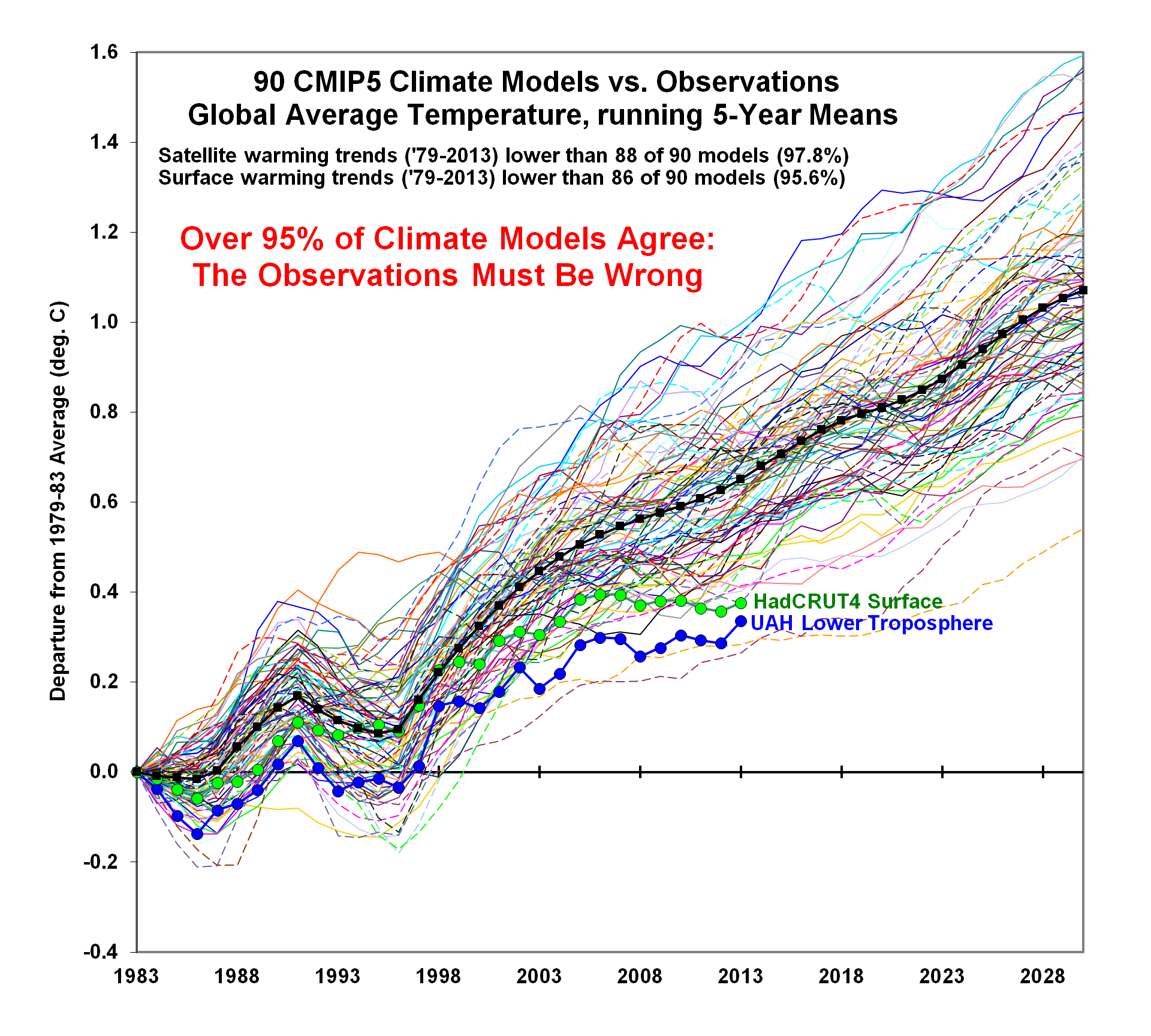
95% of Climate Models Agree: The Observations Must be Wrong

Roy W. Spencer, Ph. D.

I’m seeing a lot of wrangling over the recent (15+ year) pause in global average warming…when did it start, is it a full pause, shouldn’t we be taking the longer view, etc.

These are all interesting exercises, but they miss the most important point:the climate models that governments base policy decisions on have failed miserably.

I’ve updated our comparison of 90 climate models versus observations for global average surface temperatures through 2013, and we still see that >95% of the models have over-forecast the warming trend since 1979, whether we use their own surface temperature dataset (HadCRUT4), or our satellite dataset of lower tropospheric temperatures (UAH):

CMIP5-90-models-global-Tsfc-vs-obs-thru-2013

Whether humans are the cause of 100% of the observed warming or not, the conclusion is that global warming isn’t as bad as was predicted. That should have major policy implications…assuming policy is still informed by facts more than emotions and political aspirations.

And if humans are the cause of only, say, 50% of the warming (e.g. our published paper), then there is even less reason to force expensive and prosperity-destroying energy policies down our throats.

I am growing weary of the variety of emotional, misleading, and policy-useless statements like “most warming since the 1950s is human caused” or “97% of climate scientists agree humans are contributing to warming”, neither of which leads to the conclusion we need to substantially increase energy prices and freeze and starve more poor people to death for the greater good.

Yet, that is the direction we are heading.

And even if the extra energy is being stored in the deep ocean (if you have faith in long-term measured warming trends of thousandths or hundredths of a degree), I say “great!”. Because that extra heat is in the form of a tiny temperature change spread throughout an unimaginably large heat sink, which can never have an appreciable effect on future surface climate.

If the deep ocean ends up averaging 4.1 deg. C, rather than 4.0 deg. C, it won’t really matter.

Why Does Wynne’s Granddaughter Deserve Protection, But NOT My Son???

The SELFISH Granny…
Kathleen Wynne is not your friend. She says she wants to let you buy beer in the grocery store and save her granddaughter Olivia from Climate Change but she is not your friend.
Here is how I know.
My son Joey has a diagnosed neurological condition which has made his young life a great trial. He is extremely sensitive to noises and visual stimulations which can trigger seizures and cause serious harm to his health.
His neurological Specialist composed a letter for me to give to Kathleen Wynne describing his condition which I did have delivered to her and to the Minister of Energy Bob Chiarelli.
All say that they are concerned and that their ministry will make green energy to protect human health and that they are sure he will be ok. But they can’t say this. And they never tell the wind company not to come to your area because your son will have debilitating health problems for the rest of his life.
We moved to quiet rural area to protect Joey’s health. He has grown up here and at 14 making him leave our home will be devastating to his sense of safety and comfort. He will lose his school friends who have accepted him the way he is. His familiar surrounding will disappear.
Ms. Wynne though, only cares about her granddaughter Olivia. But I wonder what Olivia would say if she knew this? Would this make her feel good about her granny?
Like most innocent children I am sure Olivia would be very upset if she knew that this young boy Joey was going to have an impossible struggle to survive if he had to live surrounded by giant wind turbines at home and at school all day and all night? Where does he go?
I have had no help from my premier. But I have received some kind advice form an unlikely source. The Environmental Review Tribunal coordinator Eva Petrysik – a rare civil servant who seems to actually care suggested I write a pleading letter to the Mr. Dennis Maloney  lawyer for the wind developer at Tory’s LLP.
My son’s personal safety matters. There are thousands of special needs and autistic kids in rural Ontario who will be chronically exposed to wind turbine emissions both noise and visual effects. So which ones does our devoted granny select to protect?  Would you like to make this choice? Is unreliable, low performing, costly and harmful wind energy good enough to ruin these kids’ lives? We have international treaties and organizations to protect children from harm but your premier does not care. She is abusing her power and my son.

Sign a Wind Lease in Haste, Repent at Your Leisure!

Wind Leaseholders May Be On The Hook For Billions

global-landgrabA recent visit by members of the Ontario Landowners Association to the Land Registry Office in Goderich (Service Ontario) has revealed the registration of a one billion dollar encumbrance by K2 Wind Ontario Inc. on 100 wind leaseholder properties in Ashfield-Colborne-Wawanosh (ACW), home of the 140 turbine K2 Wind Project. They were looking for the original deed for a property and stumbled on K2 Wind’s charge. Certified publicrecords indicate that some properties may be encumbered at twenty times their farm land value, or more.

“We don’t know the full ramifications of what we have discovered this week”, stated Dave Hemingway, President of the Huron Perth Landowners Association. “We know that K2 Wind is not the only wind company following this practice but we don’t know at this point just how many others are involved.” Mr. Hemingway went on to say, “This raises some serious questions. Have the wind developers been smooth talkers and have rural leaseholders been too naïve and trusting? This might very well impact leaseholders’ ability to borrow money for their farming operations.”
Mr. Hemingway states that this discovery could have a profound effect on a leaseholders’ ability to borrow money, sell the farm or otherwise do what he/she sees fit with their own land.

The Ontario Landowners Association has been promoting the concept of property rights for landowners and has been encouraging them to make application for their Crown Land Patent. As part of this program the association encourages property owners to get a copy of the original deed for when the property was transferred from the Crown to private ownership. In the Huron Perth area, this happened from around 1830. The Crown sold the land to the Canada Company which then sold parcels to the local landowners of the time. The Huron Perth Landowners Association has published a Crown Letters Patent booklet to explain what a Crown Letters Patent is and how to get one for your own property. The association also recommends getting the original deed for one’s property which sets out the terms under which the first individual landowner received the property rights which have subsequently becomes the current owner’s property rights.
For further information, contact Dave Hemingway at 519-482-7005 or davehemingway@gmail.com.

EU’s Green Policies. An Example That No One Should Follow!

EU’s green energy debacle shows the futility of climate change policies

A wind turbine spins at a wind farm on February 19, 2015 near Zaragoza, Spain.

David Ramos/Getty ImagesA wind turbine spins at a wind farm on February 19, 2015 near Zaragoza, Spain.

Ontario will follow the EU at its peril — power rates will soar while industries depart

As the Ontario government announces new unilateral climate policies, Canadian policymakers would be well advised to heed the lessons of Europe’s self-defeating green energy debacle.

The European Union has long been committed to unilateral efforts to tackle climate change. For the last 20 years, Europe has felt a duty to set an example through radical climate policy-making at home. Political leaders were convinced that the development of a low-carbon economy based on renewables would give Europe a competitive advantage.

European governments have advanced the most expensive forms of energy generation at the expense of the least expensive kinds. No other major emitter has followed the EU’s aggressive climate policy and targets. As a result, electricity prices in Europe are now more than double those in North America and Europe’s remaining and struggling manufacturers are rapidly losing ground to international competition. European companies and investors are pouring money into the U.S., where energy prices have fallen to less than half those in the EU, thanks to the shale gas revolution.

Although EU policy has managed to reduce CO2 emissions domestically, this was only achieved by shifting energy-intensive industries to overseas locations without stringent emission limits, where energy and labour is cheap and which are now growing much faster than the EU.

Most products consumed in the EU today are imported from countries without binding CO2 targets. While the EU’s domestic CO2 emissions have fallen, if you factor in CO2 emissions embedded in goods imported into EU, the figure remains substantially higher.

Of all the unintended consequences of EU climate policy perhaps the most bizarre is the detrimental effect of wind and solar schemes on the price of electricity generated by natural gas. Many gas power plants can no longer operate enough hours. They incur big costs as they have to be switched on and off to back-up renewables.

Most products consumed in the EU today are imported from countries without binding CO2 targets

This week, Germany’s energy industry association warned that more than half of all power plants in planning are about to fold: Even the most efficient gas-fired power plants can no longer be operated profitably.

Every 10 new units worth of wind power installation has to be backed up with some eight units worth of fossil fuel generation. This is because fossil fuel plants have to power up suddenly to meet the deficiencies of intermittent renewables. In short, renewables do not provide an escape route from fossil fuel use without which they are unsustainable.

Gas-fired power generation has become uneconomic in the EU, even for some of the most efficient and least carbon-intensive plants. At the end of 2013, 14 per cent of the EU’s installed gas-fired plants stood still, had closed or were at risk of closure. If all gas plants currently under review were to close, this would amount to 28 per cent of current capacity by 2016. Almost 20 per cent of gas power plants in Germany have already become unprofitable and face shutdown as renewables flood the electricity grid with preferential energy.

To avoid blackouts, the government has to subsidize uneconomic gas and coal power plants. Already half of the 28 EU countries have in place or are planning to subsidize fossil fuel power plants to keep the lights on.

Germany’s renewable energy levy, which subsidizes green energy production, rose from 14 billion euros to 20 billion euros in just one year as a result of the fierce expansion of wind and solar power projects. Since the introduction of the levy in 2000, the electricity bill of the typical German consumer has doubled.

As wealthy homeowners and business owners install wind turbines on their land and solar panels on their homes and commercial buildings, low-income families all over Europe have had to foot the skyrocketing electric bills. Many can no longer afford to pay, so the utilities are cutting off their power. The German Association of Energy Consumers estimates that up to 800,000 Germans have had their power cut off because they were unable to pay the country’s rising electricity bills.

The EU’s unilateral climate policy is absurd. First consumers are forced to pay ever increasing subsidies for wind and solar energy; secondly they are asked to subsidize nuclear energy too; thirdly, they are forced to pay for increasingly uneconomic coal and gas plants to back up power needed by intermittent wind and solar energy; fourthly, consumers are additionally hit by multi-billion subsidies that become necessary to upgrade the national grids; fifthly, the cost of power is made even more expensive by adding a unilateral Emissions Trading Scheme. Finally, because Europe has created such a foolish scheme that is crippling its heavy industries, consumers are forced to pay even more billions in subsidizing almost the entire manufacturing sector.

In the last few years, major economies such as Canada, Australia and Japan have begun to realize the futility of going it alone and have retreated from unilateral policies and targets. Now even the EU has decided to walk away and has adopted a conditional climate pledge. It has burdened European taxpayers and businesses with astronomical costs while shifting its heavy industry and CO2 emissions to other parts of the world. Europe’s climate policy failure demonstrates beyond doubt that its unilateralism has been a complete fiasco. The lessons of this self-defeating debacle are clear: Don’t make the same mistakes or you will face the same fiasco.

Benny Peiser is the director of the London-based Global Warming Policy Forum. The text is based on written evidence he gave to the Committee on Environment and Public Works of the U.S. Senate.

Frauds, Crooks and Criminals

Demonstrating daily that diversity is not strength!

Family Hype

All Things Related To The Family

DeFrock

defrock.org's principal concern is the environmental and human damage of industrial wind turbines on rural communities

Gerold's Blog

The truth shall set you free but first it will make you miserable

Politisite

Breaking Political News, Election Results, Commentary and Analysis

Canadian Common Sense

Canadian Common Sense - A Unique Perspective from Grassroots Canadians

Falmouth's Firetower Wind

a wind energy debacle

The Law is my Oyster

The Law and its Place in Society

Illinois Leaks

Edgar County Watchdogs

stubbornlyme.

My thoughts...my life...my own way.

Oppose! Swanton Wind

Proposed Wind Project on Rocky Ridge

Climate Audit

by Steve McIntyre

4TimesAYear's Blog

Trying to stop climate change is like trying to stop the seasons from changing. We don't control the climate; IT controls US.

Wolsten

Wandering Words

Patti Kellar

WIND WARRIOR

John Coleman's Blog

Global Warming/Climate Change is not a problem