(May 28, 2016) — In Oceania, the dystopian society of George Orwell’s novel Nineteen Eighty-Four, a new language was created by the government to control the thinking patterns of the populace. Officially labeled ‘Newspeak’, it was the first language that, when fully adopted, was meant to limit the range of human thought. Concepts such as freedom, skepticism, and debate would be virtually unthinkable since no words existed to describe them, aside from the generic term ‘thoughtcrime.’
Perhaps most insidious was ‘duckspeak,’ a form of speech consisting entirely of words and phrases sanctioned by the party, language that conveyed politically correct messaging only. Someone who had mastered duckspeak could fire off ideologically pure assertions like bullets from a machine gun without thinking at all. Their words merely emanated from the larynx like the quacking of a duck.
Being called a ‘duckspeaker’ was considered a sincere compliment since it indicated that you were well-versed in the official language and views of the state.
More than ever before, we are now in an era of climate change duckspeak. Rather than being merely ridiculous or social satire, the apparent underlying purpose of climate duckspeak is ominous: to convince opinion leaders and the public to think about climate change only as the government wants. To consider alternative points of view is ‘climate change denial,’ today’s version of thoughtcrime, punishable by excommunication from responsible citizenry. If AGs United for Clean Power, a coalition of sixteen Democratic state Attorneys General (AG), has their way, speaking out on the other side of the climate debate could soon result in civil or criminal charges.
President Barack Obama sets the stage for climate change duckspeakers, often reassuring us that “the debate is settled. Climate change is a fact.”
But, as Carleton University Earth Sciences Professor Tim Patterson points out, “Climate is and always has been variable. The only constant about climate is change; it changes continually.” So Obama’s claim, and that of other opinion leaders who say the same, appears to be a self-evident, but trivial, truth like ‘sunrise is real’.
But it is much more than that. Intentionally or otherwise, the President is using a strategy right out of Nineteen Eighty-Four. His statements imply that experts have concluded that unusual climatic events are happening, and that government must save us.
Obama strengthens this perception with dramatic assertions such as that in the “Cutting Carbon Pollution in America” section of the White House web site: “I refuse to condemn your generation and future generations to a planet that’s beyond fixing.”
Referring to greenhouse gases (GHG) as “carbon pollution,” as the White House does twelve times on their climate change Web page, is pure duckspeak. This conjures up subconscious images of dark and dangerous emissions of soot, which really is carbon.
What Obama and others are actually referring to is carbon dioxide (CO2). But were they to call it that, most people would be unconcerned, remembering from grade school that the trace gas is essential for plant photosynthesis. So climate campaigners mislabel it ‘carbon’ to frighten the public and to discourage further thinking, closely following ‘Big Brother’s’ strategy in Orwell’s classic.
Similarly, referring to low CO2 emitting energy sources as clean or green is a mistake since the gas is in no way unclean. But the label promotes an image of environmental wholesomeness, hiding the true ineffective and damaging nature of many alternative energy sources.
Finally, the “97% of experts agree” phrase is, using Oceania’s vernacular, ‘doubleplusgood’ duckspeak, designed to suppress debate and boost the party line. After all, who would dare contest experts about such a complicated issue?
But ‘appeal to authority,’ and ‘appeal to consensus’ are logical fallacies that prove nothing about nature. And, even if such surveys were taken seriously, one would have to ask: Do these experts study the causes of climate change? What did they agree to?
In fact, none of the surveys that are used to back up the consensus argument are convincing. They either asked the wrong questions, asked the wrong people, or polled mostly those who would obviously agree with the government’s position.
Independent reports such as those of the Nongovernmental International Panel on Climate Change show that the science is highly immature with wide-ranging opinions about the future of climate change.
Although first published 67 years ago, Nineteen Eighty-Four is now more relevant than ever. University of Florida linguist M. J. Hardman summed up the important role language plays in societal control when she wrote in her paper Language and War (2002), “language is inseparable from humanity and follows us in all our works. Language is the instrument with which we form thought and feeling, mood, aspiration, will and act[ion], the instrument by whose means we influence and are influenced.”
It is not surprising, then, that language tricks like Orwell’s duckspeak are being used to justify the unjustifiable in the war of words over global warming.
Credit: Huron County, Ontario, May 18, 2016 — Concerned Citizens for Health ~~
Rural Ontario is up in arms today over the apparent suspension of a one-of-a-kind wind turbine health investigation that may never happen.
Medical Officer of Health for Huron County Dr. Janice Owen became aware of numerous health complaints from people in her community shortly after she was hired a year ago by the current Huron County Board of Health. Owen began researching the issues last August and contacted many in the field researching the topic.
This February 4, Owen presented to her Board the outline and components of a wind turbine health complaints investigation stating that she had visited wind projects, sought information from the Ministry of Environment and Climate Change as well as Public Health Ontario and had spoken and heard from many members of the community.
In March this year the announcement of the new investigation was posted on the Health Unit’s website and immediately people suffering as a result of wind projects began to sign up. In April Dr. Owen was informed her services were no longer needed and she was put on administrative leave. This is a devastating blow to Huron County people exposed without consent to the acoustical emissions of wind turbines in proximity to their homes.
More questions than answers arose about the investigation’s future and were addressed on May 12 when the Board put the research on hold – likely permanent – stating that it seemed to be a duplication of a long term Ontario-wide public health survey with nothing to do with industrial wind adverse reactions.
“The people of Huron County do not want to become another Flint Michigan. Health administrators and those tasked with the protection of our health and safety need to see this ground-breaking research through to the end,” says Gerry Ryan for the group Concerned Citizens for Health (CCH). “The eyes of communities around the world who are suffering the same fate as us are watching what happens in Huron County Ontario. The wind industry is watching and the Ontario government whose policy this is are also watching.”
The CCH calls upon the temporary Medical Officer of Health Dr. Meriam Klassen to be courageous like Dr. Owen and find out where this investigation will take her. This is only fair.
Source: Huron County, Ontario, May 18, 2016 — Concerned Citizens for Health
“For an increasing fraction of the world’s population, the real climate crisis is not the possibility that dangerous human-caused global warming may someday occur. It is the damage being caused today by government policies to supposedly mitigate climate change.
“Ontario provides a tragic example.”
…
“Climate change activists might argue that it would be worthwhile to let millions of people suffer today to save billions in the future from climate change catastrophe they claim is right around the corner if we do not change the way we generate energy. But then they would be faced with providing convincing evidence that scientists are able to meaningfully forecast future climate states. They would have to show why the United Nations Intergovernmental Panel on Climate Change was wrong when, in their 2001 Assessment Report, they wrote, “The climate system is a coupled non-linear chaotic system, and therefore the long-term prediction of future climate states is not possible.”
Click here to see map of regions in Ontario that have come out opposed to the installation of industrial wind turbines (IWTs).
Click here to visit Mothers Against Wind Turbines, the Web site of Shellie Correia, the mother of 15 year old Joey who took the picture to the right.
Click here to watch a protest against IWTs in Toronto.
Click here to visit Save the Eagles International, “an organization regrouping bird lovers, ornithologists and associations from 14 countries, who think that we cannot count on mainstream ornithologists and bird societies to save bird life from the windfarm threat.”
STT has just gorged on two episodes of what is presented as well crafted drama, but which to STT followers will play out like a hard-hitting documentary.
Australia’s SBS started screening ‘Follow the Money’ a couple of weeks ago, the plot-line for Episode 1 is described as follows:
Mads, a police detective, is called out to investigate a body washed ashore near a wind farm. At first, it merely looks like an industrial accident, but the case implicates the upper echelons of Energreen – one of Denmark’s most successful and leading energy companies. The CEO is charismatic Sander, and a young lawyer, Claudia, is working hard to advance in the company. Nicky, a former car thief and mechanic, has put his life of crime behind him for his girlfriend’s sake, but his new colleague Bimse tempts Nicky with a chance to make a quick buck.
From the creators of Borgen, Follow the Money is as slick as any of the recent crop of Nordic Noir crime dramas. While the wind-cult Weekly,The Guardian gave it a critical pasting when the BBC aired it in Britain back in March (probably something to do with it being just a tad inconsistent with green-left groupthink) – STT gives it five stars.
Indeed, Follow the Money comes with an STT consumer warning: “this TV series is more addictive than crack cocaine”.
For our Australian followers, Follow the Money screens on Thursday nights at 9:30pm. For our many international followers, the series is available at SBS On Demand, which will also allow our local followers to catch up on the first two episodes: for episode one click here and episode two here. You can view it on a PC, Smart TV or iPad etc.
The site adds a new episode after it goes to air, so return to SBS On Demand to Follow the Money. For a taste, here’s the trailer:
****
****
Without giving too much away, the company at the centre of the story, Energreen, is filled with cocksure and arrogant types, of the kind that you might find swanning around with wind power outfits like, Infigen andPacific Hydro.
Keep an eye out for one character who STT is certain was modelled on Vesta’s Australian pinup boy, Ken McAlpine (the physical resemblance to Ken is good, but the character’s similarly channelled arrogance and narcissism is uncanny).
The lone wolf detective, Mads finds roadblocks being thrown up at every turn by his superior officers, which smack of wind industry corruption and interference.
Of course Denmark, the birthplace of Vestas, is no stranger to wind industry sleaze, corruption and fraud.
Vestas and its slick financial dealings have, no doubt, provided Follow the Money’s scriptwriters with plenty of material to work with.
The plot-line reads a whole lot like the trouble that Vesta’s Chief Financial Officer, Henrik Nørremark and a band of its executives found themselves in back in 2013, having engaged in a run of fraudulent transactions that cost the company around 140 million kroner.
Just like Follow the Money, the boys from Vestas found themselves under police scrutiny; and, thereafter, the company did everything it could to quarantine itself from a PR nightmare – cutting the former corporate heroes loose and leaving them for dead (see our post here).
Now, turning closer to home let’s take a sneak peek at Australia’s own Follow the Money documentary sequel.
The Pilot for the Series kicks off in Australia’s Federal Parliament during Senate Estimates held on 5 May 2016 (the last session of play before Parliament was dissolved ready for an election in July).
****
WA Liberal Senator, Chris Back starts off with a little probing of the Clean Energy Regulator, Chloe Munro (keep a lookout for her doppelgänger in the Danish version of Follow the Money) on the topic of around $100 million worth of Renewable Energy Certificates pocketed by Babcock and Brown (aka Infigen or Energreen), which were paid out based on a signature that the CER has, despite some effort, been unable to verify. Here’s the Script for ‘Follow the Money, Downunder’, Scene 1 (taken from Hansard):
Senator BACK: Thanks Ms Munro and thank you for the information before lunch, it was very interesting. Again, I appreciate you correcting the answer—217, I think it was. At the end of stage 1 of your explanation you mentioned that on July 7 2004 Babcock and Brown lodged a new application for registry to accredit a power station showing Lake Bonney Wind Farm Pty Ltd as the applicant.
What concerned me, and I am asking for your response, is that you said it is not clear who signed the declaration on behalf of the company on that form; the signature is illegible. That is of enormous concern to me. The CER would have issued certificates to that organisation since then, probably of values—of what?—of $100 million?
Ms C Munro: I could not estimate that on the run.
Senator BACK: My guestimate is somewhere between $70 million and $160 million, based on a document the signature on which was not able to be verified. What action can be taken?
Ms C Munro: Perhaps to set your mind at rest with respect to that: first of all we were retrieving records from our predecessor organisation, the Office of the Renewable Energy Regulator, so I cannot speak about the precise processes they would have followed at the time. But I think they would have been in a position to verify that the signature was the signature of somebody they had probably been dealing with, because usually there is an exchange of correspondence and so on before the actual accreditation. I think the fact that at this stage we cannot make out the signature does not mean to say that it was unknown to them.
To be honest, my own signature, on its own, is not always decipherable. What I think was missing was that the block where the person’s name was written separately had not been filled in. But taken with the other information that would have been there at the time, I do not think it suggests an impropriety in that regard.
Going to the question that you asked before, the point is that the legal person is the ‘entity’. This person is an authorised officer. Clearly, it is important to verify that the signature is from the authorised officer. But at this stage I do not think that we have any reason to believe there was a problem in that regard.
Senator BACK: Sure. Can I have an assurance then that as a result of the Renewable Energy Regulations regulation 3L coming into effect in December 2012 that an omission of that nature would not be repeated?
Ms C Munro: No. I think that generally we have tightened up a lot of our standing operating procedures. I think that in terms of verifying who signatories are and that the authorised officers are the appropriate people across all our schemes, we probably have some more consistent processes there.
Senator BACK: Thank you. I will just go back to question 222 from the previous estimates. I asked you about the membership of the Clean Energy Council. Are you able to give the committee an assurance—if not now, then take it on notice—that members of the board, when there has been a matter involving an organisation with which they have an association, have in fact excluded themselves from any decisions regarding that particular entity? I would imagine that, with good governance, the board minutes would indicate that a person has excluded themselves from the debate.
Ms C Munro: I cannot give you that assurance on behalf of the Clean Energy Council, although I absolutely agree with you that that is normal governance. What I can say for background is: the Clean Energy Council board is a representative body, as many industry associations are, and board members are drawn from amongst participants in the industry. The chair revolves fairly frequently. Until recently it was Michael Fraser, who was the predecessor of the current chief executive of AGL, for example.
But I think, more significantly, the co-regulation takes place between ourselves and the Clean Energy Council is on matters that relate to the small-scale scheme—things like accreditation of installers, listing of components like panels and so on. So, those matters I think, generally, would not be decided by the council; they would be decided at the executive level. The council members are more likely to be participants in the large-scale renewable energy targets, in which the Clean Energy Council does not have a regulatory role. That is a long way of saying: I cannot advise you on how the Clean Energy Council conducts its meetings, because we are not a member of it. I think it is unlikely that there are occasions in its deliberations for the kind of conflicts that you might be apprehensive about. Hansard 5.5.16
Hmmm… a former wind industry exec turned government bureaucrat, brushing aside obvious conflicts of interests, deflecting enquiries about fictitious applicants for hundreds of $millions in REC Tax/Subsidy, paid to a wind power outfit that disintegrated in a $10 billion insolvency in 2009 and Phoenixed as Infigen, starts to sound very Danish Noir.
But the drama didn’t end there.
STT champion, John Madigan followed up on the story we covered back in September last year (see our posts here and here) about Pacific Hydro and Acciona presenting fabricated wind farm noise reports (claiming compliance at non-compliant wind farms – Waubra and Cape Bridgewater), allowing them to continue pocketing hundreds of $millions in RECs.
The CER is well aware that both outfits have been relying upon ‘made-to-measure’ noise reports from Marshall Day, but have steadfastly refused the act or investigate.
Now, in classic Follow the Money style, it appears that the Australian Federal Police are hot on the trail of Chloe and her gang.
****
Senator MADIGAN: Thank you, Chair. Last year, Ms Munro, I met with the Prime Minister and the Attorney-General to alert them to my concerns surrounding false wind farm noise reporting. As a result of that meeting I was led to believe that the Attorney-General had referred these allegations to the Australian Federal Police for formal investigation. Are you able to confirm whether the AFP has held any discussions with anyone from the office of the Clean Energy Regulator in relation to the CER-accredited Cape Bridgewater and/or Waubra wind farms?
Ms C Munro: Yes, Senator, I am able to confirm that. We were approached in February by the Australian Federal Police, who were making initial inquiries relating to the matters that you put.
They had a meeting with members of my staff in order to understand the way that our schemes worked and how those entities would be accredited.
Following that, and on our advice, they made an information request. I authorised the disclosure of information relating specifically to Cape Bridgewater, and that was done. We have not heard anything further from them, so I am not aware whether they proceeded to a formal investigation—this was their preliminary information gathering. We have had no further contact from them since then.
Wind and solar a waste of money for UK, Prof Sir David MacKay said in final interview
The late Prof Sir David MacKay , GEOFFREY SWAINE/REX SHUTTERSTOCK
Wind turbines and solar panels are a waste of money if Britain wants reliable low carbon electricity supplies through the winter, the late Professor Sir David MacKay said in his final interview.
Prof MacKay, who served as chief scientific advisor to the Department of Energy and Climate Change for five years until 2014, died from cancer last month.
In an interview with the science writer Mark Lynas, filmed 11 days before his death and released posthumously, Prof Mackay said the “sensible thing” for the UK to do was to focus on nuclear and on carbon capture and storage technology, which traps the emissions from power stations.
He criticised the “appalling delusion” that renewable sources of power could simply be scaled up and paired with battery storage to provide all the UK’s energy needs, citing the high costs and large areas of land that would be required.
Prof Sir David MacKay said there was no point building wind turbines if the country had enough low-carbon energy to cope with periods of no wind ADRIAN DENNIE/AFP/GETTY
Prof MacKay was renowned in the energy world for his bookSustainable Energy – Without the Hot Air, which examined the potential limitations of renewable power, but said he had “always tried to avoid advocating particular solutions”.
However in his final interview – in which he stressed he would be “content with any plan that adds up” – he set out for the first time his own recommendation for “the rational thing to do in the UK”, explaining: “Maybe [as] the time is getting thinner, I should call a spade a spade.”
“For the UK, I think we want a zero carbon solution and it has to work in the winter,” he said.
The British public also seemed to care about the cost of energy, he said, so “we should be looking for a low carbon solution that is low cost”.
Prof MacKay said: “If you just cost-optimise and say it has to keep working in the winter, even if there’s no wind for seven days at time and obviously no sun… the sensible thing to do for a country like the UK, I think, is to focus on carbon capture and storage (CCS), which the world needs anyway, and nuclear.
“Then if you ask, what is the optimal amount of wind and solar to add in as well? The answer is going to be almost zero.”
Prof MacKay said he loved wind turbines, describing them as “the cathedrals of the modern age”, but said that if the country managed to build enough low-carbon supplies to get it through periods of no wind or sun in winter, then there was “actually no point in having any wind or solar”.
Wind turbines were a “waste of money” in that scenario since “when the wind blows you are going to have to either turn those wind turbines down or something else down that you have already paid for like the nukes or the CCS”, he said.
While advocates of renewable technologies often cite the potential for electricity storage to deal with their intermittency, Prof MacKay said that balancing wind-based power supplies would require “hundreds of flooded valleys” for hydroelectric storage.
Powering the UK from solely solar and batteries would require “absurdly large” batteries, while the cost of battery technology would need to come down “by a factor of 100” for it to be a realistic option, he said.
He alleged that solar panels had been subsidised in the UK against the advice of civil servants, due to their popularity with MPs and the work of solar lobbyists.
However, Prof MacKay emphasised that the best energy solutions would vary from country to country depending on their demands and political priorities.
Solar panels were a “really good idea” in hot countries where solar power supplies correlated with times of high demand, he said, while a combination of wind and storage might make sense in a country where “price doesn’t matter”.
This very sad, but now all too common letter discussing wind turbine impacts is published here with the permission of the author.
After being awakened for the ump-teenth time by these grinding, screeching, humming, squealing, house vibrating, jet sounding, phone interrupting, television disturbing, internet interfering, shadow flickering, environmental impacting, property value lowering, aesthetic degrading, red light blaring obtrusive monsters, known as Industrial wind turbines, (IWT), thrust upon us without our permission.
It is finally time to thank the uninformed, seemingly uncaring, self-serving, publicly elected officials, for having the audacity to vote in favor of a project that they knew so little about which would forever change the lives of so many people that they are supposed to work to protect, all because a smooth tongued, representative from a less than ethical company, (which person admitted he would not live near turbines), was able to pull the wool over their eyes by making promises of untold booty with undoubtedly, falsified studies of sound, resident acceptance and environmental impact.
I would hope that these publicly elected officials are realizing how their actions have affected the residents of northeastern Tipton County, IN. Thanks to them our lives have changed forever, not for the better but for a lifetime of interruptions, inconveniences not only in the daytime but 24 hours a day. This is not an issue that you can spend an hour or two or a day in the area and comprehend the negative impact it is having upon our lives.
You have to be here for extended periods of time because there will be instances that the wind doesn’t blow yet the humming and screeching will continue as the IWTs search for wind. It was stated that residents would adjust, getting used to these monsters but alas this is not happening when you are awakened at two or three AM by something that sounds as if it is in your house and upon investigating you find that it is an IWT. It has been suggested that we move, however finding anyone to purchase our property for the true value it had before the IWTs were present is impossible.
As I realize this will serve no purpose to alleviate the situation in Tipton County, IN
I would hope it could inform others of the irritating intrusions of IWTs, these monsters have absolutely no place in a community as populated as Tipton County.
Also hoping it would lead elected officials to better investigative procedures before signing on the dotted line.
Although I have not read nor have I seen it, I understand that one of those responsible officials has written some form of apology or regret about their actions. This would show the great character and respect of that person to the citizenry, however it does nothing to alleviate the intrusions.
German opposition to these things grows by the day. And, just like everywhere else, criminals, shysters and chancers cloak themselves in groovy ‘green’ credentials and help themselves to $billions in subsidies filched from power consumers and/or taxpayers: all for the ‘good of the planet’ – or, perhaps, not.
Now, the less gullible among Germany’s Greens have worked out that wind power is the greatest economic and environmental fraud of all time.
Spiegel Puts Spotlight On Germany’s “Green Sleaze” … Wind Industry’s “Corruption Of Greens, Environmental Groups, Local Pols…”
No Tricks Zone
Pierre Gosselin
7 April 2016
The latest hardcopy issue of flagship news magazine Der Spiegel reports how Germany’s green energy revolution has bitterly divided the country’s environmental movement.
Enoch zu Guttenberg, one of Germany’s most prolific environmentalists has become an outspoken critic of wind energy in Germany, and believes children in the future will be able to see Germany’s idyllic landscape only in paintings as developers clear hill-top forests to make way for skyscraper-size industrial wind turbines.
Guttenberg, a symphony conductor, told Spiegel the movement against wind turbines has exploded over the past months and years and that his speeches against wind turbines are attracting ever larger crowds: “When I started 60 or 70 would come, now there are more than 1000.”
Moreover Guttenberg talks of “hundreds of local citizens’ initiatives” that are now mobilizing against wind projects. Spiegel writes of a whole “new quality” of resistance that governments now need to confront as many traditional environmentalists now rail against what they view as a “corruption of green party members, environmental groups, local politicians and city councils“.
So divided the environmentalists have become that Germany’s powerful BUND (Friends of the Erath Germany) launched a slander lawsuit against Guttenberg after he accused the organization of having “merged” with the Wind Lobby. BUND later dropped the suit.
Since then Guttenberg has compared the BUND directors to Judas and accused them of having sold out the environmental philosophy for a “dish of lentil”. Leading environmental activists today are now saying: “The color of sleaze is no longer black, rather it is green.”
The environmental movement has become so disunified, Spiegel writes, that once diehard nuclear energy opponents have now switched to protesting wind turbines, as many planning boards ignore concerns of the citizens and attempt to steamroll projects through against the public will.
Often the projects are politically explosive, involving a good old boys network. A typical pattern, Spiegel writes:
Town mayor, local pols, city directors, who at the same time happen to be the managing directors of wind parks and whoPROFIT from them. A dubious mesh of community and electricity interests.”
This is how it works at many communities, Spiegel describes. Often the nearby residents and citizens pay heftily through lost property values, health issues from infrasound, and high electricity prices. Invariably only very fewBENEFIT at all.
Planners often shoot back and claim nothing is illegal about the business deals. But the public is not having it. Spiegel adds:
Indeed in the meantime resistance is growing. ‘The mood has flipped because people are noticing that it is all about business,’ says anti-wind activist [Manfred] Knake”
At the end of the article Guttenberg, Spiegel writes, calls it the “capitialistic injustice of the Energiewende“.
TheMONEY of the little guy, who has to pay billions for renewables, is diverted into the pockets of some large property owners.”
This document is a review of the possible breaches by wind energy projects of various of the human rights of people living in the vicinity of a wind project.
It identifies and considers a number of potential breaches of varying impact and of differing ease or difficulty of establishing. In this context the rights to health, safe working conditions and property may be the simplest to establish whether breaches have or have not occurred.
Readers of this document need to understand that it is not in any way a legal argument and that whilst all reasonable steps have been taken in its construction the author makes no representation that the information is complete nor that the analysis and conclusions are correct.
Those interested in the subject should obtain their own advice before proceeding with a formal complaint.
Prepared by:
Peter R Mitchell AM, BChe
March 2016
Index
Summary
Introduction
The Relevant Facts
Has the Wind IndustryPROVEN Its Machines Are Safe?
Level of Disturbance
Human Rights Legislation
Major Breaches of Human Rights
Cruel, Inhuman and Degrading Treatment
Discrimination
Arbitrary Interference
Working Conditions
Family
Children
Physical and Mental Health
Homes and Other Assets
Obligations of Civil Servants
Appendices
Each Appendix repeats relevant articles from the Declaration and Convenants with comments in italics on their applicability to the problems discussed in the memorandum.
Universal Declaration of Human Rights (UDHR)
International Covenant on Economic, Social and Cultural Rights (ICESCR)
International Covenant on Civil and Political Rights (ICCPR)
Covenant on the Rights of the Child (CRC)
Convention Against Torture and other Cruel, Inhuman and Degrading Treatment or Punishment (CAT)
A. Summary
IndustrySPIN and uncritical but determined admirers of wind energy have encouraged the political and public view of the wind industry as beyond criticism and critical analysis. In contrast people living in the vicinity of Wind Energy Projects (WEPs) have been suffering both mentally and physically since turbines have appeared in their previously quiet, peaceful and healthy environments.
Some high quality work by US scientistsi in the 1980s uncovered a wind turbine sound profile (signature) that included infrasound and low frequency sound (ILFN). This signature was unlike that of any other source of sound. ILFN at very low and specific frequencies was identified as the cause of health problems in humans. The industry and their favoured acousticians “forgot” this work; but recent field workii in Australia has confirmed the unique sound profile and the cause and effect. Advances in instrumentation are allowing more work to be undertaken in victims’ homes by privately funded acousticians independent of the wind industry.
Characteristically the victims have no funds to seek legal relief or advice but that may become easier as the findings are repeated. Meanwhile the victims continue to endure what they claim are intolerable bodily impacts with their personal sensitivity increasing with timeiii.
Whilst the industry currently feels secure against court action, it has occurred to some that the industry and government regulatory authorities are quite possibly causing major breaches of certain of the victims’ human rights; and that this is an avenue that should, and can, be diligently pursued with a minimum outlay of scarce funds.
Matching of thePROVEN impacts with defined and accepted human rights is the purpose of this document.
Matching shows that rights involving:
Cruel, Inhuman and Degrading Treatment
Discrimination
Arbitrary Interference
Working Conditions
Family
Children
Physical and Mental Health
Homes and Other Assets
are seemingly being both ignored, and breached.
It is not necessary that every one of the above identified rights is breached. One alleged breach against one person at one wind project is enough to trigger the obligations of the Human Rights Commission.
B. Introduction
The Clean Energy Council website states that: “Australia had 1866 wind turbines spread across 71 wind farms at the end of 2014. Three wind farms with a combined power generation capacity of 566.7 megawatts (MW) were completed in 2014 and a further five wind farms remained in progress early in 2015 and are expected to be completed in 2015”.
Individual turbine size (rated capacity) ranges from less than 1MW to about 3.3MW.
Changes to the Renewable Energy Target will require additional renewable energy capacity to be built, most of which can be expected to be wind derived.
There are a variety of problems with wind energy that are unlikely to be rectified soon. This document is concerned solely with the physiological and psychological impact on families and farm workers living within 10km of a WEP.
The purpose of WEPs is to produce power from a sustainable source without producing carbon dioxide. It may or may not be that the planet is facing disastrous global warming; it may or not be that carbon dioxide produced from fossil fuels is a, or perhaps the, major cause. Many believe (but may not actually know) the answers to the above options are in the affirmative. Political parties and members of State and Federal parliaments have, with some exceptions, accepted the affirmative view. The Commonwealth, through the Renewable Energy Act, has directed that power consumers pay large subsidies for renewable energy in order for wind energy and some other renewable energies to become viable. Thus the wind industry operates with aGUARANTEED PROFIT at a level which is very attractive to some investors who increasingly are foreign.
The wind industry’s interest is to protect and enhance its cash flows. Capitalism has a poor record if its product or service is damaging to the public and the environment. In these circumstances it commonly does not seek to change its product but to defend its continuation. Unfortunately this reaction includes tactics of denial and dissembling, refusing to undertake sufficient research on its own products, delaying research by others and attacking those who see problems with the product and are prepared to say so. An expensive campaign of denial andSPINis progressively developed and practised.
Those convinced of the need to reduce carbon dioxide emissions see wind energy as a win-win solution (both sustainable and reducing carbon dioxide). However, in the matter of its more carefully defined purpose, that being the net reduction of carbon dioxide per unit of power produced, it is a failure.iv This is mentioned here so that readers may realise that wind energy is not the saviour first thought, and that there is no question of “wind power or we perish”.
However this document does not make the argument about wind being not fit for purpose. Others have done and continue doing that. The purpose here is to consider whetherPROVEN impacts on residents constitute transgression of their human rights.
The following facts relating to the generation of power from wind are drawn from published research and unpublished field work, much of which is available on websites such as the Waubra Foundation, National Wind Watch, etc. website. These are discovered and researched facts, not unfounded assertions nor the output of “post modern” science.
Matching of these facts with defined and accepted human rights is the purpose of this document.
C. The Relevant Facts
An understanding of the nature of the sound pressure wavesv emitted by turbines and the impacts of that energy upon neighbours is essential to any assessment of the possible breaching of human rights. Facts vital to this evaluation follow.
Wind turbines produce sound (airborne pressure waves) across the infrasound, low frequency and audible ranges.
Sound in the very low frequency spectrum (0.1 hertz to 20 hertz) characterised as infrasound, as well as excessive low frequency noise (20 to 200 Hz) causes serious physiological and psychological impacts on some or all of the residents in a significant number of houses up to at least 10 km from the nearest turbine.
Residents do not become accustomed to these pressure waves, but become sensitised, so that the impact becomes increasingly damaging with ongoing exposure.(See Endnote ii)
A major impact of these sound waves is chronic sleep deprivationvi often associated with waking suddenly and regularly in a panicked state; but other primary or secondary health problems such as tinnitus, vertigo and balance problems, tachycardia, nausea, migraine, exacerbation of chronic medical conditions such as heart disease, and concentration problems, as well as physiological and psychological stress are also common.(See Endnote ii) Chronic sleep deprivation is classified by the World Health Organisation as a contributor to diseasevii.
Many residents find their formerly peaceful homes are rendered sonically toxic and ultimately uninhabitable and, on full disclosure to possibly interested buyers, unsaleable.
Young children are unable to understand or express their discomfort, which is often extreme, old people are unable to move for various reasons including financial; and all ages suffer declining health and cognitive power and are increasingly at risk in operating farm machinery, fixed machines and even cars and trucks.
D. Has the Wind Industry Proven Its Machines Are Safe?
The information to support the above facts is readily available and mounting. Whilst the wind industry and its variously motivated supporters deny any evidence exists, and discredit the motives and background of the whistleblowers, the industry has never been inclined or required to prove that their ever larger turbines are safe, or to prove another source that has any scientific credibility for the health impacts that arise around wind turbineINSTALLATIONS.
PLEVNA — A Brule Lake resident is challenging some of the arguments the Ontario government is using to support its push to build more renewable energy projects.
Chris Albinson responded to Tuesday’s announcement by the Ontario government that it was launching the second phase of its Large Renewable Procurement.
Phase 2 of the Large Renewable Procurement program announced Tuesday called for up to 930 megawatts of green energy to be added to the province.
Contracts for Phase 1 of the program were offered in March and amounted to about 455 megawatts.
In the announcement, the government said green energy projects had created 42,000 jobs since 2003 and reduced carbon dioxide emissions.
Albinson said neither statements are true and the Liberal government’s Green Energy Act has hurt the province’s economy and increased the cost of electricity for residents and businesses.
“The Green Energy Act was a nice idea that has turned into an economic catastrophe through gross mismanagement and corruption,” he wrote in an email to The Whig-Standard.
Albinson said reports from the province’s auditor general show the expectations about the job creation, environmental benefit and economic value of the renewable energy projects in Ontario are greatly overestimated by the Liberal government.
“Any rational government would look at the facts and the auditor general report and stop the program,” he wrote. “In the bizarre thinking of this government, they are doubling the size of the disaster.”
In 2011, then Ontario auditor general Jim McCarter pointed out that while the Green Energy Act promised 40,000 jobs would be created by renewable energy products, most were short term and that estimate did not account for job losses in other sectors.
“However, about 30,000, or 75 per cent, of these jobs were expected to be construction jobs lasting only from one to three years,” McCarter wrote in his 2011 report.
Government estimates of green energy job creation also did not factor in job losses from other sectors of the economy because of higher electricity prices.
“A 2009 study conducted in Spain found that for each job created through renewable energy programs, about two jobs were lost in other sectors of the economy,” McCarter’s report stated.
Another 2009 study from Denmark noted “that a job created in the renewable sector does not amount to a new job but, rather, usually comes at the expense of a job lost in another sector.” The renewable energy job is often heavily subsidized, the study showed.
Albinson also questioned the government’s assertion that the additional renewable energy will reduce the province’s carbon dioxide emissions.
Again, he referred to reports from the auditor general that showed renewable energy sources — mainly wind and solar — rely on unpredictable weather and must bebacked up by electricity from gas-powered generation stations and nuclear power plants.
In her 2015 report, Ontario auditor general Bonnie Lysyk pointed out that the electricity sector in 2012 produced 14.5 metric tons of carbon dioxide, about nine per cent of the province’s total emissions. Transportation and industry produce 34 per cent and 30 per cent, respectively.
“According to the Ontario Society of Professional Engineers, emission reduction is important, but the cost of reducing emissions from the electricity sector should be evaluated against initiatives taken to reduce emissions from other, higher-emitting sectors such as the transportation industry,” Lysyk wrote.
“Reducing emissions from cars and trucks could very well be more cost-effective than reducing emissions through phasing out coal plants and procuring renewable energy at expensive prices.”
“It is almost as if the Ontario Liberal government has adopted a Donald Trump approach — even if you are lying and everyone knows you are lying, you just have to keep saying it long enough and loud enough that people believe you,” Albinson wrote.
That’s just the number estimated to have died in the winter of 2014 because they were unable to afford fuel bills driven artificially high by renewable energy tariffs.
But the real death toll will certainly be much higher when you take into account the air pollution caused when Germany decided to abandon nuclear power after Fukushima and ramp up its coal-burning instead; and also when you consider the massive increase in diesel pollution – the result of EU-driven anti-CO2 policies – which may be responsible for as many as 500,000 deaths a year.
But even that 40,000 figure is disgraceful enough, given that greenies are always trying to take the moral high ground and tell us that people who oppose their policies are uncaring and selfish.
It comes from an article in the German online magazine FOCUS aboutEnergiewende (Energy Transition) – the disastrous policy I mentioned earlier this week whereby Germany is committed to abandoning cheap, effective fossil fuel power and converting its economy to expensive, inefficient renewables (aka unreliables) instead.
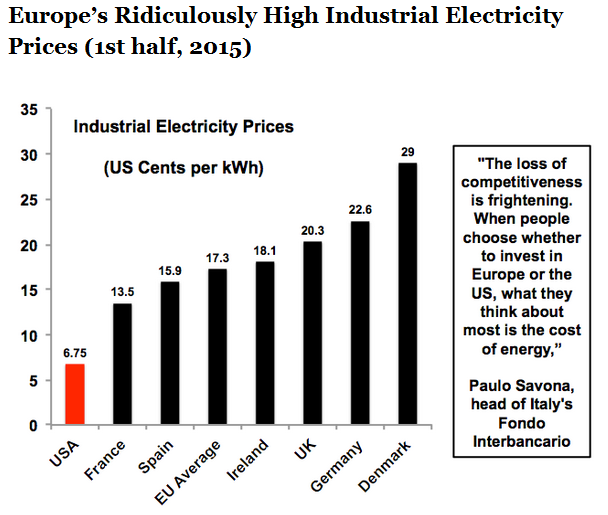
According to FOCUS around ten percent of the European population are now living in ‘energy poverty’ because electricity prices have risen, on average, by 42 percent in the last eight years. In Germany alone this amounts to seven million households.
The article is titled: The grand electricity lie: why electricity is becoming a luxury.
The reason, of course, is that green energy policies have made it that way. Many of these have emanated from the European Union, which in turn has taken its cue from the most Green-infested nation in Europe – Germany.
Germany has long been obsessed with all things environmental. Besides having invented the dodgy ‘science’ of ecology in the 1880s it was also, of course, between 1933 and 1945 the home of Europe’s official “Greenest government ever” – the first to ban smoking on public transport, an enthusiastic supporter of organic food, national parks and population control.
The Greens have also since the early Eighties been arguably the most influential party in Germany. Though their percentage of the vote has rarely risen above the 10 percent mark, they have punched above their weight either as a coalition partner in government or as a pressure group outside it.
For example, the reason that after Fukushima, Chancellor Angela Merkel completely changed Germany’s policy on nuclear power was her terror of the Greens who were suddenly polling 25 percent of the national vote.
It was the Greens too who were responsible for Energiewende – the policy which is turning Germany into the opposite of what most of us imagine it to be: not the economic powerhouse we’ve been taught to admire all these years, but a gibbering basket case.
This becomes clear in an investigation by the German newspaperHandelsblatt, which reports the horrendous industrial decline brought about by green energy policies.
Hit hardest, of course, are the traditional utilities. After all, the energy transition was designed to seal their coffin. Once the proverbial investment for widows and orphans because their revenue streams were considered rock-solid — these companies have been nothing short of decimated. With 77 nuclear and fossil-fuel power plants taken off the grid in recent years, Germany’s four big utilities — E.ON, RWE, Vattenfall and EnBW — have had to write off a total of €46.2 billion since 2011.
RWE and E.ON alone have debt piles of €28.2 billion and €25.8 billion, respectively, according to the latest company data. Losses at Düsseldorf-based E.ON rose to €6.1 billion for the first three quarters of 2015. Both companies have slashed the dividends on their shares, which have lost up to 76 percent of their value. Regional municipalities, which hold 24 percent of RWE’s shares, are scrambling to plug the holes left in their budgets by the missing dividends.
Thousands of workers have already been let go, disproportionately hitting communities in Germany‘s rust belt that are already struggling with blight. RWE has cut 7,000 jobs since 2011. At E.ON, the work force has shrunk by a third, a loss of over 25,000 jobs. Just as banks spun off their toxic assets and unprofitable operations into “bad banks” during the financial crisis, Germany’s utilities are reorganizing to cut their losses.
Why are the Germans enacting such lunacy? Aren’t they supposed to be the sensible ones?
Well yes, up to a point.
As a seasoned German-watcher explains to me, it’s with good reason that one of Germany’s greatest contributions to the world’s vocabulary is the word Angst.
The Germans are absolutely riddled with it – always have been – and it explains the two otherwise inexplicable policies with which Germany is currently destroying itself.
One, of course, is Energiewende caused by a misplaced, but deeply-held neurosis about stuff like diminishing scarce resources and “global warming” and the evils of Atomkraft (Nuclear power).
The other are its similarly insane immigration policies – the result of the neurosis that if it doesn’t replace its declining population with a supposedly healthy influx of immigrant workers, then it will wither and cease to be the great force it was under people like Frederick the Great, Bismarck and that chap in the 1930s and that no one will know or care where Germany is any more.
Ironically, though, if national decline is what the Germans most fear then the two policies they are pursuing to avoid it happening to be the ones most likely to hasten it.
This is sad. Sad for Germany which, for all its faults, has produced some pretty impressive things over the years: Beethoven; Kraftwerk; Goethe; Porsche; autobahns; those two girls on Deutschland 83.
And even sadder for those of us who, through absolutely no fault of our own happen to be shackled politically and economically to a socialistic superstate called the European Union, most of whose rules are decided by Germans over whom we have no democratic control.
Oh and by the way, Greenies: as I never tire of reminding you, you insufferable tossers, not a single one of the “future generations” you constantly cite in your mantras as justification for your disgusting, immoral and anti-free-market environmental policies actually exists.
But the people you’re killing now as a result of those environmental policies DO exist.
Or rather they did, till you choked or froze them to death, you vile, evil, eco-Nazi scumbags. Breitbart
 (May 28, 2016) — In Oceania, the dystopian society of George Orwell’s novel Nineteen Eighty-Four, a new language was created by the government to control the thinking patterns of the populace. Officially labeled ‘Newspeak’, it was the first language that, when fully adopted, was meant to limit the range of human thought. Concepts such as freedom, skepticism, and debate would be virtually unthinkable since no words existed to describe them, aside from the generic term ‘thoughtcrime.’



 "Mothers Against Wind Turbines™" Phoenix Rising...