WINDWEASELS….and How They Intend to Steal Your Home & Your Property Rights….

How Wind Farm Subsidies are Used to Steal People’s Homes

money pit

***

In two well-drawn pieces, Jamin Hübner throws light on the greatest economic and environmental fraud of all time. His insight and clarity of expression are notable; and so is his particular focus on the fact that the massive and endless subsidies being thrown at wind power outfits (to make ‘possible’, the otherwise impossible) has the insidious and unjustified result of destroying the value of neighbours’ properties; or as Jamin puts it – “wind energy is one of the most efficient ways of depreciating land“.

Some might call it ‘appropriation by stealth’, we call it ‘state-sponsored theft’.

Wind farms the worst idea since Cash for Clunkers
The Daily Republic
Jamin Hübner
29 April 2015

Remember Cash for Clunkers? That 2009 government program that spent $6 billion to save $1 billion? Imagine walking up to a person and saying, “I want to save some money; I’ll give you six dollars if you give me one dollar back.” Genius. Leave it to Congress to devise (and enact) such brilliance.

There are dozens of government programs like these — all failures. The reason why is easy to understand: the government has no money of its own. It can only take from others and “give” some of it back. A full return is impossible, since this process of organized theft costs money itself. The end result is a net loss — regardless of how many jobs were temporarily created.

Wind farms is another such program. I didn’t realize this at first when witnessing their construction near Tripp (and soon to be Bon Homme County, where I was raised).

I used to think wind farms were about electricity … until I realized:

  1. Few, if any, wind farms bring electricity to an area that does not already have it. It’s too much work and money to build an entire electrical grid from the ground up. Wind energy is “supplemental,” not essential.
  2. Wind farms are subsidized by the government precisely because they generate a loss. Wind farms have to be paid to operate. People, uncoerced and unbribed, do not want wind farms because if they did, they would build them on their own like any other product in the free market.
  3. Wind farms function as a tax deduction for the wealthy — which is why they are built in the first place. Warren Buffett says it best: “I will do anything that is basically covered by the law to reduce Berkshire’s tax rate … on wind energy, we get a tax credit if we build a lot of wind farms. That’s the only reason to build them. They don’t make sense without the tax credit.” Exactly. Wind energy is a siphoning mechanism that offsets taxes and puts federal money into political and corporate pockets. Electricity and lease-agreement royalties are only a byproduct (and a great public cover). Proof of this is that wind farm production nearly stops every time the production credit gets suspended or canceled by Congress.

I use to think wind farms were “green energy” … until I realized:

  1. Hundreds of thousands of birds (and even more bats) die each year from wind turbines.
  2. At 450 to 500 feet tall, wind farms are a pilot’s nightmare (recall the death of four air passengers near Highmore last year). Crop dusting has now become a risky and complicated agricultural venture.
  3. Wind turbines are made of heavy gauge metal and concrete — transported across the nation with the heaviest gas-guzzlers of machinery. While not as bad as Al Gore’s private jet, the carbon footprint is anything but green.
  4. Local soils are depleted because of underground vibrations, audible and inaudible low-frequency noise (“infrasound”) and electromagnetic radiation from power cables that drive away earthworms and other local organisms, the same way loud marine motors drive away fish.
  5. Wind energy cannot be stored (e.g., batteries) and can only harness wind speeds within a tight range.
  6. Chances are, there will be no incentive to remove the turbines once the temporary government funds disappear. Massive steel towers rusting over decades in agricultural fields are not very “green.”

I used to think wind farms supported local energy … until I realized:

  1. A substantial percentage of wind farms are owned by overseas investors/corporations. This is not evident until the initial developers literally “sell the farm” after having built it.
  2. Wind turbines are typically not built by local construction workers and materials.
  3. Because of noise, adverse health effects (e.g., loss of sleep), visual pollution (bright red lights at night and shadow-flicker during mornings/evenings) and all other related liabilities (e.g., shoddy 30- and 65-year wind right contracts), wind energy is one of the most efficient ways of depreciating land.
  4. Small communities are divided, not united, over wind farm projects. One only has to read the Avon Clarion editorials for March and April to witness such intensity and strife. This isn’t to mention the deceptive methods of obtaining wind rights (wind developers put snake-oil salesmen to shame).

At the end of the day, it is not politics or science that determine how wind farms should develop. It is the right to private property. If some people don’t care about the noise, shadows and flashing lights, no problem. But for those who do, they should be justly compensated to the extent that their rights are violated. As Supreme Court Justice Andrew Napolitano observed in “It’s Dangerous to Be Right When the Government is Wrong,” “If you lived in a very crowded area, would the government be justified in preventing you from blaring extraordinarily loud music at midnight, or at least requiring you to pay “damages” to your neighbors for doing so?

“Certainly, by playing obnoxious music, you are diminishing your neighbors’ natural right to the use and enjoyment of their property. And over time, if you were habitually noisy, then most likely would decrease the market value of their property. Thus, although the government could not criminalize this kind of expression, it would be more than justified in making it actionable, or in other words, the basis for lawsuit.”
The Daily Republic

Dr Jamin Hubner

***

Let’s talk about money and wind farms
The Daily Republic
Jamin Hübner
14 August 2015

On April 29, The Daily Republic published my column, “Wind Farms: The Worst Idea Since Cash for Clunkers.” Since then, there have been several local responses to both my article and to criticism of wind energy in general. Allow me to briefly focus on two items.

I reminded readers that (all things considered) government programs cost greater than what such programs “produce.” Subsidies equal (inherently inefficient) income redistribution. The government cannot “pull a rabbit out of a hat.” In a May 14 column for The Daily Republic, Anthony Rezac essentially reached into a hat and proclaimed, “oh yes it can.” I will leave him to that imaginary world.

By June 8, the CEO of American Wind Association finished crafting a remarkably misleading piece of political prose for the Sioux Falls Argus Leader. Like Rezac and others, the majority of anti-wind concerns were casually dismissed while strings of dollar bills were lowered into readers’ faces and swung repeatedly (perhaps this would silence the critics). But, no—no fires were put out, and I might suggest that waving a dismissive hand at South Dakotans as if they were too gullible to care is not a particularly good strategy.

So, since all that pro-wind advocates seem capable of consistently conversing about is money, let’s talk about money and wind farms.

First, to repeat, wind farms have to be subsidized because they generate such a huge financial loss, and no one in the free market is silly enough to build them from their own resources. In Buffett’s words, “they don’t make sense without the tax credit.” It is precisely because of this monetary loss that pro-wind advocates have to resign to exaggerated estimates, numerical figures, and macro-level statistics (absent of micro-level realities) in the first place. They are on the defensive for good reasons.

Second, by comparison, wind energy is the most financially wasteful government-sponsored energy program in existence. This was ably demonstrated in a 2010 study conducted by Simmons et. al. for Utah State University. One key finding was, “In 2010 the wind energy sector received 42 percent of total federal subsidies while producing only 2 percent of the nation’s total electricity. By comparison, coal receives 10 percent of all subsidies and generates 45 percent and nuclear is about even at about 20 percent.”

These figures have not significantly improved today. And yet we are supposed to believe Tom Kiernan’s claim that wind energy will soon “compete” with other sources of energy? Like a tricycle in Nascar.

Third, claiming American wind energy helps the American economy by being distinctively “local” is absurd. Between 75-90 percent of wind farms are owned by foreign corporations/investors, and more than 60 percent of wind turbines are manufactured by foreign companies, according to Choma. American wind energy is as American as a pair of shoes labeled “Made in China.”

Fourth, property owners who have sold their wind rights may never earn their royalties fast enough to cover the loss in property values from owning them. In other words, those who are supposed to be making millions, don’t. (You can find this out yourself simply by asking around.) None of the financial figures produced by the AWA or — to my knowledge, by any pro-wind advocate — takes into full account this central negative factor: depreciation of land. This is significant not only because of the amount of depreciation for land near and under wind farms (which is high), but because of the ever-increasing value of land (amplifying the losses).

More than a half-dozen independent studies conducted by appraisers and university-sponsored groups in the last decade found a 15-59 percent decrease in property values on or near wind farms (see McCann Appraisal LLC, summaries). (Predictably, pro-wind studies creatively generate data with lower estimates).

Combined with 30-40 percent income tax on earnings from wind royalties, shoddy contracts often not inflation-adjusted and dependent on Washington’s empty wallet (and irrational politics), certain land-owners with wind farms ultimately earn pennies instead of millions over the long haul. (This is what you won’t hear when signing a 30- or 60-year contract.) Even for the lucky few in better situations, the profits still don’t add up to the glorious estimates because of these losses.

Fifth, because of this liability, investors will go elsewhere to invest their money (as will families in local communities). Few want to live on or near a wind farm, and no investor wants to invest in land that has any potential for significant depreciation. (And this is true whether land actually depreciates or not; ambiguity is enough to stop investors).

Sixth, as mentioned above, wind-farm developers’ numbers (whether royalty estimates, long term sales, “bringing money to the community,” etc.) are so out of touch with reality that it’s hard to even keep a straight face. Speaking of, Kiernan in his article even claims wind energy will contribute to the prevention of “a total of 22,000 premature deaths by mid-century” via cleaner air. What’s next? The vibration from turbines will cure constipation? Happy day, Farmer Joe.

Space does not allow for seventh, eighth, etc. But, wind energy advocates should at least pause before mindlessly regurgitating monetary figures in public and proclaiming everyone a financial winner with wind farms. Nothing is free, and the monstrous costs of wind energy are coming to the light year after year.
The Daily Republic

thief

Once Again, Those Amazing Aussies are Fighting Back!

Three Magnificent Women Take On Australia’s Monstrous Wind Power Outfits & their Pathetic Political Backers

263977-alan-jones

****

The wind industry in Australia is in full-scale panic because the recently completed Senate Inquiry into the great wind power fraud turned a (long-overdue) blowtorch on the biggest rort in Australian history, with their thumping report on Australia’s wind power fraud – available here: Senate Report

The first 200 pages involve a detailed and thorough analysis of every aspect of the most ludicrous piece of energy ‘policy’ ever devised; the balance – written by the wind industry – and headed ‘Labor’s dissenting report’ – requires the suspension of our good friends, ‘logic’ and reason’, in order to digest.

Last Tuesday, STT Champion, Alan Jones picked up on the recommendations – first, on his 2GB breakfast radio show and, later, on Sky News – on ‘Richo + Jones’.

Alan’s morning radio show reaches some 2 million listeners through over 77 Stations, Countrywide; Sky New’s ‘Richo + Jones’ is a top rater, amongst politicians and pundits of all persuasions.  So, when AJ, talks – those in power tend to listen.

Along with applauding the efforts of the Senators on the Inquiry, Alan interviewed three of the most courageous, magnificent and stoic Australians of modern times – in Sonia Trist, Jan Hetherington and Annie Gardner. Each of them are entirely unnecessary victims of Australia’s great wind power fraud; and all of them are fighting back.

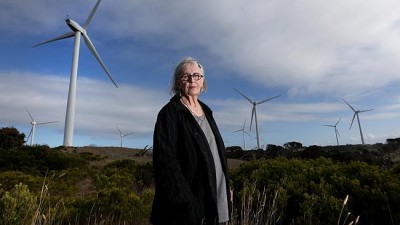
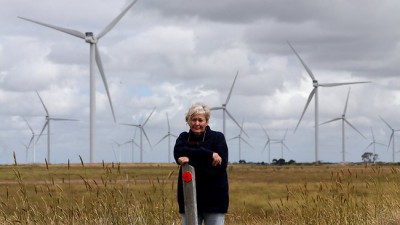
Sonia Trist near wind turbines behind her property at Cape Bridgewater in Victoria’s southwest. Picture: David Geraghty Source: News Corp Australia

****

Sonia Trist had her beautiful seaside home stolen by union super fund backed, Pacific Hydro – aided and abetted by the Federal government’s mandatory Renewable Energy Target:

‘Silly’ Sarah Henderson joins ‘Disappointing’ Dan Tehan, as another ‘Green’ in Conservative Clothing

Jan Hetherington and Annie Gardner have the misfortune of trying to live next door to AGL’s Macarthur wind farm disaster; suffering the daily onslaught of incessant turbine generated low-frequency noise and infrasound from 140 3MW, Vestas V112s.

In modern times, we’re told that the internet is all; when it comes to spreading news and telling peoples’ stories. However, take your time to listen to this little broadcast which demonstrates that – in the hands of a master – radio has lost none of its awesome power to convey human dignity, grace, strength and suffering. STT commends it as one very powerful piece of media.

Alan Jones AO: Well the final report of the latest Senate inquiry into wind farms has been tabled in the Parliament. It’s urged that the Parliament should draw up National rules restricting how wind farms are built and operated and punish States that don’t accept them.

The final report, published yesterday evening by the Senate Committee in wind farms puts forward a range of measures to curb them, including recommendations to reduce support for projects under the National Renewable Energy Target. The report recommended subsidies to new wind farms be limited to 5 years rather than the current period of 20 years.

This is ridiculous isn’t it? Subsidies to wind farms. There are mechanics, and bakers and taxi owners and hire car owners all listening to me this morning-businesses everywhere listening to this program – they don’t get any subsidies at all. Why should foreign-owned wind farms get 2 cents?

But the Clean Energy Council, wind energy’s peak body says ‘limiting wind farm subsidies to 5 years will destroy the future of the industry’. How can an outfit make any sort of claim to commercial viability if its unable to survive without 20 years of subsidies? And a government, which is operating on borrowed money?

Amid the recommendations is a proposal that an independent scientific panel be established which would have the power to block new projects being registered by the government, if it believed human health was at risk. The panel would help draw up “National wind farm guidelines” which the Federal government would introduce and ask State governments to adopt. The guidelines will include – and this by the way is just the Senate Committee’s recommendation- would include National standards on wind farms for infrasound, vibrations, air craft safety, indigenous heritage, birds and bats, shadow flicker, fire risk, electromagnetic interference and blade glint, amongst other things. Remember amazingly wind farms are currently approved and none of these receive any consideration.

The committee recommends that if a State government didn’t accept the new National measure for infrasound and low frequency noise, the Committee recommends that wind projects built in those States should not get Renewable Energy Certificates, that is, money. Yours. Unbelievable. Money – which subsidises these wind farms.

But cop this, this is the ultimate kick in the guts from Canberra. A spokesman for the Environment Minister Greg Hunt said ‘The government had no plans to make further changes to the Renewable Energy Target’. In other words the Senate committee all party committee can get stuffed. In one hit the recommendation seemed to be ruled out. Shouldn’t be available if they’re operated in States which don’t comply with new National noise rules. Remember noise guidelines are a State issue and a number of States refuse to agree to a National noise standard at the last COAG Meeting. Believe me, this renewable energy stuff is money down the drain. The cost of it with subsidies is exorbitant and you’ll pay by your electricity bills or if you’re a business, via your energy costs. And without subsidies this whole industry is not viable.

Yes it’d be nice to have clean quiet cheap energy, a bulk supply of it – everyone would love that, but the reality is that it doesn’t exist. There are wind and solar generators being built all over the world and they only add a small amount to the overall power demand and this is all because of a problem with carbon dioxide. And this is all happening because there’s a Paris conference coming up. And you know the story about carbon dioxide the amount of CO2 in the  atmosphere is 0.04% of all gases. 97% of of that 0.04 of a percent, is naturally occurring. You can’t effect it. Only 3% of it, 0.04 of a percent is caused by human activity. And we, Australia, are responsible for 1% of that 3%. What are we doing? Spending billions of dollars and Bill Shorten says well we’ll have 50% renewable energy, 50% by 2030. Utterly unaffordable, impossible to implement.

And Tony Abbott said when he became Prime Minister he wasn’t going to be chasing Holden up the road with a blank cheque. Why are we chasing foreign owned wind turbine companies up the road with a blank cheque?

Now the problem here is we’ve got ground-breaking research from Germany on low frequency infrasound which concludes that ‘exposure to infrasound below the range of hearing stimulates parts of the brain that warn of danger’. German research. Only a couple of months old. That human beings can ‘hear sounds lower than had been assumed and the mechanisms of sound perception are much more complex than previously thought’. Scientists in Japan have measured brain function and reported last year – it showed the brains of Japanese wind turbine workers could not achieve a relaxed state.  In Tehran a study of 45 people, found that despite all the ‘good benefits’ of wind turbines, it can be stated, this technology has health risks. The German project leader, Christian Cox said, ‘it’s been agreed that infrasound is perceived by human beings and it represents an unknown hazard to human health’.

Well, the people who complain to me in droves are fools, idiots and ignored. Thank God they’re women because women don’t take no for an answer. I’ve got women here who have suffered. Sonia Trist is on the line – Sonia good morning.

Sonia Trist: Good morning Alan.

Alan Jones AO: So you are 620m wind farms from your kitchen window.

Sonia Trist: From my closest wind turbine, yes.

Alan Jones AO: And your Federal member is this Dan Tehan – who is nowhere to be seen.

Sonia Trist: Dan Tehan, nowhere to be seen.

Alan Jones AO: You’ve written to him, no answers.

Sonia Trist: Repeatedly, yes.

Alan Jones AO: Repeatedly. And this Pacific Hydro mob are at Cape Bridgewater, they’ve got 29 wind generators.

Sonia Trist: They certainly have, yes.

Alan Jones AO: And it impacts on you in disturbing and harmful ways.

Sonia Trist: Most certainly, most certainly, extremely disturbing.

Alan Jones AO: But you’re just a dumb complainant.

Sonia Trist: Well, I think one thing that you learn Alan, when you lived near these things for a while, If you can possibly, possibly keep breathing, you don’t give up. And you were saying, you sort of cast a shadow on the possibility of the Senator’s recommendations getting through, well I’ve learned to look at it a different way, I think they’ve opened the window to – they’ve revealed so much, that worked so hard, they’ve open the window to the next step that we have to take, this is a journey.

Alan Jones AO: Sonia, you said something very significant, she wrote to me Sonia, and she said, ‘subsequent generations won’t march in our memory – surrounded by fields of concrete, cabling, collapsed towers and fragmenting fibreglass blades we’ve created layers of industrial graffiti across rural Australia. What a monument to progress in a young country’.

Just hang on Sonia, I’ve got Jan Hetherington on the line. Jan Good morning.

Jan Hetherington

****

Jan Hetherington: Oh hello Alan.

Alan Jones AO: You’ve suffered a range of ailments, haven’t you?

Jan Hetherington: I have yes, I have.

Alan Jones AO:  No one wants to listen to you.

Jan Hetherington: No, nobody wants to listen to me.

Alan Jones AO: You paid $10,000 for testing in your own home.

Jan Hetherington: I did, yes, yes.

Alan Jones AO:  You wake up 4-5 times a night.

Jan Hetherington: Yes, yes.

Alan Jones AO: You wake up with vibrations in your body and your eyes are wobbly.

Jan Hetherington: Yes, yes.

Alan Jones AO: You said the impact on human physiology from low frequency noise has been known for over 50 years.

Jan Hetherington: That’s right.

Alan Jones AO: And you’ve reported to authorities all these studies.

Jan Hetherington: Yes.

Alan Jones AO: And that they have frequent noise and infrasound creates nausea. You’ve talked about vertigo-like symptoms.

Jan Hetherington: Yes.

Alan Jones AO: No one wants to know.

Jan Hetherington: No, nobody does.

Alan Jones AO: AGL are the people that you have been dealing with – they ignore you.

Jan Hetherington: Yes, they do. I send in many, many complaints and I …

Alan Jones AO:  In fact you’ve written to them, you’ve written to all senators and all Federal MPs.

Jan Hetherington: That’s right. and I don’t hear from a lot of them. There’s only the, well only about 4 or 5 that are interested in it – and Senator Madigan and Leyonhjelm and Senator Back and what have you – they are interested. Our local member Dan Tehan, couldn’t ..

Alan Jones AO: Unbelievable this bloke, this bloke Tehan.

Jan Hetherington: He couldn’t care less.

Alan Jones AO: You said to said to me early this morning ‘you woke up at 4.35 with a very sharp ice pick stabbing on the top of my head.

Jan Hetherington: Oh yes.

Alan Jones AO: … behind my right ear.

Jan Hetherington: Yes

Alan Jones AO: ‘This was followed by vibration running through my body, then came the headache in my right temple and right eye. I just had to get out of bed. Unfortunately there’s no running away from this infrasound. Nothing can stop it’.

Jan Hetherington: That’s right, that’s right, it is terrible … oh it’s hard to talk about it because it’s so,  it’s so real, it happens.

Alan Jones AO: I know Jan. I know. Jan has written to me and said ‘I am sick of living like this. This is not what I intended for my future. It was to live my life in peace on my farm and enjoy the natural beauty of the landscape,  not to live in fear for my health and well-being. It’d be nice to think that just one of you reads this and thinks, yes there is a problem and decides to do the right thing by the residents suffering at the hands of the Macarthur wind factory’.

Jan Hetherington: That’s right, that’s right. I just wish somebody would do something. Sorry Alan.

Alan Jones AO: Jan, you hang on – we’re here. But just hang on there, ‘cos I’ve got Annie Gardner. Who’s, well this women is built of concrete and granite. Annie, good morning. You’ve written to everybody.

Annie Gardner: Good morning Alan, yes I do, and I keep doing it in the hope that one day somebody might do something.

Alan Jones AO: Including the ABC and now they no longer accept your emails.

Annie Gardner: Yes that’s been going on since the start of the year Alan. I have a group of journalists, probably about 20, on my complaint list and every time I send complaints to everybody, it bounces back undeliverable. But in actual fact, it’s not just those journalists. I tried someone in the ABC I’d met years ago, which wasn’t on this list, and it bounced back too. I’ve written to the Chairman of the ABC over five weeks ago I think, and still haven’t had any reply from my request.

Alan Jones AO: No, No answer, no answer from those members. And I have spoken to Annie before because this destroyed your ultra-fine merino wool growing enterprise – the sheep simply couldn’t produce in this environment. You’ve written to me to say ‘we suffer badly from infrasound emitted by the turbines in the form of headaches, severe nose pressure, excruciating ear pain, nausea, chest burning, just to mention a few. As a result from being hammered by infrasound, we’re unable to sleep at night. We’re forced to leave our home and property for at least 2 nights a week just to get some sleep’. I mean, how – you wrote that Annabel Crabb on the ABC described you on the Robyn Williams science show, you people who complain about health impacts are ‘dick brains’.

Annie Gardner: That’s correct, she did and I wrote to her, actually inviting her to come and visit us and realise that we’re not necessarily dick brains, we’re actually, some of us are quite intelligent people, if we weren’t, we would have lost our farms years ago because of, you know, unfortunate financial …

Alan Jones AO: But you can’t get local government, or anybody, politicians. And you’ve said and Jan says, and poor Jan can’t even talk about it. There are people who wake up in the early hours suffering from vibrations and dizziness caused by giant wind energy plants and Macarthur, the one you’re exposed to, is the largest of its kind in the Southern hemisphere.

Annie Gardner: That’s correct Alan.

Alan Jones AO: And a farmer, Ron Gelbart said he regularly had to leave his home to sleep in Hamilton. ‘Something is there and we can’t understand but we can not live with’. I mean everywhere, people are writing and telling these stories and Parliamentarians won’t listen.

Annie Gardner: No. That’s correct Alan, not many of them, except for the good Senators.

Alan Jones AO:  Well David Leyonhjelm is but now we’ve got the statement by Greg Hunt’s spokesperson saying we’re not changing anything about the Renewable Energy Target. Just stay there Annie, a quick word, because we are beaten for time. Jan –  just come back to Jan,

Jan Hetherington: Yes

Alan Jones AO:  I just hope…it makes you just a bit better that we do care.

Jan Hetherington: Thank you, at least somebody does. And I’m sorry – I just get emotional.

Alan Jones AO: Don’t apologise. Don’t apologise. These people should be made to live in the circumstances you are enduring.

Jan Hetherington: Well we’ve invited so many people to come and stay with us but nobody will take the offer up.

Alan Jones AO: Invited them … no one comes, no one comes. Sonia, Just to say goodbye to you and keep in touch.

Sonia Trist:  Alan – thank you very much.

Alan Jones AO: Keep in touch.

Sonia Trist:  I certainly will.

Alan Jones AO: You let me know when you write letters to these people and they refuse to answer. You let me know.

Sonia Trist:  I certainly will, and thanks for your work Alan, bye.

Alan Jones AO: Not at all, and Annie, hang in we talk everyday. This is disgraceful, we’ll get somewhere.

Annie Gardner: Thank you very much Alan for your help, we certainly appreciate it.

Alan Jones AO:  Not at all. And we will be looking at this issue again tonight with Riccho and Jones, it’s an absolute national disgrace.

Annie Gardner

That wonderful women like these are reduced to tears on national radio is nothing short of a complete disgrace; that they are left to plead to our political betters through the media, for an end to the misery that they – and hundreds of others like them – have been forced to endure at the hands of an industry that treats all and sundry with callous disregard, is a moral and political outrage.

Not content with that stand-out piece of radio journalism, Alan followed it up that night on Sky, with an equally brilliant effort. This time interviewing Senator David Leyonhjelm about the Senate’s recommendations; and bringing Annie Gardner into the Sky News studio for a reprise of her morning’s efforts on 2GB – only for Annie to excel as a voice for those set upon by an industry and its political backers – all of whom stand shorn of any trace of human empathy or compassion.

****

****

david leyonhjelm

One Man’s Tale, About the “Renewables Scheme”, and the Ultimate Consequences…

A Simple Tale About Switching To Renewable Power: Requirements & Consequences.

A comparison of coal, nuclear, combined cycle gas turbines, and wind power for the morning of Friday August 7th. 2015 Source: http://www.gridwatch.templar.co.uk/


Don Bogard,

The tale below is fictional, but every one of its elements and issues has been or will be experienced somewhere in the process of switching electrical power production from fossil fuels to renewable wind and solar. Hopefully this tale will illustrate in a non-technical way some of these complications and potential issues that can and often will arise. My reference to “city” and “government” and “city fathers” are generic and could apply to different entities and scales.

Visualize a medium-size city with two very functional electrical power plants, each producing 500 Mega-watts of electricity, with one fueled by coal and one by natural gas. (About 2/3 of U.S. power is produced from these two sources.) The government decrees that this city must reduce its CO2 emissions. The city fathers decide to retire their coal-fired plant because it generates more CO2 and replace it with 350, General Electric (G.E.) 1.5 Mega-watt wind towers (total rated capacity 525 M-watt). The entire city celebrates over their good fortune in moving into a modern era of green energy. The mood is jovial.

The city planning begins. Each of these G.E. wind towers consists of 116-ft blades atop a 212-ft tower for a total height of 328 feet, and the blades sweep an area just under an acre. Each tower weighs 164 tons and is mounted on 1,000 tons of concrete and steel rebar and must be outfitted with flashing red lights.

City Problem #1. These 350 wind towers are expensive, about $2 million each. Luckily the government will subsidize most of the cost (paid by taxpayers elsewhere).

City Problem #2. Whereas the coal plant occupies fewer than 20 acres, each GE 1.5-megawatt turbine requires a minimum of 32 acres and needs 82 unobstructed acres in order to optimally utilize wind from any direction. This is a total of 28,700 acres, or about 45 square miles of land. That much space is way too expensive to purchase, so the city fathers convince the county and state to fund subsidizes to surrounding farms to host such towers, or decree eminent domain to force their location on unwilling farmers.

City problem #3. The coal plant was located close to town. To service these new wind towers new expensive access roads and power transmission lines must be funded and constructed.

Some grumbling begins, mainly among those whose farms were forced to accept the towers, among coal plant workers who are soon to be fired, and among those long range planners of future city budgets.
The wind towers are finally constructed and tied into the city power grid.

City Problem #4. Before the coal plant is retired, which operated 24/7/365, the city planners realize that the wind does not always blow. Further, even when it does blow, it often does not blow enough, and at these times the wind towers generate less than their rated electrical output. Often some towers will be out for maintenance.
The city fathers decide to keep the coal power plant in operation (after all, it was paid for) and only use it as back-up power for when the wind does not blow.

City Problem #5. It is discovered that when the coal plant must be fired up to replace wind power that has suddenly diminished, it cannot come to power quickly enough to prevent brown-outs (voltage drops), even an occasional black-out (no power). Further, these times of rapid cooling and heating of the boilers are degrading them much faster than when they operated continuously.
Citizen grumbling increases over the power issues they individually are experiencing.

The city fathers decide to build another gas-fired plant to replace the coal plant.
Grumbling increases among city dwellers over the increased taxes and electricity costs required to pay for the second gas plant. For the first time in many years, serious challengers arise in the upcoming city council election.

The second gas plant is constructed. One gas plant operates continuously, and the second plant operates in a near idle mode (but still burning some gas and producing CO2) so that it can be rapidly fired up when the wind dies. Keeping both gas plants operating, even at lower level for one, is more expensive than expected, but now they offer adequate back-up for when the wind-towers generate too little power.
Some city citizens forget that they are now paying sizably higher electricity bills and are happy that their CO2 production is now somewhat lower than originally. But many other citizens grumble and discuss recall elections.

Time passes. The city grows and needs more power. Further, the government gives a new decree to lower CO2 emissions even more. The city fathers decide to construct more wind towers. The reasoning is threefold: a) adequate power would still be available when the wind blew only lightly; b) extra power generated by wind could be sold to the surrounding cities; and c) the city’s gas plants would not have to operate as often, thus lowering CO2 generation. The plan sounded reasonable to city council.

City Problem #6. Large citizen protests erupt. The city mayor and two city council members are recalled. Yet under demands from the government, the new city government barely convinces the annoyed citizens to proceed. Active animosity develops between those who support this rapid move to renewable energy and those who do not.

City Problem #7. With the prospect of large flows of energy among various cities, extra and expensive long-distance transmission lines must be constructed.

The city goes even much more heavily into debt and several hundred extra wind towers are constructed. Counting total power capability from two gas plants and many hundreds of wind towers, the total potential power production is much more than twice what the original power capability was, although the city has only grown by 20%.

City Problem #8. The city is now sharply divided over this issue. The “green” citizens emphasize the good that wind power is doing in reducing CO2 emission and think that good justifies the many extra costs. Financially practical citizens complain that city electricity costs are now much higher than before, that much more open land is being compromised, and that the wind towers are noisy and unsightly, whereas CO2 emissions have only modestly been reduced.
The city fathers argue than the extra wind power produced by the new turbines can be sold to ally some of their costs.

City Problem #9. However, when the wind blows hard and extra wind power is produced, the city fathers discover that surrounding cities, which by now also have converted heavily to wind power, often also have too much wind power and are not in the market for any more. The city cannot sell its unused power, and having no way to store the extra power, must simply “dump” it unused. City fathers also realize that sometimes the wind quits blowing not just over a local region, but over a very widespread one. In these cases most or all of the local cities produce too little total power, and regional brown-outs develop.

The city fathers have a new idea — develop solar energy. Often the Sun shines when the wind does not blow and the wind often blows at night. But the city citizens would never permit a huge central solar power facility, and there is no suitable place to locate such a facility. But, the city fathers learn that the government heavily subsidizes PV-solar equipment for individual homes and businesses. The city fathers again decide to utilize government subsidizes paid for by others elsewhere. The city fathers appeal to the “green” citizens to use some of their funds along with the government subsidies to install PV-solar systems on their roofs. To give further enticements, the city fathers decree that the city electrical power company must purchase at full retail prices all excess solar power than these “green” citizens may produce. Many “green” citizens comply and a few hundred extra M-watts of solar power becomes available.

City Problem #10. However, the city fathers soon discover that when the Sun is brightly shinning, these PV-solar panels feed so much solar power into the grid that sometimes either the gas-fired plants or some wind towers must be curtailed in their power production. This produces further complications in keeping power fed into the local grid precisely in balance with the local and total power demand, as it must be if equipment damages are to be avoided. The city power company strongly complains about the new problems it has been handed.

City Problem #11. Further, the city power company discovers that on sunny days, it is buying so much solar power at retail prices, that it must raise power rates to those customers who do not have PV-solar grids.
Citizen complaints about power costs increase. Some prospective new industries with sizeable power demands decide to locate elsewhere.

Surrounding cities, which have also encouraged rooftop PV systems, find themselves with similar problems.
The city finds itself in a catch-22 situation. Both producing too much power and too little power, both at significantly increased prices, have negative and unintended consequences.

MORAL OF THE TALE. Conversion of electrical power generation from fossil fuels to renewable wind and solar is a process that can readily be both quite expensive and filled with unexpected negative consequences. For governments to rush into such a transfer too quickly or without a fully thought out a plan may be a recipe for higher electricity costs, customer dissatisfaction, social disruption, and ultimate political consequences.

Games the Windpushers Play…. Rural residents are always on the losing end. It’s Universal!

Falmouth Wind 1 Turbine : Corruption Speaks Out

Falmouth has to face some facts. Those facts are corruption and its not hard to figure it out !

Falmouth Wind 1 Turbine : Corruption Speaks Out

Falmouth Wind 1: Corruption Speaks Out

Falmouth Flushing Taxpayer Dollars Down The Toilet

The Town of Falmouth is wasting money on its commercial wind turbines

You have to ask how do people sit back and allow politicians to flush our money down the toilet ?

The average citizen is always trying to make ends meet. If Jill or Joe citizen waste or lose money, they feel it in their wallet.

It is clear and obvious – corruption is a huge problem, through corruption we are wasting billions and billions of our taxpayer’s money .

Falmouth has to face some facts. Those facts are corruption and its not hard to figure it out !

The town was warned prior to any installations of wind turbines that the Vestas wind turbine known as Falmout Wind 1 generated 110 decibels of noise almost twice the manufacturers specifications. That warning meant the turbine would break state noise regulations. The end result was the courts shut down the turbines because they broke state noise laws. Everyone always knew they would !

The Massachusetts Clean Energy Center in April 2013 gave a memo to the Town of Falmouth admitting they made mistakes in noise studies prior to the installation of the wind turbines. The Massachusetts Clean Energy Center knew well before the installations because they had owned the turbine for several years being held in storage for over $3300.00 a month for several years. They couldn’t sell the turbine even at auction. The turbine was a political embarrassment. They had to dump it on someone.

The Massachusetts Clean Energy Center offered the Town of Falmouth a one million dollar bribe to take the embarrassing old turbine held in storage off their hands as it was becoming a political embarrassment.

In Massachusetts this is called ( One Hand Washes the Other ). Everyone involved with Falmouth Wind 1 knew prior to the installation the turbine generated 110 decibels of noise almost double the specifications. The Falmouth turbine is a Vestas V-82 1.65 megawatt wind turbine. Vestas wind company had just bought out another company,Neg Micon, prior to the Massachusetts Clean Energy Center making the purchase. Falmouth Wind 1 is actually a Neg Micon NM- 82 1.65 megawatt turbine. A turbine that generates 110 decibels of noise.

In order to sell the Falmouth Wind 1 turbine to Falmouth the Massachusetts Clean Energy Center had to get a good noise test to install the turbine in Falmouth. That was simple they made what they call “mistakes” in the noise tests and then admit a few years later after the installation in an April 2013 memo to the Town of Falmouth they made a “mistake.”

Along with the memo Nils Bolgen the wind turbine manager at the Massachusetts Clean Energy Center around the same time as the memo in a press release tells the public the Falmouth Wind 1 turbine was installed “Ad Hoc.”

Prior to the Falmouth wind turbine installation the Massachusetts Clean Energy Center was caught making “mistakes” in a 23 page wind turbine study in Mattapoisett. There was at least one mistake on each page that included contradictions between several sections and some cases up to three “mistakes” per page and it wasn’t spelling or punctuation. Nils Bolgen the wind turbine manager at the time blamed the mistakes on engineering students. Highly unlikely knowing what we know today.

The turbines were not installed in Mattapoisett because of a reference to two distinct types of noise. The distinct types of noise were “regulatory: and “human annoyance.” Today we know “human annoyance” is infra sound or low frequency noise.

To this day it has never been explained why the reference to “human annoyance” was dropped from the Falmouth wind study and there was NO warning to the Town of Falmouth or its citizens. Three guesses why they dropped the reference !

The only conclusion is everyone for years before the installation of Falmouth Wind 1 was aware of major noise issues with the Falmouth Wind 1 turbine. The noise issues included regulatory noise violations and human annoyance noise issues today known as infra sound or low frequency noise. The Massachusetts Clean Energy Center in 2005 described “ human annoyance” yet today acts like it doesn’t exist. Aka the Mass Clean Energy Center caught again in a contradiction.

The Falmouth Zoning Board of Appeals thinks the Town of Falmouth acted in good faith avoiding getting a special permit 240-166 prior to the installation of Falmouth Wind 1 ? Where have these people been ? At the beach with their heads buried in the sand ?

The facts speak for themselves. Had Falmouth applied for special permit 240-166 it would have required additional studies and the turbine would never have been installed. A simple fact.

This wind turbine installation is not just a mishap or “mistake.” The hiding of the noise warning from Vestas wind company, the noise study “Mistakes” by the Mass Clean Energy Center, Admission of an Ad Hoc installation, dropping noise warnings in prior studies about “human annoyance” aka infra sound and then the one million dollar bribe to the Town of Falmouth

The judicial branch of government could only conclude one thing ; C-O-R-R-U-P-T-I-O-N

The question of the 6 million dollars in stimulus funds, ARRA, American Recovery and Reinvestment Act of 2009 was the money for Falmouth Wind II a loan or a grant has never been answered.

Today everyone has got something on everyone else. The Massachusetts Clean Energy Center made its “mistakes” the town avoided the special permit 240-166 and they all knew well in advance the turbine was too loud.

Now the Town of Falmouth has the Massachusetts Clean Energy Center over a barrel and made them fork over 1.8 million dollars to help pay the town litigation fees.

Folks– You the taxpayers are financing this bunco scheme. You the taxpayers are being taken for ride of your life.

Please for the sake of humanity wake up this isn’t a dream. They are taking your health, property and your money.

Windweasels and Windpushers….a Nasty Bunch, to say the Least!

Got ‘Mercenary Sociopath’ on your CV? Then why not join the Wind Turbine ‘Taliban’

sociopath

****

The wind industry attracts a very ‘special’ kind of person, as James Delingpole details below.

The SNP has done for Scotland’s landscape what ISIS have done to Palmyra
Breitbart
James Delingpole
23 July 2015

Dear Mr Delingpole,

I am just completing my BA joint honours degree in Candy Crush and Rape Culture studies and wondered whether you could kindly advise me on my career options.

A bit about me: I’m a vicious sociopath looking for an utterly pointless job which pays me vast amounts of money while making the world an uglier place. Though I’ve considered applying to Goldman Sachs and various French arms manufacturers, they strike me as insufficiently evil for my purposes. Ideally this job should have a caring image so that hot chicks want to sleep with me. My skills include lying, puppy factory-farming, and burning ladybirds with a magnifying glass. I appreciate I might sound like a bit of a crazy mixed up kid. But I thought if anyone could solve my problem, it would be you….

Yours, etc

As you can imagine, I get this kind of letter from the younger generation all the time. And up until now I’ve had no hesitation in telling these future masters-of-the-universe where to go:

“Head for Scotland, my son,” I tell them. “And get your snout deep into the wind farm trough. If you have no conscience, no morals, no aesthetic sensibility, no understanding of free markets; if you hate wildlife, people and the natural landscape, if you loathe private property, if you want to show how much you despise the traditions of the nation that once yielded Adam Smith, James Watt, James Boswell, Charles Rennie Mackintosh and the rest, then the Scottish wind industry is undoubtedly the place for you.”

But I think in the light of recent events I may have to reconsider my advice. Obviously the Scottish wind industry remains as evil and pointless as ever it was – and the destruction it has wrought on the landscape of what was formerly one of world’s more strikingly beautiful countries has been truly spectacular.

Only the Taliban at Bamiyan or ISIS at Palmyra can really come close to matching the wind industry’s scorched-earth zeal in places like Scotland, Ontario, Texas, Denmark, Australia and New Zealand.

This map, produced last year by the John Muir Trust, gives a good indication of how impressively these veritable Attilas of aeolian slaughter have done their work.

john_muir_trust_wind_farm_visibility_map

Scotland used to be a remarkably wild, unspoilt place. Not any more, though. There’s now only 40 per cent of Scotland left where wind turbines are not blighting the view. (And already that figure is out of date because lots more turbines have sprung up since like skeletons in Jason of the Argonauts, and many more are planned).

And let’s not forget the human cost: all those Scots whose rural tranquillity and health have been jeopardised by these bat-chomping, bird-slicing, subsidy-troughing eco crucifixes.

Sadly, though, it seems the golden age of renewable rapine may bedrawing to a close. Cameron’s “greenest government ever” has finally decided to call quits on the vast subsidies which have been drawing unscrupulous rent-seeking corporatists to Scotland like sharks to blood. The renewables troughers are shrieking like staked vampires.

WWF Scotland director Lang Banks said the decision risked undermining the development of the cheapest form of renewables in the country, and was “bad news” for Scotland’s clean energy ambitions.

Jeremy Sainsbury, director of Natural Power, a renewables consultancy which employs about 300 people, mainly in Scotland, said the firm has opportunities to deploy its workforce to projects overseas.

But he added: “It’s not very healthy that Westminster has come out with this, which is clearly based on the views of some Tory MPs from middle England without really assessing the impact on investment in jobs in Scotland, or Wales for that matter, and without properly dealing with the implications in relation to the plans of those countries for delivery of their 2020 targets or their environmental commitments.

Scotland’s first minister Nicola Sturgeon isn’t too happy either.

First Minister Nicola Sturgeon said the decision was “wrong headed, perverse and downright outrageous.”

During First Minister’s Questions at Holyrood, she said: “I think it severely undermines any Tory claims to be pro-business.”

She added: “This decision comes despite the UK energy secretary admitting on radio this very morning that onshore wind is one of the most cost-effective ways of developing renewable energy.”

Ms Sturgeon argued that the move would also send out the wrong message ahead of a conference in Paris later this year aimed at getting a new global agreement on climate change.

The Scottish government believes the decision would have a disproportionate impact on Scotland, as about 70% of onshore wind projects in the UK planning system were in the country.

But personally, methinks Lady Macbeth doth protest too much. After all, long after her own name and that of her predecessor Alex Salmond are but distant memories, visitors to the blighted industrial zone formerly known as rural Scotland will be able to view their handywork on every hill top. It will be like the final scene in Spartacus, only with wind turbines instead of crucifixes.

Si monumentum requires, circumspice, eh, Nicola, eh Alex?
Breitbart

Spartacus2

Exposing Another Wind Weasel Lie….

Wind turbine syndrome is not confined to English-speaking countries!

Lilli-Ann Green gives evidence that wind turbines cause adverse health impacts for some people who live nearby in France, Germany, Holland, Denmark and Sweden.

SENATE SELECT COMMITTEE ON WIND TURBINES
Monday, 29 June 2015

Extract from Official Committee Hansard (page 1 to 6):

Lilli-Ann Green
Lilli-Ann Green
(Cape Cod Times/Ron Schloerb)

Ms Green: I am CEO of a healthcare consulting firm with a national reach in the United States. My company works in all sectors of the healthcare industry. One of the core competencies of the firm is to develop educational programs to help doctors, nurses and other healthcare workers better communicate with their patients around various disease states. Currently, as a volunteer in my town, I am secretary of our energy committee and a delegate to the Cape Cod National Seashore Advisory Commission as an alternate. Cape Cod National Seashore is part of the United States National Park Service. In the late 1970s, I built a passive solar superinsulated home. I directed an environmental education school for several years. I work seasonally as a naturalist interpretive ranger for the National Park Service. I have been interested and active in the environmental movement since the early seventies. Today, I speak as a private citizen.

CHAIR (Senator Madigan): Thank you. Could you please confirm that information on parliamentary privilege and the protection of witnesses and evidence has been provided to you?

Ms Green: It has.

CHAIR: Thank you. The committee has your submission and we now invite you to make a brief opening statement and at the conclusion of your remarks, I will invite members of the committee to put questions to you.

Ms Green: Thank you. Until the beginning of 2010, I believed wind turbines were good and green. My town was interested in constructing wind turbines and a friend visited my office in early March 2010 to provide my husband and business partner and me with new information. Following the visit, I spent the next 10 hours researching wind turbines. That very day, after concluding my research, I was saddened but I became convinced there was credible evidence that wind turbines cause adverse health impacts for some people who live nearby. In the past, over five years, I have learned it is a global phenomenon that wind turbines make some people who live nearby sick and it is a dose response so these people become more ill over time.

My husband, who is now deceased, and I travelled to Australia and New Zealand in 2010-11 and subsequently created a film called Pandora’s Pinwheels: The Reality of Living with Wind Turbines. We then travelled around the world in 2012 and conducted interviews in 15 different countries. Most of the people we interviewed expressed that they were in favour of wind energy prior to wind turbine construction nearby. There are some common symptoms people the world over report who live and work too close to wind turbines. A good summary is found in the book Wind Turbine Syndrome: A Report on a Natural Experiment by Nina Pierpont, MD, PhD.

It does not matter whether people live in English-speaking countries or in countries where people do not speak English. People reported to us they are made sick when they live too close to wind turbines, no matter what country they live in. We interviewed people in both English-speaking countries and non-English-speaking countries alike who reported to us they were not ill prior to wind turbine construction nearby and after the wind turbines were operational nearby they were made sick.

We interviewed people in five countries—France, Germany, Holland, Denmark and Sweden—who either needed an interpreter to speak with us or who spoke broken English. Some locations were quite rural with little or no internet connection. Still, the people we interviewed through interpreters expressed the same symptoms, others the world over described to us. These people with no or limited internet connection even used similar phrases, analogies and gestures, as others did globally to describe their symptoms. What we actually found is most people are reluctant to speak about their health problems.

In the United States, there are privacy laws regarding medical information. Culturally, people do not openly discuss their health problems with strangers. We found this to be the case in the countries we visited around the world. It was a brave person who opened up to us about their health problems. Usually, the people we interviewed expressed they wanted to help others. If anything, people tended to minimise their symptoms or try to attribute the symptoms to other circumstances. Even when they acknowledged a common symptom such as sleep deprivation, many people who experienced additional common symptoms were reluctant to attribute these other symptoms to the wind turbines nearby. Furthermore, people the world over reported that they and their healthcare providers puzzled over health problems that appeared after wind turbines were constructed near their homes.

Many endured a huge battery of medical tests to try to determine what the cause of their health problems were. The medical tests, at a huge cost to the healthcare system, only ruled out various diseases. Typically, the cause of their sickness was not diagnosed by their healthcare professional. Frequently, we heard that the patients would be in a social situation with others in their neighbourhood and eventually people they knew well confided they had similar health problems that recently appeared, or after research online about a different topic these people reported stumbling upon the cause of their health problems, which were the wind turbines constructed nearby.

We even interviewed people who lived for 11 years near wind turbines in a non-English speaking country—and that was in 2012. Several people came to an interview to talk about their property devaluation. It was only during the interviews when they heard others speak about health problems that the people realised they had been suffering because they lived too close to wind turbines. One man in his 80s sobbed during his interview. He had been visiting his doctor for 11 years trying to figure out what was wrong with his health.

The woman who invited us to interview her and her neighbours learned about health problems from wind turbines when she saw the film I produced Pandora’s Pinwheels, with interviews conducted in Australia and New Zealand, that was translated into her language. These people needed an interpreter; they did not speak English. She told me that her husband had passed away in the not too distant past due to heart problems. Before he died, he had complained quite frequently of common health symptoms people living near wind turbines experience. Although they visited their doctor frequently, no-one could figure out why he was so sick. She thanked us because, in seeing our film, it helped her to understand what her husband had been going through and why. It gave her closure that she did not have prior to viewing our film.

Another person at the interview told us she had to hold on to the walls of her house some days in order to walk from room to room and felt nauseous frequently. She knew she was unwell in her home and abandoned it. She did not know why until she saw our film. She came back to the area for the interview because she wanted to tell the world that wind turbines made her so ill that she sold her home at a huge loss.

One of the people I have known for the past five years lives in Falmouth, Massachusetts, which is very close to where I live—it is an hour and a half away. In 2010, he had recently retired to his dream home of many years. He was in great physical health, very fit and has over a 20-year record of normal to low to blood pressure. Since the wind turbines have been constructed in Falmouth, Massachusetts, he has reported that his blood pressure skyrockets to heart attack and stroke levels when the wind is coming in the wrong direction for him.

In Falmouth there are three wind turbines that are 1.65 megawatts near this person’s home. This person’s doctor, whom he has seen over the past 20 years, is in the Boston area and his doctor has been quite blunt. The doctor has told the patient that his life is in danger and he must move. Unfortunately, the Falmouth resident is crushed and cannot bear to leave his dream home at this point in time. He goes to other locations when the wind is predicted to be coming from the wrong direction. Others we interviewed in many different countries told us similar stories. Many reported they have abandoned their homes, sold their homes at a huge loss, purchased other homes to live in when the wind is coming from the wrong direction or in order to sleep in, and others spend time away from their homes at a huge and unexpected expense. People considered their homes as sanctuaries prior to the construction of wind turbines nearby. Now their opinion is not the same.

We have interviewed people on three continents who live more than five miles from the nearest wind turbine and are sick since wind turbine construction. I contend that we need honest research to determine how far wind turbines need to be sited from people in order to do no harm. People report to us that over time their symptoms become more severe. Many report not experiencing ill effects for some time following wind turbine construction, meanwhile their spouse became ill the day the wind turbines nearby became operational. They speak of thinking they were one of the lucky ones at first, but after a number of months or years they become as ill as their spouse. Not one person who stayed near wind turbines reported to us that they got used to it or got better; they all became more ill over time.

Since we are dealing with a dose response, we do not know over the projected lifetime of a wind turbine—say, 20 to 25 years—how far from people it is necessary to site wind turbines. To me, it is just wrong to knowingly harm the health and safety of people. There are responsible solutions to environmental issues that do not impact the health and safety of people nearby. Our humanity is in question when we continue to knowingly harm others. I thank you for your time today. I sincerely hope that you do take active steps to help the people in your country who are suffering due to living and working too close to wind turbines, and I am glad to answer questions you may have.

CHAIR: Thank you.

Senator LEYONHJELM: Good morning, Ms Green—I suppose it is not morning there. Thank you for your submission—

Ms Green: No, it is Sunday evening here.

Senator LEYONHJELM: Sunday evening? I am sorry to being interrupting your evening.

Ms Green: I am glad to speak with you.

Senator LEYONHJELM: You have interviewed people in 15 countries, I think you said, under all different circumstances and so on. I appreciate we are not pretending this is a gold-plated, statistical survey, but I am interested in your impressions because I think you have more experience of this than any other witness we have heard from. What do you think, based on your experience, are the common factors in the people you have interviewed in different communities living near wind turbines? What are the common factors to all of them?

Ms Green: I think we seriously do not have enough research to understand this problem fully. We saw the same symptoms. Slide 17 that I submitted has a listing of the common symptoms that Dr Pierpont lists in her book. I really believe that we just do not have enough information yet. But throughout the interviews, country by country, people described the same symptoms. Many times they used the same phrases to describe them and the same gestures—even if they were not speaking English. There is a common thread here.

Senator LEYONHJELM: Do you get the impression that not everybody exposed to wind turbines is affected the same? Have you seen evidence of substantial individual variation?

Ms Green: I have, indeed. Just as some people are more prone to asthma and some people are more prone to lung cancer, let’s say, or any disease, we did see a variation. It appeared that if there were people who were, say, prone to migraine headaches, they were severely affected. But, again, there were people who did not seem to have the symptoms who were living either in the same house or nearby. I do not know whether it is a question of time, if over 20 years people become more sensitised and they will become sick. Very frequently we did hear the same theme running through the stories of the people we interviewed, where, say, the husband thought he was one of the lucky ones and six months later he could not sleep, he was experiencing ear pressure, ear pain and severe headaches or other symptoms.

Senator LEYONHJELM: We are aware of community groups in English-speaking countries who have expressed opposition to wind turbines, but we are not aware of that sort of phenomenon in non-English speaking countries. Have you encountered that?

Ms Green: Yes, indeed. We travelled around the world. It was a 10-year goal. We had it very well planned out and we thought it was for pleasure. But people kept emailing us and asking us to come and interview them. So we met people in a lot of non-English speaking countries, and they were such nice people, I have to say. They had just about any profession you would like to mention. They just wanted to tell their story. Many times these people wanted to talk to us for other reasons such as their house had been devalued because the wind turbines were nearby. As they were listening to other people in the room talking about their health problems, these people realised that they had been struggling with the same illness since the wind turbines were constructed nearby. They had never made that correlation before; in fact, they were quite frustrated. They told us that they would go back and back continually to their healthcare provider and talk about these symptoms, and they could not find a resolution or a reason. As I said, there is one man I recall quite vividly just sobbing—and that was in 2012; he was in his 80s. He had realised that since the wind turbines had been constructed nearby he was experiencing these symptoms that were the common symptoms.

Senator LEYONHJELM: Some witnesses have suggested to us that there is a relationship between not only the distance their residence is from the turbine but also the power of the turbine, the size of the turbine. Have you been able to come to any conclusions on that or is that outside your interest area?

Ms Green: No, it is not outside my interest area. In fact, it is quite alarming to me, because I have interviewed people who live near wind turbines that you in Australia would probably consider to be quite small and solitary—wind turbines that are 100 kilowatts, even—and they are experiencing health problems, even people living near a 10-kilowatt wind turbine. Frankly, it is the nearest wind turbine to where I live, and a number of neighbours are having problems, and not just with the audible noise but with the infrasound and low-frequency noise, based upon the symptoms they are reporting to me. It really is quite alarming. In my state, Massachusetts, there is a woman who has told me she lives more than five miles from the nearest wind turbine and she is quite ill. The onset of her symptoms was when the wind turbine was constructed. When she went on trips she was fine; when she came back she was ill, and it has only become worse over time. That wind turbine is not as powerful as wind turbines in Australia, and it is a solitary wind turbine.

Again, we travelled quite a distance in France—mid-south-eastern France—over a number of days at the invitation of the people in the area and visited several different communities where there were wind turbines. One of the situations is that the wind turbine is 10 kilometres from one of the neighbours who is very ill and 12 kilometres from the other neighbour. The person who lives 12 kilometres away reported to us that she had been very supportive of the wind turbines. She is very well known as an environmentalist in the area, has quite a reputation as an environmentalist and is highly regarded. But she is quite ill, and it was very difficult for her to speak with us.

The other person related a story of trying to detect what the problem was because he could not sleep and was becoming so frustrated that he would go in his car to try to find the source of what was keeping him awake. He talked about going night after night until he went into the wilderness. He could not imagine what was there, and then he found the wind turbines. They were creating a humming noise in his head at that point. He could actually hear this frequency. In our discussions with researchers, medical professionals and scientists, one of the scientists told us that what people hear is mostly a bell curve—that is the way it was described to us. Most people hear audible noise within a certain range, but there are people who are more sensitive to noise, and they hear sounds that most people would consider inaudible.

Senator URQUHART: I have a lot of questions. I am not going to get through them all, so I am wondering whether you are able to take some on notice at the end.

Ms Green: I will try. I am very busy, but I will try.

Senator URQUHART: In your submission you say you run a healthcare consultancy. Do you have any qualifications in health care or medicine?

Ms Green: I have a background in education.

Senator URQUHART: What is the name of your company?

Ms Green: I do not want that on the record.

Senator URQUHART: Can I ask why?

Ms Green: I am speaking today as a private citizen. I would be glad to give you that information if it is held as in-confidence.

Senator URQUHART: Okay. How many employees do you have?

Ms Green: My husband has passed away. He was my business partner, and I have scaled back the business. I am the only employee at this point in time. However, I will tell you that I have created in our company, with teams of people, educational programs that have been implemented throughout the United States. One of the oncology programs that was created by my team, which was quite a large team, interviewed over 100 oncology patients throughout the United States and numerous doctors and nurses and was mandatory for all of the oncology nurses in the Kaiser health system in California.

Senator URQUHART: In your submission you say that 300,000 physicians and healthcare professionals have undertaken training through your company.

Ms Green: That is correct.

Senator URQUHART: What are the products or services? Is it communication? What is it that you actually sell?

Ms Green: There is a number of different core competencies in our company. One is developing educational programs around different disease states, such as oncology, diabetes, heart disease and various other disease states. Another path we have taken is to develop a service quality initiative. My husband was an extraordinary speaker and was often the keynote speaker for national conferences in all sectors of the healthcare industry.

Senator URQUHART: In your opening statement you talked about how you had interviewed many people from various countries. I could not find any of the transcripts, either in your submission or online. I am sorry if I have missed them.

Ms Green: You have not missed them. In the company we are still in the process of editing the films. It was a huge undertaking of many months, at huge expense. There is a lot of information that is still being edited.

Senator URQUHART: Are you able to provide copies of the transcripts and the full names of the people you interviewed?

Ms Green: No. It is on film; it is videotaped interviews, and the film is being edited.

Senator URQUHART: You talked about how you undertook the research after you had new information from people within your area who were concerned about wind farms. Was that the purpose of the interviews?

Ms Green: No. In my town, one month after we learned that our energy committee wanted to put one 1.65 wind turbine in our town—and we had conducted the research and people in our town were quite concerned—our board of selectmen, which is like your town councils, decided to not move forward with the project. I am now on my energy committee, as secretary, and we are devising a plan to become 100 per cent electrical energy efficient without wind energy but using other alternative methods. Are you asking me what propels me to do the interviews?

Senator URQUHART: Yes. I guess my real reasoning was whether the purpose of the interviews was to inform the body of research on international attitudes to wind farms. Is that why—

Ms Green: No. It is not an attitude; it is to understand the realities of living near wind turbines—living, working, attending school, being incarcerated near wind turbines.

What happened was that my stepson was living in Australia and we went to Australia at the end of 2010. I knew there was a location called Waubra and I had seen the Dean report that had been recently published. I put out one little email asking ‘We will be in the Melbourne area and is it possible to meet some of the people that are living near the wind turbines at Waubra? Is it possible to see the Waubra area?’

It was amazing that I was connected with the people in that area of Australia. My husband and I drove to the area and we interviewed over 17 people in one day. They welcomed us into their homes. We did not know what to expect. We turned the camera on and we asked them questions, and they told us their story. We had no idea what we were going to find. We went to New Zealand and people emailed us after they had heard we had been to Waubra. They asked us if we would come and visit them and interview them. We did that in two different locations in New Zealand. When we came home we put together this film called Pandora’s Pinwheels

Senator URQUHART: You interviewed people—

Ms Green: During our 2012 travels we just thought we would go back to Waubra and talk to the people at Waubra because we had been emailing them over the year. But people around the world kept on emailing us and asking us to come and interview them.

Senator URQUHART: So you conducted interviews in 15 countries, as I understand it from your submission. Is that how you got the contact information on the people you interviewed?

Ms Green: I do not understand your question. Everywhere we were travelling people kept on emailing us and contacting us and asking if we would come and interview them and talk with them. They wanted to go on camera and tell their story. We had no agenda; we had no plan. We work in the healthcare industry; we talk about various illnesses and disease states, and we educate doctors and nurses about disease states. I am sorry; I want to retract that: we find a cross-section where patients are having issues with the communication around their disease state, and the doctors and nurses are having issues around communicating with their patients. We find those intersections and help doctors and nurses better communicate with the patients. So we are trying to improve patient care. That is what we do as one of the core competencies of our business.

When we found the health problems with the wind turbines and when we saw in every country we visited that people were saying the same thing, we wanted to get that word out to people like you who are hearing from your constituents that they are having health problems. That is all I want to do—to provide you with the truth.

Senator DAY: Ms Green, as you might imagine, we have received submissions from hundreds of people who have reported adverse health impacts and yet we are being accused of trying to destroy the wind industry. We are being accused of rigging this inquiry and of being engaged in a political stitch up. What has been your experience with such hostility towards genuine inquiry?

Ms Green: I really do not have a response for you, Senator. I have heard a lot of stories from people and I have experiences myself, but I really do not have a response on that topic.

Senator DAY: Okay. I will follow up then: you say that a number of governments around the world are realising there is a need for more or better regulation surrounding the wind energy industry. Which governments are doing better in this area, in your opinion?

Ms Green: I know that in my state, I have a new governor and my governor has a background in health care, and I am expecting that my governor understands that people do have health problems when they live and work too close to wind turbines in my state.

Senator BACK: Ms Green, I have just one quick question; I know that we are over time. In Australia, we are proceeding to have independent medical research undertaken for the first time. One of the proposals put to us is that they try and simulate this effect of either noise or infrasound, and do so in a one-off exposure in a clinically sterile circumstance for exposure times of somewhere between 10 to 30 minutes and an hour. From what you have learned and heard—and from interviewing people—do you think there would be anything to be learned in exposing somebody for a very limited period of time, and once only, in a sort of laboratory-type circumstance? Do you believe that is likely to lead to any reasonable outcome or result that we might be able to use?

Ms Green: Senator, I am not a researcher or a doctor. But given what I have heard from people and what people have reported to me, I find it highly unlikely that that would have any results that would have any validity.

Senator BACK: Thank you.

CHAIR: Thank you for evidence today to the committee, Ms Green. You will receive questions on notice and if you are able to come back to us with answers to those, that would be appreciated.

Ms Green: Absolutely. I would like to thank the committee; the chair, Senator Madigan, and the members of the committee, and also to thank you, Graham.

CHAIR: Thank you, Ms Green.

Lilli-Ann Green’s evidence

The complete Hansard is available at ParlInfo:
Senate Select Committee on Wind Turbines – 29/06/2015

Lilli-Ann Green’s evidence

Lilli-Ann Green’s submission to the Australian Senate Select Committee on Wind Turbines:

Presentation by Lilli-Ann Green

Pandora’s Pinwheels: The Reality of Life with Wind Turbines
Australia and New Zealand

Introduction and Background of those interviewed – experts, journalist, people who live in three separate areas too close to wind turbines

INDEX:

  • 10:46 – Prior Attitudes
  • 13:14 – People felt lied to
  • 28:03 – Noise, the many facets of wind turbine noise and how it is different from other industrial noise
  • 53:37 – Health impacts and how close is too close; some people live over 2 miles from the nearest turbine
  • 1:18:51 – Shadow, blade flint, flicker, red flashing lights
  • 1:23:00 – Property values
  • 1:31:34 – Community fracture
  • 1:37:48 – Quality of Life; Amenity
  • 1:45:44 – What would you tell others if a wind developer comes to a community
  • 1:49:09 – Conclusion

Dr. Sarah Laurie sticks up for Victims of Bad Gov’t Policies, re: Wind Turbines!

Senate Wind Farm Inquiry – Dr Sarah Laurie says: “Kill the Noise & give Neighbours a Fair Go”

senate review

****

The Senate Inquiry has had to wade through a fairly pungent cesspit of ‘material’ dropped on it by the wind industry, its parasites and spruikers. No doubt to their great relief (or, in the case of wind industry stooge, Anne Urquhart, infuriation) the Senators have heard from a raft of genuine and highly qualified people, who are clearly dedicated to protecting their fellow human beings – rather than ridiculing, denigrating or deriding them as “anti-wind farm wing-nuts” or “Dick Brains“.

One of those rare breaths of empathetic fresh air arrived before the Committee in the form of Dr Sarah Laurie (one of STT’s ‘Australians of the Year); and a Champion for human health and human rights.

Sarah has been out to protect people from all manner of excessive industrial noise since she pitched up with the Waubra Foundation in 2010.

In the finest tradition of what made (and STT would like to think still makes) Australia a decent place for all comers, Sarah has thrown everything she’s got at getting a solid set of truly relevant noise regulations – that will actually be enforced – with one thing in mind: a “fair go” for all.

STT’s covered the concept of a National Noise Regulator, with the sort of teeth needed to prevent industries of all descriptions – not just wind power outfits –  from destroying peoples’ rights to sleep, live in and otherwise enjoy their homes, a couple of times:

Top Acoustics Professor Calls for Full Compensation for Wind Farm Victims, as Council Calls for “National Noise Cops”

Alan Moran: on the Insane & Pointless Cost of Wind Power

Here’s Dr Laurie detailing to the Inquiry the common-sense-concept of having one noise rule for all.

Senate Select Committee on Wind Turbines – 29 May 2015

LAURIE, Ms Sarah, Chief Executive Officer, Waubra Foundation

CHAIR: Welcome. Could you please confirm that information on parliamentary privilege and the protection of witnesses in evidence has been provided to you?

Ms Laurie: Yes, it has.

CHAIR: Thank you. I now invite you to make a brief opening statement. At the conclusion of your remarks I will invite members of the committee to put questions to you.

Ms Laurie: Thank you, Senators, for the invitation to attend this Senate inquiry into regulatory issues relating to industrial wind turbines.

The systemic regulatory failure with respect to the way industrial and environmental noise pollution is regulated in Australia is not confined to wind turbine noise. As you would have seen from the submissions of the Wollar Progress Association; and residents living near the coalmines in the Upper Hunter region and residents of Lithgow impacted by coal fired power stations and extractor fan noise and vibration. Their stories, both with respect to the range and severity of symptoms and the way they are treated by the noise polluters and the government regulatory authorities, are all too familiar to the growing numbers of rural residents living near industrial wind power generators.

Once sensitised, residents affected by infrasound and low-frequency noise from coal fired power stations find they also react to wind turbines in the same way. The body and the brain do not care about the source of the sound and vibration. The reactions are involuntary and hardwired, and part of our physiological fight/flight response.

At the heart of this systemic regulatory failure of environmental noise pollution is the failure of the planning and noise pollution regulations, because they all fail to varying degrees to predict, measure and regulate the excessive noise and vibration in the lower frequencies—in the infrasound and low-frequency noise regions, specifically between 0.1 and 200 hertz. These regulations also permit levels of audible noise which are guaranteed to cause adverse impacts because they are so much higher than the very quiet background noise environments in rural areas. These rules are not fit for purpose, and guarantee that some residents will be seriously harmed.

There has been pretence that there is no evidence of harm at the levels of infrasound and low-frequency noise being emitted. This is untrue. There is an extensive body of research conducted by NASA and the US Department of Energy 30 years ago, which: established direct causation of sleep disturbance and a range of physiological effects euphemistically called ‘annoyance’; acknowledged that people became sensitised or conditioned to the noise with ongoing exposure; and recommended exposure thresholds in order to ensure residents were protected from harm directly caused by this pulsing infrasound and low-frequency noise.

This research was conducted in residents living with sound and vibration from military aircraft, from gas and from wind turbines. Small rooms facing onto the noise source were described as being the worst. Residents described feeling unpleasant sensations at levels where the sound could not be heard but could still be perceived. These recommended exposure limits and the evidence of direct causation were widely known at the time but appeared to be ignored by noise pollution regulatory authorities and acousticians ever since and have never been adopted. This is a serious failure of the professional and ethical responsibilities of the acoustics profession.

Many medical practitioners remain completely ignorant of the effects of excessive noise in the lower frequencies, other than acknowledging that excessive night time noise could cause sleep disturbance which, if prolonged, could cause serious harm to physical and mental health. They do not realise that the neurophysiological stress, the cardiovascular pathology, the mental health pathology, and the cancers and chronic infections resulting from immunosuppression are all related to chronic sleep deprivation and chronic stress. Both these are designated as indirect effects from noise pollution by some, including the NHMRC in their 2010 rapid review.

However, the effects of chronic sleep deprivation are anything but indirect, as the UN committee against torture and cruel, inhuman and degrading treatment has specifically acknowledged. In addition, there is a substantial body of research which has established a disease complex called vibroacoustic disease, also caused by excessive infrasound and low-frequency noise. Most of that research has been done in an occupational setting. This disease causes permanent damage to a variety of organs and tissues including, for example, damage to cardiac valves from thickened collagen, which is now being reported in residents living near industrial wind turbines in Germany and in Australia. It is concerning that in Portugal this pathology has been identified in a child exposed to excessive infrasound and low-frequency noise in utero and in his early years. People living near coalmines in the Upper Hunter have also started to report pathology consistent with vibroacoustic disease.

Also of concern are the unexplained and life-threatening adrenaline surge pathologies being reported by residents living near coalmines and industrial-scale wind turbines in Canada and Australia: takotsubo heart attacks and acute adrenal crises with reported blood pressures well over 200 millimetres of mercury systolic. There is a concern among some cardiologists with an interest in takotsubo cardiomyopathies that excessive lower frequency sound energy could be causing some of these cases. At the moment we have minimal information about the exposure doses when these events occur but it is hoped that portable dosimeters which can accurately measure these exposures to infrasound will expand our knowledge.

In summary, there has been a fundamental failure of the health, planning and noise pollution regulatory authorities to listen, investigate and act decisively to stop the predictable and serious damage to the health of vulnerable rural community members. The systemic regulatory failure is not confined to rural areas, however. The culture of silence—the use of gag agreements to silence both sick people and independent acoustic consultants—has meant that important scientific knowledge is kept out of the public domain. This problem is increasing in scale because of the increasing industrialisation of our quiet rural areas and because machines are getting bigger, so there is a shift in frequencies generated down to the lower part of the spectrum. This problem is not going to go away. Planning and noise pollution regulatory authorities are invariably physically located hundreds of kilometres away from where the adverse impacts are experienced and are not held accountable to anyone for the public health disasters in rural communities which their decisions are creating.

The National Health and Medical Research Council has gravely failed the Australian public and the governments it advises by failing to ensure that serious conflicts of interest were not prevented with their choice of experts for their literature reviews. These have had a material impact on the quality of the advice from the NHMRC and have led to dangerously optimistic predictions about the safe distance of impact from wind turbine noise, for example. This has been achieved by cherry-picking data, ensuring the goalposts for the inclusion of studies were extremely narrow, and even resorting to misclassification of studies. The only possible reason for it was to ensure these studies were never included because they would damage the commercial interests of the wind industry. Incompetence is another, perhaps less likely, explanation.

The human cost of the failure to protect people from excessive noise pollution, especially at night, is terrible. I have personally helped to prevent a number of suicides of people who were utterly desperate because of the consequences of excessive noise pollution and who reached out for help. It was just lucky that I was available by phone or email and could help them find the help that they needed at the time. However, I am aware of others who did not receive such help and who did take their own lives. Sadly I have good reason to suspect that they are the tip of the iceberg and there will be more.

We need systemic regulatory reform and we need it now across all noise and vibration sources. The current system, where the noise polluters pay the acousticians handsomely to investigate, is not working to protect public health. He who pays the piper calls the tune. We also need tightly targeted research to accurately measure the exposure doses of people reporting adverse impacts inside their homes and to measure objectively their reactions to that noise as well as their reports of their symptoms. We need a commitment from the federal and state ministers of health and the chief medical officers in each state that this health-damaging excessive industrial noise pollution will be dealt with to protect people from further harm. A national noise pollution regulatory authority with strong powers to investigate, regulate, conduct targeted research and set standards free from commercial conflicts of interest, which are then actively and transparently enforced, is required right now.

Finally, there is the matter of which ministers are the most appropriate to have responsibility for this issue. It is the World Health Organization, not the world environment organisation, that has issued major reports over the last 10 or 15 years, such as the 2009 Night noise guidelines for Europe. It is our strong view that this is a public health issue and therefore should be under the direct and regulatory control of ministers for health, not ministers for the environment. Ministers for health have a stronger direct incentive to help prevent disease.

Senator DAY: Thank you, Ms Laurie. You have been here all day today and have heard evidence from a number of witnesses. For me, being on this inquiry has been a bit like living in a parallel universe. We have had people citing evidence from all over the world about the adverse health effects of wind turbines and then we have had evidence from people completely dismissing any connection whatsoever. He who pays the piper calls the tune. I accept that that could explain some, but it would not explain all of it. Can you shed any light on the rest? Why are so many people—public servants and others—so dismissive of there being any health impacts at all?

Ms Laurie: I think there are a variety of motivations. I am quite shocked that even now not one health authority has gone and directly investigated for themselves—not one. I think that says it all, really, in terms of the responsibility of health departments. I think there is enormous ignorance, as I have said, amongst the medical profession. There is a bias against believing that there is a problem with wind turbine noise.

I think people come at it from a variety of different standpoints. I know I myself was very reluctant to accept that there could be anything wrong. I used to take my children to go and watch wind turbines being built locally near our home. I had no idea about any adverse health impacts from wind turbines. I have a lot of friends who are Green-voting environmentalists, very concerned about the planet, very concerned about their children’s futures. I wonder if that has something to do with it.

But, when you listen to the stories of people affected by noise when they are trying to sleep in their beds at night, it does not matter what the source of the noise is if they cannot sleep and they are having these other very distressing symptoms and deteriorating health. The people I speak to do not mind what the source of the noise is; they just want it to stop.

Senator LEYONHJELM: Ms Laurie, I have read your submission and I have heard your comments at various times. I am interested in your thoughts on this because you have spent a lot of time working on this. You are a medical doctor, aren’t you?

Ms Laurie: That is correct.

Senator LEYONHJELM: It seems to me that it is a well-established scientific fact that infrasound can cause human harm.

Ms Laurie: That is correct.

Senator LEYONHJELM: I do not think anybody disputes that, do they?

Ms Laurie: Some do. It depends on the dose and it depends on the exposure time.

Senator LEYONHJELM: Yes. That is where I am going. So infrasound can cause harm. It is also not disputed by anybody that wind turbines emit infrasound. Have you heard anybody deny that, apart from the South Australian government?

Ms Laurie: No. Increasingly now I think the comments are that there is evidence proving that it is in fact emitted.

Senator LEYONHJELM: It seems to me the issue is whether enough infrasound is emitted from wind farms, under some circumstances if not all circumstances, to cause human harm. Would that be the proposition?

Ms Laurie: I think that is right. It is certainly a dose response relationship. However, people living near sources of industrial noise talk at various times about audible noise that is clearly disturbing to them if it is above the level of their television. I think Clive and Petrina Gare talked about that in their evidence. For some it is the pulsating, radiating quality of the sound that penetrates into their home and for some it is the sensations that they feel, which might be correlated to vibrations. Steven Cooper’s work down at Cape Bridgewater went into that in the most considerable detail of anyone in the world.

There is still a lot we do not know, but it is the combination of the frequency that people are exposed to and the features of the house, the acoustic resonance that might happen in certain rooms. Even the position in the a room can have an impact, together with the individual’s susceptibility. But until we measure what people are actually exposed to inside their homes—the sound and the pressure pulsations together with the vibration coming up through the ground—we will not know what their exposures are.

Senator LEYONHJELM: You mentioned chronic sleep deprivation and chronic stress as being key elements in this.

Ms Laurie: Yes.

Senator LEYONHJELM: Is there any particular reason for that? The reason for my question is that we have had other witnesses mention the Canadian health study, which focused on annoyance, which may not include those things. We have also had people suggest it involves the middle ear. I think somebody suggested it relates to the inner ear. We are hearing from a witness this afternoon who thinks it has a relationship to the vestibular mechanism. So why do you think chronic sleep deprivation is the key to it?

Ms Laurie: I think there are four key areas. Chronic sleep deprivation is the most widely reported symptom, and that seems to be the thing that really undoes people. Chronic stress can be associated with that. If you are chronically sleep deprived, that in itself can cause a chronic stress response. However, the chronic physiological stress is also part of what we are hearing from people.

The Japanese study, the Inagaki study, which measured the brain responses of Japanese wind turbine workers when exposed to reproduced wind turbine sound, showed clearly and objectively that the brain could not attain a relaxed state. Those EEG studies are precisely the sorts of studies I believe we need to do inside people’s homes to measure what their brains are responding to, because the clinical stories that they are giving are very consistent—that they are getting a physiological response.

Sometimes it can be that they are waking up in a very anxious, frightened, panicked state, and that can happen repeatedly. One of my colleagues from America, Dr Sandy Reider, has talked about a patient of his who woke up repeatedly in that state 30 to 40 times a night. It did not take long for that combination of sleep deprivation and repeated stress to wear this person down. He left and came back repeatedly. He was fine when he was away. He came back and got the same symptoms. He eventually moved away and his health is now improving. So the two are linked but separate.

However, I believe the vestibular system is actually the mechanism by which the brain is being affected by the sound energy. So it is via the vestibular system. Professor Salt’s work has shown that, if you stimulate the outer hair cells in the inner ear, some of the afferent fibres will take that sound energy and translate it into pulses into the brain that stimulate the alerting response in the brain. I think that is really the crux of the physiological response in what we are seeing.

Senator LEYONHJELM: But we have heard evidence that obviously not everybody—in fact, not even a majority—of people exposed to wind turbine noise or sound are adversely affected. Dr McMurtry suggested it was somewhere between five and 30 per cent of people. If that were the case, it would tend to suggest that there is a source of individual variation and that something like the motion sickness mechanism, a middle ear or vestibular mechanism, might explain it. If chronic sleep deprivation was the explanation, I think you would expect—and I am interested in your thoughts on this—people to be broadly affected the same way, wouldn’t you?

Ms Laurie: No, because everybody is impacted to different levels by the sound. Perhaps some examples will help. There are some couples where one partner was affected immediately when the turbines started operating and for the other partner it was months or years before they noticed an impact. I believe David Mortimer has given evidence to the inquiry. David and Alida are a good example. David was impacted very early on, within days to weeks of being exposed. Alida was fine for four years, and now she is quite badly impacted. Everybody is different, and everybody has different susceptibilities. Malcolm Swinbanks has shared with me some research from the 1970s related to the size of the helicotrema, which is a little hole in the inner ear. The smaller the hole, the greater the sensitivity to low-frequency sound. Alec Salt’s work with guinea pig models has provided some confirmatory evidence of that. Apparently when that hole is blocked the sensitivity to infrasound and low-frequency noise increases markedly. I also have heard from pharmacologists, pharmacists, that if people are on narcotic medication for pain relief then that can increase their sensitivity to sound.

So, a wide variety of individual factors can influence that. From my experience there is a subset of people who are terribly impacted very early on. Those people are the ones who tend to present with acute vestibular disorder type of symptoms—dizziness and motion sickness, which can be accompanied by extreme anxiety. Those people often just cannot last very long, and they move if they can. Trish Godfrey is one who has given evidence; Mrs Stepnell is another. They would fit in that category. However, for people in the same house, exposed to the same levels, like Carl Stepnell, it took a lot longer. Eventually he was impacted but in a different way.

In understanding the public health consequences, when you look at the population surveys that have been done, just looking at the sleep issue, a number have been done in Australia, one by an Adelaide University master’s student called Frank Wang. It was a population survey out to five kilometres, and 50 per cent of the people reported moderate to severe impacts from the turbine noise at Waterloo. From that, Mary Morris repeated his survey out to 10 kilometres—a smaller percentage, because it is a bigger area, so you get the dilution effect, but nevertheless she found that people were adversely impacted in terms of their sleep. Some of those people have subsequently had acoustic measurements done inside their house, which has confirmed that they are being subjected to excessive levels of low-frequency noise and that infrasound from the turbines is present. These people cannot see the turbines. Sometimes they can hear them. But they are being reliably and predictably disturbed—for example, when the wind is blowing towards them or when there is a cold, frosty night, because that cold air acts as a blanket to keep the sound energy down and stop the refraction up. That was something that Kelley and the NASA research showed 30 years ago. So, we have a lot of knowledge about what the impacts are and the distance of impacts.

Senator LEYONHJELM: But I have one final question: you mentioned this distance out to 10 kilometres; I have asked Steven Cooper what he thinks is an appropriate distance for wind turbines currently being constructed, and he says that 10 kilometres is probably about right. What is your view on that?

Ms Laurie: It depends on the size of the turbines and the power-generating capacity.

Senator LEYONHJELM: I mean the ones currently being constructed—three megawatts—

Ms Laurie: Yes, for three megawatts, 10, just based on the reports from the residents.

Senator LEYONHJELM: So, 10 kilometres for three megawatts?

Ms Laurie: Yes.

Senator URQUHART: There has been some controversy over your qualifications and professional standing so, for the record, could you let us know what your standing and professional qualifications are now?

Ms Laurie: Certainly. I am a medical graduate. I graduated from Flinders University with a bachelor of medicine, a bachelor of surgery, in 1995. I subsequently did postgraduate training in rural general practice. I attained my fellowship of the Royal Australian College of General Practitioners in 1998, I think it was, and subsequently was invited to become a clinical examiner for that college, which I did for a couple of years, until I became unwell. I attained my fellowship for the Australian College of Rural and Remote Medicine just after that, and I was one of the councillors on the South Australian Medical Association branch for a period of time, but that was prematurely cut short when I was diagnosed with an illness. I took time off and then subsequently had children, and I had intended to go back to work professionally as a country GP. A few other things got in the way, including finding out about what low-frequency noise is doing to people.

Senator URQUHART: So, currently you are not registered as a—

Ms Laurie: I am not currently registered to practise; that is correct. However, I am very keen to return. I really want to see some progress on this issue, because I do not want to abandon people who have invested a fair amount of trust and hope that things will change.

CHAIR: Just for the record: you have never been deregistered, have you?

Ms Laurie: I have never been deregistered, and apart from the defamatory complaint that was publicised and circulated from the Public Health Association of Australia, in which I believe the wind industry had a fair hand, I have never had any disciplinary complaints against me whatsoever.

Senator URQUHART: Thank you.

Senator BACK: Dr David Iser appeared before the committee in Melbourne. When did Dr Iser first report on what he believed to be the impacts and their causing of adverse health effects to people in the vicinity of industrial wind turbines?

Ms Laurie: May 2004 was when he wrote to Premier Bracks, Minister Brumby, Minister Delahunty and Minister Thwaites about the results of his population survey at Toora in Victoria. That was a world first. To my knowledge nobody else had ever done a population survey which demonstrated that not everybody was impacted but, of the people who were impacted, three were severely impacted, and I think five were moderately impacted.

Senator BACK: Did he report the actual clinical signs he was observing and did he validate medically the symptoms people were reporting to him?

Ms Laurie: He did in the sense that for some of them he was their treating doctor. In fact, that was why he became concerned about what was going on, because these people were presenting. People he had treated and known for a long time were presenting with these new problems, and some of them were very unwell, and that was why he did his research.

Senator BACK: That was the original work done. Can you tell me when the Waubra Foundation formed?

Ms Laurie: The foundation was established by Peter Mitchell in March or April 2010. I was invited to join in July or August 2010. I can give you the exact date, but I cannot remember it off the top of my head.

Senator BACK: We are actually talking about a six-year time gap between when Dr Iser first presented the population survey to the ministers of the Victorian government and when the Waubra Foundation was formed.

Ms Laurie: That is correct.

Senator BACK: Can you explain to me then why it is the Waubra Foundation that has been the butt of so many allegations and accusations of the spreading of fear if indeed Iser’s work was out in the public arena for six years?

Ms Laurie: I think there are a whole lot of reasons for that. I think it is a case of shooting the messenger—clinical whistleblowers—particularly if there are significant sums of money involved, as well as some ideology and concern about the environment. I think there are a whole lot of reasons that the message of the foundation has not been well received. And I should say that from the inception Peter Mitchell, as an engineer, was well aware that large rotating fans could generate noise, some of which was subaudible, so could therefore potentially have an impact on human health. So, from the beginning the foundation has been concerned about a variety of noise sources. We are concerned about the interface of the sound energy on people and promoting research that will help protect people. The source of the noise is a secondary consideration. We have been targeted particularly by the wind industry. If the coal industry and the gas industry were more aware of what we do, helping people directly impacted in communities like Tara in Queensland, up in the Hunter, in Lithgow, in Wellington and at some other sites, perhaps we would generate the same heat from them.

There is clearly a problem. The industry itself has admitted there is a problem. It is time that the facts were faced and we got some hard, objective evidence of what people are exposed to inside their homes, worked out exactly what thresholds are triggering this response and made sure that the noise pollution levels and vibration levels inside homes, no matter the noise source, do not exceed those thresholds.

Senator BACK: As a person with medical degrees and having been a fellow, as you have explained, of the college of rural practice and related areas, can you explain to me the circumstance of why you believe the Australian Medical Association has come out with its statement to the effect that there are no adverse health effects from industrial wind turbines in the face of evidence presented by peers within the medical profession refuting that.

Ms Laurie: I really cannot explain—I really do not understand—why they have come out and said that in the face of the clinical evidence that we know already about what sleep deprivation and chronic stress do to people. That position is not based on scientific evidence. The AMA have been repeatedly asked by people impacted by wind turbine noise to come and visit them, listen to their stories and listen to their own doctors. There are a number of doctors who have been prepared to stick their heads up above the parapet and say, ‘I believe my patient is impacted by wind turbine noise.’ Many of the people I speak to say that their doctors are not prepared to put that opinion in writing because they have seen what has happened to me and they are very concerned that they will be attacked, denigrated and publicly vilified and have their reputations smashed in the media. I can understand why the treating doctors are reluctant to put some of this in writing. For the Australian Medical Association to have come out with that position statement, in the face of the evidence that it was subsequently presented with, and refuse to either change it or investigate it, I think it reflects very poorly on the organisation.

Senator BACK: I have been nonplussed about it, but I just thought you might have had a more recent explanation, particularly given the history of some in the medical profession over time. Thank you very much and thank you for the work you do.

Ms Laurie: It is a pleasure. I should add that I have written on a number of occasions to the AMA and I am yet to receive any response whatsoever from them.

CHAIR: Ms Laurie, could you tell us when it was first known that people exposed to chronic excessive infrasound and low-frequency noise did not get used to that sound?

Ms Laurie: The first reference I can find is in Dr Kelley’s work, the extensive acoustic survey that was conducted in Boone County in America with NASA and, I think, 15 or so American research institutions—General Electric were part of it; there were quite a number of aero-acoustics and mechanical engineering university faculties involved. I was very interested to read that because on, I think, page 199 of that 1985 acoustic survey they specifically say that there are residents who have become conditioned to the sound—the later terminology is ‘sensitised’ to it. What that means is that they do not become used to it and they get progressively more sensitive as time goes on. The reason this is important is that, if you do not have sufficiently low thresholds set to protect people, over time they are going to get worse and we are going to have more and more people in our communities who are chronically sensitised to the sound. That really is a terrible thing for the people concerned because then they can pick up very low-frequency sound energy from other sources. They end up in a situation where they find it often very hard to sleep—they are perpetually sleep deprived—and they have a physiological stress response. They do not do well. They can become profoundly depressed and acutely suicidal.

One of the interesting pieces of research which a marine biologist and acoustician sent to me the other day—and I believe Geoff McPherson gave evidence to the inquiring in Cairns on this—was done into wild seal populations in Scotland. The researchers subjected the seals to different sorts of sound energy but at the same levels. There was sound energy that had a rapid acceleration, so it was very impulsive. And there was sound energy which was at the same level but had a much slower rise of the impulse. They found that the seals that were exposed to the rapidly impulsive sound did really badly. They showed signs of being conditioned and sensitised to the sound. But the seals that were exposed to the slower rising sound energy at the same peak level became used to the noise. They were habituated to it; it just did not worry them. I think there is something very profoundly important about the rate of acceleration.

There is actually one paper—although, I have not managed to track it down—that was cited by Dr Norm Broner, who you will be hearing from this afternoon, and also Dr Leventhall. It was in Dr Broner’s fairly major review from 1978 of infrasound and low-frequency noise. This was a paper by a man called Bryan. It specifically talked about the rate of rise in acceleration of the sound impulse being important with annoyance for this particular case that he was reporting on. I do think there are scientific clues from a long time ago that help us to understand that, perhaps, it is not just the level but the rate of acceleration as well.

CHAIR: Going back to the AMA’s position statement, why does the AMA’s position statement not address audible noise concerns? Do you know?

Ms Laurie: Again, I do not know. You would have to ask the AMA. I think audible noise is reported by the residents to be a major problem. As I said in my opening address, if you have loud levels of audible noise pollution way above the background level, acoustic experts say that anything that is background plus five you are going to start to notice it. Background plus 10 is excessive and is going to cause an impact. Background noise levels in Australia might be 18, 20 dB—maybe 25. You have allowable levels in South Australia of 40 or 35. That is going to cause an impact, a significant adverse impact, particularly because this sound energy is being transmitted especially at night when people are trying to sleep. Quite apart from low-frequency noise or infrasound, if you have excessive audible noise then you have regulations that are not protecting people.

Senator LEYONHJELM: I would be interested in your thoughts again. You have spent so much time on this. In light of the fact there is a paucity of research, I think your investigations are as good as we are likely to get on some of these areas, so I appreciate your thoughts. You can get used to loud noises without becoming sensitised when they are not infrasound. I am a living example. I live under the flight path of Sydney airport. I have done so for 30 odd years. Unless it blocks out the TV, I sort of tune it out. Yet we are not hearing that people, or some people at least, are capable of doing that with very low-frequency sound. Do you have any thoughts on whether anyone can do it? And if they cannot, why not?

Ms Laurie: Professor Salt has done some interesting work looking at this. He uses an analogy which, I think, is a useful one. If you think of the cochlea as being a little bit like the pupil in the eye that regulates the amount of light that gets into your eye, then, in an environment with a lot of light, your pupil constricts, and so less light gets in. And the converse happens. In quiet country environments at night, when people are asleep, because there is not a lot of loud background noise in their environment, the cochlea opens wide open. What happens, according to Professor Salt, is that a higher proportion of the low-frequency sound gets through to the afferent fibres, which are stimulated and send a message to the brain, and that, we believe, is the basis for this waking at night in a panic state, or the disturbed sleep. As to the evidence that supports this, you might remember Mrs Gare talking about how she sleeps with a radio on and ear plugs in her ears. Having some additional noise helps to close the cochlea down, if you like, in terms of the amount of the very-low-frequency sound and infrasound energy that gets transmitted through the brain.

That is where I think EEG studies inside people’s homes would help. We cannot do to the people what Professor Salt did to the guinea pigs, but I think if you have the EEGs you have objective evidence of what is going on. If you have concurrent full-spectrum acoustic monitoring at the same time, then you can see what people are exposed to and see what the brain response is.

Senator LEYONHJELM: Full spectrum, and do you have any thoughts on this argument amongst the acousticians that every 10 minutes is all right—and averages and so forth?

Ms Laurie: It is rubbish. We are talking millisecond responses. We are talking of a stimulus response. So, no, 10-minute averages will not cover it. It hides the peaks. The ear and the brain respond to the peaks.

Senator LEYONHJELM: I have no better idea than you, but I wonder whether it is the peaks we are talking about, rather than anything else, that are responsible for these adverse reactions?

Ms Laurie: My hypothesis is that it is these sudden peaks. That is why I am so interested in this idea that where you have more than one wind turbine generator and you have the synergy of the different frequencies from a number of towers, and the pressure bolt effects that people are describing, I actually think that that is a very, very important point. People are reporting being dropped to their knees suddenly with pressure waves—big, burly farmers being dropped to their knees. That is not happening at developments where there is only one wind turbine, in my experience. This is happening where there are multiple wind turbines. I suspect there is a cumulative impact from the forces.

CHAIR: Thank you for attending and for your evidence.

Hansard, 29 May June 2015

Dr Laurie’s evidence is available from the Parliament’s website here.

sarah laurie

More Proof That Infrasound From Wind Turbines is a Serious Threat!

Stationary wind turbine infrasound emissions and propagation loss measurements

Author:  <rel=author value=”Huson, Les”>Huson, Les

Summary.

Microbarometers have been used to quantify the infrasonic emissions (0.05Hz to 20Hz) from five wind farms in Victoria, Australia. The wind farms measured include; Macarthur wind farm (140 turbines type Vestas V112 3MW); Cape Bridgewater (29 turbines type MM82 2MW); Leonards Hill (2 turbines type MM82 2MW); Mount Mercer (64 turbines type MM92 2MW), and; Waubra (128 turbines 3 types of Acciona Windpower 2MW).

Upwind indoor measurements at the Macarthur wind farm during an unplanned shutdown from full power and subsequent startup to 30% load has shown that stationary turbines subject to high winds emit infrasound pressure below 8 Hz at levels similar to the infrasound emissions at blade pass frequencies and harmonics.

The stationary V112 turbine infrasound emissions are caused primarily by blade and tower resonances excited by the wind. It is apparent from the mismatch of resonances and blade pass frequency components that Vestas have carefully designed this unit to minimise fatigue of the wind turbine.

Short range (up to 2km) measurements from the Leonards Hill wind farm have shown the determination of attenuation rate with distance to be problematic due to interference between the two turbines. A model to explain the unexpected attenuation results at Leonards Hill has demonstrated that the commonly observed amplitude modulation of blade pass tones is the result of changing phase between turbine rotor speed and changes in wind speed.

Long range measurements from two different wind farms over a distance of 80km have shown that infrasound below 6Hz has a propagation loss approximating 3dB per doubling of distance.

Les Huson, L Huson & Associates, Woodend, Victoria, Australia
6th International Conference on Wind Turbine Noise, Glasgow, 20-23 April 2015

Download original document: “Stationary wind turbine infrasound emissions and propagation loss measurements”

When Bill Gates Says Wind is A Waste of Time, and Money, He Knows What He’s Talking About!

Bill Gates says Subsidies for Wind Power a Pointless Waste: Time to Back Nuclear & R&D on Systems that Can Actually Work

Bill-Gates

****

Gates: Renewable energy can’t do the job. Gov should switch green subsidies into R&D
‘Only way to a positive scenario is innovation’

The Register
Lewis Page
26 Jun 2015

Retired software kingpin and richest man in the world Bill Gates has given his opinion that today’s renewable-energy technologies aren’t a viable solution for reducing CO2 levels, and governments should divert their green subsidies into R&D aimed at better answers.

Gates expressed his views in an interview given to the Financial Timesyesterday, saying that the cost of using current renewables such as solar panels and windfarms to produce all or most power would be “beyond astronomical”. At present very little power comes from renewables: in the UK just 5.2 per cent, the majority of which is dubiously-green biofuel burning1 rather than renewable ‘leccy – and even so, energy bills havesurged and will surge further as a result.

In Bill Gates’ view, the answer is for governments to divert the massive sums of money which are currently funnelled to renewables owners to R&D instead. This would offer a chance of developing low-carbon technologies which actually can keep the lights on in the real world.

“The only way you can get to the very positive scenario is by great innovation,” he told the pink ‘un. “Innovation really does bend the curve.”

Gates says he’ll personally put his money where his mouth is. He’s apparently invested $1bn of his own cash in low-carbon energy R&D already, and “over the next five years, there’s a good chance that will double,” he said.

The ex-software overlord stated that the Guardian’s scheme of everyone refusing to invest in oil and gas companies would have “little impact”. He also poured scorn on another notion oft-touted as a way of making renewable energy more feasible, that of using batteries to store intermittent supplies from solar or wind.

“There’s no battery technology that’s even close to allowing us to take all of our energy from renewables,” he said, pointing out – as we’ve noted on these pages before – that it’s necessary “to deal not only with the 24-hour cycle but also with long periods of time where it’s cloudy and you don’t have sun or you don’t have wind.”

So what are the possible answers, in Gates’ view?

Gates is already well known as a proponent of improved nuclear power tech, and it seems he still is. He mentioned the travelling-wave reactors under development by his firm TerraPower, which are intended to run on depleted uranium stockpiled after use in conventional reactors. He also spoke of methods of using solar power to produce liquid hydrocarbons, which, unlike electricity, can be stored practicably in useful amounts: “one of the few energy storage things that works at scale”, as he put it.

Gates also spoke of the radical plan of high-altitude wind farming using kite-balloons flying high up in the jet stream – though he admitted that that one was something of a long shot.

In Gates’ view, decades from now a few of today’s new-energy companies will have become massive and early investors will have reaped the sort of rewards that he, Paul Allen and Steve Ballmer have from Microsoft. But many others won’t be so lucky.

“Now there’s a tonne of software companies whose names will never be remembered,” he told the FT interviewers.

Analysis

Gates has said a lot of this before. The main new thing is the firm assertion that renewable energy technology as it now is has no chance of powering a reasonably numerous and well-off human race.

This is actually a very simple thing to work out, and just about anybody numerate who thinks about the subject honestly comes to the same conclusion – examples include your correspondent, Google renewables experts, global-warming daddy James Hansen, even your more honest hardline greens (they typically think that the answer is for the human race to become a lot less numerous and well-off).

Unfortunately a lot of people aren’t numerate and/or aren’t honest, so it’s far from sure that the colossal subsidies pumped into today’s useless renewables will get diverted into R&D which could produce something worthwhile.

In the UK at least this would be quite difficult, as the subsidies are not actually subsidies as such – no tax money is paid out to windfarmers and solar-panellists from the Treasury.

Rather, the system works by artificially pumping up the price of ‘leccy and gas and channelling the extra cash – minus various margins for various people involved – to the windfarmers and panel people, such that they get paid vastly more than the market price of the power they produce.

A lot of people – including the government at times – prefer to pretend that this isn’t happening at all: that prices are going up because of the gas market, or corporate profiteering, or something, and that green policy isactually saving people money in some way.

So given that officially nobody is paying any more money and therefore there aren’t any subsidies, they probably can’t be diverted to anywhere. The newly-reelected Chancellor is trying to stop them getting bigger, but he probably won’t manage to seriously reduce them overall, let alone re-purpose them.

Bootnote

1DUKES chapter 1 (pdf page 1) and chapter 6 (pdf page 4)
The Register

turbine collapse 9

The Windfighters in Scotland, are not Easily Duped. Windweasel lies do not pass the muster!

Scots Fight-back as Wind Power Outfit Aims to Thump its ‘Community Message’ Home

bond-jaws-moonraker

****

Remember all those glowing stories about wind power outfits being welcomed into rural communities with open arms? You know, tales about how farmers are dying to have turbines lined up all over their properties? How locals can’t wait to pick up some of the thousands of permanent,high paying jobs on offer? How developers are viewed with the kind of reverence reserved for Royalty?

No?

We’ve forgotten them too.

If such a place ever existed? – it was probably just a case of one too many Single Malts, causing the usual senses to take an unscheduled break.

After years of being lied to, bullied, berated and treated like fools (at best) and “road-kill” (at worst), for most, the ‘gloss’ comprising wind industry PR efforts to ‘win hearts and minds’ has well and truly worn off.

These days, the communities aren’t so gullible; they aren’t so welcoming; and they aren’t willing to take it lying down. Despite having the skills of the best spin doctors in the business at its disposal, it’s “outrage” that’s become the word synonymous with the wind industry, wherever it goes. In short, rural communities have had enough – and they’re fighting back, by fair means and foul:

Angry Wind Farm Victims Pull the Trigger: Turbines Shot-Up in Montana and Victoria

Having lost the battle to ‘shape the debate’ – with soothing words about listening to ‘community concerns’ – wind power outfits are sending in the muscle, instead. Here’s a story from the Highlands on how one wind power outfit’s “Fight Club” inspired PR effort ended.

Drama at Highland windfarm event as man is allegedly assaulted by security staff
The Press and Journal
Jamie McKenzie
24 June 2015

Scots Windfarm

Police were called to a north windfarm exhibition yesterday after a member of the public claimed he was assaulted by security staff brought in to prevent trouble.

The drama unfolded outside Kiltarlity Village Hall, where plans for a 10-turbine scheme went on display for the first time.

Druim Ba Sustainable Energy Ltd (DBSE Ltd) wants to build the devices on the nearby Blairmore Estate.

It is the company’s second attempt to build a windfarm in the area after previous plans were rejected by the Scottish Government in 2013.

People attending the exhibition were shocked to find four employees from a local firm, Castle Security, had been drafted in for one-day event.

And just a few minutes after the display opened, one visitor complained that he had been involved in an altercation with a member of the team.

Cosmo MacKenzie, of Fanblair, Kiltarlity, said the man was “not pleased” and tried to stop him going into the hall.

He claimed he was then shoved as he tried to enter a second and third time.

“I called the police,” he said.

“It’s a distressing way to start the event. I am going in the door and the first thing I come to are security guards preventing people from coming into public property.”

Mr MacKenzie was allowed inside to view the plans after speaking to a security supervisor.

Two police officers arrived a short time later and spent 45 minutes taking statements from him and the staff at the centre of the allegations.

The security workers said they were there to provide “a bit of reassurance and to make people feel more comfortable” after problems at a consultation event for the previous application.

DSBE representatives at the event refused to comment on the windfarm plans or the security presence.

The company’s previous proposals – for 23 turbines – sparked outrage locally and prompted a huge campaign against the development.

Some of those protesters attended the exhibition yesterday.

The new plans involve reducing the size of the windfarm and cutting the height of turbines from 490ft to 415ft.

After viewing the designs, opponents sat at a table and chairs outside the hall and asked others to sign a petition against the development.

Denise Davis, who is leading the local campaign against the scheme, said: “We have been to dozens of exhibitions and have never seen security before.

“The proposal was refused locally by Highland Council and the Scottish Government. How much more of a message do they (DSBE) need? This new proposal is not really an improvement and they are continuing to use old noise monitoring data.”

Fellow campaigner Lyndsey Ward said: “There are more security guards here than there are members of staff inside.

“This is a ridiculous proposal and the community is fully against it.”
The Press and Journal

brave_shield3

Frauds, Crooks and Criminals

Demonstrating daily that diversity is not strength!

Family Hype

All Things Related To The Family

DeFrock

defrock.org's principal concern is the environmental and human damage of industrial wind turbines on rural communities

Gerold's Blog

The truth shall set you free but first it will make you miserable

Politisite

Breaking Political News, Election Results, Commentary and Analysis

Canadian Common Sense

Canadian Common Sense - A Unique Perspective from Grassroots Canadians

Falmouth's Firetower Wind

a wind energy debacle

The Law is my Oyster

The Law and its Place in Society

Illinois Leaks

Edgar County Watchdogs

stubbornlyme.

My thoughts...my life...my own way.

Oppose! Swanton Wind

Proposed Wind Project on Rocky Ridge

Climate Audit

by Steve McIntyre

4TimesAYear's Blog

Trying to stop climate change is like trying to stop the seasons from changing. We don't control the climate; IT controls US.

Wolsten

Wandering Words

Patti Kellar

WIND WARRIOR

John Coleman's Blog

Global Warming/Climate Change is not a problem

diaryofawindtravesty

bearing witness to the gov't sanctioned abuse of vulnerable children by wind developers