Please listen to this interview, with Ron Stevens, of Canada Live Radio. We discuss the wind scam, and how it all relates to our problems with the UN and Agenda 21. Not to be missed!
Devaluation of Homes
“Ellesworth American” Editorial – Speaks the Truth About the Wind Scam!
Another reason to just say “No”
Several good reasons exist to oppose the ongoing proliferation of giant windmills on Maine’s ridges and mountains. Recently, the Maine Department of Inland Fisheries and Wildlife (DIF&W) added yet another one in its recommendation that the Weaver Wind farm proposed by SunEdison in the towns of Eastbrook and Osborn be rejected. The department cited what it considers unacceptable risks to birds and bats migrating through the Hancock County region where one wind farm already is operating and another has been permitted but not yet constructed.
The Bull Hill Wind farm includes 19 turbines, each 476 feet tall, in Township 16. SunEdison’s Hancock Wind farm in Townships 16 and 22, already permitted, will add 18 more of the three-bladed monsters. Those two projects were enough to cause staff at the Department of Environmental Protection (DEP) to voice concerns, in a June 15 analysis, about their cumulative effect on the bird and vulnerable bat populations in the area. The Weaver Wind farm would introduce 23 more turbines, each nearly 600 feet tall, into the mix. The DEP analysis made reference to DIF&W concerns “with the risks to migrating birds and bats” posed by the proposed Weaver Wind project. “Avian passage rate, which is an index to mortality risk, was the highest record for any project in northern New England and fatality estimates of birds at the nearby Bull Hill Wind Project also were the highest recorded in the region,” said the fish and wildlife department.
Some may regard the mortality risk to birds and bats posed by the windmill blades as inconsequential. Taken by itself, that risk may seem a small price to pay for wind farm development. But there are other compelling arguments against wind energy projects and the state policy that encourages them.
Much of the scenic beauty for which Maine is so widely known will be despoiled. The stated 2,700-Megawatt goal of Maine’s Wind Energy Act would require as many as 1,500 wind turbines, each hundreds of feet tall, with accompanying access roads and new transmission lines, on up to 300 miles of Maine’s hills and mountains. Those transmission lines, to carry the electricity that could be provided by a single, high-quality conventional generator, will add billions of dollars to New England electric bills.
Maine already is one of the cleanest states in the nation for CO2 emissions and the massive buildup of wind farms will not improve that, since almost 90 percent of our CO2 emissions are from sources other than electricity generation. The myth that wind will “get us off oil” is just that. Oil accounts for just two percent of Maine’s electricity generation.
But there is a major wind generation flaw — one that goes unaddressed by wind power advocates: it is both intermittent and unpredictable. It will not — indeed, it cannot — replace constant capacity generators that meet peak load and base load demands. A 2010 New England Wind Integration Study stated, “Wind’s intermittent nature would require increased reserves, ensuring that there are other generation options when the wind isn’t blowing.”
It’s unfortunate that such concerns fall largely on deaf ears in the small communities where wind farms are proposed. Former Governor John Baldacci and the Legislature did much to assure a warm welcome for such projects by requiring that developers provide thousands of dollars in ongoing community benefit funds for public purposes in such communities. Added sweeteners are the resulting temporary construction jobs, payments to property owners where the turbines are based and the very few permanent jobs that are created — all of which benefit a handful of local residents while undermining Maine’s quality of place and imposing unnecessary extra statewide costs on taxpayers and ratepayers.
Notwithstanding the rosy and patently false picture painted by wind farm developers and their supporters, the costs and impacts of hundreds of land-based industrial wind turbines vastly exceed the minimal benefits. And despite all the hype, it remains likely that wind never will be more than a marginal supplier of electricity.
If the Dutch Hate Windmills, They Must Be Useless. Who would know better?
Dutch Quixote: Why the Dutch oppose windmills
Credit: Wind energy once powered the Netherlands. Not anymore | The Economist | Jul 4th 2015 | www.economist.com ~~
During its 17th-century golden age, the Netherlands was the world’s most enthusiastic exploiter of wind technology. Over 10,000 windmills dotted the landscape; the city walls of Amsterdam were crowned with a row of them. Today many Dutch find the stereotype of their country as the land of windmills irritating—and inaccurate. Wind turbines supplied just 5.2% of the Netherlands’ electricity in 2014, far behind Germany, Spain or Denmark. Renewable sources as a whole make up 4.2% of the country’s energy mix, putting the Netherlands 26th in the European Union, ahead only of Malta and Luxembourg.
That leaves the government in a fix. It has five years to meet an EU-wide mandate to generate 14% of energy from renewable sources. Among other things, it plans to build a lot of new wind turbines. This, however, runs up against the reason why the Netherlands has so few of them: a severe case of not-in-my-backyard syndrome. Almost everywhere new turbines are mooted, locals howl that they will be ugly and noisy. One proposed wind park prompted a group calling itself the Don Quixote Foundation to block a drawbridge on the 32km dike connecting North Holland and Friesland. The far-right Party for Freedom rails against “the sinister green-windmill subsidy complex”.
To minimise local anger, the government has turned to the sea. A national energy accord reached in 2013 calls for new wind parks in the North Sea that could generate 3,450 megawatts, more than triple the country’s current offshore capacity. But these parks are meeting resistance as well. Two of them will be as little as 18km from shore, within sight of beach towns north of The Hague. The town governments say the 200-metre masts will ruin the view and drive away German tourists. They want to push the parks back to an area midway between the Netherlands and Britain. The Dutch government says the more distant site would cost an extra €45m ($50m) per year, in part due to longer cables.
Those costs may be the least of the government’s worries. On June 24th a climate-action group won a suit in a Dutch court arguing that the government’s target for reducing greenhouse gases is not ambitious enough. Current policy would reduce emissions in 2020 to 17% below 1990 levels. But the court ruled that if the world’s governments cut 2020 emissions by anything less than 25%, it will ultimately put Dutch citizens in danger from rising sea levels. Since all governments should meet that 25% reduction, the court reasoned, the Dutch government must do so as well. If the decision is upheld, the government will have to slash emissions even further within five years.
Doing so is not impossible, says Pieter Boot, an economist at the Dutch government’s environmental assessment agency. The agency estimates that if the government fulfills its promises under the 2013 energy accord—which it is not currently on track to do—that could generate half of the necessary reductions. But more renewable energy would also be needed. New wind parks will not be part of the solution, as it would take five years to build them.
Despite the opposition to individual wind parks, polls show that over 70% of Dutch approve of wind energy in principle, a figure similar to Germany. The problem may simply be that the Netherlands is very densely populated; nearly every mast is in someone’s backyard. But other polls show that once turbines are built, local opposition tends to fade. As readers of Don Quixote know, not everyone liked 17th-century windmills either, at first.
Wind-Pushers in Denial, to Avoid Being Held Accountable…Gov’t covers up for them.
Wind farm impact ‘under-assessed’
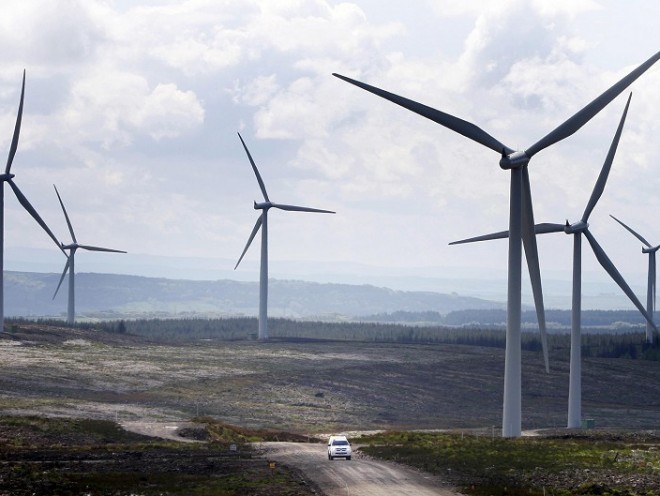
Developers are sometimes under-assessing the impact of wind farm noise and appearance on residents living nearby, according to new research.
The two-year study looked at how the visual, shadow flicker and noise impacts predicted by developers at the planning stage of ten wind farms across Scotland compared to the reality once operational.
The test sites included wind farms at Dalswinton in Dumfries and Galloway, Achany in the Highlands, Drone Hill in the Borders, Hadyard Hill in South Ayrshire, Little Raith in Fife and West Knock Farm in Aberdeenshire.
In some cases what was set out in planning applications did not match the actual impact, the research by climate change body ClimateXChange concluded.
It also found that efforts to engage with the public had not always adequately prepared residents for the visual, shadow flicker and noise impacts of a development.
The information was gathered through a combination of residents’ surveys and assessments by professional consultants.
The report said: “T here was a reasonable correspondence between the predicted impacts at application stage and the study team’s assessment of the as-built impacts.
“However, there were some instances in respect of each of the topics where impacts were under-assessed.
“This divergence between objective measurement and experience of impacts was evident from the residents’ survey which captured a range of responses.
“In respect of all three types of impacts considered by the study there were instances where no or limited impacts were predicted by the expert team, but residents reported experiencing adverse impacts.
“This finding points to the difficulties of predicting or assessing experiential responses.
“It is therefore important that the assessment process and subsequent consideration of applications by relevant authorities takes account of this.”
Researchers said this could be achieved through good project siting and design, rigorous impact assessments and improved public engagement.
Project manager Ragne Low said: “As the study has focused on issues relating to the planning process, we are confident that the findings will feed into improved practice in measuring the predicted impacts of proposed wind farms and in communicating this to decision-makers and those likely to be affected.
“The findings point to several possible improvements in planning guidance and good practice.
“Some have been implemented in the time between the case study wind farms being planned and built, and the present. The study will contribute to building on these improvements.”
Linda Holt, spokeswoman for the campaign group S cotland Against Spin, welcomed the findings.
She said: “For too long, people who have complained about wind farms have been dismissed as nimbies and we applaud the energy minister Fergus Ewing for commissioning this work.
“The recommendations show that the planning system is ill-equipped to address potentially adverse impacts on wind farm neighbours and we urge the Scottish Government to lose no time in implementing them.
“For too long, decision-makers on wind farms have been asked to determine applications while blind-folded about the true impacts of placing enormous industrial machines near people’s homes.”
A spokesman for Scottish Renewables said: “This study highlights the high standards of guidance available for those planning an onshore wind farm in Scotland, and we were pleased to see the sector has been putting these into practice.
“The industry has long worked with government and its agencies to put these high standards in place and this report demonstrates how much we have continuously improved, while identifying areas for further improvements for future schemes.”
A Scottish Government spokeswoman said: ” We welcome the publication of the wind farm impacts study report which is the first of its kind in the world and presents the findings of a two-year study involving a wide-range of interest groups.
“The report shows improvements have already been made in our planning system, which is rigorous and ensures appropriate siting of wind farms, and studies like this will make sure this improvement continues, and we look forward to considering the recommendations carefully.
“Our policy on wind farm applications strikes a careful balance between maximizing Scotland’s huge green energy potential and protecting environmental interests and residential amenity.”
Courageous Aussies Fighting The Windweasels….and Winning!
Real concerns about turbines left blowing in the wind
Credit: By Graham Lloyd, Environment Editor | The Australian | June 27, 2015 | www.theaustralian.com.au ~~
Each morning fine-wool grower Ann Gardner broadcasts her wind farm woes to an unreceptive world.
Politicians, shock jocks, journalists and anyone Gardner hopes will listen are included as recipients of uncomfortable missives that outline the “torture” of living next door to Australia’s biggest wind farm at Macarthur, Victoria.
Gardner is used to being ignored, unlike her neighbours, Hamish and Anna Officer, who routinely are quoted as model wind farm devotees.
Last week, as the deadline counted down for the revised renewable energy target agreement to be finally approved in federal parliament, the Officers again were displayed prominently on the front page of Fairfax newspapers rebutting the comments of Tony Abbott that wind farms were noisy.
As the Officers’ immediate neighbour, Gardner thinks she, too, should have been asked by Fairfax papers about the noise.
If she had been, the Fairfax reports could have disclosed that the Officers receive an estimated $480,000 a year for 25 years for hosting 48 turbines.
And, a Senate inquiry has been told, after spending lavishly on renovating their Macarthur homestead the Officers will soon be moving on and leaving their wind turbines behind.
The Officers, no doubt, have good reasons for moving. And the facts can easily be construed to suggest Gardner is simply jealous about the good financial fortune of her neighbours thanks to big wind.
But other evidence to the Senate inquiry from wind turbine hosts Clive and Trina Gare, who say they bitterly regret their decision to host turbines because of noise, undermine the widespread claims that only jealous neighbours have a problem with wind farm noise and health.
Gardner contends the failure to report the plight of the Gares or the full picture for the Officers is typical of the one-sided treatment the wind turbine issue has received.
She says much of the media has shown itself willing to misconstrue findings from the National Health and Medical Research Council and suggest research had cleared wind turbines of ill effects.
In fact, the NHMRC said only limited, poor-quality research was available and the issue of wind farms and health remained an open scientific question.
The NHMRC has called for tenders for targeted research with a particular focus on low-frequency noise and infrasound.
After receiving evidence from more than 500 people, the Senate inquiry, chaired by John Madigan, this month released an interim report recommending urgent steps to improve scientific knowledge about the health effects of wind turbines. This includes the creation of an independent expert scientific committee on industrial sound to provide research and advice to the Environment Minister on the impact on human health of audible noise (including low frequency) and infrasound from wind turbines.
The Senate committee also calls for a national environment protection (wind turbine infrasound and low frequency noise) measure.
It says to get access to the billions of dollars’ worth of renewable energy certificates, wind farm projects would have to adhere not only to the national wind farm guidelines but also with the National Environment Protection Measures.
In its deal to secure passage of the revised RET through the Senate, the federal government agreed to some of the Senate committee’s key interim demands.
Federal Environment Minister Greg Hunt says the agreement with the crossbench senators includes the appointment of a wind farm commissioner to receive complaints, make inquiries and to make appropriate findings.
The Clean Energy Council says it is “disappointed about moves to introduce further red tape on the wind sector, given the stringent and robust regulatory framework already in place for wind energy in Australia”.
However, CEC chief executive Kane Thornton says the industry will “work closely with the gov¬ernment to ensure these measures genuinely improve the regulatory framework and are developed based on credible scientific research by independent expert bodies”.
The issue of wind farms and health is not confined to Australia. The executive board of the German Medical Association is considering a motion from this year’s national congress calling for research on infrasound and low-frequency noise-related health effects of wind farms.
Like the NHMRC, the German Medical Association congress motion says there are no reliable and independent studies.
“Consequently, there is no proof that these emissions are safe from a health perspective,” it says.
Japanese researchers who have measured the brain waves of people exposed to noise from wind turbines have found “the infrasound was considered to be an annoyance to the technicians who work in close proximity to a modern large-scale wind turbine”.
And a new study by researchers from Oxford University’s Centre for Evidence-Based Medicine have found “the odds of being annoyed appear significantly increased by wind turbine noise”.
The research, published in Environment International, has found wind turbine noise significantly increases the odds of experiencing sleep disturbance, and results in lower quality of life scores.
The evidence flies in the face of wind industry claims that complaints have been confined largely to Australia and English-speaking countries where vocal lobby groups have reinforced each other’s dissatisfaction.
In fact, as Australia prepares to ramp up construction of thousands of new wind turbines to satisfy the RET, governments elsewhere are cutting back because of concerns about the cost and social cohesion.
The Finnish Energy Industries Association says the incoming government there effectively has “shut the door” on new wind farms.
Britain’s conservative government has pulled the brake on the UK’s onshore wind industry by closing its subsidy scheme a year early.
The move reportedly will stop about 2500 proposed turbines in 250 projects from being built.
Family First senator Bob Day, deputy chairman of the Senate committee that is undertaking public hearings, says in at least 15 countries people from all walks of life have come forward complaining about the health effects of wind turbines.
The complaints include nausea, blurred vision, vertigo, tachycardia, high blood pressure, ear pressure, tinnitus, headache, exacerbated migraine disorders, sleep deprivation, motion sensitivity and inner ear damage.
Current thinking is that the low-frequency noise impact from wind turbines is felt most acutely by people who are susceptible to motion sickness.
Publicly, the wind industry has an army of supporters ever ready to rubbish claims that wind farms can have any effect on health. But there is evidence the wind industry has known about the impact of infra¬sound for more than two decades.
The first documented complaints were made in 1979 by residents living 3.5km from an old model wind turbine in the US.
The residents described a “feeling” or “presence” that was felt rather than heard, accompanied by sensations of uneasiness and personal disturbance. The “sounds” were louder and more annoying inside the affected homes, they said.
NASA researchers found the wind turbine operation created enormous sound pressure waves and the turbine was redesigned from downwind to upwind, swapping the blade location on the tower.
The author of the NASA research, Neil Kelley, tells Inquirer modern turbines could have the same issues under certain conditions.
In September 1982, the results of NASA research on human impacts was provided to the wind industry. In 1985 the hypothesis was developed for infrasound-induced motion sickness and major NASA research on community annoyance from wind turbines was released.
But over the following decade wind farm noise regulations were developed that specifically avoided measuring low frequency noise.
This is despite the NASA research and the fact the harmful effects of low-frequency noise from other industrial sources have been firmly established and are well understood.
A federal Department of Resources, Energy and Tourism report into airborne contaminants, noise and vibration, published in October 2009, says “sound in the frequency range below 20 hertz is normally defined as ‘infrasound’ and can be heard (or felt) as a pulsating sensation and/or pressure on the ears or chest”.
The common sources of low-frequency noise and infrasound are large pumps, motors or fans and crushing circuits and screens.
The report says low-frequency noise can be particularly annoying and result in complaints many kilometres away from the source.
And because low-frequency noises between 20Hz and 200Hz propagate with minimal attenuation across large distances and transmit easily through building fabric, “it can be quite prominent inside residences”.
The report does not refer to wind turbines but it accurately describes many of the complaints that are being made.
Hunt says the federal government will act in good faith on the Senate inquiry recommendations when the final report is made public in August.
Done properly, the Senate committee recommendations should go to the heart of complaints being made by wind farm neighbours such as Gardner.
They want real-time monitoring of noise, including low frequency and infrasound. And if limits are exceeded they want the turbines shut down, particularly at night.
One thing is certain: when the wind farm commissioner takes up the position there is a good chance they will be receiving plenty of correspondence from Gardner.
Wind Turbine Hosts Love the Money! but…..Hate the Wind Turbines!
Macarthur Turbine Hosts Destroy Local Community & Bolt, as Hammering the Wind Industry becomes the “New Black”
June 27, 2015 by

****
When STT cranked into gear in December 2012, hammering the wind industry was a fairly lonely occupation: hardly fashionable; a bit like wearing yellow to a funeral, really.
Back then, openly questioning the “wonders” of wind power was a guaranteed dinner party showstopper. Nervous hosts – choking on their organic pinot gris – would seek to segue to another less contentious topic – the joys of dancing cat videos, say; tempers might flare, among raised voices one of the more passionate would shout something about: “the science is settled man”. The protagonist asserting that dreaded CO2 gas was an obvious planet killing “problem”; to which the only “solution” was carpeting the world in an endless sea of bat-chomping, bird slicing,blade-chucking, pyrotechnic, sonic-torture devices – not that the wound-up wind power advocate would have ever presented, let alone dealt with, minor issues like those, as part of his “we’ve gotta save the planet” manifesto.
But that was then, this is now.
Now, people with a modicum of intelligence – anything like an inquisitive nature; and gifted with a shred of logic – are able to unpick the fraud in several easy steps. Indeed, in discourse among those with an adult’s mental capacity it’s no longer a mortal sin these days to express the bleeding obvious: THESE THINGS DON’T WORK.
On the contrary, calling the great wind power fraud for what it is has become fashionable: for want of a better phrase it’s “the new black”.
For a look at the latest fashion trend, we’ll start off with this cracking article from STT Champion, Graham Lloyd, which struts the catwalk with the self-assured style of Claudia Schiffer.
Real concerns about turbines left blowing in the wind
The Australian
Graham Lloyd
27 June 2015
Each morning fine-wool grower Ann Gardner broadcasts her wind farm woes to an unreceptive world.
Politicians, shock jocks, journalists and anyone Gardner hopes will listen are included as recipients of uncomfortable missives that outline the “torture” of living next door to Australia’s biggest wind farm at Macarthur, Victoria.
Gardner is used to being ignored, unlike her neighbours, Hamish and Anna Officer, who routinely are quoted as model wind farm devotees.
Last week, as the deadline counted down for the revised renewable energy target agreement to be finally approved in federal parliament, the Officers again were displayed prominently on the front page of Fairfax newspapers rebutting the comments of Tony Abbott that wind farms were noisy.
As the Officers’ immediate neighbour, Gardner thinks she, too, should have been asked by Fairfax papers about the noise.
If she had been, the Fairfax reports could have disclosed that the Officers receive an estimated $480,000 a year for 25 years for hosting 48 turbines.
And, a Senate inquiry has been told, after spending lavishly on renovating their Macarthur homestead the Officers will soon be moving on and leaving their wind turbines behind.
The Officers, no doubt, have good reasons for moving. And the facts can easily be construed to suggest Gardner is simply jealous about the good financial fortune of her neighbours thanks to big wind.
But other evidence to the Senate inquiry from wind turbine hosts Clive and Trina Gare, who say they bitterly regret their decision to host turbines because of noise, undermine the widespread claims that only jealous neighbours have a problem with wind farm noise and health.
Gardner contends the failure to report the plight of the Gares or the full picture for the Officers is typical of the one-sided treatment the wind turbine issue has received.
She says much of the media has shown itself willing to misconstrue findings from the National Health and Medical Research Council and suggest research had cleared wind turbines of ill effects.
In fact, the NHMRC said only limited, poor-quality research was available and the issue of wind farms and health remained an open scientific question.
The NHMRC has called for tenders for targeted research with a particular focus on low-frequency noise and infrasound.
After receiving evidence from more than 500 people, the Senate inquiry, chaired by John Madigan, this month released an interim report recommending urgent steps to improve scientific knowledge about the health effects of wind turbines. This includes the creation of an independent expert scientific committee on industrial sound to provide research and advice to the Environment Minister on the impact on human health of audible noise (including low frequency) and infrasound from wind turbines.
The Senate committee also calls for a national environment protection (wind turbine infrasound and low frequency noise) measure.
It says to get access to the billions of dollars’ worth of renewable energy certificates, wind farm projects would have to adhere not only to the national wind farm guidelines but also with the National Environment Protection Measures.
In its deal to secure passage of the revised RET through the Senate, the federal government agreed to some of the Senate committee’s key interim demands.
Federal Environment Minister Greg Hunt says the agreement with the crossbench senators includes the appointment of a wind farm commissioner to receive complaints, make inquiries and to make appropriate findings.
The Clean Energy Council says it is “disappointed about moves to introduce further red tape on the wind sector, given the stringent and robust regulatory framework already in place for wind energy in Australia”.
However, CEC chief executive Kane Thornton says the industry will “work closely with the government to ensure these measures genuinely improve the regulatory framework and are developed based on credible scientific research by independent expert bodies”.
The issue of wind farms and health is not confined to Australia. The executive board of the German Medical Association is considering a motion from this year’s national congress calling for research on infrasound and low-frequency noise-related health effects of wind farms.
Like the NHMRC, the German Medical Association congress motion says there are no reliable and independent studies.
“Consequently, there is no proof that these emissions are safe from a health perspective,” it says.
Japanese researchers who have measured the brain waves of people exposed to noise from wind turbines have found “the infrasound was considered to be an annoyance to the technicians who work in close proximity to a modern large-scale wind turbine”.
And a new study by researchers from Oxford University’s Centre for Evidence-Based Medicine have found “the odds of being annoyed appear significantly increased by wind turbine noise”.
The research, published in Environment International, has found wind turbine noise significantly increases the odds of experiencing sleep disturbance, and results in lower quality of life scores.
The evidence flies in the face of wind industry claims that complaints have been confined largely to Australia and English-speaking countries where vocal lobby groups have reinforced each other’s dissatisfaction.
In fact, as Australia prepares to ramp up construction of thousands of new wind turbines to satisfy the RET, governments elsewhere are cutting back because of concerns about the cost and social cohesion.
The Finnish Energy Industries Association says the incoming government there effectively has “shut the door” on new wind farms.
Britain’s conservative government has pulled the brake on the UK’s onshore wind industry by closing its subsidy scheme a year early.
The move reportedly will stop about 2500 proposed turbines in 250 projects from being built.
Family First senator Bob Day, deputy chairman of the Senate committee that is undertaking public hearings, says in at least 15 countries people from all walks of life have come forward complaining about the health effects of wind turbines.
The complaints include nausea, blurred vision, vertigo, tachycardia, high blood pressure, ear pressure, tinnitus, headache, exacerbated migraine disorders, sleep deprivation, motion sensitivity and inner ear damage.
Current thinking is that the low-frequency noise impact from wind turbines is felt most acutely by people who are susceptible to motion sickness.
Publicly, the wind industry has an army of supporters ever ready to rubbish claims that wind farms can have any effect on health. But there is evidence the wind industry has known about the impact of infrasound for more than two decades.
The first documented complaints were made in 1979 by residents living 3.5km from an old model wind turbine in the US.
The residents described a “feeling” or “presence” that was felt rather than heard, accompanied by sensations of uneasiness and personal disturbance. The “sounds” were louder and more annoying inside the affected homes, they said.
NASA researchers found the wind turbine operation created enormous sound pressure waves and the turbine was redesigned from downwind to upwind, swapping the blade location on the tower.
The author of the NASA research, Neil Kelley, tells Inquirer modern turbines could have the same issues under certain conditions.
In September 1982, the results of NASA research on human impacts was provided to the wind industry. In 1985 the hypothesis was developed for infrasound-induced motion sickness and major NASA research on community annoyance from wind turbines was released.
But over the following decade wind farm noise regulations were developed that specifically avoided measuring low frequency noise.
This is despite the NASA research and the fact the harmful effects of low-frequency noise from other industrial sources have been firmly established and are well understood.
A federal Department of Resources, Energy and Tourism report into airborne contaminants, noise and vibration, published in October 2009, says “sound in the frequency range below 20 hertz is normally defined as ‘infrasound’ and can be heard (or felt) as a pulsating sensation and/or pressure on the ears or chest”.
The common sources of low-frequency noise and infrasound are large pumps, motors or fans and crushing circuits and screens.
The report says low-frequency noise can be particularly annoying and result in complaints many kilometres away from the source.
And because low-frequency noises between 20Hz and 200Hz propagate with minimal attenuation across large distances and transmit easily through building fabric, “it can be quite prominent inside residences”.
The report does not refer to wind turbines but it accurately describes many of the complaints that are being made.
Hunt says the federal government will act in good faith on the Senate inquiry recommendations when the final report is made public in August.
Done properly, the Senate committee recommendations should go to the heart of complaints being made by wind farm neighbours such as Gardner.
They want real-time monitoring of noise, including low frequency and infrasound. And if limits are exceeded they want the turbines shut down, particularly at night.
One thing is certain: when the wind farm commissioner takes up the position there is a good chance they will be receiving plenty of correspondence from Gardner.
The Australian

****
Nice work, Graham! Typically hard-hitting stuff, focusing on the sort of things that STT dishes up on a daily basis, like the damning evidence given by Clive and Trina Gare:
And the fact that the wind industry has known about – and sought to cover up – the devastating impacts of incessant turbine generated low-frequency noise and infrasound for over 30 years:
That Graham Lloyd has the temerity to present those kind of facts – against the run of the drivel dished up by the struggling Fairfax stable and the ABC’s “Ministry of Truth” (see our post here) – might be seen by some as “controversial”; and, by the wind industry, its parasites and spruikers, as an “outrage”: STT, however, simply calls it journalism.
And it’s that kind of journalism that has started to educate the dinner party dimwits referred to above.
In the last couple of months there has been a monumental shift in the attitudes and responses among those commenting on newspaper websites, blog forums and the like.
No longer do eco-fascist fantasists get a free run. Instead, they’re rounded up with what they hate most: FACTS. Quite often the ‘debates’ on comments pages and web forums about the ‘merits’ of wind power get pulled to a conclusive halt with links from STT, used in a “put-that-in-your-pipe and smoke it” moment.
Call it an “awakening”; call it a “fashion trend” – or whatever takes your fancy – but it’s real, and irreversible. As we’ve pointed out before, in our travels we’ve met plenty of people that started out in favour of wind power and turned against it. But we’ve yet to meet anyone who started out opposed to wind power, who later became a supporter.
As STT was putting this post together there were only three comments on The Australian’s website and all of them directed at hammering the great wind power fraud:
Roger
$10,000 per turbine per year. Now that’s what I call easy money. Largely provided by the gullible taxpayer.
Bernie
The whole wind energy thing is a complete farce – that will eventually turn into a disaster.
The only way these monstrosities make money is because of government subsidies – on their own, they can never generate sufficient income to be profitable.
It is therefore blindingly obvious what will eventually and inevitably happen: one day the government subsidies will stop, because future governments will logically decide that this folly can no longer continue and that the pointless expenditure of public funds must cease.
That is when things will get interesting.
As soon as the government subsidies cease – all the companies that own the wind turbines will immediately go out of business. So what then happens to the thousands of wind turbines scattered across the country side? Well, the first thing to determine will be this: who owns them? The company that has gone out of business? The banks and other financiers? The farmer whose land the wind turbine is on? The State? That question in itself will keep legions of lawyers well fed for years.
But the next thing to determine is even more important: who is responsible for their maintenance? Because an unmaintained wind turbine is a disaster waiting to happen – eventually a strong wind will make it turn at the speed of an aircraft propeller – and if it hasn’t been maintained for a couple of years, it will suffer from terminal friction and burst into flames.
Which is not what you want on a scorching Victorian summer day with a temperature of 45C and with a 50 knot wind.
Just one of those wind turbines, on such a day and in such a condition, spewing flames, molten plastic and molten metal on to the long, dry grass below, could be responsible for the next Black Saturday. Who will be sued for hundreds of millions? The banks? The farmer? The state?
All of these questions and issues are just a-blowin’ in the wind.
Terence
Wind energy – “works” SEVEN hours a day with a capital cost of FOUR times base load power is now considered to be unsafe.
Reminds me of Victoria’s State Electricity Commission business model which was to provide Safe, Cheap and Reliable energy. Wind energy promoted by the Renewable Energy industry, politicians and the MSM is quite obviously Unsafe, Expensive and Unreliable.
Yep we got rid of those who understood the energy business like the SECV which planned 20 years into the future whereas today planning only extends to the next election creating industry uncertainty as politics discard our previous safe, cheap reliable power and for what? A few Green preferences.
Hmmmm…. Not a lot of support for “wonderful, free wind energy” being expressed there. And no apparent hesitance amongst the correspondents in hammering the greatest economic and environmental fraud of all time.
Now, back to Graham Lloyd’s article. Graham raises the story of Hamish and Anna Officer – who are pitched up by the wind industry as the happiest turbine hosts on earth. Well …. not quite.
As Graham points out, the Officers have – with all the personal integrity of Judas Iscariot – pocketed their 30 pieces of silver; destroyed their community into the bargain; and are all set to leave their long-suffering neighbours for dead. Here’s some more detail on the Officer’s fine community spirit and moral integrity in this letter from Annie Gardner to 2GB’s Alan Jones.
2GB, Alan Jones Breakfast
Dear Alan,
Our neighbour, turbine host of around 40 turbines (this is an approximate number as we are not sure of exact figures) Mr Hamish Officer, who gave evidence at the Portland Senate Inquiry hearing on 30th March – omitted to inform the Senators in this hearing that he and his family will no doubt soon be moving off their property Brandon, where they host turbines to a new property which they purchased quite some time ago and on which they are building a new, very substantial home.
During the Planning Panel for the Macarthur wind farm in 2006, the Officer family denigrated the many neighbouring families objecting to their proposal, claiming they would be happy to build their new dream home and live amongst the turbines. We were described as “mad” by the locals for objecting and were told there would be “not as much noise from the turbines as an ordinary working farm”.
Several years ago, we heard that the Officers had purchased several hundred acres about 30 kilometres from the Macarthur wind farm where they host around 40 turbines. This is where they planned to build their new “dream home” …..

****

****
From the pictures above you will observe that this magnificent new home is not far from completion yet Mr. Officer, during his presentation to the panel on 30th March 2015, and in his submission where he extremely sarcastically told the story that he was disappointed he couldn’t open his bakery specialising in pavlovas, as his eggs, alas were not yolkless – FORGOT to tell the Senate Inquiry he and his family were intending to MOVE AWAY FROM THE WIND FARM ……
However, in recent years, the Officers have spent megabucks, renovating their homestead on the wind farm – this home is absolutely beautiful now – and also have, I’m informed, spent around $1 million on an equestrian horse complex.
The new property which I think is a few hundred acres – it’s five minutes out of Hamilton at least 30 km if not 35 km from the wind farm at “Brandon”.
I drove past the new property some weeks ago and the house is nearly finished. They’ve begun building a horse complex close to the road, and the new house which they’ll move into very soon I’m told, is quite close to the road, which surprised me. It’s relatively large, maybe 35 squares, but I had expected it to be more grand…. After all, we’d heard for years they were going to build their dream home, possibly $1-$2 million worth and whilst very nice and quite substantial, this didn’t quite fit the picture.
BUT, recently we were told this new house into which they’ll move soon, is only where they’ll live whilst their far grander “dream home” is being built further back into the property!!!!
In his evidence to the Senate Inquiry on 30th March in Portland, Mr. Officer claimed “There are not a lot of people who actually live and work in amongst turbines so that is why I am here today …. My experiences so far have been very positive”.
If that is the case, then why are the Officer family moving 30 kilometres away from the turbines?
People have heard that their two young daughters have admitted that the turbines are “terribly noisy”. We’ve also heard their move is to be closer to education, but the truth is that there are most convenient school bus services to Hamilton College, a very fine private school in Hamilton and after all, it is most likely that the Officer children will be sent away to boarding school in keeping with the tradition on both sides of the family for several generations.
In the opinion of the local people of this district Mr. Officer is guilty of misleading the Senators, by not divulging the information that he and his family will soon be moving away from their turbine host property.
With the inevitable relocation of the Officer family from the Macarthur wind farm, the absentee ownership of one other host (they live full-time in Hamilton 35 kms away) and the situation whereby the principal host, the Robertson family own properties in Port Fairy and Melbourne which they visit regularly, and to where they could easily relocate if necessary. It appears that in reality NOT ONE of the turbine hosts, once the Officers have moved into their new home near Hamilton, live permanently on their turbine host properties.
Ann Gardner

If you Host a Wind Turbine, You’re Part of the Problem! Stop the Wind Scam!
Wind Turbines: The Evil Seed
June 26, 2015 by
They came in like a soft silent breeze
Hushing the naïve
Speaking with forked tongues
Proclaiming black is green
Maiming thinkers with corrupt words
Casting a thick cloud of concern
Residing with hidden evils
Leaving a trail of trash
Forever scarred
The stench you see
Smells of decay
What appears above and below is a plea from Michigan. The author quite rightly sees the roll out of giant industrial wind turbines akin to an evil seed – that, like an errant tumour, takes root, multiplies and ends up totally consuming once productive, healthy and happy rural communities.
It all starts with a host – no host, no turbines.
That host may start with good intentions, hoping to be ‘green’, and accepting what they have been told. But the reality is so profoundly different. Many hosts are gagged by the slick and cunning lawyers and can not share their suffering – but some can and do:
David Mortimer, Turbine Host: An “Inconvenient” Wind Industry Fact
Once turbines are allowed in a community, it becomes easier for the system to bring in more – chasing the stream of subsidies that have caused this perversion in the first place.
This story comes from Tuscola County, in Michigan, in the US, where with no more than a week of notice, the first turbines were approved.
This area, called the Thumb (the shape of the State resembles a mitten protruding into the Great Lakes of North America) is considered the third most fertile agricultural land on earth – the naturally blackened dirt fields are ‘bars of gold’ for farming.

****
It intersects key bird migration pathways.

****
Now turbines are everywhere. The views of the Northern lights are replaced with an industrialised red light district.
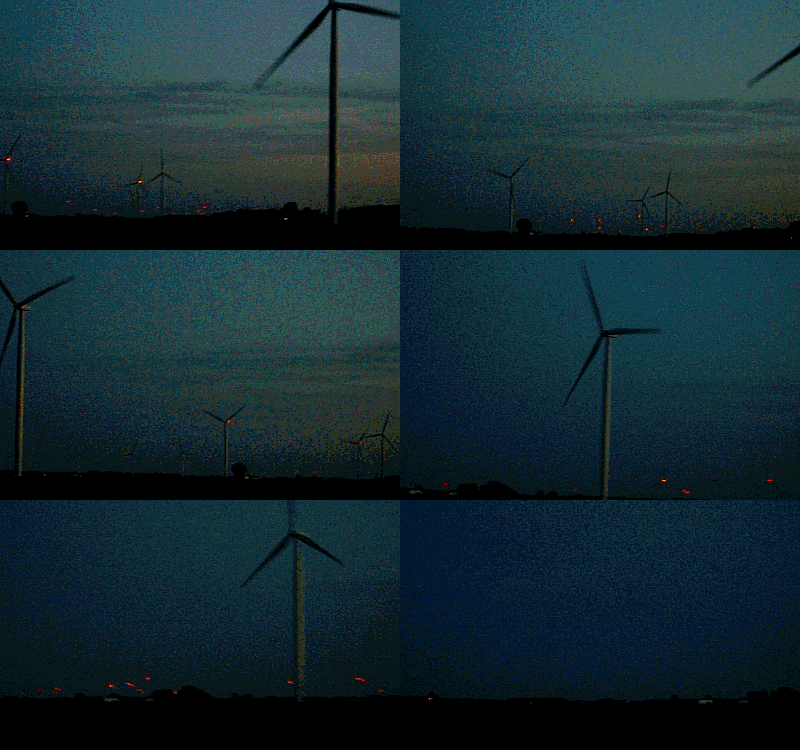
****
And the community is ruined. Community cohesion is gone. All those years of built community friendships are gone.
But the aggressive cancer of turbines progresses unabated. A further 2,700 turbines are planned for the area, with a new transmission line now completed. That number is more than twice the total number of wind turbines in Australia.
And it all starts with a host, who signs away so much, for a tiny sack of silver.
Don’t let the evil seed settle where you live. Please stop these things before they start.

When the Truth is Told, Wind Turbines Are a Wast of Time, Space & Money!
Larry Pickering: on the Quixotic Calamity of Wind
June 25, 2015 by

***
Larry Pickering is a four-time Walkley Award winning political commentator and Churchill Fellow, whose life’s work has been irritating the loopy-left. Here he is slaying the great wind power fraud.
It’s more than a Quixotic Calamity
Larry Pickering
The Pickering Post
20 June 2015

****
The European Renewable Energy Foundation, a Green body supportive of all forms of renewable energy, has carried out research at Edinburgh University involving a look at years of wind farm performance data from the UK and Denmark.
Their conclusion is this:
“Put bluntly, wind turbines onshore and offshore still cost too much and wear out far too quickly to offer the developing world a realistic alternative to coal.”
And these guys are Green renewable energy nuts!
The good news for Australia is that this highly subsidised and ineffective form of Green inspired visual pollution will be non-existent within ten years.
The report [available here] found that by 10 years of age, the output of an average wind turbine will have declined by a third … and by 12 years of age it will be uneconomic to recondition the moving parts.
The bad news for Australia, if they intend to persist with this windmill madness, is that they will all reach their maximum life span at the same time!
Bloody thousands and thousands of these hideous, noisy monstrosities will all need to be replaced at once, and guess what? Investors will have headed for the hills because all those delicious subsidies will have disappeared like Christine Milne and it will cost governments (again you and me) a motza to dismantle and dump the things in the ocean as fish reefs.
They will become worthless bits of metal and plastic no other industry can possibly use. The government of the day will no doubt keep one turbine in a museum somewhere as an artifact so schoolchildren can be shown just how stupid the Greens really are.
South Australia, which has the highest cost of electricity in the nation and the most wind turbines per capita, has saved 4% of their rated capacity in fossil fuels at a cost of $1,484 per ton. That’s roughly $1,474 per ton more expensive than Europe’s current carbon credit price.
The cost of these commercial white elephants, that must eventually be destroyed, is between a highly subsidised $350,000 and $1.3 million each…and the temperature of the globe hasn’t shifted one thousandth of a degree.
Stand underneath a wind turbine that is typically 120 metres tall and try to imagine how our beautiful countryside once looked.
But that’s a visual and noise pollution that will never disadvantage the Greens, oh no, they’ll be happily sipping their lattes in leafy green inner suburbs.
Only two forms of energy can replace the Greens’ hated coal, and neither is wind or solar.
The only freely available clean forms of energy are hydro and nuclear but the Greens refuse to allow dams to be built while frogs need protecting and uranium evokes Green paranoia. Funny eh?
The Pickering Post
Wind Turbines Bring Down Value of Surrounding Property~!
The Gag is Off, and This Wind Turbine Host, Tells the True Story!
SA Farmers Paid $1 Million to Host 19 Turbines Tell Senate they “Would Never Do it Again” due to “Unbearable” Sleep-Destroying Noise
June 15, 2015 by 4 Comments

****
Clive and Trina Gare are cattle graziers from South Australia’s Mid-North with their home property situated between Hallett and Jamestown.
Since October 2010, the Gares have played host to 19, 2.1MW Suzlon s88 turbines, which sit on a range of hills to the West of their stately homestead. Under their contract with AGL they receive around $200,000 a year; and have pocketed over $1 million since the deal began.
In a truly noble and remarkable move, the Gares gave evidence to the Senate Inquiry into the great wind power fraud during its Adelaide hearing, last week. Here’s their tragic story.
COMMONWEALTH OF AUSTRALIA
Proof Committee Hansard
SENATE
SENATE SELECT COMMITTEE ON WIND TURBINES
WEDNESDAY, 10 JUNE 2015
Mr Gare: Thank you for inviting me to present my submission today.
My submission deals with the impact on my health and lifestyle living in close proximity to a wind farm. Let me say from the outset that we were excited about the prospect of being part of the renewable electricity industry. I am a host to wind towers on my property, the nearest being about 800 metres away with three towers within approximately one to 1.5 kilometres away.
We were not made aware of the impacts of noise on our health or lifestyle. Fortunately, we had heard from others that they were quite noisy. Luckily, in our contracts we inserted clauses about the need for noise mitigation.
I do wonder why though the wind tower operators inserted the following clause in all the hosts’ contracts section 77C, which is on the memorandum of lease which I will table:
‘The landlord acknowledges and agrees that it is adequately compensated for any noise or inconvenience caused as a result of the permitted use of the site or the land and that it will not seek any further compensation from the tenant in relation to such matters.’
If the wind tower operators were confident of their impact studies, that clause would not be necessary.
After a short period of living with an operating wind farm, we had these products installed. I find that, because I work and reside in close proximity to the wind farm, I suffer sleep interruption, mild headaches, agitation and a general feeling of unease; however, this occurs only when the towers are turning, depending on the wind direction and wind strength.
My occupation requires that I work amongst the wind towers during the day which means I suffer the full impacts of noise for days at a time without relief. The impacts are that we are not able to open our windows because of the noise at night and we are not able to entertain outside because of the noise.
In conclusion, if we did not have soundproof batts in VLam Hush windows, our house would not be habitable. In my opinion, towers should not be within five kilometres of residences, and I would personally not buy a house within 20 kilometres of a wind farm. Thank you.
Mrs Gare: Good afternoon Senators, and ladies and gentlemen. Thank you for letting me speak to the committee today. I would like to open my statement with the following: developers and construction. In the beginning, I was excited about the wind farm and of course the financial security for our property and family.
The process began with high-pressure consultations, negotiations for weeks on end, numerous phone calls and face-to-face meetings with the developers. We seemed to be under constant pressure to agree to their wishes and, if we wanted any changes, it took a lot of negotiation.
We had to try and foresee any problems that may impact on our lifestyle for the next 25 years plus. With little or no previous information to go on, this was a very taxing time. Having gone through this, I would like to see that a person or persons – probably with a legal background and well-schooled in wind turbine information – be contactable for future wind farm hosts for advice and even to help with negotiations with the development companies.
Construction was also a very stressful and challenging time. The landowners are up against not only the power company but also all the big contractors and civil works companies. Any meetings with the above parties had to be attended by both of us with me taking notes so that we had some kind of record of what was said and what matters needed to be addressed at the time.
We had a lot of erosion problems from the pads and roadways, which we had to chase up with the power company to get them to address. During construction there were lots of problems with gates left open, boxing up mobs of cattle which then took a full day of redrafting and settling back into their paddocks.
We also had gates opening onto public roadways. We have a main bitumen road that goes past our property. This caused great angst as far as public liability is concerned, if our stock got out into the roads. We also had lots of rubbish scattered around the property. We witnessed one of our cattle eating a one metre by one metre piece of plastic sheeting.
Living with wind turbines.
Our house is solid sandstone, built for the late Charles Hawker in the 1920s, with concrete internal walls and a steel roof. The house is surrounded by a lot of vegetation and trees. I have brought some photos to show the Senate.
In the months after the towers started in October 2010, the noise was unbearable, especially when two towers became in sync. A loud thumping would radiate throughout the house. Even watching TV in the furthermost room from the towers, you could hear them. Sleeping was most difficult. I use, and still do, an earpiece radio every night, which helps block out the noise to a certain degree. If they are really going I have to up the volume.
After some time, due to a very slow installer, the house was finally insulated: sonobatts in the ceiling cavity; all our outside air vents blocked; a special American glass called Vlam Hush, which is two sheets of glass with a special gel between, were installed in every door and window of the house. This has improved the situation for me considerably, but at times the noise still penetrates into the house.
Ongoing issues.
Due to the house being sealed we have refrigerated air conditioning, because we cannot open windows because of the noise. A separate meter was installed on the wind farm operator’s advice, so that they could pay the cost of the air conditioning usage. That went in over 12 months ago and we are still chasing payment.
Another issue is the increase in our emergency services levy. The value of our property has increased by double, which has had a major increase in the levy. The power company pay council rates on the land that they lease, and we pay rates on the rest. We brought up the issue of the increased ESL with the power company, but they have not addressed it. We feel they should be responsible due to the increase in our land value. I have the value difference here: I think it is about $1.6 million increase. I quote from the contract, 6.1, rates and taxes, section B:
However, during each year of this lease the tenant must pay any increase in rates and taxes above the rates and taxes that were payable immediately before the start of the agreement to lease, if the increase is directly attributable to the works or the use of the site for the permitted use.
We also have ongoing problems with the cables which run across our property and connect into the individual towers to transport the power to a substation. There seem to be constant cable breakages, which have to be dug up and fixed. This, of course, happens all over the property. Having 19 towers, it has quite a big impact. Quite a large area is disturbed and then has to be recovered with sand or soil.
We have asked for compensation concerning this, as we have numerous cable breaks on the property with disturbance to our pastures, which interferes with our stock grazing. This was discussed at a meeting back in August 2014. We are still waiting for compensation, which is agreed by the wind operators. As you can see, they are not fast movers.
The land owners need to know their rights in regard to their property and how it is treated during and after construction of towers. Land owners with residences close to towers need to be made aware of the noise impact and there should be discussion of how close towers should be permitted to their premises. In my opinion, towers should not be any closer than five kilometres to a dwelling. If we had to buy another property, it would not be within a 20-kilometre distance to a wind farm. I think that says it all.
We have a son who will come home in a couple of years, and I have concerns for him and a family that he might have in the future, with regard to any health problems that may arise. Having lived with towers now for five years, in my opinion future hosts should glean as much information as they can and find out their rights so they can fully understand what they are taking on.
Senator XENOPHON: I would just like to ask some questions to Mr and Mrs Gare. I think the fact that you are hosts of wind turbines and you are giving evidence is significant. How many turbines are there on your property?
Mr Gare: Nineteen.
Senator XENOPHON: How long have you had them there?
Mr Gare: Five years.
Senator XENOPHON: And when did your start complaining about the turbines in terms of the adverse impacts?
Mr Gare: Straightaway.
Senator XENOPHON: Is it AGL that you are dealing with?
Mr Gare: Yes.
Senator XENOPHON: You may want to provide us with any documents in respect of this. How did they deal with the process? Once you raised the issue, what happened?
Mr Gare: We had it in our contract that if we found there was a problem they would put in noise mitigation products. We said: ‘You will have to do it. We cannot bear it.’ Because it was in the contract they went along with it, but I am sure, Nick, that they would not have if they did not have to.
Senator XENOPHON: It is a contractual relationship so it is under the terms of the contract. Are you able to say – and you may not want to – what level of payment have you been getting? If you do not feel comfortable saying how much you are being paid for the 19 turbines on an annual basis, you do not have to.
Mr Gare: All up, in total, about $200,000, so there is not a lot of advantage for us in coming here today.
Senator XENOPHON: When you experienced the noise, could you stay in the property or did you have to move out?
Mr Gare: If we did not have the noise mitigation products put in, we would have moved out.
Senator XENOPHON: Prior to the noise mitigation products being put in, how did it affect your sleep? Did you spend more time away from home?
Mr Gare: Fortunately, we have eastern rangeland country where I could go to get away from it. As I said in my submission, I am there 24 hours a day in amongst it. I had to go away to wind down. What was your question, sorry?
Senator XENOPHON: What period of time was it from the time the noise affected you until the time you had the noise mitigation – several weeks or several months? How long was it?
Mrs Gare: I reckon it took about 15 months or more. We had a very slow installer of the batts and things.
Senator XENOPHON: You are protected by parliamentary privilege when speaking out here today. Did AGL say to you: ‘Sometimes this happens. It is just one of those things’? Did they give an explanation as to the level of disruption? Did they say, ‘This has not happened before’?
Mr Gare: No. It was all glossed over right from the start. We were given no information.
One of their little tricks is to take people right up to the towers and say, ‘This is how noisy they are.’ But that is not so.
The further you get away from the tower the noisier they are. That is a funny thing, to a point I guess. When you are right underneath them and they are 80 metres up in the air there is very little noise. There is just a bit of wind noise. As you go away one or two kilometres it actually gets worse.
Senator XENOPHON: Before the noise attenuation or noise suppression in your home what was your quality of life like?
Mr Gare: Crap, to put it honestly.
Senator XENOPHON: You got a bit of sleep each night, didn’t you?
Mr Gare: With earplugs, yes. I wore earplugs constantly – only while they are turning, mind you, and providing they are in the right direction and have the right wind strength. Frosty nights are the worst because the sound tends to travel so much clearer and further on a frosty night. But earplugs.
Senator XENOPHON: Anything else, Mrs Gare?
Mrs Gare: No. Pretty much what Clive has said.
Senator XENOPHON: Do you sleep okay now?
Mrs Gare: No, they were waking me up on the weekend. You wake up to the thumping. This is with all the soundproofing in the house. As I said, I sleep with the radio on every night. If they are really cranked up I have to turn the volume up, so I will probably just go slowly deaf.
Senator DAY: I just want to clarify something. Frosty nights are normally not very windy.
Mr Gare: That is a funny thing. Our country is very hilly, and they put wind farms on top of hills. It can be blowing an absolute gale on the top of the hills and you can have frost in the valley.
Senator DAY: It is just that we have heard evidence that, even when the blades are not turning, they do have a similar infrasound impact on people because of the effect of the wind across the blades, across the aerofoil.
Mr Gare: Yes, but if there is that much wind the blades are turning, aren’t they?
Senator DAY: That is right.
Senator LEYONHJELM: If you had your time over again, would you host a wind farm?
Mr Gare: No, absolutely not. If I were a rich man, I would not have a wind farm on my property.
Senator LEYONHJELM: And you said it was $200,000 over five years approximately?
Mr Gare: No, 12 months.
Senator LEYONHJELM: Per year.
Mr Gare: Yes.
Senator LEYONHJELM: That is a fairly healthy income.
Mr Gare: Absolutely.
Senator LEYONHJELM: In spite of that, you would say that you would not have them.
Mr Gare: Absolutely, if I were a rich man, but unfortunately I am a farmer and there are not many rich farmers around.
Senator LEYONHJELM: What sort of farming?
Mr Gare: We are grazing, we can be cropping but we –
Senator LEYONHJELM: Sheep or cattle?
Mr Gare: Mostly cattle.
Senator LEYONHJELM: Has there been any effect on your cattle from the wind farms?
Mr Gare: No.
Senator LEYONHJELM: Okay, thank you.
Hansard, 10 June 2015
The evidence given by Gares will have ramifications for the wind industry, in Australia and beyond. To call it a major development in the ‘debate’ about the impact of incessant turbine generated low-frequency noise and infrasound on human health, is mastery in understatement.
You see, the shills that run propaganda for the wind industry – including a former tobacco advertising guru – run the story that it’s only “jealous” wind farm neighbours who complain about wind turbine noise, “jealous” because they’re not getting paid; and that those who get paid to host them never, ever complain (see this piece of cooked-up propaganda piffle here).
The Gares pocket $200,000 a year for the ‘pleasure’ of hosting 19 of these things; and, yet, make it very clear that it was the worst decision of their lives.
To describe the noise from turbines as “unbearable”; requiring earplugs and the noise from the radio to help them get to sleep at night; and the situation when the turbines first started operating in October 2010 as “Crap, to put it honestly” – is entirely consistent with the types of complaints made routinely by wind farm neighbours who don’t get paid, in Australia and around the world.
The Gare’s evidence is also entirely consistent with the experience of David and Alida Mortimer, also paid to host turbines for Infigen at Lake Bonney, near Millicent in SA’s South-East (see our post here).
Despite AGL spending tens of thousands on noise “mitigation” measures, the noise from turbines continues to ruin their ability to sleep in their own home, as Trina Gare put it:
No, they were waking me up on the weekend. You wake up to the thumping. This is with all the soundproofing in the house. As I said, I sleep with the radio on every night. If they are really cranked up I have to turn the volume up, so I will probably just go slowly deaf.
With the aid of their pets at the NHMRC, the wind industry continues the fluff about there being no evidence of adverse health impacts caused by wind turbines (see our post here). However, the evidence given by the Gares – as to the routine sleep disturbance caused by turbine noise – is, in and of itself, conclusive proof of adverse health effects.
The World Health Organisation has viewed “noise-induced sleep disturbance … as a health problem in itself” for over 60 years – its Night-time Noise Guidelines for Europe – the Executive Summary at XI to XII which covers the point – says:
NOISE, SLEEP AND HEALTH
There is plenty of evidence that sleep is a biological necessity, and disturbed sleep is associated with a number of health problems. Studies of sleep disturbance in children and in shift workers clearly show the adverse effects.
Noise disturbs sleep by a number of direct and indirect pathways. Even at very low levels physiological reactions (increase in heart rate, body movements and arousals) can be reliably measured. Also, it was shown that awakening reactions are relatively rare, occurring at a much higher level than the physiological reactions.
The review of available evidence leads to the following conclusions.
- Sleep is a biological necessity and disturbed sleep is associated with a number of adverse impacts on health.
- There is sufficient evidence for biological effects of noise during sleep: increase in heart rate, arousals, sleep stage changes and awakening.
- There is sufficient evidence that night noise exposure causes self-reported sleep disturbance, increase in medicine use, increase in body movements and (environmental) insomnia.
- While noise-induced sleep disturbance is viewed as a health problem in itself (environmental insomnia), it also leads to further consequences for health and well-being.
- There is limited evidence that disturbed sleep causes fatigue, accidents and reduced performance.
- There is limited evidence that noise at night causes hormone level changes and clinical conditions such as cardiovascular illness, depression and other mental illness. It should be stressed that a plausible biological model is available with sufficient evidence for the elements of the causal chain.
STT tends to think the World Health Organization – after more than 60 years of studying the problem – might just know a thing or two about night-time noise, sleep and health. And, after more than 5 years of suffering, so do Clive and Trina Gare.
Notwithstanding a $200,000 annual pay-cheque, and thousands spent on noise ‘mitigation’, the Gares still can’t sleep properly; or otherwise enjoy their own home – their suffering continues.
Against that backdrop, it’s to be noticed that the lunatics that pass for our political betters keep advocating for ever decreasing set-backs for turbines from residential homes: in South Australia, it’s currently a derisory 1,000m; in Victoria, it’s just been cut by the recently installed Labor government to 1,000m, too – although their wind industry masters are pushing to cut that measly distance even further.
So, it is more than just significant to hear from people who’ve had to live up close and personal with these things for over five years, especially when over that period they’ve pocketed over $1 million for doing so – Trina Gare observing, in the same terms as Clive, that:
In my opinion, towers should not be any closer than five kilometres to a dwelling. If we had to buy another property, it would not be within a 20-kilometre distance to a wind farm. I think that says it all.
The other point that arises loud and clear is the developer’s use of bullying, lies and deceit in order to get the Gares into their contract in the first place – starting with lies about the impact of turbine noise, Clive pointing out:
One of their little tricks is to take people right up to the towers and say, ‘This is how noisy they are.’ But that is not so.
The further you get away from the tower the noisier they are. That is a funny thing, to a point I guess. When you are right underneath them and they are 80 metres up in the air there is very little noise. There is just a bit of wind noise. As you go away one or two kilometres it actually gets worse.
And that type of skulduggery was being pulled amidst the usual inordinate pressure applied to unwitting farmers by developers, described by Trina as a process that:
began with high-pressure consultations, negotiations for weeks on end, numerous phone calls and face-to-face meetings with the developers. We seemed to be under constant pressure to agree to their wishes and, if we wanted any changes, it took a lot of negotiation.
All tricks; all traps; and all to the developer’s advantage.
Standard tricks, like telling the potential hosts – on a one-on-one basis – the very same story: “that all of their neighbours had already signed up”. Words usually uttered at a point in time when the developer had not signed ANY contracts in relation to its proposed development at all. Pressure often being added by telling the targets that they needed to sign up quickly, because if they didn’t they would be holding up hundreds of $millions in investment, hundreds of jobs etc, etc.
Working on the adage of “loose lips sink ships”, on each occasion, the farmers being targeted were told that they mustn’t breathe a word about the contract being offered to any living soul: so much easier to perpetuate a lie when it can’t be tested by your target with a quick phone call to their neighbours.
In order to add a little more pressure to their targets – and to get their monikers on the contract being offered – the developer’s goons would tell the target farming family that, because everyone else had signed up, they would end up with turbines right up to the boundaries of their properties (sometimes within a few hundred metres of their homes); so they “may as well sign up anyway”, because that way they would at least get paid for hosting some turbines on their own property.
The thrust of the developer’s pitch being that: your life is going to be ruined by dozens of turbines on your neighbour’s property, so you may as well receive a few grand a year for your pending troubles.
The same set of lies would be told repeatedly; until such time as ink appeared on all of the contracts needed to get the wind farm project off the ground, and on its way to a dodgy-development approval. The ruse has been used in numerous cases in Australia, in the USA and elsewhere:
On the strength of what the Gares have told Australia’s Senate, STT can only offer this advice to any farmer considering entering a landholder agreement with a wind power outfit: DON’T.
And, if you’re in a contract, do whatever you can to get out of it NOW. We suggest you obtain competent, independent legal advice on avoiding the kind of suffering thrust upon the Gares.
No matter how much you get paid, your home, along with those of your neighbours, will become practically uninhabitable. Moreover, you are unlikely to remain friends with your neighbours.
The Gares got into their contract at a time when nobody in South Australia knew about how noisy and disruptive giant industrial wind turbines could be in quiet rural environments But, that’s all changed now. Plenty of rural communities are now suffering in precisely the same manner described by the Gares.
The Gares – along with plenty of others in the same position – were played by wind power outfits for dupes; as their evidence attests.
Admitting to a mistake takes honesty and personal integrity; admitting to a colossal mistake, even more so. However, to not only do so in public, but to your Parliament, exhibits moral decency – especially given the potential of that admission to operate as a sobering warning to others who have made, or who are likely to make, the very same error.
STT hears from its operatives at the hearing, that the Gares were warmly thanked for telling their story publicly. One who did so was STT Champion, Marina Teusner, from SA’s iconic Barossa Valley; and a voice of reason for the solid local group dedicated to killing off Pac Hydro’s threat of turbine terror for Keyneton (see our post here). Marina, in tears, embraced Trina Gare and gave her heartfelt thanks for what the Gares had just done.
As we said above, what the Gares have done is both remarkable and noble: these fine and decent people deserve the gratitude and sympathy of all; from those in their community, and well-beyond.
What they also deserve is that our political betters admit their mistakes; and immediately correct the errors that have led to the single greatest policy disaster in the history of the Commonwealth. After what the Gares have done, anything less is a monstrous insult.

 "Mothers Against Wind Turbines™" Phoenix Rising...