Next Sunday, I will join Ron Stephens, on his radio show, where we will be discussing the wind fiasco, and the problems it is causing for so many people. Follow the link below. Available on YouTube

Next Sunday, I will join Ron Stephens, on his radio show, where we will be discussing the wind fiasco, and the problems it is causing for so many people. Follow the link below. Available on YouTube
Tom Harris has used the situation with my son, Joey, to show that the way the climate alarmists are going about pushing senseless solutions, (for problems they can’t prove will ever occur), is harming people here, and now. This is obscene, and has to stop! Please read this article, and share!
Hi all,
This very important German documentary from Spiegel TV was aired on June 7, 2015. We have added English subtitles.
(The YouTube link is just under the video)

****
Ron and Chris Jelbart, and their son, Peter have come to prominence on these pages once or twice; for all the wrong reasons.
Ron and Peter have given evidence about the debilitating impacts of incessant turbine generated low-frequency noise and infrasound on their ability to sleep and function as a farmer and heavy-vehicle driver:
Tide Turns as Senate Inquiry hears from the Wind Industry’s “Road-Kill”
Peter went on to detail how incessant night-time noise from AGL’s non-compliant Macarthur disaster impacts on his ability to operate safely behind the wheel:
Now, Peter has penned a simple but cutting riposte to the useful idiots at Fairfax and the ABC (aka the ‘Ministry of Truth’) that parrot wind industry lies and myths in blind deference to their Overlords. The letter got a run in the local rag, but STT thinks it worthy of much wider distribution.
TO THE EDITOR
Dear Sir,
I am writing in response to the latest media bombardment from the Clean Energy Council, formerly known as the Australian Wind Energy Alliance. This was in response to Tony Abbott’s interview where he said in no uncertain terms that he finds wind turbines visually awful and very noisy.
My radio station of choice is triple j. I listen to this daily at work and on weekends, and enjoy the musical content and lack of commercialisation.
Whilst listening to Dr Karl with Zan Rowe last week a person rang in with a question concerning health impacts from living in the vicinity of wind turbines. The answer that followed by the somewhat funny, often likeable doctor raised questions in my mind. There wasn’t a mutter or stumble, a tangent or a hesitation, no tweets from the audience and no need to refer to google scholar, just a torrent of denial of any sort of health impacts from wind turbines, all in all a very unscientific answer.
The definite nature of the response, although not surprised by his slant, aroused my suspicion. It all clicked after talking to my father on Friday night. This was a posed question with an already written answer, as was “Ian” from Macarthur who spoke to Neil Mitchell Friday morning. “Dennis” from Woodhouse who spoke to 774 ABC was also a suspect caller, again on Friday morning.
The ABC 7:30 report Thursday evening spoke to Mark Butler, the Federal Shadow Minister for Environment, obviously pro Wind Farm. Hamish and Anna Officer appeared in the Sydney Morning Herald, The Age and the Standard, over the course of a couple of days.
What we have seen is the full force of the wind energy sectors Media and HR departments trying to turn the tide after Tony Abbott’s interview, well helped by the heavily Left leaning and gutless Media. The ABC is well known for its allegiance to the Labour side of politics and the Fairfax run Standard is obviously nailing its colours to the mast in no uncertain terms, after the last few days’ stories and editorials.
Whilst the Fairfax Warrnambool Standard does a great job on covering local news, such as school fetes and country football and netball, their coverage on the issue of wind farms has been pathetic. No journalist has sought deeper answers or asked proper questions. It seems they get all they need to cover a story straight from the huge Media departments of the wind farm operators, the same rhetoric always. Any complainant is just a jealous neighbour suffering from Nocebo.
There is a reason that there is a senate inquiry happening at the moment. I spoke briefly at the Portland hearing about the effects of sleep disturbance and deprivation that I suffer as a neighbour of Industrial Wind Turbines, a consequence of being stimulated by low frequency noise and infrasound. Steven Cooper’s research at Cape Bridgewater along with NASA’s research done years ago by Neil Kelley, confirm that infrasound has been known, and hidden by wind farm companies for a very long time.
The noise testing done at home pre and post windfarm is farcical, designed and financed by the wind farm companies to give them the answers they seek, lost data, flat batteries and setting up testing equipment under trees etc to distort and manipulate the truth all part of the game. Low frequency noise and infrasound is not part of the testing.
No one who has not had to live beside a windfarm for an extended period, and who isn’t subject to strict “gag” clauses, such as hosts and other neighbours who receive money for tree screening etc. is qualified to speak on the subject of windfarm noise. The sheer stupidity of the comments from people who pull up under them and say “I can hardly hear them” shows a complete lack of understanding of the infrasound problem and can only be put down to absolute ignorance or complete arrogance.
These visually awful, or “somewhat graceful and beautiful towers of man’s going to save mankind from himself” windmills, depending on your persuasion, apparently blend in a little too well to the landscape for our avian friends. As reported in 2014 “conservative estimates of bird deaths are at 10 per tower per year” and during official searches at AGL’s Macarthur wind farm 64 carcasses were found including falcons, kestrels, shrouded kites and a spotted harrier, as well as 6 Wedge Tailed Eagles. For an individual this bird kill would be disastrous, resulting in prison, fines and (rightly deserved) bad publicity but for a wind farm it’s all in a “day’s work”.
The people who are writing in weekly to papers such as the Standard are not political activists. They are farmers, teachers, secretaries, retirees, Salt of the Earth people. People with far better things to do, but impacted to such a degree that they will fight, they will tell their story and they will pursue the truth. The only thing that keeps them motivated is the fact that they know they have a problem and it’s not just “in their heads”.
They are not the liars, the villains, the cheats, the greedy, or the soft of heart or will.
Peter Jelbart
Hawkesdale
Nice work, Peter.
Although we think him too fair on the wind industry shills that people the struggling Fairfax stable and the ABC.
Pig ignorance, among children and the uninitiated, can be excused for a while, but in the face of insurmountable facts, not forever.
STT has repeatedly clobbered the myth perpetuated by the lunatics of the hard-‘green’-left that wind power is capable of not only displacing, but wholly replacing, conventional generation sources, such as coal, gas and hydro:
Why Coal Miners, Oil and Gas Producers Simply Love Wind Power

Either our current crop of journos can’t interpret simple graphs or understand basic economics? Or their eyes simply glaze over while they mutter “no, it can’t be true?”

And the same horror and disbelief must grip them when faced with buckets of splattered bats and ute-loads of slaughtered birds:
Bird Carcass Count proves AGL’s Macarthur Wind Farm is an Avian Slaughterhouse
Faced with a few pics of Eagles sliced in two, shaken, they’re reduced to stuttering something about its “all okay because their cat once killed a bird too”.
Then there’s the classic wind industry spin – highlighted by Peter – that: “Any complainant is just a jealous neighbour suffering from Nocebo”.
It’s a wind industry line that was always specious and self-serving, but – in the light of the evidence given by Clive and Trina Gare to the Senate Inquiry – it’s downright dishonest.
Clive and Trina have hosted 19 2.1 MW Suzlon s88 turbines for five years, pocketing over $1 million along the way; and, yet, gave solemn evidence that the incessant low-frequency noise that’s generated at night-time has ruined their ability to sleep in their own home; and that they wouldn’t live within 20 km of a wind farm if they had their choice over again:
While Graham Lloyd from The Australian gave that story a run, don’t expect the ABC or Fairfax to do likewise.
And a little journalistic nouse would have uncovered what the wind industry has known, and worked like demons to cover up, for around 30 years:
But, no, those kind of facts would never do.
You see, as with any cult, even so much as questioning the mantra is tantamount to heresy – which leads to exclusion, if not expulsion, from the warmth and safety of the compound.
Instead, the chants from acolytes have grown louder, and more shrill, in an effort to maintain their own confidence in their increasingly shaky beliefs.
And so it was, in the last week, that hitherto hard-core heathens started quoting that world renowned long-range weather forecaster, the Pope – as the answer to their apocalyptic prayers and need for self-validation.
Now, with all due respect to His Holiness, directing his congregation in prayer for the poor and needy is a far more sensible use of his time, than prophesying about the temperature in 50 years time.
As that great philosopher, Yogi Berra warned: “It’s tough to make predictions, especially about the future.”
Notwithstanding that sage advice, STT is happy to predict that the Pope will end up with the same level of credibility as Australia’s own long-range weather forecaster, and ABC favourite, Tim Flannery (for a rundown on Tim’s prodigious prognostic skills see our post here).

****
Not only is the current crop, claiming to call themselves journalists, gullible, they’re nasty too. The ABC’s political cutie pie, Annabel Crabb scooped the gold medal when she called long-suffering wind farm victims “Dick Brains” on ABC radio:
And the same outlets cite, with veneration, a former tobacco advertising guru as their “high priest” on the question of adverse health effects. Notwithstanding that his qualifications are limited to the effect ofadvertising on rates of smoking. The fact that he ridicules and demeans people he’s never met as “wind farm wing-nuts” doesn’t seem to trouble the ABC at all. What’s that stuff in its Charter about “balance” and “objectivity”?
No, what’s dished up from Fairfax and the National Broadcaster can’t be explained by simple, seasoned ignorance. As Ben Franklin put it:
“We are all born ignorant, but one must work hard to remain stupid”.
At Fairfax and the ABC they’re clearly working very hard.


“This report records the committee’s concern with the issue of infrasound and low frequency noise emitted from wind turbines and the possible impact on human health.
Independent, multi-disciplinary and high quality research into this field is an urgent priority.”

1.1 The Senate Select Committee on Wind Turbines was established in December 2014. To date, it has received 464 submissions from a wide range of stakeholders. It has conducted public hearings in Portland in south-west Victoria on 30 March, in Cairns on 18 May, in Canberra on 19 May, in Melbourne on 9 June and in Adelaide on 10 June 2015. Further public hearings are planned in Canberra on 19 June and 23 June and in Sydney on 29 June 2015.
1.2 This represents a considerable volume of evidence relating directly to the committee’s terms of reference. The committee has received written and verbal evidence from State Governments, local councils, various federal government agencies, wind farm operators and manufacturers, country fire authorities, acousticians, medical experts and representatives from various associations and institutes. In addition, many private citizens have had the opportunity to voice their concerns with the planning, consultation, approval, development and operation of wind farms in Australia.
1.3 Access to all public submissions and public hearing transcripts can be found on the committee’s website.
1.4 This report presents seven headline recommendations. The committee believes that these recommendations are important and urgent given that legislation on the renewable energy target is due to be debated in the Senate shortly. The final report in August this year will provide supporting evidence and supporting recommendations. It will also address other terms of reference, including the merit of subsidies for wind farm operators and the effect of wind power on household power prices.
Recommendation 1
1.5 The committee recommends the Commonwealth Government create anIndependent Expert Scientific Committee on Industrial Sound responsible for providing research and advice to the Minister for the Environment on the impact on human health of audible noise (including low frequency) and infrasound from wind turbines. The IESC should be established under the Renewable Energy (Electricity) Act 2000.
Recommendation 2
1.6 The committee recommends that the National Environment Protection Council establish a National Environment Protection (Wind Turbine Infrasound and Low Frequency Noise) Measure (NEPM). This NEPM must be developed through the findings of the Independent Expert Scientific Committee on Industrial Sound. The Commonwealth Government should insist that the ongoing accreditation of wind turbine facilities under the Renewable Energy (Electricity) Act 2000 in a State or Territory is dependent on the NEPM becoming valid law in that State or Territory.
Recommendation 3
1.7 The committee recommends that the Commonwealth Government introduceNational Wind Farm Guidelines which each Australian State and Territory Government should reflect in their relevant planning and environmental statutes. The committee proposes these guidelines be finalized within 12 months and that the Commonwealth Government periodically assess the Guidelines with a view to codifying at least some of them.
Recommendation 4
1.8 The committee recommends that eligibility to receive Renewable Energy Certificates should be made subject to general compliance with the National Wind Farm Guidelines and specific compliance with the NEPM. This should apply immediately to new developments, while existing and approved wind farms should be given a period of no more than five years in which to comply.
Recommendation 5
1.9 The committee recommends that the Commonwealth Government establish aNational Wind Farm Ombudsman to handle complaints from concerned community residents about the operations of wind turbine facilities accredited to receive renewable energy certificates. The Ombudsman will be a one-stop-shop to refer complaints to relevant state authorities and help ensure that complaints are satisfactorily addressed.
Recommendation 6
1.10 The committee recommends that the Commonwealth Government impose a levy on wind turbine operators accredited to receive renewable energy certificates to fund the costs of the Independent Expert Scientific Committee on Wind Turbines—including the funding of additional research—and the costs of a National Wind Farm Ombudsman.
Recommendation 7
1.11 The committee recommends that the data collected by wind turbine operators relating to wind speed, basic operation statistics including operating hours and noise monitoring should be made freely and publicly available on a regular basis. The proposed Independent Expert Scientific Committee should consult with scientific researchers and the wind industry to establish what data can be reasonably made freely and publicly available from all wind turbine operations accredited to receive renewable energy certificates.
1.12 Why are there so many people who live in close proximity to wind turbines complaining of similar physiological and psychological symptoms? As with previous Senate inquiries, this committee has gathered evidence from many submitters attributing symptoms of dizziness, nausea, migraines, high blood pressure, tinnitus, chronic sleep deprivation and depression to the operation of nearby wind turbines. The committee invites the public to read and consider the evidence of people who have experienced these symptoms and who attribute their anxiety and ill health to the operation of turbines.
1.13 These health affects should not be trivialised or ignored. The committee was particularly distressed by renewable energy advocates, wind farm developers and operators, public officials and academics who publicly derided and sometimes lampooned local residents who were genuinely attempting to make known the adverse health effects they were suffering.
1.14 The committee is aware of people complaining of these impacts who have since left their family home. Some now live a nomadic and uncertain existence. In one case, the now deserted home had been in the family for five generations—since the 1840s. These are not decisions taken lightly. Having left the turbine vicinity, several witnesses noted that the symptoms had faded if not disappeared.
1.15 Some submitters attribute these illnesses to a ‘nocebo effect’—a result of expectations of harm rather than exposure to turbine activity. This claim has been made by Professor Simon Chapman, a sociologist by training and a professor of Public Health at Sydney University. He has labelled wind turbine syndrome ‘a communicated disease’, claiming that it ‘spreads by…being talked about and is therefore a strong candidate for being defined as a psychogenic condition’.
1.16 However, most people recognise that noise including low frequency noise could cause these impacts and emphasise that noise standards, properly enforced, are crucial to ensuring public safety. This view acknowledges that the noise from wind turbines creates annoyances which can manifest in sleep disruption. The clear remedy is to set noise standards (such as the New Zealand Standard) and enforce these standards. This is essentially the public position of the relevant authorities in Australia.
1.17 The committee highlights the need for more research into the impact of low frequency noise and infrasound (0–20 hertz) from wind turbines on human health. A 2014 pilot study conducted by acoustician Mr Steven Cooper found a correlation between infrasound emitting from turbines at Cape Bridgewater in Victoria and ‘sensations’ felt, and diarised, by six residents of three nearby homes. By identifying a unique infrasound ‘wind turbine signature’, recording it as present in the homes, and linking it to ‘sensations’ felt by the residents, Mr Cooper’s research has received international attention.
1.18 It is clear that the extent and nature of wind turbines’ impact on human health is a contested issue. The nocebo effect, the existing standards for measuring audible noise and the NHMRC’s 2011 literature review have all been criticised by submitters and witnesses to this inquiry. The criticisms relate both to flaws in methodology and to inaccurate and incomplete findings.
1.19 Fundamentally, the lack of detailed, reliable data does not allow for a proper scientific conclusion to be drawn. The committee is struck by the considerable gaps in understanding about the impact of wind turbines on human health. These gaps have widely acknowledged key issues, both explicitly and implicitly:
1.20 Independent scientific research is needed into acoustic matters—such as whether each wind turbine has unique ‘signature’ and the effect of that signature on neighbouring turbines—and into health matters.

****
More than once or twice, STT has picked up on hard-hitting scientific research that shows that those who suffer the worst effects of incessant turbine generated low-frequency noise and infrasound are generally prone to suffer seasickness:
Sick Again – motion sickness sufferers cop it worst from giant fans
Top Acoustic Engineer – Malcolm Swinbanks – Experiences Wind Farm Infrasound Impacts, First Hand
Adverse Health Effects of Wind Turbine Infrasound Explained
Now, a top Neuroscientist from Sydney University – Simon Carlile – is set to build on that body of research.
Wind farm effect on balance ‘akin to seasickness’: scientist
The Australian
Simon King
12 June 2015
The scientist who set up the Sydney University Auditory Neuroscience Laboratory — and who was asked to be involved in assessing the National Health and Medical Research Council’s targeted research examining the effect of wind turbines — says the growing body of evidence points to the low-frequency infrasound they create directly affecting the human nervous system.
Medical faculty associate professor of neuroscience Simon Carlile said it was time to properly examine the effects of low-frequency wavelengths and recognise that, like seasickness, they don’t affect everybody.
“In terms of the physiology, in terms of how we know the nervous system responds to this low-frequency noise, the evidence says ‘yes, the nervous system is activated at these frequencies’,” he told The Australian.
“But not in the traditional way you might think hearing works — it’s stimulating the system that’s involved in balance — the vestibular system. So there’s some good physiology, some good neuroscience, that this does exist and it’s been shown in animal models.”
But Associate Professor Carlile said its existence was only “one part of the story”.
“The other part is that some people are susceptible and some aren’t,” he said.
“It just means that when you look across 1000 people you can’t see a statistical effect across that population — because 90 per cent of them aren’t affected. Then the question is: why are some people affected and other people aren’t?
“And the answer to this could be because it’s not stimulating the ears — you can’t hear it at low frequency — it’s stimulating the vestibular system.’’
Associate Professor Carlile said that was similar to people who suffered seasickness.
“They get seasick because of the simulation of the vestibular system — and there seems to be quite significant variations of susceptibility to vestibular-induced nausea.
“A lot of the symptoms some people report around wind turbines are very similar to vestibular induced nausea or seasickness, like sleep disturbance.
“The nervous system is definitely sensitive to this stimulus.”
He said research could feed back to design: “This is going to be an important energy source and if we’re building tons of these things in the wrong places or building them in the wrong way then we’ve got big trouble.”
He felt the statistical and epidemiological approaches informing the debate had not been “hitting the mark. You have got potentially a wide range of individual difference on this: you’ve really got to be homing in on those differences.”
The Australian
Simon Carlile may well have the nouse to crack the precise mechanism that has turbine infrasound causing vertigo and nausea among wind farm neighbours. However, his claim that: “This is going to be an important energy source” has him straying well outside his area of expertise. As STT followers well know, wind power is not, and will never be a meaningful power generation source, simply because it will never be available on-demand:
What we have is a nonsense power source – on which billions of dollars in subsidies have been squandered – that causes wholly unnecessary suffering to thousands of people around the world.
While Carlile’s planned investigation is clearly worthy, those people who suffer the worst effects (eg, vertigo, nausea etc) form a subset of a much, much larger group that suffer from the most common adverse health effect – sleep deprivation:
Danish Experts: Sleep Deprivation the Most Common Adverse Health Effect Caused by Wind Turbine Noise
For every wind farm neighbour that suffers problems with balance or nausea, there are dozens more that suffer from what the World Health Organisation calls “environmental insomnia” – which it views as an adverse health effect in and of itself, and has done for over 60 years: see its Night-time Noise Guidelines for Europe – the Executive Summary at XI to XII which covers the point.
With researchers focusing on a small group of sufferers, there is a tendency to overlook the suffering of the many more who can no longer obtain a healthy night’s sleep.
Where people like Carlisle start talking about 10 or 15% of people affected with nausea and vertigo, that proportion – in the hands of the eco-fascists that run cover for the wind industry – quickly turns into a “tiny minority”, which is then used to feed that classic, malicious Marxist line about “the greatest good for the greatest number”. You know, the kind of argument that has wind farm neighbours tagged as “collateral damage” or “road-kill”; in an effort to justify the unjustifiable.
Civil societies (like ours once was) have used a bundle of common sense rules aimed at protecting the sanctity of sleep.
Humane societies have separated noisy activities since the time of the ancient Greeks – booting roosters, tinsmiths and potters out of Greek cities – and, in later times, organ grinders out of London.
In Australia today, roosters are banned in cities, suburbs and in most country towns. They have a body clock set earlier than most people and have a routine habit of waking up the whole neighbourhood. Faced with an errant rooster, authorities are quick to act against Foghorn Leghorn & Co on PUBLIC HEALTH GROUNDS.

****
Planning laws in most States prevent panel beaters from operating in built up areas before 8am and after 6pm.
And – either by operation of EPA regulations or planning laws – there is a total ban on the operation of chainsaws and lawn mowers in cities, suburbs and most towns. That strictly enforced prohibition operates, in Victoria, for example, Monday to Friday: before 7 am and after 8 pm; and on weekends and public holidays: before 9 am and after 8 pm.
So, if night-time noise isn’t a health problem, then why is it that there are strict rules about the permitted times for operating chainsaws, leaf blowers and lawn mowers – rules that keep roosters out of towns and cities – and rules that mean the plug gets pulled on rock bands and music venues at midnight in residential areas?
None of those long-settled rules required the ‘magic wand’ of peer-reviewed science; or the stamp of approval from the NHMRC. No. Those rules were the product of plain, old common sense – well rested individuals are happier and healthier, wherever they might plop down for some kip.
In short, sleep matters – and having turbines grinding and thumping away in the next paddock without let-up, all night long, deprives people of the ability to enjoy it – and that has consequences for everyone:
With a solid set of rules set up to benefit one class (all those not forced to live next door to giant fans) by prohibiting night-time noise from a variety of rather innocuous sources, the only question is why the same type of rule isn’t there to benefit the other class?
With everyone waxing lyrical about the Magna Carta’s 800 years of helping to keep tyrants honest – and ensuring that the little man got treated the same whoever he was – now is a fair time to ask, just what’s fair about having one set of rules for the 99% and no rule at all for the 1% forced to suffer sonic torture night-after-merciless-night?

June 14,2015
Honorable Dr. Eric Hoskins
Minister of Health and Long Term Care
10th Floor, Hepburn Block
80 Grosvenor Street
Toronto, Ontario M7A 2C4
Dear Dr. Eric Hoskins,
It was with little to no enthusiasm that I read your response dated June 8th 2015, to the package and letter that I provided you with on September 16th, 2014 in Grey Highlands at the announcement of the New Markdakle Hospital. In fact the letter was not even penned by you but by J. Dhamrait in your Correspondence Services. After waiting 9 months for a reply I received a boilerplate letter that does not address any of the concerns of which I presented to you.
Mention of the Ontario Chief Medical Officer of Health, Arleen King’s report shows just how out of touch your Ministry is when citing a report that is 5 years old while ignoring the growing body of evidence which I included in my first letter to you; “Systematic Review 2013: Association between Wind Turbines and Human Distress” in which it was demonstrated “the presence of reasonable evidence that an association exists between wind turbines and distress in humans” as well as “A summary of some of the peer reviewed articles and conference papers, abstracts and other citations, regarding impairment of health in general and relating to industrial wind turbines. Industrial Wind Turbines and Health: Wind Turbines Can Harm Humans if too close to Residents”
Reference to the Health Canada Study, although positive did not address the Summary of Results of November 6, 2015 determined by objective and subjective measures which states “The following was found to be statistically associated with increasing levels of WTN:
In Ontario, the predicted noise models are 40 dBA but the allowable noise level imposed on people is up to 51 dBA with increased wind speed. As the Minister of Health, the finding of Health Canada at 35 dBA should be of concern to you. Health Canada and WHO acknowledge annoyance is an adverse health effect.
Further no mention was made of the findings dated April 9 2015 of the Council of Canadian Academies that the “Expert Panel finds that annoyance can be caused by wind turbine noise — a clear adverse health effect.”
Your response suggests that I might wish to share my concerns with the MOECC or the Ministry of Energy. It is because of years of doing exactly that with the result of boilerplate responses such as yours that I turned to your Ministry for help. I have filed 68 complaints with the MOECC since April 17, 2012 with no remedy or mitigation provided. Out of sheer frustration and growing cynicism I have now given up filing complaints but continue to document my adverse effects in a journal that has entries dating over 3 years. The Ministries mentioned above only serve to administer the GEA and are mandated to support more IWTs, at any cost, including imposing health risks on the rural population.
Are you aware that when you search the term “health” in association with affects of IWTs, the only hits relate to the impossible test imposed during ERT appeals – causality of serious harm? Most of the rural population and many in urban areas know this test cannot be met.
This is a health issue and I believed that as a Minister of Health and a physician, the principle of “do no harm” would be paramount and respected. My physician conducted a series of tests to get at the root cause of my symptoms. I included in my package to you a copy of a letter from him in which he had determined that “the main factor contributing to her symptoms is her proximity to the wind turbines.” Obviously his findings are not sufficient for invoking any mitigation and had you read the letter you would no doubt have not felt the need to council me to consult him as you would have been aware that I had already done so.
In a subsequent letter written to you on October 17, 2014 I wrote “As a physician I would hope that your political ideology as Minister of Health and Long Term Care would not override your moral conscience. Rural Ontarians deserve the same justice and humanitarian rights as those whom you advocate on behalf of in other parts of the world. The public interest should never take precedence over the human rights of others.”
The response from you to my plight and that of so many other people in rural Ontario has created a loss of trust and credibility especially when the public seems more informed than the Ministry of Health. That you can only respond with dated information when the evidence is clear, then one has to wonder how long this harmful policy will continue to be sustained.
This is an open letter, it will be shared along with your response attached with the very public that has lost all faith in the government of which you hold office.
Sincerely,
Virginia Stewart Love
Cc: Prime Minister Stephen Harper
Rona Ambrose, Federal Minister of Health
Premier Kathleen Wynne
Deputy Premier Deb Mathews

****
Australia’s PM, Tony Abbott has never had a soft spot for the wind industry (see our posts here and here). Now, he’s effectively set fire to its chances of obtaining the finance it needs to carpet Australia with another 2,500 giant fans. The match was lit on Alan Jones’ breakfast Show last Thursday.
Alan Jones Breakfast
2GB
11 June 2015
ALAN JONES: Now, you have just done a deal with the Labor Party over Renewable Energy Targets which I personally think are ridiculous. I don’t know how any Government could give a green light to wind power. You have got a Senate Inquiry into wind farms. It is an inquiry with all government and most crossbench support. It had its fifth public hearing yesterday.
Senator Leyonhjelm wrote yesterday and I have talked about this for years – quote, “it is beyond dispute that wind turbines emit infrasound and low frequency noise. It is well established that inappropriate levels of infrasound, regardless of the source, cause adverse health impacts. Since 1987,” he wrote, when Neil Kelley and I spoke about this a million times, “identified a direct cause or link between impulsive infrasound and low frequency noise had adverse effects on people.” He said, as part of the inquiry, “I have met these effected people, they tell me they mainly suffer from chronic sleep, some suffer from sinus pressure, tinnitus, pains in the chest, headaches, nausea and vertigo.”
Prime Minister, these people are refugees in their own homes. You have done a deal on Renewable Energy which includes wind power when there is a Senate Inquiry highlighting the deleterious effects these turbines are having on public health. When will someone in Government listen to these poor people and the problems they face? I mean if it didn’t effect health put them on top of parliament House, put them on Macquarie Street, put them on Parramatta Road.
PRIME MINISTER: Well, there are two issues here, Alan. One is the proximity of these things to people’s dwellings and I think that is a very important issues and the state government here in New South Wales, as I understand it, has increased the distance that these have got to be kept away from dwellings…
ALAN JONES: Not really.
PRIME MINISTER: … and the former Liberal Government in Victoria did likewise.
ALAN JONES: No.
PRIME MINISTER: Well, Alan, look, I do take your point about the potential health impact of these things. When I have been up close to these windfarms there’s no doubt not only are they visually awful but they make a lot of noise…
ALAN JONES: So, why are we allowing this? We have done a deal. Why are we allowing this? Leyonhjelm wrote yesterday, he said, “this all reminds me of big tobacco’s denials 50 years ago that cigarettes caused lung cancer.” They denied it. This is having deleterious effects on people’s health and no one, they have written to you, they have written to Sussan Ley, they don’t get an answer.
PRIME MINISTER: Well, I hope they get an answer from me because I do try to respond to the letters that I get.
ALAN JONES: So, what are you saying to these poor people?
PRIME MINISTER: The sites of these things is a matter for the state government.
ALAN JONES: It is!
PRIME MINISTER: What we did recently in the Senate was reduce, Alan, reduce capital R E D U C E, we reduce the number of these things that we are going to get in the future. Now, I would frankly have liked to reduce the number a lot more.
ALAN JONES: Good, well you are the boss.
PRIME MINISTER: We got the best deal we could out of the Senate and if we hadn’t had a deal, Alan, we would have been stuck with even more ofthese things.
ALAN JONES: Isn’t it fair to say, Prime Minister, if it such a good thing, I mean there are people listening to you now and they have got up at 5 o’clock they are only going to make $900 a week if they are lucky. They have rolled their sleeves up. You are not subsidising their little business whether they are breaking bread. Why are we subsidising China’s windfarm at Gullen Range which is illegal? Why?
PRIME MINISTER: Alan, this particular policy was a policy that was put in place in the late days of the Howard Government. Knowing what we know now I don’t think we would have gone down this path in this way. At the time we thought it was the right way forward. Sometimes you have got to deal with the situation that you have got rather than the ideal and what we have managed to do through this, admittedly imperfect but better than the alternative deal with the Senate is reduce the growth rate of this particular sector as much as the current Senate would allow us to do.
Alan Jones Breakfast, 2GB
Glad to see the PM using the correct terminology there (as highlighted)!!
But we have to pull the PM into gear over one or two furphies.
One is the claim that the impacts of the great wind power fraud are all the fault of the States. Without the Coalition’s latest $46 billion wind industry rescue package, there is no way any more of these things would be built, anywhere, FULL STOP:
Out to Save their Wind Industry Mates, Macfarlane & Hunt Lock-in $46 billion LRET Retail Power Tax
Tony Abbott’s line that the “sites of these things is a matter for the state government” is a whole lot like the bloke that sells the sawn-off shotgun to an armed robber; and who then protests his innocence for what follows.

****
Sure, the illegal firearm vendor didn’t actually pull the trigger and send a bank teller for an unscheduled trip to the morgue. However, in the absence of the weapon supplied, there may have been no robbery – certainly not an “armed” one – and no harm done to bank tellers, in any event.
In the criminal law, the concept of liability for those who provide the arms to known bandits is picked up in the concepts of accessorial liability – the ol’ chestnuts about aiding and abetting, accessory before the fact and all that.
In this case, though, the Coalition is not only providing the weapon, from now until 2031 it will be supplying the offenders with an endless stream of ammunition – in the form of over 500 million Renewable Energy Certificates; designed to be worth over $90 – as young Gregory Hunt calls them: “a massive $93 per tonne carbon tax” – the $46 billion cost of which will be borne by all Australian power consumers.
Tony, the only way to stop “these things” is to disarm the bandits by killing the LRET now.
The other serious misconception popped up (and jumped on by AJ) is the nonsense that State governments have increased setback distances.
In South Australia – Australia’s wind power capital – it’s a derisory 1,000m. In Victoria, the lunatics from Labor recently cut theirs from 2km to 1,000m too. And Labor’s wind industry masters are pushing hard to do away with even that miniscule distance.
And if the PM thinks that 2km is a fair thing, he might like to pay attention to what Clive and Trina Gare told the Senate last week; viz.:
“towers should not be within five kilometres of residences, and I would personally not buy a house within 20 kilometres of a wind farm”.
And that’s not coming from your average “wind farm wing-nuts”. Oh no. The Gares have, so far, pocketed $1 million for hosting 19 of these things on their property since 2010:
But, hats off to the PM for recognising the adverse health effects suffered by the likes of the Gares – and hundreds of other Australians – forced to live next to these things: the most common and obvious of which is sleep deprivation caused by incessant turbine generated low-frequency noise and infrasound at night-time.
And, not afraid to go on with it, Tony Abbott backed it up with comments reported in The Australian.
RET deal ‘saved windfarm explosion’
The Australian
Sarah Martin
13 June 2015
Tony Abbott claims the government was “right and proper” to scale back the renewable energy target, saying it had prevented an “explosion” of windfarms across the country.
The Prime Minister said the RET deal struck with the Senate — which resulted in the Coalition and Labor agreeing to lower the target from 41,000 gigawatt hours to 33,000GWh — was a good outcome.
“It’s right and proper that we have reduced the renewable energy target because, as things stood, there was going to be an explosion of these things right around our country,” he said.
“There will still be some growth, but it will be much less than it would otherwise have been thanks to measures that this government has taken.”
Mr Abbott also revealed his experience encountering an “ugly” wind turbine during a cycling trip on Western Australia’s Rottnest Island.
“I cycled around the island most mornings and my path took me almost directly under the big wind turbine which has been on Rottnest Island for some time,” Mr Abbott said.
“Now, up close, they’re ugly, they’re noisy and they may have all sorts of other impacts which I will leave to the scientists to study, and that’s why I think it’s right and proper that state governments should have increased the distance from habitations that these installations now need to keep.”
The comments come after the renewable energy sector and Labor reacted angrily to Mr Abbott’s claim he had wanted to further slash the growth of wind generation through negotiations on the RET scheme.
But he said what the government could achieve had been limited by a hostile Senate.
When asked if he supported Mr Abbott’s view that wind turbines were “visually awful”, Environment Minister Greg Hunt said he was “neutral” on their appeal.
“Look, I’d put it this way — beauty is in the eye of the beholder,” Mr Hunt said.
“I’m less fussed about them but I know there are many people who are concerned and they have a right to be heard and they have a right to be heard without those who don’t live with them in their backyards deriding them.”
He said he expected more wind power would be required to meet the government’s policy goal of having 20 per cent of energy production from renewable sources by 2020, but said solar was becoming “more competitive.”
The Australian
Good to see young Gregory Hunt continuing to spread the lines fed to him by the wind industry plants and stooges that people his office – like Patrick Gibbons, who just happens to be best mates with Ken McAlpine, the head spruiker for struggling Danish fan maker, Vestas. Although, as events are unfolding, Hunt’s limp efforts at wind industry advocacy are likely to fall entirely flat.
You see, in the last week or so the response by the lunatics from the hard-green-left to the PM’s comments – laid out above – and efforts by the good Senators on the Inquiry to expose the scale and scope of the great wind power fraud (including recent media forays by David Leyonhjelm) – have been little short of hysterical.

****
STT couldn’t have asked for better. There is no easier battle to win, than the one that your enemies win for you.
Every time one of the wind industry’s parasites or spruikers chimes in with a rant about there being “no evidence …” or “the NHMRC said that …”, these idiots simply highlight the fact that there is a problem.
It’s a bit like police at the scene of a multiple car pileup telling passers-by that “there’s nothing to see here, move on”. The natural human response is to stand fast and gawp at the gore.
And so it is among the wind industry’s erstwhile “helpers”. The more they rant, the more they rave the more attention they attract to the carnage.
From STT’s perspective, the more attention the better. You see, the wind industry’s ability to roll out the 2,500 giant fans needed to satisfy the latest LRET doesn’t depend upon Alan Jones, Tony Abbott or David Leyonhjelm – it depends upon commercial lending institutions (ie banks).
With all the sound, fury and bloodletting taking place in the media on a daily basis, no banker in touch with their earthly senses is going to lend so much as a penny to a wind power outfit to build any new wind farms from here on. The insurmountable obstacle to that event can be summed up in a single word: RISK.
Whether or not the wind industry’s parasites and spruikers’ “case”, about there being no adverse health impacts from wind turbine noise stacks up, is neither here nor there.
What matters is the potential for wind power outfits to be sued by wind farm neighbours; or, of governments responding with increasingly stringent regulation on the operation of wind farms – such as shutting them down at night-time to let the neighbours sleep, say. And it’s the potential realisation of those facts, that will keep bankers from even considering lending any more money to wind power outfits, from here on in.
While there may not always be fire where there’s smoke, sometimes, smoke on its own, is more than enough to signal the risk that one might just get burnt.


****
The wind industry, its parasites and spruikers, around the globe, hail Germany as THE wind power ‘Super Model’. Trouble is, in Germany – as elsewhere – the ‘gloss’ has well-and-truly worn off – and the ‘Model’ is looking more than just a little worse for wear.
The Germans went into wind power harder and faster than anyone else – and the cost of doing so is catching up with a vengeance. The subsidies have been colossal, the impacts on the electricity market chaotic and – contrary to the environmental purpose of the policy – CO2 emissions are rising fast: if “saving” the planet is – as we are repeatedly told – all about reducing man-made emissions of an odourless, colourless, naturally occurring trace gas, essential for all life on earth – then German energy/environmental policy has manifestly failed (see our post here).
Some 800,000 German homes have been disconnected from the grid – victims of what is euphemistically called “fuel poverty”. In response, Germans have picked up their axes and have headed to their forests in order to improve their sense of energy security – although foresters apparently take the view that this self-help measure is nothing more than blatant timber theft (see our post here).
German manufacturers – and other energy intensive industries – faced with escalating power bills are packing up and heading to the USA – where power prices are 1/3 of Germany’s (see our posts here and hereand here). And the “green” dream of creating thousands of jobs in the wind industry has to turned out to be just that: a dream (see our post here).
In response to mounting health complaints, German Medicos have called for an outright halt to wind farm construction, in order to protect their fellow citizens; and to stave off medical malpractice suits:
German Medicos Demand Moratorium on New Wind Farms
Now, apart from unnecessary wind farm harm, Germans are fast waking up the unassailable fact that wind power is not only insanely expensive, it’s utterly meaningless as a power source.
Here’s a couple of recent pieces from Deutschland, that detail the scale of the disaster and the German’s brewing hostility to it.
The Madness Of Germany’s Energy Socialism
GWPF
Wolfram Weimer, Handelblatt
1 May 15
Germany’s energy revolution is getting more and more absurd. After nuclear power and gas, coal power is about to be phased out. The madness is reaching new proportions.
Thirty years ago, he would have certainly been honored as “Master Architect of Socialism” or “Chief Activist of Socialist Labour” – east of the Elbe. Sigmar Gabriel is doing everything possible to re-establish a comprehensive planned economy in Germany: the green energy transition pushes the gates to energy-socialism far open.
His latest coup: the German coal mining industry should be subjected to a national climate change regime and should submit to bureaucratic CO2-tonnes planning and arbitrary special levies. The German economy, the coal-states of North Rhine-Westphalia and Brandenburg, and the unions are up in arms. Verdi boss Frank Bsirske sees up to 100,000 jobs at risk and calls for mass demonstrations. The unfortunate RWE CEO Peter Terium warns desperately: “The levy would mean the immediate end for much of lignite mines and coal-fired plants.” And the Christian Democrat’s Armin Laschet warns:” With its special tax on coal the Minister of Economy purges the last subsidy-free, economic and import-independent domestic energy source from the German electricity market.”
In fact, the new coal plan is just another step in the great socialist power master plan that Sigmar Gabriel is rolling out all over Germany. Already a whole republic of Green electricity councils establishes determined plan-prices, solar and wind comrades produce arbitrary amounts of power, the population pays compulsory levies, supply and demand are suspended and party politics determine plan fulfillment figures. In this eco-socialism, everybody who produces electricity from renewable sources receives a nationally defined “energy feed-in tariff” (the very word sounds like it comes from East Berlin) according to plan specifications. This has as much to do with free market prices for electricity as Stasi boss Erich Mielke had to do with the freedom to travel – nothing.
What was once launched as a – well-intentioned – green energy revolution has now mutated into a giant VEB [i.e. East German state company]. In Gabriel’s system electricity production is no longer determined by demand – as is usual in a market economy. It is not demand that determines supply – but the subsidy billions. Produced is only what wind and solar power and feed-in tariffs expensively allow, not what the public and the economy need – cheap energy. In Gabriel’s national energy system there is an ideological distinction between “good” (green) and “evil” (traditional) energy. Therefore, even profitable and clean gas power plants are switched off – as just happened to Europe’s most modern gas-fired power plant in Irsching. Instead, new subsidy-fed projects are connected to the grid without the necessary network capacity and without the necessary storage technology. For these intermittent power plants, coal power plants have to be kept running as backups, which in turn emit a lot more CO2, which now are also extra-taxed. It all feels like socialist self-perpetuating: this energy revolution cannot be stopped.
Environmental Destruction
The eco-guaranteed prices already lead to all sorts of classic features of a planned economy all of which are well known from the Soviet bloc economies: unprofitable excess capacity, for example. Meanwhile, 1.4 million photovoltaic panels have been installed in the rather shady Germany.
No other country in the world has built up such a tremendous and wholly unprofitable contingent. With around 25,000 wind turbines as well as thousands of biogas plants we are world leader. Like in the five-year plans of the socialist German Democratic Republic, quotas, objectives, and targets are prescribed by central ministries.
The new eco-planned economy devours vast billions in subsidies, not less than 22 billion euros total EEG feed-in tariff per year – and yet electricity from renewable sources, even after more than ten years of continuous subsidies, is more expensive than that from coal, oil, nuclear energy and gas. Rather than terminate the subsidy socialism, however, a parasitic mix of funding application experts, investors, plant manufacturers and subsidy distributers continues to drive the industry forward.
They have created an eco-industrial complex, which performs perfect lobbying in Berlin, but which also ruins the country with windmills and fleeces it with collective money, because on top of that the Kreditanstalt für Wiederaufbau (Credit Bank for Rebuilding) grants the green lobby subsidised loans to ensure that the planned economy is also financially rounded.
The wrong-headed system is so expensive that only a very rich country like Germany can afford this large-scale experiment. Around 100 billion euros have already been burnt by this subsidy socialism. Currently the green energy levy costs 56 million euros every day. The expanding eco-socialism has turned energy providers to state combines of the Federal Grid Agency. Because this agency determines which prices may be charged for electricity transmission, it allows subsidies and authorised returns on investments. Because the industrial electricity prices are the second highest in Europe, energy-intensive businesses are gradually saying good-bye to Gabriel’s energy-socialism.
The fact that the colossal construction of wind turbines and solar installations also causes dramatic landscape blight is the sad irony of this green story. A journey through Gabriel-Germany is now like a green tunnel of horror, a roller-coaster ride through vast tracks of destroyed nature, a subsidy-grave filled with turbines and panels.
That’s why – rather than chasing coal off the market too – the green command and control economy needs to be reformed fundamentally. It has set in motion the biggest rip-off subsidy of recent history and has damaged the environment, it burdens the economy and forces all consumers to suffer from rising electricity prices. The worst distortions of the market have to be balanced by more and more new regulations. In this way, one government intervention justifies the next. Germany’s ‘real existing socialism’ has been history since 1989, thank God. The energy-existing Gabriel-socialism, however, is on the rise.
Translation Phillip Mueller
Wirtschaftswoche, 24 April 2015
****
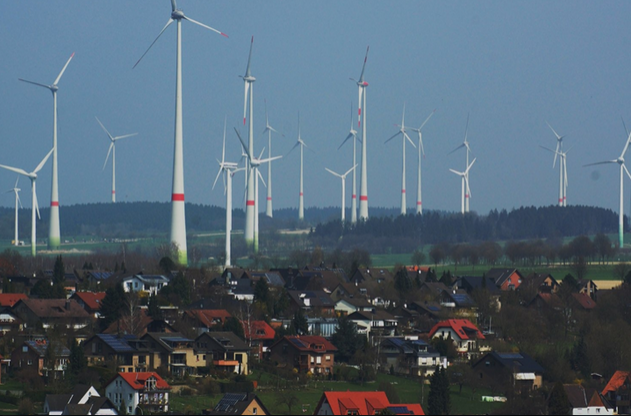
Part of what’s got Germans up in arms is what the wind industry has done to their beloved towns and country-side (for a pictorial taste of the aesthetic destruction – see this article).
And the Germans are not taking what the wind industry has dished up, lying down: they’re getting angrier and more organised by the day.
Germany’s Anti-Wind Energy Elements Morph Into A Massive Network Of Protest Groups… Call Wind Energy “A Lie”
NoTricksZone
4 June 2015
Resistance to the junk green energy is growing in Germany.
Last month a print edition of Germany’s Braunschweiger Nachrichtenfeatured a commentary by the head of a German wind protest organization, Dr. Thomas Carl Stiller. The title: “Madness With Wind Turbines”

Hat-tip K.E. Puls, European Institute for Climate and Energy (EIKE).
In the commentary Stiller says that Germany’s once highly ballyhooed Energiewende (transition to renewable energies) “cannot and will not function“, and what was once only a few single protesters voicing opposition to wind parks, is now an entire nationwide umbrella organization of protest groups against the “subsidy-robbing empire” of wind energy industry.
Stiller describes a technology whose produced energy cannot be stored and which depends on random, unpredictable winds. The technology is so inefficient that builders are now forced to erect 800-foot tall monster size machines in a desperate effort to extract real power. He also writes that “wind energy has done nothing to combat climate change”.
“Despite increased wind energy installation, CO2 emissions in Germany have risen. […] Climate protection and reliable power supply by wind turbines installed on the land is thus a lie.”
Stiller also writes that the maximum output of a wind turbine “is far below its rated capacity” and that the German citizenry is paying 20 billion euros annually for a “misconception“. To illustrate the folly of wind energy, Stiller writes that Germans are paying 20 billion euros a year for a commodity that gets sold on the power exchange for only around 2 billion euros.
What’s encouraging is that Stiller writes:
“German citizens are waking up to this insanity”. He comments that “wind energy would not be able to supply the country even if the entire country were covered with wind turbines”.
Stiller also calls for more research for the health impacts that wind turbines are having and that the energy source has got to be for the good of the public and not profit a few opportunists. He adds:
“Us organized citizens are demanding independent feasibility studies and calling for more transparency during the planning process and that man and nature be put back in the focus.”
NoTricksZone

Demonstrating daily that diversity is not strength!
All Things Related To The Family
defrock.org's principal concern is the environmental and human damage of industrial wind turbines on rural communities
The truth shall set you free but first it will make you miserable
Breaking Political News, Election Results, Commentary and Analysis
Canadian Common Sense - A Unique Perspective from Grassroots Canadians
a wind energy debacle
The Law and its Place in Society
Edgar County Watchdogs
My thoughts...my life...my own way.
Proposed Wind Project on Rocky Ridge
by Steve McIntyre
Trying to stop climate change is like trying to stop the seasons from changing. We don't control the climate; IT controls US.
Wandering Words
WIND WARRIOR
Global Warming/Climate Change is not a problem
 "Mothers Against Wind Turbines™" Phoenix Rising...