Barnard….the Windweasel Troll, that Works for IBM!
https://mail.google.com/mail/u/0/?ui=2&ik=442e1005fd&view=att&th=1486132f1b70d0e0&attid=0.1&disp=inline&safe=1&zw
J A Rovensky
Vicious, grossly inaccurate and sometimes defamatory attacks on professionals and researchers are relentless from the wind industry and its vocal cheer squad. Their targets include individuals such as Dr Nina Pierpont, Professor Bob McMurtry, Dr Michael Nissenbaum, Dr Sarah Laurie, Mr Steven Cooper, Professor Colin Hansen, Mr Les Huson, Mr Rick James and numerous others, who work to uncover the truth of reported acoustic emission related adverse health impacts linked to Industrial Wind Turbines.
One of the most prolific and virulent is someone called Mike Barnard, an IBM employee. It seems he began his attacks when living in Canada, and is now physically located in Singapore. Whilst Barnard claims to be operating independently of his employer, IBM, the amount of time he spends blogging on wind power and smart grid related issues, and the business connections IBM have with the renewables industry with respect to smart grid technology and renewable energy, make his assertion that IBM are not involved and supporting his activities questionable.
When one of Barnard’s cyber bullying victims informed him what he’d written was libellous, Barnard’s comment in response was to the effect that he was laughing at them because he was untouchable by living in Singapore and utilising free blogging software in a “Cloud”? IBM has a strict policy on cyberbullying, and has been specifically made aware of Barnard’s activities. What action has IBM taken to discipline their vocal employee, who is bringing their organisation into considerable international disrepute with his behaviour?
So who is Mike Barnard, and what are his professional qualifications? On Barnard’s personal blog site he states he became interested in blogging on energy concerns several years ago, and this led:
to significant contacts, research and writing related to wind energy and its myriad societal and commercial interconnections, including the electrical grid, wind energy innovations, social license, health, noise and legal aspects.[1]
In a response to comment on one of his blogs he responded with:
For a little context on my background, I was the Business Architect responsible for delivery of the world’s first full public health surveillance system for communicable diseases, … funded by the Canadian government …
On his blog site introduction he states:
IBM was engaged to build the major technical solution which automated management of communicable disease and public health surveillance.
This related to Canada. He goes on to state he:
joined the program in the late 2000’s as the business architect, responsible for understanding policy, epidemiology and other business drivers and balancing them with what was pragmatically possible …
IBM was contracted in 2006 to design a system to be completed in 2007. They completed the design of the program in 2008, but in June 2013 the Canadian Medical Association Journal : Journal de l’Association medicale canadienne (CMAJ:JAMC) published an article which reported since then progress had been delayed because of numerous technical problems and confusion among provinces and little had been heard of the program since, “The concept has gone almost nowhere” [2].
Barnard continues to inform us how he has read through health studies and reviews related to wind power from around the world and claims:
constant and deep access and conversations related to public health management, epidemiology and the nature of medical evidence … That experience and on-the-job education has been invaluable as I’ve read through health studies and reviews related to wind power from around the world …
This has apparently also led to
recognition of my expertise … I’m pleased to say that my material is helping to shape legal defences of wind energy, advocacy programs and investments in several countries.
In addition in 2013 he was assigning a blog “debate” relating to bird flight paths through a proposed Wind Turbine site, as being his impetus to start collecting material, and creating his own personal blog saying:
A few years ago I started down a road that has led to an unexpected place.
However, blogs can be found from him on energy from around 2010 [3], his voyage into health issues seems to have begun around 2012 when he attacked Dr Nina Pierpont and Dr Nissenbaum. Barnard has been involved in blogging on wind energy issues for some time, and he considers himself to be an integral part of the wind industry’s product defence strategy, which is certainly consistent with his behaviour. This is also consistent with how he is perceived by others who are also actively engaged in the same dishonest activities of denying the known adverse health impacts of wind turbine acoustic emissions; known to the wind industry and acousticians to cause damage to health via “annoyance” symptoms including sleep disturbance and body vibrations for nearly thirty years, since the work undertaken by Dr Neil Kelley et al in collaboration with NASA and a number of research organisations and wind turbine manufacturers.
The list of “publications” following these claims relate to blog sites and/or websites which are sites supporting Renewable Energy production and blogs which repeat the misinformation. They are not peer reviewed journal articles, nor has Mr Barnard been qualified to give expert evidence in any jurisdiction on wind turbine health and noise issues.
Barnard proudly displays a list of his 50 “Skills and Expertise” which includes “Wind Energy and Health”. None of the others cover any medical or health skill or expertise, and it hasn’t been possible to locate any medical or health related training or degree, or indeed any other relevant technical, professional or academic qualifications he has achieved with direct relevance to wind turbine noise or health, as he does not provide details of them. This suggests that Mr Barnard does not have that relevant professional background, academic training or expertise.
Just what is Mr Barnard’s specific expertise in this area?
Throughout Barnard’s blogging career he has concentrated on castigating, defaming and ridiculing those who do have qualifications, research and/or authorships, and who are demonstrably independent of the wind industry and from those who benefit financially from its operations.
One person in particular he’s taken aim at is Dr Sarah Laurie from South Australia, who is the CEO of the Waubra Foundation. The Waubra Foundation was established to facilitate independent multidisciplinary research into the impacts of infrasound and low frequency noise and vibration on human health. Wind turbine noise is just one source of noise the Foundation is concerned with.
Dr Sarah Laurie is a fully trained and qualified doctor, with clinical experience as a highly regarded rural General Practitioner, but she is not currently registered to practice medicine because of personal and family health issues and caring responsibilities. In Australia, it is a requirement that to practice medicine, you must be currently registered with the Australian Health Practitioners Regulatory Agency (AHPRA). Dr Laurie is not currently practising medicine with her current work as CEO of the Waubra Foundation. She is not seeing patients, she is not diagnosing conditions, and she is not prescribing medicine. She is listening carefully to what people adversely impacted by environmental noise tell her about their health problems, and the diagnoses their treating health practitioners have given them, if they choose to share that information with her.
Claims made by Mr Barnard (and others working with the wind industry such as Infigen Employee Laura Dunphy, and VESTAS employee Ken McAlpine) that she is deregistered are deliberately false. Implying that she has been “struck off” for professional misconduct is just one example of Barnard’s regular defamatory utterances, which are then repeated by others. Further his claims that she was “forced” to stop using the title of Doctor are also false. Mr Barnard continually deliberately misleads his readers with such comments and is clearly disinterested in the truth.
Because of a spurious complaint to the regulatory authority that she was “practising medicine whilst being unregistered” Dr Laurie voluntarily offered to AHPRA not to use the title “Dr” which retired or non-practising doctors are legally entitled to do in Australia, because she did not wish to mislead anyone about her current non registered status in her work with the Waubra Foundation. There had been no complaints to AHPRA from anyone who Sarah had interacted with that she had misled them as she had always been careful to ensure that anyone contacting her directly for information about their own circumstances was well aware of her current unregistered status. Indeed anyone with any awareness of this issue would be well aware of her current unregistered status because of the wide and frequent publicity this issue was given by the wind industry and its vocal supporters, particularly Professor Simon Chapman, the ABC and Fairfax media.
There is no restriction on anyone else referring to her as “Dr”, nor is there a restriction on her using the title if she was not performing her role as the Waubra Foundation CEO. AHPRA staff expressed their gratitude to her for this offer not to use the title “Dr”, which they accepted, with the proviso that when she reregistered to practice she would resume using the title “Dr”.
This issue was specifically clarified in the Environmental Review Tribunal Decision: Bovaird v. Director, Ministry of the Environment where the judgment stated the following:
The Tribunal finds that this evidence supports Ms. Laurie’s assertion that the AHPRA did not make any finding in respect of the complaint made against her.
Why did Mike Barnard ignore this finding of the Tribunal?
It is clear that he did not mention it because his intent was to deliberately smear Dr Laurie’s professional and personal reputation. It is also clear that the original widely publicised complaint to the NHMRC and AHPRA alleging professional and research misconduct, was done for precisely the same reasons by those within public health and wind industry circles in Australia who were unhappy with the attention the issue of health damage from wind turbine noise was attracting.
Those involved in this sordid episode include senior people in the ranks of public health bodies in Australia, including the Public Health Association of Australia, whose CEO, Michael Moore made the complaint, and whose computer created the defamatory “anonymous” allegation document. Mr Moore has since apologised to Dr Laurie, and the NHMRC CEO Professor Warwick Anderson has also apologised for the NHMRC’s behaviour towards Dr Laurie in a letter to the Chair of the Waubra Foundation, Peter Mitchell. The NHMRC unnamed “spokesperson” had leaked information about the allegations to crikey journalist Amber Jamieson, specifically naming Dr Laurie. Others such as Professor Simon Chapman have admitted they “saw a draft” of the defamatory allegations document, and Infigen Energy’s propagandist Ketan Joshi is uncharacteristically silent when challenged by others on various blog sites about his knowledge and involvement in the production and distribution of this defamatory document. The format of the document was remarkably similar to the way Infigen energy prepares their responses to issues raised by objectors to their environmental assessments.
Among Dr Laurie’s credentials are her positions as a former Examiner for the Australian College of General Practitioners, a former Mid-North Division of General Practice representative and former member of the regional Mental Health Advisory Committee. She was a provider of pro bono services to the local Aboriginal community and a cofounder of the regional Rape and Sexual Assault service. She also undertook emergency care work at the local rural hospital as a visiting medical officer, in addition to her role as an employee, associate and then partner in a local medical practice.
These credentials are not confidential, and are available to Mr Barnard and anyone else who wishes to ascertain her qualifications, just by looking at the Waubra Foundation website [4], and reading the speech given in the Australian Federal Parliament about this matter, by the former Member for Hume, Alby Schultz [5].
Dr Laurie states clearly she has no expertise in acoustics, but does consult regularly and collaborates closely with those who are acousticians, to help ensure she understands what she needs to in relation to exposure levels of infrasound, audible noise and vibration and correlations with reported health symptoms. She also repeats constantly she does not undertake and is not trained to do research in an academic manner, but is actively facilitating the research being conducted by others. What she goes to great pains to explain is that she listens very carefully to the symptoms people living near environmental noise experience themselves and then try and describe. This is a core skill required by rural general practitioners, something she was specifically trained to do and was particularly skilled at. Rural doctors need excellent diagnostic skills, most of which is dependent on taking a very careful clinical history, as they do not have the luxury of specialists “next door” and easy and rapid access to a range of diagnostic facilities which city counterparts take for granted.
Dr Laurie then collects and collates pieces of information given to her by people reporting changes to their health after wind turbines and other industrial noise sources begin operating in their vicinity, looking for similarities and patterns which give important clues as to direct causation. Occasionally people provide her with some of their medical records and other health data, which is kept confidential unless the person concerned gives their permission for the information to be out in the public domain, or the information has already been reported publicly in the media or in oral or written testimony to courts, tribunals, and parliamentary inquiries.
Dr Laurie always maintains confidentiality, even when under significant and very public pressure from others demanding she release information to them for their research. One example is the repeated private and public harassment from Professor Simon Chapman, Professor of Public Health at Sydney University, and Expert Adviser to the Climate and Health Alliance, to release the names of residents forced to leave their homes and other details such as locations of their abandoned homes [6]. Much of that information had been provided to her in confidence, and some of the information could have caused significant harm to the people concerned – for example because of non-disclosure clauses in legal documents signed by people providing the information, or by their close relations. Others requested privacy because of concerns about property damage, burglary or arson to unoccupied homes. It has subsequently emerged from inquiries made by Senator Madigan’s staff, that at the time Professor Chapman conducted his inquiries, he did not have in place prior ethics committee approvals from the Sydney University Ethics Committee. Requests for information were made directly to wind turbine noise affected residents, causing them considerable distress.
Whatever the Bovaird ERT Tribunal said in Ontario, Dr Laurie cannot be objectively considered as having been “diagnosing” patients since she ceased practicing.
Examination of information consisting of health issues diagnosed by treating physicians and discussing this information with the informants does not constitute “making a diagnosis”, which is a process requiring a thorough clinical evaluation by a treating health practitioner. What Dr Laurie did in the Boviard case is no different to what she has done elsewhere, and can only be considered as evaluating the combination of specific individual clinical circumstances with respect to the available research evidence and clinical knowledge. That was precisely what Dr Laurie had been asked to do. She was not asked to diagnose patients, nor would she have done so, as she is well aware of the appropriate constraints on such activities for those who are not currently registered to practice medicine.
Irrespective of the Environment Review Tribunal’s questionable determination in the Boviard case, which is consistent with other questionable decisions made by the same Tribunal resulting in many rural Ontarians being harmed by wind turbine noise because of unsafe and continuing wind turbine development approvals, it is logically impossible for anyone to diagnose someone “before” they have symptoms.
Identifying that some people who have one or more acknowledged risk factors prior to Industrial Wind Turbines beginning to operate provides information about predictable health problems which may ensue with exposure to infrasound and low frequency noise. You don’t have to be a trained doctor or research academic to come to that conclusion, but clearly the knowledge attained from years of study and subsequent clinical practice does put a formerly registered practising medical practitioner in a position where her expertise can be utilised, as an expert witness in this field, without her currently “practising” medicine.
The complete lack of critical thinking used by members of the Ontario Environment Review Tribunal who used such irrational logic to determine whether someone has the ability to offer a hypothesis, is mind boggling at best and disturbingly suggestive of bias at worst.
There are constant references to Dr Laurie not being able to stipulate what distance she determines is a safe distance these turbines should be from people. Dr Laurie consistently states she cannot provide a fixed distance, as there are many variables to be considered and the multi-disciplinary research needs to be undertaken first. After all, not only are turbines becoming larger, and installed in greater numbers in individual projects or through extending existing project many other variables have to be taken into account, such as the geology, wind directions and speed, seasonal changes, temperatures to name some.
Professor Colin Hansen’s research group’s latest acoustic survey at Waterloo Wind Development in South Australia [7] is a good example of the sort of research Dr Laurie has been stating is required for the last four years. That acoustic survey demonstrated that there is indeed a low frequency noise problem for neighbours to Waterloo wind development, and that it can extend out even beyond 8km under certain circumstances.
This is precisely what Dr Laurie stated three years ago; when the Waubra Foundation’s explicit Cautionary Notice was issued on 29th June, 2011. The information which led to the distance of 10km being specified in that document came from adversely impacted residents at Waterloo. Professor Hansen’s team’s research findings have now supported Dr Laurie’s statement in 2011 about the distance of impact and are consistent with the residents’ consistent reports for nearly four years of a low frequency noise problem from the wind turbines at Waterloo, which severely disrupts their sleep.
Much is made by Mr Barnard and others of the “nocebo” effect, whilst they dismiss the existence of “wind turbine syndrome”. However Mr Barnard fails to disclose that British Acoustician Dr Geoff Leventhall specifically acknowledges the existence of the symptoms of wind turbine syndrome, indeed Leventhall stated in June 2011 in a presentation to the National Health and Medical Research Council [8] that he had been familiar with the identical symptoms to WTS which he calls “noise annoyance” for “years”. Leventhall further noted that Dr Nina Pierpont’s contribution to the field of environmental noise was to identify certain risk factors for developing “noise annoyance” symptoms.
For those interested, the presentation and the slide show are available on the NHMRC website, and also on www.wind-watch.org. The relevant slides are slides 42–44, and the footage is between 49 and 52 minutes of the video.
Mr Barnard has also failed to disclose that leading otologist, and Harvard Professor Steven Rauch has recently confirmed that he is seeing patients with the characteristic symptoms of “wind turbine syndrome”. Journalist Alex Halperin had this to say in a recent article [9]:
Dr Steven Rauch, an otologist at the Massachusetts Eye and Ear Infirmary and a professor at Harvard Medical School, believes WTS is real. Patients who have come to him to discuss WTS suffer from a “very consistent” collection of symptoms, he says. Rauch compares WTS to migraines, adding that people who suffer from migraines are among the most susceptible to turbines. There’s no existing test for either condition but “Nobody questions whether or not migraine is real.”
“The patients deserve the benefit of the doubt,” Rauch says. “It’s clear from the documents that come out of the industry that they’re trying very hard to suppress the notion of WTS and they’ve done it in a way that [involves] a lot of blaming the victim.”
Mr Barnard also fails to mention the opinions of rural family physicians such as Dr Sandy Reider, from Vermont, who is at the front line of clinical care for those affected by wind turbine noise, that “wind turbine syndrome” is a euphemistic description which does not sufficiently depict the clinical severity of the clinical cases he is seeing [10].
Mr Barnard fails to mention the opinion of Irish Deputy Chief Medical Officer, Dr Colette Bonner, who has also publicly acknowledged the existence of “wind turbine syndrome” and said that those affected need to be treated with understanding. A recent media report from Ireland stated the following [11]:
The Department of Health’s Deputy Chief Medical Officer, Dr Colette Bonner, has said that older people, people who suffer from migraine, and others with a sensitivity to low-frequency vibration, are some of those who can be at risk of “wind turbine syndrome”.
“These people must be treated appropriately and sensitively as these symptoms can be very debilitating,” she commented in a report to the Department of the Environment last year.”
Mr Barnard, and those whose commercial interests he is working so hard to protect, is involved in a grubby, dishonest, misinformation and vilification campaign, as part of a global defence strategy for the global wind industry. This industry has been well aware of the problems directly caused by wind turbine noise since 1987, when Dr Neil Kelley’s research [12] establishing direct causation of annoyance symptoms from infrasound and low frequency noise was presented at the American Wind Energy Association conference.
Mr Barnard and his associates’ behaviour is further eroding the personal and professional reputations of all those involved, and eroding the reputations of the companies and organisations they work for, including in this instance IBM.
However, perhaps more importantly Mr Barnard’s behaviour is further eroding the public’s confidence in the global wind industry and its social licence to operate. Such tactics in Australia will only result in the lessening of political and public support for the large subsidies from electrical consumers which are required to keep the wind industry operating.
As Professor Ross McKitrick from the University of Guelph in Ontario, Canada, recently pointed out, the wind industry runs on subsidies [13]. Without the support of the public who are funding the wind industry via their mounting electricity bills, and the politicians responsible for the legislation which forces the subsidies to be collected directly from the public, the wind industry in Australia and elsewhere around the world is doomed – a fitting consequence for such a dishonest and health damaging industry which has shattered the lives of too many rural residents and their families for too long.
It’s time, as a growing number of professionals and researchers are openly saying, for the wind industry to accept the problem, and work to eliminate it. “Shooting the professional messengers” as the Energy and Policy Institute publication by Barnard [14] has tried to do, will not stop the litigation for noise nuisance, negligence against complicit acousticians, or applications for injunctions to cease the operation of turbines, and will only further reduce the diminishing social licence for the wind industry to operate.
Footnotes:
1. http://www.barnardonwind.com
2. CMAJ 2013. DOI:10.1503/cmaj.109-4450 June 11 2013. National electronic disease surveillance: a dream delayed
4. http://www.waubrafoundation.com.au
5. http://www.stopthesethings.com May 31, 2013, Schultz Slams Simon Chapman and Mauls Michael Moore in the Big House on the Hill.
6. http://www.reneweconomu.com.au by Simon Chapman, Where are Australia’s wind farm refugees, by Simon Chapman. 3 October 2013 and Abandoning homes due to wind farm : the deep fragrance of factoid. 25 July 2014
7. Kristy Hansen, Branko Zajamesek and Colin Hansen, Noise Monitoring in the vicinity of the Waterloo Wind Farm. School of Mechanical Engineering, University of Adelaide, May 2014
8. http://www.nhmrc.gov.au Leventhalls June 2011 NHMRC presentation, Wind Farms and Human Health Scientific Forum, 7 June 2011
9. http://www.newrepublic.com/article/118138/big-wind-is-better-than-big-oil- by Alex Halperin, June 15, 2014
10. http://www.waubrafoundation.com.au Dr Sandy Reider, Testimony, Wind Noise & Adverse Health Effects PBS Hearing July 29, 2914: Wind Noise and Adverse Health Effects
11. http://www.waubrafoundation.com/2014/i-need-protect-my-child-from-wind-farms Credit: by Celine Naughton/Irish Independent/ Published 9 June 2014
12. Kelly, et al, 1898, Acoustic Noise Associated with the MOD 1 Wind Turbine. Solar Energy Research Institute, Feb 1985
13. http://www.stopthesethings.com Professor Ross McKitrick: Wind Turbines don’t run on wind, they run on subsidies, August 31 2014.
14. http://www.energyandpolicy.org Wind Health Impacts Dismissed in Court, Authors: Gabe Elsner and Matt Kasper, Forward Simon Chapman, August 2014.
Additional References:
http://waubrafoundation.org.au/resources/shepherd-k-hubbard-h-noise-radiation-characteristics- westinghouse-wwg-0600-wind-turbine-generator/
http://waubrafoundation.org.au/resources/swinbanks-m-nasa-langley-wind-turbine-noise-research/
http://waubrafoundation.org.au/resources/moller-pedersen-low-frequency-noise-from-large-wind- turbines/
http://waubrafoundation.org.au/resources/falmouth-mass-judge-muse-decision-shut-down-wind- turbines-causingirreparable-harm/
http://waubrafoundation.org.au/resources/judgement-erikson-v-min-environment-suncor-kent-breeze- case/
http://waubrafoundation.org.au/resources/cherry-tree-wind-farm-vcat-heating/
http://waubrafoundation.org.au/resources/vcat-cherry-tree-wind-farm-hearing-orders/
http://waubrafoundation.org.au NSW Planning Assessment Commission concerning Gullen Range Wind Development. 5 September 2014
https://www.wind-watch.org

We don’t usually pay much attention to the wind power lobby front line soldier Mike Barnard (who is by day an employee of IBM, working in Singapore) but we were amused recently by his diatribe on the claims of health problems from wind turbine noise and low frequency noise. (Mike, it’s this simple: don’t sleep, get sick.)
Claiming that wind power impacts on health have been almost universally dismissed in court, Mr Barnard actually had a “top 10″ list of witnesses who have appeared at Canadian quasi-judicial tribunals, including Ontario community health specialist nurse, Debbie Shubat. Doris Grinspun and the RNAO must be so proud. Anyway, Mr Barnard’s piece prepared for the so-called Energy & Policy Institute is so full of errors it doesn’t need any comment, except perhaps to point out that Ontario’s Environmental Review Tribunals are NOT “court” and the truth is the Green Energy Act and Regulation 359/09 have been so meticulously set up by the wind industry that it is almost impossible for an appeal to be won.
In fact, there was never supposed to be a successful appeal, as lawyer John Terry explained at the Ostrander Point appeal last January, where he represented the wind power lobby, the powerful Canadian Wind Energy Association (CanWEA). He petulantly suggested to the panel of judges that the Ostrander Point success ought never to have happened, and that the judges should provide instructions to the ERT so that this could never happen again.
Open letter regarding Barnard, in an earlier post, today!

The central, endlessly repeated lie (upon which the great wind power fraud rests) is that increasing wind power generation results in decreases in CO2 emissions.
In Australia, the central object of the Renewable Energy (Electricity) Act 2000 is for “renewable” energy to “reduce emissions of greenhouse gases in the electricity sector” (see s3). But, somewhere along the way, what was a CO2 abatement scheme became an industry subsidy scheme which is nothing short of “corporate welfare on steroids” (see our post here).
At no point since that legislation took effect over 13 years ago has the wind industry provided any actual proof that it has in fact reduced CO2 emissions in the electricity sector. When we talk about “proof” we’re not talking about smoke and mirrors “modelling” based on long-term average wind farm output – which ignores the extra gas and coal being burnt (and wasted) in order to balance the grid to account for wild fluctuations in wind power output (see our post here); and to maintain additional “spinning reserve” (see our post here) to account for complete collapses in wind power output – as seen in this post.
As we have pointed out just once or twice – the need for 100% of wind power capacity to be backed up 100% of the time by fossil fuel generation sources means that wind power cannot and will never reduce CO2 emissions in the electricity sector (see our posts here and hereand here and here and here and here and here).
E.ON operates numerous transmission grids in Germany and, therefore, has the unenviable task of being forced to integrate the wildly fluctuating and unpredictable output from wind power generators, while trying to keep the German grid from collapsing (E.ON sets out a number of the headaches caused by intermittent wind power in the Summary of this paper at page 4). Dealing with the fantasy that wind power is an alternative to conventional generation sources, E.ON says:
“Wind energy is only able to replace traditional power stations to a limited extent. Their dependence on the prevailing wind conditions means that wind power has a limited load factor even when technically available. It is not possible to guarantee its use for the continual cover of electricity consumption. Consequently, traditional power stations with capacities equal to 90% of the installed wind power capacity must be permanently online [and burning fuel] in order to guarantee power supply at all times.”
STT is happy to go all out and say that in Australia wind power requires 100% of its capacity to be backed up 100% of the time by conventional generation sources. As just one recent example, on 3 consecutive days (20, 21 and 22 July 2014) the total output from all of the wind farms connected to the Eastern Grid (total capacity of 2,952 MW – and spread over 4 states, SA, Victoria, Tasmania and NSW) was a derisory 20 MW (or 0.67% of installed capacity) for hours on end (see our post here). The 99.33% of wind power output that went AWOL for hours (at various times, 3 days straight) was, instead, all supplied by conventional generators; the vast bulk of which came from coal and gas plants, with the balance coming from hydro.
For wind power to reduce CO2 emissions in the electricity sector it has be a true “substitute” for conventional generation sources. Because it can’t be delivered “on-demand” (can’t be stored) and is only “available” at crazy, random intervals (if at all) wind power will never be a substitute for conventional generation sources (see our post here).
Perhaps the reason that the wind industry has never produced a shred of evidence to show that wind power has reduced CO2 emissions in Australia’s electricity sector is simply because it can’t. Running counter to wind industry claims about wind power abating CO2 emissions, the result of trying to incorporate wind power into a coal/gas fired grid is increased CO2 emissions (see this European paper here; this Irish paper here; this English paper here; this American article and this Dutch study here).
This American study details just why increasing wind power capacity – and trying to incorporate its wildly fluctuating output into a coal and gas fired grid – results in increased CO2 emissions across the electricity sector.
Wind Integration vs. Air Emission Reductions: A Primer for Policymakers
Master Resource
Mary Hutzler
24 June 2010
Many claim that wind generation is beneficial because it reduces pollution emissions and does not emit carbon dioxide. This isn’t necessarily the case. The following article explains a phenomena called cycling where the introduction of wind power into a generation system that uses carbon technologies to back-up the wind actually reduces the energy efficiency of the carbon technologies. Recent studies with actual data have estimated the impact of cycling on air pollution and carbon dioxide emissions.
Energy modelers evaluating the impact of legislation such as Senator Bingaman’s American Clean Energy Leadership Act and the American Power Act proposed by Senators Kerry and Lieberman should take note for their models most likely are underestimating the cost of compliance by incorrectly modeling the integration of wind power into the electricity grid.
Wind is not a new technology. It was one of our principal sources of energy, along with wood and water, prior to the carbon era. But the use of renewables in the pre-carbon age was very different from the current use of renewables. Today, people rely on energy being available 24 hours a day, 7 days a week, 365 days a year, regardless of whether the sun shines, the wind blows, or there are high or low water levels. We now have over 1,000 gigawatts of generating plants[1], and a large and elaborate electrical grid that requires great coordination among system operators to avoid disruptions.
Also, in the pre-carbon energy era, when renewables were the sole source of energy, there were no coal-fired or natural-gas fired power plants to provide back-up power. Studies have found that the efficiency of those carbon-based plants is affected by incorporating wind energy into the system. When a plant’s efficiency is reduced, its fuel consumption and emissions increase, causing unintended consequences that wind proponents do not disclose. Requiring even larger amounts of renewable energy through renewable portfolio standards will only exacerbate this problem.

Background
Our various electricity generating technologies were designed and constructed to meet electricity demand based on their best operating characteristics for meeting portions of the electricity load duration curve. The load duration curve illustrates periods of constant demand that are served by base-load power versus periods of intermediate and peak demand. Owing to their high capital cost, low fuel cost, and high capacity factors, technologies such as coal and nuclear were designed to operate continuously to meet the base-load demand component. Owing to their lower capital costs but higher fuel costs, natural gas technologies, including combined-cycle and turbine plants, were designed to meet intermediate and peak electrical load.
Wind is an intermittent technology since it can generate power only when the wind blows. Its low operating cost (with no fuel component) and the mandates of state Renewable Portfolio Standards (RPS) make it practically a “must take” technology for system operators. RPSs require that a certain amount of electricity generation be produced by renewable fuels. The renewable target mandates tend to start out low but increase over time, with those of most RPS states reaching 15 to 30 percent by 2020 or 2025.[2] Wind tends to be the primary technology for meeting RPS targets, since it is lower in capital cost than solar, thermal, and photovoltaic technologies, the other politically acceptable “green” technologies.
Part of the rationale for introducing RPSs is that the substitution of “green” technologies for carbon technologies is supposed to reduce pollution emissions as well as carbon dioxide emissions. However, studies have shown that this may not be the case. As conventional generation (coal or natural gas) is reduced to make room for wind generation and is then increased as wind generation subsides, its heat rate rises. The heat rate is a measure of a generating station’s thermal efficiency commonly stated in units of Btu per kilowatt-hour. This reduction in efficiency increases its fuel consumption and emissions. When sudden increases or decreases occur in generation output, it is referred to as “cycling”.
The Bentek Study
Bentek did a study of the results of integrating wind into the generation mix of the Public Service Company of Colorado (PSCO), using data from the company’s financial reports, the Energy Information Administration, the Federal Energy Regulatory Commission, the Environmental Protection Agency, and the National Renewable Energy Laboratory.[3] PSCO is a largely coal-fired utility with 3,764 megawatts of coal-fired generators, 3,236 megawatts of gas-fired combined-cycle and gas turbine capacity, 405 megawatts of hydro and pumped storage capacity, and 1,064 megawatts of wind generators. Colorado has an RPS that required 3 percent of the electricity generated by investor-owned utilities come from qualifying renewable technologies by 2007, and 30 percent by 2020.[4]
Colorado’s energy demand is highest during the day, peaking in late afternoon or early evening. Wind generation, however, is greatest between the hours of 9 pm and 5 am; it cannot be counted on to provide power when most needed, and so is used when available to meet the RPS. Most of the time that wind generation is available, it backs out (or replaces) natural gas. However, there are times when coal generation, which provides over 50 percent of PSCO’s base-load generation, is backed out to make room for the wind generation. When this happens, coal generation is cycled, causing its heat rate to increase and resulting in more fuel consumption and emissions. In PSCO, coal cycling predominates because of the low amount of gas generation in the system since most of its gas-fired generation is from turbines and because wind is strongest at night when coal use is even more pronounced.

In the Denver non-attainment area, PSCO has 4 coal-fired plants: Arapahoe, Valmont, Pawnee, and Cherokee. Between 2006 and 2009, these coal-fired plants have experienced higher emissions rates ranging from 17 to 172 percent higher for sulfur dioxide, 0 to 9 percent higher for nitrous oxide, and 0 to 9 percent higher for carbon dioxide. In 2008, Cherokee even switched to a lower sulfur coal, but still ended up with sulfur dioxide emissions higher by 18 percent. And, between 2006 and 2009, these plants reduced their generation by over 37 percent, exacerbating further the increase in emissions.
Because the PSCO data are limited, Bentek checked their results against data from the Energy Reliability Council of Texas, whose utilities are required to report generation levels by fuel every 15 minutes. Texas has the most wind capacity in the country—over 9,500 megawatts.[5] Texas also has an RPS that was instituted during George W. Bush’s governorship and that pushed Texas ahead of California in wind capacity during 2006. The Texas renewable portfolio standard requires that utilities have 5,880 megawatts of renewable capacity by 2015, including a target of 500 megawatts of renewable-energy capacity from resources other than wind. The legislation also set a target of reaching 10,000 megawatts of renewable energy capacity by 2025, although it will be exceeded much earlier.[6] However, even in Texas, which has a large natural gas–fired capacity base, with over 40 percent of its generation being natural gas-fired,[7] coal-fired generation is cycled as is shown in the graph below.

Another benefit that wind power generators get is that their forecast power generation entails no penalty if it is not available. Other generators must provide their own back-up power if their generation is suddenly unavailable. But the owners of wind generators believe that they can’t be held accountable for whether the wind blows and thus for inaccuracies in their forecasting capability. For example, on February 26, 2008, a cold front moved through West Texas and rendered wind’s output 1,000 megawatts less than promised, and that unexpectedly had to be made up by other generating technologies.[8] Only careful and extensive coordination, such as was carried out in West Texas on that cold February day, can prevent brown outs and black outs from occurring.
The Netherlands Experience[9]
Two researchers, C. le Pair and K. de Groot, found that the Netherlands government was overestimating the amount of carbon dioxide reductions associated with wind production. The government was using incorrect data because it did not correct for the reduction in efficiency of the conventional power plants once wind was introduced into the system. Using data provided by CBS, the Dutch Institute for Statistics, the researchers made an estimate of the “turning point” where the efficiency reduction of conventional power plants balances out the fuel savings from wind energy. Using data for 2007, when wind power was at 3 percent, they found the turning point to be at an efficiency reduction of 2 percent based on all the power stations serving the Netherlands. That is, when the efficiency of the back-up plants was reduced by over 2 percent due to cycling caused by the integration of wind energy into the system, fuel use and emissions of the back-up plants increased.
Heat Rate Simulations
An engineer, Kent Hawkins, evaluated several heat rate simulations to represent cycling of the plants when wind is introduced into the system.[10] One set of simulations evaluates wind energy replacing coal power with different technologies serving as the back-up power to wind, in order to evaluate their effect on fuel use and carbon dioxide emissions. He found that because of cycling, carbon dioxide emissions increase with the incorporation of wind energy if coal is the sole back-up power for wind. If coal and gas turbines or gas combined-cycle and gas turbines are used to back up the wind power, carbon dioxide emissions are reduced mainly due to the lower carbon dioxide emissions produced from natural gas generators as compared to coal generators. This is best seen by examining the last bar in the chart below where the lowest carbon dioxide emissions result when natural gas combined-cycle plants are solely used to replace coal.

An interesting consequence of this analysis is that certain areas of the world where wind is integrated into a system that is primarily coal-based may result in an increase in total carbon dioxide emissions from using wind in their generating sector. That is, in these circumstances, wind would not be providing an offset in carbon dioxide emissions, but would actually be providing an increase in those emissions. China, for example, relies on coal for 80 percent of its generation and natural gas for only 2 percent.[11] China also added the most wind power of any country in 2009, 13 gigawatts,[12] ranking third in the world in total wind capacity, with the United States first and Germany second.[13] Since China’s wind would primarily be backed up by power from coal-fired generating units, it is no wonder that China’s carbon dioxide emissions increased by 9 percent in 2009.[14]
Conclusion
As more wind units are built and data become available regarding their integration into conventional energy systems, we will learn more about the effects of wind units on the operation of conventional plants. A few studies have been done showing that the effect of wind integration on both fuel consumption and emission reductions can in fact be negative. Further evaluation of our current wind units and their effects on fuel consumption and emissions should be done before increasing the penetration of renewable energy to the 20 and 30 percent levels currently mandated by some state renewable portfolio standards, and before a national renewable portfolio standard is considered for enactment.
[1] Energy Information Administration, Electric Power Annual,http://www.eia.doe.gov/cneaf/electricity/epa/epat1p2.html
[2] Institute for Energy Research, Energy Regulation of the States: A Wake-up Call, www.instituteforenergyresearch.org/states/
[3] Bentek Energy LLC, How Less Became More: Wind, Power and Unintended Consequences in the Colorado Energy Market,http://www.bentekenergy.com/WindCoalandGasStudy.aspx
[4] Institute for Energy Research, Energy Regulation of the States: A Wake-up Call, http://www.instituteforenergyresearch.org/states/colorado/
[5] American Wind Energy Association,http://www.awea.org/projects/projects.aspx?s=Texas
[6] Institute for Energy Research, Energy Regulation of the States: A Wake-up Call, http://www.instituteforenergyresearch.org/states/texas/
[7] Energy Information Administration, Electric Power Monthly, March 2010, http://tonto.eia.doe.gov/ftproot/electricity/epm/02261003.pdf
[8] The Wall Street Journal, Natural Gas Tilts at Windmills in Power Feud, March 2, 2010,http://online.wsj.com/article/SB10001424052748704188104575083982637451248.html
[9] The impact of wind generated electricity on fossil fuel consumption, C. le Pair and K. de Groot, http://www.clepair.net/windefficiency.html
[10] Wind Integration: Incremental Emissions from Back-Up Generation Cycling (Part V: Calculator Update), Kent Hawkins, February 12, 2010,http://www.masterresource.org/2010/02/wind-integration-incremental-emissions-from-back-up-generation-cycling-part-v-calculator-update/#more-7271
[11] Energy Information Administration, International Energy Outlook 2010, Tables H10, H12, and H13,http://www.eia.doe.gov/oiaf/ieo/pdf/ieoecg.pdf
[12] Global Wind Energy Council, Global wind power boom continues amid economic woes, March 2, 2010, http://www.gwec.net/index.php?id=30&no_cache=1&tx_ttnews[tt_news]=247&tx_ttnews[backPid]=4&cHash=1196e940a0
[13] Global Wind Energy Council, http://www.gwec.net/index.php?id=13, and Global Wind Energy Council, Global wind power boom continues amid economic woes, March 2, 2010, http://www.gwec.net/index.php?id=30&no_cache=1&tx_ttnews[tt_news]=247&tx_ttnews[backPid]=4&cHash=1196e940a0
[14] Reuters, China top carbon emitter for second year running, June 9, 2010, http://alertnet.org/thenews/newsdesk/LDE6580Y1.htm

| Posted: September 07, 2014
By Phil Goodwin

A collapsed turbine
Safety concerns have been raised about the wind energy industry after reports showed two Westcountry turbines collapsed because of faults.
The giant masts crashed down on farmland amid initial rumours of sabotage and claims they had fallen victim to severe weather.
Documents obtained by the WMN on Sunday have revealed that the towers actually toppled over due to defects and mistakes in the construction process.
A 115ft (34 metre) mast at East Ash Farm, Bradworthy, in Devon, tumbled in January 2013, prompting claims of foul play from the local parish council.
Around the same time, a 60ft (18-metre) tower sited at Winsdon Farm, North Petherwin – the family farm of Liberal Democrat Cornwall Councillor Adam Paynter – also came loose from its moorings and fell.
Subsequent investigations by both manufacturers identified further defects and prompted warnings to other sites, including in Somerset, Devon and Cornwall.
Glasgow-based Gaia Wind wrote to owners and overhauled its entire first generation fleet.
Canadian firm Endurance Wind Power said it was also concerned about machines on dozens of locations.
Initial reports suggested high winds may have been responsible for the failures but restricted reports by the Healthy and Safety Executive (HSE), obtained under the Freedom of Information Act (FoI), have blamed the way the towers were secured.
Specialist inspector Darren Nash concluded that the first generation model of the turbine sited in Cornwall appeared “susceptible to fatigue failure” and said Gaia Wind had found “ten units with existing defects” out of the company’s 70 or 80 turbines.
“A plan of remedial actions is in place to address these units,” he wrote.
Endurance Wind Power, makers of the E3120 turbine which fell in Devon, identified a further 29 turbines that might have been affected by a problem with the foundations.
Mr Nash said it had fallen because Dulas – the installation company – had used “cosmetic grout” to cement the structure in place and not the “prescribed” substance.
On his visit to the site on May 8, more than three months later, he also noted that the turbine had already been “re-instated using the original anchor bolts and studs.
He added that “no evidence remained to assist investigation”, recommending that Edurance improve its quality assurance procedures.
Dr Philip Bratby, a retired nuclear scientist and spokesman for the Campaign to Protect Rural England, said several wind turbines in Devon were sited much too close to roads and factories and “pose a real threat to the public”.
“It is not the responsibility of the Health and Safety Executive at the planning stage – they can only get involved after an incident occurs,” he added.
“It has been apparent to me for a long time that most developers of wind turbines and wind farms do not do a proper assessment of safety and of the risks to the public from wind turbines and none of them have acceptable quality assurance procedures in place.”
Alan Dransfield, a campaigner based in Exeter, who visited the Devon site days after the incident and later secured the two reports, said he was “disappointed”.
He criticised the response from the HSE, which rather than publish their findings, said the documents were not available in electronic form then only released the papers after a formal FoI request.
“These wind turbines which collapsed were unsafe and unfit for purpose,” he added.
“We should not have to resort to Freedom of Information Act to find this out.
“The root causes were not high winds but poor design, inferior materials and a systemic failure through the chain of command.”
Martin Paterson, spokesman for Gaia-Wind, said:
the firm and its reselling agents inspected all “first generation” towers, which were designed to the “prevailing engineering standard of the time”.
“This standard was superseded in early 2011 and this tube tower design is no longer available for sale or installation,” he added.
“Our second generation towers are designed to current industry standards reflecting the development of more demanding design protocols in this field.”
Dulas declined to comment on the findings.
The High Court for Western Denmark sets compensation over and above the amount assessed by the government.
By Søren Stenderup Jensen

The judgment is significant as it granted compensation after the erection of the wind turbines. This is contrary to the main rule in the Promoting Renewable Energy Act; however, both the city court and the high court found sufficient legal authority under the act to admit the claim after the erection of the wind turbines.
“Moreover, both courts paid considerable attention to the evaluation of the court-appointed expert. While this is quite normal in Danish case law, it is unusual in cases where an authority such as the assessment authority has previously dealt with the matter.
“Finally, the high court paid attention to the city court’s own observations of the property. It is quite unusual to see such a reference to the observations of a lower court in a higher court’s grounds of judgment.
“The judgment gives cause for optimism to those who intend to challenge decisions of the assessment authority under the Promoting Renewable Energy Act. From a procedural point of view, it seems to be important for the court to see the property at issue to form its own opinion of the level of noise pollution caused by wind turbines.”

By Søren Stenderup Jensen
Depending on their location, wind turbines can cause noise, visual interference and light reflections.
These issues are governed by public and private law, including neighbour law. The main rules regarding noise from wind turbines can be found in Executive Order 1284 of December 15 2011 on wind turbine noise, issued pursuant to the Environmental Protection Act. To some extent, the order safeguards neighbours from noise inconvenience by establishing maximum noise levels from wind turbines in outdoor areas. The noise limit varies depending on the surroundings.
Wind turbines may also cause visual interference which may negatively affect the value of surrounding properties. Thus, the location of wind turbines on land has proved a difficult political issue for years. Every municipality supports the idea of more wind turbines – just not within its own borders.
In order to promote local support for wind energy projects, the Parliament passed the Promoting Renewable Energy Act, which establishes a compensation scheme for neighbours of wind turbines. Under the scheme, those who build one or more wind turbines are obliged to compensate their neighbours for any reduction in property value that the wind turbines may cause, regardless of whether the wind turbines accord with the necessary permits.
The compensation scheme departs from the court-based neighbour law in that it does not operate with a tolerance limit which the neighbour must prove has been exceeded.
The starting point is that the issue of compensation must be settled before the wind turbines are built. However, the Promoting Renewable Energy Act does allow neighbours to claim compensation in certain circumstances thereafter. The competent authority to deal with claims for compensation is the assessment authority set up by the act.
Compensation granted to neighbours under the act has been relatively low so far.
In a recent case before the High Court for Western Denmark the plaintiffs had been awarded Dkr250,000 in compensation for the erection of eight wind turbines by the assessment authority. They brought the matter before the courts seeking higher compensation.
Before the erection of the wind turbines, an environmental study had concluded that the noise level at their property would amount to 38.8 decibels at wind speeds of 12 knots and 40.9 decibels at wind speeds of 16 knots.
Before the city court, a court-appointed expert stated that the reduction in the value of the property amounted to between Dkr600,000 and Dkr800,000. The city court also arranged a visit to the property.
Where the assessment authority found that the plaintiffs’ property would be subject to limited noise pollution, the city court found the level to be more significant. The court further ruled that the plaintiffs had documented their loss of value at Dkr600,000 and thus awarded them an additional Dkr350,000.
Finally, the court held that the plaintiffs had suffered no other economic loss covered by the Promoting Renewable Energy Act. In particular, the court held that the fact that the wind turbines had been erected with all necessary permits prevented the plaintiffs from claiming compensation under neighbour rules.
The High Court for Western Denmark upheld the city court’s judgment, but fixed the compensation at Dkr500,000 because, among other things, there were certain deficiencies in the masonry of the house. However, the court also considered the findings of the court-appointed expert witness who had seen the plaintiffs’ house after the erection of the wind turbines – which the assessment authority had not done – as well as the city court’s own observation of the property. Finally, the court ruled that the Promoting Renewable Energy Act does not restrict the courts’ competence to review decisions from the assessment authority.
The judgment is significant as it granted compensation after the erection of the wind turbines. This is contrary to the main rule in the Promoting Renewable Energy Act; however,both the city court and the high court found sufficient legal authority under the act to admit the claim after the erection of the wind turbines.
Moreover, both courts paid considerable attention to the evaluation of the court-appointed expert. While this is quite normal in Danish case law, it is unusual in cases where an authority such as the assessment authority has previously dealt with the matter.
Finally, the high court paid attention to the city court’s own observations of the property. It is quite unusual to see such a reference to the observations of a lower court in a higher court’s grounds of judgment.
The judgment gives cause for optimism to those who intend to challenge decisions of the assessment authority under the Promoting Renewable Energy Act. From a procedural point of view, it seems to be important for the court to see the property at issue to form its own opinion of the level of noise pollution caused by wind turbines.
For further information on this topic please contact Søren Stenderup Jensen at Plesner by telephone (+45 33 12 11 33), fax (+45 33 12 00 14) or email (ssj@plesner.com). The Plesner website can be accessed at www.plesner.com.

Promoting Parasitic Power Producers
carbon-sense.com
Viv Forbes
17 July 2014
Wind and solar are parasitic power producers, unable to survive in a modern electricity grid without the back-up of stand-alone electricity generators such as hydro, coal, gas or nuclear. And like all parasites, they weaken their hosts, causing increased operating and transmission costs and reduced profits for all participants in the grid.
Without subsidies, few large wind/solar plants would be built; and without mandated targets, few would get connected to the grid.
Green zealots posing as energy engineers should be free to play with their green energy toys at their own expense, on their own properties, but the rest of us should not be saddled with their costs and unreliability.
We should stop promoting parasitic power producers. As a first step, all green energy subsidies and targets should be abolished.
For those who wish to read more:
Wind Power Chaos in Germany:
The reality of green energy:
http://wattsupwiththat.com/2014/07/18/the-stark-reality-of-green-techs-solar-and-wind-contribution-to-world-energy/
Blowing Our Dollars in the Wind
Wind energy produces costly, intermittent, unpredictable electricity. But Government subsidies and mandates have encouraged a massive gamble on wind investments in Australia – over $7 billion has already been spent and another $30 billion is proposed.
This expenditure is justified by the claim that by using wind energy there will be less carbon dioxide emitted to the atmosphere which will help to prevent dangerous global warming.
Incredibly, this claim is not supported by any credible cost-benefit analysis – a searching enquiry is well overdue. Here is a summary of things that should be included in the enquiry.
Firstly, no one knows how much global warming is related to carbon dioxide and how much is due to natural variability. However, the historical record shows that carbon dioxide is not the most important factor, and no one knows whether net climate feedbacks are positive or negative. In many ways, the biosphere and humanity would benefit from more warmth, more carbon dioxide and more moisture in the atmosphere.
However, let’s assume that reducing man’s production of carbon dioxide is a sensible goal and consider whether wind power is likely to achieve it. To do this we need to look at the whole life cycle of a wind tower.
Wind turbines are not just big simple windmills – they are massive complex machines whose manufacture and construction consume much energy and many expensive materials. These include steel for the tower, concrete for the footings, fibre glass for the nacelle, rare metals for the electro-magnets, steel and copper for the machinery, high quality lubricating oils for the gears, fibre-glass or aluminium for the blades, titanium and other materials for weather-proof paints, copper, aluminium and steel for the transmission lines and support towers, and gravel for the access roads.
There is a long production chain for each of these materials. Mining and mineral extraction rely on diesel power for mobile equipment and electrical power for haulage, hoisting, crushing, grinding, milling, smelting, refining. These processes need 24/7 reliable electric power which, in Australia, is most likely to come from coal.
These raw materials then have to be transported to many specialised manufacturing plants, again using large quantities of energy, generating more carbon dioxide.
Then comes the construction phase, starting with building a network of access roads, clearance of transmission routes, and excavation of the massive footings for the towers. Have a look here at the massive amount of steel, concrete and energy consumed in constructing the foundations for just one tower: https://www.youtube.com/watch?v=KX0RhjeLlCs
Not one tonne of steel or concrete can be produced without releasing carbon dioxide in the process.
Almost all of the energy used during construction will come from diesel fuel, with increased production of carbon dioxide.
Moreover, every bit of land cleared results in the production of carbon dioxide as the plant material dozed out of the way rots or is burnt, and the exposed soil loses its humus to oxidation.
Once the turbine starts operating the many towers, transmission lines and access roads need more maintenance and repair than a traditional power plant that produces concentrated energy from one small plot of land using a small number of huge, well-tested, well protected machines. Turbines usually operate in windy, exposed, isolated locations. Blades need to be cleaned using large specialised cranes; towers and machinery need regular inspection and maintenance; and mobile equipment and manpower needs to be on standby for lightning strikes, fires or accidents. All of these activities require diesel powered equipment which produces more carbon dioxide.
Even when they do produce energy, wind towers often produce it at times when demand is low – at night for example. There is no benefit in this unwanted production, but it is usually counted as saving carbon fuels.
Every wind farm also needs backup power to cover the 65%-plus of wind generating capacity that is lost because the wind is not blowing, or blowing such a gale that the turbines have to shut down.
In Australia, most backup is provided by coal or gas plants which are forced to operate intermittently to offset the erratic winds. Coal plants and many gas plants cannot switch on and off quickly but must maintain steam pressure and “spinning reserve” in order to swing in quickly when the fickle wind drops. This causes grid instability and increases the carbon dioxide produced per unit of electricity. This waste should be debited to the wind farm that caused it.
Wind turbines also consume energy from the grid when they are idle – for lubrication, heating, cooling, lights, metering, hydraulic brakes, energising the electro-magnets, even to keep the blades turning lazily (to prevent warping) and to maintain line voltage when there is no wind.
A one-month study of the Wonthaggi wind farm in Australia found that the facility consumed more electricity than it produced for 16% of the period studied. A detailed study in USA showed that 8.3% of total wind energy produced was consumed by the towers themselves. This is not usually counted in the carbon equation.
The service life of wind towers is far shorter than traditional power plants. Already many European wind farms have reached the end of their life and contractors are now gearing up for a new boom in the wind farm demolition and scrap removal business. This phase is likely to pose dangers for the environment and require much diesel powered equipment producing yet more carbon dioxide.
Most estimates of carbon dioxide “saved” by using wind power look solely at the carbon dioxide that would be produced by a coal-fired station producing the rated capacity of the wind turbine. They generally ignore all the other ways in which wind power increases carbon energy usage, and they ignore the fact that wind farms seldom produce name-plate capacity.
When all the above factors are taken into account over the life of the wind turbine, only a very few turbines in good wind locations are likely to save any carbon dioxide. Most will be either break-even or be carbon-negative – the massive investment in wind may achieve zero climate “benefits” at great cost.
Entrepreneurs or consumers who choose wind power should be free to do so but taxpayers and electricity consumers should not be forced to subsidise their choices for questionable reasons.
People who claim climate sainthood for wind energy should be required to prove this by detailed life-of-project analysis before getting legislative support and subsidies.
Otherwise we are just blowing our dollars in the wind.
Viv Forbes
17 July 2014
carbon-sense.com

Wind energy development in the United States has slumped.
Despite record installations in 2012, and eking out a 1-year, $12 billion extension of the wind production tax credit (PTC), new wind capacity last year fell to just 1,087 megawatts, a level not seen in more than a decade. Development in 2014 is showing signs of improvement but the year may not fare much better.
Reasons for the slowdown
The Section 1603 cash grants enacted under ARRA fueled a wind bubble as developers raced to build and qualify their sites. By the end of 2012, the industry’s project pipeline was exhausted with just 43 MW of wind under development in two states. The surge in new capacity created a glut in RPS-qualified generation and eroded demand for wind as states met and/or exceeded their renewable mandates. The shale gas boom further hampered growth by driving down energy prices and harming wind’s economic competitiveness against cheaper, more reliable fuels.
Proponents insist wind energy is a few short years away from thriving without government assistance, but the trends do not support the claim.
For wind to go it alone, average wind capacity factors need to increase dramatically and/or project construction costs must drop dramatically. But that’s not happening according to the U.S. Department of Energy’s (DOE) Wind Technologies Market Report 2013, just released.
The authors, Ryan Wiser and Mark Bolinger from the Lawrence Berkeley National Laboratory (LBNL), report that average capacity factors for projects built after 2005 have been stagnant despite advances in turbine technology. The interior region of the country covering Texas and the plains states continues to show the best capacity factors (36-38%) and lowest project costs ($/kw) but it’s also the most remote. A smaller population means miles of expensive new transmission is needed to transport the energy to higher demand centers east and west.
Turbine prices and project costs may have declined somewhat from 2012, but with only 11 projects in LBNL’s 2013 sample, drawing a firm conclusion about construction costs is premature. The same applies for average wind pricing. According to the report, the national average price for wind dropped to a surprising $25/MWh in 2013, but again, the small sample of power purchase agreements examined was skewed by projects sited in the lowest-priced interior region of the country.
We agree that wind PPAs from 2012-13 have seen some decline in prices but nowhere near $25/MWh in most areas of the country and not for the reasons cited. Wind power is not more competitive. Rather, its pricing in the U.S. is under severe pressure because of the shale gas boom and the accumulation of new wind capacityconcentrated in just twelve states, which has lowered demand.
Also, by constructing tens of thousands of megawatts of generation that produces largely off peak, wind developers actually hurt their own energy sales by driving down wholesale prices, which makes the PTC even more critical.
Subsidizing Big Wind
The PTC offsets the high price of wind energy, giving the false impression that wind is competitive with other resources, but at 2.3¢/kWh, the subsidy’s pre-tax value (3.5¢/kWh) equals, or exceeds the wholesale price of power in much of the country! The tax credit provides a significant out-of-market revenue source for developers by shifting costs to taxpayers at large. At current energy prices, we’re not convinced wind power can demonstrate sustained growth without the PTC, and this is confirmed in EIA’s latest Annual Energy Outlook 2014.
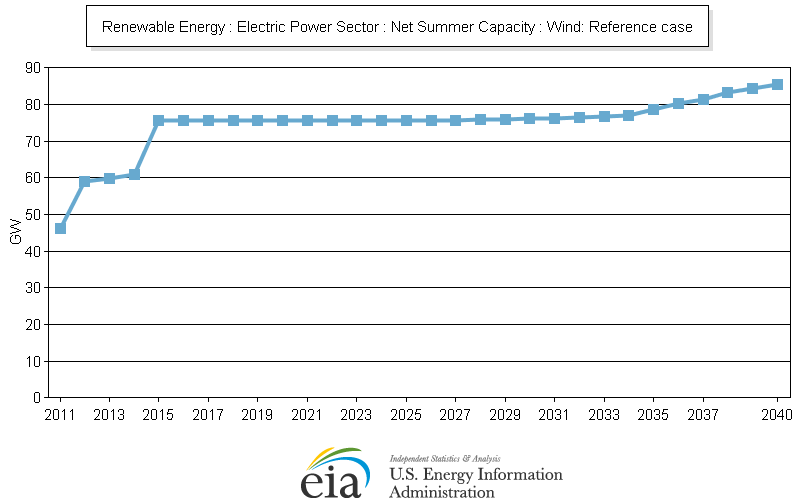
According to EIA, if the expired PTC is allowed to stay expired, their models show an expected stair-step increase in wind capacity by 2015 that flattens out for the next decade until gas prices rise and technology improvements make wind more competitive (see chart). If the PTC and the 30% ITC were made permanent EIA shows it would drive more renewables, particularly wind and solar, but at a significant cost: $4.5 billion/year from 2014 to 2040.
So what’s next
Big wind grew up on the tax credit, developed market plans and forecasts that relied on it, and now the wind PTC appears to be a required component of the industry’s economics. That was never the intent of Congress when this temporary tax credit was enacted 24 years ago. The PTC and ITC are now expired and we can expect roughly 15,000 MW of new wind to be built in response to the 1-year extension passed in 2013. After that, it’s over. It’s now time for taxpayers to consider better ways to spend their money.

A power generation system that can’t produce power on demand is no system at all. Wind power – entirely dependent on the weather – has consistently proven itself incapable of supplying meaningful power – requiring 100% of its capacity to be backed up by fossil fuel generation sources 100% of the time, both here (see our posts here and here andhere and here and here and here and here and here) and in Europe (seeour post here).
While the greentard shrugs and mumbles something about “battery technology improving” when presented with the fact that wind power can only ever be delivered at crazy, random intervals (see our post here) – those in touch with reality point to the social and economic catastrophe just waiting for the next occasion when wind power output plummets.
Here’s a great little piece from the Independent outlining the lunacy of our reliance on wind power and the potentially fatal consequences of placing faith in pure fantasy.
Energy policy based on renewables will win hearts but won’t protect their owners from frostbite and death due to exposure
Kevin Myers
Independent.ie
7 February 2012
Russia’s main gas-company, Gazprom, was unable to meet demand last weekend as blizzards swept across Europe, and over three hundred people died. Did anyone even think of deploying our wind turbines to make good the energy shortfall from Russia?
Of course not. We all know that windmills are a self-indulgent and sanctimonious luxury whose purpose is to make us feel good. Had Europe genuinely depended on green energy on Friday, by Sunday thousands would be dead from frostbite and exposure, and the EU would have suffered an economic body blow to match that of Japan’s tsunami a year ago. No electricity means no water, no trams, no trains, no airports, no traffic lights, no phone systems, no sewerage, no factories, no service stations, no office lifts, no central heating and even no hospitals, once their generators run out of fuel.
Modern cities are incredibly fragile organisms, which tremble on the edge of disaster the entire time. During a severe blizzard, it is electricity alone that prevents a midwinter urban holocaust. We saw what adverse weather can do, when 15,000 people died in the heatwave that hit France in August 2003. But those deaths were spread over a month. Last weekend’s weather, without energy, could have caused many tens of thousands of deaths over a couple of days.
Why does the entire green spectrum, which now incorporates most conventional parties across Europe, deny the most obvious of truths? To play lethal games with our energy systems in order to honour the whimsical god of climate change is as intelligent and scientific as the Aztec sacrifice of their young. Actually, it is far more frivolous, because at least the Aztecs knew how many people they were sacrificing: no one has the least idea of the loss of life that might result from the EU embracing “green” energy policies.
Frau Merkel has announced that Germany is going to phase out nuclear power, simply because of the Japanese tsunami. Well, that is like basing water-collection policies in Rhineland-Westphalia on the monsoon cycle of Borneo.
As I was saying last week, the Germans have a powerfully emotional attachment to everything that is “green”, and an energy policy based on renewables will usually win German hearts. But it will not protect the owners of those hearts from frostbite and death due to exposure, for wind can often be not so much a Renewable as an Unusable, and also an Unpredictable, an Unstorable, and – normally when it’s very cold – an Unmovable.
The seriousness of this is hard to exaggerate. The temperature in the Baltic countries last weekend was -33 degrees Celsius. The Eurasian landmass from Calais to Naples to Siberia was an icefield in which hundreds of millions of people were trapped. Without coal, oil and nuclear energy, mass deaths of the old and the young would have occurred on the first night. Three nights of such conditions, and even the physically fit would have been dying of exposure, as the temperature inside dwellings fell and began to match that of the outside, an inverse image of what happened during the French heatwave 10 years ago, when there was no escape from the heat.
Yet you will see nowhere in Dail Eireann, or Brussels, or the Palace of Westminster, a serious discussion about energy policies based on these realities, or which acknowledges that wind usually doesn’t blow when it is very cold, or that even when you have strong and steady winds blowing, you will still have to have created a parallel and duplicate energy supply to provide cover for when the wind stops. And merely to create that standby energy system will generate a zillion tons of carbon dioxide.
Wind power in Ireland actually produces only 22pc of its capacity: would you spend €100,000 on a car if it meant that €78,000 of the purchase price was wasted? It gets worse. On a really cold day, we actually need about 5,000 megawatts, but yesterday wind was producing under 50 megawatts: a grand total of 1pc of requirements.
Yet despite such appalling figures, we legally prohibit civil servants from even looking at the nuclear option. They won’t even take a phone-call on the subject. Instead, the fiction has taken hold amongst our media classes that we are close to being an exporter of renewable energy through the much-vaunted interconnector with Britain. But this is grotesquely untrue. We shall actually be exporting through the connector only 3pc of the time, and importing 86pc, with the system otherwise idle.
Mad, isn’t it? And madder still that RTE or the BBC will continue to trot out their pet wind-enthusiasts to bluster balderdash and poppycock about global warming and how renewables are the solution – and without the contrary point of view ever being given an airing.
This is dogma, as created, promulgated and enforced by the John Charles McQuaids of our time – and if sceptics are not actually anathematised from the pulpit, they are ruthlessly and systematically ignored. These dishonest, hypocritical and deceitful energy policies are now widely accepted by our political and teaching classes as being the very embodiment of environmentalist virtue. Such imbecilic virtue, if implemented as energy policy across Europe, could have brought about a human catastrophe last weekend.
Independent.ie

Demonstrating daily that diversity is not strength!
All Things Related To The Family
defrock.org's principal concern is the environmental and human damage of industrial wind turbines on rural communities
The truth shall set you free but first it will make you miserable
Breaking Political News, Election Results, Commentary and Analysis
Canadian Common Sense - A Unique Perspective from Grassroots Canadians
a wind energy debacle
The Law and its Place in Society
Edgar County Watchdogs
My thoughts...my life...my own way.
Proposed Wind Project on Rocky Ridge
by Steve McIntyre
Trying to stop climate change is like trying to stop the seasons from changing. We don't control the climate; IT controls US.
Wandering Words
WIND WARRIOR
Global Warming/Climate Change is not a problem

