Wynne Protects her Granddaughters “Future”, at the Expense of My Child’s Well-Being, NOW!

An Ill-Wind in Ontario

78808847Despite rising public complaints about adverse health effects from industrial wind turbines, thousands continue to be erected across the province.

Environmentalists often talk about people whose lives are ruined by man-made global warming.

But they never mention the lives that are devastated by misguided climate change policy.

There is no better example than the debilitating human health impacts of the hundreds of thousands of industrial wind turbines (IWTs) that are being erected around the world to supposedly mitigate climate change.

In “Adverse health effects of industrial wind turbines,” a 2013 paper in the magazine of the College of Family Physicians of Canada, Dr. Roy D. Jeffery, Carmen Krogh, and Brett Horner explained, “People who live or work in close proximity to IWTs have experienced symptoms that include decreased quality of life, annoyance, stress, sleep disturbance, headache, anxiety, depression, and cognitive dysfunction.”

“The problem is not just cyclical audible noise keeping people awake but also low frequency infrasound which can travel many kilometres,” notes Dufferin County-based Barb Ashbee, who says she was forced out of her Amaranth, Ontario home by the siting of IWTs too close to it.

“Infrasound goes right through walls,” said Ashbee, operator of the Wind Victims Ontario website. “It pummels your body.”

Tens of thousands of complaints have been received by governments around the world.

Sherri Lange, CEO of North American Platform Against Wind, said, “I have personally received hundreds of phone calls from distressed people who need to vacate their homes [because of IWTs].”

Lange contended governments try to not address the issue.

“It is my experience from talking to doctors, researchers and other high-level professionals, that governments seem to be (under the influenced of) the industry.”

Ontario Premier Kathleen Wynne promised her government would not force any of the 6,736 IWTs being erected by the province into “unwilling communities”.

To date, 90 communities have declared themselves as “Unwilling Hosts”, yet construction is underway, or planned, in many of these areas.

For example, in West Lincoln and surrounding regions, wind developers have received approval to install at least 77 three-Megawatt IWTs, each as tall as a 61-storey building, despite strong public objections.

Local resident Shellie Correia is particularly concerned.

Her 12-year-old son, Joey, has been diagnosed with Sensory Processing Disorder and it is crucial that he live in a quiet environment.

But now, as part of the Ontario government’s climate change plans, an IWT will be sited only 550 metres from his home, the closest “setback” allowed in Ontario for residents who do not sign lease agreements with wind companies.

The province, which cites a 2010 report from its Chief Medical Officer of Health that found no direct causal links between IWTs and adverse health effects, has claimed the province’s setbacks are “the most stringent in North America”.

In reality, most jurisdictions in Canada, the U.S., Australia, and Europe require greater setbacks. Two kilometres is commonplace.

As Correia explained in her January, 2015 presentation before the government’s Environmental Review Tribunal, “On top of the incessant, cyclical noise, there is light flicker, and infrasound. This is not something that my son will be able to tolerate.”

Correia is supported by her son’s pediatrician, Dr. Chrystella Calvert, a specialist in the care of children with developmental and mental health problems.

Calvert says, “I, as a ‘normal brain’ individual would not want this risk [of an IWT] to my mental health (or my children’s) in my neighbourhood.”

Like most governments, Ontario officials insist the adverse health effects of IWTs are minimal, citing various studies.

But there is much scientific evidence to the contrary and studies are lacking with regards to children.

Krogh, one of the authors of the report on health problems linked to IWTs that appeared in the magazine of The College of Family Physicians of Canada, wrote in a May 13, 2013 open communication to Canada’s health minister, “Vigilance and long-term surveillance systems regarding risks and adverse effects related to children are lacking. … This evaluation should take place before proceeding with additional approvals.”

But the approvals go ahead regardless.

As Correia notes, “Wynne speaks about ‘protecting’ her granddaughter’s future (in defending her government’s plan to introduce carbon pricing through cap-and-trade.) Why then, is it not important for her to protect my son, now?”

As the Green Scam Implodes, the Wind Weasels Scream Louder!

‘Greens’ Gamble on Your Future; while PM Stops CEFC from Laying Wind Power Bets

kenny-rogers-420x0

****

A little while back, that great philosopher, Kenny Rogers spelt out the rules for Gamblers in clear and simple terms:

You got to know when to hold ‘em, know when to fold ‘em,

Know when to walk away and know when to run.

You never count your money when you’re sittin’ at the table.

There’ll be time enough for countin’ when the dealin’s done.

That sound and sage advice is ignored in the breach by the wind industry, its parasites and spruikers.

Every time there’s a ‘little blow’ – and wind power output registers more than the usual piddling fraction of its ‘installed capacity’, there’s a flurry of Tweets and blog posts about the ‘monumental’ (but always ‘momentary’) energy effort. All laced with the kind of tear-filled joy that accompanies cheers for a disabled athlete, who’s just won Olympic Gold.

But, when it comes to cheering on the ‘disabled’ energy runner, wind power fans are always in breach of the Gambler’s 3rd rule, about counting their money while sittin’ at the table – they always count too loud and too soon.

And, just like the Gambler, the greentard is always quick and ready to tell you about their “wins”, but never about their “losses”.  When he’s down on his luck, the Gambler will happily lie to himself, friends and family about his failing fortunes – the greentard Gambler is no different.

In the last two posts (here and here) we popped up the some of the “track results” for wind power and, as laid out in dozens of pictures, its shameful ‘form’ would have had it “scratched” from the book, long ago – but for the gullible and naive (not to mention corrupt) among our political betters that control the field.

We’ll start with another example of how the “Gambling Bug” has displaced common sense, with greentards cock-a-hoop about “a single windy NIGHT in Denmark” – said to herald a ‘new dawn’ in our wind powered ‘future’.

GetUp! striving for an Australia where wind power meets 3am demand
Freedom Watch
Brett Hogan
14 July 2015

The hearts of climate change lobbyists were aflutter recently with news that wind farms had generated 140 per cent of Denmark’s electricity demand, and local advocates contrasting this with the Abbott Government’s supposed ‘war on wind’.

What this story is really saying is that in a country with a population the size of Victoria (around 5.6 million) and less than half the geographical area of Tasmania (at 43,000 square kilometres), wind power is able at 3am in the morning, when very few people are using electricity, to generate electricity in excess of demand.

Great work!

To get a sense of what 3am demand for electricity looks like, here it is this morning in Victoria:

400Energy_demand

****

Denmark is of course famous for having the most expensive electricity prices in the world and enjoys the luxury of being close enough to Germany, Sweden and Norway to buy their excess electricity (in part supplied by significant nuclear and hydroelectric facilities) when the wind isn’t blowing.

Wind farms turn the economics of energy markets upside down. Traditional power plants, like any other commodity, generate a product (power) that is sold in a market competing with other providers, and charging a price that is set balancing demand and supply.

However, wind farms, which are typically only economical in the first place due to significant government subsidies, which often include fixed tariffs (so much for the free market) actually rob the market of price signals when the wind blows. It can destroy the economics of electricity providers that need to stay in the market as backup for the 70 per cent of the time that the wind doesn’t blow.

Every country needs cheap and affordable electricity to build and sustain a modern economy and for its people to enjoy quality of life.

Australia has a population of almost 24 million people spread over 7 million square kilometres with an electricity demand more than 6 times that of Denmark, and no neighbouring country’s electricity to fall back on. Denmark offers no lessons for Australia other than “Don’t do this.”

Chris Berg in The Drum today wrote about the history of the Clean Energy Finance Corporation and its political genesis. The Abbott government was right to follow the lead of the United Kingdom and instruction to the Clean Energy Finance Corporation to no longer invest in wind or small-scale solar facilities.
Freedom Watch

roulette-table-2

****

Now, while the wind industry and its greentard-gamblers are ready to keep rolling the dice with our energy future, thankfully, the PM, Tony Abbott and his Vice-Squad, Treasurer “Smokin’” Joe Hockey and Mathias “The Terminator” Cormann have tipped the gaming tables and prevented the Clean Energy Finance Corporation from laying anymore high-risk bets, with taxpayers’ money. Here’s a little piece on the Vice-Squad’s raid.

There’s no ‘war on wind’, just MPs doing their job
Chris Berg
14 July 2015
The Drum

There are a lot of objectionable things in Australian politics, but Government ministers directing the Clean Energy Finance Corporation to stop funding new wind farm projects doesn’t rate, writes Chris Berg.

There was a lot of heat in the debate about the Clean Energy Finance Corporation over the weekend, but not much light.

On Sunday, Fairfax papers reported the Abbott Government had directed the CEFC to stop funding new wind farm projects.

Social media was livid. Tony Abbott was waging a “war on wind power”. How dare the Abbott Government presume to interfere with such a virtuous independent market program to tackle climate change?

That reaction was, to put it mildly, a load of nonsense. The Government’s direction to the CEFC is not unprecedented interference in an independent body. Nor is the CEFC a “market” mechanism. The CEFC is a government program whose funding policies are set by the executive.

Yes, the Coalition wants to abolish the CEFC outright. But it can’t. So the Government says it would rather the CEFC focus on funding innovation rather than established technology. There are a lot of objectionable things in Australian politics. This doesn’t rate.

The CEFC’s enabling legislation – which was written and introduced by the Gillard government and passed without Coalition support – allows the sitting government to do exactly what the Coalition is doing now. Asnoted in an explanatory memorandum authored by the Gillard government:

It is appropriate that the Government, as manager of the economy and owner of the Corporation, have a mechanism for articulating its broad expectations for how the Corporation’s funds will be invested and managed by the Board.

So each year the government is required to provide the CEFC with an investment mandate direction.

The memorandum specifically nominated “allocation of investments between different types of clean energy technologies” as one of the areas in which ministers might issue a direction.

What independence is provided by the CEFC Act is a requirement that ministerial directions not be contrary to the CEFC’s statutory obligations, and that ministers must not direct or prevent CEFC investments in specific companies. All fair enough.

With these provisions, the Gillard government gave itself the statutory leeway to direct the CEFC’s investment direction. If it didn’t want an Abbott Government to have the same leeway, it should have written the legislation differently. It knew the Coalition was opposed to the CEFC.

Anyway, that discretion is entirely proper. The CEFC is not an ethereal, non-political part of the Australian social fabric. It is the result of a four-year-old political compromise, designed to funnel money into one particular sector of the economy as part of the quid pro quo for theGreens’ carbon tax support.

So it’s a little bit silly to hear (as we did over the weekend) that by changing the CEFC’s mandate the Abbott Government is “picking winners”. That’s exactly what the CEFC was designed to do. The CEFC was designed to pick winners. It was designed to choose investments that it felt were not being adequately funded by open capital markets.

And the CEFC legislation already favours specific technologies. The body is not allowed to invest in carbon capture and storage or nuclear power. Nor can it invest in non-Australian projects. This last constraint seems a little peculiar if you think the CEFC’s ultimate goal is to reduce carbon emissions – a global, not a national, problem. But foreigners can’t vote.

Because it is not driven by the profit motive in a competitive market, the CEFC has to rely on non-market criteria on which to evaluate alternative investments. Right now that is done by these folk – the board of the CEFC. All the Abbott Government’s no-wind mandate does is constrain their criteria some more.

The idea that the CEFC is a “commercial” operation is nonsense. If it makes a profit consistently then it is a good candidate for privatisation. Why should the government own a profit-making financier? Why would it need to?

The CEFC got upset earlier this year when the Abbott Government asked it to lift its investment returns, asking it to “consistently outperform the market by a large margin”. But if the CEFC can’t beat the market with its government support, then the case for its continued existence is pretty weak.

Australia has a long history of government-owned banks like the CEFC – banks designed to push money into politically favoured sectors.

Who now remembers the Commonwealth Development Bank or the Australian Industry Development Corporation? Or the Commonwealth Bank’s Mortgage Bank Department and Industrial Finance Department? Or the joint public-private ventures of the Australian Resources Development Bank, the Primary Industry Bank of Australia, or the Australian Banks’ Export Refinance Corporation?

These banks were abolished or privatised because Australia came to recognise that markets allocate capital better than bureaucrats.

Right now there is a majority in the Senate preventing the abolition of the CEFC.

But it is almost inevitable that one day parliament will end the CEFC. Just as it ended all its other special development banks.
The Drum

abbott, hockey, cormann

More Evidence, that Wind Power is a FRAUD!

The Wind Power Fraud (in pictures): Part 1 – the South Australian Wind Farm Fiasco

Definition of fraud

****

In today’s post we lay out the wind power fraud in pictures, as it’s perpetrated in, what’s referred to as, ‘Australia’s wind power capital’, South Australia (tomorrow we expand the net to capture the debacle on the entire Eastern Grid).

To call the ‘performance’ of SA’s 17 wind farms (spread over a vast area of the State – with an installed capacity of 1,477MW) over the last few months “diabolical” is to flatter them.

SA’s Labor government has been talking up a wind powered future for months now – it’s presiding over the worst unemployment in the Nation, at 8.2% and rising fast – and seems to thinks the answer is out there somewhere – ‘blowin’ in the wind’. The fact that its wind power debacle has led to South Australians paying the highest power costs in the Nation – if not (on a purchasing power parity basis) the highest in the world – and, yet, the dimwits that run it wonder why it’s an economic train wreck (see our posts here and here).

Well, today, STT – always ready to rain on the wind industry’s parade – as well as the gullible and corrupt that cheer it on – spells it out in pictures – that even the most intellectually interrupted should be able to grasp.

The derisory data that follows comes courtesy of Aneroid Energy. We’ll start with a quick look at SA’s monthly performance (oh, and if the graphs appear fuzzy, click on them and they’ll pop up crystal clear in a new window).

May 2015 SA

Looking a bit like the meanderings of a drunken spider that had dipped one leg in the ink-well and staggered over the page, that’s the nonsense that wind farms can deliver power as an “alternative” to on-demand power generation sources such as hydro, gas and coal belted, yet again.

With 31 ‘chances’ to make a meaningful contribution to lighting up the230,000 homes said by wind power outfits to be ‘powered’ by their wind farms in SA – output collapses 13 times to less than 100MW – or less than 6.8% of the total installed capacity of 1,477MW.

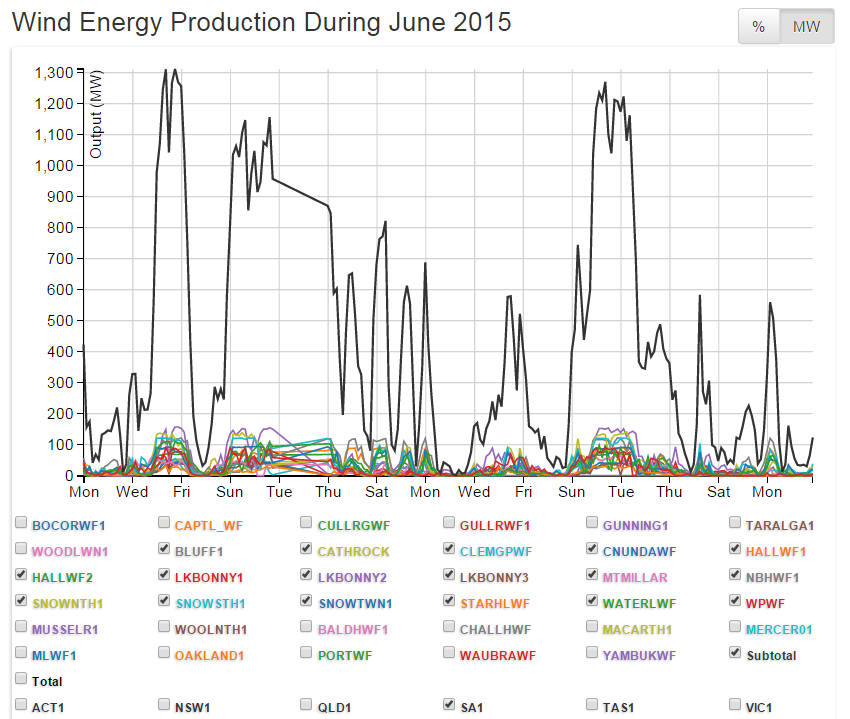
Here’s the total output from all wind farms in SA for June 2015.

June 2015 SA

Having hardly lit up the screen for much of May, you’d think that June would see a better effort – but, oh no. Total output spends more time below 200MW (or 13% of installed capacity) than above. And hits the bottom of the pool more than 7 times – with ‘output’ failing to power a single kettle – let alone the hundreds of thousands of SA homes we’re constantly told are ‘powered’ by the wind.

Here’s the total output from all wind farms in SA for the start of July 2015.

July 2015 SA

Looking more like the fat bloke bouncing around in the deep-end of the local pool, after a long lunch, July’s effort (so far) isn’t much better than the months before.

A couple of short-lived ‘spurts aside, and the rest is largely a ‘joke’: crashing by around 1,000 MW over 24 hours; and almost repeating the ‘performance’ a few days later with a precipitous plummet of over 500 MW in a couple of hours – makes it pretty clear that the words ‘reliable’ and ‘wind power’ don’t belong on the same page, let alone in a sensible sentence.

Spending days struggling to produce 200MW; hours and hours producing less than half that (or less than 6.7% of capacity); and 50MW (3.38%) or less for hours at a stretch, tends to take the gloss off the glory heaped on SA’s wind power dream; and suggests its future will be more of an energy nightmare.

Having taken a ‘helicopter view’, we’ll zoom in now – for a closer look at some of the more outlandish results on: May 3, 16, 25 and 26; June 12, 13, 14, 16, 17, 20, 29 and 30; July 2, 3 and 7.

3 May 2015 SA

Entire SA Grid – 3 May 2015 – from midnight to 9pm (21hrs):

Total wind farm output: midnight to 9pm – never more than 100MW; from 3am to 8pm (17hrs) – never much more than 50MW; and during the same period collapsing to ZERO around 6am, and 5pm to 6pm.

Output as a percentage of total installed wind farm capacity: midnight to 2 am – 3.4%; 7am to 2pm – 1.7%; 2am to 9pm – 3.38%; 6am and 5pm to 6pm – ZERO%.

16 May SA

Entire SA Grid – 16 May 2015 – from 1am to 12.30pm – a total collapse of 720MW to ZERO:

Total wind farm output: 11.30am to 5pm (5.5hrs) – never more than 100MW; collapsing to ZERO from 12.30pm to 2pm (1.5hrs).

Output as a percentage of total installed wind farm capacity: 11.30am to 5pm (5.5hrs) – never more than 6.8%; collapsing to ZERO% – from 12.30pm to 2pm (1.5hrs).

25 May SA

Entire SA Grid – 25 May 2015 – from 8am to noon – a collapse of 325MW to ZERO – a 100% drop in output, in around 4hrs.

Total output: from 11am to 9pm (10hrs) – never more than 50MW; from noon to 4pm (4hrs) – ZERO.

Output as a percentage of total installed wind farm capacity: 11am to 9pm – less than 3.85%; from noon to 4pm – ZERO%.

26 May SA

Entire SA Grid – 26 May 2015 – from midnight to 6pm (18hrs):

Total wind farm output: from midnight to 6pm – never much more than 350MW; from midnight to 2am 150MW; from 8am to 4pm – never more than 200MW; and falling to 90MW at 11am.

Output as a percentage of total installed wind farm capacity: from midnight to 2am – 10%; 8am to 4pm – never more than 13.5%; and dropping to 6.1% – at 11am.

Now for a closer look at June 2015.

12 June SA

Entire SA Grid – 12 June 2015 – from midnight to 4pm a collapse of over 600MW:

Total wind farm output: 10am to 6pm – less than 150MW; 3pm to 5pm – dropping to 50MW.

Output as a percentage of total installed wind farm capacity: 10am to 6pm – 10%; and 3pm to 5pm  – dropping to 3.85%.

13 June SA

Entire SA Grid – 13 June 2015 – from 9am to 3pm – a collapse of 750MW – 800MW to 50MW – or an output drop of 94% – at a rate of 125MW/hour:

Total wind farm output: from 2pm to 8pm – never much more than 100 MW; from 3pm to 5pm – around 50MW.

Output as a percentage of total installed wind farm capacity: 2pm to 8pm – between 6.8% and 10%; 3pm to 5pm – around 3.85%.

14 June SA

Entire SA Grid – 14 June 2015 – from 8am to 3pm – a collapse of over 650MW – from 700MW to 30MW – or a 96% drop in output:

Total wind farm output: from 1pm to 4pm (3hrs) – less than 100MW – dropping to 30MW.

Output as a percentage of total installed wind farm capacity: 1pm to 4pm – less than 6.8% – dropping to 2.03%.

16 June SA

Entire SA Grid – 16 June 2015 – 24 hours – never more than 140MW:

Total wind farm output: from midnight to 5pm (17hrs) – less than 30 MW; from 3am to 7am (4hrs) – ZERO; falling to ZERO between 9am and 11am.

Output as a percentage of total installed wind farm capacity: never more than 10% for the entire 24 hour period; midnight to 5pm – less than 2%; with ZERO% produced for around 5hrs.

17 June SA

Entire SA Grid – 17 June 2015 – 24 hours – never more than 260MW – or 17.6% of capacity:

Total wind farm output: from 5am to 8am – less than 140MW; dropping to 100MW at 8.30am.

Output as a percentage of total installed wind farm capacity: never more than 17.6%; 5am to 8am less than 9.4%; falling to 6.8%.

20 June SA

Entire SA Grid – 20 June 2015 – from midnight to 6pm (18hrs) – never more than 70MW:

Total wind farm output: from midnight to 6pm – less than 70MW; 3am to 6am (3hrs) – around 25MW; from 1pm to 6pm (5hrs) – 25MW; falling to 10MW – around 4pm.

Output as a percentage of total installed wind farm capacity: midnight to 5pm – less than 4.7%; 3am to 6am – 1.7%; 1pm – 6pm – 1.7%, falling to 0.7% – at 4pm.

29 June SA

Entire SA Grid – 29 June 2015 – from 3am to 1pm – an almost total collapse of 550MW to 10MW – or a 98% drop in output:

Total wind farm output: from 1pm to 5pm (4hrs) – never more than 10MW; from 6pm to midnight (6hrs) – 50MW – briefly rising to 170MW and dropping to 90MW.

Output as a percentage of total installed wind farm capacity: from 1pm to 5pm – 0.7%; 6pm to midnight – 3.3% – briefly rising to 11% – dropping back 6.1%.

30 June SA

Entire SA Grid – 30 June 2015 – for the 24 hour period – never more than 200MW:

Total wind farm output: from 1am to 7pm (18hrs) – never more than 80MW; from around 3am to around noon – less than than 40MW and closer to 20MW for that period; falling to less than 20MW around 4pm.

Output as a percentage of total installed wind farm capacity: 1am to 7pm (6hrs) – never more than 5.4%; from around 3am to around noon (9hrs) – less than than 2.7% and closer to 1.3% for that period; falling to less than 1.3% around 4pm.

Now a look at the scoreboard for July, so far.

2 July SA

Entire SA Grid – 2 July 2015 – a total collapse of output over the period – 700MW to around 10MW:

Total wind farm output: from noon to midnight (12hrs) – never more than 150MW; generally around 100MW – falling to 10MW around 10pm to midnight.

Output as a percentage of total installed wind farm capacity: from noon to midnight (12hrs) – never more than 10%MW; generally around 6.8% – falling to 0.7% around 10pm to midnight.

3 July SA

Entire SA Grid – 3 July 2015 – for the 24 hour period – never more than 150MW:

Total wind farm output: from midnight to 3am (3hrs) – never more than 20MW; twice falling to around 10MW; short burst to reach 80MW by 6am; dropping back to 40MW by 8am; with peaks and troughs later in the day – before dropping back to less than 100MW – 7pm to midnight.

Output as a percentage of total installed wind farm capacity: never more than 11% for the 24 hour period; much of it producing less than 6% – and often less than 2%.

7 July SA

Entire SA Grid – 7 July 2015 – from 2am to 1pm – a collapse (almost total) of 450MW – from 470MW to 20MW – or a 97% drop in output:

Total wind farm output: from 10am to midnight (14hrs) – never more than 60MW; twice falling to less than 20MW; and to ZERO around 10pm to midnight.

Output as a percentage of total installed wind farm capacity: from 10am to midnight (14hrs) – never more than 4.1%; twice falling to less than 1.3%; and to ZERO% – around 10pm to midnight.

We’re bored now – we’ve made our point: the idea that SA (or anywhere else for that matter) can ditch fossil fuel power generation sources and – by relying on wind power – go ‘100% renewable’ is pure fantasy.

Anyone who – after perusing the pitiful pictorial above – tries to tell you otherwise is probably not playing with the full deck. Either that, or they’ve got their trotters firmly planted in the wind power fraud trough.

At STT we love scorching wind power myths – and all the more so when it can be done with pictures.

In the last few months the lunatics from the fringes of the Labor party – and other hard-green-left nutjobs – have ramped up their rhetoric – pressing all and sundry join in their ultimate mission to go “fossil free” – they mean abstaining from the use of “fossil fuel”, rather than ceasing to rely on T-Rex and his – now stony/boney – kin. Although they have no apparent hesitation when it comes to burning up millions of litres of kerosene, flying to groovy backpacker must-sees, and “climate change” jamborees, all over the globe (see our post here).

Contrary to the anti-fossil fuel squad’s ranting, there isn’t a ‘choice’ between wind power and fossil fuel power generation: there’s a ‘choice’ between wind power (with fossil fuel powered back-up equal to 100% of its capacity) and relying on wind power alone. If you’re ready to ‘pick’ the latter, expect to be sitting freezing (or boiling) in the dark more than 60% of the time.

Wind power isn’t a ‘system’, it’s ‘chaos’ – the pictures tell the story.

One thing that amuses the STT gang, is seeing links to our posts appearing on the comments pages of online news sites, blog forums and the like: often they’re dropped into a ‘debate’ about the ‘wonders of wind’, with an apparently gleeful ‘splat’ – in a ‘get around that, and play fair’ kind of moment – that usually pulls the ‘debate’ to a shuddering halt.

STT predicts that this is going to be one such post.

So, next time you find yourself dealing with the intellectual pygmies, that are still clinging to their wind power myths and fantasies, why not flick them a link to this post – or have a little fun with an STT ‘splat moment’, on their favourite blogs and news sites?

Why not pitch a few sitters along with it, such as: on 3 May; after lunch on 25 May; after lunch on 13 June; on 16 June; on 20 June; and after lunch on 7 July:

How many South Australian homes (not kettles) were actually being powered by ‘wonderful wind’?

Where did all the power come from that kept the lights on and got the kettles boiling?

Was it coal? Was it gas? Or a bit of both?

In the light of your last answer, how much ‘dreaded’ CO2 gas was saved by SA’s 17 wind farms?

And what effect did wind power have on power prices in SA’s wholesale market for electricity?

We don’t expect them to enjoy it; but wind power worshippers have never been that keen on the facts.

Facts

Windweasels Take a Much-Deserved Beating, At The Hands of the Wonderful Aussies!!

ARREA Spears Wind Industry’s Parasites During Thumping Senate Appearance

senate review

****

The mandatory RET has seen the cost of around $9 billion worth of Renewable Energy Certificates added to retail power prices and recovered from all Australian power consumers.

Under the Large-Scale Renewable Energy Target, a further $45 billion is designed to be transferred from power consumers to wind power outfits via the REC Tax/Subsidy over the next 17 years:

Wind Power Fraud Finally Exposed: Senator John Madigan Details LRET’s Astronomical 45 Billion Dollar Cost to Power Consumers

The latest LRET deal was struck by the Coalition’s wind industry front men, Ian “Macca” Macfarlane and his youthful ward, Gregory Hunt for no other purpose than saving their mates at Infigen, Vestas & Co – and is doomed to fail, in any event (see our posts here and here).

With that phenomenal cost being added to already spiralling power bills – there will be many more households who will be unable to afford power; adding to the tens of thousands of homes already deprived of what was once a basic necessity of (a decent) life. And thousands more destined to suffer “energy poverty” as they find themselves forced to choose between heating (or cooling) and eating:

Victoria’s Wind Rush sees 34,000 Households Chopped from the Power Grid

Casualties of South Australia’s Wind Power Debacle Mount: Thousands Can’t Afford Power

If our political betters in Canberra don’t get a grip and line up to kill the LRET very soon – in less than a decade – Australia will have created an entrenched energy underclass, dividing Australian society into energy “haves” and “have-nots”.

For a taste of an escalating social welfare disaster, here are articles from Queensland (click here); Victoria (click here); South Australia (click here); and New South Wales (click here).

There’s something deeply troubling about thousands of Australian households descending into gloom after dark – unable to afford the power needed for electric lighting; or troubling, at least, for those with a social conscience.

The ONLY justification for the massive stream of subsidies filched from power consumers and directed to wind power outfits is the claim that wind power reduces CO2 emissions in the electricity sector and, therefore, provides a solution to climate change (or what used to be called “global warming”). The former proposition is a proven fallacy (seeour post here). And, because the planet hasn’t reached boiling point (in bitter defiance of the IPCC’s models), the once concrete relationship between CO2 emissions and increasing global temperature now seems murky, at best.

Claiming the “global warming” moral high ground, wind power proponents continue to blindly chant the mantra that wind power reduces CO2 emissions – although they rarely, if ever, talk about the actual cost of the claimed reductions.  Probably because there are, in fact, no reductions.

STT has focused on the fact that industrial scale wind power does not – and will never – reduce CO2 emissions simply because it is intermittent; being delivered at crazy, random intervals, such that 100% of its capacity must be backed up 100% of the time by fossil fuel generation sources (see our post here).  Accordingly, we call it an environmental fraud.

Because wind power fails to deliver on its primary claim (and the wind industry’s only reason for existence) the $billions in subsidies purloined from taxpayers and power consumers have been received on an utterly false premise. Accordingly, we call it an economic fraud. Wind power, whichever way you slice it, is not, and will never be, a meaningful power generation source.

May 2015 National

With that in mind, power consumers and taxpayers are clearly entitled to ask whether the subsidies received by wind power generators represent a cost-effective means of reducing CO2 emissions; if, indeed, there is any such reduction at all.

One such group is the Association for Research of Renewable Energy in Australia (ARREA): a band of hard-hitting, pro-farming and pro-community advocates, with a mission to ensure Australia gets the sensible energy policy it needs. Rather than the present policy fiasco, foisted on power consumers and rural communities by eco-fascist nutjobs – that wouldn’t know the first thing about markets and/or power generation – and the rent-seekers from the wind industry and its parasites that profit from the useful idiots they pay handsomely to run cover on their behalf: like yes2-ruining-us, GetUp!, the Climate Speculator and ruin-economy.

On that score, ARREA went hell-for-leather in an effort to put some of the real facts before the Senate Inquiry into the great wind power fraud.

ARREA lobbed a cracking submission before the Committee – available here: sub372_ARREA

In its submission ARREA has a very solid crack at the most colossal industry subsidy scheme in the history of the Commonwealth; and the fact that, despite the ridiculous cost of the LRET (originally set up as a $3.8 billion a year subsidy for wind power – but – under the latest 33,000 GWh target – a mere ‘snip’ at $3 billion annually), there has never been any cost/benefit analysis of the policy in its 15 years of operation.

ARREA also takes a well-aimed swipe at the ludicrous claims by the wind industry that each and every MWh of wind power dispatched to the grid results in the abatement (or reduction) of 1 tonne of CO2 gas in the electricity generation sector.

It’s that relationship that is said to justify – what Greg Hunt calls – the “massive $93 per tonne carbon tax” imposed on all Australian power consumers under the LRET (see our post here).

Under the LRET, a REC is issued for each MWh of wind power dispatched to the grid, on the assumption that it in fact reduces or abates 1 tonne of CO2, that would otherwise be emitted by a conventional generator. The figure of $93 talked about by Hunt as a 1 “tonne carbon tax” is the full cost of a REC, that will be reached when the shortfall penalty starts to apply: the full cost of the REC is added to retail power bills.

STT hears that young Greg has taken to arguing that there is no such assumption: his argument appears to be that a REC is issued for a MWh of wind power, irrespective of whether any CO2 is abated elsewhere in the electricity sector; which simply begs the question as to what Australians are getting for their $93 per MWh electricity tax? Hmmm …

ARREA’s submission also picks up on the work done by Dr Joseph Wheatley, a graduate of Trinity College Dublin with a PhD in condensed matter physics from Princeton University:

Wind Industry’s CO2 Abatement Claims Smashed by Top Physics Professor – Dr Joseph Wheatley

ARREA’s top operatives, Doug Bucknell, Mark Glover and Sam McGuiness fronted up to the Inquiry to continue their attack on the greatest economic and environmental fraud of all time.

Senate Select Committee on Wind Turbines – 29 May 2015

BUCKNELL, Mr Lionel Douglas Wentworth (Douglas), Member, Association for Research of Renewable Energy in Australia Ltd

GLOVER, Mr Mark Berry, Member, Association for Research of Renewable Energy in Australia Ltd

McGUINESS, Mr Sam, Member, Association for Research of Renewable Energy in Australia Ltd

CHAIR: Welcome. Could you please confirm that the information on parliamentary privilege and the protection of witnesses and evidence has been provided to you?

Mr Bucknell: Yes.

Mr Glover: Yes.

Mr McGuiness: Yes.

CHAIR: The committee has your submission. I invite you to make a brief opening statement. At the conclusion of your remarks, I will invite members of the committee to put questions to you.

Mr Bucknell: Thank you. First I congratulate you on the conduct of this inquiry. We have been engaged observers at public hearings and have intently followed your progress, including the interim report and the wind turbine commissioner proposal. Your work here will last on the public record and be proven over time to have added a great deal to the public understanding around wind turbines and their relative value or otherwise. In our view, you have covered the detail and the terms of reference items with one major exception, and that is why we are here today.

The ARREA submission directly addresses that missing point, which is the economic impact of wind turbines, including the associated matters on how effective the Clean Energy Regulator has been, the adequacy of monitoring, the energy and emission input and output equations and related matters. This issue is fundamental. It goes to the very heart of what the Renewable Energy (Electricity) Act 2000, the act, is supposed to be doing. Specifically, if the second object of the act, reducing greenhouse gas emissions, and the third object being ecologically sustainable are to be met, the encouragement of additional generation, which is the first object, must be achieved by displacing thermal production. In order to assess the economic impact, historical performance data is crucial and a fundamental benchmark. Under the current regime adopted by the CER, it appears that no real effort has been made to verify the claims by the wind industry as to the actual performance of wind turbines as they relate to the fundamental task of reducing greenhouse gases in the electricity sector.

This is why we, ARREA, commissioned the Wheatley study to independently investigate the effectiveness of wind power in reducing greenhouse gas emissions from electricity generation in Australia during 2014, using actual empirical five-minute data from each of the grid-connected generators. We were at the Joe Wheatley teleconference you held in Canberra. We are not here to revisit the technical detail. That is why we and you got the expert in. However, we are here to focus on the outcome, to connect the dots, to explain why this is important to the terms of reference and your final report recommendations.

As a headline reminder, analysis of the actual data in the NEM in 2014 shows that wind power production has overstated the emission reductions by 22 per cent—that is, 100 per cent minus 78. It is 22 per cent overstated. This percentage will continue to increase as the percentage of wind power entering the NEM increases. The current lack of performance measurement is just not acceptable. It would not be tolerated in any other industry, let alone one reliant on mandated subsidies. It should not be up to entities like ARREA to commission this independent research. Performance measurement should be a fundamental and first step in any oversight regime, particularly where taxpayers’ funds and electricity consumers are involved. The CER should have independently commissioned this research, or the Senate, or perhaps in the future the wind turbine commissioner. The CER should be admonished for this failure to properly monitor the true impact of an industry which comes at a high cost to the nation’s economy and electricity consumers in particular.

Many are asking: is this regulator asleep at the wheel? Do we have another HIH royal commission occurring here? Or do they already have the information but are not releasing it? Senators should be concerned about the impact that this lack of measurement has on the CER fulfilling its responsibilities under the act and regulation. There are financial flow-on impacts to electricity consumers and in respect of public moneys received by inappropriately issued RECs. The issue of CER’s effectiveness exists regardless of your political views, regardless of whether you like or dislike wind turbines and regardless of the environmental and social impact issues. This is a public accountability issue. We are urging all to make a joint recommendation on this matter, and that involves an audit of the CER.

In 2014 electricity consumers effectively paid wind farms $100 for emissions reduction and they got only $78 worth of value. The dollar value of these certificates that did not lead to a reduction in emissions was estimated at $70 million in 2014 alone. What is more, it will get worse year by year as more turbines are installed. This 22 per cent or $70 million in ineffective wind production is not ecologically sustainable as defined by the act. The act’s definition of ‘ecologically sustainable’ includes ‘promoting improved valuation, pricing and incentive mechanisms’. That is the act’s definition. Including the 22 per cent ineffective wind production is clearly not consistent with this principle. In particular, it clearly distorts valuation and pricing and creates unjustified incentives. Under regulation 15A(a) electricity omitted from this calculation includes ‘electricity that was generated by using an eligible renewable energy source that is not ecologically sustainable’. Let me restate that: electricity produced by a wind turbine that is not ecologically sustainable cannot be counted. They cannot issue RECs for it.

The approach taken above is what parliament intended for regulation 15A(a). The issue was also the core of the amending act—the Renewable Energy (Electricity) Amendment Act 2006—with the explanatory statement saying that it would:

… enhance market transparency and improve business certainty, provide increased opportunities for solar and bioenergy technologies, and improve the operational effectiveness and efficiency of the Act.

The Wheatley research has now clearly established using the actual empirical 2014 data that 22 per cent of the electricity generated by wind as the eligible renewable energy source in 2014 was not ecologically sustainable and should not have received RECs.

No-one likes being ripped off, but what is worse is when the gatekeeper, the regulator, the CER, is complicit or is turning a blind eye. Please do not add insult to injury to your electors by ignoring this problem, which is only set to get worse. Senator Back has repeatedly asked the CER for details on regulation 15A(a). The CER has responded to those questions, including on notice, with answers relating to other regulations, including regulation 15A and 15A(b). They have tried to answer using ineligible energy sources, which is regulation 15 and not relevant to the question asked. It appears as though the CER is avoiding answering the question or making up its own legislative rules.

ARREA believes renewable energy is very important for the sustainability of Australia’s future. However, the current policy settings in regard to wind turbines are flawed. Their implementation has led to systemic failure. The simple production of electricity from wind, subsidised or otherwise, to the extent that it does not effectively offset thermal production does not serve any material economic purpose. It duplicates electricity production, distorts market signals, especially compared to other renewable energy sources such as solar, and leads to inappropriate public perceptions about the value of wind power, to the detriment of the long-term sustainability of our nation.

Our recommendations as per our report stand, and those recommendations are that this committee:

  1. Receive the full Phase 1 report—CO2 Emissions Savings from Wind Power in the National Electricity Market (NEM), by Dr Joseph Wheatley, Biospherica Risk Ltd, Ireland.
  2. Obtain an assurance from the CER that nominated persons—the wind energy companies—will be advised of the need to apply, consistent with the Act and its regulations, a 0.78:1 relationship when issuing certificates.
  3. Confirm that the Regulator will use its powers under the Act, including Part 15A Civil Penalty Orders and/or Enforceable Undertaking under S15B, to uphold the purposes of the Act.
  4. Seek that the Australian National Audit Office (ANAO), conduct a performance audit on the CER’s compliance with its role under the legislation. In particular:
    1. What information did the CER hold on wind effectiveness in offsetting CO2 emissions at both 30 June 2014 (end of financial year) and 3 May 2015?
    2. What Risk Management and Fraud Mitigation practices and processes are in place, have they been appropriate? If not, who should be held responsible and what rectification actions is required.
    3. If all public monies collected in respect of the Act are appropriate.
    4. If there are financial or other incentives, including but not limited to, the collection of public monies under the Act that are distorting the CER’s role in achieving the Objects of the Act.
    5. If the expenditure of public monies by the CER has been appropriately focused on achieving the Acts objects.

CHAIR: Thank you, Mr Bucknell.

Senator LEYONHJELM: I read your report yesterday, at the end of 550 other pages.

Mr Bucknell: Thank you, Senator.

Senator LEYONHJELM: If my questions were answered in your submission, that is the reason: it has gone in one eye and out the other. I assume the 0.78 ratio which I think you mentioned is attributable to spinning reserve. Is it?

Mr Glover: Can I just answer that one. The Wheatley report basically showed that wind power supplied 4½ per cent of system demand in 2014 but only reduced CO2 emissions by 3½ per cent. Wind power generation is intermittent; in fact, in Australia it fails completely over 100 times a year. The grid must supply sufficient power at all times, and therefore, when the wind is blowing, backup power must be available at all times. In practice, a significant fraction of South Australia’s wind power displaces low-emissions gas generation within South Australia, and in fact in New South Wales we are importing power from South Australia and it is displacing black coal. The dirtiest power of all is brown coal. That is not being displaced at all by wind power generation.

Senator LEYONHJELM: Yes, but the explanation for the 0.78 is this backup that you are referring to?

Mr Glover: He did not measure spinning reserves or cycling. That is not even included in that. In fact, if we go forward, if we can get more data—in the back of Wheatley’s report he lists his requirements—I think that 22 per cent inefficiency will actually become greater, because that was not measured.

Mr Bucknell: If your direct question is in relation to 0.78, 0.45 production by wind only offsets 0.35 in emissions. If you divide one by the other, you get 0.78.

Senator LEYONHJELM: Have you compared that to solar, geothermal and hydro?

Mr Glover: We have not done the studies there. To an extent, what solar is actually doing is reducing demand on the grid. Households that are running on solar reduce the total demand on the grid, so it is a lot harder to measure, because we do not know how much solar is being produced at any one point in time.

Senator LEYONHJELM: I was talking about large-scale solar.

Mr Glover: No, we have not scoped that.

Senator LEYONHJELM: Are you confident that the ANAO is the appropriate organisation to investigate the performance of the Clean Energy Regulator? My impression is that it is primarily concerned with accuracy of financial accounts.

Mr Bucknell: That is correct. There are two types of audits: there are financial accounts audits and there are performance audits. The audit that we are asking for is an audit of the correspondence that is held within the CER, particularly in relation to regulation 15A(a). Why have we got to the point we have got to? Why is this 22 per cent currently being counted? Why is it currently a one to one relationship? When RECs are issued, there are public moneys that are received by the CER, so it is a financial and a performance issue. We think the ANAO is set up to do those types of audits. This is not an unusual request; it is simply a request for an audit.

Senator URQUHART: Thanks very much, Mr Bucknell. How many members does ARREA have?

Mr Bucknell: Seven.

Senator URQUHART: How do you go about becoming a member? I have looked for you on the internet. I cannot find a street address, a website or a Facebook page, so how do you—

Mr Bucknell: We are a public company that has been registered for a number of years. In fact, I can give you some details on that. You are offered membership by the organisation, and we are on the public record.

Senator URQUHART: Okay, but you do not have a website, a street address or a Facebook page? I have not been able to find any.

Mr Bucknell: No.

Senator URQUHART: Can you describe the structure of your organisation. Who are the key personnel?

Mr Bucknell: The three directors are on the public record. We have seven members, as we have described. We are an organisation who are most concerned about ensuring that renewable energy in Australia and the decarbonisation of the Australian economy are done in the most efficient and effective way. That is why we have raised funds to have the Wheatley research done.

Senator URQUHART: I understand that spokespeople for your organisation are Tony Hodgson and Rod Pahl—is that correct? And they were also spokespeople for an opponent wind group called Friends of Collector—is that right?

Mr Bucknell: I understand that to be correct.

Senator URQUHART: You said that you have not received any research grants and that you raised that money yourselves through your organisation.

Mr Bucknell: That is correct. These are privately raised funds. As I said in my opening statement, we think this is research that should have been done independently by the CER or by the Senate. Public moneys should have been used and, in our view, they should be admonished for the fact that they have not done that research, because it is required in order for them to be able to know how many certificates should be issued underneath the act.

Senator URQUHART: Do any of the key office holders within your association have any research qualifications?

Mr Glover: No, I do not think so. We have a number of people in the organisation with a number of different skills. I am actually a qualified geologist, so I have a scientific background. Mr Bucknell used to work for APRA, so he knows how the regulators work. I was also the Australian country treasurer for the Bank of America Merrill Lynch for over 10 years, so I have a strong background in banking. We have backgrounds in PR, economists and stuff like that who are all members. It is a broad background.

Mr McGuiness: I have been a farmer for 29 years and I have dealt with parasites most of that time, so I am pretty well qualified in this area too.

Senator URQUHART: I presume you mean parasites on the backs of sheep or cattle.

Mr McGuiness: Just all parasites. There are an awful lot.

Senator URQUHART: Aside from the work that you commissioned Joseph Wheatley to do, what other research have ARREA undertaken? Have you undertaken any other research or is it just the work that you commissioned Joe Wheatley to do?

Mr McGuiness: That is the only commissioned work that we have done so far. There are other works to do with waste to energy. Part of our group is looking into stand-alone solar as well, especially in regional areas.

Senator URQUHART: You are looking at doing some research into that?

Mr McGuiness: Absolutely.

Mr Bucknell: And we made a submission in relation to the review of the renewable energy target.

Senator URQUHART: Thank you very much.

CHAIR: Gentlemen, in order to accurately measure CO2 abatement going forward and the concerns that you have raised, what additional data and resources are required, do you believe?

Mr Glover: The Wheatley report, as I said earlier, omitted start-up and power plant cycling. CO2 emissions were not calculated for power stations not despatching electricity to the grid. Most coal fired power stations are at their most efficient when running at 100 per cent capacity. As this capacity is reduced, CO2 emissions per megawatt hour rise. If this reduction in capacity is due to wind power generation entering the grid, this increase in CO2 inefficiency needs to be measured. The input data needs to be improved with actual fuel use data by individual generators at short time intervals, preferably five-minute time intervals. An emissions parameter for individual generators is required to include zero load energy consumption data, that is when they are not producing, incremental heat rate slopes—this is starting to get into the engineering side—start-up energy costs and thermal relaxation times. Obviously, if you shut a power station down because wind power comes on, the coal is still burning, the heat has to dissipate out of that power station and CO2 is still being produced.

This data will help measure efficiency of generators at different capacity points, as well as measure CO2 emissions when these generators are not supplying electricity. In many cases these coal fired power stations are on standby, where they are burning coal but not supplying electricity—in essence, waiting for the wind to drop. As we have stated, there have been other reports done that I think show the whole wind power fleet in Australia switches off 130 times a year. The other thing required is: both ‘sent out’ data and ‘as generated’ data are needed for each generator. ‘As generated’ data basically includes the power used in the generation process, whereas ‘sent out’ is the actual power delivered to the grid. Obviously, there is a certain amount of electricity used within the plant; that needs to be picked up as well.

We are proposing that a detailed multi-year CO2 abatement study is needed to reduce the statistical uncertainty and provide clear information about the variability of wind power effectiveness. I suppose really what we are suggesting is that the Clean Energy Regulator would probably need to create a full-time position to properly calculate these CO2 emissions. The computing power is there to do it on a five-minute basis, if we can get the real fuel feed in data and all the other engineering data for each generator. I think it is probably a full-time job for one person.

Mr McGuiness: What happens is: to start a coal fired power station, they might use up to 35,000 or 40,000 litres of diesel to get it up to an operating temperature. This is a small one—say, a 150 megawatt one. When you get it up to temperature—and I will use an example of one that I know a little bit about in the Hunter—that consumes 80 tonnes per hour of coal to keep it ticking along. It might not be generating any electricity, but you cannot stop feeding it coal. They have to have a thermal efficiency where they do not crack and heat and cool down; otherwise they break. Then it gets a bit complicated. You have thermal reserve, where it is hot and generating a small amount of steam. It uses a thermal generator. Then you have spinning reserve, where it is spinning, and then you have spinning reserve that is synchronised to the grid. Basically you just dump the clutch and she is jamming sparks into the grid. All of those have to stay warm the whole time. You only shut a big thermal generator down if you have a breakdown or a maintenance schedule. These people are scheduled generators. They schedule into the grid to supply electricity 12 to 18 months ahead of when they actually generate. When wind comes into the system, they pull down—but only for a very short period of time. They have to be sitting there so, if something happens, that spinning reserve is ready to drop into the grid.

So there are thermal reserves and spinning reserves. The emissions on those, because they are not generating into the grid at the time, are not necessarily calculated. If we got the correct data and the government did the correct job and got their legislation so it worked, rather than nice and fluffy at the moment, you would get some real evidence of what is going on—and then you would be fair dinkum about getting results.

Mr Glover: Interestingly, under the last carbon tax regime, you only paid a carbon tax when you were supplying electricity to the grid. There was no carbon tax charged if you just happened to be burning coal and not supplying electricity.

Senator DAY: Could you just elaborate further, Mr Bucknell, on the difference between ecologically sustainable wind turbines and non-ecologically sustainable ones?

Mr Bucknell: Absolutely. I think this does go to the heart of a number of questions asked in relation to regulation 15 and regulation 15A. Regulation 15, which is how the CER answered the question on 15AA, relates to eligible and not eligible energy sources. For the record, wind farms do only use eligible renewable energy sources under the act, by definition, but it is not relevant to the question. They do not use any ineligible energy sources, but it is not relevant to the question of reg 15AA. Reg 15AA excludes electricity produced by a wind farm that is not ecologically sustainable. That is why the 22 per cent in 2014, and an increasing percentage in future years to probably 30-plus per cent, is not ecologically sustainable.

Perhaps I could just run through that a bit more clearly for you, if I can. ‘Ecologically sustainable’ is defined in the act. It means an action that is consistent with the following principles of ecologically sustainable development:

Decision-making processes should effectively integrate both long-term and short-term economic, environmental, social and equitable considerations.

That is point a). And then it goes on to b), which is irreversible environmental damage—not relevant. It goes on to intergenerational equity, which is not particularly relevant, and the conservation of biological diversity, which is not particularly relevant. But point e) is:

improved valuation, pricing and incentive mechanisms should be promoted.

Actions that improve valuation, pricing and incentive mechanisms are ecologically sustainable. Excluding the 22 per cent is ecologically sustainable. It is defined in the act. We just want them to do it.

CHAIR: There being no further questions, we thank you for your appearance here today before the committee.

Hansard, 29 May June 2015

Mr Bucknell’s, Mr Glover’s and Mr McGuiness’ evidence is available from the Parliament’s website here.

mosquito-7192_lores

Silly German Windpushing Politicians….They can’t Say We Didn’t Warn Them!

Germany’s Wind Power Debacle Escalates: Nation’s Grid on the Brink of Collapse

German wind farm

Calamitous Planning: German Wind Parks Overload Power Grid … “At Its Limits” … Record 50,000 Grid Interventions In May!
NoTricksZone
Pierre Gosselin
1 July 2015

Online German NDR public radio here wrote last week how northern Germany’s power grid had suffered a major bottleneck that led to the overload of the Flensburg-Niebüll power transmission line in Schleswig Holstein last week.

Transformer

North German transformer stations constantly overloaded by wind power. Photo image cropped here (not a German station, for illustration only).

The overload resulted from a power surge from North Sea wind parks when winds picked up a bit. What is unusual in this case, however, is that there was no storm present and the overload was caused by normal wind fluctuations. Thus the incident illustrates the increasing volatility of wind as a power supply, even under regular weather conditions.

At its limits

It turns out that intervening in power grids to avert a widespread power supply breakdown is nothing new in Germany. NDR writes that nowadays power engineer Stefan Hackbusch at the grid’s control center in Northern German increasingly has to intervene even when there are even moderate breezes. The north German public radio media outlet writes: “Because of the strong growth in wind park installations, the power grid up north is at its limits.”

Intervened 50,000 times in May

As winds pick up with little warning, engineers at control centers constantly have to keep a close eye out and be ready to act at a minute’s notice and intervene if the power surges (or drops) to dangerous limits. To prevent overloading of the grid, control centers often have to shut down wind parks until the power supply moves into a safe range. These unplanned wind park shutdowns are occurring more and more often, NDR writes. “Switching off has become much more frequent the workers at the control center confirm. Transformer stations in Schleswig-Holstein had to have their output reduced 50,000 times in May – a record.

“Waste electricity” skyrocketing

Not only is grid stability a problem, but “waste power” is also growing astronomically, NDR writes, citing the Bundesnetzagentur (German Network Agency), that 555 gigawatt-hrs of renewable power went unused in 2013 because of overloading and the surplus had to be discarded. The trend of “waste electricity” is skyrocketing, NDR writes.

According to the provisions of Germany’s EEG renewable energy feed-in act, waste electricity still needs to be paid for, which means that consumers foot a bill for something that is never delivered. Consumers are also required to pay for the electricity that doesn’t get produced when a wind park gets shut down. Wind park operators get paid whether they feed in or not.

Grid bottleneck dampens new installations

One solution for the German grid overloading from the uncontrollable wind and sun sources would be to vastly expand the German national power grid so that wind power produced near the North and Baltic seas power could get transmitted to the industrial south, where demand is big.

But here too the costs of building the such transmission power lines are astronomical and permitting entails a bureaucratic mess.

Moreover political opposition against these lines is mounting rapidly. Experts say that the earliest, most optimistic completion date for a major power transmission expansion is 2022. This however is now looking totally unrealistic, as pie in the sky.

With the German grid often becoming hopelessly overloaded and with no real expansion in sight, the future looks bleak for wind and solar power systems suppliers.

With no place to send the power, there’s no need for new installations. Orders and contracts for new projects have been drying up and wind and solar companies are now being hit hard.
NoTricksZone

studying candle

What appears above isn’t exclusive to Germany, it’s part and parcel of trying to integrate an entirely weather dependent generation “system” into electricity grids designed to operate in a steady, stable state; and that includes Australia.

In the video that follows, an electrical engineer, Andrew Dodson explains – in somewhat technical terms – the lunacy of trying to distribute wind power via a grid deliberately designed around on-demand generation sources. STT recommends it to anyone with even the vaguest interest in how our electrical grid works.

At the simplest level, think of our distribution grid as akin to a mains water distribution system. In order to function, the pipes in such a system need to be filled at all times with a volume of water equal to their capacity and, in order to flow in the direction of a user, the water within the pipes needs to be maintained at a constant pressure.

Where a household turns on a tap, water flows out of the tap (in electrical terms “the load”); at the other end an equal volume of water is fed into the system and pumps fire up to maintain the pressure within it (although gravity often does the work).

In a similar fashion, an electricity grid can only function with the required volume of electricity within it; maintained at a constant pressure (voltage) and frequency (hertz) – all of which fluctuate, depending on the load and the input.

What Andrew Dodson makes crystal clear is that these essential certainties (essential, that is, to maintaining a stable and functioning electricity grid) have been tipped on their head by the chaos that is wind power.

What Andrew has to say about wind power, in general, has special pertinence to Australians; given the fact that our Coalition government has just locked in a $45 billion electricity tax – which is to be directed at wind power outfits; and for no other purpose than to help them spear another 2,500 of these things all over the country.

****

Under the category….”We Told You So!”….Wind Turbine Noise is Harmful!

Can YOU hear wind farms? Researchers prove human hearing is better than thought and ‘turbine phenomenon’ is real
German study found humans hear sounds from around 8 hertz
This is a whole octave lower than had previously been assumed
Wind farms produce something known as infrasound at 16HZ
Wind energy sector has previously claimed noise was inaudible
By ELLIE ZOLFAGHARIFARD FOR DAILYMAIL

Wind farms are not only a blight on the landscape, the noise of these giant structures can make you ill.
This is the controversial claim of some turbine opponents who infrasound from the rotor blades and wind flow is damaging our health.
To settle the debate, scientists have taken a closer look at the frequency range of human hearing – and revealed that humans can hear lower sounds than have been previously assumed.
Infrasound describes very low sounds, below what is thought to be the limit of hearing, which is around 16 hertz. But scientists say humans can hear far more than previously thought. This image shows how the auditory cortex lights up when someone hears infrasound

Infrasound describes very low sounds, below what is thought to be the limit of hearing, which is around 16 hertz. But scientists say humans can hear far more than previously thought. This image shows how the auditory cortex lights up when someone hears infrasound
The project, which is part of the European Metrology Research Programme (EMRP), was coordinated by the German National Metrology Institute (PTB).
Infrasound describes very low sounds, below what is thought to be the limit of hearing, which is around 16 hertz.
It’s not just generated by the ‘turbine phenomenon’ of wind farms, but sometimes when a truck thunders past a house, or
The wind energy sector has previously claimed that infrasound generated by wind farms are inaudible and much too weak to be the source of health problems.
‘Neither scaremongering nor refuting everything is of any help in this situation,’ said PTB researcher Christian Koch.
‘Instead, we must try to find out more about how sounds in the limit range of hearing are perceived.’
To do this, the team generated an infrasonic source which is able to create sounds that are completely free from harmonics.
The researchers didn’t go as far as to say wind farms were damaging health. But their research did find that humans hear lower sounds from around 8 hertz on – a whole octave lower than had been assumed
+2
The researchers didn’t go as far as to say wind farms were damaging health. But their research did find that humans hear lower sounds from around 8 hertz on – a whole octave lower than had been assumed
Volunteers were asked about their hearing experience, and these statements were then compared by to their brain scans.
The results revealed that humans hear lower sounds from around 8 hertz on – a whole octave lower than had previously been assumed.
The study also revealed a reaction in certain parts of the brain which play a role in emotions.
‘This means that a human being has a rather diffuse perception, saying that something is there and that this might involve danger,’ Christian Koch says.
The researchers, however, didn’t go as far as to say wind farms were damaging health.
‘We’re actually at the very beginning of our investigations,’ said Koch. ‘Further research is urgently needed.’
WIND TURBINES ARE NOT MAKING YOU SICK, CLAIMS REPORT
Sickness caused by wind turbines is not a real illness, a controversial report claimed last year.
Instead, symptoms such as nausea, dizziness and migraines are simply imagined by those living nearby, say US scientists.
Compiled by the Energy and Policy Institute in Washington DC, the report says ill-health blamed on turbines is merely the result of the ‘nocebo’ effect.
This is a term for something that creates a negative reaction in a person, despite there actually being nothing to affect their health or well-being.
The new US report reveals how court cases against wind turbines in five Western countries have been regularly dismissed.
In 49 cases brought to court in the US, Canada, New Zealand, Australia and the UK, 48 were dismissed as having no basis to their claims.
And the only winning case, in Falmouth, Massachusetts, related to noise caused early in a turbine’s operation that apparently caused grievance to some nearby residents.
‘These claims about wind turbines causing health impacts are not being upheld, which means there isn’t sufficient evidence to prove that wind turbines cause any problems with human health,’ said Gabe Elsner, the nonprofit’s executive director, according to Climate Central.

Read more: http://www.dailymail.co.uk/sciencetech/article-3156778/Can-hear-wind-farms-hum-electricity-Researchers-claims-human-hearing-better-thought.html#ixzz3fbzfclCb
Follow us: @MailOnline on Twitter | DailyMail on Facebook

Climate Alarmism as an Excuse for Useless Wind Turbines….

STT’s Take on the ‘Global Warming’ Story

earth-globe

****

Now and again, STT gets a comment that seeks to pin us down as “anti-wind”, “climate deniers”. Here’s one from Enough Already:

I agree with your specific arguments against wind turbines, but even hosting AGW-denial articles puts me off. It perpetuates stereotypes of dumb bogans when we need all possible intelligence on this side!

I consider the wind turbine industry as greedy environmentalism armed with slick propaganda. You can’t effectively fight articulate propaganda with conspiracy theories like AGW-denial. We anti-wind folk need to stick to science.

CO2 is well understood as the main source of radiative forcing; it moderates the more powerful water vapor that cycles in and out. The Earth would be mostly frozen without that “trace gas,” CO2, but most denial arguments dumb that down by saying there’s just not enough CO2 to matter (sip a glass of water with “just” 400 ppm of cyanide and see how it goes). Denying AGW is like denying the whole CO2 greenhouse effect.

While Enough Already doesn’t appear to level that charge fairly and squarely against STT, his or her comment is worthy of dissection and defence on our part.

Dear Enough Already,

We apologise if some of those who appear on our pages with views contrary to your own concerning “AGW”, as you put it, offend your sensibilities.

We agree that “intelligence” is a useful weapon in any public or political discourse; hence our own particular choice of language. For example we do not claim to be “anti-wind folk”; nor do we accept such a tag.

The guff about STT (or any other repository of common sense, for that matter) being “anti-wind” is … well … just plain silly.

yacht

****

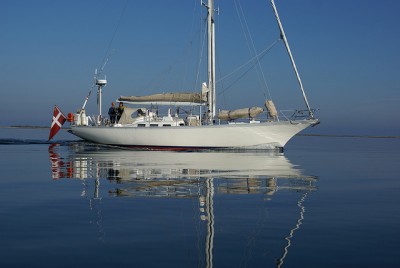
STT loves a summer breeze just as much as the next family sweating on the beach – we’re partial to a ‘winter-stormy’ when jumping into the surf for a little ‘board action’ – and we’re pretty fond of the howl of wind, mixed with heavy rain drumming on an iron roof in June. And sailing just wouldn’t be the same without a little puff of the stuff, to fill the jib.

No, it’s the nonsense that is wind power that’s the target for STT – for obvious reasons:

There’s Only One Problem with Claims that Wind Power ‘Kills Coal’: and that’s the Wind

Language matters.

As George Orwell – a bloke who knew a thing or two about the way words are employed by the powerful and corrupt – put it:

If thought corrupts language, language can also corrupt thought. A bad usage can spread by tradition and imitation even among people who should and do know better.

The use of words and phrases such as “anti-wind”, “denier”, “denial”, “belief” and “believer” have no place in science, politics or economics. The latest hysterical abuse of our mother tongue is the phrase “climate denier”.

No one at STT, well actually no one anywhere, denies that there is such a thing as the “climate”.

That word, by definition, incorporates within it the concept of “change”; for if the climate had not changed over the 4.6 billion years that our Earth has been lapping around the Sun, it would have probably remained a solid frozen lump of ice; and we would not be here arguing the toss about a few degrees, one way or the other.

ice age earth

****

The nonsense peddled by climate hysterics is premised on some ‘Goldilocks fantasy’ that, at some point in the recent past (we can’t quite pin down when) the climate was “just right”. Ever since, apparently, we’ve been lurching towards a man-made climate catastrophe. STT grew up in the 1970s and was terrorised in school with forecasts of a looming ice age. 20 years on and the reign of terror was reversed: global incineration was next on the menu.

While we note your use of the term AGW, we understand that to incorporate “global warming” as an irrefutable fact. It is, however, a theory with which there is only one problem: and that’s the evidence. Even the most hysterical have been forced to accept the fact that global surface temperatures have not budged for 18 years, despite human generated CO2 emissions increasing at a rollicking rate: generally referred to as “the pause”. The last piece STT read on the topic takes us back to our childhood with warnings about, wait for it, another looming ice age:

http://www.theaustralian.com.au/national-affairs/climate/chances-of-little-ice-age-on-rise/story-e6frg6xf-1227415254811

And it’s the lack of evidence for global warming that appears to have shifted the terminology to “climate change”: a tautology if ever there was one.

Of course, the climate “changes” – change is endogenous to the model. Whether that change is significant or “dangerous”, as the most strident hysterics would have us believe, is yet to be seen. Humans have tolerated severe ice ages and, somehow, miraculously managed to survive. If the planet warms, as we’ve been lately warned, STT is pretty confident we will survive that too: it’s called “adaptation” – a feature of humanity, oft referred to as “ingenuity”.

However, in the main, we leave the topic of global warming or climate change (whichever is your poison) to others.

STT takes the position that man-made emissions of CO2 may increase atmospheric temperatures. But we don’t concede that wind power has made – or is even capable of making – one jot of difference to CO2 emissions in the electricity sector; principally because it is NOT – and will never be – an ‘alternative’ to conventional generation systems, which are always and everywhere available on demand:

South Australia – Australia’s ‘Wind Power Capital’ – Pays the Highest Power Prices in the World and Wonders Why it’s an Economic Basket Case

Let’s assume, as we do, that man-made CO2 emissions in the electricity sector are a problem. Then the only presently available solution is nuclear power; unless, of course, you’re prepared to live in Stone Age darkness.

Our attack is directed at a meaningless power source; that is insanely expensive, and utterly pointless, on every level. For those on both sides of the argument (including “AGW deniers” as you refer to them) that foolishly connect industrial wind turbines with global warming (or climate change) they, in effect, box themselves into a logical corner.

On the one hand, if the AGW hysterics are wrong (and icebergs start turning up in Port Phillip Bay), then, applying their (by then failed) man-made CO2/warming argument, we should scrap every last (planet cooling) wind turbine and start burning coal and gas as fast as humanly possible to warm the joint up, in order to prevent the ‘big freeze’.

chris turney stuck in ice

****

On the other hand, if the AGW “deniers” are wrong, temperatures start to rise, and Australia looks set to become a boiling desert devoid of all life forms (save card-carrying “Greens”, of course), then the hysterics will claim absolute licence (if not high moral imperative) to carpet this, and every other country, in an endless sea of giant industrial wind turbines. Having pinned their arguments against wind power on the basis that CO2 caused AGW is a furphy, the “deniers” would be forced to logically concede their opponents’ case; and, with it, to also concede the need for a completely wind powered electricity system.

Hence, STT seeks to completely disconnect claims for and against global warming, and wind power generation.

As wind power can only ever be delivered (if at all) at crazy, random intervals it will never amount to a meaningful power source and will always require 100% of its capacity to be backed up 100% of the time with fossil fuel generation sources; in Australia, principally coal-fired plant. As a result, wind power generation will never “displace”, let alone “replace” fossil fuel generation sources.

Contrary to the anti-fossil fuel squad’s ranting, there isn’t a ‘choice’ between wind power and fossil fuel power generation: there’s a ‘choice’ between wind power (with fossil fuel powered back-up equal to 100% of its capacity) and relying on wind power alone. If you’re ready to ‘pick’ the latter, expect to be sitting freezing (or boiling) in the dark more than 60% of the time.

Wind power isn’t a ‘system’, it’s ‘chaos’ – the pictures tell the story: this is the ‘output’ from every wind farm connected to the Eastern Grid (based in NSW, VIC, TAS & SA – and with a combined installed capacity of 3,669MW) during May.

May 2015 National

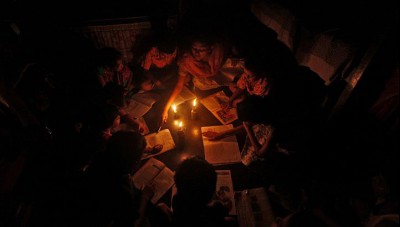
Consider a country where its electricity supply was exclusively based on wind power generation; a place where businesses would attempt to run around the vagaries of the wind; where houses would be well-stocked with candles and their occupants left to keep food cold with kero-fridges or iceboxes – and those homes otherwise run on wood, sticks or dung, used for cooking or heating. Sounds like fun, doesn’t it?

As soon as that country had the chance (due to the availability of technology and/or as a process of economic development) it would build a system based on power generation sources available “on-demand” (ie coal, gas, hydro, nuclear, geo-thermal).

Its people would then be able to enjoy around the clock illumination; factories could run to the clock, and not the weather; homes would be heated and cooled according their occupants’ needs, making life safer and more comfortable (no-one need be frozen to death or expire from the heat because the wind stopped blowing); economic development and prosperity would follow, as night follows day.

Placed in the practical context of the needs of a functioning society, wind power can be seen as the patent nonsense that it clearly is. If a country didn’t have a conventional power system (as we have), it would build one, anyway.

Once people grasp that fact, the rest of the wind industry’s ‘case’ falls away.

Talk about “wind farms being in the right place” just sounds silly; ergo, with arguments about distances from homes; separation from bird nesting sites or migration routes etc, etc.

All of these other considerations – while legitimate – simply jump to the periphery and dilute the strength of the key argument.

Keep hitting our political betters with the pointlessness of wind power as a generation source and the rest falls away.

What reasonable decision maker would back policies that favour something that has no economic benefit? Moreover, as the central claim that wind power reduces CO2 emissions in the electricity is a complete falsehood, the justification for the hundreds of $billions in subsidies directed to wind power looks like pure lunacy, at best; or graft and corruption (aka ‘crony’ capitalism), at worst.

What the wind industry hates most are facts.

STT dishes them up on a daily basis. The facts outlined above – and which we’ve detailed many times before – are unassailable.

Wind power is a fraud, pure and simple.

Australia has just locked in a $45 billion electricity tax which will be directed as subsidies to wind power outfits to generate power which has NO commercial value.

Were that same amount to be applied to building state-of-the-art nuclear power plants, Australia would enjoy cheap, dependable power for a century to come. Moreover, anyone concerned about AGW, as you clearly are, should be pleased as Punch knowing that the power being generated will not add a single gram of the CO2 gas to the atmosphere. And, who knows? Maybe, just maybe, the Earth’s climate will remain constant – forevermore fixed in a “just right” Goldilocks state.

goldilocks_1393092c

The Truth About Wind Turbines Being Brought To Light, in Australia

Dr Malcolm Swinbanks tells Senate: ‘NASA’s 1980s Research on Health Effects from Wind Farm Noise More Relevant Than Ever’

senate review

****

The Senate Inquiry into the great wind power fraud has heard evidence and received submissions from some of the best in the acoustics and health business: Dr Malcolm Swinbanks, among them.

Here’s what he had to say.

Senate Select Committee on Wind Turbines – 23 June 2015

SWINBANKS, Dr Malcolm Alexander, Private capacity

CHAIR (Senator Madigan): I declare this meeting open and welcome Dr Malcolm Swinbanks. Information on parliamentary privilege and the protection of witnesses has been provided to you, has it?

Dr Swinbanks: Actually it has not. It was not in amongst the emails that I got. Perhaps you could quickly indicate.

CHAIR: The committee has your submission. I now invite you to make a short opening statement, and at the conclusion of your remarks I will invite members of the committee to put questions to you.

Dr Swinbanks: Just briefly, I will review the submission that I made. I addressed four separate issues: first of all, the physical mechanisms for generating low-frequency sound and infrasound; secondly, the mechanisms by which people can perceive such infrasound; thirdly, I commented on the health effects and, in particular, two reports relating to these supposed health effects or the absence of them; and, finally, I gave an account of my own personal experience of adverse effects I have encountered when taking measurements near to a wind turbine installation.

If I could start off with the generation of infrasound, it is not often realised that NASA, in the early 1980s, actually carried out research on upwind rotor turbines. That is the modern configuration where the rotor is upwind of the supporting the tower, rather than downwind. Wind developers have often dismissed NASA’s work, saying it was not relevant because it related only to downwind turbines, but this is completely inaccurate. NASA had in fact identified the benefits of going to the upwind configuration at a very early stage.

They also examined the effects of multiple turbines operating together and the effects of the separation between those turbines. They found that seven to 10 diameters separation was the ideal requirement for a turbine located downwind of its neighbours. But, in recent years, some wind developers have compromised on that spacing and have reduced it even to as little as three diameters in some cases, and that is asking for trouble, because the increased turbulence leads to increased low-frequency sound and infrasound.

The other effect that has to be considered is that as wind farm arrays are made larger and larger, the rate of attenuation as you move away from the wind farm is reduced. The result is that the setbacks from the boundaries have to be much greater to achieve the same reduction in sound. In recent years, people have stated that they have problems at distances of as much as three miles, and that is entirely consistent with the effects of increasing the size of the wind farms. Finally, I would point out that under conditions where the temperature profile is what is known as a temperature inversion, the low-frequency noise and what would I call the ‘silent thump’ of wind farms can carry over distances of three miles or more.

I would like to turn to how people perceive infrasound. The conventional method of hearing is through what are known as the inner hair cells of the cochlear. The effects of infrasound can be measured by a G-weighting scale, which is very similar to the A-weighting scale. It is effectively an extension of it, although the exact values do not correspond directly.

Many people have evaluated whether or not the effects of infrasound are perceptible by simply comparing spectra with the hearing threshold and stating that the spectra are well below the threshold values and therefore the sound cannot possibly be perceived. That is not correct. At very low frequencies, it is the combination of different frequency components adding together which defines the total level of the infrasound, and that can be significantly greater than is observed simply by looking at the par spectrum.

People have reported having significant problems believed to be due to infrasound at distances from wind turbines. In that context, there are three different mechanisms which may be contributing to enhanced sensitivity. I have analysed a specific effect relating to the interaction with the thresholds as a result of low and high frequencies being present simultaneously.

In America, Dr Alec Salt has identified that the outer hair cells of the cochlear are actually much more sensitive at very low frequencies. He believes that there is some input to the nervous system resulting from them. Most recently, Paul Schomer, also in America, has considered the possible effects of sound pressure on the vestibular organs, which are the balance organs, and those effects could give the person on the receiving end a sensation of apparent motion, even though they are actually stationary.

I would like to make a further addition, which is just related to my own experience. Lying in bed, at a distance of three miles from a wind farm, my wife and I have on occasions been disturbed by the wind turbine noise. The most marked feature is that when you have gusts of wind, the turbine noise is masked by the gust and you get a huge sense of relief, only to find that when the wind subsides, the turbine noise returns and you again find yourself subject to the relentless sound.

The point is that when the wind gusts rise it is very much like the effect of when you come out of a tunnel into the light—a huge sense of relief. The sound levels of the turbines under those circumstances are probably less than the average sound levels of the wind, but nevertheless they are far more disturbing. This is noted also at higher frequencies, where people have identified that the annoyance from turbines at 35 dB(a) can be comparable to the annoyance of other more conventional sources at 55 dB(a). One commonly sees statements made that wind turbine noise is no different from any other noise, but the fact is it is different. It is clearly more perceptible at lower levels, and criteria relating to more conventional noise do not necessarily apply.

Turning to the health effects of wind turbines, there was an early report in 2009, which was an American Wind Energy Association funded report. This was the first time that experts had been brought together from both the medical profession and the acoustics profession. That report has been regarded as a definitive baseline report, and subsequent reports have tended to draw on it because of the qualifications of its authors. I consider that report to have been extremely biased. It failed to mention at all two of the most important aspects of wind turbine perception.

Firstly, that in rural areas the hearing threshold is much reduced compared to the threshold when you are in urban areas and consequently you are much more sensitive to additional noise.

Secondly, there is increasing sensitivity with continuing exposure. Some authors have described this as learned aversion. I have also experienced that at firsthand myself 30 years ago when working on natural gas compressor installations, which are effectively jet engines driving a compressor into an exhaust. In those circumstances, I found that over time, ultimately a period of two years, I had become very sensitive indeed to the low frequency noise and I could detect it under circumstances where previously I could not detect it at all.

That same health report misrepresented guidance which had been given in America by the Environmental Protection Agency as long ago as 1974—that is 40 years ago—and they have failed to indicate that the presently permitted sound levels in the USA are too high and can lead to sleep disruption.

The most recent health report that has been produced, again, funded by CanWEA, the Canadian Wind Energy Association, finally acknowledges the excessive permitted levels in the United States and the resultant consequences for sleep disturbance, but it does not highlight this. The statement is effectively buried in 25 pages of closely-spaced text. Now I believe a lot of the problems have been created as a result of that report and some of its successors, because it has completely understated the nature of the problem and has led, undoubtedly, to people being exposed to higher levels than they should be exposed to.

At the same time, it is common practice to place the burden of the effects of wind turbines onto the homeowners by stating that it is annoyance on the part of the homeowners and nocebo effects.

By placing the burden on the homeowners, the apparent responsibility of the wind developer is reduced but, at the same time, this ignores completely the fact that the noise and, indeed, the infrasound can represent a significant intrusion into a rural home, particularly at night when people are trying to sleep. So I believe the correct terminology is to say that people suffer annoyance. It is something which is imposed on them.

I would also comment with respect to the nocebo effect that many communities welcomed wind turbines—this was particularly true of one island community in Vermont—but once the turbines started they discovered that there were some significant adverse effects. That is the very opposite of a nocebo effect.

A nocebo effect is when there is prior anticipation of a problem, not when the problem is noted after the event. In that sense, I would like to make a brief comment that NASA, as long ago as 1982, presented a curve which showed the levels of infrasound that could cause adverse reactions by occupants. This showed that the levels of infrasound could be very much lower than the nominal threshold of hearing. People debate whether or not this is due to effects of vibration on a house structure—this is for people inside a house—or whether it is a true perception of infrasound; but that does not really matter. The fact is that, at octave levels as low as 60 decibels, which is a very low level for infrasound, there can be adverse reactions from occupants. That data goes back almost 35 years. Finally, I would like to—

CHAIR: Excuse me, Dr Swinbanks—

Dr Swinbanks: comment briefly on my own personal experience of wind turbine health effects. I was asked by some friends of mine to help them measure the infrasound levels in the basement of their home at the wind farm at Ubly in Michigan.

It is noteworthy that this particular wind farm had been designed in 2005, at which time Dr Nina Pierpont, a doctor in New York state, had been opposing that wind developer because of concerns she had relating to the likely noise environment of a wind farm. She has been roundly criticised all around the world for supposedly promoting scare stories. But in fact the wind farm that was developed at Ubly by exactly the same developer has proven to demonstrate all of the adverse effects that Dr Nina Pierpont warned about. Indeed, 10 families ultimately took legal action against that wind farm. The matter was settled out of court. But the important point is that I myself experienced directly many of the effects that Dr Nina Pierpont warned about, and she certainly was not making it up. The fact is that these effects can occur.

In my particular case, I was working on a very calm evening when wind turbines were operating but there was very little wind at ground level and you could not hear the turbines at all inside the house. I actually had to keep going outside to check that they were still running. After three hours in the house I began to feel ill and I found that I was lethargic and losing concentration, but it was not until sometime afterwards that I began to realise that it was the wind turbines that were likely to be responsible.

The level of infrasound that I was measuring was a level that I considered to be very low and definitely not a problem. After five hours in the house I was only too glad to leave, and I thought, ‘At last I’m getting away from this,’ only to find that, when I started driving, my driving ability was completely compromised. The front of the car seemed to sway around as I consistently oversteered. I had lost coordination and I had difficulty judging speed and distance. When I arrived home, my wife observed immediately that I was ill; she could see that straight off. And it took me a further five hours to finally recover and for the effects to wear off.

The important point about that incident was that I had considered that the conditions—a nice calm evening at ground level, but with the turbines still running—were extremely benign, and I had wondered whether I would even get any results. So I certainly was not anxious about infrasound. Similarly, when I got—

CHAIR: Excuse me, Dr Swinbanks—

Dr Swinbanks: Yes?

CHAIR: We have got very short time. Would you mind if we go to questions now?

Dr Swinbanks: Yes, that is fine. In fact, I had effectively completed, so that is fine.

CHAIR: We will start with Senator Urquhart.

Senator URQUHART: Thanks, Dr Swinbanks. I picked up, I think, from your opening statement that you live near an operating wind farm—is that right?

Dr Swinbanks: Yes. We have a farmhouse in Michigan, and the county, Huron County, in which we live decided that they were going to install very large numbers of wind turbines.

They installed a first set at two locations in the interior of the region where we are, and the significant problems developed at one of those wind farms, but since then they have been installing progressively more wind turbines. We have an installation three miles south of us, which affects us only when the wind blows from a southerly direction and then only under certain weather conditions. But the intention is to install many times more turbines, and, essentially, the whole county will be covered in turbines if this situation continues as it is.

Senator URQUHART: Have you published any articles on infrasound from wind turbines in any peer-reviewed journals?

Dr Swinbanks: Not in peer-reviewed journals. I have presented, at conferences, the work that I have done, and it has represented a sequence of work. But I believed that it was better simply to get the information out into the public domain.

Senator URQUHART: In your submission you mention Steven Cooper’s study from the Cape Bridgewater wind farm. Do you believe this was a scientifically valid study equipped to make conclusions about the link between participant sensations and infrasound?

Dr Swinbanks: I believe that in a situation where people are reporting the effects that they observe while at the same time the operating characteristics of the wind farm are being monitored remotely, if you find that there is then a close correlation between those two situations, when they are well separated and there is no communication between the relevant parties, that does imply that there is a significant link and that people are reacting to real events.

Senator URQUHART: We heard from the Association of Australian Acoustical Consultants. They had done a small statistical analysis of Mr Cooper’s work. In this they found that Mr Cooper did not meet his hypothesis 63 per cent of the time. Do you think it is reasonable to suggest causality when a hypothesis is not meeting close to two-thirds of the event occurrences?

Dr Swinbanks: I would point out that I am not a statistician. I do not approach my own work from a statistical point of view. What I prefer to do is go and find out for myself what it is all about, and from my own experience I believe that what Steven Cooper has observed is entirely credible.

Senator URQUHART: Here in Australia we have had a population level study done that found no difference in the prescriptions that Australians had been given regardless of the distance that they lived from wind farms. Are you aware of any population level studies internationally that have found otherwise?

Dr Swinbanks: I am not aware of such studies. But I do know a lot of families whose life has been made pretty miserable by the wind turbines, and I find that every bit as impressive as the statistics that people collect. It is a characteristic of the medical profession that they operate hands-off and perform their evaluations entirely on a statistical basis.

In the engineering profession, whenever possible we go and find out what it is like and subject ourselves to those conditions to gain an appreciation for ourselves. Sometimes I read documents from people who clearly have no direct experience. It is apparent from what they say. In this particular instance, occurrences are so comparatively rare amongst the general population that it is very easy to end up with a large number of negative responses and only a very small number of positive responses; yet the fact is that those positive responses can be directly associated with real problems.

Senator URQUHART: We are going to hear in a minute from Dr Leventhall. He has put forward in his submission that a much higher correlation in Mr Cooper’s work could be found between audible noise and sensations rather than infrasound and sensations. Do you agree with Dr Leventhall that the correlation that Mr Cooper found is statistically much higher with audible noise than infrasound?

Dr Swinbanks: There are both components of sound present. The definition of infrasound, according to Dr Leventhall himself, is that there is a very fuzzy boundary between infrasound and low-frequency noise. He has stated that that often causes confusion.

In reports that he has written his definition of infrasound versus low-frequency sound, which is generally considered to be audible sound: he has defined boundaries of 20 hertz on some occasions as being the boundary between the two effects—16 hertz. In a different report he talked of 10 hertz to 200 hertz. Finally he even proposed five hertz to 200 hertz in a 2006 paper. So the point is that this definition of where you are between infrasound and audible noise is a very flexible definition. I do not consider that it is particularly important whether the noise is truly audible or just perceived as a sensation. The important effect is that people do detect something; they detect a sensation and can tell that something is happening.

I learnt this 30 years ago when I was working on a gas turbine installation. Initially, I was very insensitive to the sound but, ultimately, I could drive up in my car and detect that the gas turbines were running even before the car engine had been turned off. There was a very marked increase in sensitivity. So I do not really think that it is important whether it is audible noise or inaudible noise that gives rise to the sensation. The fact is: people do experience real sensation, and these sensations can be very unpleasant.

Senator BACK: You mentioned size of wind farms. Were you referring to numbers of turbines or the actual physical size of the individual turbines, or both, when you made your comments in that regard?

Dr Swinbanks: I am referring primarily to the number of turbines. That is obviously related to the overall dimensions of the wind farm. But I have in mind, in particular, the Macarthur wind farm, which has very closely spaced turbines. It has a very large number—something in excess of 140.

People are, I understand, experiencing adverse effects at distances of three miles. I believe that is a consequence of a large, closely spaced wind farm. Whether the effects would be as severe if the spacing of the turbines is made greater, I believe that would relieve some of the effects. But I think the main issue is the sheer number of turbines.

Senator BACK: You mentioned about what the 2009 American Wind Energy Association report had failed to take account of. You made the reference to increased sensitivity over time—increased exposure—and you gave an example of your own situation with gas turbines. One of the witnesses who has appeared before us, Dr Tonin, from this Association of Australian Acoustical Consultants, put to the committee that you could undertake this testing for infrasound using a pneumatic signal attached to hearing protectors effectively in a quiet room for a limited period of time. I think he mentioned 15 or 20 minutes. Could you comment on how much value you regard such testing would be in trying to come to terms with our situation?

Dr Swinbanks: My attention was drawn to that paper, and I have read it. I have two immediate comments.

Firstly, he was attempting to distinguish whether symptoms were due to actual infrasound or due to nocebo effects. The important point is: there are two different outcomes which could distinguish between those effects, but, in fact, there are many more than two possible outcomes from the experiment. There are up to 16 outcomes of which only two are definitive outcomes relating to nocebo effects or infrasound effects. When I looked at the data, the most impressive correlation that I could see from the data was that the sheer action of putting on the headphones appeared to have increased the symptoms of the people being studied by at least 44 per cent. This was an experiment in which putting on the headphones had a measurable effect. I would argue that we do not yet know what exactly the mechanism causing people to suffer adverse effects.

As I indicated, NASA, 30-odd years ago, had shown that people could experience adverse reactions at what are nominally very low levels of infrasound, but that was in houses where there was possibly vibration from the structures—and we do not know whether people are sensing anything through their body rather than their ears, because people often report in low-frequency noise or infrasound environments that they can feel—

Senator BACK: Can I stop you there. We need to get the answers fairly quickly so that all of us can have a go. You made reference to the circumstances of your own experience, where the wind was gusting and then was not gusting and the sound of the turbines with each.

Some people have put to us the idea that an average sound or an average level is adequate. You in your paper have suggested that the use of an averaging technique may be missing cumulative pressure fluctuations and, in particular, peak pressure. Could you briefly explain that further and whether or not there is a value in averaged sound or averaged levels of infrasound decibels, please.

Dr Swinbanks: My immediate comment is that there is no value at all in an averaged level. In that example I gave, if you average it all, you find that the wind turbine level if anything would be less than the gusting level and you would then conclude that the wind turbines are not significant, whereas in fact it is very clear that they are significant.

But the other important point is that there is a very well acknowledged paper that was written in 2004 by two authors, Moller and Paterson, where they made it very clear that for the very low frequencies it is the actual shape and time history and peaks of the waveform that are important. In fact, Dr Leventhall, in an expert witness statement a couple of years ago, criticised me for supposedly not having read that report properly, but what I was doing was studying directly what the report recommended—namely, the time history and shape of the waveforms rather than long-term averaged versions of the waveforms.

Senator BACK: Thank you.

Senator LEYONHJELM: Dr Swinbanks, I have several questions. I hope we have time for them. Dr Leventhall was giving evidence in 2013 to a Vermont Senate hearing on the adverse health impacts of wind turbine operations in which he said they were ‘made-up, make-believe’, ‘hoo-hah’ and ‘a propaganda technique’. I understand he also dismissed some of your work on impulsive infrasound. Has he communicated those concerns to you?

Dr Swinbanks: He has not communicated the concerns directly.

I have known Dr Leventhall for 40 years, but until very recently I had not seen him for 20 years. I was quite surprised, when I met him, that he appeared to have a very different perspective on the noise conditions in America from the perspective he gave at that Vermont meeting.

When he was in the UK, he told me that he thought the sound levels in America were disgraceful.

At the Vermont conversation, he attributed problems to ‘hysterical reaction’. The point is that permitted noise levels in the United States are significantly higher than in other countries and certainly higher than in Australia, so it is hardly surprising that there is what he called ‘hysterical reaction’. You would certainly expect that, if people are subjected to more adverse conditions, they are going to react and respond more strongly.

But it most certainly is not hoo-ha. I can say that from my own experience. There is no question that there are some significant effects. We do not know precisely what the mechanisms are. But people did not know what the mechanisms for seasickness were for many hundreds of years, and they still recognised the existence of seasickness.

Senator LEYONHJELM: In the NASA work in the 1980s, Kelley describes in detail the physical sensations resulting from infrasound. Are his descriptions consistent with what residents are now describing as the physical impacts of wind turbine sound?

Dr Swinbanks: Yes, I believe they are consistent. These symptoms have been known for a long time. Dr Leventhall says they are entirely consistent with his knowledge of low-frequency noise. He does not find it surprising, but he argues that it is not due to infrasound.

As I have indicated, Dr Leventhall has even defined low-frequency noise as being from five hertz up to 200 hertz, which overlaps very substantially a region that most people tend to call infrasound. So we have a situation where, for frequencies around 12, 13 and 14 hertz, do you say, ‘That’s infrasound. That can’t be a problem,’ or do you say, ‘That’s low-frequency sound. The symptoms are perfectly understandable’?

The fact is it is a very fuzzy distinction and you can place yourself either side of that boundary dependent on precisely how you choose to define the boundary. I believe that the symptoms are consistent. They are certainly consistent with low-frequency noise. It is a moot point whether or not people are subconsciously hearing something. They are aware of something. I have no doubts about the nature of the symptoms.

Senator LEYONHJELM: I just want to ask you a few technical questions. Your submission had some graphs that showed the pressure fluctuations and frequency. Mr Cooper’s report points out the need for narrowband measurements and not one-third octave bands for DBA or DBG when looking at infrasound and low frequency. Do you agree with that?

Dr Swinbanks: Certainly. I would not even dream of using one-third octaves or even averaging, over extended periods of time, just the pure spectrum levels.

A proper analysis is both a narrowband frequency analysis coupled with a temporal analysis to look at the time history, as I commented earlier. If you go out to sea in a small boat, you do not worry about the spectrum of the waves; you worry about the shape of the next wave. This is what happens as you go down in lower and lower frequencies. For frequencies like 20 hertz and upwards, you tend to be more concerned with the blurring overall effect, but, as you get down to the very lowest frequencies, it is the shape of the individual waveforms that influences you. So one certainly should not be using these long-term averaging techniques.

Senator LEYONHJELM: Following up on from a question from Senator Back earlier in relation to peaks and averages, could you comment on whether or not it is possible to take a recording of infrasound or low-frequency sound—whatever you like—from a wind turbine and replicate it in a laboratory under controlled conditions in order to measure whether or not there is an adverse effect to it?

Dr Swinbanks: Yes, it is possible to do so, but the way in which people have been doing it so far, to me, seems a bit back to front.

What they should be doing is, first of all, testing people who are known to be sensitive to wind turbines to try to find out what conditions enable an accurate replication of the effects.

I do not see the point in just setting up an experiment in a laboratory and saying, ‘We didn’t observe anything’ if you have not first established, for a person who does suffer ill-effects, whether or not they actually respond to that test. There are real questions about what exactly are the important effects and what exactly should be reproduced in a laboratory. For example, I have quoted the NASA work of 30 years ago.

People consider that, possibly, it was the vibration of the structures that people were sensing rather than the physical pressure variations of the infrasound. We do not know exactly what gives rise to the adverse effects. One has to validate any laboratory testing by being satisfied that people who are sensitive and have reported adverse effects can indeed experience those effects under the test conditions.

Senator CAMERON: Thank you for being here, Dr Swinbanks. You are three miles from the wind farm—is that correct?

Dr Swinbanks: That is correct.

Senator CAMERON: Was your house there before the wind farm was built?

Dr Swinbanks: Yes. I must make it clear that I am not directly complaining about those noise levels because at the moment the effects occur only when the wind is blowing from the south, which is only five per cent of the time. They only occur under circumstances of very severe temperature inversion. So it is a very occasional event. The point is simply that it can occur, and people who are in a position where they are encountering those sorts of conditions more frequently could also be expected to encounter such effects at such distances.

The point that I am making is that such effects can be detected at these distances, not that those effects are a significant intrusion at the moment. But I would point out that in the future they are proposing to build turbines not just to the south of us, but to the west and the north-west, in which case those conditions may prevail for 35 or 40 per cent of the time. The fact is that modest numbers of turbines at sensible distances are not generally a consistent problem. Large wind farms operating under adverse circumstances can indeed be a significant problem at those sorts of distances.

Senator CAMERON: So when the turbines started to be built, was there an opposition group formed in your area?

Dr Swinbanks: There was never an opposition group as such, but there were a significant number of people who were making known their concerns. There was not a formal opposition group, but people were making known their concerns. The fact that there were two wind farms built at an early stage meant that people had some experience of what could be happening.

The interesting feature was that you might say that those two wind farms, if you looked at them initially, looked pretty similar and pretty comparable; but one of them gave rise to very severe problems, while the other one did not appear to give rise to anything like as many complaints. The skill of constructing a good quiet wind farm is still pretty well lacking. It is very much a trial and error process, unless people obey sensible guidelines like ensuring that the separation between the turbines is of a sensible size and they are not choosing to mount turbines in locations, for example, on ridges where there can be a significantly distorted wind pattern and shear flow effects. The point is that there is a difference between a well constructed wind farm with sensible spacings and numbers and a poorly constructed wind farm.

Senator CAMERON: You also indicated that an inversion caused problems, and you gave evidence in relation to one night when it was not windy, and you had to keep going outside to check if the turbines were operating, then you became lethargic, you were losing concentration, you lost coordination when you were driving. Were you the only one in your household who had these symptoms?

Dr Swinbanks: It was not my household, it was the house belonging to some people who lived at the wind farm, who had asked me to take the measurements for them.

Those people have experienced adverse effects to the extent that they actually had to rent alternative accommodation and go and sleep in the alternative accommodation at night. They initially tried to look at weather forecasts and decide if they could sleep in their own house or not, but they ultimately decided that the wind conditions could change during the night, and it could go from a benign night to a bad night. Therefore they began to sleep away from the property routinely and regularly.

The particular point that I should like to make is that I was extremely surprised to experience these symptoms. I thought it was a non-event. But one particular point was that I was using a computer very extensively, and if there is a relation to motion sickness, I would certainly comment that if I am in a motor car and I try to use the computer or read—assuming I am not driving—I can very quickly become ill. I wondered whether this was purely conjecture, whether the fact that I was concentrating on using a computer actually enhanced the severity of the effects.

Senator CAMERON: Are you aware of the study that was done by Fiona Crichton, George Dodd, Gian Schmid, Greg Gamble, and Keith J. Petrie, titled ‘Can expectations produce symptoms from infrasound associated with wind turbines?’ It was a peer reviewed analysis reported in Health Psychology. They indicated that if there were high expectancy that you would get sick from infrasound then you would become sick. They did work with infrasound and sham infrasound, and it really did support the analysis that the psychogenesis and nocebo effect were real. Have you had a look at that?

Dr Swinbanks: Yes, I am familiar with that and I wrote a criticism of that document at the time. The point was that the difference between their sham infrasound and their real infrasound was essentially negligible. The real infrasound was at a level of 40 decibels, which is very low, and not surprisingly there was no difference in the response of any of the people between the sham and the actual infrasound. The other point is that the duration was only 10 minutes. In the effects that I described it took five hours for the full effects to become apparent.

I have related that whole situation to sea sickness. It used to be the case, in the 1970s, when I did a lot of sailing, that one would frequently encounter people who considered that seasickness was just psychological. Very often, they learned the hard way that it is not. But the point is that, if you wanted to test two groups of people for seasickness, you would not put two separate groups into two separate boats and put them on a flat, calm lake for 10 minutes and then announce that any reactions prove that seasickness was caused by a nocebo effect. That would actually be regarded as a joke. So I am afraid that I consider that that particular experiment was more an experiment in a pretty obvious psychology than anything relating to the validity of whether infrasound represents a real problem or not.

Senator CAMERON: So many questions, so little time. Thank you.

CHAIR: Dr Swinbanks, is the sound pressure level important when considering biological effects of infrasound and low frequencies, or could it be the frequency via acoustic resonance?

Dr Swinbanks: I think I should make it clear that I am not a biology specialist, so anything I say is amateur in that context. But I believe that the long exposure times can be a factor in inducing effects in people. Again, drawing a parallel with seasickness, it was not uncommon to go to sea for eight, 12 or even 24 hours and think, well, you are not going to get seasick this time, only to discover suddenly at the end that you do in fact start to succumb. In that context you can find that the onset of the symptoms can seem to be very rapid, even although you have been exposed for a long duration. So I think there are important considerations relating to duration of exposure.

I point out briefly that Dr Alec Salt, who is an expert on the characteristics of the cochlea, has suggested there is a phenomenon known as temporary endolymphatic hydrops, which is a progressive swelling and blockage of the little pressure relief hole at the end of the cochlea. If that becomes blocked then you can become very much more sensitive to infrasound. So it is quite possible to hypothesise that long-duration exposure is causing a blockage to progressively develop, and when it becomes severe then the person will start to experience much more extreme effects from the sound pressure than they would if there were no blockage.

So you could imagine in those circumstances that there might be a protracted period where there was no effect and then a comparatively rapid onset of effects. It would then take time after the exposure for those effects to clear, so you would then have persistence for some time afterwards. This is a whole area that requires a great deal more study. One of the conclusions, though, of the original 2009 AWEA report was that there was no need for any further research. I would completely disagree with that. I think it is apparent that people are now taking the issue seriously and at last people are beginning to investigate more thoroughly exactly what may be happening.

CHAIR: From what you have told me, I take it that the level of sound pressure is less important?

Dr Swinbanks: There are several factors that are important and when they come together they can effectively reinforce one another. I am not certain that you can take out one specific component and reject the rest. It is a combination of different contributions that can ultimately lead to the end condition. But the obvious conditions are length of exposure, sound pressure levels but also the frequency and the nature and character of the time history of the wave forms.

CHAIR: Thank you. We are running over time. If there are no further questions—

Senator BACK: I have one, but it will have to go on notice.

CHAIR: Dr Swinbanks, there may be further questions placed on notice by senators. We would appreciate it if you accept those and respond.

Dr Swinbanks: Certainly.

CHAIR: Thank you for your appearance before the committee.

Dr Swinbanks: Thank you for giving me the opportunity to speak. I am very grateful for that.

CHAIR: Thank you.

Hansard 23, June 2015

Dr Swinbank’s evidence is available on the Parliament’s website here. And his submission to the Inquiry is available here (sub189_Swinbanks).

Swinbanks

****

Nice work, Malcolm! That couldn’t have been clearer or plainer. But that’s usually the case where a witness is dishing up good ol’ common sense.

In his evidence, Dr Swinbank’s talked about his own unnerving experience with turbine generated infrasound, for more detail on what happened see this post:

Top Acoustic Engineer – Malcolm Swinbanks – Experiences Wind Farm Infrasound Impacts, First Hand

And we’re very pleased to see Dr Swinbanks smashing the wind industry’s claim that the NASA research from the 1980s has no relevance to the present calamity, simply because the blades were shifted from behind the tower (‘downwind’) to in front of the tower (‘upwind’). For a detailed rundown on the NASA research and its relevance to what wind farm neighbours are forced to suffer, see this post:

Three Decades of Wind Industry Deception: A Chronology of a Global Conspiracy of Silence and Subterfuge

After hearing and receiving a vast swathe of evidence of the kind given by Dr Swinbanks and a cast of others, our political betters in Australia’s Parliament won’t be able to run the Sergeant Schultz defence any longer ….

sgt schultz

Realistic View Of Government-induced Climaphobia, & the Unintended Consequences”.

Editorial by Tom Harris
July 8, 2015
‘Marching with the enemy’
Imagine pro-tobacco groups wanted to participate in fund raising marches for cancer research. ‘We want to help defeat cancer too,’ the tobacco advocates announce.
Anti-cancer campaigners would never march in solidarity with tobacco promoters. They know that if smoking increased, cancer rates would undoubtedly rise as well. Marching arm in arm with those working against one’s interests is irrational.
This logic does not seem to have occurred to the groups concerned with social justice and wildlife protection who participated in the July 5 “March for Jobs, Justice, and the Climate” in Toronto. They were, in effect, marching with the enemy, groups such as  and Citizens’ Climate Lobby which unwittingly encourage outcomes that are harming the poor and disadvantaged, biodiversity, and endangered species.
For example, by promoting the idea that carbon dioxide (CO2) emissions must be reduced to prevent dangerous climate change, climate mitigation activists support the expanded use of biofuels. This is resulting in 6.5% of the world’s grain being diverted to fuel instead of food, causing food price spikes that are a disaster for the world’s most vulnerable people.

The growing demand for biofuels is also creating serious problems for indigenous land owners in developing countries. In a February 2015 open letter to the European Parliament endorsed by 197 civil society organisations from Asia, Africa, and Latin America, it was asserted:

“The destruction of forests and fertile agricultural land to make way for oil palm plantations is jeopardising the food sovereignty and cultural integrity of entire communities who depend on the land as their source of food and livelihoods.”
Replacing virgin forests with monoculture plantations to provide palm oil for biodiesel greatly reduces biodiversity over vast regions.
In another attempt to reduce CO2 emissions, hundreds of thousands of industrial wind turbines (IWT) are being constructed worldwide. For example, the Ontario government is erecting 6,736 IWTs across the province, the most recent as tall as a 61 story building.
Only 4% of the province’s power came from wind energy in 2013 and 1% from solar, yet together they accounted for 20% of the commodity cost paid by Ontarians. Despite massive government subsidies for wind power, electricity rates in Ontario have soared, mostly affecting the poor and seniors on fixed incomes.
IWTs kill millions of birds and bats across the world. Ontario’s situation has drawn the attention of the Spain-based group, Save the Eagles International, which, on May 23, issued the news release “Migrating golden eagles to be slaughtered in Ontario.” They showed that some of the turbines planned for Ontario are being placed directly in the path of migrating golden eagles, which are already an endangered species.
The consequences for people living near IWTs can be severe as well. Besides a significant loss in property value, health concerns abound.
A particularly tragic example is occurring in the West Lincoln and surrounding regions of Southern Ontario.  There, despite the objections of local residents, wind developers have received approval to install at least seventy-seven 3 Megawatt IWTs, each up to 609 ft. tall, the largest such machines in North America.
One resident, Shellie Correia of Wellandport has a particular reason to be concerned.
Her 12 year old son Joey has been diagnosed with Sensory Processing Disorder and it is crucial that he live in an environment free from excessive noise. But as a result of Ontario’s Green Energy Act, the primary focus of which is climate change mitigation, an IWT will be sited only 550 metres from their home.
Correia explained in her January 2015 presentation before the government’s Environmental Review Tribunal, “On top of the incessant, cyclical noise, there is light flicker, and infrasound. This is not something that my son will be able to tolerate.”
But the approvals go ahead anyways. As Correia told the Tribunal, “No one was able to help, because of the Green Energy Act.”
The drive to reduce CO2 emissions makes it difficult for developing countries to finance the construction of vitally-needed hydrocarbon-fueled power plants. For example, in 2010 South Africa secured a $3.9 billion loan to build the Medupi coal-fired power station only because developing country representatives on the World Bank board voted for approval. The U.S. and four European nation members abstained from approval because of their concerns about climate change. They apparently wanted South Africans to use wind and solar power instead, sources too expensive for widespread use even in wealthy nations.
Finally, because of the belief that humans control climate, only 6% of the one billion dollars spent every day across the world on climate finance goes to helping vulnerable people cope with climate change today. The rest is spent trying to stop phenomena that might someday happen.  This is immoral, effectively valuing the lives of people yet to be born more than those in need today.
In all of these cases, climate mitigation takes precedence over the needs of the present. Groups such as Ontario Coalition Against Poverty, Oxfam Canada, and Great Lakes Commons, all of which participated in Sunday’s event, must distance themselves from climate activists, not march with them.
Tom Harris is Executive Director of the Ottawa-based International Climate Science Coalition.

It’s Happening All Over the World. Electricity is Becoming a “Luxury Item”! Energy poverty!

EPA’s war on the poor

Friend,

What happens when government regulations cause more harm than they prevent?

In an important new research article at CFACT.org, senior policy advisor Paul Driessen joins with energy analyst Roger Bezdek to consider EPA’s “Clean Power Plan” and ask, “what effect will the regulation itself have on poor and minority communities?”

The answer is shocking.

“The plan will result in higher electricity costs for businesses and families, lost jobs, lower incomes, higher poverty rates, reduced living standards, and diminished health and welfare, our exhaustive recent study found. This damage will be inflicted at the national level and in all 50 states. The CPP will impact all low-income groups, but hit America’s 128 million Blacks and Hispanics especially hard.”

Obama Administration bureaucrats want to dramatically increase the cost of electricity, despite the fact that these painfully expensive rules will provide little or no meaningful benefit to the climate or the environment.

“The EPA regulations will significantly increase the minority family ‘energy burden’ – the percentage of annual household incomes they must pay for residential energy bills – and thus the number of families driven into energy poverty. Inability to pay energy bills is second only to inability to pay rent as the leading cause of homelessness, so increasing numbers of poor and minority families will become homeless.”

Over the weekend we shared a Hoover Institution piece on Facebook, “When Bureaucrats Get Way With Murder,” which calculates that every $7 to $10 million in regulatory costs induces one fatality through what is called the “income effect.”  The author concludes that excessive regulation is tantamount to “statistical murder.”
When bureaucratic ideologues over-regulate, the law of unintended consequences will take its toll.

Unfortunately, the poorest and most vulnerable among us will find that toll hardest to pay.

For nature and people too,

Craig Rucker
Executive Director

Obama and EPA imperil minority welfare

By Paul Driessen

& Roger Bezdek