The Truth About Wealth Redistribution, & the Unaffordable, Renewables Scam!

Want to Help the Poorest? Then It’s Time to Ditch Wind Power

The only reason that Western economies have entertained the infantile nonsense of wind power, is that the rich world can afford (at least in the short term) to throw $billions in subsidies at a wholly weather dependent “system”, that will never stump up as an “alternative”, unless your starting point is sitting freezing (or boiling) in the dark; and you’re happy with that as your status quo (see our post here).

Some, however, might call backing wind power a form of wanton waste, aimed at satisfying the political vanity of the naive and gullible.

Then there’s the moral bankruptcy of a policy that’s aimed at wind power producers to (notionally) add more electricity to the system, notwithstanding that, in Australia, there is NO shortage of power – what there is a shortage of, however, is affordable power; and wind power will never provide that (see our post here).

Australia’s wind industry depends entirely on the Large-Scale Renewable Energy Target – which has already transferred $9 billion, and is set up to transfer $50 billion more, from power consumers (in the form of the REC Tax on retail power bills) to subsidise wind power outfits, at the expense of the poorest and most vulnerable who, as the policy bites in the next 2 years and beyond, will simply be denied access to power (see our post here).

When the concept of directing $50 billion worth of Australian taxes springs to mind, it doesn’t take long to think of groups within Australia that could easily be considered more worthy recipients, than foreign owned wind power outfits, backed by Union Super Funds.

aborigines-001

STT’s first picks would be Aboriginal health and education; where standards in many regional and remote communities are positively third world. A fraction of what the wind industry is clamouring to pocket by keeping the LRET alive would, if well-managed, go a long way to giving a lot of under-privileged Australians an opportunity to improve their lot; and the lives of their children. Healthy kids have a better chance of learning; and educated kids have a better chance, all round.

aboriginal school kids

But Aboriginal health and education hardly rates a mention from inner city “greens” – instead, their present obsession is “wonderful wind power” and ‘saving’ the RET.

Their worship of wind turbines, as some kind of Divine gift from the wind Gods, is a form of mania, akin to a deluded, religious fanaticism.

hepburn

****

The mania extends to pumping up the fiction that the world can obtain 100% of its electricity needs from wind and solar power.

If left unchallenged, the end result of the ‘Greens’ ludicrous push for 100% ‘renewables’, will be to prevent the poorest and most vulnerable in developed economies from ever affording power again; and to simply deny power to under-developed economies and the poorest on the planet, altogether.

Steadily, though, the fiction that developing Nations can pull themselves out of poverty using insanely expensive and utterly unreliable wind power is being challenged. Here’s The New York times, throwing down the gauntlet.

Then there is the fridge in your kitchen. A typical 20-cubic-foot refrigerator — Energy Star-certified, to fit our environmentally conscious times — runs through 300 to 600 kilowatt-hours a year.

American diplomats are upset that dozens of countries — including Nepal, Cambodia and Bangladesh — have flocked to join China’s newinfrastructure investment bank, a potential rival to the World Bank and other financial institutions backed by the United States.

The reason for the defiance is not hard to find: The West’s environmental priorities are blocking their access to energy.

A typical American consumes, on average, about 13,000 kilowatt-hours of electricity a year. The citizens of poor countries — including Nepalis, Cambodians and Bangladeshis — may not aspire to that level of use, which includes a great deal of waste. But they would appreciate assistance from developed nations, and the financial institutions they control, to build up the kind of energy infrastructure that could deliver the comfort and abundance that Americans and Europeans enjoy.

Too often, the United States and its allies have said no.

The United States relies on coal, natural gas, hydroelectric and nuclear power for about 95 percent of its electricity, said Todd Moss, from the Center for Global Development. “Yet we place major restrictions on financing all four of these sources of power overseas.”

This conflict is not merely playing out in the strategic maneuvering of the United States and China as they engage in a struggle for influence on the global stage.

Of far greater consequence is the way the West’s environmental agenda undermines the very goals it professes to achieve and threatens to advance devastating climate change rather than retard it.

“It is about pragmatism, about trade-offs,” said Barry Brook, professor of environmental sustainability at the University of Tasmania in Australia. “Most societies will not follow low-energy, low-development paths, regardless of whether they work or not to protect the environment.”

If billions of impoverished humans are not offered a shot at genuine development, the environment will not be saved. And that requires not just help in financing low-carbon energy sources, but also a lot of new energy, period. Offering a solar panel for every thatched roof is not going to cut it.

“We shouldn’t be talking about 10 villages that got power for a light bulb,” said Joyashree Roy, a professor of economics at Jadavpur University in India who was among the leaders of the Intergovernmental Panel on Climate Change that won the 2007 Nobel Peace Prize.

“What we should be talking about,” she said, “is how the village got a power connection for a cold storage facility or an industrial park.”

Changing the conversation will not be easy. Our world of seven billion people — expected to reach 11 billion by the end of the century — will require an entirely different environmental paradigm.

On Tuesday, a group of scholars involved in the environmental debate, including Professor Roy and Professor Brook, Ruth DeFries of Columbia University, and Michael Shellenberger and Ted Nordhaus of the Breakthrough Institute in Oakland, Calif., issued what they are calling the “Eco-modernist Manifesto.”

The “eco-modernists” propose economic development as an indispensable precondition to preserving the environment. Achieving it requires dropping the goal of “sustainable development,” supposedly in harmonious interaction with nature, and replacing it with a strategy to shrink humanity’s footprint by using nature more intensively.

“Natural systems will not, as a general rule, be protected or enhanced by the expansion of humankind’s dependence upon them for sustenance and well-being,” they wrote.

To mitigate climate change, spare nature and address global poverty requires nothing less, they argue, than “intensifying many human activities — particularly farming, energy extraction, forestry and settlement — so that they use less land and interfere less with the natural world.”

As Mr. Shellenberger put it, the world would have a better shot at saving nature “by decoupling from nature rather than coupling with it.”

This new framework favors a very different set of policies than those now in vogue. Eating the bounty of small-scale, local farming, for example, may be fine for denizens of Berkeley and Brooklyn. But using it to feed a world of nine billion people would consume every acre of the world’s surface. Big Agriculture, using synthetic fertilizers and modern production techniques, could feed many more people using much lessland and water.

As the manifesto notes, as much as three-quarters of all deforestation globally occurred before the Industrial Revolution, when humanity wassupposedly in harmony with Mother Nature. Over the last half century, the amount of land required for growing crops and animal feed per average person declined by half.

“If we want the developing world to reach even half our level of development we can’t do it without strategies to intensify production,” said Harvard’s David Keith, a signer of the new manifesto.

The eminent Australian conservationist William Laurance, who is not involved with the eco-modernists, put it this way, “We need to intensify agriculture in places that we have already developed rather than develop new places,” he said. “What is happening today is much more chaotic.”

Development would allow people in the world’s poorest countries to move into cities — as they did decades ago in rich nations — and get better educations and jobs. Urban living would accelerate demographic transitions, lowering infant mortality rates and allowing fertility rates to decline, taking further pressure off the planet.

“By understanding and promoting these emergent processes, humans have the opportunity to re-wild and re-green the Earth — even as developing countries achieve modern living standards, and material poverty ends,” the manifesto argues.

This, whether we like it or not, would require lots of energy. Windmills or biofuels would put large swaths of the earth’s surface in the service of energy production, so they have only limited usefulness. Solar panels andnuclear plants, by contrast, could eventually provide carbon-free energy on a very large scale.

The new strategy, of course, presents big challenges. Notably, it requires improving the safety of nuclear reactors and bringing down their price. Solar energy at scale requires new energy storage technologies.

“Decoupling of human welfare from environmental impacts will require a sustained commitment to technological progress and the continuing evolution of social, economic, and political institutions alongside those changes,” says the manifesto.

Until they are developed, poor countries will require access to other forms of energy — including hydroelectric power from dams, natural gas, perhaps even coal.

“There are enormous energy demands,” Professor DeFries noted. “It will be some time before we can fulfill them with wind and solar energy. It is only realistic that there will be a lot of coal and gas along the way.”

For all the environment-related objections one could pose to these paths, the alternative seems indefensible: Let the poor of the world burn dung and wood, further degrading the world’s forests. Or put solar panels on their huts so they can recharge their cellphones.

“Sustainable development” has been around for over a quarter century, since the United Nations’ Bruntland Commission proposed it in 1987.

Even then, it acknowledged its energy problem. “A safe and sustainable energy pathway is crucial to sustainable development,” it stated. “We have not yet found it.”

A quarter of a century on, the discourse has changed little. Today, the International Energy Agency states that it is within our grasp to provide modern energy access to everyone. What does it mean? Five hundred kilowatt-hours per year to urban households and 250 for rural ones.

Maybe enough to power a fridge.
The New York Times

fridgemh

When it Comes to Energy, We Need SCIENCE, not Symbolism!

Science, not symbolism

Glen Brand’s recent Earth Day OpEd and his passionate embrace of renewables fails to address the big problems associated with grid-scale wind and solar. Neither are dispatchable on demand, and their intermittent energy production cannot be stored, which means traditional power plants must be kept running to back them up.

Grid-scale solar installations don’t take into consideration the massive amounts of heat being generated by acres of black panels blanketing the earth, heat intense enough to incinerate birds flying overhead. The sprawling industrial wind “farms” being constructed along Maine’s mountains and ridge lines do not address the ecological and environmental impacts of blasting and road building at high elevations, clear cutting of forests, spraying of herbicides, building of large transmission corridors from remote mountain locations and the loss of critical habitat for our winged friends.

Three hundred miles of 500-foot tall blinking turbines stretching from north to south will impact 12,000 square miles of scenic viewsheds, which represent priceless economic assets in a state that relies on tourism as its biggest industry. Government-subsidized, grid-scale wind and solar do not pass the real cost-benefit analysis, and worse they siphon much needed funds away from finding truly clean solutions for a power-hungry planet.

Our energy policies should be based on science, not symbolism.

Penelope Gray

Registered Maine Master Guide

Freeport

Wind Turbine Noise and Action: Open Letter from Waubra, EPAW & NAPAW


April 23 2015


Open letter on wind turbine noise and action
in response to this letter

Dear decision-makers, politicians, Members of the EU Parliament, EU-Commission and other responsible public officials,


 1) 29th April, 2015 is the 20th anniversary of International Noise Awareness Day, so we would like to warn you about the dangers of wind turbine infrasound and low frequency noise (ILFN) which have been largely and intentionally ignored by the global wind industry, politicians and even health authorities. Worldwide the wind industry has been trying to force their wind turbines (WT) as close to people’s homes as possible, for the sake of profit but at the expense of the health of the local residents, by deliberately ignoring the known sleep disturbance and serious health problems caused directly by impulsive wind turbine ILFN.  Government authorities have been complicit in ignoring the existing scientific evidence, and the harm.

2) We therefore request you do your own due diligence on this issue, and investigate for yourself.  There is an abundance of acoustic, scientific and clinical information independent of wind industry influence at websites such as epaw.org;na-paw.org; waubrafoundation.org.au and scientific evidence found there, and books as Wind Turbine Syndrome by a medical doctor Dr. Nina Pierpont, MD PhD, 2009 (see also: windturbinesyndrome.com) and The Wind Farm Scam by a Reader in Ecology at the University of Wales Dr. John Etherington, 2009).

3) The facts are that wind turbine noise: audible (low frequency noise LFN – under 200 Hz) and inaudible, but sensed very much (infrasound– under 20 Hz) results in serious adverse health effects, and is extremely dangerous to human health.  Direct causation of symptoms and sensations from wind turbine generated impulsive infrasound and low frequency noise was established by US scientist Dr Neil Kelley in the 1980’s.  More recently Steven Cooper’s work in Australia at Cape Bridgewater for wind developer Pacific Hydro has confirmed many aspects of Kelley’s research thirty years earlier.

4) The lifetime span of wind-turbines is from 20 up to 25 years and there are another 25 years to be expected with new turbines at the same place, therefore there is no escape from them for people in their lifetime. People are mostly exposed to pulsating infrasound. These pulses arise as the wind turbine blades pass the pillar.

5)  Therefore we firmly demand that you, as one of the decision-makers:

5.1.  Start considering the scientific evidence on the dangers of wind turbine noise, which go back as far as 30 years (NASA study, others and a historical overview on the wind turbine noise). These studies have shown that especially infrasound penetrates through closed windows and walls, and even resonates and amplifies within rooms to cause even stronger effects (cdn.knightlab.com ),

    5.2.   Stop ignoring so many people all over the world crying for help and even leaving their homes due to the wind turbine noise (for example: epaw.org; na-paw.org),

   5.3.   Recognize that wind farms are one of the worst night time noise pollutants of today and that prolonged sleep deprivation is also considered to be a method of torture by the ‘’The UN Committee against Torture (CAT),

   5.4.   Recognize what the wind industry does not want the general public and responsible public officials to learn, that there is much evidence on infra- and LFN wind turbine noise including the facts that:

– More megawatts produced by more powerful wind turbines means a greater proportion of infrasound and low frequency noise is generated,

– Infrasound is known to travel very, very long distances,

– Noise-pollution by wind power developments with many wind turbines is much, much stronger than one with only wind turbine, although serious health damage can occur from just one wind turbine if it is too close to homes and workplaces,

– Infrasound from wind turbines on hills will travel greater distances,

– Stronger winds, higher air moisture, lower background noise in rural areas, temperature inversion, etc., can mean greater adverse impacts from relatively higher levels of infra- and LFN noise pollution,

– No current models exist which accurately predict real wind farm infrasound and low frequency noise pollution,

– Children, older people, pregnant women are especially sensitive and threatened,

– Safe setback distances for different sized wind turbines in different terrain have NOT yet been established and demonstrated to protect the surrounding population.

– Change the current noise measurements to full spectrum measurement inside homes and recognize that A-Weighted Sound Level (dBA) is inappropriate and unsafe because it does not include low-frequency noise and infrasound,

– Stop the use of dBA for wind turbine noise assessments immediately,

– Stop the wind power subsidies immediately. 


                We look forward to hearing from you soon. Thank you in advance.


                                                 Yours faithfully,


Jean -Louis Butré
European Platform Against Wind Farms
EPAW : 877 organisations from 24 European Countries
President  3 rue des eaux Paris 75016 France
contact@epaw.org
www.epaw.org
+33 6 80 99 38 08

Sherri Lange
North American Platform Against Wind Power
NA-PAW, USA-Canada : 106 organisations
CEO
416-567-5115
kodaisl@rogers.com
www.na-paw.org


Sarah Laurie
WAUBRA FOUNDATION
The Waubra Foundation is a national Australian organisation formed  to facilitate properly conducted, independent multidisciplinary research into the new health problems identified by residents living near wind turbines
BMBS CEO PO Box 7112 Banyule VIC 3084 AUSTRALIA

+61 474 050 463
sarah@waubrafoundation.org.au
www.
waubrafoundation.org.au/

Wind Energy….NOT clean, NOT green, NOT affordable!

Wind Power’s Toxic Embrace

china rare earth toxic lake

Our Toxic Relationship with Wind Power
The Valley Patriot
Christine Morabito
February, 2015

If clean, safe and efficient energy is to be our standard, then why use wind power at all?

When we examine the entire process, the construction and operation of wind turbines is a dangerous and toxic affair. It begins with the mining of rare earth minerals, a collection of chemical elements manufactured mostly in China. The ill-protected workers are exposed to hazardous materials like hydrofluoric acid and radioactive particles. These substances are then exported worldwide, for use in wind turbines as well as computers, cell phones, hybrid cars and energy saving light bulbs.

The process of refining of these elements leaves death and destruction in its wake, polluting farmland, killing livestock, seeping into waterways and poisoning drinking water. Besides the devastation to the environment, nearby villagers report significant health problems, like bone, respiratory and heart diseases. Some residents suffer helplessly while their teeth fall out. But, since all this is occurring in the Far East, Western environmentalists don’t seem particularly concerned.

Meanwhile, in the United States, the massive windmills gobble up valuable habitat, as do the roads needed to access them. These eyesores ruin otherwise picturesque landscapes, and are built with little regard for the migratory paths of protected wildlife. The deadly blades can reach speeds up to 170 mph, often chopping birds into pieces. Most recent data estimates that 600,000 birds and hundreds of thousands of bats fall prey to this “green” technology every year.

Just east of San Francisco lies a 58 square mile wind farm called theAltamont Pass. The turbines have reportedly killed some 3,000 golden eagles, putting their population in serious jeopardy.

In the 30-odd years that wind energy has existed, only 2 companies have been prosecuted for illegally killing protected birds. The first was in 2013, when the U.S. Department of Justice and Duke Energy, of Wyoming, announced a $1 million settlement related to the deaths of 14 golden eagles and 149 hawks, blackbirds, larks, wrens and sparrows.

In January, 2015, Pacific Corp, also in Wyoming, was ordered to pay $2.5 million for killing 38 golden eagles and 336 other protected birds.

Under the auspices of fighting climate change, the Obama Administration is awarding wind-power companies a 30-year amnesty in the form of “take permits,” which allow the killing of endangered species. It’s ironic that our tax dollars are being used to study and protect endangered species, while simultaneously subsidizing an industry that is killing the aforementioned animals.

By working with the U.S. Fish and Wildlife Service, wind producers can avoid creating killing fields. The key is to bypass well-known migration routes.

I spoke to Bob Johns, Public Relations Director at the American Bird Conservancy. When holding energy companies accountable, Johns says, “green energy is held to a different standard.” The problem is one of selective enforcement. Fish and Wildlife Service guidelines are voluntaryand not enforced via regulation like those governing oil and electric companies. Johns stressed that “wind producers are not ‘mom and pop’ businesses, but large corporations,” with little incentive to follow mere guidelines. He believes regulations are needed to stop the egregious killing of birds and level the playing field. Deadly turbines are a worldwide problem, with wind farms in Spain, Belgium, Sweden, Germany and the Netherlands, among others.

What exactly is the up-side? Wind energy is expensive, costing about twice as much as conventional power sources. And, since wind is heavily subsidized, taxpayers fund it before and after it is produced, as evidenced by the infamous Cape Wind project in Massachusetts, which is already $10 million over budget. Wind energy is not particularly efficient, producing only between 3 to 4 percent of our country’s electricity. Like other alternative energy sources, turbines must be backed-up by fossil fuels when the wind isn’t blowing.

Like all fledgling energy sources, new technologies, combined with regulations, will make wind energy safer, cleaner and more efficient. Through innovative filtration systems, we have made great strides inremoving pollutants from fossil fuel emissions. The plastics we have come to rely on were once discarded waste products from oil refining, proving that the human race will continue to innovate – because that’s what we do.

While there is risk in producing every type of energy, the risks of using fossil fuels are greatly exaggerated; the benefits rarely mentioned. The well-funded, well-connected environmental lobby has an ideological, knee-jerk reaction to energy. In their world, fossil fuels = bad, alternative energy = good.

Massachusetts State Senator, Kathleen O’Connor Ives plans to introduce legislation to ban the practice of hydraulic fracturing (fracking) in Massachusetts. While carrying some hypothetical risk, fracking has the phenomenal ability to make America energy independent. Lower energy costs make us all richer, and we are sending billions less to our oil producing enemies – who, as we speak, are plotting our demise.

I know Senator Ives to be a reasonable legislator, and I’m hoping she and others will consider the pros and cons of every energy source at our disposal. In our quest for energy alternatives, facts should trump ideology. The earth and all its inhabitants deserve nothing less.
The Valley Patriot

christine morabito1

Wind is Novelty Energy. Too much Pain, For Far Too Little Gain!

Brits Waking Up to the Insane Cost of its Wind Power Disaster

Nightmare (1962) Jerry wakes up

****

Green targets ‘cost £214 a year’: Report says rush for renewable energy has been ‘most expensive policy disaster in modern British history’
Jack Doyle
Daily Mail
18 March 2015

  • Shifting to wind and solar power has increased costs to consumers
  • Ditching green energy targets would save households £214 a year
  • Report into renewable energy carried out by The Centre for Policy Studies
  • Found the rush to go green has been the ‘most expensive policy disaster’
  • Say no British Government has carried out analysis of costs vs benefits
  • Annual cost of renewable target is said to be a staggering £9 billion

Ditching green energy targets would save every household in Britain around £214 a year, a report reveals today.

The Centre for Policy Studies paper concludes that the rush for renewable energy has been the ‘most expensive policy disaster in modern British history’.

Shifting to wind and solar power have hugely increased costs to consumers, while creating an energy supply that is ‘intermittent’.

As a result, huge additional investment has been required in backup capacity to cover for when the wind isn’t blowing and the sun isn’t shining.

And billions more have been spent to connect remote wind farms to the national grid.

Author Rupert Darwall concludes that, astonishingly, no British government has conducted a rigorous analysis of the costs and benefits of the renewables target which was first negotiated by Tony Blair at the European Council in 2007.

The Government is committed to providing 15 per cent of its energy from renewable power by 2020.

Mr Darwall, the author of The Age of Global Warming, concludes that the annual costs of the renewables target is a staggering £9billion.

Switching back to a free market in power would save households around £214 a year, assuming that gas replaces renewables, he says.

The report says: ‘Energy policy represents the biggest expansion of state power since the nationalisations of the 1940s and 1950s. It is on course to be the most expensive domestic policy disaster in modern British history.

‘By committing the nation to high, cost, unreliable renewable energy, its consequences will be felt for decades.’

‘In addition to their higher plant-level costs, renewables require massive amounts of extra generating capacity to provide cover for intermittent generation when the wind doesn’t blow and the sun doesn’t shine.’

The report concludes that the costs of ‘intermittent renewables’ have been ‘massively understated’.

As a result, ‘massively subsidiesed wind and solar capacity floods the market with near random amounts of zero marginal cost electricity.’

‘To keep the lights on, everything ends up requiring subsidies, turning what was once a profitable sector into the energy equivalent of the Common Agricultural Policy.’

The cost of the national grid has nearly trebled as a result of connecting to remote wind farms, he says. More solar and wind means Britain is having to more than double its overall capacity, because additional sources are needed when wind isn’t working.

Without renewable energy, the UK would need 22GW of new capacity to replace old coal and nuclear stations, but as a result of renewable energy, an additional 50GW is required, the report says.

Abandoning renewables and going back to a market system would save around £6billion a year, or around £214 for every household, he says.

But Professor Catherine Mitchell, Professor of Energy Policy at the University of Exeter said the report ‘downplays climate change as a problem’.

She said: ‘What is needed is an electricity market that is constructed to best integrate renewable energy and energy efficiency for the benefit of customers, the environment and security.’

Last month, Energy Secretary Ed Davey announced £4billion in new energy deals for wind and solar schemes. It means a guarantee for some 27 new renewable energy projects that they can sell their power at a fixed price until 2040. The subsidised schemes include 15 onshore wind farms, five solar arrays, two offshore wind programmes and five waste conversion plants.

It will be paid for by householders through their electricity bills with a subsidy added to the basic cost of electricity.

A spokesman for the Department of Energy and Climate Change said: ‘We are dealing with a legacy of underinvestment to safeguard people’s electricity supplies now and in the years ahead.

‘The Government’s Electricity Market Reforms are designed to attract up to £100 billion of capital investment that we will need in the sector over the next decade. By creating the world’s first low carbon electricity market, we are going green at the lowest cost, and attracting tens of billions of pounds of infrastructure investment, creating huge numbers of green jobs.’
Daily Mail

Rupert Darwall’s brilliant, but sobering, analysis is covered in full here:

How Wind Power Subsidies Destroy Both Electricity Markets & Economies

Money Wasted

People Worldwide are Waking Up to the Reality of the Wind Scam!

Top US Energy Economist Takes the Scalpel to the Great Wind Power Fraud

surgeon-with-scalpel-page1

****

One of the great mysteries behind the lunacy that is the great wind power fraud is how and why so many governments launched into mandating massive and endless subsidies (filched from unwitting power consumers and/or taxpayers) for an utterly meaningless power generation source – WITHOUT ever having carried out a cost/benefit analysis?

You know, the kind of analysis that economists put together on a daily basis; and which are used to give the thumbs up (or down) to government policies BEFORE they’re set rolling like unstoppable locomotives; especially where, as here, they involve massive streams of corporate welfare.

runaway train lone ranger

****

In a better late than never move, economists the world over are now taking the scalpel to the wind industry and, especially, its wilder claims about being “competitive” with conventional generation sources. Of course, if there was a shred of truth in that ripping yarn, the wind industry and its parasites wouldn’t need to spend every waking hour on the rent-seeker trail; bleating about the need for Renewable Energy Targets (written in stone), and the need to keep the subsidy gravy train rolling, interminably.

As the myth, fantasy and fallacy gets sliced away to reveal the true costs of wind power, the number crunchers are finding that wind power simply doesn’t measure up, on any score. Here’s Newsweek with one such dissection.

What’s the True Cost of Wind Power?
Newsweek
Randy Simmons
11 April 2015

As consumers, we pay for electricity twice: once through our monthly electricity bill and a second time through taxes that finance massive subsidies for inefficient wind and other energy producers.

Most cost estimates for wind power disregard the heavy burden of these subsidies on US taxpayers. But if Americans realized the full cost of generating energy from wind power, they would be less willing to foot the bill – because it’s more than most people think.

Over the past 35 years, wind energy – which supplied just 4.4% of US electricity in 2014 – has received US$30 billion in federal subsidies and grants. These subsidies shield people from the uncomfortable truth of just how much wind power actually costs and transfer money from average taxpayers to wealthy wind farm owners, many of which are units of foreign companies.

Financial advisory firm Lazard puts the cost of generating a megawatt-hour of electricity from wind at a range of $37 to $81. In reality, the true price tag is significantly higher.

This represents a waste of resources that could be better spent by taxpayers themselves. Even the supposed environmental gains of relying more on wind power are dubious because of its unreliability – it doesn’t always blow – meaning a stable backup power source must always be online to take over during periods of calm.

But at the same time, the subsidies make the US energy infrastructure more tenuous because the artificially cheap electricity prices push more reliable producers – including those needed as backup – out of the market. As we rely more on wind for our power and its inherent unreliability, the risk of blackouts grows. If that happens, the costs will really soar.

NW1

Many government agencies are in the wind business these days. GAO

Where the subsidies go

Many people may be familiar with Warren Buffet’s claim that federal policies are the only reason to build wind farms in the US, but few realize how many of the companies that benefit most are foreign. The Investigative Reporting Workshop at American University found that, as of 2010, 84% of total clean-energy grants awarded by the federal government went to foreign-owned wind companies.

More generally, the beneficiaries of federal renewable energy policies tend to be large companies, not individual taxpayers or small businesses. The top five recipients of federal grants and tax credits since 2000 are: Iberdrola, NextEra Energy, NRG Energy, Southern Company and Summit Power, all of which have received more than $1 billion in federal benefits.

Iberdrola Renewables alone, a unit of a Spanish utility, has collected $2.2 billion in federal grants and allocated tax credits over the past 15 years. That’s equivalent to about 6.7% of the parent company’s 2014 revenue of $33 billion (in current US dollars).

President Obama’s proposed 2016 budget would permanently extend the biggest federal subsidy for wind power, the Production Tax Credit (PTC), ensuring that large foreign companies continue to reap most of the taxpayer-funded benefits for wind. The PTC is a federal subsidy that pays wind farm owners $23 per megawatt-hour through the first ten years of a turbine’s operation. The credit expired at the end of 2013, but Congress extended it so that all projects under construction by the end of 2014 are eligible.

In all, Congress has enacted 82 policies, overseen by nine different agencies, to support wind power.

I explained in December why Congress shouldn’t revive the PTC, which expired at the end of 2014. In this article, I’m adding up the true cost of wind power in the US, including the impact of the PTC and other subsidies and mandates. It’s part of a study I’m doing of other energy sources including solar, natural gas, and coal to determine how much each one actually cost us when all factors are considered.

NW2

As Warren Buffett has said, there wouldn’t be a wind industry without the PTC. UCS, DOE, AWEA

Tallying the true costs of wind

Depending on which factors are included, estimates for the cost of wind power vary wildly. Lazard claims the cost of wind power ranges from $37 to $81 per megawatt-hour, while Michael Giberson at the Center for Energy Commerce at Texas Tech University suggests it’s closer to $149. Our analysis in an upcoming report explores this wide gap in cost estimates, finding that most studies underestimate the genuine cost of wind because they overlook key factors.

All estimates for wind power include the cost of purchasing capital and paying for operations and maintenance (O&M) of wind turbines. For the studies we examined, capital costs ranged from $48 to $88 per megawatt-hour, while O&M costs ranged from $9.8 to $21 per megawatt-hour.

Many estimates, however, don’t include costs related to the inherent unreliability of wind power and government subsidies and mandates. Since we can’t ensure the wind always blows, or how strongly, coal and natural gas plants must be kept on as backup to compensate when it’s calm. This is known as baseload cycling, and its cost ranges from $2 to $23 per megawatt-hour.

This also reduces the environmental friendliness of wind power. Because a coal-fired or natural gas power plant must be kept online in case there’s no wind, two plants are running to do the job of one. These plants create carbon emissions, reducing the environmental benefits of wind. The amount by which emissions reductions are offset by baseload cycling ranges from 20% to 50%, according to a modeling study by two professors at Carnegie Mellon University.

While the backup plants are necessary to ensure the grid’s reliability, their ability to operate is threatened by wind subsidies. The federal dollars encourage wind farm owners to produce power even when prices are low, flooding the market with cheap electricity. That pushes prices down even further and makes it harder for more reliable producers, such as nuclear plants, that don’t get hefty subsidies to stay in business.

For example, the Kewaunee Nuclear Plant in Wisconsin and the Yankee Nuclear Plant in Vermont both switched off their reactors in 2013. Dominion Energy, which owned both plants, blamed the artificially low prices caused by the PTC as one of the reasons for the shutdown.

As more reliable sources drop off and wind power takes their place, consumers are left with an electrical infrastructure that is less reliable and less capable of meeting demand.

Lost in transmission

Another factor often overlooked is the extra cost of transmission. Many of America’s wind-rich areas are remote and the turbines are often planted in open fields, far from major cities. That means new transmission lines must be built to carry electricity to consumers. The cost of building new transmission lines ranges from $15 to $27 per megawatt-hour.

In 2013, Texas completed its Competitive Renewable Energy Zone project, adding over 3,600 miles of transmission lines to remote wind farms, costing state taxpayers $7 billion.

Although transmission infrastructure may be considered a fixed cost that will reduce future transmission costs for wind power, these costs will likely remain important. Today’s wind farms are built in areas with prime wind resources. If we continue to subsidize wind power, producers will eventually expand to sub-prime locations that may be even further from population centers. This would feed demand for additional transmission projects to transport electricity from remote wind farms to cities.

The final bill comes to…

Finally, federal subsidies and state mandates also add significantly to the cost, even as many estimates claim these incentives actually reduce the cost of wind energy. In fact, they add to it as American taxpayers are forced to foot the bill. According to Giberson, federal and state policiesadd an average of $23 per megawatt-hour to the cost of wind power.

That includes the impact of state mandates, which end up increasing the cost of electricity on consumer power bills. California is one of the most aggressive in pushing so-called Renewable Portfolio Standards (RPS), requiring the state to consume 33% of its electricity from renewables by 2020. Overall electricity prices in states with RPS are 38% higher than those without, according to the Institute for Energy Research, a non-profit research group that promotes free markets.

The best estimate available for the total cost of wind power is $149 per megawatt-hour, taken from Giberson’s 2013 report.

It is difficult to quantify some factors of the cost of wind power, such as the cost of state policies. Giberson’s estimate, however, includes the most relevant factors in attempting to measure the true cost of producing electricity from wind power. In future reports, Strata will explore the true cost of producing electricity from solar, coal, and natural gas. Until those reports are completed, it is difficult to accurately compare the true cost of wind to other technologies, as true cost studies have not yet been completed.

Blowing in the wind

The high costs of federal subsidies and state mandates for wind power have not paid off for the American public. According to the Mercatus Center at George Mason University, wind energy receives a higher percentage of federal subsidies than any other type of energy while generating a very small percentage of the nation’s electricity.

In 2010 the wind energy sector received 42% of total federal subsidies while producing only 2% of the nation’s total electricity. By comparison, coal receives 10% of all subsidies and generates 45% and nuclear is about even at about 20%.

NW3

Wind gobbles up the largest share of subsidies yet produces little power. EIA

But policymakers at the federal and state level, unfortunately, have decided that the American people will have renewable energy, no matter how high the costs. As a result, taxpayers will be stuck paying the cost of subsidies to wealthy wind producers.

Meanwhile, electricity consumers will be forced to purchase the more expensive power that results from state-level mandates for renewable energy production. Although such policies may be well intended, the real results will be limited freedom, reduced prosperity and an increasingly unreliable power supply.

Randy Simmons is professor of political economy at Utah State University. Megan Hansen, a Strata policy analyst, co-authored this article, which first appeared on The Conversation. Full disclosure: Randy Simmons receives funding from the U.S. Department of Energy (grant has been completed and there is no current funding) and Strata, a 501 (c)3 non-profit organization. Megan Hansen, a Strata policy analyst, co-authored this article.

Newsweek

randysimmons

Australian Senate Inquiry Drags Wind Industry’s “Dirty Secrets” Into Light if Day!

Senate Inquiry: Hamish Cumming & Ors tip a bucket on the Great Wind Power Fraud

senate review

****

The Australian Senate Inquiry into the great wind power fraud kicked off on 30 March.

And, fitting it was, that this band of merry men – Queensland National Senator, Matthew Canavan, WA Liberal, Chris Back, independents Nick Xenophon and John Madigan, Liberal Democrat, David Leyonhjelm, Family First Senator, Bob Day (and one, not-so-happy, Labor women, and wind power fraud apologist), Tasmanian ALP Senator, Anne Urquhart – set to work taking the lid off the wind industry’s “stinky pot”, at Portland, Victoria: the town next door to Pacific Hydro’s Cape Bridgewater disaster.

The hall was packed with people from threatened communities from all over Victoria and South Australia; and long-suffering wind farm neighbours from there – and from elsewhere – keen to hear Steven Cooper’s exposition on the findings of his groundbreaking study (see our posts here and here and here). And see our last few posts for Cooper’s evidence to the Inquiry; and the ripping report from Today Tonight’s Rodney Lohse.

Beyond that it was also an opportunity for witnesses to tip a bucket on the great wind power fraud, and the state-sanctioned malfeasance of wind power outfits, more generally.

On that score, set out below is the Hansard (transcript) of the evidence given by a number of STT Champions, like Hamish Cumming, Annie Gardner and Keith Staff.

The way that their evidence played out and was received speaks volumes about the calibre of the witnesses. It also points to the very obvious fact that the Senators on the Inquiry, all bar one, are out to help the wind industry’s countless and unnecessary victims. Whereas, on the other hand, the wind industry and its apologists, like Anne Urquhaut, are hell-bent on preventing that from ever happening.

Senate Select Committee on Wind Turbines
Application of regulatory governance and economic impact of wind turbines
Private Capacity
HANSARD
30 March 2015

CUMMING, Mr Hamish, Private capacity
EZARD, Ms Catherine, Private capacity
GARDNER, Mrs Ann, Private capacity
HETHERINGTON, Mrs Janet, Private capacity
POLLARD, Mrs Robin, Private capacity
POLLARD, Mr John, Private capacity
ROGERSON, Mr Bill, Private capacity
ROGERSON, Mrs Sandy, Private capacity
STAFF, Mr Keith, President, Southern Grampians Landscape Guardians
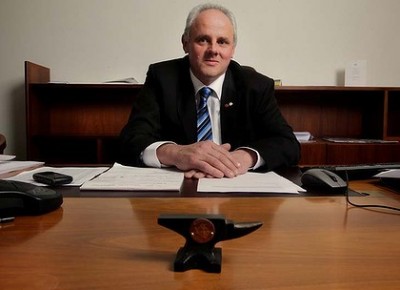
John Madigan

****

CHAIR: I welcome Mr Bill and Mrs Sandy Rogerson, Mr John and Mrs Robin Pollard, Mr Keith Staff, Mrs Jan Hetherington, Mr Hamish Cumming, Ms Cathy Ezard and Mrs Ann Gardner to the hearing. Thank you for your submissions. The committee has a copy of these before them. Before we begin, can I again remind everyone that, in giving evidence to a parliamentary committee, witnesses are protected by parliamentary privilege. It is a contempt of the Senate for a witness to be threatened or disadvantaged on the basis of their evidence to a parliamentary committee. Privilege resolutions 6.11 and 6.12 clearly state that interference with or molestation of witnesses may constitute a criminal offence under section 12 of the Parliamentary Privileges Act.

I want to repeat the following advice from the Clerk of the Senate that was provided to this Senate Community Affairs References Committee inquiry into wind farms in 2011:

If a person who is covered by a confidentiality provision in an agreement gave evidence to a parliamentary committee about the contents of that agreement, they could not be sued for breaching that confidentiality agreement.

I also remind everyone here today that a person who is adversely named in evidence to a parliamentary committee has a right of reply. A right of reply has been afforded to those people who have been adversely named in written submissions to this inquiry. For the purposes of the public hearings, where a witness adversely reflects on another person, I will interrupt the witness and may suspend proceedings. It is the committee’s intention to gather evidence that is directly relevant to the terms of reference for this inquiry. While adverse reflections on third parties may be a matter of related interest, they do not assist the committee in responding directly and objectively to the terms of reference.

Information on parliamentary privilege and the protection of witnesses and evidence has been provided to you and copies are available from the secretariat. I now invite you to make a short opening presentation, and at the conclusion of your remarks I will invite members of the committee to put questions to you. Who would like to make a brief opening statement?

Mr Rogerson: Good afternoon, Senator Madigan and panel members. My wife and I are third-generation farmers and live adjacent to the 32-turbine Oaklands Hill Wind Farm at Glenthompson, Victoria, operated by AGL. Our home is 2.5 kilometres and our woolshed, where we work almost every day, is 1.7 kilometres from the nearest turbine, in an area deemed as an extreme fire risk through its location relative to the Grampians National Park. The Oaklands Hill Wind Farm, which is sited over the ridge lines of rolling hills in a saline, tunnel-erodible area, on a breached volcano, began operating in August 2011.

By September 2011, one of our sheepdogs became severely affected. Soon after, we both started to experience physical changes. I began to wake suddenly at night with heart palpitations, and my wife started to experience humming and vibration in her ears and waking up frequently at night. We notified AGL, and they conducted noise testing at our woolshed and home. AGL identified what they termed a tonality problem at three to five minutes per second wind speed. They replicated our dog kennels at the woolshed, moving the dogs to the house. By 14 March 2012, nine turbines west of the Caramut-Glenthompson road were turned off between 8 pm and 7 am Australian Eastern Standard Time. In April 2012, we found deformed lambs, something we had never seen before in all our years of farming. By marketing time, we found the mob closest to the turbines had lambed at the rate of only 37 per cent, down from a normal average of 85 per cent for our merinos.

AGL told us: ‘We are going to fit dampeners to the gearboxes of the turbines to fix the tonality problem and return operations to full capacity by November 2013.’ However, this did not happen at that time. But last Wednesday night, 25 March 2015, the turbines were all turned back on at night, after being off for three years. With the turbines off at night, we had been able to survive and work our farm. Whilst my wife’s ear problems persist, my palpitations have subsided. Our sheepdogs, however, have never fully recovered; there is a marked alteration in their personalities and their ability to work. And, despite our best efforts to reduce the effects by moving our lambing ewes from the paddocks closest to the wind farm, there are still deformities evident.

There is a huge problem between wind farms and life. The effects are debilitating. The National Health and Medical Research Council must investigate our concerns and do something about the problems we have to endure. In fact, there is a real need for all wind turbines, Australia wide, to be turned off at night to ensure life’s essential—sleep. The current guidelines for wind farms are based on outdated and inappropriate standards, with measurement of infra-sound, low-frequency noise and vibration non-existent. The siting of wind farms is incomprehensible where human and animal detriment, geological and environmental affliction—including fire risk—are precariously reconciled as net gain. Thank you.

CHAIR: Is there anybody else who wishes to make a brief statement? Just so that people are clear: the committee does want to ask questions of all of you, and it is very easy for us to chew up the time allocated for your presentations. That is just so you are conscious of it. So you are welcome to make a statement, but can we just keep them condensed so that we can get time to ask questions of you.

Mrs Pollard: Good afternoon. My message is short. Most aspects will be covered by others and are already in our submission. I did not believe for one moment that I would be affected by low-frequency infra-sound. Three to four months after the wind farm commenced, I realised I was badly affected. It was still extremely difficult but I managed to cope when the turbines were turned off at night. It varies with climatic conditions and is worst when the wind drops in the late afternoon but there is still wind turning the turbines on the hill. Infra-sound is more severe in various parts of the house. I could only cope because I knew I had a few more hours before they ceased for the night. The turbines were off for three years but were turned on again five days ago, and for two nights since it has been impossible to sleep. I appeal again to the Senate for help. Thank you.

CHAIR: Thank you.

Gardners

****

Mrs Gardner: Thank you very much to all the senators for instigating this inquiry and allowing me the opportunity to speak. The suffering at Cape Bridgewater has been appalling. Steven Cooper has done a great job with his studies, and the residents must be commended for their cooperation during this groundbreaking investigation.

It is well known that the larger the turbines the larger the noise emissions. I would like to point out to the committee that at Macarthur we are forced to live with 140 three-megawatt turbines as close as 90 metres from our fence. In August 2013, a preliminary health survey was conducted around the wind farm. Sixty-six per cent of responding households reported acoustic impact; 96 per cent of those reported disturbance during the day; 100 per cent reported disturbance from turbines at night. Twenty-three households were affected, with 62 people being affected—out to eight to nine kilometres.

In January 2014 Piper Alderman acted on behalf of 42 residents, issuing Moyne Shire with a claim of nuisance under the Victorian Public Health and Wellbeing Act. This was denied, with reference to the NHMRC statement: ‘No consistent or reliable evidence of health impacts.’ My family have made nearly 200 health complaints to AGL and government agencies, and AGL has received hundreds more complaints from other impacted residents. AGL denies responsibility for our health symptoms. They refer to the NHMRC statement, the AMA and Victoria health department’s two reports, and then recommend we visit our doctor—the same district doctors who had received AGL’s letter mischievously informing them that there is no infra-sound from turbines. AGL breached the doctor-patient relationship with this action. I received a letter from AGL asking permission for them to contact my doctor, no doubt to inform him that my complaints of infrasound were not due to their turbines. AGL has treated us very shabbily.

We were offered turbines in 2005. We refused. Several years later we were offered a relocation package by Meridian Energy, which we also refused. Not long after being awarded second prize in the Zegna of Italy prize for the finest fleece in the world, our ultrafine sheep enterprise was destroyed by dust inundation, contaminating drinking water over months and poisoning the sheep. We were one of only 10 producers in the world producing this wool. We lost a projected income of several million over the next 10 to 20 years. This business was 80 per cent of our farm income.

Despite ongoing complaints to AGL, they denied responsibility even though we were forced to clean our house several times. We had fraudulent compliance noise testing carried on at our property not according to the New Zealand standard. Moyne Shire and the Victorian department of planning ignored this and deemed the Macarthur Wind Farm compliant. We have comprehensive acoustic evidence proving noncompliance all around the wind farm. AGL wrote to us saying that, if infrasound testing takes place at our home, I must make a public statement claiming the Macarthur Wind Farm is compliant.

Nobody has ever visited our property to investigate our complaints of pain and suffering. My husband and I are forced to leave our farm for two nights every week to get some sleep. We cannot see or necessarily hear the turbines from our home, but we are being hammered with infrasound low-frequency noise. There is every indication that the New Zealand standard does not protect sleep as it does not measure the infrasound low-frequency noise inside homes. Thirty years ago, NASA research confirmed wind turbine infrasound and low-frequency noise directly cause sleep disturbance. Why is this crucial evidence from the US Department of Energy and NASA led by Dr Neil Kelley still being ignored, in particular by the NHMRC?

My husband experienced bolts of pressure which tallied up with pressure peaks measured by Les Houston 86 per cent of the time while my husband was blind to the acoustic measurements of the time. Refer to his recap statement. I suffer day and night from headaches, nose and ear pressure, nausea, heart palpitations and chest burning from vibrations through the floor, couch, chair and in bed all night.

Lack of accountability for all health authorities is a scandal. We cannot guarantee a safe working place for employees. I can no longer work in the paddocks. The current standards are just a joke. The New Zealand standard does not protect sleep as it does not measure infrasound inside homes. Infrasound is a real problem, and Steven Cooper’s results have demonstrated what Dr Neil Kelley’s study discovered 30 years ago. There are real safety issues on our farms.

Ongoing sleep deprivation is particularly dangerous when driving or operating farm machinery. I refer the committee to the case of Mr Peter Jelbart who has a huge problem driving his truck. He is exhausted. He has discovered he cannot continue his trucking business and live at his home at the same time due to severe sleep deprivation. Moyne Shire has refused to accept our peer reviewed assessment report by Les Houston. The shire has failed to protect us from noise nuisance despite hundreds of complaints. One councillor even suggested that residents may have tampered with noise-testing equipment. At a meeting in 2014, I along with one other neighbour was verbally abused by a representative of the Ararat Shire Council when we attempted to discuss health issues. Needless to say, we left that meeting in tears. There is no transparency in the authorship of the two Victorian department of health reports released in May 2013. Many peer reviewed reports were ignored, and my FOI request for information regarding authors and correspondence was refused. My appeal was upheld and now this case has been going on for nearly two years already. What does the Victorian department of health have to hide?

This is not about money, as you will have realised from our refusal of AGL’s offer to us. We just want to be able to live in our own home and work on our property the way we had for 32 years before the Macarthur Wind Farm began to create a nuisance and to trespass on our property rights with acoustic emissions from turbines 1.7 kilometres from our home. Please do not ignore our pain and suffering. These same symptoms were reported in 2004 by Dr David Iser at the Toora wind farm.

We need thorough compliance investigation and proper enforcement. We need thorough multidisciplinary health research in the field. Infrasound measurements must take place both inside and outside people’s homes. It is essential that Steven Cooper is employed at the Macarthur Wind Farm, as the symptoms are exactly the same to those in Cape Bridgewater. We need the turbines turned off at night so we can sleep in our own homes, which is our common law right.

Instead of moving to rectify this public health disaster, all levels of government and the wind industry are hiding behind the smokescreen of the NHMRC’s statements when in fact Professor Anderson recently admitted at, I believe, a Senate estimates hearing that there are health effects from turbines. To continue to ignore our pain and suffering is pure wilful blindness. Once again, I invite the committee to visit the Macarthur Wind Farm to speak to the impacted residents. Thank you very much.

Mrs Hetherington: My name is Jan Hetherington. I am an artist, I am a widow, I live three kilometres from the Macarthur wind facility and I am heavily impacted on by the low-frequency and infrasound emitted by the 140 three-megawatt turbines. The Macarthur wind facility was accredited in September 2012 before it was fully operational. In late January 2013 AGL was receiving recs for the wind facility which was not necessarily compliant and was not deemed compliant until the Moyne Shire voted in September 2014, ignoring residents’ pleas for council to view their independent acoustic report showing ample evidence that the Macarthur wind facility was not compliant. Residents have done independent noise testing for two years at their own expense where they have proved that there is infrasound, but no-one seems to want to listen to the truth. There is no-one looking out for us. The Victorian planning department and the Victorian health department take no responsibility for us. The system is broken. It has failed us, all because money and profits are the priority.

My business has suffered as I find it hard to work solidly in my studio for any length of time because of a vibration which feels like an electrical charge running through my body and noise nuisance. My ability to earn a living has diminished. My family no longer enjoy lengthy holidays with me on the farm for fear for their health and their children’s health from the damaging infrasound and noise nuisance. I have now become sensitised. After a recent procedure in hospital in Melbourne I experienced the same sensations of vibration, palpitation and tinnitus as I experience at home. I have become permanently damaged through the exposure to infrasound from the Macarthur wind facility.

At my farm, I experience severe adverse health effects such as vibration, heart palpitations, tinnitus, head pressure, headaches, sleep deprivation, anxiety, night sweats, nausea, itchy skin, cramps, and ear, nose and throat pain. Twice now I have experienced horrendous pain in my chest stabbing through to my backbone in between my shoulder blades. I contemplated calling an ambulance both times but could not move to do so because of the severity of the pain. Ten minutes later it had dissipated, leaving me with great stress and anxiety and feeling washed out. All these sensations leave me drained in the morning. I find it very hard to start work that day.

When I make a formal complaint to AGL they respond in the most contemptuous manner, with references from the NHMRC statement saying there is no reliable or consistent evidence that proximity to wind farms or wind farm noise directly causes health effects. The wind industry uses this statement to deny claims of health impacts; therefore, they refuse to do anything about it. Warwick Anderson from the NHMRC admitted in a Senate estimates hearing that there are health impacts from wind farms. What is going on?

AGL’s objectionable letter to the doctors at 12 medical clinics in the western district made my blood boil. I had a perfectly healthy, happy and trusting relationship with my doctor before AGL started meddling with my doctor-patient relationship. Many times I spoke to him about my health complaints due to the Macarthur wind facility and he was caring and wanted to help me. But one day during a consultation he turned to me and told me that infrasound will not hurt me and that I will just have to get used to it. I was gobsmacked and could not believe my ears. I asked him where he got his information from. He rifled through some paperwork on his desk and, as he did so, I noticed a letter with an AGL letterhead. I asked him to explain himself. That is when he told me that this information came from AGL, asking doctors to refer patients to the AGL website if they presented themselves with complaints due to the wind farm. This interference is outrageous. AGL have no medical expertise and have no right to interfere in a doctor-patient relationship. In my opinion, it should be a criminal offence to interfere in a doctor’s medical assessment of a patient.

We need comprehensive, multidisciplinary research into the health impacts from this noise nuisance. This research has to be carried out in the field and not behind a desk in downtown Melbourne. We need to have the same research carried out at Macarthur wind farm by Stephen Cooper as he did with Cape Bridgewater wind farm, where he found ground-breaking evidence that there is infrasound. I have pleaded with AGL to turn the turbines off at night between 7 pm and 7 am so I can get a good night’s sleep, but they simply ignore my pleas and refer me to the NHMRC statement. What a crock! AGL’s Glenthompson wind farm is turned off at night because of the health impacts and noise nuisance on residents. Why can AGL not do the same at Macarthur? Lord knows we continually request that, and the answer is still no.

Mr Pollard: My name is John Pollard. I am a retired station manager and we live on a lifestyle property of approximately 80 acres. Firstly, I would to say that Robin and I find it very difficult to appear here today as a number of our friends have turbines on their land. It is such a serious problem for us and many others that we felt compelled to be heard. Too many people have had to leave their homes. One family near us left their home almost 3½ years ago, and they are here today—Adrian and Helen Lyon.

The wind farm guidelines on health issues of this very serious problem have to be assessed. They will not acknowledge infrasound. I will relate one incident that happened in our home one night. My wife was sleeping in the chair beside me and I was watching television. This is after they had turned the turbines off. She was dead to the world and I was just watching the television. All of a sudden she woke up, completely startled and disorientated, and I was really worried about her because I thought she had had a stroke or something. Eventually she came to her senses and she said the turbines must be on. I said, ‘No, they’re not. It’s 10.30. They turn off at nine o’clock.’ I went outside and they were still running. So I thought that next day I would ring AGL. When I was about to ring, they rang me and said, ‘I’m sorry, John. We forgot to turn the turbines off last night.’ This is before it was computerised.

It really is a problem, and there are people further away from the turbines than us who are badly affected. One property is 3.5 kilometres away and she has got exactly the same symptoms that Rob has. Our property is on the bottom of a volcanic breach and it is the end of the lava flow and the turbines are well above us. Whether there is a seismic effect I would not know, and there have been queries about that. Dr Mosley in New Zealand said that they are tuning forks on hills. I do not know whether that applies to us, but we are certainly suffering from infrasound very badly.

Mr Cumming: I have tabled my opening statement in lieu of time. It just talks about the destructive impact of wind farms on brolgas and raptors and how greenhouse gases are not being abated. If you are happy with that, I would prefer to take the time in questions.

Keith staff

****

Mr Staff: I have lived in Penshurst for the last seven years plus. My wife and myself, after 30 years of living and working in Melbourne, decided that it was time for retirement, and what better part of the world could we retire to but the Southern Grampians. It was beautiful, quiet and rural. Were we wrong! After two years or so of making the big move, or tree change, we found out by accident about a proposal for an industrial wind energy facility of 223 turbines 175 metres tall to be located three kilometres from the edge of our historic property and the Penshurst township. This proposal would adjoin the Macarthur facility. The implications are horrendous.

If I could backtrack, at first I had an open mind about wind farms when we found out about this proposal. However, being a fairly independent minded sort of person, I decided that I would do some of my own research into the whole topic and question. This included visiting some impacted residents at Waubra. I had heard of Waubra but I had never visited. People said to me, ‘If you want to find out a little bit about this wind farm, visit these people.’ So we did. I was horrified. For the first time, I got up close and personal to a gigantic wind turbine—several of them. I heard the noise. These people were badly impacted—their health. That was the first indication to me that all is not what the proponents say. Secondly, we visited people at Glenthompson—and you have just heard some comments. There were the same repercussions, the same problems, the same impact. Then there was Macarthur. We visited Macarthur and we know people at Macarthur. To all of our quiet questions, our inquiries, the same message came back. Cape Bridgewater was the same. I visited the residents. I know how badly they are impacted. So we packed away a lot of personal experience and meeting people over a period of maybe two years.

So then I decided to get active. I changed from being non-committal and open minded to being anti industrial wind farms—and I am proud to use the word ‘anti’. Rather than just complain, I did one or two things. I formed a group. I am president of the Southern Grampians Landscape Guardians. Also I am an active member of the Australian Industrial Wind Turbine Awareness Network—a bit of a mouthful but there is such a group. We estimate that we have over 3,000 members in that network nationally. So it is not just a few people complaining in a few isolated rural areas; this is happening nationally. I am a committee member of the recently formed group in Victoria called Wind Industry Reform Victoria. Also I am a committee member of the Brolga Recovery Group—and that is a whole different situation. The brolga is a threatened species and an iconic bird in the south-west. Wind farms are the natural enemy of brolgas—they leave.

I sometimes have to justify my position to people. Locally, the town is bitterly divided. Families are divided. I do not have to justify my position—I am perfectly comfortable with my position and my knowledge—but I sometimes have to state the obvious facts. When people—and maybe the media—infer that I have connections I have to tell them that I do not receive any funding from the fossil fuel industry, I do not belong to any political party and I do not belong to a religious organisation; all of this is formed from my own contacts, knowledge and travel, including to the previous Senate inquiry in Canberra two or three years ago.

I will not go into the detail of my submission but it is based on my informed view that the whole industrial wind power business is a catastrophe on every level—environmental, social, fiscal and economic. The whole industry is characterised by exaggerated claims and false propaganda put out by the wind industry. I will finish with some comments about planning issues, the full text of which is in my submission. The planning issues are many and varied, and there is a strong case of fraud to be levelled at wind proponents and their paid consultants. If anybody wants clarification about what fraud means, it is easy. Fraud is an individual, a company, an organisation or a business supplying incorrect and misleading information in the pursuit of making a financial gain—and that is the wind industry.

Proponents’ consultants are paid large amounts of money to produce reports and assessments with one aim in mind, and that is to ensure that their clients gain a planning permit approval. These same consultants are then retained to make expert witness submissions at planning hearings, such as the VCAT scheme in Victoria. Individual community members making submissions at the panel hearings—and we have attended some in Melbourne—are effectively closed down by lawyers and barristers acting on behalf of the proponents. The common phrase is that you are not regarded as an expert witness. These are people who have lived and worked on their properties in rural areas for ages, and they are told: ‘You really don’t know what you are talking about; you are not an expert witness.’

Finally, the same misleading and inaccurate assessments by the consultants are then presented to planning and environment ministers and shire councils, with no independent experts appointed to check on the assessments. Shire councils, I believe, sometimes act with vested interests. Their first priority should be the health and wellbeing of their residents and their ratepayers, not to make it easy for wind proponents to gain planning permit approvals. Shire councils can be accused of wilful blindness; you have already heard some comments. Openness, honesty and transparency are a joke, as are shire councils’ community consultation processes. They are simply a ‘tick the box’ exercise run by slick city-based PR organisations acting on behalf of proponents. Thank you.

Ms Ezard: My statement is very short. I wish to thank the committee for taking on this important debate. The wind turbines at Cape Bridgewater have impacted on my enjoyment of my area. We are currently trying to sell our property so we can relocate away from the turbines in retirement. At the time the turbines were proposed for the Portland area, there was talk of 5,000 turbines for Victoria, a very small state. Where do you relocate to in order to get away from the impact of turbines? Some people have relocated, only to find another proposal for a wind factory in their new area.

Climate change is spruiked as the reason for the necessity of wind factories; it is said that, if we do not act, we leave a burden on future generations. Wind turbines will also cause a burden, with compromised landscapes even when turbines are decommissioned. Many companies, or wind factories, may no longer exist in 20 to 25 years, so who will be responsible for removing these monstrosities and rehabilitating the landscapes? Advances in technology will also cause the wind industry to become obsolete. Thank you.

Senator LEYONHJELM: I have a question for Ann Gardner. I think you said AGL has written to you, saying that you are not to say anything about infrasound.

Mrs Gardner: No. I had been complaining about the infrasound and wanting them to carry out testing on our property, because we have our own evidence anyway. They wrote to me—and I have a copy of the letter in my submission—informing me that, should the infrasound testing take place at our property, if this resulted in not breaking the rules or whatever, I had to make a public statement claiming the Macarthur Wind Farm is compliant. Compliance has nothing to do with infrasound anyway. I have the letter.

Senator LEYONHJELM: That is in your submission?

Mrs Gardner: Yes.

Senator BACK: We would like you to table that letter, if you would.

Senator LEYONHJELM: You put it in your submission, did you?

Mrs Gardner: It is in my submission.

Senator LEYONHJELM: I have not got to that bit. There are 330 pages to read for today, and so I haven’t got to that.

Mrs Gardner: I am sorry about that, but it is in there.

Senator LEYONHJELM: It is page 201, is it?

Mrs Gardner: It is a copy of the email.

Senator LEYONHJELM: Thank you. I have a couple more questions, and then I will give someone else a go. Mr Cumming, in your submission you say that the Loy Yang A power station annual report shows a rising carbon intensity, which is increasing proportionally to the increase in wind turbine output. Why is this so?

hamish-cumming

****

Mr Cumming: If you look through the annual reports from 2005 report through to about 2013 you will see that carbon intensity has continued to rise. Off the top of my head, it was something like 1.14 tonnes of carbon per megawatt and it is currently running at about 1.35. If you look at all the power stations, you will see where you can get the information—it is very hard to get some of it—and you will see that it is happening across the board, even in Queensland. The Queensland power stations are the same. It is all to do with backing up wind farms and making the grid safe so that it will not blackout. The more wind farms that come on, the higher the backup has to be. In 2005, it was something like 600 megawatts and now it is over 1,000. Nothing has changed in the grid. In fact, demand is less. The reasons for having it should be less. Industry is less. And it is all in line with wind farms coming on line.

Senator LEYONHJELM: So you think Loy Yang, Yallourn and Hazelwood burn more coal now than prior to the penetration of wind energy capacity into the grid?

Mr Cumming : Very much so. The data for Loy Yang is very clear and very public—much to their horror when I point it out to them. Now they have even changed the way they do their carbon intensity calculation. They have removed a third of the input data to try and make it look smaller, but it is very public for Loy Yang. If you look at the savings that they have made in thermal efficiency and other in-house savings of performance of the plant and then you look at the coal-led burning, there is a gap for Loy Yang of six million tonnes of coal a year today versus 2005.

Senator LEYONHJELM: Did you hear the evidence of Pacific Hydro this morning?

Mr Cumming: No. I was not here for that, sorry.

Senator LEYONHJELM: They basically put a completely alternative point of view to us on that.

Mr Cumming: Did he use Loy Yang’s annual reports and public data?

Senator LEYONHJELM: He did not provide any data. The view was simply that there was no increase in spinning capacity.

Mr Cumming: That is incorrect. You have to look at the documents that the industry runs on. There is a guy called Hugh Saddler, who works for Pitt & Sherry. He does what are called CEDEX reports, ACIL Tasman reports. That is what the industry is always based on. All the emissions, all the RECs—everything—is based on that. It is all reverse calculated. It is all calculated from what power is sold through theoretical thermal efficiency and data. It has a number of errors in it, including a seven per cent error for the Yallourn power station. When I highlighted this to them, they said, yes, they know. It is the closest thing they have got, whereas carbon intensity is actual fuel burnt. You cannot get away from it.

Senator LEYONHJELM: Do you think the Clean Energy Regulator’s reports of emissions reductions are accurate?

Mr Cumming: No, not at all.

Senator LEYONHJELM: Why is that?

Mr Cumming: Because they are relying on the CEDEX reports and the ACIL Tasman reports and those are all based on reverse calculation. None of it is based on fact. The fact has to come from the actual carbon, the actual fuel burnt—

Senator LEYONHJELM: The actual fuel burnt?

Mr Cumming: The actual fuel burnt. If you have actual fuel burnt for a half-hour period and then you use the AEMO data for the same half-hour period, you can see exactly what is happening. And this was highlighted in my submission on 4 July 2013, when McArthur, Lake Bonney and another one went off line at the same time. The power was instantly picked up, without a flicker of a light bulb, without down time of any industry. It was picked up by New South Wales and Queensland coal-fired power stations—450 megawatts. That is a massive amount of power. It is bigger than the largest Victorian single generating plant, and it was picked up instantly. The only way they can do that is if they are burning the coal already and venting for steam as backup. None of that is covered in the reports that are used officially by government.

Senator LEYONHJELM: Do you have a view on how effectively the Clean Energy Regulator is performing its legislated responsibilities?

Mr Cumming: My personal belief is that they cannot perform their responsibilities if they are not using facts. If they are using reverse calculated data estimates, they cannot perform their responsibilities. They have got to get the facts.

Senator LEYONHJELM: What would you do? Would you broaden their responsibilities or change the way they calculate what they are supposed to calculate already?

Mr Cumming: I would change the rules so that they have to use base data from the entire power industry. That will force the generators to provide the hourly coal feed, gas feed, fuel feed data. At the moment there is no regulation to enforce those companies to provide the data—and it is not in their interests to because it affects how they get paid. If they tell the truth about what they are doing then the investors are not going to allow AGL to buy more wind farms or build more wind farms when AGL owns Loy Yang A. It is the same with the other power stations. They all own wind farms, power stations and coal seam gas. It is in none of their interests to tell the truth.

Senator LEYONHJELM: Do you have some data on raptors and brolgas in relation to turbines?

Mr Cumming: Yes.

Senator LEYONHJELM: Could you quickly summarise that for us?

Mr Cumming: Raptors are being killed at an alarming rate by wind turbines. At one of the first Portland plants to start up at Codrington one turbine was killing 11 falcons every two weeks. Turbines in Woolnorth in Tasmania were killing at such an alarming rate that they were stopped. They come in from outside areas to feed on the dead birds and get killed themselves. AGL Macarthur employed consultants to look at it and they are estimating that the Macarthur wind farm is killing 10 birds per turbine per year, 30 per cent of which are raptors. That is 10 times what their planning permit has said they would do, yet the responsible authorities have done nothing about stopping it, limiting it or making them abide by their permit conditions.

With brolgas you have a separate issue. You have got displacement. Studies have been done in America and Australia that show that the turbines are displacing cranes—and brolgas are a crane—for a distance of up to 14 kilometres but regularly a distance of six kilometres. Since the Macarthur wind farm started—and I try to use all these people’s own reports; they are the best thing to use—their reports have said that 45 wetlands were abandoned in the first 12 months, and 25 of them were potential breeding wetlands, and no brolgas have successfully nested within six kilometres of turbines.

Three attempts at nesting were made during the first year of operation when the wind turbines were stopped. I have the whole year’s data from the AEMO from Macarthur and from other means through DSE. There were three attempts at nesting and as soon as the turbines hit 30 per cent capacity they abandoned their nests. On the first attempt they stuck it out for a few days, on the second attempt they stuck it out for one day and on the third attempt they did not stick it out—they just took off. That is what the American studies have found. The problem is getting worse over time. The displacement is greater and the time is shorter. They are a disaster for brolgas and raptors.

Senator LEYONHJELM: It is the equivalent of habitat loss, is it?

Mr Cumming: Yes, it is forcing them out of habitat. For brolgas there is very little habitat left. I am trying to stop RES at Penshurst and Trustpower at Dundonnell. Half of the remaining brolga habitat is going to be destroyed by those two wind farms if they are allowed to go ahead. They have to be stopped.

Senator CANAVAN: What would happen if you went out into the backyard and shot a few raptors in Victoria? Are you allowed to do that?

Mr Cumming: If you shot a raptor in Victoria it would be a $5,000 fine and potentially two years in jail. Macarthur’s own estimates is they killed 500 in the first year of operation. That is their own estimate and there was no penalty. They are not even told to try to prevent it.

Senator DAY: I know we have a veterinarian on our committee here.

CHAIR: Two of them.

Senator DAY: Are there any veterinarian studies you are aware of into the effects on animals of these wind turbines?

Mr Rogerson: None that I am aware of. We actually had one sent to the Werribee research place just out of Melbourne. They did not find any results. They could not pin down what caused anything to the lamb we sent down. He was badly deformed. Like I said in my thing this is the first time we have had deformities and I have been on the farm all of my life.

Senator DAY: You are not aware of any studies that have been undertaken?

Mr Rogerson: No, none whatsoever.

Senator BACK: No chemicals used?

Mr Rogerson: No.

Mr Cumming: If I can just very briefly jump in there. When touring Gippsland there was a dairy farmer who lost 30 per cent of his dairy calves that were born. When he moved them a distance away from the turbines the following year there were no losses. That is just a very strange possible coincidence.

Senator LEYONHJELM: Not exactly strange. I can understand the conception, the low fertility, but it is very hard to equate that with what Mr Rogerson is arguing about with deformities. I cannot think of any reason.

Senator URQUHART: Was there any evidence, any veterinary studies, on that one?

Mr Cumming: They based it on a study on goats that was done in Thailand, where half of a goat herd died.

Senator URQUHART: No, particular to the farm you were talking about.

Mr Cumming: No. They based their study on the Thailand one. There was no direct study on it. The Thailand one was a proper study.

Senator URQUHART: You were talking about studies in relation to the raptors and cranes.

Mr Cumming: In America, it was done by a person called—

Senator URQUHART: What about here, in relation to the comments you made about AGL?

Mr Cumming: The AGL one was done by consultants paid for by AGL. It was their own report and their own consultant.

Senator URQUHART: Can you direct us to that? Maybe not now, if you can provide it on notice.

Mr Cumming: I think I sent it as an attachment, and I attached my own analysis of it. Also, there was another study done, for Codrington-Yambuk by Biosis, again paid for by Pacific Hydro, that said the same thing: within five kilometres half of the native bird population had disappeared in the first year and it got worse in the second year and in the third year.

Senator URQUHART: Senator Leyonhjelm was asking about your claims that wind farms result in an increase rather than a decrease in greenhouse gas emissions. I think you have also claimed that coal is burnt without generating power as a result of wind turbines, so it is all sort of wrapped up.

Mr Cumming: As backup spinning reserve, yes.

Senator URQUHART: I understand that you sent a letter recently which was printed in the Mortlake Dispatch, the local paper.

Mr Cumming: Yes.

Senator URQUHART: Is that a regular daily?

Mr Cumming: It is a weekly.

Senator URQUHART: Is that all around this region?

Mr Cumming: It would be Mortlake, Camperdown, that sort of area.

Senator URQUHART: So it has a fairly broad reach. I have a letter from AGL who are the owners of Loy Yang A power station, on which you based your claims. It was sent to the Mortlake Dispatch. AGL sent this letter to the editor of the newspaper last Friday, as I understand. I am happy to table the letter for the committee. I will take you through it. Referring to the letter you had published in the paper, it says, ‘In a letter dated 19th March, Hamish Cumming claimed that wind farms operating in the electricity grid have resulted in an increase rather than a decrease in greenhouse gas emissions from the electricity sector.’ That was what was in your letter. Their comment then goes on to say, ‘This is completely untrue.’ It also states: ‘On average, the amount of emissions produced per unit of electricity sold into the network has gone down by over eight per cent since 2006, according to the national greenhouse accounts.’ The letter goes on to say that you also claimed: ‘Over this period the emissions intensities of coal power stations, including AGL’s Loy Yang A power station, have increased substantially because they necessarily burn a lot of coal without generating power so that they can be on standby to back up the intermittent power generated by wind farms.’ AGL say in their letter that this also is untrue: ‘Over the past six years the emissions intensity of AGL’s Loy Yang A power station has not substantially changed. In financial year 2009 it was 1.27 tonnes of greenhouse gas emissions per megawatt-hour of electricity sent into the network. In financial year 2014 it was 1.28 tonnes and the average tonnes of coal burnt to produce each unit of electricity sold also has not changed significantly. Over the same period, wind generation in the network has increased dramatically, with numerous wind farms built in Victoria and other states. If Mr Cumming’s claims were true both the emissions intensity and the tonnes of coal burnt per megawatt-hour of power sold would have increased during this period as additional wind power came into the market, but this has simply not occurred.’ In light of that information from AGL, would you agree that your arguments have been revealed as being incorrect?

Mr Cumming: No, not at all. What AGL are saying there is totally incorrect. I can prove that very easily, and have provided you—

Senator URQUHART: Just to clarify, you have put the letter in and they have responded to the paper, and you are saying that what they are saying is wrong—

Mr Cumming: Correct.

Senator URQUHART: that they are actually lying.

Mr Cumming: Correct, as they did when we put in the paper their report that they refused to give us for several weeks about the brolgas and raptors. They said that I was wrong as well, but it was their report I was quoting. It is the same now. I am quoting AGL’s annual report and Loy Yang A’s annual reports for 10 years. The data I am quoting is out of their annual reports. They have not said there that for last year’s figure, which has gone from 1.35 down to 1.29, they have changed the calculation of carbon intensity to reflect that. They have not gone back and changed the calculation for the last 10 years to show that the graph has gone up. In my submission there is a graph, which I did not create. It is their graph out of their own annual report that they put on the Australian Stock Exchange. They cannot argue with that.

Senator URQUHART: I am not arguing; I am just trying to get the facts, that is all.

Mr Cumming: The facts are that they are lying through their teeth.

Senator URQUHART: So, basically, what you are saying is that they are lying.

Senator BACK: To assist the committee—this is very important point—was that a letter to you, Senator Urquhart?

Senator URQUHART: It was a letter to the editor.

Senator BACK: I ask, through the chair, Mr Cumming if you would be kind enough, when you have seen the text of the AGL letter, to respond to the secretariat and explain to the committee through the secretariat where you believe AGL’s response to your correspondence is wrong so that the committee can understand completely.

Mr Cumming: I will not see that until Thursday unless you give it to me.

Senator URQUHART: The secretariat might be able to get copies. I will table it with the secretariat.

Mr Cumming: It will not be published in the paper until Thursday.

Senator BACK: We do not need it in five minutes; we just need to get your response to it.

Mr Cumming: And the community will also get my response in next week’s paper!

Senator URQUHART: Mr Staff, you said you are anti-wind and proud of it. I think those were your words.

Mr Staff: I said ‘industrial wind’.

Senator URQUHART: Industrial wind, sorry. I understand that one of the most prominent anti-wind campaigns in Australia seems to be the website stopthesethings.com, which proudly states:

We’re not here to debate the wind industry – we’re here to destroy it.

The site has also been known to use abusive language and to attack individuals who support wind. I could not find any contact information from the owners of the site on any of its pages. The contact details were also removed from a domain name own research. Did know about the site are referring to?

Mr Staff: STT? No. There must be some very committed, knowledgeable people who put that together. I am not involved with it and do not do not know of anybody who is, but they have access to a lot of factual information, including from overseas. They tend to put over their point of view in a tongue-in-cheek, rather cynical way in order to make a point. It is very well researched. I have no idea who is behind STT.

Senator URQUHART: In 2013, there was an anti-wind rally at Parliament House. You were interviewed by the ABC is the co-organiser of the stopthesethings anti-wind rally.

Mr Staff: Excuse me? The ABC said I was the co-author?

Senator URQUHART: You were interviewed by the ABC as the co-organiser of the stopthesethings anti-wind rally. That is not correct?

Mr Staff: Wrong! I never said that. They never asked me that. It is completely wrong.

Senator URQUHART: Were you interviewed by the ABC at that stage about the rally?

Mr Staff: I was asked some questions, but not whether I was an organiser.

Senator URQUHART: But you were interviewed by the ABC at the time?

Mr Staff: Can I tell you what the ABC said?

Senator URQUHART: Certainly.

Mr Staff: They said, ‘Mr Staff, it appears to us that you,’ meaning the large group of protesters who were there in front of Parliament House, ‘have reached critical mass,’ which in media speak means you can no longer be ignored—your group, supporters, the people. It was nothing to do with STT.

Senator URQUHART: I am happy to throw this open to anybody else who feels like they want to have a say: some of you have mentioned in your statements, and in your submissions as well, that you are genuinely concerned about the health impacts of wind farms, and I think we have heard from a number of you today outlining that. A 2011 article in the Medical Journal of Australia, by four Australian doctors, cited studies showing that the risk of premature death for people living within 30 miles of coal-burning power plants is three to four times that of people living at a greater distance. In that context, I would be interested in whether you would be more concerned about living near a coal plant than a wind plant.

Mr Cumming: What about solar? What is wrong with solar? We do not need to do wind turbines. What is wrong with thermal molten salt solar, which is baseload, does work, does not displace brolgas, does reduce greenhouse gas and does not make people sick? Why not use that? Why are we entertaining the idea of trying to keep something supported and alive that has so many things against when there are technologies there that do work and do not have these issues?

Senator URQUHART: Anybody else?

Mr Staff: Could I just add that all of the pictures and the visuals that ABC in particular like to throw up on their news items showing coal fired power stations have cooling towers—everybody knows the cooling towers—and all the apparent smoke and pollution billowing out. It is not pollution; it is water vapour. But there are certain people—political parties and others—with vested interests in trying to indicate that that is actual pollution coming out of those cooling towers. It is not; it is water vapour.

Senator URQUHART: I just want to go the issue of birds and bats. I think, Mr Cumming, you outlined this in some of your answers. There was a 2007 study by the government of South Australia—I am not sure whether you are aware of that—that showed that one domestic cat kills more birds in a year than one wind turbine.

Mr Cumming: Next time I see a cat take down an eagle or a brolga, I will let you know.

Senator URQUHART: That is a very good point. I am just wondering whether you are aware of that report.

Mr Cumming: I am also aware of a report that says more birds fly into windows in Melbourne as well, but they are talking about sparrows, starlings and other small birds, not iconic birds that are protected and carry a $5,000 fine; if you killed one, you would be charged $5,000.

Senator URQUHART: Yes, that is what the 2007 report is referring to, not the bigger birds. I am just trying to get to the bottom of what you are referencing in terms of the big birds versus the other birds.

Mr Cumming: It is not relevant to wind turbines.

Senator URQUHART: I think I will leave mine there and give someone else a go. I might come back if I have some time.

brolga112

****

Senator BACK: Mrs Gardner, we cannot find the correspondence, so would you be kind enough to provide the correspondence.

Senator CANAVAN: Sorry, we have. It is being sent through.

Senator BACK: No worries. Okay. Mr Rogerson, I will be interested—and Senator Leyonhjelm might also be interested—in whether we can actually see some records going back over time of lambing percentages et cetera in different paddocks. We cannot advance it here, but I would be interested to have a look at that.

Mr Rogerson: Yes, no worries.

Senator BACK: I have actually never spoken at all publicly about any issues associated with animals but, because I am a veterinarian, I suppose advice has come to me over time from France, Italy and other places of foetal abnormalities in different species, including a well-documented case in thoroughbred foals. I do not want to spend the time here, but I am just saying to you I am interested, and I am sure other colleagues would be.

Mr Cumming, the net greenhouse gas beneficial effect of industrial wind turbines has often been discussed, when you take into account the manufacturing of the steel and obviously the engineering work associated with the fabrication of the steel, the concrete that is poured et cetera. Do you have any advice for the committee as to what length of time—in terms of days, weeks, months or years—an industrial turbine would have to operate for before you would reverse that greenhouse gas negative from its construction and actually start seeing some benefit to the environment? Are these figures, or estimates, available?

Mr Cumming: I did a study some years ago now for a planning panel regarding this sort of thing. I used as much information as I could glean for the construction, maintenance and other associated greenhouse gas costs for the wind farm. I then used their manufacturer’s up time of the 30 per cent generation. I was then very conservative in favour of the wind farm company’s backup requirements. I used gas fired power stations. I used open cycle power stations, the most cost effective for the wind farm, making it look good for them as much as I could, so to speak. It came out with a 20-year life return payback of greenhouse gas.

Senator BACK: Could you explain what you mean by 20-year return?

Mr Cumming: It would mean it would take the wind farm 20 years running 30 per cent of its time generating into the grid to pay back those emissions.

Senator BACK: Before it would get back to equality.

Mr Cumming: That is right.

Senator BACK: Before it would start making a beneficial effect.

Mr Cumming: Yes. Without any major catastrophic bearing failure or anything like that, it would take 20 years. The industry claims four or five months, and I question those numbers quite seriously.

Senator BACK: You have also been quoted at different times—and even in today’s discussion you have been giving us the benefit of your advice—in terms of calculations, real versus apparent, et cetera. Can you tell us what data is needed from power stations to accurately determine what greenhouse gas impact wind farms are having on the grid? I am only talking about grid based industrial wind turbines now. I am not talking about those standing apart from the grid.

Mr Cumming: If they were genuine in wanting to show how good they were they would have provided this already. What you need to do it accurately is at least hourly actual fuel feed generation data—and preferably five minute, because AEMO data is every five minutes for generation and sales—from each of the power stations. Then you could crossmatch that against the AEMO’s data and you would see instantly who is burning coal and not producing power, if they are venting steam to the atmosphere waiting to back up, if they are spinning in reserve, if they are shut down, You will see that instantly. At the moment, the companies are not willing to give that willingly because it highlights too many problems on their side.

Senator BACK: A core concern of this committee, given the fact that we represent, at the federal level, expenditure by taxpayers, is that all these other issues, as I said earlier in the day, are interesting, but they are constitutionally the role of the states and territories and, through them, local government. But where this body—and where the Senate—has a direct involvement is in defending and justifying to taxpayers where their money is being spent. In view of the Clean Energy Regulator and renewable energy certificates, which the Clean Energy Regulator has responsibility for, what is the basis upon which the companies running industrial wind turbines should be, in your view, paid the renewable energy certificates?

Mr Cumming: In my view, if you have a transparent view of the entire grid and the inputs to the grid, the wind farm companies should only be paid for a net reduction of greenhouse gas. At the moment they have got open slather. Whatever they put into the grid is accepted, and coal is put offline. There is no saving in that. If it was a net saving then companies like AGL would think twice about burning an extra 6 million tonnes of coal to back it up, because there is no net gain for them between their wind farms and their power station if they have to declare that.

Senator BACK: If I am wrong my committee member colleagues will tell me, but I understood Mr Richards to say that the Australian Energy Market Operator, the AEMO, can predict out, with a high degree of accuracy—as in the high 90s percentage accuracy—some time into the future what the contribution will be from a wind farm. Therefore, the AEMO can make adjustments. In your view, is that correct?

Mr Cumming: In my view, it is bordering on some correctness. Yes, they can say, ‘We expect the demand to be this. We expect the power stations to do that. We expect the wind to be available for this period of time.’ But it cannot predict accurately enough how much capacity the turbines are going to generate, because they will not generate under 40 kilometres per hour and they will not generate over 90 kilometres per hour. Do not quote me on that, but there is a band where their generation is not efficient. They are relying on Bureau of Meteorology weather forecasts, wind directions and other things to come up with that number. If that was the case and it was able to predicted, on 4 July 2013, when Macarthur and so on went off line, it was a fault. When they went off line, there should have been a blackout because, if they were predicting and running the grid in such a finetuned way as was claimed—

Senator BACK: It was a sudden fault, was it?

Mr Cumming: It was an unplanned fall off the line. They lost an interconnector—

Senator BACK: Without advance notice?

Mr Cumming: Yes, 450 megawatts fell off the line and was picked up from Queensland and New South Wales. If that was, supposedly, such a super finetuned grid and they were predicting all this, you would have had a blackout then, and we did not have a blackout. For those power stations to be able to deliver, you are talking coal fired power stations that take eight hours to ramp up from zero to full capacity. They can do about 10 to 15 per cent in half an hour; they cannot instantly respond in less than a second unless that power was available—

Senator BACK: Whereas, by contrast, would it be your argument that solar—and certainly those who promote wave energy can say that they can tell with a high degree of accuracy 48 to 72 hours out what the wave action is going to be and the amplitude of the waves—is an equivalent? Can people predict with a high degree of accuracy what it is going to be like on Wednesday afternoon in the peak demand time on the Melbourne-Sydney-Hobart-Brisbane grid?

Mr Cumming: You are talking about two different sorts of solar here: one is the household—

Senator BACK: I am talking about the large-scale; not the household.

Mr Cumming: With large-scale molten salt solar, yes, you can predict it well because their ability to store molten salt means that they can have a capacity of X megawatts up their sleeve ready to flash water onto the heat exchanger to produce steam. So the prediction ability is great, but the responsibility is even greater. It is almost like having your own little nuclear power plant running off the sun.

Senator BACK: And hydroelectricity, again, has the same degree of predictive accuracy.

Mr Cumming: Yes. I have been arguing with the Victorian government for 10 years now that we should be using the backup coal that is being wasted and the wind off-peak that is being sold for 1c a megawatt hour because no-one wants it in the middle of the night. We should be pumping the water back up the mountain—the hydro. We have the technology and the ability; they do it in other countries. The Victorian government will not entertain that at all.

Mr Staff: If I could make one comment which I think is really pertinent with Mr Cumming’s comments, these are our official figures. I think behind many of the questions and comments today is: just how efficient are industrial wind farms? These official figures are produced from the National Electricity Market board. Figures as of Saturday in Victoria for electricity generation in Victoria by category are very pertinent. For brown coal, which is obviously in the Latrobe Valley, Yallourn, capacity produced generation for Saturday was 5,714 megawatts. This is one day: Saturday just passed. Next is gas, which was 30 megawatts. Hydro was 245 megawatts. Wind was 29 megawatts. These are official figures. Large solar capacity was zero. The smaller solar capacity, which is obviously rooftop panels, was 194 megawatts. That is the total electricity generated in Victoria last Saturday.

Senator BACK: Large solar was zero?

Mr Staff: Large solar was zero.

Senator CANAVAN: Ms Ezard, I believe in your submission you raise the issue of the impact on land values or your ability to sell your property. Would you expand a little on your experience of the impact of wind turbines in that regard.

Ms Ezard: We have had the property on the market for four years. A lot more people have come in. Not long ago one came all the way from Western Australia to have a look at the property, and she was very upset when she got there and saw the wind turbines and with the fact that we had not mentioned that there were wind turbines in the area. It was just a wasted trip, as far as she was concerned. We also had the issue of using an agent in Melbourne. He was trying to sell the property for us and he brought the issue up with a client. He said: ‘There are wind turbines in that area. If the client is prepared to drop the price down, we’ll negotiate from a lower figure’—which means downwards again. So it is definitely having an impact.

Mr Pollard: We are in a similar position. We have 80 acres and we have wind turbines beside us. We have been devalued. If anybody wanted to buy our place, we would have to say, ‘You could be impacted by the turbines.’ Some people are affected and some are not—you know, Rob is badly affected but I am not so badly affected. You just have to explain to them that there could be an impact.

Senator CANAVAN: You are not going to know until you live there, of course, and it is too late then. Have you estimated a figure for the devaluation?

Mr Pollard: It has been quoted as 30 to 40 per cent. I do not know whether that is a figure that has been bandied around a lot and how true it would be.

Senator CANAVAN: Is anyone aware of sales that have occurred post wind turbine construction that might give a market valuation?

Mr Pollard: Not really, no.

Senator CANAVAN: You can’t properly say?

Mr Pollard: No.

Senator URQUHART: Has there been any valuation doe since then?

Mr Staff: A study is being done at the moment by the University of Melbourne. Two or three people visited the Penshurst-Macarthur area 18 months ago and they were specifically studying the possible impact on rural property values—related obviously to wind turbine facilities. I have not heard the result of that report. It was sponsored by the University of Melbourne.

Senator CANAVAN: It was done by the University of Melbourne or by some researchers there?

Mr Staff: Researchers from the University of Melbourne.

Senator CANAVAN: If you can provide any more detail on that to the committee it might be worthwhile.

Senator URQUHART: Do you know who the researchers were?

Mr Staff: I have the names and I can supply them.

Senator URQUHART: That would be great. Ms Ezard, you spoke about the real estate agent. Have you had a property valuation done?

Ms Ezard: Not personally, but the council has had one done. According to the council, our property value has actually gone up.

Senator URQUHART: I do not know how it works in Victoria. Is that a government valuation? Government valuers come around every couple of years and do that. Is that what they are basing that on?

Ms Ezard: Yes.

Senator CANAVAN: Presumably those valuations are for a broad area, not for individual properties.

Ms Ezard: They apparently drive around and value each individual property.

Senator CANAVAN: I have a couple more questions for the Rogersons. Senator Day was asking about the lambing percentages. Senator Back, you have already asked for more detail on that.

Senator BACK: I have.

Senator CANAVAN: Mr Rogerson, have you had any more discussions with AGL? Is that the company you are impacted by?

Mr Rogerson: Yes.

Mrs Rogerson: They took videos of the lambs.

Senator CANAVAN: Have you broached the topic of compensation for the impact on your business?

Mr Rogerson: No.

Senator CANAVAN: You have not had any discussions about it at all? They do not accept there is a direct link between the turbines and the lambing percentage?

Mrs Rogerson: No, they do not. But they still have the video; they actually took it themselves.

Senator CANAVAN: What is it a video of?

Mrs Rogerson: Of the deformed lambs.

Senator CANAVAN: Can I just clarify this. In your view, there is an impact on percentages as well as the deformities?

Mr Rogerson: Yes.

Senator CANAVAN: Can you give us a ballpark figure on the percentages? Is that lambing percentage just straight births regardless of whether they are deformed?

Mrs Rogerson: Regardless of deformities.

Senator CANAVAN: That has reduced? And after you have taken account of that reduction there is also the impact on lambs not being able to live?

Mr Rogerson: We take our percentages from when we mark the lamb.

Senator BACK: And these are paddocks that you have used over the years?

Mr Rogerson: Yes, that is right.

Senator BACK: You have not suddenly changed and put the lambing ewe flock over there under the wind turbines?

Mr Rogerson: No, that is right. What we have to do now is: we have to take our flock, our lambing ewes, away from that area and put them in another part of the property. And that is what we have tried to do.

Senator CANAVAN: And Mrs Gardner, you had a similar—

Mrs Gardner: We have had the same experience. In the paddock of ours, which is 90 metres from a turbine, where we had always lambed 85 per cent, we had between five per cent and seven per cent the first year of operation. Needless to say, we do not lamb in that paddock anymore.

Senator BACK: Down by five or seven?

Mrs Gardner: No, no; it was only five per cent.

Senator BACK: Lambs marked?

Mrs Gardner: Absolutely. I was talking to a neighbour on the other side of the wind farm and he said, ‘Hey—that’s exactly the same as happened to me.’ He had less than 10 per cent. But of course there is no control. We are not going to keep lambing in that paddock, because it was such an enormous financial loss that we have just abandoned that paddock for lambing.

Senator CANAVAN: I think you are saying you have moved your lambing operation.

Mrs Gardner: Yes.

Senator CANAVAN: What sort of buffer zone do you think that it has an impact over?

Mrs Gardner: I do not know. It is a bit hard to tell, because we do not know. There are other factors for our other lambing or whatever.

Senator CANAVAN: So you have moved the lambs. Where are they now? How far away are they now—the lambing ewes?

Mrs Gardner: One or two paddocks over, and there is nowhere near the impact of that. That was just unbelievable.

Senator CANAVAN: So you are getting good lambing percentages—

Mrs Gardner: Yes—the same as normal; up and down 10 per cent a year.

Senator CANAVAN: So a couple of paddocks over, but you were saying that 90 metres was the proximity?

Mrs Gardner: Yes. I cannot even go into that paddock; the noise, the vibration—just the roar—

Senator CANAVAN: But you were not hosting the turbines then at 90 metres; they were just that close, on someone else’s property?

Mrs Gardner: They are right next to our fence. If they fell over they would fall into our property. We were told by AGL that the closest turbine to our fence would be 130 metres and now it is 90, if not fewer, metres.

Senator CANAVAN: And likewise, Mrs Gardner, you are not offered compensation at all for that impact?

Mrs Gardner: No. AGL denied anything, totally.

Senator CANAVAN: Can I ask a broader question that is related to that. Has anyone here spoken to lawyers or legal firms about the impact? I would be interested to hear. Anyone can comment, but I will go to Mr Staff to start with.

Mr Staff: Our group, the Southern Grampians Landscape Guardians group, and its supporters retained the services of a lawyer and barrister some two years ago. They sent—can I call it this—a warning letter to landholders south of us where the proposed turbines would go—’proposed’—and essentially it was a warning letter to say that there was a danger that they could be sued under that small but very important word ‘nuisance’ if they caused noise and problems to a neighbour who has not signed up. That is law. That is legal. Every person has a legal right to live in peace and quiet in their own home.

Mrs Gardner: Thirty families around the Macarthur wind farm also employed, several years ago, a barrister and solicitor to represent them.

Senator CANAVAN: Can I ask what the status of these engagements is at the moment? Is there court action that you—

Mrs Gardner: Not as yet, because none of us can afford it. And we are fighting AGL, probably the most powerful and wealthy power company in Australia. Everything we say they deny. The media will not put our case over. It is David and Goliath, and Goliath at this stage, particularly with the media, has precedence over the people, who are literally just collateral damage. It is ongoing.

Mr Rogerson: Just going back to the bit in this paper that I read out to you about our dogs: we have been compensated for the dogs. They did shift our dog kennels from our woolshed—they were up there all the time—to our house. As I said, the woolshed is 1.7 kilometres away and the house is 2.5 kilometres away. That cost AGL $20,000.

Senator CANAVAN: What did they do? Was it compensation or was it being paid for something?

Mr Rogerson: No, it paid for something—to shift the dog kennels. They relocated the dog kennels, for 20 grand.

Senator CANAVAN: Have there been other examples where AGL have, if you like, admitted an issue?

Mr Rogerson: There is a house being done not far from us, on the northern edge of the wind farm at Oaklands Hill. That was double-glazed.

Senator CANAVAN: In the same vein, I was interested in the operation at night. I think, Mrs Pollard, you might have mentioned they had switched them off at night. Why did they do that? Did they accept at the time that there were issues with running them at night?

Mrs Pollard: We just found it impossible, and we appealed to them.

Senator CANAVAN: Did they accept that there was an issue?

Mrs Pollard: Yes, they did.

Mr Pollard: They did testing out in our paddock, and they said there was a tonality problem. They were blaming the gearboxes and, as we said, they put dampeners on the gearboxes. They did that over at Hallett with no effect at all. They came one Sunday morning with their computer and showed us what was happening on the thing. I think they did realise there was a problem there, but they could not put their finger on it, so they kindly turned the turbines off each night for us. That lasted for three years, which we were very grateful for. Otherwise it would have been absolute hell to stay there.

Senator CANAVAN: But they are back on now.

Mr Pollard: They are on now. When there is wind on the hill and it is calm where we are, that is when we get the worst effect. If it is blowing a gale, it does not worry you so much, but, if the turbines are turning on the hill and it is calm where our house is, that is when the infrasound is at its worst. They are east of us, so an easterly wind would make it worse, but with other directions you feel it. Rob feels it too. If there is a gale blowing, it does not affect us all that much.

Senator LEYONHJELM: Could I ask a follow-up to that. On this issue about the tonality, were you able to identify yourself what they thought was a tonality issue?

Mr Pollard: No, we could not. They had it on the computer, and I could not identify it.

Senator LEYONHJELM: Did you try to compare what you felt with what they were finding?

Mrs Pollard: There was no correlation.

Mr Pollard: No correlation. Robin is affected badly. I can hear them, but I do not feel them. Rob feels them but cannot hear them, but I can hear it; it sounds like a train coming over the hill.

Mrs Pollard: It is pressure to the body, the temples and the ears and down my spine. But we were tested three years ago by Steven Cooper.

Mr Pollard: Steven Cooper tested our house three years ago, yes.

Senator LEYONHJELM: Has there been any attempt to compare what he found with what AGL conceded was a tonality issue?

Mr Pollard: I do not know. I do not think so.

Mrs Pollard: No.

Senator LEYONHJELM: You are not aware of anything? Okay, thank you.

Senator URQUHART: Mrs Pollard, have you sought medical treatment and advice about what is happening with you?

Mrs Pollard: Absolutely, with an ENT specialist. Yes.

Senator URQUHART: What are they saying is the cause of your problem?

Mrs Pollard: They agree that there is a problem with infrasound and it is very serious.

Senator URQUHART: So that is your ear, nose and throat specialist?

Mrs Pollard: Yes.

Senator URQUHART: Do you have a report or something that verifies that?

Mrs Pollard: No, I have not.

CHAIR: Mrs Gardner, I was just going through this letter from AGL that you tabled with the committee, where they say, in response to your comments on infrasound, that there have been multiple scientific, thorough, peer-reviewed studies on wind farm noise that have found that infrasound from wind farms is not problematic. It goes on to say, ‘AGL will soon be publishing the results of its own infrasound studies at the Macarthur Wind Farm, which we will send to you.’ This letter is dated 20 June 2013. Have you received a copy of the infrasound studies that they said here that they would be sending to you?

Mrs Gardner: I am not sure, actually. I possibly have. I would have to check on that.

CHAIR: Would it be possible for you to take on notice and, if you have received a copy of this infrasound study that AGL claimed to be doing, for you to provide the committee with a copy of that infrasound report?

Mrs Gardner: I am sure it was just their general infrasound report that was released.

Senator LEYONHJELM: It says that is a result of its own infrasound studies at Macarthur Wind Farm. I was thinking that it was probably another thing in the submission which I had missed. But, if you cannot think of it, then perhaps it was not. If you have it, that would be interesting to see.

Mrs Gardner: I will see. Whether I was sent it personally, I am not sure.

Senator LEYONHJELM: Yes, exactly.

Mrs Gardner: I am sorry. I cannot quite remember that one.

CHAIR: Ladies and gentlemen, with your experience with the wind farm operators in your areas and the complaints procedure that you are asked to follow with them, how would you rate that and the wind farm proponents’ response to you?

Mrs Gardner: I would say it is absolutely appalling. It is total denial, as I said in my statement. All they do is respond to us giving that one particular pet phrase, which I think the whole wind industry uses, of the NHMRC statement saying there is no consistent and reliable evidence of health impacts due to proximity of wind turbines. Then they quote—and I could read this to you:

Thank you for your email recorded on our database. Your reference number is … The health and wellbeing of the communities in which we operate remains a priority for AGL. To date we have carried out extensive noise monitoring at various locations around the wind farm. Over 40,000 hours of data has been captured, well above our permit obligations. All the information from our noise monitoring program shows that the wind farm remains compliant with the noise levels outlined in the planning permit. Independent infrasound monitoring also confirms that there has been no change in infrasound levels from before the turbines started to current operations today. In February 2014 Australia’s medical and scientific research body, the National Health and Medical Research Council, published a study titled—

And this is in blue—

Evidence on Wind Farms and Human Health, which concludes ‘there is no reliable or consistent evidence that proximity to wind farms or wind farm noise directly causes health effects.’

Again in blue—

The Australian Medical Association has concluded that ‘the infrasound and low-frequency sound generated by modern wind farms in Australia is well below the level where known health effects occur.’ The Victorian department of health have also released a report on wind turbines and infrasound which can be found here…. The South Australian Environmental Protection Agency has also released a report on wind turbines and infrasound which can be found here…. We encourage you to seek medical attention for any health-related matters.

Regards

Community Engagement Manager.

That is the response we receive every single time we put in a report, a complaint, as from 2014 when the NHMRC report came out. Prior to that, they were a little different, depending on what studies were out, but this is what we get every single time.

CHAIR: The monitoring that AGL referred you to that they say they are continuing—I think you said it was 40,000 hours.

Mrs Gardner: Yes, at two homes. Two homes apparently, neither of whom had complained of any health impacts as far as I am aware.

CHAIR: Do you know if the research that they have conducted is publicly available for public scrutiny?

Mrs Hetherington: I asked them to send me that report, and they declined.

Senator BACK: Perhaps the committee might ask for it. As a follow on, Mrs Gardner, I refer to the letter from Ms Frances Duffy of June 2013. Did you comply with the requirements that AGL had?

Mrs Gardner: No, we did not.

Senator BACK: I imagine you did not.

Mrs Gardner: We did not proceed at all. That was just appalling.

Senator CANAVAN: That was just to clarify and put on the record that that request was to require a public statement from yourself to say that AGL were compliant with existing standards.

Mrs Gardner: Yes, because I am the one who has been complaining. I had to get out there and make it.

Senator BACK: Had it gone ahead, regardless of what the outcome of the infrasound testing would have been, this document still required you to make a public statement to acknowledge that compliance with the standards required by the permit have been established?

Mrs Gardner: Correct.

Senator BACK: Regardless of what the outcome of the infrasound might have been, because the infrasound did not form part of the original compliance requirement.

Mrs Gardner: It is not part of the planning permit obligations.

Mr Staff: On the point of complaints, I attended in Canberra the Senate Community Affairs References Committee on the Social and Economic Impacts of Rural Wind Farms. Recommendation 2 was:

The Committee recommends that the responsible authorities should ensure that complaints are dealt with expeditiously and that the complaints processes should involve an independent arbitrator. State and local government agencies responsible for ensuring compliance with planning permissions should be adequately resourced for this activity

My comment is: I do not believe anything is happened.

Mr Pollard: Your previous question was about AGL; we had numerous meetings with AGL. They have come to see us. We have always been polite to them but we have had quite a few aggressive meetings. The second last meeting we had with them, she was very rude to Rob and upset Rob for about a month afterwards. The next time she came she apologised. I am in my 80s. We are too old for that sort of treatment. We are past that. We just want to live quietly on our block and do not need that sort of thing.

Ms Ezard: Can I table this for the committee? It is the latest response from Pacific Hydro when we requested a guarantee that wind farms do not cause health impacts, a guarantee that there is no devaluation of property as a result of the wind farm and a response to Pacific Hydro regarding trees that were removed from our property.

CHAIR: Thank you for your submissions today.

Mr Cummings: Cranes and brolgas do not have any land values to worry about. They are not nimbys and have no vested interests but they cannot live next to a wind farm. In America the crane studies showed that within two kilometres of a wind farm, when they fed cranes to see the reaction, they could not eat enough food as was needed to offset the stress they were under. They lost weight and in some cases were deemed to be about to die. A crane has no vested interests. When these people say they cannot live there, I would tend to believe them—when you see what the cranes do.

CHAIR: Thank you for appearing today.

Hansard, 30 March 2015

stinky pot

Friend to Wind Turbine Victims, French Senator Jean Germain, Dies Mysterious Death

10

‘SUICIDE’ OF FRENCH SENATOR JEAN GERMAIN, FRIEND OF WINDFARM VICTIMS

Written by Mark Duchamp, World Council for Nature on 10 Apr 2015

French Senator Jean Germain, a friend of windfarm victims, has been found dead in what appears to be a suicide. He had made increasingly effective political opposition against ‘Big Green’ interests in recent times. His death may be considered suspicious. Jean Germain As UK national newspaper, The Guardiannoted:

“He is a martyr of the republic. He has been thrown to the dogs” said his lawyer (1).
Recently, Jean Germain had convinced his fellow Senators to propose an amendment doubling the setback between wind turbines and habitations to 1,000 meters. The French government, house of representatives and  wind industry are opposed to it.
In a country like France, a 1,000-meter buffer zone would make relatively few wind projects possible. But the majority of Senators thought the health of their constituents was more important.
Other French politicians who, according to the authorities, committed suicide:
 
 Pierre Bérégovoy in 1993, who “shot himself” – yet it turned out later that he had two bullets in his head (sic)  (2)
– Robert Boulin, who was found in a pond in 1979, with clear evidence of blows to the face – in other words, this Minister would have commited suicide by beating himself up (3).
– There may be more examples…
We are not implying that the death of Jean Germain is suspicious. We are just remembering that, in these matters, it may take years before the whole truth is known. Prudently, a number of media have been titling: French senator found dead in apparent suicide (4).
If you read French, see the moving letter from Pascale Hoffmeyer, WCFN’s Coordinator for Switzerland: “… the distress of giant turbines’ neighbours …” (5).
Contact:
Mark Duchamp      +34 693 643 736
Chairman
www.wcfn.org

Brilliant Aussies, Drag the Truth Out of the Windies, and Into the light of Day!

Senate’s Wind Farm Inquiry: Steven Cooper’s Evidence on his Groundbreaking Study

senate review

****

The Australian Senate Inquiry into the great wind power fraud kicked off on 30 March.

And, fitting it was, that this band of merry men – Queensland National Senator, Matthew Canavan, WA Liberal, Chris Back, independents Nick Xenophon and John Madigan, Liberal Democrat, David Leyonhjelm, Family First Senator, Bob Day (and one, not-so-happy, Labor women, and wind power fraud apologist), Tasmanian ALP Senator, Anne Urquhart – set to work taking the lid off the wind industry’s “stinky pot”, at Portland, Victoria: the town next door to Pacific Hydro’s Cape Bridgewater disaster.

The hall was packed with people from threatened communities from all over Victoria and South Australia; and long-suffering wind farm neighbours from there – and from elsewhere – keen to hear Steven Cooper’s exposition on the findings of his groundbreaking study (see our posts here and here and here).

Set out below is the Hansard (transcript) of the evidence given by Steven Cooper. What he has to say is a study in how careful, skilled and methodical people, like Cooper, and all bar one of the Senators on the Inquiry, are out to help the wind industry’s countless and unnecessary victims; and how, on the other hand, the wind industry and its apologists, like Anne Urquhaut, are hell-bent on preventing that from ever happening.

Senate Select Committee on Wind Turbines:

Application of regulatory governance and economic impact of wind turbines COOPER, Mr Steven, Principal Engineer, The Acoustic Group Pty Ltd
HANSARD
30 March 2015

John Madigan

*****

CHAIR (Senator Madigan): Good morning. I declare open this first public hearing of the Senate Select Committee on Wind Turbines. Firstly I would like to acknowledge the traditional owners of the land on which we meet and pay respect to their elders past and present.

There are various matters I want to raise before we proceed with our first witness. I remind all present here today that in giving evidence to a parliamentary committee witnesses are protected by parliamentary privilege. Firstly, it is a contempt of the Senate for a witness to be threatened or disadvantaged on the basis of their evidence to a parliamentary committee. Privilege resolutions 611 and 612 clearly state that interference with or molestation of witnesses may constitute a criminal offence under section 12 of the Parliamentary Privileges Act.

Secondly, I want to repeat the following advice from the Clerk of the Senate that was provided to the Senate Committee Affairs References Committee inquiry into wind farms in 2011. If a person who is covered by a confidentiality provision in an agreement gives evidence to a parliamentary committee about the contents of that agreement, they cannot be sued for breaching that confidentiality agreement.

Thirdly, I remind everyone here today that a person who is adversely named in evidence to a parliamentary committee has a right of reply. A right of reply has been afforded to those people who have been adversely named in written submissions to this inquiry. For purposes of the public hearings where a witness adversely reflects on another person, I will interrupt the witness and may suspend proceedings. There will of course be a right of reply for individuals who have been adversely reflected upon in the Hansard transcript. It is the committee’s intention to gather evidence that is directly relevant to the terms of reference for this inquiry. While adverse reflections on third parties may be a matter of related interest, it does not assist the committee in responding directly and objectively to the terms of reference.

Fourthly, this is a sitting of the federal parliament, and it is my responsibility as chair of this committee to ensure that witnesses have the opportunity to speak without interjections. If members of the public here today do disrupt the committee’s proceedings, I will suspend the committee and ask the interjector to leave the room.

Fifthly, the following comments are directed to members of the media who are present here today. There are rules that govern the attendance of the meeting of federal parliamentary committee hearings. A copy of these rules is available from the secretariat. I ask that members of the media present here today do not film or photograph from behind the committee and do not get in between the committee and the witnesses. If you are unsure where you can film or photograph, please ask the committee secretariat for instructions.

There is an opportunity at 3:55 pm today for people who are not appearing as witnesses on the program to give a short statement to the committee. This session will run for 30 minutes. There will be a strict three-minute time limit on these statements. When three minutes are up, I will ask the next speaker to take the microphone. To participate in this session I ask that you register with the secretariat. The order for speaking will be on a first-come, first-served basis. The secretariat will write your name down and advise you of the time that you will be speaking.

Welcome. Information on parliamentary privilege and the protection of witnesses and evidence has been provided to you, and copies are available from the secretariat. I now invite you to make a short opening presentation and at the conclusion of your remarks I will invite members of the committee to put questions to you.

Steven Cooper giving evidence to the Senate Committee on wind farms

*****

Mr Cooper: I am an acoustical consulting and vibration engineer based in Lilyfield, a suburb in Sydney. I am here in the capacity of myself and my company, although I am the author of the Cape Bridgewater wind farm noise study, which was funded by Pacific Hydro. The study is a small telephone book, and I do not intend in terms of my submission to go through that study. It identifies problems, issues, measurements and results that occurred from the wind farm study. For simplicity one can go to the executive summary in the conclusion. The importance is that study has been hailed around the world as finding new information and material previously not put together or understood with regard to wind farms. It is such a point that I have been invited to a number of conferences in America to talk about this very study.

I have provided a submission to the committee, but it only went to the committee late on Friday, so it was not up on the website. It covers a brief outline of the study itself and then two specific parts of the terms of reference, of which there are some issues that I have raised of a technical nature. To go through the study itself will take some time, so I am basically here to answer any questions that the committee may wish to put to me in relation to the study.

CHAIR: Senator Leyonhjelm.

david leyonhjelm

*****

Senator LEYONHJELM: Good morning and thank you for coming along. I would like to know a little bit about you to begin with. How long have you been an acoustics engineer?

Mr Cooper: Thirty-seven years.

Senator LEYONHJELM: Have you been involved in standards committees?

Mr Cooper: Yes, I have been on a number of standards committees here in Australia in terms of noise and vibration. I was on the aircraft noise standards committee for 26 years, the railway noise subcommittee for about 10 years, the architectural acoustics standards in relation to laboratory testing for about 12 years, the whole-body vibration standards committee for 25 years and committees overseas in relation to helicopter and aircraft noise. I have been with the Helicopter Association International for acoustics fly neighbourly committee for about 23 years. I have been an observer to the American standards aircraft noise committee and I have advised the International Civil Aviation Organisation by way of the UK Department of Transport.

Senator LEYONHJELM: Have you been an expert witness based on your expertise as an acoustician?

Mr Cooper: Yes, I must do about 50 cases a year.

Senator LEYONHJELM: Fifty cases a year?

Mr Cooper: Yes. I appear regularly in the Land Environment Court of New South Wales and sometimes, in terms of licensing matters, local courts or what used to be a licensing court and occasionally district court, Supreme Court matters and two matters in the Federal Court.

Senator LEYONHJELM: All right. Let’s get on to some broad detail. Is it an established fact—is it scientifically proven—that wind turbines emit infrasound?

Mr Cooper: Yes it is.

Senator LEYONHJELM: What can you tell us about infrasound? I am only a senator, so I do not know anything much. Give me a run-through on what it means.

Mr Cooper: If we imagine in many cases considering noise as the same as light, if you pass light through a prism, it will break up into different colours of the rainbow. We go from the reds, which is a low frequency, up to the yellows and ultraviolet as a high frequency. So that covers the broad spectrum of noise that we can hear, from bass in music up to cymbals, but there is also energy, just as in light that is generated outside what you can see. People understand infrared exists and can be used for therapy, and there is ultraviolet, which contributes to sunburn. In terms of acoustics we have the same terminology. Infrasound are the low frequencies below the normal level of hearing, so they are normally considered as being below 20 hertz. Ultrasonics are the frequencies above what we can hear and are normally taken as above 24,000 hertz or thereabout. As we age we lose our level of hearing in terms of its dynamics of frequency range, so some people have trouble hearing high frequencies. Musicians who train themselves to listen to music can pick a lot of these frequencies. Bats are very good at picking the high frequencies they use as sonar. So infrasound covers the area below normal hearing. Infrasound therefore is normally confined to the region between zero hertz or DC and 20 hertz. Low frequency in terms of discussion of turbines and general industry is considered between 20 hertz and 200 hertz.

The ear responds in a non-linear manner to noise. What happens is that we do no respond or detect the noise in the same way as a sound level meter. Sound level meters simply measure pressure. As we get different levels of sound, so the hearing changes in its sensitivity. You can generate high levels of infrasound where people can hear it, so studies have been done to determine what is called the threshold of hearing just as you can do the threshold of hearing for sound. When we get down to a level that it is no longer heard, that becomes inaudibility. The thresholds of hearing are done with various subjects, and you get a mean level. What is typically taken is the threshold of inaudibility is one standard deviation or about 10 decibels below the levels. When we measure noise, the common concept is to use decibels—after Alexander Bell, the originator of Bell—and it is a logarithmic scale. So one talks about different levels by reference to decibels.

Below what you can hear for infrasound are levels much lower at which people can perceive the level, so we actually have a threshold of perception where people can be subject to infrasound and they can feel it. Then at a much higher level we get the level of infrasound where people can hear it. Then when it goes above certain levels it can be a level of pain. You can do the same thing with the audible noise. We can have satisfactory levels, we can have painful levels, we can have inaudible levels. We can still have levels lower than inaudibility. It is just that we cannot hear it.

Senator LEYONHJELM: Does infrasound travel further? Is it transmitted any differently from audible sound?

Mr Cooper: Yes. What happens is that one normally expresses the attenuation or loss of energy on a basis of distance. Typically, for normal noises—the noises that you are hearing at the moment, traffic noise or industry noise when you are outside—it is normally considered to fall off at six decibels per doubling of distance. If you have a noise of, say, 50 decibels and you are 20 metres from a noise source—imagine a pump or an air conditioner—when you then go to double the distance, it will go down six decibels. Double the entire distance again and it will go down another six. That is normal noise and a normal propagation.

When you are dealing with the low frequency down to infrasound, the wavelength—that is, the dimension from a positive to negative and back to a positive of a wavelength—is much longer. Infrasound propagates at a lower rate. For many people who have carried out the work, it is between three and four decibels per doubling of distance. On low frequency energy, if you are subject to monitoring a rock concert, what people hear is the boom, boom, boom and they can hear the noise; but as you go further away, the general noise disappears and they are left with the base. The base frequency travels longer distances and particularly with infrasound.

matt canavan

*****

Senator CANAVAN: How long is the distance?

Mr Cooper: I have measured infrasound from the Waterloo wind farm at eight kilometres. The University of Adelaide, during a shutdown of Waterloo, measured the Hallett wind farm, which was something in the order of 30 kilometres away. They are not hearing it, but they can see the data by the specific frequencies that are associated with the operation of turbines.

Senator LEYONHJELM: Does the ability to hear it or feel sensations from infrasound vary by individual?

Mr Cooper: Yes, different people will be subject differently. For an example, with sick sickness—going out on a boat—not everybody will get seasick. Certainly, not everybody will hear or perceived noise from various industrial operations. In terms of wind farms, not everybody detects the presence of the infrasound.

Senator LEYONHJELM: Can it penetrate insulated buildings and be felt in a built environment, so to speak, differently from outside?

Mr Cooper: If we take the first part of your question, all products that we have in building elements have a lower degree of the attenuation for low frequencies than high frequencies.

Senator LEYONHJELM: So they are more likely to be felt inside a building?

Mr Cooper: We will do the transmission part first. There is a lower degree of attenuation in the low frequency and infrasound. As to what happens with people perceiving low frequency or infrasound, firstly it is dependent on how loud or how much energy is there and secondly it depends as to whether the building interacts. In some cases, when you have energy such as infrasound that impinges upon buildings, it sets parts of the rooms, the walls and the floors into vibration so that it amplifies. If you go into an echoing room, everything sounds differently than if you go into a cinema, where it is designed to be dead. The room provides colouration of sound. You can understand that for normal sound. If you look at it or study acoustics, different materials in rooms change how a sound occurs once it is in the room. This same thing happens with infrasound. As a function of how big the room is or how small the room is, there can be natural modes or echoes that occur in the room.

URQUHART2

*****

Senator URQUHART: Given that we are not going to have a lot of time, are you happy to take questions on notice if I do not get through the number of questions I have got?

Mr Cooper: Yes, no problem.

Senator URQUHART: Thanks very much. Can I just confirm that you do not have any medical qualifications and that your experience is not of a medical background?

Mr Cooper: Correct.

Senator URQUHART: I understand that the study that you were involved in involved no medical professionals and also you did not gather any medical data about the participants. Is that correct?

Mr Cooper: That is correct.

Senator URQUHART: You and Pacific Hydro released a joint statement regarding the report that you talked about earlier. I would just like to go to some of the statements to see if you still agree with them. Firstly, the Acoustic Group and Pacific Hydro agreed that the study was not a scientific study. Do you still agree with that statement?

Mr Cooper: Yes.

Senator URQUHART: Secondly, the Acoustic Group and Pacific Hydro agreed that the report does not recommend or justify a change in regulations. Do you still agree with that statement?

Mr Cooper: Yes.

Senator URQUHART: Thirdly, the Acoustic Group and Pacific Hydro agreed that this was not a health study and did not seek or request any particulars as to health impacts. Do you agree with that?

Mr Cooper: Yes.

Senator URQUHART: Finally, on the statement that the study clearly states that no correlation had been found with standard acoustic parameters versus the wind farm, is that correct?

Mr Cooper: Yes.

Senator URQUHART: There are a number of experts that a very serious concerns about the methodology and the validity of your study. Among these are issues with the tiny sample size of six people and the fact that you only use subjects who already thought that wind turbines were the source of their health problems. Can I ask how you chose the participants of your study?

Mr Cooper: Yes. If you look specifically at the brief, the brief said that I was to undertake noise and vibration measurements to determine certain sound levels and certain wind speeds that related to specific local residents. The brief, which was issued by Pacific Hydro, said six residents. Those were the six residents, being the three houses that were looked at. Therefore, that was a restriction right from the start. The brief says that that is what I had to do. Some of the comments that have been made are from people who actually have not read the brief or looked at the report.

Senator URQUHART: The reason why there was not a larger sample size or a control group was that that is what the brief actually said from Pacific Hydro.

Mr Cooper: That is correct.

Senator URQUHART: Is it right that you have a history of appearing in court cases for wind opponents and casting aspersions on the academic research which shows that there is no evidence of the health impacts of wind turbines?

Senator LEYONHJELM: That is a bit loaded.

Senator URQUHART: I did not interrupt when you are talking, Senator Leyonhjelm. I am sure if Mr Cooper is uncomfortable with answering it, he will tell me.

Mr Cooper: I have appeared in one court case in South Australia and a VCAT hearing in Melbourne; I am not sure if you would classify it as a court as a strict technicality. I have been in no court cases in Sydney. I have only appeared in two matters in terms of providing evidence as to measurements that have occurred in wind farms. As to health impacts, I am not qualified so I have reported on the acoustic matters, that there is a wind turbine signature that is generated and that the dBA level which appears in permits, conditions and guidelines—so the New Zealand standard—do not cover infrasound and low-frequency noise. There is an issue there that they are inadequate to cover that specific spectrum of noises generated from wind turbines.

There is an issue in looking at saying this is what happens. Of the 11 wind farm that I have been to to conduct measurements, every one of them has exhibited this wind turbine signature. I am not the only person who has identified this. As my report sets out, the University of Adelaide has found this, the Shirley wind farm people identified this signature and Health Canada, in their major study, has identified the same signature. All of them have identified that that signature is not covered by the dBA method.

Senator URQUHART: With some of those groups that you talk about there—the Shirley wind farm and Health Canada, et cetera—do you have documentation supporting that?

Mr Cooper: Yes.

Senator URQUHART: Are you able to provide that to the committee?

Mr Cooper: Yes. I have made a reference in the submission to the material—

Senator URQUHART: As to all of those?

Mr Cooper: Yes. I have made reference to and I have included some data from the University of Adelaide, I have included the principal graph from the Shirley wind farm main report, I have included the spectrum information from Health Canada and I have made references to the primary source documents. For Health Canada, I have the two reports that have been issued by the group doing infrasound. I can give that to you. There are parts of it redacted in terms of it. I can certainly give you the entire Shirley wind farm report and also papers that have been issued by the University of Adelaide’s research group, who have got an Australian Research Council grant to look wind farms.

Senator URQUHART: Great. If you could provide that, that would be useful. On the one that has the redactions, why are there redactions in it?

Mr Cooper: It identifies locations in terms of it. It is the same thing in terms of the Cape Bridgewater study. None of the residents are identified by name. The numbers that are used are houses, which are not the same as any other studies. The numbers went way up. They became house 87, 88 and 89. I have not mentioned any names. The residents have provided their section and an appendix for their comments, but the report is specific about not identifying people. That is the same thing that has occurred in the Health Canada report, because they talked about some locations. That is what I assume is the basis of the reductions.

Senator URQUHART: I understand the South Australian Environment, Resources and Development Court dismissed your expert evidence against the Stony Gap Wind Farm, saying of your work:

At present, on the basis of his evidence before us, it seems that his approach to the task includes privileging the subjective experiences of those residents who have experienced problems, and their perceptions as to the cause of these experiences, over other contradictory data.

What would you say to that?

Mr Cooper: I would say two things: the court also, if you read the judgement, said that they are required to utilise the guidelines that are in existence at the time—and the South Australian EPA guidelines actually state that a well maintained wind farm does not produce infrasound, so it has a bit of a problem; and it uses DBA so it has a second problem. The evidence that was provided at the ERD court was actually during the early stages of doing the work there at Cape Bridgewater.

The fundamental problem that you have in looking at the issue of wind farms is that there have not been health studies so the health studies are not there to show either an impact or no impact. Therefore, you cannot answer the question about what is occurring. It is a concept that I presented in Portland 2½ years ago. To get into this area, we needed to find first a signature from an acoustic viewpoint and do a socio acoustic study to work out the impacts from the noise perspective. Then when we had that we could move into the full character in the medical studies.

You read out just earlier that Pacific Hydro have agreed that there is no correlation between the normal noise indices and the wind farm. What that means is that even the permit conditions are not correlated to wind farms whereas if you use what I call the wind turbine signature, that is correlated to the wind farm and it is that concept that now enables that to move forward in the medical study. So acousticians that have been researching wind farms on both sides of the fence have actually said this concept of WTS or DWTS—it is in my report—actually make sense because it fits up with all the graphs and now it gives a tool so that you can move into the medical phase.

There are a number of places in America that are already adopting the survey profile that was done here for Cape Bridgewater and are looking at that very exact tool with people looking forward to move forward into the medical studies. If you did not have a way of relating the wind farm to what was occurring in the houses then you could not do the medical studies. Therefore, what you have said in the ERD judgement is correct and that is the basis why it is correct.

Senator URQUHART: Is that the same process that you undertook with the Cape Bridgewater study?

Mr Cooper: The Cape Bridgewater study had a specific brief. The brief was to determine certain wind speeds and certain sound levels that related to disturbances. It was not looking at health. I did satisfy the brief on both of those components. Having satisfied the brief, we now have an index that says we can relate it to disturbance. That index allows those studies to proceed.

Chris Back

*****

Senator BACK: I go to the New Zealand standard 6808. You made the observation earlier that it does not measure infrasound; it is not mention infrasound in its particular assessment and measurement of sound.

Mr Cooper: Yes, it does not measure infrasound and it uses of a DBA parameter and that does not work for infrasound because the filter curve that appears has a very substantial amount of attenuation that it becomes insignificant in the DBA level.

Senator BACK: So the New Zealand standard is actually the one that has been used throughout Australia. Is that correct in satisfying local and state government requirements in planning?

Mr Cooper: That is incorrect. The New Zealand standard is used in Victoria and it is referenced in the permit for Cape Bridgewater Wind Farm and other wind farms in Victoria.

Senator BACK: What about in other states?

Mr Cooper: In other states, South Australia has a guideline and that guideline is also being used in New South Wales and sometimes it is being looked at in Queensland.

Senator BACK: And do those guidelines from South Australia and New South Wales also include infrasound in their particular assessments?

Mr Cooper: No they do not. The South Australian guidelines are DBA and they also make a point of saying well maintained wind farms do not produce infrasound.

Senator BACK: Can I conclude from the work here that any assessment process that does not incorporate infrasound is of little value?

Mr Cooper: That is correct.

Senator BACK: As an adjunct to that in the event that infrasound has not been considered by any sets of standards, then, by definition, they cannot have incorporated impacts on human health. Is that correct?

Mr Cooper: That is correct.

Senator BACK: The wind turbine signature concept that you have introduced in the Cape Bridgewater study, is that new to this whole world of acoustic interpretation of wind turbines around the world?

Mr Cooper: No, the use of ‘wind turbine signature’ is my use. I have been expressing it for a number of years because it was a way of describing what occurs from wind turbines. The fundamental of physics says that if you have a fan that rotates, it will produce a frequency that is called the blade pass frequency—the number of blades times the speed that the fan is doing—and it will produce harmonics. It is the law of physics. So all that happened was that does exist and it occurs from wind turbines.

If I go back to the late 1970s and early 1980s, a lot of work done in America including by organisations such as NASA, MIT et cetera identified that this signature exists. They were using a downwind turbine rather than an upwind turbine. All the other researchers had looked at narrow band—that is an important thing. So I have just used the term ‘WTS’.

Senator BACK: So the term ‘wind turbine signature’ is accepted. I have a question in relation to these sensations as you describe them. The sensations seem to be what people anecdotally record and they record them on the level of severity from zero to five, with zero being nothing and five being maximum. The value of any scientific research, of course, is that it can be replicated anywhere and one would expect then that, if replicated faithfully, the same results or similar results would be repeated in other locations. That is what I understand to be the value of a scientifically valid outcome.

Mr Cooper: That is correct. What I attempted in the first instance for Cape Bridgewater was to replicate the South Australian EPA survey questionnaire from Waterloo.

Senator BACK: Which you have now developed further?

Mr Cooper: That is correct. What happened was, when the residents tried it, they found that it had ambiguity but it did not describe what they were perceiving. The EPA study was on noise and noise did not fit into what was occurring because they were not hearing it; they were perceiving it. We added in vibration as a separate distinction because residents were reporting vibration that they could feel through the floor or just experience.

I had looked at the concept of sensation in Waterloo in 2013 when I had looked at the perception. I put it to them: would this be an answer for what you have had trouble describing? They agreed that was the case and many of their complaints that had been attributed to noise should have been attributed to sensation.

Senator BACK: Finally then, one would expect we could now take your Cape Bridgewater findings and they could be replicated in other locations in Australia and elsewhere using the same methodology, using controls as in this case, using a wider sample of the population, and we would hope or expect that we would actually find similar outcomes based on sensations as they relate to changing of the activities of the turbines themselves?

Mr Cooper: Yes, that is already happening overseas. There is one looking at happening in Australia. As to the similar results, we may be getting some lower levels of sensation because they will involve people in controls who do not have a sensitivity.

Senator CANAVAN: Thank you, Mr Cooper, for appearing. Your report is very interesting reading. You prepared the report for Pacific Hydro; have you had any discussions with Pacific Hydro about your evidence today?

Mr Cooper: No.

Senator CANAVAN: I was interested in Senator Back’s questioning before about the South Australian guideline. The guideline said that a well maintained wind farm would not produce infrasound. Is it possible in your view for a wind farm or wind turbine not to produce infrasound?

Mr Cooper: The laws of physics say a wind farm will produce infrasound for the speeds that we see. A windmill pumping on a farm has a small blade, has more blades and operates at a higher speed so it will produce a signature but there will not be any infrasound. What happens is as the blades get bigger, they have to reduce the speed. You get supersonic wind effects at the tips of the blades like helicopters. They are governed by the speed that the rotar can go by the number of blades and the size of them. So you have dynamic problems as you start getting bigger. What has occurred is the bigger turbines have started to reduce the speed

Senator CANAVAN: So it is physically possible to reduce infrasound but for practical purposes, it is not possible?

Mr Cooper: Yes and no.

Senator CANAVAN: I will phrase my question another way. Could a wind turbine operator change its operating guidelines to reduce or mitigate the production of infrasound, not necessarily to remove it but to moderate its generation?

Mr Cooper: I have not been permitted to talk to the wind farm turbine people to give you an answer. I found in terms of the data from the resident’s observations that there were four different scenarios in which there was a greater degree of sensation: when the turbines were trying to start up, when the turbines were at maximum power, when they started to depower the blades and when they were changing the power output by more than 20 per cent going up or down.

If you are a pilot and you fly a plane with a variable pitch propeller, you can change the pitch to be more efficient in its operations. So what happens is the angle of the blade changes with the wind to have a more efficient flow. It has been suggested that when that angle is not correctly aligned for efficiency then you get more disturbance across the blades and the infrasound component becomes greater. They seem to be the four scenarios that the residents came up with that had a heightened level of sensation. But I was not able to talk to the wind farm designers to actually ask: does this hypothesis fitting with what’s occurring—

Senator CANAVAN: Why were you not able?

Mr Cooper: Pacific Hydro said that they would handle it in-house.

Senator CANAVAN: Did you ask Pacific Hydro?

Mr Cooper: Yes I did.

Senator CANAVAN: And they said ‘no’?

Mr Cooper: They said they would ‘handle it in-house’ and I did not get a reply.

Senator CANAVAN: What does ‘handle it in-house’ mean?

Mr Cooper: They have people who govern and look after turbines and who can look at the answers.

Senator CANAVAN: Did they say they would look into what you have raised but do so in-house? Did they actually make a commitment to look into this issue of the design of the turbine blades?

Mr Cooper: It was not the design; it was finding out what was happening in my concept. I never got an answer.

Senator CANAVAN: In your study, you say at the end there is a potential need for further investigations—although you do say there would be significant costs involved. Could you outline what are the priorities for further investigations now, given the results of your work?

Mr Cooper: Statistically, if we start off with six people who are sensitised then we find the worst-case scenario. If you want to create a standard or look at it, you need a much larger database or you need to repeat the study to see how it occurs across a wider area with different turbines. Therefore, there is an automatic limitation of being just six people in this work. You would need to have a much larger database if you were looking at introducing a standard. You certainly could not change the regulations in Victoria based upon six people.

The second part is you need to look at the medical impacts. If you go back a couple of Senate inquiries, they talked about the need for medical research into it. So I believe that if we have this tool we could go to that step. That needs a multidisciplinary approach, because it is not just AGP; you need people that look at brainwave function, sleep disorder—all of these combinations. So, in effect, the acoustic side is very much the tail that is wagging the dog.

Senator CANAVAN: I take your point that we could not really change regulations on an existing operator based on six people, but what do we do for future wind developments? There is a well-established precautionary principle in regulation. Is there enough here to say we should be very precautionary about approving further wind developments until we can do these studies?

Mr Cooper: If you look at the material that is available from the University of Adelaide, the Shirley Wind Farm and Health Canada, it tells you what is happening with infrasound. They say it is easy to measure out to 10 kilometres. We have material from NASA talking about annoyance; we have perception. The question becomes, in infrasound: what is the level at which we should be protecting people? I certainly cannot give you that level; I am just a noise engineer. So it is that that you need to look at. That is where the research needs to occur. People in America, particularly Dr Paul Schomer, are looking at this work. That is why they want me to come to America in May and August—to be on panels to talk about research into wind farms and where we should go as the next step.

Senator CANAVAN: But there are questions that remain about the impacts of wind farms, in your view, after you have done your study?

Mr Cooper: There are certainly questions about wind farms, but infrasound is not just restricted to wind farms. You get infrasound from power stations and gas turbines. I have been doing work up in the Blue Mountains, west of Sydney, where I have found that a coal powered fire station is affecting hundreds of people 15 kilometres from the power station. I started by looking at infrasound from a ventilation fan on a coalmine. I found that the coalmine does produce infrasound, but it is not of the order of magnitude that is causing the problem for residents. But the residents are experiencing the same sorts of effects as residents around wind farms. I have shown, very conclusively, that the infrasound components are coming from a very large power station.

Senator Bob Day

*****

Senator DAY: On the same path here, I played in a rock’n’roll band for many years, so I am very familiar with noise complaints and decibel levels. Also, coming from Adelaide, we hosted the grand prix for many years, and that took the concept of noise to a whole new level. We could hear that high-pitched sound from the grand prix 10 or 15 kilometres away. So I am interested in the difference with this whole new province of infrasound. What calibration or measurement system would you envisage would be encompassed in this new area of subaudible sound called infrasound? This is a fascinating subject. We all know about the sound above the audible level; we all experience that. But how is this new province measured in layman’s terms?

Mr Cooper: I have an entire chapter in this report, chapter 10, that talks about instrumentation problems. Not everybody puts forward reports and says, ‘These are the problems that we have,’ but it is there for other researchers, because you require special equipment and knowledge in terms of doing this work. So it has cost me a lot of money in instrumentation to be able to do the job. I lost hundreds of thousands of dollars doing this Cape Bridgewater study in terms of time and money that I had to expend to be able to do it. So the report gives an entire chapter to help others. We got a special calibrator to measure down to infrasound for our microphones, because we could not rely upon manufacturers’ work. So there are a whole pile of different protocols. I and other acousticians in America have been researching using microbarometers, pressure detectors, to measure what is occurring from wind farms, as a much cheaper alternative than special microphones. That seems to be the way that it is occurring. There is a draft American standard that is also including this in the mix for doing measurements. The Health Canada report on infrasound shows that they are using microbarometers, because this becomes a relatively simple way of doing it.

This is quite a new area, although it is not so new if people were doing it 30 years ago. It has just been forgotten about. But infrasound affects things like sick building syndrome. A former Prime Minister of New Zealand moved into an office and had an infrasound problem from the air conditioning. So it is a matter of understanding it and having the specialised knowledge to look at it. I have the advantage of having carried out for years machine vibration measurements looking at rotating equipment, so I automatically think about frequencies and dynamics. I have done a lot of work at concerts and nightclubs, and that is about controlling low frequency.

Senator DAY: I remember you. You shut us down once.

Mr Cooper: The laws shut them down. My job is to keep them going.

Senator BACK: A wise move, I think.

Mr Cooper: I did a lot of work with F111s and the Joint Strike Fighter for the Department of Defence. We were doing tests out in the middle of the desert on full afterburner, and we could tell when the pilot turned off the afterburner at 18,000 feet. So we understand how it travels, but actually there is not that much infrasound. It is noise frequency.

But it is very new, interesting work and a lot of people, if they do not have the right gear or they have not spent thousands of hours checking it to see what is going on, have problems. So I have worked closely with Adelaide university on calibration and we have exchanged ideas to help one another, to make sure we have the right microphones, the right settings, the right preamps.

Senator DAY: Those who are familiar with the movie This is Spinal Tap know they covered that by taking the dial up to 11 from 10. So you cannot just take it into minus when you are measuring the decibel level, because it is not decibels, is it?

Mr Cooper: Correct. It changes. We do a little bit more sophisticated limiting in nightclubs. Unfortunately, I have those very bad hours doing nightclubs and concerts at night—

Senator DAY: I am pleased to hear that.

Mr Cooper: sorting out those problems. So I understand where you are coming from and it is different. Infrasound is a completely new area and it is challenging to get the right results—that is for sure. That is where we have problems. A lot of the instruments that are available are measuring the wrong thing. We found two instruments from the same manufacturer that had different curves electronically and we had to unweight all those curves to get the right answers.

Senator DAY: I have a science background, so I know what you are talking about. That is very interesting. Thank you very much.

CHAIR: Senator Xenophon, are you there?

Nick Xenophon

*****

Senator XENOPHON: Yes, I am. I can barely hear you, Chair, and the irony is that a jackhammer has just started up outside my office in Adelaide. So there you go. There is no infrasound with that one, I think. Mr Cooper, I want to ask you some general questions about whether you have ever been gagged, silenced or limited in your ability to comment by anyone who has retained you as a consultant to investigate and remedy noise pollution. Bear in mind you are covered by parliamentary privilege in what you say, so any confidentiality clauses you may have signed would not be valid in the context of anything you say before this inquiry.

Mr Cooper: I have had a number of gag clauses in relation to contracts, in terms of legal engagements. Specifically I had one on providing an opinion with respect to the Uranquinty gas fired installation, which had a significant infrasound problem.

Senator XENOPHON: Where is Uranquinty?

Mr Cooper: Uranquinty is near Wagga, in New South Wales.

Senator XENOPHON: And there is a gas fired power station there?

Mr Cooper: That is correct. It was new one that presented problems on a particular mode of operation, basically the start-up of the power station. It affected houses out to about two kilometres.

Senator XENOPHON: And you were prevented from speaking out on that?

Mr Cooper: Yes. Well, I was retained and had significant clauses on disclosure of any material on it. I was representing the Australian supplier and the German manufacturer in various court proceedings. In relation to—

Senator XENOPHON: So if the committee were minded to ask you for a copy of that, if there were a formal request—that is a matter for the committee and I will go through the chair and the committee generally—is it the sort of material that you still have?

Mr Cooper: Yes, I still have some files and information on it.

Senator XENOPHON: Sorry, I interrupted you then. What else were you going to say?

Mr Cooper: In relation to this Cape Bridgewater service, I have a contract which has limitations in terms of confidential information that is provided to me from Pacific Hydro, which is a standard sort of format. The intellectual property material that is associated with this study has four components. There is confidential material provided by the company. There is principal intellectual property, which is material relating to the wind farm data which was supplied to me by Pacific Hydro. There is background IP, which is material I brought to the study, being my wind turbine signature—my graphical presentation of the noise level versus the wind and the power outputs et cetera. I hold that, so I do not have a restriction on that. Then there is the project IP, which is whatever is developed through the project.

So the dB(WTS) developed in the project is the property of Pacific Hydro. The observations that have been recorded and presented on graphs that show the output is the property of Pacific Hydro under the terms of the contract. Therefore, under copyright, I am not permitted to reproduce those graphs out of the report. So people around the world can have the report and look at it, but I am not permitted to take these graphs and present them. I have a number of peer reviewed papers that have been done for the purpose of identifying sections of this report and what has happened, and under the copyright laws I am not permitted to use those and I do not have a licence from Pacific Hydro to use even dB(WTS).

We have now proposed, with some other academics around the world, to use the terms LS-WT for wind turbines, LSW-AC for air conditioning or LSW-PS for power stations. So other researchers who were thrilled about the concept of dB(WTS) have now looked to use this terminology. Of course, if I have copyright problems, it is a bit hard to go to a conference and say, ‘Here’s the work,’ if I cannot show any of the graphs. Most of the graphs refer to the wind speed, because that is a very important part of the Cape Bridgewater study. So that has presented a problem for me. Further than that, I still have what I will call gag clauses in the contract.

Senator XENOPHON: I just want to understand this. I think appropriate peer review is important for the robustness of any reports such as this, but you are saying that there are limitations on the level of peer review that can be carried out by virtue of the copyright limitations placed upon you?

Mr Cooper: No, I am not saying that about peer review. There was no peer review from my side of the equation before the report was done. There have been peer reviews done since the report was issued and people are using that work. What I am saying is that I am not permitted under copyright to provide any papers or publications that have graphs directly out of the report. My lawyers have confirmed that is the property of Pacific Hydro. I have requested a licence and permission for some peer reviews. In the submission that I have uploaded to the Senate committee’s website, I have two of my peer reviewed papers where all the graphs have been removed, as required by Pacific Hydro. It shows that two of the papers to be published are completely useless. I could not present them to any conference.

Senator XENOPHON: To summarise, would it be fair to say that the absence of this copyright licence from Pacific Hydro restricts further public debate and discussion in respect of wind turbine noise?

Mr Cooper: It does not restrict people overseas or anywhere else in Australia discussing it; it restricts me from entering into those discussions and showing the material. So it just restricts me.

Senator XENOPHON: But the effect of restricting you as the author of this report would be presumably to restrict some robust debate and discussion about this whole issue.

Mr Cooper: I am having difficulty as to how I prepare a paper in May. That says I cannot use the material in the report—the Cape Bridgewater study the causal links. It is correct that I cannot use the data I have got and reanalyse it. I am okay about that, but there is a published report and it has a wealth of information. For example, chapter 9 identifies the problems in using the South Australian EPA methodology and it shows quite clearly how if you go a little bit finer in the resolution the answers are all there but if you restrict it you cannot do it. That is one of the papers that have been refused to be issued.

Senator XENOPHON: Before I go to the South Australian EPA methodology, have you raised your concerns with Pacific Hydro? To give credit to them, they did give you access to Cape Bridgewater. It was groundbreaking in that sense—that there was a level of cooperation—and I congratulate them for that. Have you raised with them your concerns about the lack of access or the copyright constraints placed on you?

Mr Cooper: Yes, in December last year I requested this very matter in terms of the licence because under the contract every time I want to use DWTS I have to write to them to get their permission. So I did raise it and there were discussions about a licence. I provided them papers earlier this year and raised it again. I have been told that a licence is coming about DWTS but I have been instructed that there is copyright over the reproduction of the report.

Senator XENOPHON: Could you please provide to the committee copies of all of your correspondence, including emails, any documents exchanged and any notes of conversations you may have had with Pacific Hydro or between your company and Pacific Hydro in respect of this. I would be quite interested to see that chain of correspondence.

Mr Cooper: I can but I point out that I am a little bit reluctant. But, yes, I can provide it.

Senator XENOPHON: Perhaps we can get advice from the secretariat and even the Clerk of the Senate as to your legal protections to provide such information. If there is a concern about that, you may want that to be considered in camera by the committee in the first instance. That is something we can perhaps ask Pacific Hydro shortly. Are there any other reports you have written in relation to environmental noise pollution where you have been constrained, gagged or in anyway fettered in terms of what you can discuss about those reports?

Mr Cooper: There are a couple but they are related to the Department of Defence where I used to have top secret clearance so that is involving matters of military concern. If I exclude that, no, I have not had any other restrictions.

Senator XENOPHON: Thank you. Finally, you refer in chapter 9 of your report to the South Australian EPA methodology. In a short summary—and you may want to elaborate on this on notice given the time constraints—are you saying that the South Australian EPA guidelines are fundamentally flawed in considering these types of applications?

Mr Cooper: Yes, I have detailed in my submission as to where the flaws are. What I was saying in chapter 9 is if you go into one-third octave resolution you will not find any difference between a natural environment and a windfarm affected environment. If you put the narrow band in you see straight away that there are differences. That is what chapter 9 is all about—to show that if you use the right tools you can actually measure what is going on. If you restrict yourself to a dBA or a dBG, you will not find any difference between a natural environment and a windfarm affected environment. That is actually the critical aspect.

There is an acknowledgement that this study, which had the cooperation of the windfarm and the residents and did on-off testing, had never been done before in the world. We have the likes of Dr Paul Schomer praising this work. He was one of the authors on the Shirley windfarm report. They were very critical that the energy company would not assist in the work. They have said this is exactly what they needed. So when they did see the report—and they could not see the report before it was issued—every one of those authors of the report congratulated me. There is dialogue. I have in appendix B to my submission their comments about it. They think it is a major step forward as well as the threshold work that I have done.

Senator XENOPHON: Thank you.

Senator CANAVAN: I would like to follow up on Senator Xenophon’s questioning. I find it extraordinary that you cannot use your own charts. Can I just clarify, if you are doing a PowerPoint presentation overseas, you cannot copy and paste a chart out of your report and put it on a slide?

Mr Cooper: If it is in this published document, I have been advised that I cannot. I prepared two peer reviewed papers and they are attached in my submission. I have a copy of it here, but I have cut out all of the charts on that specific instruction of Pacific Hydro about 10 days ago. My lawyer has confirmed that I cannot do it.

Senator CANAVAN: Ten days ago, they advised you that you could not do that.

Mr Cooper: That is correct.

Senator CANAVAN: That advice related to your submission to this Senate hearing?

Mr Cooper: I was in the process of doing my submission. It related to papers that I had given to them for the purpose of publication. I had a paper on infrasound, I had a paper on the narrow band and I had a paper on sensation.

Senator CANAVAN: I find it unbelievable that you cannot do that. These are all public documents too; that is, the charts in this document that you are not allowed to use. But you can google that, can’t you, and find that on the internet?

Mr Cooper: That is correct. But my lawyer said under copyright law they are correct and I cannot do anything about it.

Senator CANAVAN: I will leave it there. I have some other questions, but I will put them on notice.

Senator LEYONHJELM: It is just straight copyright law that your lawyers are working off, isn’t it, and it is not a specific laws that you had in the contract you had with Pacific Hydro?

Mr Cooper: There is a contract at the IP. It is their IP and the project IP is Pacific Hydro’s IP. I cannot use it without their permission.

Senator LEYONHJELM: That is actually normal.

Senator CANAVAN: But you have asked their permission and they have not given it yet?

Mr Cooper: That is correct.

CHAIR: On my examination of the material in your report and in particular a reference to the Shirley wind farm, it would appear that the noise or the infrasound levels in house 87 are significantly greater than those obtained in the Shirley wind farm investigation. Is that correct?

Mr Cooper: Yes.

CHAIR: As I understand it, at the Shirley wind farm a lesser level that was recorded there was considered a public health risk. Is that right?

Mr Cooper: That is what the report says, yes.

CHAIR: Thank you for your testimony today before the committee.

Hansard, 30 March 2015.

Steven Cooper’s submission to the Senate Inquiry is available as a pdf by clicking on the link here: sub254_Cooper

Facts

Wind Industry Fights To Deny Accountability, at the Expense of the Victims…

Health Impacts of Waterloo Wind Farm

Wind farm amplitude-modulation

****

In the recent review (not study) of the health impacts of wind farms, the NH&MRC renewed their call for a precautionary approach and emphasised the need for more research. This recommendation echoed their earlier Rapid review, as well as the Senate enquiry in 2011 – that more research was needed as there was a paucity of  high quality studies available.

This most recent review from the NH&MRC  contained only one Australian study – where a farmer’s wife, STT pin-up girl, Mary Morris, put in the hard yards and got something  decent done to survey the residents around the Waterloo Wind farm in South Australia (see our posts here,here and here).

The South Australian EPA promised big, but delivered a pitiful effort in their study of the noise impact on the Waterloo wind farm (see our posthere).

They put their microphones in places that violated their own guidelines  – such as near trees and reflective surfaces – to hide the low frequency noise and infrasound from the turbines.

epa gear under tree at Quast place

****

But once bitten – twice shy – the Waterloo residents also brought in acousticians from the University of Adelaide to run the sound studies at Waterloo in parallel with the disgraceful EPA work. This Channel Seven news story covers it.

Transcript

JOHN RIDDELL: Locals in the Mid-North are banking on independent research to confirm their claims about the health impacts of living near wind farms. They want to stop future projects in the area. Earlier results back their concerns.

MARIJA JOVANOVIC: Waterloo residents have long complained of health effects from constant noise and vibration.

COLIN SCHAEFER: We spend days and hours trying to fight these wind farms and we’ll continue to.

KRISTY HANSEN: The complaints are world wide so it’s hard to believe that these complaints don’t have some element of truth to them.

MARIJA JOVANOVIC: Adelaide Uni researchers are using microphones to analyse low frequency noise from turbines up to 10 km away. Early results show rumbling sounds at 46 Hz which are just audible to the human ear.

KRISTY HANSEN: When the wind farm is shut down those peaks just don’t exist.
A two month investigation by the State’s environmental watchdog found no evidence linking wind farms to adverse health impacts. But critics say that study was flawed as just one microphone was used instead of several to average out sound in different parts of a room. Microphones close to trees outside also skewed the data.
KRISTY HANSEN: This can cause the noise levels to be higher than they actually are when the wind farm is shut down.

MARIJA JOVANOVIC: For the locals it is acknowledgement at long last of their complaints. And while it may be too late for those living near existing turbines, it is hoped that the findings will stop those proposed elsewhere. Marija Jovanovic, Seven News.
Channel 7

Frauds, Crooks and Criminals

Demonstrating daily that diversity is not strength!

Family Hype

All Things Related To The Family

DeFrock

defrock.org's principal concern is the environmental and human damage of industrial wind turbines on rural communities

Gerold's Blog

The truth shall set you free but first it will make you miserable

Politisite

Breaking Political News, Election Results, Commentary and Analysis

Canadian Common Sense

Canadian Common Sense - A Unique Perspective from Grassroots Canadians

Falmouth's Firetower Wind

a wind energy debacle

The Law is my Oyster

The Law and its Place in Society

Illinois Leaks

Edgar County Watchdogs

stubbornlyme.

My thoughts...my life...my own way.

Oppose! Swanton Wind

Proposed Wind Project on Rocky Ridge

Climate Audit

by Steve McIntyre

4TimesAYear's Blog

Trying to stop climate change is like trying to stop the seasons from changing. We don't control the climate; IT controls US.

Wolsten

Wandering Words

Patti Kellar

WIND WARRIOR

John Coleman's Blog

Global Warming/Climate Change is not a problem