Climate Lies Used by the Fear Mongers, Fall Apart Under Closer Scrutiny!

Blinded by Beliefs: The Straight Poop on Emperor Penguins

Guest essay by Jim Steele,

Director emeritus Sierra Nevada Field Campus, San Francisco State University and author of Landscapes & Cycles: An Environmentalist’s Journey to Climate Skepticism

clip_image002Two recent press releases concerning the Emperor Penguin’s fate illustrate contrasting forces that will either advance or suppress trustworthy conservation science. The first study reminds me of Mark Twain’s quip, “Education consists mainly in what we have unlearned.” Embodying that truism is a paper by lead author Dr. Michelle LaRue who reports new advances in reading the Emperor Penguin’s fecal stains on Antarctic sea ice that are visible in satellite pictures. Two years ago the fecal stain method identified several large, hitherto unknown colonies and nearly doubled our estimate of the world’s Emperor Penguins.1,2 That didn’t mean climate change had necessarily increased penguin numbers, but a larger more robust population meant Emperor Penguins were far more resilient to any form of change. 

LaRue’s new study advances the science by analyzing the shifting patterns of penguin poop, and her results are prompting some scientists to “unlearn” a key belief that has supported speculation of the Emperors imminent extinction. Believing Emperors are loyal to their breeding locations (philopatry), whenever researchers counted declining penguins at their study site, they assumed the missing penguins had died. However other studies had shown populations could suddenly double, and such observations challenged the notion of philopatry.10 The only reasonable explanation for unusual rapid population growth was that other penguins had immigrated from elsewhere, and loyalty to a breeding location was a misleading belief. LaRue’s study confirmed those suspicions by identifying the appearance of freshly stained ice in several new locations. LaRue rightfully said, “If we want to accurately conserve the species, we really need to know the basics. We’ve just learned something unexpected, and we should rethink how we interpret colony fluctuations.”….”That means we need to revisit how we interpret population changes and the causes of those changes.”

Of course several alarmist websites have spun this evidence of an ancient behavior into a new behavior forced by climate change disruptions.

Although mistaking unanticipated emigration for a local extinction has been the hallmark of several bad global warming studies, some researchers refuse to unlearn mistaken beliefs. In 2009 scientists argued that a missing herd of caribou that once numbered 276,000, had been extirpated by climate change. But the herd was later found in an unexpected location in 2011 just as native peoples had suggested. Likewise the co-author of the penguin extinction papers 3,8, Hal Caswell from the Woods Hole Oceanic Institute, mistakenly interpreted polar bear emigration as evidence of death due to climate change to advocate the bears’ imminent extinction as discussed here and here). He was similarly instrumental in modeling the extinction of the “March of the Penguins” Pt. Geologie colony. (Pt. Geologie Emperor Penguins are also known as the Terre Adelie colony or the Dumont d’Urvillecolony, named after the adjacent French research station known by the locals as DuDu.). Caswell and his co-authors are now doubling-down on their first prophesy of extinction for DuDu’s penguins to promote a more calamitous continent‑wide extinction scenario.

In a recent interview posted at ScienceDaily, the lead author Jenouvrier summarized their new extinction study saying, “If sea ice declines at the rates projected by the IPCC climate models, and continues to influence Emperor penguins as it did in the second half of the 20th century in Terre Adélie, at least two-thirds of the colonies are projected to have declined by greater than 50 percent from their current size by 2100.” “None of the colonies, even the southern-most locations in the Ross Sea, will provide a viable refuge by the end of 21st century.”

But Jenouvrier’s reference to sea ice’s influence on Emperor penguins during “second half of the 20th century in Terre Adélie” is a belief that should have been wisely abandoned. It was originally based on bizarre speculation in a 2001 paper Emperor Penguins And Climate Change,9 speculations that defied well-established biology and contradicted observations. The most obvious being Antarctic sea ice has not declined as al climate models predicted, but sea ice has now reached record extent. By attaching flipper bands and monitoring how many banded birds returned to DuDu researchers argued the penguins were less able to survive due to climate change. The paper’s authors, Barbraud et al, reported a 50% population drop from 1970 to 1981, and they blamed a prolongedabnormally warm period with reduced northward sea-ice extent. But any correlation with northward sea ice extent was absolutely meaningless.

Indeed the northward extent of sea ice had varied from 400 to 150 kilometers away from the colony, but the Emperor’s breeding success and survival depends solely on access to the open waters within the ice such as “polynya” and “leads.” That open water must be much, much closer. When open water was within 20 to 30 kilometers from the colony, penguins had easier access to food and experienced exceptionally high breeding success. When shifting winds caused open water to form 50 to 70 kilometers away, accessing food became more demanding, and their breeding success plummeted.7 Yet Barbraud et al absurdly argued that a reduction in sea ice extent, for unknown reasons, had lowered the penguin’s survival.9 It was catastrophic climate change speculation based on nothing more than a meaningless statistical coincidence.

Barbraud also argued that the warming of winter air temperatures from -17° to -11°C in 1981 contributed to the penguins demise, even though penguins would welcome any respite from deadly cold. When the penguins spend most of their lives swimming in +2°C water, there is no reason to believe the rise to -11°C had any deadly consequences. Again it was nothing more than a statistical coincidence. Yet the journal Nature gladly published their nebulous analyses and climate far, and then Jenouvrier, Caswell and several climate scientists were using that apocryphal study to predict more catastrophic extinctions.

Below is the graph featured by penguin expert Dr. David Ainley on his PenguinScience website showing a purported connection between the penguins’ decline and rising temperatures. His website argues, “The Emperor Penguin colony where the movie “March of the Penguins” was filmed has been shrinking. The colony ( Pt Géologie) is located in northern Antarctica where temperatures have been steadily rising. In recent years, the ice has become too thin, and so it blows away before the chicks are grown. Therefore, fewer and fewer young penguins have been returning to live in this colony. Most Emperor Penguin colonies occur much farther south where temperatures are still very cold. This could change, however, if global warming trends continue.”

clip_image004

The blue arrow in Figure A. suggesting a “steadily rising” temperatures, is a figment of Ainely’s imagination. The actual temperatures for the DuDu research station are seen in Figure B. Ainley and I had been involved in several pleasant and thoughtful email discussions about the decline of DuDu’s Emperors, when I became aware of his Fig. A. I emailed him and asked how he justified such a false representation. He apologized and promised to remove it saying, “My intent with the graph was to refer to the temperature trend, a period when temperature was increasing. Sorry about that.” I have always had great respect for Ainley’s work and from our discussion felt a kindred spirit and dedication to being good environmental stewards. But 2 years have passed and his bogus graph remains as of this writing. Perhaps it will be removed if enough people object to its the gross misrepresentation.

Despite satellite estimates that more than doubled the population of known Emperor Penguins, the International Union for the Conservation of Nature (IUCN) changed their ranking of Emperors from a species of Least Concern to a Near-Threatened species based on modeling studies blaming the decline of DuDu’s penguins on climate change as presented in Jenouvrier and Caswell’s study. Likewise Ainley’s paper Antarctic Penguin Response To Habitat Change As Earth’s Troposphere Reaches 2°C Above Preindustrial Levels10 had great influence. Ainley believed the DuDu colony had been unable to recover since 1980 because global warming had caused a thinning of the sea ice resulting in a premature loss of sea ice that was drowning chicks. Based on his faith in the models, he warned thinning se ice would get worse. However there was no evidence for such catastrophic events. So I first contacted Ainley to determine if his “drowning chicks” were based on observation or theoretical beliefs. Ainley confessed his claims were based on a sentence in Barbraud’s paper that stated, “Complete or extensive breeding failures in some years resulted from early break-out of the sea-ice holding up the colony, or from prolonged blizzards during the early chick-rearing period.” The early break-out of the sea-ice holding up the colony was merely a belief consistent with global warming hypotheses.

Mark Twain again provides insight to why bad science so easily goes viral having written, “In religion and politics people’s beliefs and convictions are in almost every case gotten at second-hand, and without examination, from authorities who have not themselves examined the questions at issue but have taken them at second-hand from others.” And apparently scientists suffer the same second‑hand folly. Not wanting to succumb to a similar mistake, I emailed Barbraud and asked for the dates during which he had observed an “early break-out of sea-ice holding up the colony”. As it turns out, I was not the only one having difficulty finding that evidence. Dr Barbraud replied, “We are currently doing analyses to investigate the relationships between meteorological factors and breeding success in this species, including dates of sea ice break out, which are relatively difficult to find for the moment!” So why did he ever make the claim of “premature breakouts” in the first place?

There is a much more parsimonious explanation for the DuDu penguins’ decline. Between 1967 and 1980 researchers from DuDu attached flipper bands to breeding penguins, and that is exactly when the penguins began to desert the colony as seen in Figure A. By the time the much-ballyhooed “warm spike” occurred in the winter of 1981, the colony had already declined by 50%.

Several studies have shown that tight flipper bands can increase penguin mortality because flippers can atrophy or swimming efficiency is reduced. Those observations have prompted researchers to argue for another “unlearning” writing, “our understanding of the effects of climate change on marine ecosystems based on flipper-band data should be reconsidered.”15 However it is unlikely that atrophied flippers from tight bands can fully explain the 50% drop in the Emperor’s abundance. However, interrupting the Emperor’s pair-bonding and vital huddling behavior to attach flipper bands and count birds is a significant disruption that would encourage penguins to seek a more secluded breeding colony.

Placing a band on an Emperor Penguin is no easy task. Male Emperors must conserve energy in order to survive their 4 month winter fast, and tussles with researchers consumed their precious energy. Emperors must also huddle in order to conserve vital warmth (as seen below in the picture from Robertson 2014). But huddling was disrupted whenever researchers “drove” the penguins into files of 2 or 3 individuals in order to systematically read bands or more accurately count the population. “Droving” could also cause the males to drop their eggs that are so precariously balanced on their feet.

When DuDu’s flipper banding finally ended in 1980, coincidentally the Emperors’ “survival rate” immediately rebounded. Survival rates remained high for the next four years despite extreme shifts in weather and sea-ice extent. However, survival rates suddenly plummeted once again in 1985, despite an above-normal pack-ice extent.Coincidentally, that is when the French began building an airstrip at DuDu, and to that end they dynamited and joined three small islands.


clip_image006

I had argued with Ainley that the only parsimonious explanation for the decline in DuDu’s penguins was that researchers had created such disturbances to their breeding ground, that the Emperors chose to abandon the colony to join others far from such disruptions. Satellite studies such as LaRue’s now support that interpretation as 2 new colonies have been discovered and are the likely home for DuDu refugees.

Yet despite those obvious disruptions, and despite the growing and thickening sea ice, and despite the lack of any warming trend what so ever, the scientific literature is spammed and the public bombarded with more propaganda claiming climate change has put penguins in peril. A peril derived from how they imagined climate change had killed the DuDu penguins in the 1970s. Robert Bolton wrote, ““A belief is not merely an idea the mind possesses; it is an idea that possesses the mind” and catastrophic climate changes is tragically possessing too many minds. To repeat LaRue’s advice, if we want to accurately conserve the species, we really need to know the basics. And basically, changing concentrations of CO2 have done absolutely nothing to hurt the Emperor Penguins.

clip_image008


Literature Cited

1.Woehler, E.J. (1993) The distribution and abundance of Antarctic and Subantarctic penguins. Scientific Committee on Antarctic Research, Cambridge.

2. Fretwell, P., et al.,, ( 2012) An Emperor Penguin Population Estimate: The First Global, Synoptic Survey of a Species from Space. PLoS ONE.

3. Jenouvrier, S., et al., (2009) Demographic models and IPCC climate projections predict the decline of an emperor penguin population. Proceedings of the National Academy of Sciences, DOI: 10.1073/pnas.0806638106

4. Brahic, C., (2009) Melting ice could push penguins to extinction. NewScientist,http://www.newscientist.com/article/dn16487-melting-ice-could-push-penguins-to-extinction.html.

5. BBC New, (2009) Emperor penguins face extinction.http://news.bbc.co.uk/2/hi/science/nature/7851276.stm

6. Fraser, A., et al. (2012) East Antarctic Landfast Sea Ice Distribution and Variability, 2000‑08. Journal of Climate, vol. 25, p. 1137-1156.

7. Massom, R., et al. (2009) Fast ice distribution in Adelie land, east Antarctica: interannual variability and implications for Emperor penguins Aptenodytes forsteri. Marine Ecology Progress Series, vol. 374, p. 243-257.

8. Jenouvrier, S., M. Holland, J. Stroeve, M. Serreze, C. Barbraud, H. Wimerskirch and H. Caswell (2014), Climate change and continent-wide declines of the emperor penguin. Nature Climate Change, , doi: NCLIM-13101143-T

9. Barbraud, C., and Weimerskirch, H. (2001) Emperor penguins and climate change. Nature, vol. 411, p.183‑186.

10. Kato, A. (2004) Population changes of Adelie and emperor penguins along the Prince Olav Coast and on the Riiser-Larsen Peninsula. Polar Biosci., vol. 17, 117-122.

11. Ainley, D., et al., (2010) Antarctic penguin response to habitat change as Earth’s troposphere reaches 2°C above preindustrial levels. Ecological Monographs, vol. 80, p. 49–66

12. Dugger, K., et al., (2006) Effects of Flipper Bands on Foraging Behavior and Survival of Adélie Penguins (Pygoscelisadeliae). The Auk, vol. 123, p. 858-869

13. Robertson , G. et al (2014) Long-term trends in the population size and breeding success of emperor penguins at the Taylor Glacier colony, Antarctica. Polar Biol (2014) 37:251–259

14. Saraux, C., et al., (2011) Reliability of flipper-banded penguins as indicators of climate change. Nature, 469, 203‑206.

Adapted from the chapter “The Emperor Penguin Has No Clothes” in Landscapes & Cycles: An Environmentalist’s Journey to Climate Skepticism
Global Warming Alarmists, have Some Bitter Pills to Swallow!

Forget Global Cooling Predictions…It’s Already Happening!

Global Temperature Falling More Than A Decade!

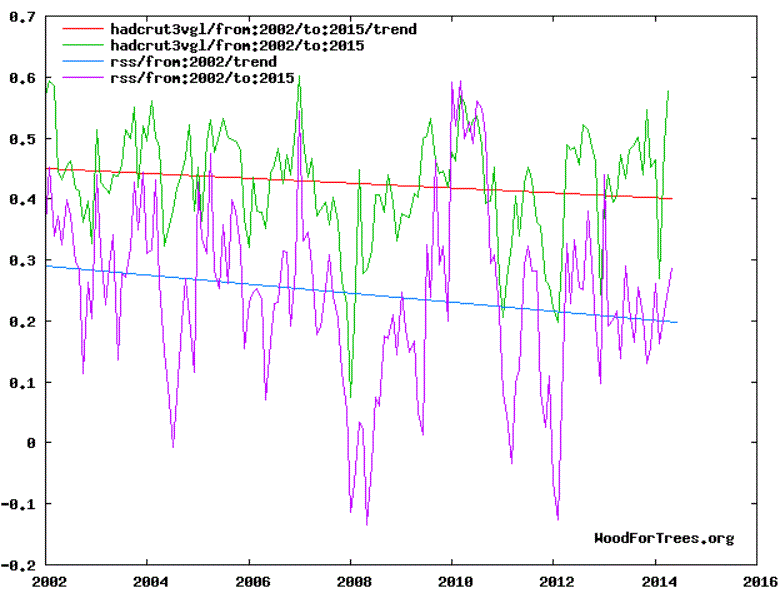
Climate scientists on both sides of the debate agree on one thing: the earth’s surface and atmosphere have (unexpectedly) stopped warming; there’s been no temperature increase in over 17 years and counting.

While global warming scientists insist the pause is only temporary and that warming will resume in earnest sometime in the future (once the missing heat comes out of hiding), other scientists are very skeptical. Today a growing number of distinguished scientists all over the globe believe the earth will be cooling due to the forces of natural cycles that have recently come into play.

Yet as many scientists are making forecasts of cooling, there’s one fact that seems to have escaped them: the datasets of the world’s leading climate data institutes clearly show that planetary cooling is already taking place and has been happening for over a decade.

2002_Cooling

Chart source: www.woodfortrees.org.

Danish solar scientist Henrik Svensmark recently declared: “Global warming has stopped and a cooling is beginning.” The cold reality, however, is that the cooling actually started 12 years ago!

There are more signs other than temperature readings that show global cooling is in full swing. Antarctica has just set a new record positive sea ice anomaly. Global sea ice has been mostly above average for a year and half, flying in the face of stunned scientists who warned just 5 years ago that the Arctic could soon be ice-free in the summertime. Moreover Asia, Europe and North America have been hard hit by a string of unexpectedly harsh winters.

So how cold is it going to get and for how long?

Although a large number of scientists agree on cooling, they differ widely on how much and for how long.

Geologist and climate researcher Sebastian Lüning of Germany in a just released video forecasts a global cooling of 0.2° by 2030, before it starts to warm up again. However, many scientists see this as too mild of a forecast. Russian solar physicist Habibullo Abdussamatov, for example, predicts another Little Ice Age by 2055. Also Russia’s Pulkovo Observatory claims we “could be in for a cooling period that lasts 200-250 years.”

Long list of experts

At his Climate Depot website, Marc Morano has a list of a number of renowned scientists who believe the data are clear on what’s ahead.

Prominent geologist Dr. Don Easterbrook warns that “global cooling is almost a slam dunk” for up to 30 years or more. The Australian Astronomical Society warns of global cooling as the sun’s activity “significantly diminishes”.

The reason for the cooling? Scientists agree that it’s natural solar and oceanic cycles overpowering the overhyped effects of greenhouse trace-gas CO2.


– See more at: http://notrickszone.com/2014/06/30/forget-global-cooling-predictions-its-already-happening-global-temperature-falling-more-than-a-decade/#sthash.iiRucSUK.dpuf

Clive Palmer Triggers the Warmist’s Scream!

Anguished cries in the global warming debate.

Anguished cries in the global warming debate.

TWO sentences neatly and completely capture the total irrationality and sheer, raging religious fervour of the global warming true, true believers.

They both came as deep primeval screams in delayed reaction to Clive Palmer’s climate change twostep with Mr Climate Hysteria himself, the man who used to be the next president of the US, until he found religion and fortune could be combined in very convenient climate untruths, Al Gore.

The initial reaction of true believers was one of almost euphoric rapture. Al and Clive had seemingly united to defeat the Climate Anti-Christ Abbott; Julia Gillard’s carbon tax and Gaia would be saved.

Nowhere was this reaction more extensive or ecstatic than at Climate Central Downunder, The Age. The paper revelled in the Anti-Christ’s coming discomfort.

Then as the truth sunk in that Gore had merely given cover to Palmer’s continued support for axing the tax, the scream erupted in The Age’s editorial on Friday. It included a delicious, utterly, if utterly unintentionally, revealing sentence.

The editorial noted that under the Palmer plan, while the scaffolding of an emissions trading scheme (ETS), would remain in place, the scheme would have no effect.

That’s actually not so, as we won’t even get that “scaffolding”. But returning to The Age, its lament was that such a scheme would have no effect because there’d be no price on carbon until Australia’s major trading partners implemented their own schemes.

Then the sentence: “That might occur next year, next decade, or never.”

A rational sentient human being would have then said; exactly, and thank you Clive. For there is absolutely no point in Australia going down the aggressive ETS path, cutting our emissions of carbon dioxide, unless precisely our major trading partners were doing the same.

To argue otherwise is to argue for Australia to unilaterally hurt both its industries and its citizens, to send industries and jobs to ‘our major trading partners,’ for absolutely no point. Our pain would have not the slightest effect on the global or even the local climate.

That lamenting sentence is so revealing; that to The Age rationality has absolutely nothing to do with the issue. It is all about religious fervour.

Quite irrespective of what the world does, quite irrespective of whether our CO2 cuts would achieve anything at all, we have to cut; we have to flagellate like a 12th century penitent, to exculpate our sins, to pay penance to Gaia.

The sentence is deeply revealing on another level. For The Age is also admitting that in its collective hearts of hearts, it really knows that the operative word in that sentence is ”never”.

Despite all the increasingly desperate propaganda nonsense pumped out that everyone else is taking big steps to cut emissions, and we are so laggard — including of course by The Age itself — the truth is the exact opposite.

Let a few more years run out, and apart from even more evidence that the planet, as opposed presumably to Gaia, ain’t warming as predicted, the emptiness of that claim will become almost undeniable.

And in its deepest, most inchoate scream, The Age is telling us that it just can’t bear that prospect.

The second primeval scream of pain and inchoate anger at Palmer assuaging the Climate Anti-Christ came from David Llewellyn-Smith on his MacroBusiness Blog.

Now LSD as we’ll call him, projects as at least a moderately intelligent human being. Yet he could come out with such a sentence, and more particularly one word, reveals an irrationality and stupidity so fundamental that it can only be explained by a religious belief. And a belief so fervent that a blinding curtain of rage isolates his brain.

LSD expressed sarcastic surprise that a hugely wealthy mining magnate would rubber stamp the end of a carbon price costing him millions of dollars per year for “tipping filth into the atmosphere”. Filth? FILTH?

Does LSD walk around all day in total self-hatred for doing exactly the same thing, pumping out his own filth with every exhaling breath?

Does he awake in complete despair every morning, at the prospect of another totally unavoidable day of exhaling filth? How many times a day does he flagellate himself, penitent-style if figuratively, or perhaps even literally?

For this is all we are talking about, whether it is Palmer’s business emissions or their shared personal emissions. CO2. Carbon dioxide. Plant food. The basis of life on Earth. And nothing else.

No, despite the best efforts of a battalion of modern day Goebbelian wannabes, from Gillard down, none of this — carbon tax or ETS — is about real pollution.

That’s the dirty bits of grit that used to come out of both power stations and home hearths and killed thousands, and will continue to kill thousands if people like The Age, LSD & Co succeed in denying Africa modern, clean, coal-fired power stations that would stop them relying on burning wood and dung.

Lamentably, the way pollution has been able to be attached to CO2 — presumably in time we’ll start renaming heavy rain as ‘water pollution’ — seems to have succeeded with people like LSD.

So when he thinks — more accurately, emotes — about emissions, cognitive dissonance, the disease of the modern intelligentsia, kicks in and he sees in his minds-eye, those dirty bits of grit, the ‘filth’ of modern civilisation.

So there you have it; the religion of global warming in two sentences.

No matter what anyone does, we must cut in self-flagellation for our sins against Gaia.

The self-hatred flowing from the original sin of personal exhalation of CO2 “filth” makes for even more aggressive warriors against business emissions of that same “filth”.

Originally published as Palmer triggers warmest screamCOMMENTS

Farmers in Sweden, Too Smart to Fall for Climate Alarmist B.S.!

Swedish farmers have doubts about climatologists

June 27, 2014 – 06:10

Farmers rely more on their own experiences with changing weather than on climatologists who have no agricultural experience, according to Swedish research.

Climatologists are not often found in the Swedish countryside. So farmers have their doubts about climate predictions. (Photo: Microstock)

Researchers the world over almost unanimously agree that our climate is changing because of the increasing amounts of carbon dioxide humankind pumps into our fragile atmosphere. But many farmers – at least Swedish ones – have experienced mild winters and shifting weather before and are hesitant about trusting the scientists.

Surprised

The researcher who discovered the degree of scepticism among farmers was surprised by her findings.  Therese Asplund, who recently presented her PhD thesis at Linköping University, was initially looking into how agricultural magazines covered climate change.

Asplund found after studying ten years of issues of the two agricultural sector periodicalsATL and Land Lantbruk that they present climate change as scientifically confirmed, a real problem.

But her research took an unexpected direction when she started interviewing farmers in focus groups about climate issues.

Asplund had prepared a long list of questions about how the farmers live with the threat of climate change and what they plan to do to cope with the subsequent climate challenges. The conversations took a different course:

“They explained that they didn’t quite believe in climate changes,” she says. “Or at least that these are not triggered by human activities.”

Used to changes

The climate of course has previously gone through natural spells, and the farmers tend to think in terms of their experiences in recent decades.

“Many have a lot of experience, for instance they recall the mild winters of the 1960s,” explains Asplund.

The farmers also distrust climatologists partly on the grounds of what they perceive of as too much concurrence.

“They think information about climate change is too uniform. Credibility would increase if more contrary perspectives were presented,” she says.

Office science

And above all: They think climatologists lack the experience they have living in keeping with the soil, weather and growth seasons.

The climate of course has previously gone through natural spells, and the farmers tend to think in terms of their experiences in recent decades. (Photo: Mary Evans Picture)

“Climate researchers also are given less credence by farmers because they think the scientists draw their conclusions from theoretical analyses rather than practical experience,” says Asplund.

She finds it hard to say how climatologists can make use of the farmers’ experiences:

“For the research of a scientifically trained climatologist, the opinions of farmers might not be all that essential.  But that does not necessarily make their views irrelevant. For a sociological approach to climate research the farmers’ opinions are highly relevant, on a par with those of other social groups,” asserts Asplund.

Information is not enough

She is concerned about understanding disparate ways of thinking and responding with regard to climate issues.

“With insufficient knowledge, we risk believing that information will readily alter human perceptions and behaviour. The example of climate communication in Swedish agriculture shows what challenges a climatological point of departure for communication can encounter,” says Asplund.

After talking with focus groups all over Sweden, she thinks that information alone cannot change attitudes and behaviour – no matter how well rooted it is in empirical science.

Does this mean it is harder than thought to get Swedish farmers to engage in climate-friendly agriculture? The researcher says both “yes” and “no”.

It will be hard as long as the implementation of improvements is voluntary. But in the discussions the farmers signal that they can adapt – if not to physical climate changes, at least to climate policy decisions. Thus it should be no harder to get them to adjust to climate measures as to other political mandates.

But there is one proviso: “This is a resistance to decrees which they think undermine competitive Swedish agricultural production,” says Therese Asplund.

————

Greenpeace has Become a Corrupt Organization, that Promotes Alarmism!


Greenpeace In Decline Like The AGW Scam

They Support

by Tory Aardvark


Dr Patrick Moore “They have a whole fleet of ships, pretending the $32 million Rainbow Warrior III is powered by the wind when it has two large diesel engines for propulsion. I like to joke that when we first sailed against US hydrogen bomb testing in Alaska we did not have a nuclear weapon on board." Dr Patrick Moore “They have a whole fleet of ships, pretending the $32 million Rainbow Warrior III is powered by the wind when it has two large diesel engines for propulsion. I like to joke that when we first sailed against US hydrogen bomb testing in Alaska we did not have a nuclear weapon on board.”

Things have not been going well for environmental NGO Greenpeace in the last few months, there was the insanely stupid attempt to interfere with Gazprom operations in the Arctic, which led to the Arctic 30 enjoying the hospitality of the Russian penal system for a few months. Greenpeace also lost a ship, the Arctic Sunrise which is still impounded in the Russian port of Murmansk, and likely to be there until it rusts away and sinks, or ends life as a towed target for the Russian Navy.

In the words of Greenpeace Co-Founder Patrick Moore “I’d like to think that Greenpeace left me, rather than the other way round. I became a sensible environmentalist. Greenpeace became increasingly senseless.

Greenpeace apart from being increasingly senseless have also been caught losing millions in donations by failed currency trading, been labelled as a threat to national economic security, and one of their top executives has been caught out hypocritically commuting by air from Luxembourg to Amsterdam.

All this makes for very bad publicity for Greenpeace:

“Greenpeace has been careful to cultivate an image as intrepid defenders of the environment,” editorializes Der Spiegel, a major German newspaper. “Calling themselves the rainbow warriors, activists hang from factory chimneys, throw themselves in front of whaling ships or risk jail time in Russia by calling attention to the plight of the Arctic.”

“Now, another activity has been added: playing the financial markets,” Der Spiegel adds. “For an organization almost entirely financed by donations, the revelation is a PR disaster, endangering from one day to the next the greatest asset Greenpeace possesses: its credibility.”

Even that organ of left wing biased climate change propaganda the UK Guardian has turned against Greenpeace:

The Guardian, a left-wing newspaper, has been especially critical of Greenpeace lately. The paper even obtained internal documents detailing the disarray within Greenpeace International.

A November 2013 document obtained by the Guardian shows that Greenpeace’s executive team was for years fully aware of major problems within the group’s finance department.

“[The] international finance function at GPI [Greenpeace International] has faced internal team and management problems for several years and the situation did not improve during 2013 despite efforts and support,” says the Greenpeace document.

India’s Intelligence Bureau has come to the conclusion that Greenpeace is a threat to the countries national economic security:

The Indian Express reports that the Intelligence Bureau submitted a report to the prime minister’s office saying Greenpeace was “negatively impacting economic development” through political activism and its anti-fossil fuels agenda. The reports says that Greenpeace activities have reduced the country’s GDP by 2 to 3 percent a year.

The report mentioned other activist groups, but singled out Greenpeace for trying to “change the dynamics of India’s energy mix” and orchestrating “massive efforts to take down India’s coal fired power plants and coal mining activity.”

“It is assessed to be posing a potential threat to national economic security… growing exponentially in terms of reach, impact, volunteers and media influence,” the report warns of Greenpeace, adding the group is finding “ways to create obstacles in India’s energy plans” and to “pressure India to use only renewable energy.”

It is not just in India, but other countries as well there seems to be a shift towards curtailing the activities of Green NGO’s, in Tasmania the politicians want to remove charitable status from Green NGOs and give the status to real charities:

The government is being pressed to alter the charitable status of environmental groups after a Liberal MP successfully argued to his party that the groups are not “real charities” like the Red Cross or the Salvation Army.

A motion introduced by MP Andrew Nikolic to the Liberal federal council called for environmental groups to be stripped of charitable rights, such as the ability to receive tax-deductible donations.

Nikolic, the federal member for the Tasmanian electorate of Bass, said the groups should not be subsidised for political activism, some of it which he claimed was illegal. The conference motion passed the motion unanimously.

The news of Greenpeace’s massive loss of donations currency trading was soon followed by the revelations that Greenpeace’s international program director Pascal Husting was regularly taking the plane from his home in Luxembourg to the office in Amsterdam:

The UK Telegraph noted that Greenpeace actively campaigns against “the growth in aviation,” which the group says “is ruining our chances of stopping dangerous climate change.”

“Each round-trip commute Mr Husting makes would generate 142kg of carbon dioxide emissions,” reports the Telegraph. “That implies that over the past two years his commuting may have been responsible for 7.4 metric tons of carbon dioxide emissions — the equivalent of consuming 17 barrels of oil.

None of these antics have done much to bolster Greenpeace’s declining credibility with its life blood, the millions of people who make the small donations that keep Greenpeace functioning, instead they have been shown to be nothing more than one of those duplicitous  corporations the environmentalists so love to despise.

Faux-green Eco-fanatics are bad for our Environment, and everything in it!

Never-Ending Green Disasters.

Newton’s 3rd law of motion, if applied to bureaucracy, would state: “Whenever politicians attempt to force change on a market, the long-big-govtterm results will be equal and opposite to those intended”.

This law explains the never-ending Green energy policy disasters.

Greens have long pretended to be guardians of wild natural places, but their legislative promotion of ethanol biofuel has resulted in massive clearance of tropical forests for palm oil, sugar cane and soy beans.  Their policies have also managed to covert cheap food into expensive motor fuel and degraded land devoted to bush, pastures or crops into mono-cultures of corn for bio-fuel. This has wasted water, increased world hunger and corrupted the political process for zero climate benefits.

Greens also pretend to be protectors of wildlife and habitat but their force-feeding of wind power has uglified wild places and disturbed peaceful neighbourhoods with noisy windmills and networks of access roads and transmission lines. These whirling bird-choppers kill thousands of raptors and bats without attracting the penalties that would be applied heavily to any other energy producers – all this damage to produce trivial amounts of intermittent, expensive and blackout-prone electricity supplies.

Greens have long waged a vicious war on coal, but their parallel war on nuclear power and the predictably intermittent performance of wind/solar energy has forced power generators to turn to hydro-carbon gases to backup green power. But Greens have also made war on shale-gas fracking – this has left countries like Germany with no option but to return to reliable economical coal, or increase their usage of Russian gas and French nuclear power. Their war on coal has lifted world coal usage to a 44 year high.

Greens also say they support renewable energy, but they oppose any expansion of hydro-power, the best renewable energy option. For example, they scuppered the Gordon-below-Franklin hydro-electric project, which would have given Tasmania everlasting cheap green electricity. But they never mention their awkward secret – the Basslink under-sea cable goes to Loy Yang power station in Victoria and allows Tasmania to import coal-powered electricity from the mainland.

Robbie Burns warned us over 200 years ago:

“The best laid schemes of Mice and Men
Gang aft agley,
An’ lea’e us nought but grief an’ pain,
For promis’d joy!”

Climate Alarmists Try to Push Their “Religion”, on the Rest of Us! Just Say NO!

CO2 GOOD; CLIMATE CHANGE BUNK;

GREENS ARE RAGING EXTREMISTS,

SAYS GREENPEACE CO-FOUNDER

“Climate change” is a theory for which there is “no scientific proof at all” says the co-founder of Greenpeace. And the green movement has become a “combination of extreme political ideology and religious fundamentalism rolled into one.”

Patrick Moore, a Canadian environmentalist who helped found Greenpeace in the Seventies but subsequently left in protest at its increasingly extreme, anti-scientific, anti-capitalist stance, argues that the green position on climate change fails the most basic principles of the scientific method.

“The certainty among many scientists that humans are the main cause of climate change, including global warming, is not based on the replication of observable events. It is based on just two things, the theoretical effect of human-caused greenhouse gas emissions, predominantly carbon dioxide, and the predictions of computer models using those theoretical calculations. There is no scientific “proof” at all.”

Moore goes on to list some key facts about “climate change” which are ignored by true believers.

1. The concentration of CO2 in the global atmosphere is lower today, even including human emissions, than it has been during most of the existence of life on Earth.

2. The global climate has been much warmer than it is today during most of the existence of life on Earth. Today we are in an interglacial period of the Pleistocene Ice Age that began 2.5 million years ago and has not ended.

3. There was an Ice Age 450 million years ago when CO2 was about 10 times higher than it is today.

4. Humans evolved in the tropics near the equator. We are a tropical species and can only survive in colder climates due to fire, clothing and shelter.

5. CO2 is the most important food for all life on earth. All green plants use CO2 to produce the sugars that provide energy for their growth and our growth. Without CO2 in the atmosphere carbon-based life could never have evolved.

6. The optimum CO2 level for most plants is about 1600 parts per million, four times higher than the level today. This is why greenhouse growers purposely inject the CO2-rich exhaust from their gas and wood-fired heaters into the greenhouse, resulting in a 40-80 per cent increase in growth.

7. If human emissions of CO2 do end up causing significant warming (which is not certain) it may be possible to grow food crops in northern Canada and Russia, vast areas that are now too cold for agriculture.

8. Whether increased CO2 levels cause significant warming or not, the increased CO2 levels themselves will result in considerable increases in the growth rate of plants, including our food crops and forests.

9. There has been no further global warming for nearly 18 years during which time about 25 per cent of all the CO2 ever emitted by humans has been added to the atmosphere. How long will it remain flat and will it next go up or back down? Now we are out of the realm of facts and back into the game of predictions.

Moore makes his remarks in the foreword to a new book by bestselling Australian geologist Dr Ian Plimer called Not For Greens. The book describes the various, complex industrial processes which go into the making of just a single teaspoon, starting with the mining of various metals.

If Greenpeace’s membership remained true to their principles they would have to eat with their bare hands because, as Moore notes, they are opposed to mining in all its forms.

“If you ask them for the name of any mine that is operating in an environmentally acceptable standard you will draw a blank. They have become so cornered by their own extremism that they must deny their daily use of cell phones, computers, bicycles, rapid transit, and yes, the simple teaspoon.

We are Wasting Precious Time and Money on Faux-Green Renewables!

Photovoltaic Energy Is Not Renewable Energy

Photovoltaic (PV) power is created from a burst of coal-sourced energy priced at 4 cents/kWh, which you get back as an intermittent and declining dribble over the following 20 years at 15 cents/kWh.  The numbers vary with location, but the basic relationship remains the same – at best, the energy produced by PV panels is at least four times the cost of the power consumed in making them.

That is one thing.  The main thing is that over their lifetimes, PV panels now produce slightly more energy than what it took to make them.

So a civilization that relies upon PV power is just getting its energy back, but at four times the cost.  If PV power were used only to make PV panels, and even assuming no energy losses in the process, then PV power at 15 cents/kWh would produce panels that made power at 60 cents per kWh, and so on to infinity.  So there is nothing renewable about PV power.

There are some applications in PV power is very useful, such as pumping irrigation water, in which the requirement is too small to justify a diesel pump or the cost of extending grid power to the site.  In fact, PV power is well under the cost of power from diesel – you just can’t access it at a time of your choosing.  It also has a role where high-priced grid power and reticulation costs make it competitive.  But it can’t pretend to be renewable or sustainable.  Apart from those niche applications, it bleeds energy and treasure from our civilisation.

The economics of wind power might be a net positive, but a wind-powered economy would have a standard of living similar to that of 17th-century Holland.  One rule of thumb is that each megawatt of wind power used in the grid requires half a megawatt of gas turbine backup.  That is why some of the major oil companies have been so much in favor of renewable energy.  It tricks us into burning a higher-cost fossil fuel.

Making cheap energy from a process requires that the energy produced from that process be at least five times the amount of energy that went into making it.  Anything less than that, and civilization will go backward very rapidly.  Instead of mandating renewable energy and installing PV panels, we should be concentrating on developing the technology that will sustain civilization in the post-fossil fuel eternity.

In that regard, we have a choice: either plutonium breeder reactors or thorium breeder reactors.  We should make the choice and get on with it.

David Archibald, a Visiting Fellow at the Institute of World Politics in Washington, D.C., is the author of Twilight of Abundance: Why Life in the 21st Century Will Be Nasty, Brutish, and Short (Regnery, 2014).

Aussies to Scrap the Carbon Tax, next it’s the Renewable Energy Targets!

PM’s Top Advisor – Maurice Newman – Hammers Palmer’s “Inconsistent” RET Plan

the_sting_3_newman_redford

As the dust settles on the Palmer/Gore circus of the bizarre, it’s now evident that the PUP’s leader has pulled one the greatest confidence tricks since Paul Newman and Robert Redford joined forces in “The Sting”. As the hard-green-left stared in awe at their grand warming alarmist, Palmer slipped through the net unnoticed.

It was a good 24 hours before the green-lefty press (Fairfax/ABC) and the Greens worked out that they’d been had. The play was a good ol’ fashioned “swithcheroo”. Clive put forward an ETS with the impression – sucked up by the Greens and their acolytes – that this was a die-in-a-ditch condition for supporting the Coalition’s plan to abolish the carbon tax. So far, so “green”.

But – as with most politics – the Devil’s in the detail. With the price for a tonne of CO2 under Clive’s ETS set at zero until all of Australia’s major trading partners also sign up to an international ETS, there will be NO price placed on CO2 at all: not now; not ever. Good one, Clive. To the horror of the Greens, it soon became clear that even that “policy” was a rubbery as Clive’s ample figure.

By lunchtime on Thursday, big Clive had dropped his demand to have his ETS replace the “carbon” tax, when repealed. The “carbon” tax will hit the legislative scrapheap within weeks – without a whimper; to be replaced by nothing: the “Sting”, complete.

There is, however, the small matter of the mandatory RET – which – as covered in detail in our last post – Palmer seems keen to support – at least for the moment.

The mandatory RET will see power prices double again between now and 2020, when the target hits the full annual 41,000 GWh target. The risk to the economy is something we’ve been banging on about for some time now. And it’s a matter not lost on the PM, Tony Abbott’s top business advisor, Maurice Newman – among others.

Here’s The Australian on the risk to real businesses in maintaining the mandatory RET.

Palmer’s RET policy ‘too costly for businesses’
The Australian
Annabel Hepworth
27 June 2014

THE head of the Prime Minister’s business advisory council has warned the Palmer United Party’s plan to retain key climate-change policies is at odds with getting electricity prices down and boosting industry competitiveness.

In the wake of Clive Palmer’s move to back the repeal of Labor’s carbon price, Maurice Newman said the carbon tax repeal should lower costs on businesses and households. “But it’s only part of the story,” he said, arguing that “we need to go a lot, lot further”.

He criticised the plan to oppose any changes to the renewable energy target before 2016 and to block the government’s plans to scrap Labor’s $10bn Clean Energy Finance Corporation and Climate Change Authority.

“Mr Palmer seems to want to hang on to them, which seems totally inconsistent with this idea of bringing down the price of energy,” Mr Newman said.

Australia needed to reduce its energy prices. “Australia is getting less and less competitive … We’ve got a very high wage structure and we’ve got very high energy costs.”

Other leading business figures lined up to back the warning on the RET, which is being reviewed by an expert panel headed by businessman Dick Warburton.

Australian Chamber of Commerce and Industry chief executive Kate Carnell said it was “enormously expensive”.

EnergyAustralia chairman Graham Bradley said it was “a very good thing” the carbon tax was likely to go swiftly, but that the RET should be changed to a “real” 20 per cent.

Executives at EnergyAustralia, which owns the Yallourn brown coal power station in Victoria’s Latrobe Valley, estimated that ­delivering the required investment in renewables to meet the target would require a fivefold increase on past investment.

“We don’t believe this is achievable without driving up the cost of renewable energy,” group executive manager of strategy and corporate affairs Clare Savage said.

Mr Palmer’s single condition for his support for the carbon tax repeal is a legal requirement that power companies pass savings from scrapping the tax to households. This would go beyond government plans to give the competition watchdog extra monitoring arrangements in the carbon tax repeal.

Energy Supply Association chief executive Matthew Warren said: “It is not clear to us what other head of power the commonwealth could use, as regulating energy prices is a matter for state governments,” Mr Warren said.

Australian Industry Group chief executive Innes Willox raised concerns most businesses had been unable to pass carbon costs to their customers.

The Australian Competition & Consumer Commission should “not expect reductions in prices for those goods and services that never rose in the first place”.

ACCC chairman Rod Sims said he was confident that when the carbon tax repeal passed the savings would be passed on.
The Australian

A while back, Maurice Newman identified the mandatory RET as the Elephant in the room – tagging it as being responsible for the demise of motor manufacturer, Ford and lots of other energy intensive businesses (see our posts here and here and here).

The mandatory RET must go. As retiring Queensland Senator, Ron Boswell put it: “We can have a carbon price and renewable energy targets or viable manufacturing. We can’t have both” (see our post here).

maurice-newman


The Left-wing Government of Ontario, is Destroying our Economy.

Government stifles business in Ontario and Quebec, report says

Canada is becoming a country of two solitudes when it comes to business investment.

Provinces are increasingly falling into one of two camps, according to a report being released Wednesday by the C.D. Howe Institute. In the West, business spending powers the economy. In much of the rest of the country, government spending is swallowing an ever greater share of economic activity, most notably in Ontario and Quebec.

The report puts a new spin on the “dead money” debate and why Canadian companies have been running up growing cash reserves since the recession.

The C.D. Howe report theorizes that governments in parts of the country may be crowding out and dissuading private investment.

Canada’s corporate cash holdings have continued to grow in recent months, according to Statistics Canada. Non-financial companies had cash holdings of $630-billion in the first quarter, up from $621-billion in the final three months of last year.

Part of the reason is that some provinces are creating a more business-friendly environment, while others are scaring away investment, argued the report’s author, Philip Cross, the former chief economic analyst at Statistics Canada and member of the C.D. Howe Institute’s Business Cycle Council.

“It’s not a case of dead money and companies not willing to invest,” he said in an interview. “You can see that in certain provinces, they are willing to invest like mad men.”

It’s more than just about the Alberta oil sands and other resources projects, Mr. Cross said. “The West has had resources for a long time. What unlocked them were good policies,” he said.

Mr. Cross said the blockage lies in Quebec, Ontario and much of Atlantic Canada, where high deficits and the prospect of higher taxes are crowding out access to capital and discouraging business investment, according to Mr. Cross.

And efforts to kickstart business investment with government money clearly are not working, he explained. “If I was a firm in Ontario, what I’m planning for next year is a hike in minimum wages, higher income taxes and the introduction of a new pension plan,” he said. “I’m dealing with all these things and I’m not planning on the future of my firm.”

Private-sector investment has grown rapidly in all four western provinces, particularly since the resource boom took off in 2003. In Alberta, business investment as a share of GDP reached 25.5 per cent in 2012, the highest of any province. Public-sector investment has stabilized at less than 3 per cent.

In much of the rest of the country, there has been a “marked shift” the other way. In Quebec and Ontario, for example, private-sector investment slumped to 7 per cent of GDP in 2012 from 10 per cent in the 1990s. Government spending in Quebec is now the highest in the country at 5.7 per cent of GDP. In Ontario, it’s roughly 4 per cent, up from 3 per cent in the mid-2000s.

A separate report released Tuesday by Toronto-Dominion Bank presents a much rosier picture of the investment environment. Senior economist Randall Bartlett is predicting that business investment is poised to “rev up” in Canada over the next two years after a long slump.

He says six things will drive investment – the strengthening U.S. economy, a rebound in corporate profits, stronger corporate balance sheets, shrinking spare capacity, low interest rates and growing business optimism.

Business investment will lead GDP growth over the next couple of years, expanding at an annual rate of 4 to 5 per cent through the rest of 2014 and in 2015, the report said. “As investment increases, so does productivity, and ultimately wages and incomes in the long term,” Mr. Bartlett said.

Follow  on Twitter: @barriemckenna