Wind Turbines would NEVER pass a Cost/Benefit Analysis!

Special report: The true cost of our wind farms

BY BEN ROBINSON4 MAY 2014 11.00AM.

The true cost of the massive expansion of wind farms in England can today be revealed by a special Sunday Post investigation.

Staggering new figures show turbine operators have been handed taxpayer-funded subsidies of £7 billion in just over a decade. That means an average of £1,211 has been paid from the public purse every MINUTE since 2002.

The eye-watering costs are recouped by being added to fuel bills, leaving each household £178 worse off.

Now there is concern at the size of the subsidies being siphoned off for renewables at a time when 2.4 million people in England are living in fuel poverty.

The revelations come in the wake of Prime Minister David Cameron’s announcement that the Conservatives will end their support for onshore wind farms if they win the next election.

Tory MP Philip Davies who represents Shipley in West Yorkshire, said: “Not only are they a blight on the landscape, they are the most expensive, inefficient and unreliable form of energy.

“Many people are struggling to pay their energy bills and the dash for wind energy unnecessarily adds a considerable amount on to everyone’s bills in order to line the pockets of rich landowners.

“It is Robin Hood in reverse — taking money from the poorest in order to line the pockets of the richest.

“It is also making our manufacturers extremely uncompetitive when they are up against other firms based abroad who enjoy much cheaper energy bills.”

European law dictates the UK must achieve 15% of its energy consumption from renewable sources by 2020, which has sparked heavily subsidised incentives for large wind farms and individual turbines to be built.

We can reveal between 2002 and December 2013 wind farm owners received £7bn under the renewables obligation scheme which subsidises large-scale green energy production.

Introduced by the Labour Government to encourage investment in renewables, the money is recouped via a supplement added to all domestic and commercial electricity bills.

According to the Renewal Energy Foundation, since 2002 the levy supporting English renewables has added about £178 to the average UK household’s cost of living, with £89 of that in electricity charges alone.

These subsidies have bankrolled 259 operational wind farms with around 850 turbines.

Our probe has found northern England is bearing the brunt of the drive for renewables by hosting half the country’s wind farms. Using Government planning statistics, the Renewable Energy Foundation looked at the number of wind farms in operation or with planning permission across England.

It found Northumberland has the largest wind farm capacity of any county, with around 155 turbines spread over 19 farms, generating up to 302 megawatts (MW).

East Yorkshire is second highest, while Lancashire is sixth, Durham seventh and Cumbria eighth.

Don Brownlow, from Berwick-Upon-Tweed, who has battled a series of large-scale wind farms in Northumberland, claimed developers see the region as an easy target.

He said: “Contrary to popular belief this is not about the region being windy. Most of Northumberland outside the national park is fairly poor for that. The reason, first and foremost among developers, is landowner compliance.

“A lot of wind development in Northumberland has been old estates being broken up which means landowners have borrowed a lot of money to buy them and they see the opportunity to reduce their debts. We are also seen as having compliant local planning authority.”

Across the North West, North East and Yorkshire and the Humber there are 129 wind farms containing around 500 turbines already in operation — half of the entire country’s wind energy capacity.

But planning permission has been given for another 100 farms to be built which will add another 330 turbines to the landscape.

It means residents in the north will see a massive 70% increase in the number of turbines, while a further 150 turbines are in the planning system.

Dr John Constable, director of Renewable Energy Foundation, a UK charity publishing data on the energy sector, said: “The northern counties of England are bearing a disproportionate share of the national onshore wind burden.

“Not all of this focus can be explained by better wind conditions.

“Northumberland in particular is relatively windless. I’m afraid the explanation is that developers have picked on the rural north because it lacks the resources to defend itself in the planning system.

“Extremely high subsidies have overheated and corrupted the wind industry; site choice has been poor and little respect has been shown to the opinions of rural populations, whose local environments have too often been significantly damaged.”

A Department of Energy and Climate Change spokesperson said: “As you would expect, there are more wind farms where there is more wind.

“Wind farms will only get planning permission where the impacts – including visual impact, cumulative impact and impact on heritage sites – are acceptable.

“We have also changed the law to require wind farm developers to consult with local people before they put in a planning application.”

Top 10 counties with most wind farms

1. Northumberland Onshore wind capacity 311MW – Sites 19 – Approximate turbines 155

2. East Yorkshire – 302MW – sites 49 – turbines 151

3. Lincolnshire* – 281MW – sites 22 turbines – 141

4 Cambridgeshire – 273MW – sites 32 -turbines – 136

5. Northamptonshire – 185MW – sites 20 – turbines 92

6. Lancashire – 177MW – sites 23 – turbines – 88

7. Durham – 168MW – sites 24 – turbines – 84

8. Cumbria – 158MW – sites 38 – turbines – 79

9. Devon – 133MW – sites 22 – turbines – 66

10. Cornwall – 130MW – sites 86 – turbines – 65

*Historic county of Lincolnshire, comprised of Lincolnshire, North Lincolnshire and North East Lincolnshire.

A Horrific Waste of Time and Money – Renewable Energy Scam!

Renewable Energy in Decline, Less than 1% of Global Energy

Oil-Refinery-Pump-ImageThe global energy outlook has changed radically in just six years. President Obama was elected in 2008 by voters who believed we were running out of oil and gas, that climate change needed to be halted, and that renewables were the energy source of the near future.

But an unexpected transformation of energy markets and politics may instead make 2014 the year of peak renewables.

In December of 2007, former Vice President Al Gore shared the Nobel Peace Prize for work on man-made climate change, leading an international crusade to halt global warming. In June, 2008 after securing a majority of primary delegates, candidate Barack Obama stated, “…this was the moment when the rise of the oceans began to slow and our planet began to heal…” Climate activists looked to the 2009 Copenhagen Climate Conference as the next major step to control greenhouse gas emissions.

The price of crude oil hit $145 per barrel in June, 2008. The International Energy Agency and other organizations declared that we were at peak oil, forecasting a decline in global production. Many claimed that the world was running out of hydrocarbon energy.

Driven by the twin demons of global warming and peak oil, world governments clamored to support renewables. Twenty years of subsidies, tax-breaks, feed-in tariffs, and mandates resulted in an explosion of renewable energy installations. The Renewable Energy Index (RENIXX) of the world’s 30 top renewable energy companies soared to over 1,800.

Tens of thousands of wind turbine towers were installed, totaling more than 200,000 windmills worldwide by the end of 2012. Germany led the world with more than one million rooftop solar installations. Forty percent of the US corn crop was converted to ethanol vehicle fuel.

But at the same time, an unexpected energy revolution was underway. Using good old Yankee ingenuity, the US oil and gas industry discovered how to produce oil and natural gas from shale. With hydraulic fracturing and horizontal drilling, vast quantities of hydrocarbon resources became available from shale fields in Texas, North Dakota, and Pennsylvania.

From 2008 to 2013, US petroleum production soared 50 percent. US natural gas production rose 34 percent from a 2005 low. Russia, China, Ukraine, Turkey, and more than ten nations in Europe began issuing permits for hydraulic fracturing. The dragon of peak oil and gas was slain.

In 2009, the ideology of Climatism, the belief that humans were causing dangerous global warming, came under serious attack. In November, emails were released from top climate scientists at the University of East Anglia in the United Kingdom, an incident christened Climategate. The communications showed bias, manipulation of data, avoidance of freedom of information requests, and efforts to subvert the peer-review process, all to further the cause of man-made climate change.

One month later, the Copenhagen Climate Conference failed to agree on a successor climate treaty to the Kyoto Protocol. Failures at United Nations conferences at Cancun (2010), Durban (2011), Doha (2012), and Warsaw (2013) followed. Canada, Japan, Russia, and the United States announced that they would not participate in an extension of the Kyoto Protocol.

Major climate legislation faltered across the world. Cap and trade failed in Congress in 2009, with growing opposition from the Republican Party. The price of carbon permits in the European Emissions Trading System crashed in April 2013 when the European Union voted not to support the permit price. Australia elected Prime Minister Tony Abbott in the fall of 2013 on a platform of scrapping the nation’s carbon tax.

Europeans discovered that subsidy support for renewables was unsustainable. Subsidy obligations soared in Germany to over $140 billion and in Spain to over $34 billion by 2013. Renewable subsidies produced the world’s highest electricity rates in Denmark and Germany. Electricity and natural gas prices in Europe rose to double those of the United States.

Worried about bloated budgets, declining industrial competitiveness, and citizen backlash, European nations have been retreating from green energy for the last four years. Spain slashed solar subsidies in 2009 and photovoltaic sales fell 80 percent in a single year. Germany cut subsidies in 2011 and 2012 and the number of jobs in the German solar industry dropped by 50 percent. Renewable subsidy cuts in the Czech Republic, Greece, Italy, Netherlands, and the United Kingdom added to the cascade. The RENIXX Renewable Energy Index fell below 200 in 2012, down 90 percent from the 2008 peak.

Once a climate change leader, Germany turned to coal after the 2012 decision to close nuclear power plants. Coal now provides more than 50 percent of Germany’s electricity and 23 new coal-fired power plants are planned. Global energy from coal has grown by 4.4 percent per year over the last ten years.

Spending on renewables is in decline. From a record $318 billion in 2011, world renewable energy spending fell to $280 billion in 2012 and then fell again to $254 billion in 2013, according to Bloomberg. The biggest drop occurred in Europe, where investment plummeted 41 percent last year. The 2013 expiration of the US Production Tax Credit for wind energy will continue the downward momentum.

Today, wind and solar provide less than one percent of global energy. While these sources will continue to grow, it’s likely they will deliver only a tiny amount of the world’s energy for decades to come. Renewable energy output may have peaked, at least as a percentage of global energy production.

We need a Conservative Majority to Repair Liberal Damage to this Province!

Tim Hudak woos voters with job creation plan

Progressive Conservative Leader Tim Hudak says the economy will be the focus of his campaign as he looks to win support for June 12 vote.

Progressive Conservative Leader Tim Hudak painted the June 12 vote as a choice between his party’s economic plans on one side or the scandal-plagued Liberals, whose minority government was propped up by the NDP.</p>
<p>

BRUCE CAMPION-SMITH / TORONTO STAR

Progressive Conservative Leader Tim Hudak painted the June 12 vote as a choice between his party’s economic plans on one side or the scandal-plagued Liberals, whose minority government was propped up by the NDP.

OTTAWA—Progressive Conservative Leader Tim Hudak heads into his second-chance election hoping to win over voters with promises to curb hydro bills, cut taxes and create thousands of new jobs.

“I’m going to get Ontario working again,” he said. “I have got a laser-like focus on job creation.”

Hudak painted the June 12 vote as a choice between his party’s economic plans on one side or the scandal-plagued Liberals, whose minority government was propped up by the NDP until Friday.

“If you want more spending, higher hydro rates and want to stay on the path that we’re on, good news is you’ve two choices, the Liberals and NDP . . . you can’t tell them apart these days,’ Hudak said.

A relaxed-looking Hudak used a town hall meeting Friday afternoon to preview the themes his party plans to take on the campaign trail, notably the pledge to curb electricity rates.

“If we don’t get our hydro bills under control and our taxes down, we’re going to lose a lot of small businesses in this province. We’ve already lost far too many jobs,” he said.

“My plan is not simply to make a small change. It’s a fundamental change in the way we address energy policy, make it focused on jobs,” he said.

At the heart of his campaign platform will be the strategy first unveiled in January to create one million jobs over eight years.

“Employers don’t want to open up in a province with the highest hydro rates and worst debt in Canada. I intend to turn that around and turn it around fast,” Hudak said.

He also repeated his vow to scrap the Ontario College of Trades, dismissing the self-regulating college as a “new bureaucracy run by the special interests.”

Hudak’s scheduled townhall took on added profile Friday, happening soon after Liberal Premier Kathleen Wynne visited Lieutenant Governor David Onley to seek dissolution of the legislature.

It’s the second provincial campaign for Hudak since taking over the party leadership in 2009 and while his campaign will centre on job creation, the reality is that Hudak’s own job as leader could rest on the outcome of the June 12 vote.

Asked how he intends to win over voters who were wary about his leadership last time around, Hudak said

“If you’re looking for who is going to be the best actor on the stage, if you’re looking for someone who is running a popularity contest . . . then vote for the Liberal leader and the NDP leader,” he said.

“But if you want someone who has got a turn-around plan to get Ontario working again, look at me,” Hudak said.

Joe Hockey points out the Futility of Wind Turbines!

Joe Hockey keen to scrap Infigen’s “utterly offensive” Lake George Wind Farm

joe hockey 2

In our last post we covered the Alan Jone’s interview with Federal Treasurer Joe Hockey that’s sent the wind industry and its parasites into a tailspin.

Apart from the fact that Joe detests the very sight of these things, the Treasurer made it abundantly clear that when the Coalition talks about ending the “age of entitlement” it includes the fat pile of subsidies in the form of Renewable Energy Certificates being gouged from unwilling (or, rather, unknowing) Australian power consumers – and set to be delivered to wind power generators for another 17 years.

The mandatory RET/REC scheme started operation in 2001. RECs are issued to wind power generators from the moment a turbine starts delivering power to the grid – and will (under the current legislation) continue to be issued until 2031. So, there are giant fans that went up in 2001 that have the potential to collect RECs every year for 30 years – 1 for every MW delivered to the grid: 30 years is clearly “ages” of “entitlement”.

STT is hard pressed to think of any “infant” industry subsidy (and that’s what it was pitched as) that’s paid at precisely the same rate for more than a generation. That’s probably why we call the mandatory RET the most ludicrous energy policy ever devised. It is inherently unsustainable – and any policy that’s unsustainable is doomed to fail.

Anyway, back to the reaction to Joe’s comments. The Fairfax press have gone ballistic – resorting to the standard tactic of calling Joe a “climate change denier”. Once upon a time, it used to be called “global warming” but the inconvenient fact that the World’s thermometers haven’t budged for 17 years has seen that label drop off the radar.

Although, the grand prize for abusing the English language has to go to shadow Climate Change Minister, Labor’s Mark Butler – who, in theWeekend Australian was quoted as saying that Joe Hockey: “had joined the ranks of the Coalition’s caucus of climate deniers”.

Now, clearly, that’s a far more serious charge than simply questioning the true cause(s) of “climate change” – whatever that is. However, we’re pretty sure that Joe Hockey – and all other members of the Coalition will grudgingly concede that there is such a thing as the “climate”.

The continued efforts of Labor and the hard-green-left to paint giant fans as the only “solution” to “global warming” or “climate change” (call it what you will) are, of course, infantile nonsense.

We’ll return to this theme in a moment. But, first, here is an uncharacteristically objective piece from the ABC covering Joe Hockey’s full frontal assault on the wind industry.

Joe Hockey says wind turbines ‘utterly offensive’, flags budget cuts to clean energy schemes
ABC Online
Latika Bourke
2 May 2014

Government sources have moved to reassure the energy sector that they have no plans to close down the Clean Energy Regulator, despite Treasurer Joe Hockey saying it is in the Government’s sights.

Mr Hockey made the comment while launching an attack on wind farms, saying he finds the giant turbines “utterly offensive” but is powerless to close down those operating outside Canberra.

Speaking to Macquarie Radio, Mr Hockey was being asked about whether the Government would target clean energy programs in its quest for massive spending cuts.

“Well, they say get rid of the clean energy regulator, and we are,” he said.

He then mounted an attack on wind farms, specifically the wind turbines operating outside the national capital.

“If I can be a little indulgent please, I drive to Canberra to go to Parliament, I drive myself and I must say I find those wind turbines around Lake George to be utterly offensive,” he said.

“I think they’re just a blight on the landscape.”

Infigen Energy, which owns the turbines, says the farm is capable of producing 189 megawatts of wind power, which is used to supply Sydney’s desalination plant.

It falls in the electorate of Hume, which is represented by the Liberal MP Angus Taylor.

He has told the ABC he does not support wind farms either but for different reasons.

“The economics don’t work. Right now wind requires massive subsidies over and above other means of reducing carbon emissions,” he told the ABC.

“This is not about their appearance; this about their cost and we all pay.”

Asked if he would cut Government subsidies to wind farms, in line with the Government’s stance on corporate welfare, Mr Hockey said he could not stop the Bungendore wind turbines from spinning.

“We can’t knock those ones off because they’re into locked-in schemes and there is a certain contractual obligation I’m told associated with those things,” he said.

But Mr Hockey hinted new climate and green energy schemes could be on the chopping block come budget night.

“You will see in the budget that we have addressed the massive duplication that you have just talked about and the vast number of agencies that are involved doing the same thing,” he said.

“We are addressing that in the budget, [and] we are considering that very carefully.”

But a Government source has told the ABC that the Clean Energy Regulator [CER] will not be one of them.

The CER will oversee and enforce the Coalition’s Direct Action policy.

The Government is abolishing other climate change programs and schemes, including the Clean Energy Finance Corporation and Climate Commission.
ABC Online

Nice work there from Angus “the Enforcer” Taylor – precisely what you’d expect from a Rhodes Scholar with a love of hard numbers and a hatred of “corporate welfare” that matches his hatred of giant fans.

But we can’t let this comment from our favourite whipping boys, Infigen go unnoticed:

Infigen Energy, which owns the turbines, says the farm is capableof producing 189 megawatts of wind power, which is used to supply Sydney’s desalination plant.

The wind farms which Joe Hockey finds so “utterly offensive” and “a blight on the landscape” – and being referred to by Infigen in the extract above – are “Capital” and “Woodlawn” on the shores of Lake George, north of Canberra. So let’s have a quick look at their last Report Card to see that they’re really “capable of”.

REPORT CARD: CAPITAL & WOODLAWN

Dear Mr and Mrs Infigen,

Please find below our assessment of your children’s performance for Term 1. As Capital and Woodlawn have worked jointly, we have assessed their performance jointly.

ASSESSMENT – GRADE:

We have included several pieces of their recently submitted assessable work. This work was drawn from work set over the last month to date: April/May 2014.

Capital’s performance is shown by the red line; Woodlawn’s performance is shown by the purple line; and their combined performance is shown by the grey line. If you have any trouble reading their work, click on the graph – it will pop up in a new window, use your magnifier to enlarge it and all will become clear.
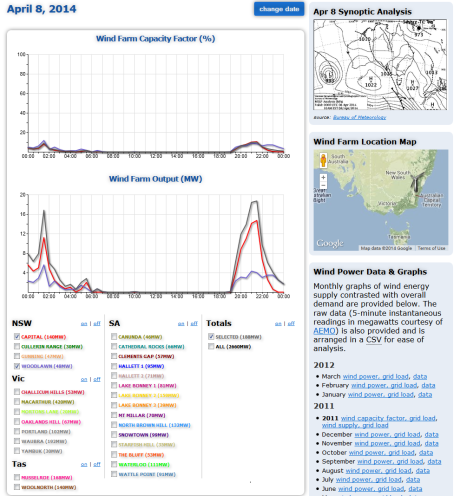
Capital 8.4.14

GRADE: Fail.

COMMENT: When power was needed most in the middle of the day, Capital and Woodlawn showed no interest in their set task, instead annoying grid managers with a couple of spurts of less than 20 MW of their combined capacity of 188 MW.

Captital 9.4.14

GRADE: Fail.

COMMENT: Again, Capital and Woodlawn appear to have no interest in applying themselves. A momentary spurt of 30 MW – which is no more than 16% of what they claim to be capable of – is totally unsatisfactory. And by choosing to work late at night or in the early hours of the morning, yet again, they are simply disrupting others trying to enjoy their homes and sleep.
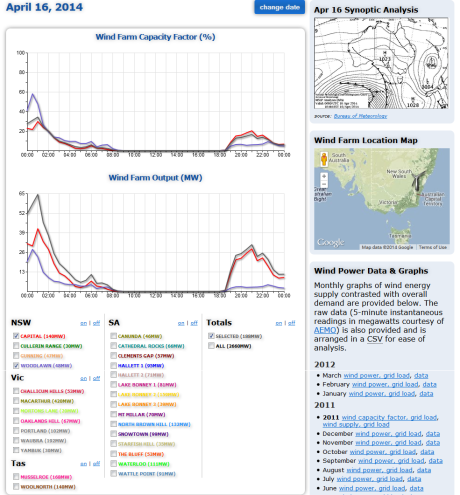
Capital 16.4.14

GRADE: Fail.

COMMENT: A marginally better effort, but at 1am, as they know, there is no demand for their output and all they are doing is sending the dispatch price towards zero and engaging in “predatory pricing” – punishing the diligent students (coal, gas and hydro) who are always prepared to work around the clock.

Capital 17.4.14

GRADE: Fail.

COMMENT: As per above. Two brief and tiny spurts of 8 MW is simply nuisance value for grid managers, forced by the RET to take those insignificant efforts ahead of base-load power; they have been repeatedly warned about destabilizing the grid by this kind of behaviour.

Captial 19.4.14

GRADE: Fail.

COMMENTS: Sporadic efforts like this make a mockery of the claims made by Capital and Woodlawn to be serious substitutes for coal, gas and hydro power. They have been asked to provide a report explaining where the power came from on this occasion – and the hundreds of other occasions – when they failed to apply themselves: they are yet to provide any sensible explanation.
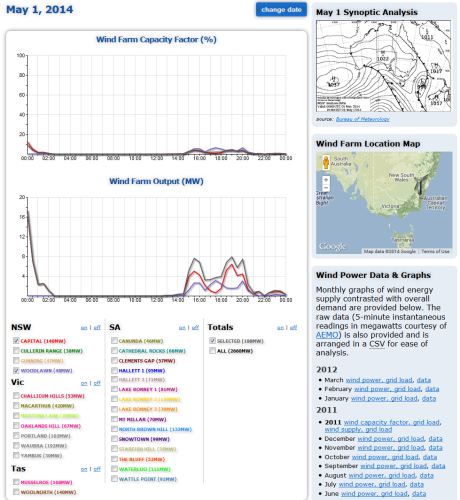
Captital 1.5.14

GRADE: Fail.

COMMENT: Capital and Woodlawn continue to frustrate with their poor attitude to carrying out set tasks. Two fleeting spurts of less than 8 MW is totally unsatisfactory. They have been spoken to many times about their failure to perform even the simplest tasks required of them. This pitiful effort takes to 6 the number of times in less than 24 days when Capital and Woodlawn have completely failed in their set tasks.

ATTITUDE & BEHAVIOUR:

Capital and Woodlawn are on their final warning concerning their poor attitude and unsettling behaviours. They have been repeatedly warned about telling lies, half-truths and spreading misinformation about their performance; and their relationships with other students leaves much to be desired.

Despite repeated warnings, Woodlawn keeps claiming that it “powers” 32,000 homes and saves over 138,000 tonnes of CO2 emissions every year (here is a note seized in class). It is evident from Woodlawn’s continued and repeated failure to perform (as summarised above) that these wild claims are nothing but complete fiction.

As Woodlawn well knows, its persistent failure to deliver any meaningful power to those homes – hundreds of times each year – has threatened to leave their owners freezing (or boiling) in the dark.

Woodlawn is also well aware that while it was slacking off, the power it failed to deliver was all made up by “spinning reserve” from base-load gas and coal thermal generators and highly inefficient Open Cycle Gas Turbines – which spew out 3-4 times the CO2 per unit of power generated, compared to a modern coal-fired plant. These simple and unassailable facts mean that its claims about reducing CO2 emissions are patent nonsense. We sent these notes home last month about spinning reserve and OCGTs.

Capital has performed no better.

Capital continues to claim that it “powers” the Sydney Desalination Plant (this was found scrawled on the blackboard).

As Capital well knows it fails to “power” so much as a kettle for hours and days on end, hundreds of times each year – the abysmal examples above make that plain.

And, despite repeated warnings about lying, Capital is acutely aware that its claims about “powering” the Sydney Desalination Plant are doubly wrong.

First, because any power Capital has bothered to produce is dispatched into the same Eastern Grid – along with power from every other generation plant connected to that grid: an electron produced by a coal-fired plant and Capital is indistinguishable. Any power generated by Capital is simply lost in the system and, therefore, its claim to be the exclusive provider of “power” to the Sydney Desalination Plant is simply nonsense.

And second, because the Sydney Desalination Plant has not produced a single drop of desalinated water since July 2012 it, therefore, has had no need for Capital’s power for almost 2 years (another helpful student sentus this report on the mothballed Desal plant – see the section headed “Operation”).

All of which raises the question of what Capital is “powering” when it finds itself bothered to apply itself to its assigned task?

Capital and Woodlawn have also demonstrated a range of unsettling and anti-social behaviours. They continue to falsely claim that the noise they generate is no louder than listening to a refrigerator 500m away (for an example of what they really sound like – when they’re working – click here).

Because of their erratic work habits – generating most of their power at night-time when there is simply no demand for it – they continue to disturb and annoy other students trying to sleep and enjoy their homes. This behaviour, in particular, demonstrates a lack of empathy and emotional intelligence (for just one example of the impact Capital and Woodlawn’s thoughtless behaviour is having on others – click here).

In an effort to correct their behaviour in this regard, we recommend that both Capital and Woodlawn attend the counselling sessions that the school has previously offered to them.

Capital and Woodlawn have also been repeatedly warned about stealing people’s lunch money. Their excuse that it is not really “money” because they’re only taking Renewable Energy Certificates is unsatisfactory.

Whenever challenged, they continue to lie about the cost of the power they do (on rare occasions) manage to produce by pointing to the dispatch price – which is totally irrelevant to power consumers, who – thanks to under-performers like Capital and Woodlawn – now pay among the highest retail power prices in the world (see page 11).

And they refuse to mention at all the rates paid under their Power Purchase Agreements with retailers – which are 3-4 times higher than the diligent and consistent students, coal, gas and hydro. Capital and Woodlawn also ignore the cost of coal/gas thermal generators maintaining spinning reserve (wasting mountains of coal and gas every year) and the cost of running insanely expensive OCGTs – both needed to keep the power flowing to customers when Capital and Woodlawn continually fail to deliver – costs which are all ultimately added to power consumers’ bills, crippling energy intensive businesses and harming poor and vulnerable families.

Capital and Woodlawn continue to disappoint with their erratic performance; their continued lies, half-truths and misinformation about their performance; and the callous way that they treat their neighbours trying to sleep at night time. We find their repeated promises to perform better next time hollow and tiresome.

OVERALL ASSESSMENT:

FAIL.

LAKE GEORGE HIGH SCHOOL

Principal: A. Power-Consumer

May 2014.

report-card

Mark Dewdney lists “a few” of the Reasons, the Liberals have got to go!

So…it’s “only” the gas plants and e-Health, according to some friends who, if the Liberals even admitted they were guilty of this list, would still create justifications to vote for them this time. Well, here you go – if you can’t stomach the idea of anything less than a massacre at the polls this time around, I suggest posting this to your timelines once a week.
Green Energy Act (20 billion).
eHealth scandal (almost 2 billion).
Gas plant scandal (1.1 billion theft and cover-up of our tax dollars).
ORNGE scandal (700 million).
Ontario Northland Railway scandal (820 million).
Caledonia Hydro Line scandal (116 million).
Lobbyist scandal (two multi-million dollar scandals).
Eco-Fee Reversal scandal (18 million).
CancerCare Ontario scandal (millions of dollars).
Slush Fund scandal (32 million).
Niagara Falls Commission scandal.
Ontario Power Generation scandal.
Children’s Aid Society scandal.
Nanticoke Coal Power Plant Shutdown scandal.
G20 Secretly Approved Police Power scandal.
Auto Insurance scandal.
Foreign Scholarships scandal (our students pay the highest tuition in Canada while foreign students get free university educations).
Offshore Wind Turbines scandal.
Samsung scandal (sole-sourcing).
Pan Am scandal (cost increase from 1.4 to 2.5 billion).
MPAC scandal (over and under-valuation of properties).
OLG scandal (millions of dollars).
Isotape Shortage scandal.
Chemotherapy Dosage scandal.
Payout for Pan Am CEO (250 million).
Trillium Wind Power and Sky Power Limited lawsuit (500 million)
Cement company lawsuit (275 million) – Quarry outside Hamilton was scuttled for political reasons.
School bus service lawsuit.
Augusta/Westland lawsuit as it pertains to ORNGE.
Elliot Lake Collapse lawsuits (two lives lost due to recovery delays).
Ontario Medical Association lawsuits – applied to Superior Court alleging McGuinty not negotiating in “good faith” .
Breast Screening scandal (ensuing lawsuits due to thousands of misread mammograms, one life lost.)
Class-action lawsuit for autism funding cancellation.
Over 650 new agencies, boards, commissions and entities such as LHIN’s and CCAC’s.
Over 300,000 new public servants many of whom, are on the sunshine list.
Public sector employment in health care increased by 39%.
Public sector employment in social services increased by 39%.
Public sector employment in education increased by 34%.
Paying more Liberal taxes only to receive fewer services as taxes now being spent to pay the salaries and perks of newly-assigned, Liberal-friendly public servants.
Gutted our manufacturing base (job growth across Canada except in Ontario).
Nearly one million Ontarians now out of work.
Increased spending by 80% while our economy grew by only 9%.
More than doubled our debt to 288 billion.
Running a 11.3 billion annual deficit.
Debt servicing costs will rise from 11.4 billion today to 14.5 billion once the debt exceeds 300 billion by 2017-18.
Interest payments on our debt now the third largest budget expenditure after health and education.
Task Force on Competitiveness, Productivity and Economic Progress confirmed that McGuinty’s Green Energy Act grossly underestimated the cost to consumers and overestimated the number of new jobs that would be created.
Tax collectors getting 45,000.00 severance packages for switching job titles from provincial to federal.
Two ministries under an OPP criminal investigation – ORNGE and gas plant scandals.
Pharmacy war.
Illegal green taxes.
Increased smart meter, electricity, hydro, tuition and car insurance costs.
Implemented tire tax, electronics tax, eco fee, health premium (tax), WSIB tax increase, HST, beer surtax.
Failing grade on ADHD education.
Ranking the lowest of all provinces for fiscal performance.
Delisting eye exams, physiotherapy, chiropractic care, diabetic strips, etc.
Increasing wait time for cataract surgery.
No longer covered for eye exams yet taxpayers paying for sex changes.
Wait time for nursing home bed tripled.
Failure to disclose elevated radiation levels.
OES missed its collection and recycling targets by 59%.
Not correcting the foreign ownership of our beer market.
Acceptance of garbage striker extortion.
Harassing labour inspectors.
Kowtowing to green energy lobbies.
Imposing blood alcohol rules that punish people who are not impaired.
Public utilities donating to Liberals.
Voting to cover up the Niagara Parks Commission scandal.
Emergency room wait times not meeting provincial targets.
Put on notice by Standard and Poor, credit rating downgraded, under a very serious credit watch.
Have-not province for the first time in Canadian history
Borrowing more debt than any province except NB
Dramatic cuts in health care services in schools
Nurses getting bonuses despite a wage freeze
Insufficient senior homecare services
Failing grade of Family Responsibility Office
Abstained from vote to investigate CBC expenses
Cash kickback scheme involving government cleaning contracts
Talked about a two-year freeze on wages for public sector while previously giving the OPP a 5% wage increase – the OPP received another raise of over 8% in January, 2014
Energy now unaffordable yet we must pay Quebec and some north-eastern States to take our surplus energy.
Encouraging farmers to build small-scale solar projects but having no way to connect them to the power grid.
Laid up in US hospital beds as no beds available in Ontario.
Refusing public inquiry into G20 fiasco.
Giving those who hire only newcomers a 10,000.00 tax credit.
Third highest user of food banks.
Announced pay freezes knowing that 38,000 were getting a 3% salary increase after the election.
Nortel Pensions bailout .
Hiding hospital errors from the public.
Teachers skipping classes to assist with anti-Conservative campaign.
Failing grade in northern forestry management.
Almost 40 C. difficile deaths to date.
Loss of 6,500 cancer patient health records.
Highest rent increase rate in years.
Ignoring evidence that wind turbines can cause poor health.
Workers at eHealth suing for not receiving bonuses.
Liam denied eye care that another child is receiving under OHIP.
Ontarians pleading for their lives or dying because they aren’t getting the health care they need.
Lady with a brain tumor denied help to cover costs which costs are covered in Manitoba.
Electricity rates to rise 42% over five years.
Prior loss of 60,000 jobs in the horse racing industry – now attempting to correct this.
Presto
Ring of Fire Cleaning kick-back scheme that ended with the conviction of three Liberal officials.


Please Support us at Carmen Krogh’s Talk at University of Waterloo!

Capture

WE NEED YOUR SUPPORT!

Here is a map of the University.  Parking available.    Please have exact change…($4.00)

We are in Building DC.  About “F” (horizontal) “3” (vertical) approx.

“Visitor parking lots” are shown as black circles.   Coin operated (4 dollars).

From University Ave use lots H, C.

From Columbia use lots M, R (south of Columbia) first, then (farther away, north of Columbia) X.


There is NO Net Benefit to Industrial Wind Turbines~

The cost of wind-farms will dwarf that of HS2

We’ll need four times the number of planned offshore wind farms to meet EU energy targets

Wind farm

The £60 billion cost of the extra wind farms needed would be added to household electricity bills Photo: ALAMY

Much attention was paid to the vote by a huge majority of MPs for the HS2 project, the main objections to which are that it will cost a staggering £50 billion and cause immense environmental damage, to much less useful purpose than is claimed for it.

But no one seems to have noticed that the same is true for another of the Government’s projects: its bid to meet our agreed EU target that, within six years, we must treble the amount of our electricity derived from “renewables”. Ed Davey, our energy and climate change minister, claims that his £12 billion plan, centred on six giant offshore wind farms, will add “4.5 gigawatts” to our generating capacity.

What Davey concealed, as I wrote last week, is that, thanks to the unreliability of the wind, the actual output of his project will be half that, 2.2 gigawatts, a mere 4 per cent of the electricity we use.

So, to meet our EU target by 2020, we would need four more projects of similar size, at a total cost of £60 billion, paid for through subsidies hidden in our electricity bills equating to £3,000 a year for every home in the land. We would need to spend billions more on connecting these wind farms to the grid, plus further billions on gas-fired power stations to provide back-up for the times when the wind isn’t blowing at the right speed.

When people finally wake up to what we are being let in for, their anger will make the row over HS2 look like chicken feed. But fortunately for Mr Davey, none of our MPs have yet done enough homework to grasp that what he is proposing is utterly insane.

Donna Quixote’s “Liberal Monopoly” makes the NEWS!!!

Merriam: Grits’ fixation on wind power is a losing game

By Jim Merriam

How dreadful . . . to be caught up in a game and have no idea of the rules.

— Caroline Stevermer

Two games have taken on new meanings, thanks to opponents of the Ontario government’s fixation with wind power.

First is the game of politics and second is the board game Monopoly.

A new game circulating via electronic media is called Ontario Liberal Monopoly. The game highlights the relationship between this power-hungry party and its various power flubs.

Instead of jail, there’s an unemployment line for all those thrown out of work by the government’s destruction of the manufacturing sector.

There’s also a wind victims’ safe house, presumably a place where all the folks can move after they’ve been driven from their farms by wind turbines that have caused serious health problems.

Permit me an aside. I recently exchanged correspondence with a dear friend who couldn’t understand how I could abandon the “Liberal family,” to which my clan has belonged since Ontario was nothing but unsettled bush.

The answer: I could never support a party that condones big business delivering health problems to people and driving them off the land, for no good reason. I doubt most of my ancestors would have supported such reckless disregard for people either.

But I digress.

Back on the special monopoly board, we see the price of various wind factory developments. These include Wolfe Island at $75 billion, Melancthon wind farm at $80 billion, Port Alma at $30 billion and Underwood at $50 billion.

As you roll the dice and make your move you might land on a square that gives you a gift basket. Of course, it’s for Toronto residents only.

Another square says you can take a ride on an Ornge ambulance. Perhaps it should have said, be taken for a ride by Ornge.

Just like real Monopoly, another square moves you directly to the unemployment line because your company has moved to New York for cheaper electricity rates.

When CEOs pass “Go” they receive $2 million in salary, but unlucky players might end up paying $20 in gas tax and 10% or $200 in debt retirement charges.

On the square for electricity charges, you get to choose one only from heat, light, food or shelter.

Instead of the likes of Marvin Gardens, you can buy various parts of the province. Widely ranging prices seem related to how much the province cares about the area in question.

For example you can buy Don Valley West for $2,000, but Guelph will cost you only $25. Shelburne is $12, while Port Burwell and Kincardine are $10 each.

Huntsville will cost you $50 or you can buy Vaughan for $110 and the Muskokas for $150. (I know it’s not “Muskokas” but that’s what it says on the board.)

If you get an unlucky roll, you land on the cancelled gas plants square and get to pay $1.1 billion. Other unlucky players take a chance and get to deal with the fact their neighbours leased land to a wind developer.

You can learn more about this special game and about the Liberal party’s destruction of Ontario at http://www.QuixotesLastStand.com. Here is the history of the Liberal monopoly game:

“With more and more families in Ontario entering energy poverty, thanks to the insane policies of the Liberal party, families are now finding themselves sitting in the dark at night. This has spawned a resurgence in board games, and the newest rage in board games is the Ontario Liberal party version of Monopoly.”

It’s all kind of funny, except it’s a sad commentary on the last decade of Liberal rule in Ontario.

jmerriam@bmts.com


UK is Wising Up to the Windscam….JUST SAY NO!!!

New! Manage Your Group
See pending posts, member requests and reported posts for the group in which you are an admin.
Okay

Close popup and return

Finally….the plug is pulled on the Liberal Fiasco!!! Oh HAPPY DAY!!!

TORONTO – Ontario is heading to the polls.

NDP Leader Andrea Horwath said she will vote against Premier Kathleen Wynne’s spring budget which means that the Liberal minority government would fall on a confidence vote as early as May 7.

“It’s time for change,” Horwath said Friday. “You deserve a better government.”

Horwath said the growing list of scandals attached to the Liberal government and her lack of confidence in Wynne to deliver on her budget promises are behind her party’s decision to pull the plug on its support.

Wynne had given Horwath until May 8 to decide but she rendered her decision one day after Finance Minister Charles Sousa delivered his supposedly NDP-friendly budget.

“Kathleen Wynne cannot even build a raft. How do we expect her to actually build a ship?” Horwath said. “We will not be voting in favour of any confidence motion including the budget.”

A confidence vote could be held any time between May 7 and June 2, but Wynne could also trigger an earlier election herself.

Premier Kathleen Wynne, speaking on the Lorne Brooker Show on CJBQ radio in Belleville, said Friday that she was disappointed that Horwath would not meet with her as requested to discuss the budget.

“I think there’s a lot in this budget that needs to be implemented in the province,” Wynne said. “But I’ve said all along if we didn’t have a partner in the Legislature then we would taken this budget to the people of the province. And we will do that.”