Lies that the Wind Developers tell…..Will that be their downfall?

Elected officials suppressed key report, failed to halt project or recover taxpayer dollars

“It was heartbreaking to see this project desecrate such a historically and culturally significant landscape, and it’s even worse when you find out that it was built on false claims by the developer, and with the assistance of the BLM. “– Anthony Pico, Chairman, Viejas Band of Kumeyaay Indians

By Miriam Raftery

April 30, 2014 (Ocotillo) – An international wind energy expert has concluded that Pattern Energy appears to have defrauded the federal government in order to obtain lucrative tax subsidies for a wind energy development in southern California that has failed to live up to the developer’s claims.

“I believe we have a clear case for the False Claims Act,” Nicolas Boccard told East County Magazine, after reviewing full first-year wind production data for the Ocotillo Wind Energy Facility on U..S. Bureau of Land Management (BLM) public land.  The project produced only about half of the energy that Pattern claimed it would produce—far below levels deemed viable for a wind project, a second expert confirms.

These dismal results are no surprise to Boccard, who predicted in a report written before construction of the project was  completed that Ocotillo lacks sufficient wind speeds to sustain a viable wind energy project.

So were Pattern’s lofty wind speed claims nothing more than spin?

Boccard, an international energy expert and assistant professor of economics at the University of Girona, Spain, has written and published in Energy Policy prior reports exposing exaggerated wind  production claims made by energy companies in Europe. The Ocotillo report authored by Boccard was commissioned by the  Desert Protective Council but its findings have since been independently validated by multiple experts.

Concerned tribal leaders, environmentalists and residents initially kept the Boccard  report  on Ocotillo confidential, but did share copies only with their public officials– members of Congress and the Legislature, who failed to take action to prevent the project from being built—with one exception; one Congressman sent a letter to the U.S. Treasury Department asking that funds for the project be halted pending an investigation of wind speeds, but the agency failed to act.  The other political leaders appear to have done nothing to investigate the fraud allegations before the project was built.  Confronted with the year-end wind speed data, however, a second Congressional member has now taken action, asking the U.S. Department of Energy to investigate fraud claims.

The citizens’ coalition also provided evidence strongly suggesting fraud to the North American Development Bank, which financed the project, but the evidence was ignored. Documents obtained by East County Magazine, which were provided to NADB,  suggest that Pattern falsified maps to make it appear that wind turbines would be built atop windy ridges 3,000 feet higher in elevation than the flat desert sands on which the project was actually built. 

Boccard’s report has not been published—until now.  East County Magazine received the Boccard report on Ocotillo Wind before the  Federal Energy Regulatory Commission (FERC) released its data  on the project’s actual wind production,  under condition that we withhold publication until the first full year of wind speed data was available and analyzed.  That analysis is now complete, confirmed by multiple experts.

The project was offline for several weeks due to dropping a multi-ton blade on a Jeep trail on public land.  But even after accounting for the missing months using several different calculations, all with very generous estimates for how much power the project might have produced if not for the accident, the full-year results are still very poor.  Moreover, experts agree, there is no reason to believe this project will ever produce significantly more power.  After all, Boccard noted, “California winds for 2013 were not unduly weak.”

Decommission Ocotillo Wind  Now (DOWN), a coalition of environmentalists,  Native American tribal representatives and Ocotillo residents has formed and is calling on the federal government to take action and order the decommissioning of the project on public lands, which has a long track record of  serious  and in some cases, dangerous problems. (Photo, left: protesters beneath turbine section on passing truck)

Pattern Energy has not responded to our requests for comment on this story.

The finds raise doubts not only about the Ocotillo project’s viability, but about the fast-tracking process and the potential viability of other projects proposed in our region. Pattern Energy has indicated it aims to expand to add a future phase at Ocotillo. Federal agencies and San Diego County have approved Tule Wind, a massive project slated to be built in McCain Valley. Plus San Diego’s Supervisors recently enacted a controversial county wind ordinance that would open wide much of East County to industrial-scale wind energy development.

Scroll down for details with links to full documentation regarding the dubious claims in Ocotillo and citizens’ efforts to expose what they contend is fraud.

Why the Boccard report was commissioned

We thought this was a terribly inappropriate and destructive project to begin with,” Terry Weiner with the Desert Protective Council told East County Magazine.  The DPC, along with Native American tribes, residents and others, had grown frustrated that new federal fast-tracking procedures had failed to heed serious concerns raised by the project—including doubts about the developer’s wind speed projections raised by Jim Pelley, an aerospace engineer and Ocotillo resident, and others.

So the DPC with help from consultant John Kennedy of San Diego sought out Boccard, a University of Girona, Spain faculty member and wind energy expert who had authored a prior report which found that the wind industry in Europe had published wind production estimates that were overly optimistic, given the experiences of Denmark and Germany.

That earlier report found that though the wind industry had claimed a capacity factor of 35% overall in Europe, the actual wind capacity for 2003-2007 was only about 21%, thus making “costs 66% higher than previously thought.”

Kennedy had learned about Boccard after reading peer-reviewed materials in the book Green Illusions: the Dirty Secrets of Clean Energy and the Future of Environmentalism, by Ozzie Zehner.

Weiner recalls, “We told Boccard, ‘We don’t want you to alter the report in any way, shape or form. We want the truth.”

Boccard report predicted failure of Ocotillo project

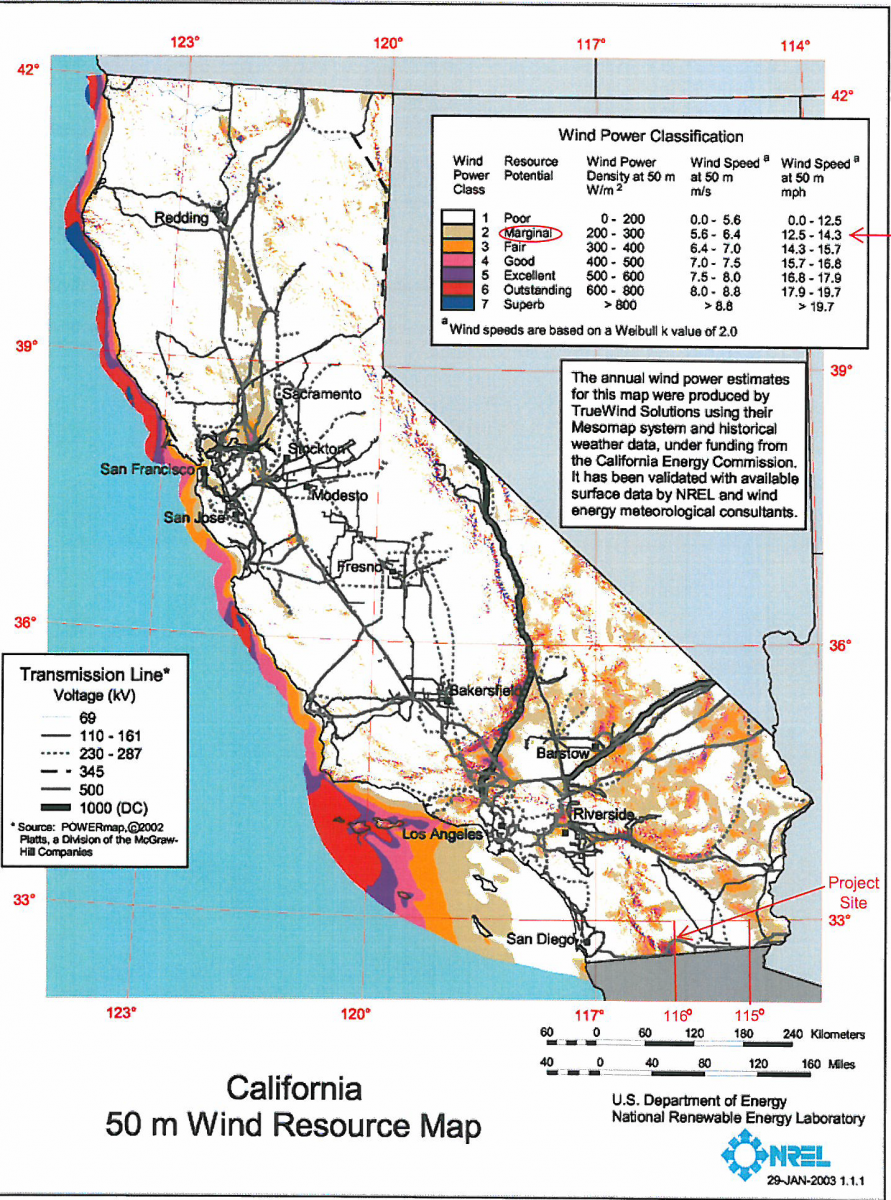
Boccard’s Ocotillo Wind Resource Study examined numerous documents including wind density maps from the federal government.  He concluded that the Ocotillo project design was “suboptimal” due to its location in what he found to be a class 2 wind resource area—class 1 being the worst on a scale of 1 to 7.   “If one is to follow the standard rule, this site should be listed as `unsuitable for the development of wind-powered electricity,’” Boccard concluded while the project was being built. He concluded the report with: “The 34% capacity factor claimed by the  Ocotillo developer is far off the mark and shall never be achieved.”

How inflated were Pattern Energy’s claims, in Boccard’s estimation?  To produce as much power as Pattern projected would require wind speeds higher than some of the windiest places on earth, such as Ireland’s Atlantic coast wind projects.  Overall, Ireland had a 30% wind capacity factor for the past decade, Boccard found.  He then predicted that the actual power produced at Ocotillo would likely range between 20% and 23%.

Actual wind production at Ocotillo during first year

In fact, wind production at Ocotillo during its first year was even lower than Boccard forecasted.  After obtaining federal data from FERC following a long day delay due to a website upgrade at the agency, we had four different sources crunch the numbers based on a standard mathematical calculation for wind capacity factor.  Below are the results.

Over the year 2013, the Ocotillo Wind capacity factor was somewhere between 15.7% and 17.7%. Expert calculations varied slightly, due to minor variables and whether turbine sizes were 2.3 or 2.37 MW, how long each turbine was actually offline, and so forth. All turbines were off line for the last half of May, and some remained offline for June and a portion of July due to the fallen blade.

But even if we look at only the 9 months with full data, the capacity factor is still only 18.9%.

If we make a generous estimate of strong winds for those months (purely a guess) and estimate how much the project might have produced if it hadn’t dropped a multi-ton blade and been forced offline, the number would still be only about 21.5% in a best case scenario for Pattern.

Overall for the year, Pattern’s project generated only 334 gigawatts (Gwh of power.  That’s astonishingly short—less than 52%–of the 646 Gwh that Pattern claimed in its application to the NADB.  It falls even more short—just 37.5% of an even higher claim, 891 Gwh, that SDG&E claimed  the project would produce in a resolution  sent to the California Public Utilities Commission.  Even allowing for a fallen blade, it’s clear that this project could not have come close to the wind production claims made to secure financing, a 30% cash grant under Section 1603, and an approved Power Purchase Agreement funded by SDG&E ratepayers.

The following calculations were made by Parke Ewing and Jim Pelley, a former construction superintendent and an aerospace engineer in Ocotillo.   Since both are on record opposed to the project, East County Magazine’s staff ran the calculations and confirmed their estimates.

We then sent the data to Reza Alam, a wind energy expert and assistant professor of mechanical engineering at the University of California, Berkeley College of Engineering. At the time, we had the first 11 months of data.  “Yes, capacity factors are calculated correctly,” Alam confirmed.

He added, “Anything below 30% capacity factor for wind is considered relatively low.” He added that other factors may impact output such as storms, long-term weather patterns, turbine models and efficiency.

OCOTILLO ACTUAL WIND PRODUCTION CHART:

Shown the first year of wind data at Ocotillo, Boccard’s initial reaction was, “Told ya. There’s no rocket science here.”

Boccard calculated that if the blade had not fallen, Ocotillo might have reached at best a 17.7% capacity factor and 379 Mwh for the full year—far below Pattern’s projections.

Boccard subsequently crunched some more numbers, comparing data from the Kumeyaay Wind facility in nearby Campo atop a ridgeline. He found that the Kumeyaay facility lived up to its projected capacity factor, actually hitting 33.9% for the year overall—nearly spot on the 34% that Pattern predicted for Ocotillo.

Pattern Energy’s predecessor built the Kumeyaay wind facility (photo, right), so the company had good reason to know  that wind speeds at the higher elevations were strong.  But why would Pattern claim an identical capacity factor for Ocotillo, knowing the site is on flat desert, at several thousand feet lower in elevation in an area ranked only a class 2 wind resource area?

Boccard observed, “The builder may be excellent but if you do that at the bottom of a valley you’re doomed.” He predicted, “There is no reason to believe it will improve, since performance is driven by Mother Nature alone, unless the local shaman put a spell on local winds.”

Boccard stated that he would support decommissioning (tearing down) the Ocotillo project and moving the turbines to a good location since many Californians favor this type of electricity. Further,  he stated, he believes the U.S. government should seek financial redress from Pattern.  “After all, “ he said, “they lied to their funding bank and the authorities, for they must have seen the wind maps.” He added that he hoped such action would “set a precedent against stupid, rushed locations.”

The False Claims Act, also known as the Lincoln Law, imposes liability on companies or people who defraud the U.S. government, typically federal contractors. Over 70% of such cases are initiated by whistleblowers, who can share in a portion of any financial recoveries.  Over $35 billion has been recovered under the False Claims Act from 1987 to 2012.

Alam stated that he, too, might support decommissioning if turbines could be reassembled elsewhere.

A Pattern of misrepresentation

Pattern’s spokesperson, Matt Dallas, failed to respond to multiple requests for comment including requests sent to his email list listed as a current contact on an April 25, 2014 press release on Pattern Energy’s website.  We also asked Pattern to disclose proprietary wind data now that the project is built, but the company ignored our requests over several weeks.

John Calloway from Pattern Energy, at a public Bureau of Land Management scoping meeting on Ocotillo wind, made this statement, “Why here in Ocotillo?”  He then showed a map from the National Renewable Energy Laboratory of wind resources at 50 meters above ground.  “As you can see, almost all of Imperial County is absolutely no wind,” he stated, then later added that their measurements confirm that “as the wind comes off of the mountains, as it hits the flat area it starts to dissipate out and it just goes away,” confirming that Pattern knew the flat desert area lacks wind, unlike the ridgelines above.  View video with embedded clip from the meeting.

Pattern put up meteorological (MET) wind testing towers for two to three years, the Imperial Valley Press reported and residents confirm. But Patternsubmitted less than a year of data (7,700 hours from 2010, according to the Final Enviornmental Impact Report section on meteorological resources) to the federal government. Why?  Pattern also claims to have conducted additional wind speed testing with equipment such as “Sodar” and “Lidar” system (or as residents derisively call it, “Lie-dar”) .  An Imperial Valley Pres article quoted Pattern’s Matt Dallas stating these “showed the Ocotillo area to have a strong wind resource.”

Numerous interested parties have sought to obtain the full data on all testing, but neither the federal government nor Pattern would release that information, claiming it is proprietary data.  In other words, your government wants to keep secret whether or not your tax dollars are being paid out for projects that may have been funded based on incomplete, inaccurate, or outright falsified reports.

“I have argued to all decision makers that they should include public access to the MET tower data in any permits that get issued,” Donna Tisdale with the Protect Our Communities Foundation said.  “At a minimum, the agency with jurisdiction should require access to that data in order to make an informed decision before handing over public land and funds for private profit.”

It gets worse.

In its application for financing and certification sent to the Border Environmental Cooperation Commission (BECC) Pattern again claimed the project has “excellent wind resources” and that the “area boasts strong winds…”

But William C. Pate, an attorney representing Ocotillo residents,  has concluded in a letter he sent seeking to block funding of the project that Pattern falsified data to make it appear that the project would be situated atop ridgelines –where winds actually are strong.

The North American Development Bank (NADB) and its sister institution, BECC, were created by the governments of the U.S. and Mexico in a joint effort to “preserve and enhance environmental conditions and the quality of life of people living along the U.S. –Mexico border.”

Numerous opponents of the Ocotillo project sent letters to the NADB or BECC urging that funds be withheld on a wide range of grounds. But Pate’s letter stood out for bold-faced allegation that Pattern provided misleading data on not only wind speeds, but the location of the project itself.

In a letter to the BECC, Pate overlaid maps from Pattern and from the National Renewable Energy Lab (a California wind resources map).  His shocking conclusion: the NREL map that Pattern submitted with its application “has been altered to remove longitude lines and Interstate 8 as a point of reference…GPS coordinates do not lie.” But Pattern did lie, Pate contends.  “GPS confirms that contrary to Pattern’s statement in this federal financing proposal, none of the project boundary is where wind speeds achieve “excellent” and above classifications.”

According to the maps Pate provided, Pattern’s application for certification and financing falsely indicated that the project would be located 3,000 feet higher in elevation and substantially further west than where it was actually built.  Pattern’s mapping (click to see enlarged copy of map, right) would have placed the project atop the Mountain Springs grade at Boulder Park, where the Desert View Tower in Jacumba is located –a place known for his strong winds—and a place off-limit to development due to bighorn sheep habitat and other factors.

Moreover, Pate  noted, the Record of Decision approving the project lists blade diameters that were never included when the project was built. “Complete bait and switch,” he said.

He called for the loan proposal to be rejected   “because Pattern has materially misrepresented the wind resources for the project.”

Pate wasn’t the only one to alert the NADB.

Edie Harmon, a biologist, wrote in her comments to the NADB, that a review of San Diego-Imperial Counties at the NREL website revealed that, “Indeed, the project area for Ocotillo wind is not even mentioned as one of the places with records of high wind potential at  . Similarly, a review of the Wind Atlas map for southern California suggests that the site for the Ocotillo Wind Energy Project is not a good wind resource. ,” she wrote.

Harmon added, “Because I could not locate the source of any map for Southern California which looks anything like the overlay on BECC Figure 6, I conclude that the NREL maps are more likely to be an accurate assessment of wind resource potential. Failure of the OWEF EIS/EIR to provide the results of any wind speed data at the site should raise considerable concerns with the BECC staff about a potential recipient of a NADB loan.”

Many similar complaints were made to elected officials in Congress and to the Bureau of Land Management (BLM), but the project was built anyhow atop 12,000 acres of publicly owned BLM land.

Before construction, residents were so confident that the area lacked winds that they staged a public kite-flying contest and invited the media, offering cash prizes for any child who could fly a kite for at least one minute. None could.

Since construction, Pelley has taken videos nearly every day documenting in almost all cases, turbines not moving, or barely moving due to no or low winds far below what a viable project would need. View sample videos.   Also read about serious questions about wind production vs. claims around the world and at Ocotillo raised in our January 2013 special report, Where is the Wind?

Another possible red flag suggesting Pattern has something to hide occurred when Pelley and Ewing videotaped Ocotillo’s wind project manager giving a tour at the project on public land.  Asked how many homes the project would power, he gave a figure that was one-tenth the number Pattern had promised the federal government the project would power.  The manager, Russell Graham, later threatened both photographers with violence and physically attacked Ewing, attempting to take his camera as he demanded the video be taken offline. Ewing recorded the exchange on his camera as Graham threatened to “kick a hole in your f***ing throat.”

A judge later issued restraining orders against Graham to protect both photographers. Graham claimed in court that he made a mistake on the wind production remark. So why didn’t he simply ask to have his statement /explanation added to the photographer’s story, which was published on ECM?

Edi Harmon, a biologist and Ocotillo resident, wants to know if Pattern misled the government and is upset that records on wind tests are kept secret.

If this was not fraud, she asks, “What is the alternative explanation of why turbines are motionless ghosts so much of the time?  I wonder if ratepayers and investors in SDG&E might be having similar questions and awaiting answers.”

Warnings ignored by elected officials

Consultant John Kennedy says the FERC findings on poor energy output in Ocotillo demonstrate that Boccard’s predictions were accurate and Pattern’s were wrong.  “The Boccard report serves as a big `We told you so’ and all the while, local Congressmen had the Boccard report and sat on their hands,” he concluded.

Robert Scheid, vice president of community and public relations at Viejas, observed, “It was frustrating to all of us that it [the Boccard report] didn’t blow things wide open. It’s been a tough battle.”

“We were hoping that our legislators, both Democratic and Republican, would pick up on this and realize that this is a great example of what not to do with people’s tax funds and our stimulus dollars,” Weiner told ECM. “We have a wind project that’s not producing wind.”

The DPC wanted to release the Boccard report immediately, but after consulting with other stakeholders, decided to wait in hopes that their Congressional members would agree to hold a joint press conference to expose what increasingly looked like a taxpayer-funded boondoggle, Weiner told ECM.

Despite the Boccard report bearing out this forecast, however, officials largely ignored such concerns and one official, Congressman Darrell Issa, led residents and tribal representative to believe his House Oversight Committee would take action, but dropped the ball entirely.

Members of the coalition opposed to the Ocotillo project met with Congressman Issa’s staffer, John Franklin in August 2012, Kennedy confirmed. “He said he needed more than our interpretation of the data to set up a meeting with the Congressman. It was at that point we contracted with Dr. Boccard to do the study. The study was completed in October 2012 and forwarded to John Franklin immediately.”

At all of the meetings, Kennedy emphasized “We asked the same question. How can Pattern Energy achieve an above average capacity factor with the sub-standard winds in Ocotillo?” He elaborated, “If the average of all the projects in the U.S. for the last 40 years is only 24%, how can Ocotillo generate significantly higher capacity factor with a below average wind resource?”

But three months passed, and nothing was done. A string of emails from Issa’s office to concerned citizens revealed repeated promises of a full investigation, but we could find no evidence that any such investigation was ever done. Our pointed request to Issa, including asking if defrauding taxpayers should be a matter his committee should investigate, never received a response.

The project opened in December 2012. Congressman Issa declined to meet with his concerned constituents until January 2013, at which time he said his staff needed to vet Dr. Boccard’s finding. “We have been waiting for 12 months for any word from his office,” Kennedy said.  ECM contacted several  Issa staffers with a detailed list of questions, but did not receive any response.

The group also asked  then-Congressman Bob Filner and later, Congressman Juan Vargas to ask the U.S. Treasury Department to withhold all stimulus funds pending an investigation into the wind speed claims. “To date, there has been a deafening silence,” Kennedy said.

Rep. Filner, before stepping down from Congress to become Mayor of San Diego, did send a letter to Treasury Secretary Timothy Geitner asking that the funds be withheld. Written shortly after the Solyndra scandal over a failed solar company in which the government had invested taxpayer funds, Filner’s letter included this hand-written note in the margin: “Mr. Secretary–this could be another embarrassment for the Administration.”  A Treasury official, Richard Gregg, wrote back to Filner indicated the agency would look into the matter. The letter said payment is required to any applicant meeting statutory criteria, but that a review of the application would be conducted as in all applications to determine if eligibility criteria had been met.  Geitner subsequently has been replaced as Treasury Secretary.

ECM sent a public records request to the Treasury Department asking to see results of its “review.”  We received hundreds of pages in response, with more than a thousand pages more withheld on various grounds including proprietary data.  However all the key portions that might have proved informative had been redacted, or blacked out. The agency also refused  to turn over any correspondence with Pattern, members of Congress, or the White House.

Viejas Chairman Anthony Pico, along with Kennedy, met with Aaron Allen, a staffer for Congressman Juan Vargas, who replaced Filner.  A Vargas staffer read a statement on behalf of the Congressman into the record at a California Native American Heritage Commission (NAHC) hearing in San Diego. Vargas supported Viejas’ request, granted by the NAHC, to declare Ocotillo a scared cemetery and chastised the BLM for building atop a site that tribes had testified repeatedly to federal and local agencies had been a burial site for over 10,000 years.  The NAHC Chairman indicated he believed the Ocotillo project should be torn down for desecrating Native American cultural resource sites that should have been protected under federal and state law.

Chairman Pico said, “It was heartbreaking to see this project desecrate such a historically and culturally significant landscape, and it’s even worse when you find out that it was built on false claims by the developer, and with the assistance of the BLM. We absolutely support renewable energy but the costs of this project clearly outweighed the benefits. It’s a travesty, not only to Native Americans but to all area residents and taxpayers.”

Vargas office did not initially respond to constituents’ requests for help to stop taxpayer funding of what increasingly appeared to be a boondoggle project in Ocotillo.   Last June, in a meeting with Vargas staffer Jason Moore in Chula Vista, Kennedy recalled, “He already had seen the Boccard report or was aware of it because it had been given to the Congressman at the Chairman Pico meeting.  We discussed fully all of the issues.” He  was referred  to Vargas’ El Centro office and further, advised that  since the project was now operational, this was a state issue (despite being a federally funded project on federal land) and referred them to State Senator Ben Hueso.

“We met with Ben Hueso on October 18, 2013,” said Ocotillo resident Parke Ewing. But Hueso’s office took no actions.

Our initial request for records of correspondence to Vargas office was rejected because Congress has exempted itself from the Freedom of Information Act.  However, at a meeting with constituents of the Congressmen at his Imperial Valley office, a Vargas staffer ,  Rebecca Terrazas Baxter, did obtain FERC data on wind records that had been unavailable previously despite repeated requests from FERC.

After ECM forwarded analysis of the wind data for Ocotillo’s first year, along with other documentation such as the claims of map falsification and more, we received a response from Dianna Zamora in Rep. Vargas’ office in Washington D.C. on March 1, 2014.

“I would like to thank you and our constituents, as it is clear that you did your due diligence,” she stated. The Congressman takes any accusations of impropriety or fraud very seriously. He has reached out to the Department of Energy to share with them the information you have provided.”  She added that Vargas has asked the best method for evaluating the information to “determine if any wrongdoing has occurred,” she added, promising to get back to us “as soon as we hear details of the Department’s evaluation.”  Two months later, we have not received a response.

Congresswoman Susan Davis’ office also made efforts to obtain the FERC records on our behalf, questioning whether FERC’s delays in providing data may have violated federal law.

We also reached out to Senator Barbara Boxer’s office with a detailed list of concerns and requests, since Senator Boxer chairs the Senate Environmental committee. Her staff referred our request to the committee, which in turn passed the buck back to her office.  Neither ever responded to our requests, other than to refer us to Matt Weiner, legislative director for Rep. Henry Waxman, to assist us in getting wind speed data. He didn’t.

In each of our inquiries to officials – Issa, Vargas, Davis, and Boxer, we attached the Boccard report, Filner’s letter, additional documentation and asked how many other “green” projects might be similarly questionable or even fraudulent.

Nor is this the only indication of misleading claims made by Pattern.  ECM has previously documented dubious claims made about earthquake seismic safety, distances from homes and earthquake faults, avian radar,  health, safety and jobs, and wildlife issues at a project that has also been linked to Dust Bowl-scale dust storms and pollution of Ocotillo waterways and residential areas with a flammable dust suppression chemical.

The company also drew criticism from multiple Native American tribes for desecrating sacred sites and burial grounds.  In addition, the project also destroyed groves of century-old Ocotillo plants for which the town was named, as this video and the photo (right) shows.

Follow the Money

Why didn’t public officials do more to prevent taxpayer dollars from being squandered on a wind project that appears to lack adequate wind resources?

We don’t know.  What we can tell you, however, is that officials in both parties have taken substantial sums of money in campaign contributions from vested special interests including energy companies, utilities, and labor unions that all backed construction of the Ocotillo wind project.

According to Open Secrets, Rep. Issa’s top 20 contributors in 2009/2010 included Leidos Engineering (formerly SAIC). Leidos, which has wind projects, contributed $20,000 to Issa and its executives or employees donated another $9,600 for a total of $29,600.  In 2011/2012, Leidos and its representatives gave even more–$41,150 –to Issa.  Issa had other energy industry donations including oil companies; Carlyle Group, Pattern’s parent corporation, also has oil interests. Carlyle was also a major donor to the Republican National Committee, giving $35,000.

Rep. Vargas received $52,000 in his 2012 campaign for the state legislature from the building trades union, which supports wind project construction to create jobs. His second highest contribution in his  2014 Congressional race was the International Brotherhood of Electrical Workers, which backs construction of  industrial wind projects and power lines.

State Senator Hueso received $8,000 from Sempra Energy and $28,200 from electric utilities, as well as $175,300 from general trade unions.

Responses and reactions

We asked SDG&E to review the Boccard report and respond.  Jennifer Ramp replied that SDG&E is not in a position to comment or critique validity of the Boccard report.  As for whether SDG&E is disappointed in the first year energy production levels, or might consider cancelling its power purchase agreement for the project, she said, “It would be imprudent to review the first year of operation to make assumptions as to the longer term viability of any project.”

Could ratepayers be stuck with a higher bill? Not according to Ramp. “SDG&E only pays a developer for the amount of energy actually produced. In the event that the amount of energy falls short of initial expectations in any year, then SDG&E’s customers are protected.”

Perhaps.  But if a project repeatedly fails to produce the power promised, where will replacement power come from?  Building additional power plants, power lines and substations are costs that in part have historically flowed back to ratepayers to absorb.

Ramp added that SDG&E had to comply with state law requiring it to meet renewable portfolio obligations.  She said Pattern placed successful bids and received all required state and federal approvals to construct the project. In addition, SDG&E’s contracts were reviewed and approved by the California Public Utilities Commission (CPUC) as being “in the best interest of SDG&E’s customers,” Ramp stated.

Terrie Prosper, director of news and information at the CPUC, told ECM, “The contract terms are based on the electricity actually produced, so if the facility is underperforming, ratepayers pay less.  The risk of underperformance is on the developer and not SGD&E ratepayers.”

But federal tax subsidies are coming directly out of taxpayers’ pockets—and not just for construction.  Wind projects reap subsidies for years or even decades on each wind turbine—and Ocotillo has 112. This amounts to many millions of dollars per project. Moreover, KCET reported that the IRS recently revealed that many energy companies have been illegally double-dipping, taking both stimulus funds and wind production tax credits—but that the agency has no mechanism to check and find out how many companies may have engaged in this form of theft from taxpayers.  ECM has asked the IRS whether Pattern Energy was among companies found double-dipping in an initial check, but has not yet received a response.

Greener options

The Washington Post recently ran an editorial calling for an end to wind production tax credits, noting that the credits have been renewed repeatedly “with a cockroach-like resilience” despite evidence of what the Post calls a “boondoggle” as “industries develop to chase federal handouts.”   The Post calls for a simple, transparent tax on carbon credits instead.

Others, including the DPC, favor shifting tax credits to homeowners and business owners to install  solar on rooftops (distributed generation with power produced near where it is used instead of remote industrialization of public lands). Rooftop solar increasingly is being shown to be available at lower cost than wind projects and with far fewer negative impacts on the environment, wildlife, public health and safety.

Ironically, utilities are required to produce 33% of their power from renewable sources by 2030 in California—but due to utility lobbying, state law does not allow utilities to even consider rooftop solar as alternatives to utility-scale projects such as Ocotillo wind. Utilities make money charging back costs to ratepayers for every mile of transmission lines, so remote projects are far more profitable for utilities such as Sempra Energy, owner of SDG&E.

Utilities also support construction of backup gas-fired “peaker” power plants such as Quail Brush proposed near Mission Trails Regional Park for when the wind doesn’t blow, which in Ocotillo is the vast majority of the time.  Cogentrix, applicant for the Quail Brush project, is owned by the Carlyle Group—the same company that owns Pattern Energy, developer of Ocotillo wind. Carlyle’s 2009 Annual Report confirms that Carlyle founded Pattern Energy.   Riverstone Holdings, parent of Pattern Energy, formed  a joint venture partner of the Carlyle Report, Bloomberg News reported.

Thus if the Quail Brush gas plant  is approved by the CPUC, Carylye would be poised to make money regardless of whether Ocotillo produces significant power or not.

For area residents, tribes, and environmentalists, destruction of the Ocotillo desert now seems not only heartbreaking, but senseless.

Tom Budlong, an outdoor enthusiast recently met with a Bureau of Land Management representative at a community meeting and asked why data on a project built on public land was kept secret from the public.  If it had been made public, he concluded, “It might have revealed that the wind resources here were indeed insufficient.”

After discovering that the project is generating electricity at only half the capacity factor of a well-sited wind energy facility, he lamented that while Pattern pocketed profits off tax subsidies,  “A lot of very good land got chewed up. Added together, it is all a farce.”

Miriam Raftery is a national award-winning journalism who has won more than 200 major journalism prizes, including top honors from the Society of Professional Journalists in San Diego and the San Diego Press Club, for her investigative reporting on issues involving the Ocotillo Wind Energy Facility. She is the editor and founder of East County Magazine, a nonprofit, nonpartisan media outlet which has won over 58 awards.  You can help support independent reporting in the public interest by donating online atwww.EastCountyMagazine.org

Ontario Chamber of Commerce discusses the Liberals 2014 budget….

Ontario Budget 2014: What Businesses Needs to Know

Today, the Government of Ontario tabled its 2014 Budget. What follows is a summary of the key highlights from a business perspective.

On the whole, this is a ‘two-steps back’ budget for Ontario businesses. The budget does little to address Ontario’s most significant problem: its runaway debt and deficit.


Spending, deficit, and debt are going up.

This budget increases government spending by $3 billion, from $127 billion in 2013-14 to $130 billion in 2014-15.

The deficit will grow from $11.3 billion to $12.5 billion over the same period. Meanwhile, Ontario’s overall debt will grow to $289.3 billion by end of 2014-15 and $317.2 billion by the end 2016-17. The province’s debt-to-GDP ratio will grow to an alarming 40.3 percent in 2014-15.

Servicing the debt will cost $11 billion in 2014-15, approximately $3 billion more than government spends on colleges and universities.

The budget includes an annual program review savings target of $250 million for 2014-15 and $500 million for each of the subsequent two years.

OCC Analysis

Ontario requires a robust plan to reduce spending and tackle the debt. Controlling spending in an effort to reduce the deficit and debt is a top priority for the OCC and the number one means by which Ontario can guarantee its long-term prosperity.

This budget falls short on the pace of deficit and debt reduction. The annual program review targets are too modest. For the OCC’s vision for a smarter, more efficient government, see Unlocking the Public Service Economy in Ontario.


Ontario is introducing a new pension plan, but at what price?

The government plans to establish the Ontario Retirement Pension Plan (ORPP) in 2017. The new pension plan will coincide with expected reductions in Employment Insurance premiums. Employers and employees will each contribute 1.9 percent of wages to a maximum of $90,000. These premiums would be in addition to existing Canada Pension Plan (CPP) contributions.

The government will also introduce legislation on Pooled Registered Pension Plans (PRPPs) in 2014. PRPPs are a new form of tax-assisted individual retirement savings plan for workers without employer-sponsored pension plans.

OCC Analysis

According to an OCC survey, 72 percent of members feel that pension reform should be a provincial priority. Eighty-six percent of members support PRPPs.

The OCC does not support a stand-alone Ontario pension plan, as the plan will create administrative duplication with the CPP, further fragment Canada’s pension landscape, and potentially deter job creation.

Only 23 percent of those surveyed said they could afford additional employer premiums. Seerecent OCC economic analysis projects that the Ring of Fire will contribute up to $9.4 billion to Ontario’s Gross Domestic Product and sustain over 5,000 jobs annually over the first 10 years of its development. In the analysis, it is estimated that government will receive between $1.8 and $1.95 billion in revenue in the first 10 years of Ring of Fire development, and up to $6.7 billion over the first 32 years.

The federal government has a history of investing in large transformational economic development projects (e.g. Alberta’s oil sands and Churchill Falls in Newfoundland and Labrador). The federal government should match the province’s commitment.


The government is dedicating revenue for transit and transportation infrastructure.

The Government of Ontario is dedicating $29 billion in funding over the next 10 years to public transit and transportation infrastructure projects. The money will come from new sources (including a 148 percent increase in the provincial aviation fuel tax over the next 4 years) and repurposed revenues from the HST on gasoline and road diesel.

OCC Analysis

Improving transit and transportation in the Greater Toronto and Hamilton Area is a priority for the OCC. The OCC is disappointed that the government has not looked to reducing costs to help fund any new government spending.


Some taxes are going up.

The government is raising some taxes, including tobacco taxes (up 1.5 cents per cigarette), personal income taxes (a 1-point increase for those who earn between $150,000 and $220,000 annually, and a 2-point increase on those who earn between $220,000 and $514,000 annually), and aviation fuel taxes (148 percent increase in the provincial aviation fuel tax over the next 4 years).

Further, government will no longer allow larger businesses to use the Small Business Deduction (SBD). The SBD reduces the general corporate income tax rate from 11.5 percent to 4.5 percent on the first $500,000 of income.

OCC Analysis

Any measures that diminish the province’s tax competitiveness will hurt job creation and detract from investment. For example, the government’s plan to more than double the provincial aviation fuel tax will increase the cost of flying domestically and internationally. Fuel is already airlines’ biggest cost, and Canada already loses nearly 5 million passengers to American airports every year.


The government is creating a $2.5 billion fund to attract investment to Ontario.

The government is creating a 10-year, $2.5 billion Jobs and Prosperity Fund aimed at attracting business investment to Ontario. The fund will be used to secure investments that will create jobs in Ontario and/or improve the province’s productivity and export performance.

OCC Analysis

Ontario must focus its efforts on the overall business climate, including lowering energy prices and holding the line on payroll taxes.


The province will impose registration and licensing requirements on road-building machines that use public roads and highways.

Road-building machines, including mobile cranes, hydrovacs, and concrete pumpers, are currently allowed to use tax-exempt diesel fuel in unlicensed commercial vehicles. The government will end this exemption and dedicate the revenues to public transit and transportation infrastructure.

OCC Analysis

The OCC will consult with its members to further understand the impact of these changes.


Ontario is moving forward with sector-based strategies in an effort to capitalize on the province’s competitive advantages.

The province is partnering with industry and, in some cases, providing new funding to boost growth in key industries, including Information and Communications Technology, Manufacturing, and Agri-Food.

OCC Analysis

The OCC is pleased to see the government taking a sector-based approach to economic development. The OCC’s economic agenda for Ontario, Emerging Stronger, calls on government to support the province’s competitive advantages.


Aussie Federal Treasurer finds Wind Turbines….”Utterly offensive”!

Joe Hockey says wind turbines ‘utterly offensive’, flags budget cuts to clean

energy schemes

Wind turbines at Capital wind farm stand next to Lake George near Canberra.

Federal Treasurer Joe Hockey says he finds wind turbines “utterly offensive”, but is powerless to close down the ones operating outside Canberra.

Speaking to Macquarie Radio, Mr Hockey was being asked about whether the Government would target clean energy programs in its quest for massive spending cuts.

“Well, they say get rid of the clean energy regulator, and we are,” he said.

He then mounted an attack on wind farms, specifically the wind turbines operating outside the national capital.

“If I can be a little indulgent please, I drive to Canberra to go to Parliament, I drive myself and I must say I find those wind turbines around Lake George to be utterly offensive,” he said.

“I think they’re just a blight on the landscape.”

Asked if he would cut Government subsidies to wind farms, in line with the Government’s stance on corporate welfare, Mr Hockey said he could not stop the Bungendore wind turbines from spinning.

“We can’t knock those ones off because they’re into locked-in schemes and there is a certain contractual obligation I’m told associated with those things,” he said.

But Mr Hockey hinted new climate and green energy schemes could be on the chopping block come budget night.

“You will see in the budget that we have addressed the massive duplication that you have just talked about and the vast number of agencies that are involved doing the same thing,” he said.

“We are addressing that in the budget, [and] we are considering that very carefully.”

Inefficient, Unreliable, Unaffordable Wind turbines! What a waste of money!!!

Wind power may be responsible for £200m of constraint payments

Credit:  The Herald | Thursday 1 May 2014 | www.heraldscotland.com ~~


Having digested Jenny Hogan’s defence of wind power (“Time truth was told about the vital role of renewables in our wellbeing,” Agenda, The Herald, April 22), I feel I must respond.

As the policy director of Scottish Renewables she is clearly concerned that wind energy is getting an increasingly bad press because of rising constraint payments with wind farms being shut down by the National Grid controller, and being paid for not producing electricity. By her own estimate £39m was paid to UK wind farms for this reason over the last 12-month period.

Her defence seems to be that fossil fuel generators are also paid for not putting power on the grid – about £270m over the same period. What she does not point out, or perhaps does not understand, is that the majority of these payments are also due to the deployment of wind power, forcing the fossil fuel power stations to operate less efficiently.

Wind may well be responsible for nearer to £200m of constraint payments for our bills, rather than the £39m declared.

It used to be the case that a small “spinning reserve” was all that was needed at some gas-fired power stations to cover for the occasional unexpected blips in supply or demand on the grid caused by unit failure, weather damage or unexpectedly high or low customer demand. However these were rare events, probably amounting on average to no more than one incident per month.

The advent of wind power with significant amounts of variable and unpredictable power spikes and slumps being offered to the grid coming from many wind turbines powering up or down more or less together, forces more conventional power stations, especially gas-fired power stations, to run or be constrained much more frequently.

For example, over the 30 days of a recent November, six very large power spikes and eight almost complete power slumps were experienced from the combined output of all wind farms in the UK. Constraint payments would have been made on all of these occasions, both to the wind farm operators and to those companies providing the balancing reserve power.

Renewables are of course a very mixed bag – hydro, biomass, and solar are very much more controllable and predictable technologies, and at the level they are deployed, cause no real problems for the grid.

Wind power is vastly different, expensive and inefficient in ways that we have yet to get our minds fully around.

Bruce McIntosh,

Corriedoo,

Dalry,

Castle Douglas.

Source:  The Herald | Thursday 1 May 2014 | www.heraldscotland.com

The Windscam – Hurting Families and Others who Cannot Afford it!

Bjørn Lomborg: Cost of Renewables Hit Poorest the Hardest

Bjorn-Lomborg-wsj

Bjørn Lomborg has become one of the most high profile critics of insanely expensive and utterly pointless renewable energy policies across the globe (see our posts here and here).

Bjørn’s back – and this time adds the impact our ludicrous Renewable Energy Target has had – and will have – on power prices and the ensuing punishment that spiralling power costs cause to the poorest and most vulnerable in Australian society.

Renewables pave path to poverty
The Australian
Bjørn Lomborg
29 April 2014

THE Australian government recently released an issues paper for the review of the renewable energy target. What everyone engaged in this debate should recognise is that policies such as the carbon tax and the RET have contributed to household electricity costs rising 110 per cent in the past five years, hitting the poor the hardest.

A Salvation Army report from last year found 58 per cent of low-income households were unable to pay their electricity bills on time. Lynne Chester of the University of Sydney estimated last year that 20 per cent of households are now energy poor: “Parents are going without food, families are sitting around the kitchen table using one light, putting extra clothes on and sleeping in one room to keep warm, and this is Australia 2013.”

What is true in Australia is true globally. According to the UN Secretary-General Ban Ki-moon, “Climate change harms the poor first and worst.” But we often forget that current policies to address global warming harm the world’s poor much more.

Solar and wind power was subsidised by $65 billion in 2012. And because the total climate benefit was a paltry $1.5bn, the subsidies essentially wasted $63.5bn. Biofuels were subsidised by another $20bn, with ­essentially no climate benefit. All of that money could have been spent on healthcare, education, better roads or lower taxes.

Forcing everyone to buy more expensive, less-reliable energy pushes up costs throughout the economy, leaving less for other public goods. The average of macroeconomic models indicates the total cost of the EU’s climate policy will be $US310bn a year from 2020 until the end of the century.

The burden of these policies falls overwhelmingly on the world’s poor, because the rich can easily pay more for their ​energy. In the US, well-meaning and well-off environmentalists often cavalierly suggest petrol prices should be doubled or electricity exclusively sourced from high-cost green sources.

That may be OK in affluent suburbs, where residents reportedly spend just 2 per cent of their income on petrol. But the poorest 30 per cent of the US population spends almost 17 per cent of its after-tax income on petrol.

Similarly, environmentalists boast that households in Britain have reduced their electricity consumption almost 10 per cent since 2005. But they neglect to mention that this reflects a 50 per cent increase in electricity prices, mostly to pay for an increase in the share of renewables from 1.8 per cent to 4.6 per cent.

The poor, no surprise, have reduced their consumption by much more than 10 per cent, whereas the rich have not reduced theirs at all.

Over the past five years, heating a home has become 63 per cent more ​expensive in Britain while real wages have declined. About 17 per cent of households are now energy-poor — they have to spend more than 10 per cent of their income on energy; and, because the elderly are typically poorer, about a quarter of their households are energy poor. Pensioners burn old books to keep warm because it is cheaper than coal; they ride on heated buses all day, and a third leave part of their homes cold.

In Germany, where green subsidies will cost $US35bn ($37.6bn) this year, household electricity prices have increased 80 per cent since 2000, causing 6.9 million households to live in energy poverty. Wealthy homeowners in Bavaria can feel good about their inefficient solar panels, receiving lavish subsidies essentially paid by poor tenants in the Ruhr who cannot afford solar panels, but still have to
pay more for power.

In Greece, where tax hikes on oil have driven up heating costs 48 per cent, more and more Athenians are cutting down park trees, causing air pollution from wood burning to triple. It is even worse in the developing world, where three billion lack access to cheap energy. They cook
and keep warm by burning twigs and dung, producing indoor air pollution that causes 3.5 million deaths a year — by far the world’s biggest environmental problem.

Access to electricity could solve that while allowing families to read at night, own a refrigerator or use a computer. It would also allow businesses to operate more competitively, creating jobs and economic growth.

Consider Pakistan and South Africa, where a dearth of generating capacity means recurrent blackouts wreak havoc on businesses and cost jobs. Yet funding new coal-fired power plants in both countries has been widely opposed by well-meaning Westerners and governments.

Instead, they suggest renewables. This is hypocritical. The rich world gets just 1.2 per cent of its energy from hugely expensive solar and wind technologies, and we would never accept having power only when the wind was blowing. In the next two years, Germany will build 10 coal-fired power plants.

In 1971, 40 per cent of China’s energy came from renewables. Since then it has lifted 680 million people out of poverty using coal. Today, China gets a trifling 0.23 per cent of its energy from wind and solar. Africa gets 50 per cent of its energy today from ​renewables — and remains poor.
New analysis from the Centre for Global Development shows that, investing in renewables, we can pull one person out of poverty for about $US500.

But, using gas electrification, we could quadruple that. By ​focusing on our climate concerns, we deliberately choose to leave more than three out of four people in darkness and poverty.

Addressing global warming requires long-term innovation that makes green energy affordable. Until then, wasting enormous sums of money at the expense of the world’s poor is no solution at all.
The Australian

For a household to be “energy poor” is defined as needing to spend more than 10% of household income on energy, which, in practice, often leaves families with the choice of lighting or heating their homes and putting bread on the table.

The finding that 20 per cent of Australian households are now energy poor is a National Disgrace. That it has occurred as a consequence of renewable policies that amount to the largest wealth transfer from the poor to the rich in human history is nothing short of obscene.

The mandatory Renewable Energy Target is utterly devoid of merit and is simply punishing those who cannot fight back: it must go now.

bread and water for dinner

Matt Ridley Dispels the Ugly Rumors of the Alarmists!

The World’s Resources Aren’t Running Out

Ecologists worry that the world’s resources come in fixed amounts that will run out, but we have broken through such limits again and again.

 
April 25, 2014 7:47 p.m. ET

A worker inspects solar panels in Dunhuang, China. We have an estimated supply of one million years of tellurium, a rare element used in some panels. Reuters

How many times have you heard that we humans are “using up” the world’s resources, “running out” of oil, “reaching the limits” of the atmosphere’s capacity to cope with pollution or “approaching the carrying capacity” of the land’s ability to support a greater population? The assumption behind all such statements is that there is a fixed amount of stuff—metals, oil, clean air, land—and that we risk exhausting it through our consumption.

“We are using 50% more resources than the Earth can sustainably produce, and unless we change course, that number will grow fast—by 2030, even two planets will not be enough,” says Jim Leape, director general of the World Wide Fund for Nature International (formerly the World Wildlife Fund).

But here’s a peculiar feature of human history: We burst through such limits again and again. After all, as a Saudi oil minister once said, the Stone Age didn’t end for lack of stone. Ecologists call this “niche construction”—that people (and indeed some other animals) can create new opportunities for themselves by making their habitats more productive in some way. Agriculture is the classic example of niche construction: We stopped relying on nature’s bounty and substituted an artificial and much larger bounty.

Economists call the same phenomenon innovation. What frustrates them about ecologists is the latter’s tendency to think in terms of static limits. Ecologists can’t seem to see that when whale oil starts to run out, petroleum is discovered, or that when farm yields flatten, fertilizer comes along, or that when glass fiber is invented, demand for copper falls.

That frustration is heartily reciprocated. Ecologists think that economists espouse a sort of superstitious magic called “markets” or “prices” to avoid confronting the reality of limits to growth. The easiest way to raise a cheer in a conference of ecologists is to make a rude joke about economists.

Stephen Webster

I have lived among both tribes. I studied various forms of ecology in an academic setting for seven years and then worked at the Economist magazine for eight years. When I was an ecologist (in the academic sense of the word, not the political one, though I also had antinuclear stickers on my car), I very much espoused the carrying-capacity viewpoint—that there were limits to growth. I nowadays lean to the view that there are no limits because we can invent new ways of doing more with less.

This disagreement goes to the heart of many current political issues and explains much about why people disagree about environmental policy. In the climate debate, for example, pessimists see a limit to the atmosphere’s capacity to cope with extra carbon dioxide without rapid warming. So a continuing increase in emissions if economic growth continues will eventually accelerate warming to dangerous rates. But optimists see economic growth leading to technological change that would result in the use of lower-carbon energy. That would allow warming to level off long before it does much harm.

It is striking, for example, that the Intergovernmental Panel on Climate Change’s recent forecast that temperatures would rise by 3.7 to 4.8 degrees Celsius compared with preindustrial levels by 2100 was based on several assumptions: little technological change, an end to the 50-year fall in population growth rates, a tripling (only) of per capita income and not much improvement in the energy efficiency of the economy. Basically, that would mean a world much like today’s but with lots more people burning lots more coal and oil, leading to an increase in emissions. Most economists expect a five- or tenfold increase in income, huge changes in technology and an end to population growth by 2100: not so many more people needing much less carbon.

In 1679, Antonie van Leeuwenhoek, the great Dutch microscopist, estimated that the planet could hold 13.4 billion people, a number that most demographers think we may never reach. Since then, estimates have bounced around between 1 billion and 100 billion, with no sign of converging on an agreed figure.

Economists point out that we keep improving the productivity of each acre of land by applying fertilizer, mechanization, pesticides and irrigation. Further innovation is bound to shift the ceiling upward. Jesse Ausubel at Rockefeller University calculates that the amount of land required to grow a given quantity of food has fallen by 65% over the past 50 years, world-wide.

Ecologists object that these innovations rely on nonrenewable resources, such as oil and gas, or renewable ones that are being used up faster than they are replenished, such as aquifers. So current yields cannot be maintained, let alone improved.

In his recent book “The View from Lazy Point,” the ecologist Carl Safina estimates that if everybody had the living standards of Americans, we would need 2.5 Earths because the world’s agricultural land just couldn’t grow enough food for more than 2.5 billion people at that level of consumption. Harvard emeritus professor E.O. Wilson, one of ecology’s patriarchs, reckoned that only if we all turned vegetarian could the world’s farms grow enough food to support 10 billion people.

Economists respond by saying that since large parts of the world, especially in Africa, have yet to gain access to fertilizer and modern farming techniques, there is no reason to think that the global land requirements for a given amount of food will cease shrinking any time soon. Indeed, Mr. Ausubel, together with his colleagues Iddo Wernick and Paul Waggoner, came to the startling conclusion that, even with generous assumptions about population growth and growing affluence leading to greater demand for meat and other luxuries, and with ungenerous assumptions about future global yield improvements, we will need less farmland in 2050 than we needed in 2000. (So long, that is, as we don’t grow more biofuels on land that could be growing food.)

But surely intensification of yields depends on inputs that may run out? Take water, a commodity that limits the production of food in many places. Estimates made in the 1960s and 1970s of water demand by the year 2000 proved grossly overestimated: The world used half as much water as experts had projected 30 years before.

The reason was greater economy in the use of water by new irrigation techniques. Some countries, such as Israel and Cyprus, have cut water use for irrigation through the use of drip irrigation. Combine these improvements with solar-driven desalination of seawater world-wide, and it is highly unlikely that fresh water will limit human population.

The best-selling book “Limits to Growth,” published in 1972 by the Club of Rome (an influential global think tank), argued that we would have bumped our heads against all sorts of ceilings by now, running short of various metals, fuels, minerals and space. Why did it not happen? In a word, technology: better mining techniques, more frugal use of materials, and if scarcity causes price increases, substitution by cheaper material. We use 100 times thinner gold plating on computer connectors than we did 40 years ago. The steel content of cars and buildings keeps on falling.

Until about 10 years ago, it was reasonable to expect that natural gas might run out in a few short decades and oil soon thereafter. If that were to happen, agricultural yields would plummet, and the world would be faced with a stark dilemma: Plow up all the remaining rain forest to grow food, or starve.

But thanks to fracking and the shale revolution, peak oil and gas have been postponed. They will run out one day, but only in the sense that you will run out of Atlantic Ocean one day if you take a rowboat west out of a harbor in Ireland. Just as you are likely to stop rowing long before you bump into Newfoundland, so we may well find cheap substitutes for fossil fuels long before they run out.

The economist and metals dealer Tim Worstall gives the example of tellurium, a key ingredient of some kinds of solar panels. Tellurium is one of the rarest elements in the Earth’s crust—one atom per billion. Will it soon run out? Mr. Worstall estimates that there are 120 million tons of it, or a million years’ supply altogether. It is sufficiently concentrated in the residues from refining copper ores, called copper slimes, to be worth extracting for a very long time to come. One day, it will also be recycled as old solar panels get cannibalized to make new ones.

Or take phosphorus, an element vital to agricultural fertility. The richest phosphate mines, such as on the island of Nauru in the South Pacific, are all but exhausted. Does that mean the world is running out? No: There are extensive lower grade deposits, and if we get desperate, all the phosphorus atoms put into the ground over past centuries still exist, especially in the mud of estuaries. It’s just a matter of concentrating them again.

In 1972, the ecologist Paul Ehrlich of Stanford University came up with a simple formula called IPAT, which stated that the impact of humankind was equal to population multiplied by affluence multiplied again by technology. In other words, the damage done to Earth increases the more people there are, the richer they get and the more technology they have.

Many ecologists still subscribe to this doctrine, which has attained the status of holy writ in ecology. But the past 40 years haven’t been kind to it. In many respects, greater affluence and new technology have led to less human impact on the planet, not more. Richer people with new technologies tend not to collect firewood and bushmeat from natural forests; instead, they use electricity and farmed chicken—both of which need much less land. In 2006, Mr. Ausubel calculated that no country with a GDP per head greater than $4,600 has a falling stock of forest (in density as well as in acreage).

Haiti is 98% deforested and literally brown on satellite images, compared with its green, well-forested neighbor, the Dominican Republic. The difference stems from Haiti’s poverty, which causes it to rely on charcoal for domestic and industrial energy, whereas the Dominican Republic is wealthy enough to use fossil fuels, subsidizing propane gas for cooking fuel specifically so that people won’t cut down forests.

Part of the problem is that the word “consumption” means different things to the two tribes. Ecologists use it to mean “the act of using up a resource”; economists mean “the purchase of goods and services by the public” (both definitions taken from the Oxford dictionary).

But in what sense is water, tellurium or phosphorus “used up” when products made with them are bought by the public? They still exist in the objects themselves or in the environment. Water returns to the environment through sewage and can be reused. Phosphorus gets recycled through compost. Tellurium is in solar panels, which can be recycled. As the economist Thomas Sowell wrote in his 1980 book “Knowledge and Decisions,” “Although we speak loosely of ‘production,’ man neither creates nor destroys matter, but only transforms it.”

Given that innovation—or “niche construction”—causes ever more productivity, how do ecologists justify the claim that we are already overdrawn at the planetary bank and would need at least another planet to sustain the lifestyles of 10 billion people at U.S. standards of living?

Examine the calculations done by a group called the Global Footprint Network—a think tank founded by Mathis Wackernagel in Oakland, Calif., and supported by more than 70 international environmental organizations—and it becomes clear. The group assumes that the fossil fuels burned in the pursuit of higher yields must be offset in the future by tree planting on a scale that could soak up the emitted carbon dioxide. A widely used measure of “ecological footprint” simply assumes that 54% of the acreage we need should be devoted to “carbon uptake.”

But what if tree planting wasn’t the only way to soak up carbon dioxide? Or if trees grew faster when irrigated and fertilized so you needed fewer of them? Or if we cut emissions, as the U.S. has recently done by substituting gas for coal in electricity generation? Or if we tolerated some increase in emissions (which are measurably increasing crop yields, by the way)? Any of these factors could wipe out a huge chunk of the deemed ecological overdraft and put us back in planetary credit.

Helmut Haberl of Klagenfurt University in Austria is a rare example of an ecologist who takes economics seriously. He points out that his fellow ecologists have been using “human appropriation of net primary production”—that is, the percentage of the world’s green vegetation eaten or prevented from growing by us and our domestic animals—as an indicator of ecological limits to growth. Some ecologists had begun to argue that we were using half or more of all the greenery on the planet.

This is wrong, says Dr. Haberl, for several reasons. First, the amount appropriated is still fairly low: About 14.2% is eaten by us and our animals, and an additional 9.6% is prevented from growing by goats and buildings, according to his estimates. Second, most economic growth happens without any greater use of biomass. Indeed, human appropriation usually declines as a country industrializes and the harvest grows—as a result of agricultural intensification rather than through plowing more land.

Finally, human activities actually increase the production of green vegetation in natural ecosystems. Fertilizer taken up by crops is carried into forests and rivers by wild birds and animals, where it boosts yields of wild vegetation too (sometimes too much, causing algal blooms in water). In places like the Nile delta, wild ecosystems are more productive than they would be without human intervention, despite the fact that much of the land is used for growing human food.

If I could have one wish for the Earth’s environment, it would be to bring together the two tribes—to convene a grand powwow of ecologists and economists. I would pose them this simple question and not let them leave the room until they had answered it: How can innovation improve the environment?

Mr. Ridley is the author of “The Rational Optimist” and a member of the British House of Lords.

Invest in the Renewables Scam? Better think again!!!

German Consumer Agency Issues Open Letter, Warns Deutsche Bank Of

“Dubious Renewable Energy…Burdens Of Over 1 Trillion Euros Feared”

In a bid to protect consumers and investors. The Berlin-based consumer investor protection organization Verbraucherzentrale für Kapitalanleger (VzfK) has issued a press release here warning Deutsche Bank AG of the high risks of investments in “dubious renewable energy companies” and their projects after a string of spectacular insolvencies.

Hat-tip: EIKE.

What follows is the VzfK press release, translated to English:

The Verbraucherzentrale für Kapitalanleger [Consumer Agency for Investors] has sent an open letter to Jürgen Fitschen, the spokesman of the board of directors of Deutsche Bank AG, warning of engagement in the sector of renewable energies. The VzfK especially requests a critical review of customer relations to controversial project developer juwi AG based in Wörrstadt.

The VzfK argues that the spectacular insolvency of Prokon, Windwärts, Windreich, Solar Millennium AG and many other dubious renewable energy companies leads us to expect further damage not only to capital investors, but also to shareholders of credit institutes due to the sheer grievances in the sector of renewable energies. The VzfK requests the Deutsche Bank board of directors to assure that the damage to Deutsche Bank AG, its shareholders, and customers be minimized through appropriate portfolio measures and credit decisions. Especially requested is a critical review of the credit engagement that has come under fire because of the corruption scandal in Thuringia and controversial wind projects in the Hochtaunus nature reserve by project developer juwi AG.

Referring to the federal government’s Council of Expert Advisors the VzfK expects the EEG renewable energy feed-in system has to collapse and that economic damage of at least triple-digit billions are to be expected. Already today consumers are groaning and German industry are burdened by ludicrously high costs compared to other European countries and internationally. Energy prices are often more than 50% higher than those in neighboring countries or in the USA. In other words: German workers, as electric power customers, are paying for a gigantic job destruction program. The EEG system is only forcing the chemical industry and other energy-intensive industries to move abroad.

Dr. Martin Weimann, Chairman of the VzfK: “We ask the board to use the societal and political influence of Deutsche Bank AG to act to bring about a stop to the EEG feed-in system and to usher a fundamental reform for the interests of the stakeholders.“

In the letter itself, Weimann writes:

Should the renewable energy support continue to develop further and go on unbraked, burdens to the economy to the tune of over one trillion euros are to be feared.”


– See more at: http://notrickszone.com/2014/04/30/german-consumer-agency-issues-open-letter-warns-deutsche-bank-of-dubious-renewable-energy-burdens-of-over-1-trillion-euros-feared/#sthash.x0nrSgKY.dpuf

The Liberals claim of “Green Jobs”, was just another scam!!!

Labour war: Green energy and foreign workers

The taxpayer-subsidized green energy industry brings in temporary foreign workers

Tamsin McMahon

4

(Nick Brancaccio, The Windsor Star)

When it opened for business at the site of a shuttered assembly plant in Windsor, Ont., CS Wind was hailed as an early success story for the Ontario government’s flagship green energy program, which aimed to spark a renewable resource industry in the province and create jobs for thousands of unemployed manufacturing workers.

The Korean company, which manufactures the towers used in wind turbines, is a partner in a consortium led by Samsung that promised to open factories to employ Canadians building wind turbines and solar panels. In exchange, the province agreed to buy nearly $10 billion worth of renewable energy from producers at above market-rates (later reduced to $6 billion after complaints it would drive up energy bills). CS Wind said it planned to hire as many as 500 local workers, many of them out-of-work welders, and build towers out of steel from Sault Ste. Marie.

Yet years after then-premier Dalton McGuinty toured the plant for its December 2011 opening—sitting at the controls of a specialized hoist truck and declaring that his green energy strategy was “creating good jobs for our families”— the company’s use of two dozen temporary workers from Vietnam has become a key issue in an ongoing labour dispute at the factory.

An Ontario Labour Relations Board ruling released last month to determine which of CS Wind’s employees could form a prospective bargaining unit—as part of a union drive by the Iron Workers—noted the company had employed more than 30 workers from Vietnam in jobs that ranged from welding to assembly to quality control. Many worked more than 60 hours a week, compared to an average of 46 hours a week for Canadian counterparts. Three employees told the board they were being paid the equivalent of between $960- $1,600 a month in Vietnamese currency, while the company also gave them a retention bonus and covered their Canadian living expenses. The employees, who had come from the company’s Vietnamese factory, originally expected to stay between six months to a year to train Canadian workers. But the company extended their work permits because of “production and quality control issues” at the plant. Many have now been there more than two years.

CS Wind says it has had no choice but to bring over Vietnamese workers since it has struggled to find workers in Windsor experienced in the specific type of welding it needs. Its critics, however, have questioned why so many foreign workers are employed in a provincial program aimed at trading government- subsidized energy for Canadian jobs. “Back in the day we trained young Canadians,” says Lash Ray, business representative for the Iron Workers, who is involved in trying to organize the plant. “Today, unless you fit the exact criteria, they’ve got an easy way out to say, ‘We’ve got to get workers from halfway around the world that cost us less.’ ”

Canada’s Temporary Foreign Worker Program has been under fire amid allegations some restaurants have abused the system to hire low-wage foreign workers in place of Canadians. Last week, the federal government set a moratorium for restaurant employers. CS Wind’s Vietnamese workers came to Canada through an intra-company transfer, which allows companies to bring in workers with “specialized skills” without getting a labour- market opinion to show no Canadian workers can do the job. Employment Minister Jason Kenney has said that process is being investigated for abuse after complaints an Indian outsourcer contracted by the Royal Bank of Canada used it to replace Canadian IT employees.

CS Wind says its use of temporary workers from Vietnam has nothing to do with replacing Canadians with low-wage foreign labour, but is instead a reflection of the country’s skilled labour shortage and the challenges of trying to build a renewable energy manufacturing industry in Ontario from scratch. “This is a company that’s invested tens of millions of dollars in Canada and created employment for Canadians in an area that was frankly depressed with high unemployment,” says David McNevin, the company’s legal counsel. Today, the plant indeed employs 500 workers, just 25 of whom are from Vietnam. They’re mainly welders who have a decade of experience with a highly specialized type of welding not widely used in Ontario’s heavy manufacturing industry. Initially, says McNevin, the workers were paid roughly five times their Vietnamese salary, which ranged from $140-$421 a month, because they were expected to stay for only a few months. Back then the company had just one Canadian customer. But the green energy industry “has just exploded,” says McNevin, and the company has had to grow quickly to fill orders from across North America.

In January of last year, when it became clear the Vietnamese workers would be there a while, the company began paying them the same as its Canadian employees, between $17.50 and $23.50 an hour. Ultimately, McNevin says CS Wind hopes to transition to an entirely Canadian workforce, but the training process can take years. “This is not an employer attempting to avoid hiring local workers,” he says. “The bottom line is a lack of skilled workers in Canada and the need to improve apprenticeship programs.” Ray, of the Iron Workers, argues that two years is plenty of time to train a group of welders on how to learn a new type of welding. “We build cars, we build robots. We’re used to building stuff in this country, he says. “You can’t tell me that you can’t have your workforce trained in two years.”

Company vice-president S.H. Bang says he’s still desperately scouring the country in search of skilled welders. Whether they would be willing to accept the company’s wages is another matter. At $17.50-$23.50 an hour, roughly $33,000-$41,000 a year, the wages are less than half of what experienced welders can make in the Alberta oil sands, for instance.  Bang says the company’s wages are competitive in the sector, which faces intense international competition. Alberta oil workers may be rolling in cash, but Ray says the legions of unemployed welders in the Windsor region would be happy to work for $17 an hour. That’s the other issue with the foreign worker program: it risks driving down wages, even in industries looking for workers, like Ontario’s taxpayer-supported green energy industry.

“It’s not about finding skilled people or people who are interested in these jobs. It’s: ‘This is the wage we’re going to pay and we’re going to scan the globe to find people who are will- ing to work for that wage,’ ” says Angelo Dicaro, a researcher at private sector union Unifor. “It’s globalization run amok.”

Finally….American Bird Conservancy decides to sue Obama, and the Interior Dept!

Group plans lawsuit against Interior rule that ‘gambles recklessly’ with eagles

Scott Streater, E&E reporter  4-30-2014

http://ads.eenews.net/b/ident.gif?b=266&r=3qytg5495w&a=64670&p=4
A leading bird conservation group has notified the Obama administration that it intends to sue over a rule for renewable energy projects that would permit injuring, killing or disturbing bald eagles for up to 30 years.

The American Bird Conservancy (ABC) today sent a notice of intent to sue to Interior Secretary Sally Jewell and Fish and Wildlife Service Director Dan Ashe saying the group plans to take legal action against the Interior Department and FWS over the revised eagle “take” rule announced in December 2013 and implemented earlier this year.

ABC states in the eight-page notice of intent that the rule — which allows Fish and Wildlife to grant programmatic incidental take permits to wind farms, transmission projects and other long-term energy operations for a much longer period than the previous five-year term — is riddled with violations of federal law, including the National Environmental Policy Act (NEPA), the Endangered Species Act (ESA) and the Bald and Golden Eagle Protection Act.

“ABC strongly supports wind power and other renewable energy projects when those projects are located in an appropriate, wildlife-friendly manner and when the impacts on birds and other wildlife have been conscientiously considered and addressed before irreversible actions are undertaken,” according to the notice filed on behalf of ABC by the Washington, D.C.-based public interest law firm of Meyer Glitzenstein & Crystal.

“On the other hand, when decisions regarding such projects are made precipitously and without compliance with elementary legal safeguards designed to ensure that our nation’s invaluable trust resources are not placed at risk, ABC will take appropriate action to safeguard eagles and other migratory birds.”

The group asserts in the notice that Fish and Wildlife adopted the rule “in the absence of any NEPA document or any consultation under Section 7 of the ESA,” marking it as “a glaring example of an agency action that gambles recklessly with the fate of the nation’s bald and golden eagle populations.”

ABC wants a court to throw out the rule “pending full compliance with federal environmental statutes,” according to a press release accompanying the notice.

“ABC has heard from thousands of citizens from across the country who are outraged that [FWS] wants to let the wind industry legally kill our country’s iconic Bald and Golden eagles,” Michael Hutchins, national coordinator of ABC’s Bird Smart Wind Energy Campaign, said in a statement. “The rule lacks a firm foundation in scientific justification and was generated without the benefit of a full assessment of its impacts on eagle populations.”

Laury Parramore, an FWS spokeswoman in Arlington, Va., said the agency cannot comment on pending litigation.
The notice of intent to sue is the latest in the ongoing debate over federal regulation of the wind industry and the impacts of the growing number of wind turbines on birds and bats.

The rule at issue in the notice of intent amends an eagle permitting program established in 2009 that initially allowed the five-year take permits only if the disturbing, harming or killing of eagles was unavoidable.

The take permits are only to be issued to applicants that commit to strict adaptive-management measures that include site-specific steps that reduce impacts to eagles. Fish and Wildlife would review the permits and the conservation measures every five years.

Groups including the National Audubon Society and Natural Resources Defense Council strongly opposed FWS’s decision to allow 30-year eagle take permits.

The National Audubon Society says it is considering following ABC’s lead and taking similar legal action.

“This is an eagle-killing rule that deserves to be challenged,” Mike Daulton, Audubon’s vice president for government relations, said in an emailed statement. “We strongly support the deployment of renewable energy, but reckless slaughter of eagles is not an option. We’re considering legal options of our own.”

ABC “made a decision to go it alone” with legal action because the group “feels very strongly about this issue,” said Robert Johns, a spokesman for the group.

“We’re losing many eagles a year,” Johns said.

What’s more, the federal government has filed only one criminal enforcement action involving bird-protection laws at a wind energy facility, entering a plea agreement last year with Duke Energy Corp. that involved fining the North Carolina-based energy giant $1 million for killing more than 150 migratory birds, including 14 golden eagles, at two Wyoming wind farms over the past few years (Greenwire, Nov. 25, 2013).

“We think that’s ridiculous,” Johns said.

The American Wind Energy Association has argued that the industry takes enormous steps to protect birds, more so than other industries, and that when it comes to eagles, the industry has been unfairly singled out. AWEA has pointed to studies that show eagle populations over the last 40 years have stabilized and that the wind power industry conducts more pre- and post-construction studies to guard against impacts to eagles and other sensitive avian species than any other energy sector.

Lindsay North, an AWEA spokeswoman, said the group would not comment on the ABC notice of intent to sue.

But the wind industry says such incidental take permits give it more regulatory certainty while allowing it to incorporate measures that help protect eagles. And the industry has argued that it makes no sense to not have an eagle permitting system that covers the typical 30-year life of an operating commercial-scale wind farm.

Ashe, the FWS director, told Greenwire last year that the permit should also help protect eagles by ensuring that wind power developments take proper steps to avoid affecting the iconic birds (Greenwire, Dec. 23, 2013).

But ABC states in the notice of intent to sue that the 30-year take rule “undermines the nation’s longstanding commitment to conservation of eagles” and that the group has no choice but to take legal action to “ensure that eagles, and the millions of Americans who enjoy and benefit from them, obtain the legal protections to which they are entitled under U.S. law.”
Frauds, Crooks and Criminals

Demonstrating daily that diversity is not strength!

Family Hype

All Things Related To The Family

DeFrock

defrock.org's principal concern is the environmental and human damage of industrial wind turbines on rural communities

Gerold's Blog

The truth shall set you free but first it will make you miserable

Politisite

Breaking Political News, Election Results, Commentary and Analysis

Canadian Common Sense

Canadian Common Sense - A Unique Perspective from Grassroots Canadians

Falmouth's Firetower Wind

a wind energy debacle

The Law is my Oyster

The Law and its Place in Society

Illinois Leaks

Edgar County Watchdogs

stubbornlyme.

My thoughts...my life...my own way.

Oppose! Swanton Wind

Proposed Wind Project on Rocky Ridge

Climate Audit

by Steve McIntyre

4TimesAYear's Blog

Trying to stop climate change is like trying to stop the seasons from changing. We don't control the climate; IT controls US.

Wolsten

Wandering Words

Patti Kellar

WIND WARRIOR

John Coleman's Blog

Global Warming/Climate Change is not a problem