Cut off the Subsidies, and the Wind Weasels Scurry! Great!

Britain’s uncertain renewables policy puts off investors

Decision to bring forward cap on solar power projects and mixed

signals on renewables support sees the UK slip down EY’s ranking

Uncertainty about Government support for renewable energy has meant the UK has become less attractive to investors

Uncertainty about Government support for renewable energy has meant the UK has become less attractive to investors Photo: ALAMY

The UK has slipped down the rankings of global destinations for investors in renewable energy because of policy uncertainty leading into next year’s election, according to EY.

The conflicting signals over the future of support for renewables beyond the 2015 election and the proposed cap on solar power projects eligible for support being brought in earlier than planned has meant the attractiveness of UK’s renewables market has fallen back to the levels last seen in November 2012. EY’s Renewable Energy Country Attractiveness Index now rates the UK behind the US, China, Germany, Japan and Canada.

“The UK has slipped to sixth place for the first time in more than a year. Policy tinkering and conflicting signals once again become too much for investors and developers to handle”, Ben Warren, EY’s Environmental Finance leader said on the UK’s position in the index said.

The Government has said that subsidies, which have driven the spread of large solar farms across Britain, are to be scrapped under plans to stop the panels blighting the countryside. Energy companies that build solar farms currently qualify for generous consumer-funded subsidies through the so-called ‘Renewable Obligation’ (RO) scheme, and had expected to keep doing so until 2017.

But the Department of Energy and Climate Change announced last month that it planned to shut the RO to new large solar farms two years early, from April next year. Mr Warren said the proposals had “taken the shine off the UK’s otherwise booming solar market”.

The decision follows an admission by ministers that far more projects have been built than expected, leading to a rising subsidy bill for consumers and increasing local opposition. Greg Barker, the energy minister, said in April that solar farms must not become “the new onshore wind” and proposed solar panels installed on factory rooftops instead.

Prime Minister David Cameron wants to go into the next election pledging to “rid” the countryside of onshore wind farms and cut subsidies that would reduce the number of planned wind farms and could encourage developers to start “dismantling” turbines built, in recent years.

A report by the Renewable Energy Foundation has shown that Britain has already approved enough renewable energy projects to hit its EU targets, rendering all 1,000 projects still in the planning system surplus to requirements.

The UK’s 15% target for 2020 covers all energy, including heating and fuels – and in practice is expected to require at least 30% of electricity to come from renewable sources.

“As ever with the renewables sector, more damaging than the outcome of any review itself, is the uncertainty it creates and the trust it erodes. This last quarter has been no exception, with little done to foster sympathy from the renewable energy sector, which appears to be continuously caught in the firing line” Mr Warren said.

“The recent carbon tax freeze, an energy market competition probe and Conservative Party plans to scrap onshore wind subsidies post 2015 are weighing heavily on the sector’s ability to assess the long-term outlook,” he added.

Tim Hudak is the Obvious Best Choice for Ontario’s Premier!


Shellie Correia

“the original Mothers Against Wind Turbines TM”,
thank Tim Hudak, for a Job Well Done!
    We went to the CBC, on Front St., in Toronto, to support the Conservative Party, and Tim Hudak, at the
Leader’s Debate. and also to attend the party afterward.  When Tim came into the room, after the debate, the
crowd went crazy!  I congratulated Tim, and told him that he had done a wonderful job this evening, and that
were very proud!  Tim’s wife, Deb, was beaming, and looked radiant.  What an awesome couple!
Tim Hudak made the other two lack-luster candidates, look like blithering fools.  He really nailed this debate!!!
He answered questions, while they tried their best, to avoid them. He had clear, logical answers, while they
made ridiculous statements about what they were going to do with money that we, the taxpayers, do not have.
Tim nailed this debate….hands down!  I am thrilled with his accomplishments!
     While Tim talked about improving our kid’s math and science grades, Horwath said she would give them breakfast.
Tim wants our kids to thrive and succeed, while Horwath, wants them to be dependent upon government handouts.
Tim Hudak was the only one, that would even discuss the wind turbine fiasco, the others didn’t dare even speak of
that scam!  Tim Hudak has a serious plan for repairing the damage that was done, by the Liberal party, (enabled by the NDP!)
     Wynne was a complete bomb.  She looked terrified in the beginning, Saying she was sorry for the gas plants,
repeatedly, but we already know, that she is sorry, only that they got caught!   She then became defensive, and angry,
finishing off by pleading with her ever-outstretched arms, and offering to spend more of our money on Toronto’s infrastructure
The ratio for infrastructure, was half for the GTA, and half for the rest of the entire province…..none of which she has any way
to pay for, other than sinking us even further into debt!
All in all, it was an incredible evening.  We thanked our hosts, at Boston Pizza, for the wonderful food, drinks, and service,
shook hands with the other jubilant Conservative supporters, from all over the province, and we felt very satisfied with the outcome
of the Leader’s Debate!  I believe it was quite obvious to all, that Tim Hudak, is by far, the Best Choice for Ontario’s next Premier!


The Faux-Green Energy Fiasco is Coming to Light! Wake up People!!

Ontario, Canada: A Mirror of America’s Economic Future Mortgaged To Falsified Climate Science

Guest essay by Dr. Tim Ball

clip_image002If Obama’s policies on energy and environment were truly original they would be worth consideration, but they are not. He dismisses claims that

The economy will lose millions of jobs and billions in growth. He said, “Let’s face it, that’s what [critics] always say,” and “every time … the warnings of the cynics have been wrong.

Wrong! They failed disastrously everywhere and every time they were applied. Figure 1 above shows a poster from Britain, one of several European nations on the path
Obama pursues.

Ironically, Maurice Strong, architect of the false claims of human produced CO2 causing catastrophic global warming/ climate change, provided a classic example.

Obama and other world leaders are basing their policies on the Reports of the Intergovernmental Panel on Climate Change (IPCC). This was the climate science agency created by Maurice Strong through the United Nations Environment Program (UNEP) and presented to the world in Rio de Janeiro in 1992. Figure 2 shows a simple flow chart of the structures created to control the political and scientific sectors to achieve a political agenda.


clip_image004

Figure 2

Strong chaired the Rio 92 conference and in the same year was appointed to Ontario Hydro. He became Chair and was given free rein by Bob Rae, socialist Premier of the Province. He set about applying the philosophy and policies enshrined in the UNEP program. These were designed to demonize CO2 as the byproduct of fossil fuel driven industries and nations. It was speculated by Strong in his comments to Elaine Dewar cited in The Cloak of Green (1995). He suggested,

Isn’t the only hope for the planet that the industrialized civilizations collapse? Isn’t it our responsibility to bring that about?


Dewar asked why he didn’t enter politics to implement his plan. He essentially said you can’t do anything as a politician, but knew a political vehicle was required. He knew that convincing individual governments was almost impossible, as Kyoto negotiations proved. His experience told him the United Nations (UN) was his vehicle.

Dewar wrote that he liked the UN because:

He could raise his own money from whomever he liked, appoint anyone he wanted, control the agenda.

Dewar concluded:

Strong was using the U.N. as a platform to sell a global environment crisis and the Global Governance Agenda.


Strong had similar powers and objectives as Chairman of Ontario Hydro and became the architect of that Provinces problems. A 1997 article titled “Maurice Strong: The new guy in your future” says,

Maurice Strong has demonstrated an uncanny ability to manipulate people, institutions, governments, and events to achieve the outcome he desires. It concludes, The fox has been given the assignment, and all the tools necessary, to repair the henhouse to his liking.

This applied to his UN role, but also to his Ontario Hydro role.

Under the guise of claiming Ontario’s debt was a result of expensive nuclear power plants he set about implementing an anti-fossil fuel agenda. One commentator referencing a later scandal involving Strong called “Hydrogate says,

Within no time of his arrival, he firmly redirected and re-structured Ontario Hydro. At the time, Ontario Hydro was hell-bent on building many more nuclear reactors, despite dropping demand and rising prices. Maurice Strong grabbed the Corporation by the scruff of the neck, reduced the workforce by one third, stopped the nuclear expansion plans, cut capital expenditures, froze the price of electricity, pushed for sustainable development, made business units more accountable.

Sounds good, but it was a path to inadequate supply. Key is the phrase he, pushed for sustainable development. In Strong’s, keynote speech at the Rio Earth Summit he said:

Current lifestyles and consumption patterns of the affluent middle class – involving high meat intake, the use of fossil fuels, electrical appliances, home and work-place air-conditioning, and suburban housing – are not sustainable.


He’d already created mechanisms to eliminate fossil fuels and bring about reduction and destruction of western economies. Ontario was his personal application and they were a disaster.

Despite evidence of the failures, Canadian environmentalist David Suzuki became involved and urged Liberal Premier Dalton McGuinty to continue Strong’s disastrous policies. Suzuki was forced to resign from his own Foundation because his political activities violated his tax situation. As one commentator noted,

The McGuinty government has a major electrical power problem, one created by its decision to use the power system as a political policy tool. This policy has resulted in the doubling of rates in Ontario to a level higher than in most U.S. states. Ontarios former industrial advantage has disappeared, while the government has been pretending that nothing is wrong.

Because of these energy policies Ontario’s economy continued to decline. The real impact of the decline is offset by the great Canadian socialist policy of equalization. So-called “have” provinces with thriving economies pay money through the Federal government to “have not” provinces. It was Ontario’s destiny as equalization covered political failures

If this continues  this is not hyperbole, this is a fact  Ontario will become a have notprovince in confederation. And it will be Premier (Dalton) McGuintys legacy that he in two terms took Ontario from being the strongest economic province in the federation to a have not province.

Replacing nuclear and fossil fuel energies with alternate energies drives up the costs and creates a multitude of other problems. A US Senate report notes,

Comparisons of wind, solar, nuclear, natural gas and coal sources of power coming on line by 2015 show that solar power will be 173% more expensive per unit of energy delivered than traditional coal power, 140% more than nuclear power and natural gas and 92% more expensive than wind power. Wind power is 42% more expensive than nuclear and natural gas power. Wind and solarcapacity factor or availability to supply power is around 33%, which means 67% of the time wind and solar cannot supply power and must be supplemented by a traditional energy source such as nuclear, natural gas or coal.


Changes in Ontario illustrate the problems. Wind turbulence restricts the number of turbines to 5 to 8 turbines per 2.6 square kilometers. With average wind speeds of 24 kph it needs 8,500 turbines covering 2590 square kilometers to produce the power of a 1000 MW conventional station. Ontario closed two 1000MW plants in 2011 – the Lambton and the Nanticoke coal fired plants. Besides the land, (5,180 km2) you still need coal-fired plants running at almost 100 percent for back up. Strong’s policies eliminate the back up, so you either have dramatically increased costs, inadequate power or both.

Source: Steve Hunter

In 2008 Obama told the San Francisco Chronicle that the

notion of no coal . . . is an illusion, and he favored a cap-and-trade system. So if somebody wants to build a coal-powered plant, they can, Its just that it will bankrupt them because theyre going to be charged a huge sum for all that greenhouse gas thats being emitted.

clip_image006

It’s only valid if science supports the claim that CO2, because of human production, is causing warming or climate change. It doesn’t, so there is no scientific need to replace fossil fuels.

Focus on CO2 and the assumption an increase causes temperature increase are built into the computer models. William Kinninmonth, former head of Australia’s National Climate Centre explains,

… current climate modeling is essentially to answer one question: how will increased atmospheric concentrations of CO2 (generated from human activity) change earths temperature and other climatological statistics?”…It is heroic to assume that such a view is sufficient basis on which to predict future climate.

Indian Union Environment Minister Jairam Ramesh said

science is politics in climate change; climate science is politics and we are being led by our noses by Western (climate) scientists who have less of a scientific agenda and more of a political agenda.

He should add that western politicians like Obama are promoting energy policies based on falsified political science and alternative energies that don’t work. Ontario, under the control of the grandmaster Maurice Strong, tried and they’ve already failed. It is unadulterated evidence that pursuing them still is purely political. As always the people will pay the price as they have in many jurisdiction beyond OntarioAn appropriate quote to explain such blind behavior comes from former Soviet leader Nikita Khrushchev; “Politicians are the same every all over. They promise to build a bridge even where there is no river. Figure 1 cartoons the alternative energy bridge to nowhere in the UK.

I once said the Kyoto Protocol was a political solution to a non-existent climate problem. Obama’s energy policy is more of the same. It is more inexcusable because it failed everywhere it was tried, including by Maurice Strong, the father of the deception that global warming and climate change are a man made problem.

UK is Waking Up to the Fact, that the Wind Fiasco is a Threat to Energy Security!

Renewable Energy Poses Security Risk, New Paper Warns

Sign_of_RiskLondon, 2 June: A new paper published today by the Global Warming Policy Foundation warns that intermittent wind and solar energy pose a serious energy security risk and threaten to undermine the reliability of UK electricity generation.

Many people – including ministers, officials and journalists – believe that renewable energy enhances Britain’s energy security by reducing the dependency on fossil fuel imports. The ongoing crisis over the Ukraine and Crimea between Russia and the West has given much attention to this argument. 

Written by Philipp Mueller, the paper (UK Energy Security: Myth and Reality) concludes that domestic and global fossil fuel reserves are growing in abundance while open energy markets, despite the conflict in the Ukraine, are enhancing Britain’s energy security significantly.

In contrast, the ability of the grid to absorb intermittent renewable energy becomes increasingly more hazardous with scale.

Germany provides a warning example of its growing green energy insecurity. Last December, both wind and solar power came to an almost complete halt for more than a week. More than 23,000 wind turbines stood still while one million photovoltaic systems failed to generate energy due to a lack of sunshine. For a whole week, conventional power plants had to provide almost all of Germany’s electricity supply.
Germans woke up to the fact that it was the complete failure of renewable energy to deliver that undermined the stability and security of Germany’s electricity system.

“Open energy markets are a much better way to ensure energy security than intermittent generation systems like wind and solar. It would be a huge risk in itself for Britain to go down the same route as Germany and destabilise what is still a reliable UK electricity grid,” said Philipp Mueller.
Full paper (PDF)

The Liberals have Destroyed our Affordable Electricity


Ontario’s Power Trip: Irrational energy

planning has tripled power rates under

the Liberals’ direction

Parker Gallant, Special to Financial Post | June 2, 2014 | Last Updated:Jun 3 8:17 AM ET

Dalton McGuinty's Liberals claimed the province’s electricity sector was in a mess when they took over in 2003. Look at it today.

Ontario Hydro may well have been a mess. But it was a mess that produced less expensive electricity

In the summer of 2003, just before Dalton McGuinty’s Liberals gained power in Ontario, 50 million people in the U.S. Eastern Seaboard and Ontario suffered an electricity blackout caused “when a tree branch in Ohio started an outage that cascaded across a broad swath from Michigan to New England and Canada.” Back in 2003 Ontario’s electricity prices were 4.3 cents a kilowatt hour (kWh) and delivery costs added 1.5 cents per kWh. An additional charge of 0.7 cents — known as the debt retirement charge to pay back Ontario Hydro’s legacy debt of $7.8-billion — brought all-in costs to the average consumer to 6.5 cents per kWh.

The McGuinty Liberals claimed the province’s electricity sector was in a mess when they took over in 2003. The Liberals’ first Energy minister, Dwight Duncan, said then that he rejected the old Ontario Hydro model. “It didn’t work. We’re fixing it. We’re cleaning up the mess.”

Fast forward 11 years. Today, Ontario electricity costs average over 9 cents per kWh, delivery costs 3 cents per kWh or more, the 0.7-cent debt retirement charge is still being charged, plus a new 8% provincial sales tax. Additional regulatory charges take all-in costs to well over 15 cents per kWh.. The increase in the past 10 years averaged over 11% annually. Recently, the Energy Minister forecast the final consumer electricity bill will jump another 33% over the next three years and 42% in the next 5 years.

Summing up: Whatever mess existed in 2003 is billions of dollars worse today. The cost of electricity for the average Ontario consumer went from $780 on the day Dalton McGuinty’s Liberals took power to more than $1,800, with more increases to come. The additional $1,020 in after-tax dollars extracted from the province’s 4.5 million ratepayers is $4.6 billion – per year!

Why?

First, the Liberal Party fell under the influence of the Green Energy Act Alliance (GEAA), a green activist group that evolved into a corporate industry lobby group that adopted anthropogenic global warming as a business strategy. The strategy: Get government subsidies for renewable energy. The GEAA convinced the McGuinty Liberals to follow the European model. That model was: Replace fossil-fuel-generated electricity with renewable energy from wind, solar and biomass (wood chips to zoo poo). In the minds of those who framed the Liberal’s energy policies, electricity generated from wind, solar, biomass – green energy – was the way of the future.

The plan was implemented through the 2009 Green Energy and Green Economy Act (GEA), a sweeping, even draconian, legislative intervention that included conservation spending and massive subsidies for wind, solar and biomass via a euro-style feed-in-tariff scheme. The GEA created a rush to Ontario by international companies seeking above market prices, a rush that pushed the price of electricity higher. The greater the increase in green energy investment, the higher prices would go.

At the same time, Liberals forced installation of smart meters, a measure that added $2-billion to distribution costs. Billions more were needed for transmission lines to hook up the new wind and solar generators. At the same time, wind and solar generation – being unstable – needed back-up generation, which forced the construction of new gas plants. The gas plants themselves became the target of further government intervention, leading to the $1-billion gas plant scandal.

Advertisement

To force adoption of often unpopular wind and solar plants, the GEA took away municipal rights relating to all generation projects, stripping rural communities of their authority to accept or reject them.

To pay for the rising subsidies to wind and solar, the Liberals adopted an accounting device that would spread the cost over all electricity consumers. The device was called the “Global Adjustment.” The Global Adjustment draw on consumers grew fast and will continue its upward movement. In effect, the Global Adjustment is a dump on ratepayers for energy costs that are above market rates. During 2013, the total global adjustment was $7.8-billion. Of that, 52% went to gas/wind/solar/biomass.

The GA for 2014 is expected to rise to $8.6-billion, adding another 2.9 cents per kWh for each electricity consumer.

To oversee all this, the Liberals established the Ontario Power Authority to do long-term energy planning (LTEP) and to contract renewable generation under the feed-in tariff (FIT) program that guaranteed wind and solar generators above-market prices for 20 years or more. In 10 years Ontarians have seen four versions of the so-called long-term plan, suggesting there is nothing long-term or planned. The Auditor General’s report of Dec 5, 2011, disclosed that no cost/benefit analysis was completed in respect to those feed-in tariff contracts.

Whatever mess existed in 2003 is billions of dollars worse today

The numerous Liberals who have sat in the Energy Minister’s chair have had a penchant for believing how the sector should function, issuing “directives” from the cabinet. The directives created the most complex and expensive electricity sector in North America. The Association of Major Power Consumers issued a “Benchmarking” report in which they stated: “Our analysis shows that Ontario has the highest industrial rates in North America. Ontario not only has the highest delivered rates of all these jurisdictions; the disparity in rates also is growing.”

The almost 100 directives over the past 11 years from Liberal energy ministers have instructed the OPA, the Ontario Energy Board, Ontario Power Generation and Hydro One on a wide variety of issues from building a tunnel under Niagara Falls to paying producers for not generating power, subsidizing industrial clients for conservation while subsidizing other industrial clients for consumption. Numerous new programs have been created that support clients in Northern Ontario, urban clients for purchasing EVs (electric vehicles), homeowners for purchasing CFL light bulbs and a host of other concepts without weighing the effect on employers or taxpayers.
Aside from the burden on consumers, Ontario’s Power Trip has cost jobs as companies – Caterpillar, Heinz, Unilever and others – closed Ontario operations while others, such as Magna, failed to invest in Ontario due to high electricity prices and high taxes that would have created private sector jobs.

Were “green energy” jobs created? Government claims hit 31,000 in a press release in June 2013 but since then no mention of green job claims appears in releases. The recent budget of Finance Minister Charles Sousa reported 10,100 jobs in the “clean tech” sector, a far cry from earlier claims.

Ontario Hydro may well have been a mess a decade ago. But it was a mess that produced electricity priced to consumers at 6.5 cents a kWh. Current prices of 15 cents a kWh will rise to over 20 cents a kWh by 2018/19, forcing the average Ontario ratepayer to pay an additional $700 annually. By that date the cost of “renewable energy” to Ontario’s 4.5 million ratepayers will result in an annual extraction of $8-billion to satisfy the perceived benefits of wind, solar and biomass. Over the 20 years of the FIT contracts, $160-billion in disposable income will be removed from ratepayer’s pockets to access a basic commodity, all in the name of “global warming” and renewable power without use of a cost/benefit analysis.

Perhaps it is time for a change in the governing of Ontario and particularly the way the electricity sector is overseen.

Parker Gallant is a former Canadian banker who looked at his local electricity bill and didn’t like what he saw.

Rural Ontarians Treated Despicably, by the Liberals, and it Was Condoned by the NDP!

JERRY AGAR - Callous Ontario Liberals ignore wind power’s victims

SOUTH KENT WIND FARM NEAR LONDON, ONTARIO

Credits: Mike Hensen/The London Free Press/QMI Agency

JERRY AGAR | SUN NEWS NETWORK

http://bcove.me/txilhh0p

It is heart wrenching to see and feel the pain of fellow Ontarians breaking down in tears as they explain how the Liberal government drove them from their homes.

But to understand how cold and callous our current political leadership is in this province, you need to experience it.

Rebecca Thompson’s documentary, Down Wind: How Ontario’s Green Dream Turned into a Nightmare (Surge Media Productions), airs on Sun News Wednesday at 8 p.m. and 11 p.m.

It is a story of reckless, agenda-driven politics resulting in shattered lives.

The Ontario Liberal government’s Green Energy Act isn’t just an economic failure; it is an act of brutal indifference to the human cost of politics.

A cost ignored by people living far from the thump of the giant wind turbines, secure in their downtown Toronto homes and politically correct theories; a safe distance from places like Ripley, Clear Creek and Lucknow, Ontario.

Many may not care – worshiping as they do at the altar of so-called green energy – that the jobs promised by the Liberals through their Green Energy Act were never delivered, while the cost of hydro skyrocketed.

But the human cost should matter to us all.

Giant wind turbines, as high as 50 storeys, with blades the size of a 747, were foisted on communities in rural Ontario with no consultation or agreement from the residents, their municipal governments having been stripped of their planning powers by the Green Energy Act.

Unlike politicians who pay lip service to “serving others” while stomping all over people’s lives and looking after themselves, Norma Schmidt spent her life in Underwood, Ontario in the actual service of others as a nurse and instructor of future nurses.

She and her husband spent their lives in the home they lovingly restored over the years; a place they had hoped to share with their grandchildren.

But Norma has been forced out of her home by severe migraines and depression, brought on by the relentless noise and vibration from the industrial wind turbines erected practically in her back yard.

She left both the job and the home she loved, escaping to a room in her daughter’s house.

It is not the life she worked all these years to achieve, and it is not what she deserves.

Do Norma’s tears, and those of others similarly affected, fall to no effect at the feet of Premier Kathleen Wynne?

Norma’s story is one among many, some of them told in Down Wind.

This is the same Dalton McGuinty/Wynne Liberal government that used public money to reward violent aboriginal protesters who seized private property and terrorized people in Caledonia.

That “occupation” continues today and the government, knowing that their voting base in Toronto couldn’t care less about some rubes in the country, keeps the issue quiet by caving into thugs, rather than protecting law-abiding citizens.

Would the government be as forgiving to people across rural Ontario if some were to blow up a few of the industrial wind turbines that have made their lives hell? Of course not.

There are no turbines thumping the night away in Don Valley West or Toronto-Centre.

It remains to be seen whether the people in such ridings, who overwhelmingly voted Liberal in 2011, will care more for their fellow citizens in rural Ontario this time around.

There are any number of political parties to support other than the Liberals.

Susan Smith talks about the Pre-Screening of DownWind! It was wonderful!!

Tonight I had the opportunity to watch a pre-screening of “Down Wind”….a documentary thoroughly explaining the influx of industrial wind turbines throughout Ontario during the Liberal regime. It was an amazing revelation!!! A brilliant production!!!
I was so excited to attend this show in Toronto produced by Canada’s Sun News.
I was invited to go because I have been involved with the fantastic work initiated by Shellie Correia (the original Mothers Against Wind Turbines TM.). Her persistent goal, as many of you are aware, has been to protect her son against 3MW Industrial Wind Turbines proposed around 550 meters from her home in West Lincoln. In protecting her own son, Shellie has extended her concern to protect all children within Ontario against the negative impact from IWTs. Her influence has been acknowledged worldwide and is now of significant interest to all levels of government.
Needless to say, the opportunity to support the production of “Down Wind” was significant to Shellie and all of us who have joined her work for the original Mothers Against Wind Turbines TM group.
The show itself describes the negative impact of IWTs on many communities across Ontario where over 6736 IWTs have been installed, approved or proposed and 1915 are along beautiful Lake Huron alone. www.windpower.ca.
Many of the people we have met at rallies were involved in the movie…..everything was mentioned…Mike Crawley’s influence,  how animals react, the loss of municipal control, the depreciation of real estate, illnesses that prevail,  including cancer which comes from lack of sleep, and impaired immune systems, due to infra sound and low frequency emissions. So much was included in the movie…even the plight of the tundra swans and the disappearance of earth worms, from around the wind turbines!
DownWind will be shown on Wednesday at 8 pm, on Sun News (channel 506 on Bell Expressview.)  There will be a second showing at 11 pm.
We have been invited to attend the leadership debate in Toronto tomorrow evening. It’s a busy time for all conscientious voters to get the facts.  We’ll keep you posted!    Susan


Spain Dumps the Renewable Energy Scam, Before it Destroys Their Economy, Completely!

Spain’s Renewable Energy Disaster Draws to a Close

spain unemployment

Spain has been held up by the gullible and naïve (some might say, cynical and malign) hard-green-left as the model for our “new” energy future. Some “model”!!

The Spaniards have thrown 100s of billions of euros in subsidies at solar and wind power, and have achieved nothing but economic punishment in return.

The power generated is delivered at chaotic, random intervals: the sun sets every day and the wind stops blowing, just like everywhere else in the world; requiring 100% of wind and solar capacity to be matched by fossil fuel generation sources.

As a result, in the last decade, the true cost of power has spiralled out of control. However, the Spanish government used price caps in an effort to keep prices artificially low. But that simply left taxpayers with an even greater burden to cover the massive cost of renewables subsidies (which represent a state-mandated transfer from the poorest to the richest) – add mounting government debt used to keep the subsidy stream flowing – and it can be fairly said that Spain’s energy policy is nothing short of an economic disaster.

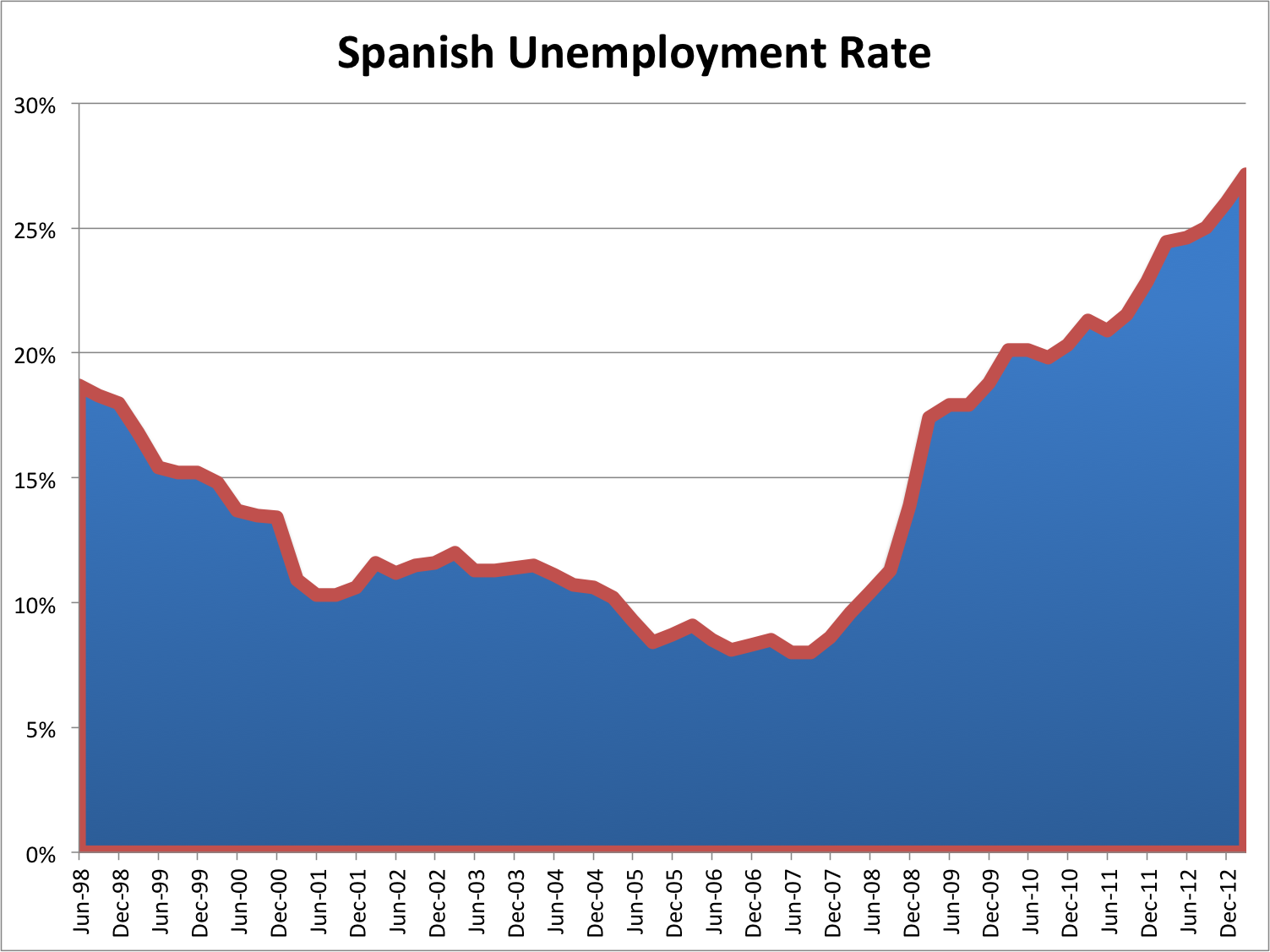
The much touted promise of thousands of so-called “green” jobs never materialized. No surprises there. Instead, the insane cost of subsidising wind and solar power has killed productive industries, with the general unemployment rate rocketing from 8% to 26% (and still rising) – youth unemployment is nearer to 50% in many regions.

spanish-unemployment-rate-2

The Spanish government is faced with a choice between salvaging what’s left of a moribund (and shrinking) economy and keeping the renewables gravy train rolling.

Here are two reports on Spain’s belated efforts to bring its renewable energy disaster to a close.

Spain close to approving new renewable energy rules: minister
Reuters
29 May 2014

MADRID (Reuters) – The Spanish cabinet could approve on Friday a law that will cut renewable energy subsidies as part of a drive to reduce a 30 billion euro ($41 billion) power tariff deficit, built up during years of keeping prices below regulated costs.

The new law, the thrust of which was announced by the government in July last year, set the rate of return for existing renewable energy facilities at 7.4 percent and at 7.5 percent for future operations.

Many renewable energy companies have made double-digit returns on investment under hefty subsidies. Spain has passed a series of measures over the past two years cutting, and in some cases eliminating, renewable energy subsidies and a number of investors have filed international legal complaints.

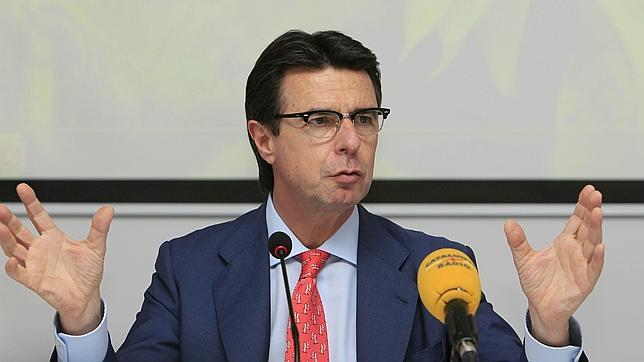
“(The decree) is ready to go,” Industry Minister Jose Manuel Soria told reporters on Thursday, adding that the decision to approve it at Friday’s weekly cabinet meeting would be taken later on Thursday.

The minister acknowledged the reform was bad news for companies that invested expecting higher returns.

According to documents annexed to the reform, to which Reuters had access last week, the government plans to cut renewable energy subsidies by 15 percent this year to 7.63 billion euros.

The new rules will be retroactive to July 2013 and many companies have already made massive provisions and writedowns in their 2013 financial results, anticipating the impact of the decree.

The regulation includes variations for a range of technologies – including wind, thermosolar, photovoltaic and biomass – and the year the assets were installed.

For example, assets installed before 2005 will receive no subsidy and will only be awarded with the wholesale power price, while newer assets will receive the wholesale price plus a separate remuneration.

(Reporting by Jose Elias Rodriguez, writing by Tracy Rucinski; editing by Julien Toyer and Keiron Henderson)
Reuters

Jose-Manuel-Soria--en-una-imagen-de-archivo-

Spanish Lesson For Obama: Green Energy Transition Unaffordable, May Soon Crash
Die Welt
Ute Müller
31 May 2014

Lawsuits may force Spain to bring its renewable energy experiment to an end, a green policy fiasco that has gone terribly wrong due to astronomical costs. It’s a powerful lesson for the White House that has often cited the Spanish model as one to emulate.

Only recently, Spain was widely praised as the champion of wind energy in Europe. What is more, all over the country new solar parks were built and renewable energy had become the main source of energy supply on the Iberian Peninsula. Those days, however, may soon be over. That’s because Spain’s industry ministry intends to drastically cut back on subsidies for “clean energy.” The whole country has to cut back, the industry ministry argues drily, and energy producers have to do too.

This argument seems irrefutable since the figures that are now assessed by the government are astronomical indeed. The subsidies that are going to flow into green energy projects on the Iberian Peninsula amount to a staggering 200 billion euros. Approximately 56 billion euros have already been paid out. The lion’s share of this sum went into rather generous feed-in tariffs for wind and solar energy which, since 1995, have attracted numerous investors from both home and abroad.

The remaining 143 billion euros are due to be paid out in the next 20 years for green energy projects that have already been connected to the grid, foremost for solar farms.

Given these sums, it would appear that industry minister Jose Manuel Soria has come to the conclusion that the only option left is to put his foot down. He now plans to cut green subsidies for the energy sector by about 20 percent, to 7.5 billion euros per annum. The minister, however, has not reckoned with affected green investors who are up in arms and fighting the planned subsidy cuts.

Moratorium on new solar farms 

This is not the first time that Spain intends to take advantage of solar investors retrospectively. Numerous foreign investment funds, especially from the US, have invested heavily in Spain’s renewable energy in recent years, expanding solar energy production significantly. They were lured by promises by the then socialist industry minister who had agreed a fixed rate of return of 14 percent per annum for solar park investments.

“The sun can be yours,” huge billboards claimed. Thousands of Spanish investors were keen not to miss this golden opportunity either. As a result, solar power production on the sun-drenched Iberian Peninsula increased from 53 to 313 gigawatt hours (GWh) between 2007 and 2010.

Surprised by the huge demand, the government of socialist Prime Minister José Luis Rodríguez Zapatero introduced a moratorium for new solar farms, guaranteed feed-in tariff were reduced to 25 years and the premiums were paid only for a certain number of hours of sunshine per year. After a change of government at the end of 2012, the new conservative administration upped the ante and introduced a new electricity tax of 7.5 percent, causing the profits for the solar industry to fall by around 30 percent.

A good opportunity for nuclear power? 

This week, U.S. energy company Nextera Energy has summoned Spain before the International Centre for Settlement for Investment Disputes (ICSID) to demand redress. The U.S. company regards the new rules as a retroactive change to the original guarantees. Nextera Energy has invested heavily in the Spanish solar power plant Termosol.

Other large investors, such as a Deutsche Bank investment fund, involved in the Andalusian power plant Andasol, and French bank BNP have asked ICSID, a World Bank organization, for arbitration. Another group of foreign investors issued first lawsuits in 2011, based on the European Energy Charter which promises investment protection and prohibits expropriation.

If the investors win their case, Spain can expect claims for damages amounting to billions of euros. In such a case, the further expansion of renewable energy in Spain would then come to end end at once. The industry minister is not the only one who is aware of the potential consequences. Two traditional power generators, Endesa and Iberdrola, even see a good chance for new deals with nuclear power. They have requested an extension of the operating license for the Garoña nuclear power plant which had already been taken off the grid. Garoña is now expected to provide electricity until 2031. The investors believe that despite new security investments the nuclear power plant will be profitable. They expect that after the boom and bust of recent years the share of renewable energy will decline.
Die Welt (translation by Global Warming Policy Foundation)

Spain provides the perfect “model” for any Country looking to destroy itself in blind pursuit of “green” energy ideology.

Trying to power a (notionally) first world economy with intermittent and unreliable wind and solar power is nothing more than an infantile delusion. When the cost of the insanity is borne by millions of struggling (and probably unemployed) power consumers and 100s of thousands thrown on the unemployment scrap heap, it borders on the criminal.

Spaniards can only hope that their political betters’ efforts to unwind the mess haven’t come too late.

spain_bullfighting_2

Experts in the UK, Finally Realize That Wind & Solar are “Novelty” forms of energy!

Press Release 02/06/14

Renewable Energy Poses Security

Risk, New Paper Warns

London, 2 June: A new paper published today by the Global Warming Policy Foundation warns that intermittent wind and solar energy pose a serious energy security risk and threaten to undermine the reliability of UK electricity generation.

Many people – including ministers, officials and journalists – believe that renewable energy enhances Britain’s energy security by reducing the dependency on fossil fuel imports. The ongoing crisis over the Ukraine and Crimea between Russia and the West has given much attention to this argument.

Written by Philipp Mueller, the paper (UK Energy Security: Myth and Reality) concludes that domestic and global fossil fuel reserves are growing in abundance while open energy markets, despite the conflict in the Ukraine, are enhancing Britain’s energy security significantly.

In contrast, the ability of the grid to absorb intermittent renewable energy becomes increasingly more hazardous with scale.

Germany provides a warning example of its growing green energy insecurity. Last December, both wind and solar power came to an almost complete halt for more than a week. More than 23,000 wind turbines stood still while one million photovoltaic systems failed to generate energy due to a lack of sunshine. For a whole week, conventional power plants had to provide almost all of Germany’s electricity supply.

Germans woke up to the fact that it was the complete failure of renewable energy to deliver that undermined the stability and security of Germany’s electricity system.

“Open energy markets are a much better way to ensure energy security than intermittent generation systems like wind and solar. It would be a huge risk in itself for Britain to go down the same route as Germany and destabilise what is still a reliable UK electricity grid,” said Philipp Mueller.

Full paper (PDF)

No One Wants to Pay to Dispose of the Gigantic Hunks of Garbage!

June 1, 2014

5/14/2014 6:38:00 AM
Bureau County leery of costs to take down old wind turbines

Katlyn Rumbold
Princeton Bureau Chief

PRINCETON — Pittsburgh-based EverPower Wind Co. is now the formal owner of Big Sky Wind Farm, which is located in northern Bureau County, the Bureau County Board heard during Monday night’s meeting.

But with that came more concerns on eventual decommissioning of the turbines and what that means for the county’s landowners and taxpayers.

At last month’s meeting, the board was looking into a letter of credit for the decommissioning plan as opposed to the existing cash-on-hand arrangements that already have been in place. Board members previously indicated they didn’t have enough information to move forward with a letter of credit, but last night Bureau County state’s attorney Pat Herrmann said the board has three options: They can either move forward with the letter of credit of just over $1.9 million, keep funds as they are currently or accept the cash that is in the cash escrow account.

“I have concerns about the letter of credit,” said Ed Gerdes, Princeton resident. “Two different issues is the amount and how that’s guaranteed.”

Based on a similar project, Gerdes said the total cost to take down 87 wind turbines came out just over $19.4 million which is approximately $224,000 per turbine.

“That’s one of the big problems we have is there’s only $1.9 million,” Gerdes said of what he says could be a $10 million-$12 million project. “That’s maybe going to take down nine turbines. Who’s going to pay for the rest?

“I don’t think the taxpayers should have to pay for taking those down. The other problem we have is that when landowners signed these leases with these companies they were promised that if this doesn’t work they’ll come back and take the turbine down. They also promised that if they weren’t here, the county would have money set aside to take them down. The county isn’t going to have money so I think all these landowners might end up with a bill for $150-$200,000 to dispose of these turbines.”

Gerdes also expressed concerned about the tax levy expiration in 2016 and what might happen if a new bank took over the letter of credit. However, Michael Speerschneider, who has been representing EverPower Wind Co., said the $1.9 million is an increase to where it was at two years ago and that number is expected to increase over the next 20 years to approximately $3 million.

The board approved a motion to go into negotiations to accept the letter of credit.