Rob from the Poor, to Give to the Rich….It’s the “Liberal” way!!

Wind Power in Britain: it’s Robin Hood in Reverse

robin hood 3

A while back, there was a plucky young English lad, called Robin Hood, who was pretty handy with both long-bow and sword; and so comfortable with expressing his “feminine side” that he wasn’t afraid to be seen in figure hugging green tights.

Hood hung out with his band of Merry Men in Sherwood Forest, dodging his arch-enemy, the Sheriff of Nottingham. The Sheriff – a fiscal filcher, if ever there was one – spent his days collecting unlimited taxes from the people of Nottingham and hunting Robin Hood and his troupe of generally happy chappies.

But it was Robin Hood’s attitude to wealth distribution that made him stand out from his outlaw peers.

Instead of indiscriminate thieving, Hood became renowned for robbing from the rich and giving to the poor. These days, some might simply call it “good progressive politics”.

In any event, Hood’s policy of “progressive redistribution” (albeit based on stand and deliver tactics) did no apparent harm to Hood’s reputation over the centuries. Indeed, it made him the legend he became – which provides a pretty fair example of the human paradox: people are ready to ignore highway robbery, provided it’s the toffs that are being rolled.

In recent times, however, Robin Hood’s much adored strategy of “targeted wealth redistribution” has been tipped on its head with insane renewables policies – that have set up the largest transfer of wealth from the poorest to the richest in modern history.

Under Britain’s ludicrous wind power policy, ordinary British power punters – who can least afford it – are being fleeced by those who can – and at a rate that would’ve made even the Sheriff of Nottingham blush.

Here’s the Sunday Post on how Britain’s wind power policy is robbing from the poor and giving to the rich.

Special report: The true cost of our wind farms
Sunday Post
Ben Robinson
4 May 2014

The true cost of the massive expansion of wind farms in England can today be revealed by a special Sunday Post investigation.

Staggering new figures show turbine operators have been handed taxpayer-funded subsidies of £7 billion in just over a decade. That means an average of £1,211 has been paid from the public purse every MINUTE since 2002.

The eye-watering costs are recouped by being added to fuel bills, leaving each household £178 worse off.

Now there is concern at the size of the subsidies being siphoned off for renewables at a time when 2.4 million people in England are living in fuel poverty.

The revelations come in the wake of Prime Minister David Cameron’s announcement that the Conservatives will end their support for onshore wind farms if they win the next election.

Tory MP Philip Davies who represents Shipley in West Yorkshire, said: “Not only are they a blight on the landscape, they are the most expensive, inefficient and unreliable form of energy. Many people are struggling to pay their energy bills and the dash for wind energy unnecessarily adds a considerable amount on to everyone’s bills in order to line the pockets of rich landowners.”

“It is Robin Hood in reverse — taking money from the poorest in order to line the pockets of the richest.  It is also making our manufacturers extremely uncompetitive when they are up against other firms based abroad who enjoy much cheaper energy bills.”

European law dictates the UK must achieve 15% of its energy consumption from renewable sources by 2020, which has sparked heavily subsidised incentives for large wind farms and individual turbines to be built.

We can reveal between 2002 and December 2013 wind farm owners received £7bn under the renewables obligation scheme which subsidises large-scale green energy production.

Introduced by the Labour Government to encourage investment in renewables, the money is recouped via a supplement added to all domestic and commercial electricity bills.

According to the Renewal Energy Foundation, since 2002 the levy supporting English renewables has added about £178 to the average UK household’s cost of living, with £89 of that in electricity charges alone.

These subsidies have bankrolled 259 operational wind farms with around 850 turbines.

Our probe has found northern England is bearing the brunt of the drive for renewables by hosting half the country’s wind farms. Using Government planning statistics, the Renewable Energy Foundation looked at the number of wind farms in operation or with planning permission across England.

It found Northumberland has the largest wind farm capacity of any county, with around 155 turbines spread over 19 farms, generating up to 302 megawatts (MW).

East Yorkshire is second highest, while Lancashire is sixth, Durham seventh and Cumbria eighth.

Don Brownlow, from Berwick-Upon-Tweed, who has battled a series of large-scale wind farms in Northumberland, claimed developers see the region as an easy target.

He said: “Contrary to popular belief this is not about the region being windy. Most of Northumberland outside the national park is fairly poor for that. The reason, first and foremost among developers, is landowner compliance.  A lot of wind development in Northumberland has been old estates being broken up which means landowners have borrowed a lot of money to buy them and they see the opportunity to reduce their debts. We are also seen as having compliant local planning authority.”

Across the North West, North East and Yorkshire and the Humber there are 129 wind farms containing around 500 turbines already in operation — half of the entire country’s wind energy capacity.

But planning permission has been given for another 100 farms to be built which will add another 330 turbines to the landscape.

It means residents in the north will see a massive 70% increase in the number of turbines, while a further 150 turbines are in the planning system.

Dr John Constable, director of Renewable Energy Foundation, a UK charity publishing data on the energy sector, said: “The northern counties of England are bearing a disproportionate share of the national onshore wind burden.  Not all of this focus can be explained by better wind conditions.  Northumberland in particular is relatively windless. I’m afraid the explanation is that developers have picked on the rural north because it lacks the resources to defend itself in the planning system.  Extremely high subsidies have overheated and corrupted the wind industry; site choice has been poor and little respect has been shown to the opinions of rural populations, whose local environments have too often been significantly damaged.”

A Department of Energy and Climate Change spokesperson said: “As you would expect, there are more wind farms where there is more wind.  Wind farms will only get planning permission where the impacts – including visual impact, cumulative impact and impact on heritage sites – are acceptable.  We have also changed the law to require wind farm developers to consult with local people before they put in a planning application.”

Top 10 counties with most wind farms

1. Northumberland Onshore wind capacity 311MW – Sites 19 – Approximate turbines 155

2. East Yorkshire – 302MW – sites 49 – turbines 151

3. Lincolnshire* – 281MW – sites 22 turbines – 141

4 Cambridgeshire – 273MW – sites 32 -turbines – 136

5. Northamptonshire – 185MW – sites 20 – turbines 92

6. Lancashire – 177MW – sites 23 – turbines – 88

7. Durham – 168MW – sites 24 – turbines – 84

8. Cumbria – 158MW – sites 38 – turbines – 79

9. Devon – 133MW – sites 22 – turbines – 66

10. Cornwall – 130MW – sites 86 – turbines – 65

*Historic county of Lincolnshire, comprised of Lincolnshire, North Lincolnshire and North East Lincolnshire.
Sunday Post

robin hood famous duel 4


Why are our Electricity Rates So High??? Read this!

Bookmark and Share

Paying More for Power

Type: Research Studies
Date Published: May 5, 2014
Authors:
Research Topics:
Energy

Canadians are paying more for their power, on average, than our neighbors to the south. When outlier Honolulu is excluded, rates for small commercial electricity consumers are 19 percent greater in Canada than in the US, while rates for small industrial consumers are almost 30 percent greater. When the comparisons are based only on the rates in cities located in provinces and states that are not well endowed with developed hydroelectric generation capacity, the Canada-US differences are even greater. Canadian commercial and industrial electricity consumers appear to have a competitive disadvantage versus their US counterparts. The authors call on Canadian federal and provincial policy makers to focus on measures that could help to secure lower electricity costs for future generations and reduce the disparity between Canadian and US electricity rates.

Paying More for Power - Infographic

Free Download(s):

Revisiting an Article by Parker Gallant….This man knows about energy!!!

Ontario Liberals: 10 years of Mismanagement of the Energy Portfolio

At the advent of the five (5) by-elections in Ontario and as we close in on the 10th anniversary of the current Liberal’s tenure as the governing party in Ontario it is time to look back on their management of the “Energy” portfolio. It is particularly appropriate to examine their past as the energy issue is bound to be on voter’s minds. Additionally, the current Minister of Energy, Bob Chiarelli, has embarked on what he refers to as a “review” of the Long-Term Energy Plan (LTEP) which was never a “plan”! When the LTEP was released in the fall of 2010 by Energy Minister, Brad Duguid it was to be a “guide” to the Ontario Power Authority (OPA) so that they could produce IPSP II. The original IPSP (Integrated Power System Plan) was thrown to the curb by George Smitherman when he held this portfolio and Chiarelli’s predecessor, Chris Bentley tossed LTEP II in the trash!

So let’s examine the list of energy events brought to us by the Ontario Liberal Party after they condemned the predecessor governments of Premier’s Harris and Eves for their management of that portfolio! Please note that the costs of the Liberal policies over the past 10 years are estimates based on the best information available. Here they are:

Ontario Power Authority: The Liberals created the OPA as a temporary agency to generate an IPSP. The OPA annually consumes about $75 million of tax dollars but is responsible for pricing and contracting all electricity generation including the OPG and Hydro One on transmission builds. Nothing happens without Ministry directives. When Smitherman took over the Ministry the OPA lost their mandate to actually plan via the GEA. The OPA was instrumental in generating the first and second IPSP which comprised tens of thousands of pages and input from various parties throughout the province.  As noted, the two IPSP’s were eventually relegated to the trash bin at considerable cost to the ratepayers. Based on the annual budget of the OPA we estimate:

Total Costs over the 10 years since they were created: $750 million

Big BeckyA directive from the Minister of Energy caused Ontario Power Generation (OPG) to build what the current Minister refers to as the “largest renewable energy project in the world”. The cost of “Big Becky” (the new tunnel under Niagara Falls) cost Ontario’s ratepayers $1.6 billion for a marginal increase in hydro electric capacity. The 140 megawatts (MW) that it is rated at, had a capital cost of $11.5 million per MW. Presumably the “largest” reference in the Minister’s announcement refers to those excessive capital costs that were partially caused by being over budget by $600 million. It should be mentioned that “Big Becky” had been rejected by prior governing parties because it was deemed too expensive for the marginal power it would deliver. Normal “levilized” costs for new hydro generation should be in the $1/$1.5 million range or 10% of what Big Becky cost Ontario’s ratepayers.

Total Capital Costs for Big Becky: $1.6 billion

Pensions: When the Liberals came to power the pension plans of the publicly owned electricity sector were not in deficit. OPG and Hydro One are now in deficit by $4.8 billion caused by the excessive amounts spent by both to follow the directives of the Liberal Energy Ministers to build new infrastructure (related to renewable energy) and increasing staff levels to execute those directives instead of sticking to their traditional business roles.

Pension Deficit to be paid by ratepayers: $4.8 billion

Upper & Lower Mattagami: Yet another “directive” to the OPA directed them to negotiate a contract with the OPG for the upper and lower Mattagami project which was eventually contracted for $2.6 billion. This hydro electric project will also add marginal power to the Ontario grid and present itself principally in the spring months when the Ontario power demand is usually at it lowest, meaning we will either spill it or sell it to neighbouring states and provinces at a loss.

Estimated costs of the Upper and Lower Mattagami project: $2.6 billion

Ontario Electricity Financial Corp: The Ontario ratepayers are awaiting the release of the March 31, 2012 and March 31, 2013 Ontario Electricity Finance Corporation’s (OEFC) audited financial statements which the Minister of Finance, has not yet released. One must wonder why financial statements that were presumably delivered to the Minister a year ago have not found their way to the public. Have the Liberals somehow squandered the $2 billion or so that the ratepayers have been obliged to pay for the past two years? What are the Liberals hiding?

Total Estimate of Missing “stranded debt” monies: $2 billion

Transmission BuildsYet again several of the Liberal Energy Minister’s directives instructed Hydro One to construct transmission lines to connect wind and solar energy projects to the grid. Those directives required Hydro One to spend billions of ratepayer dollars to build the transmission lines, purchase transformers for that purpose and included “reserving” transmission facilities for the Korean Consortium, commonly known as the Samsung contract.

Estimated Costs to hook up Wind and Solar to the Grid: $2 billion

Ontario Clean Energy Benefit: As energy costs rose the governing Liberal party became concerned that the ratepayers would balk at the huge increases they were seeing so they launched the “Ontario Clean Energy Benefit” (OCEB) which gave ratepayers a 10% rebate on their electricity bills. This burden of approximately $1.5 billion annually for the years 2011 through to 2014 will be added to the growing provincial debt but will end January 1, 2015.

Estimated Cost to taxpayers of the OCEB over 4 years: $6 billion

Smart Meters: Not to be forgotten is the $2 billion or more spent to install “smart meters” on each household throughout the province. These meters have provided no benefits to ratepayers despite all of the rhetoric from the Ministry. Recently Hydro Ottawa announced that they will be replacing 215,000 of their smart meters, installed only a few years ago, because they are deficient. How many more will need replacement by other local distribution companies (LDC) throughout the province is an unknown. It would appear that the Minister’s (Dwight Duncan) directive at that time didn’t require any standards—the Liberals just thought it was a good idea!

Estimated cost of the “Smart Meters”: $2 billion

Smart Grid: Another ongoing expense related to “smart meters” is the “smart grid” which the Independent Electricity System Operator (IESO) is working on. Preliminary estimates of the cost of the “smart grid” are in the $1.5 billion range and the “smart grid” is/was supposedly required to manage the intermittent power that is delivered by wind and solar along with management of “imbedded generation” (the small and microFIT generator hookups to the LDCs), the charging stations (for the 500,000 electric vehicles) that the Liberals foresaw being installed throughout the province and the ability to turn your air conditioner and refrigerator up at peak demand times.

Estimated Cost of developing the “Smart Grid”: $1.5 billion

Constrained Power: Also aligned with the smart grid was the need to constrain and pay for the power that the grid didn’t need from the “first to the grid” rights of wind and solar generated during times when the Ontario demand for power is low. Commencing in September 2013 we will pay those private developers for power “they might have been able to produce” but which would have caused problems that may have led to blackouts or brownouts. The estimates of this are unknown however 80% of the power they deliver normally presents itself when our demand is low so a best guess is that this will cost ratepayers in the area of $300/$400 million annually based on only the existing wind and solar generation presently installed.

Estimated Cost of Constrained Wind and Solar over 20 years: $6 billion

Gas Plan Idling: Ontario’s ratepayers are also obliged to pay for idling gas plants (backing up wind and solar) at the rate of $15K per MW per month and with approximately 7,000 MW currently installed and another 1,200 MW contracted for that will cost ratepayers upwards of $1 billion annually.

Estimated Cost of idling Gas Plants over 20 years: $20 billion

Nuclear Steam Off: The grid problems that might be caused by wind and solar also affects the nuclear operations of Bruce Power who have been frequently called on to “steam off” power when the Ontario demand is low. The ratepayers are also obliged to pay for that steamed off power. Efforts to determine the costs to the ratepayers of that steamed off power have been fruitless as the grid operator does not post that information nor make it available for analysis. We would expect that as increasing amounts of wind and solar are added the costs will escalate and should easily approach $100 million.

Estimated Cost of “steaming off” nuclear power over 20 years: $2 billion

OPG as scapegoat: The addition of intermittent electricity generation from wind and solar has had a direct effect on OPG operating revenue and profitability as it has lowered the wholesale price of the market, defined as the hourly Ontario electricity price or HOEP. OPG is basically the only market participant exposed to the HOEP so they have been selling their unregulated power from hydro and coal at low prices (2.4 & 2.6 cents a kWh [2012]) and since 2003 have seen their revenues fall by almost $2 billion dollars weakening their value to the shareholders; the Ontario taxpayer.

Estimate of Revenue Losses to OPG over the past 10 years: $15/20 billion

Class A to Class B transfer: As the rates climbed ever higher the Liberal government also heard from large industrial users in Ontario, who were being crippled by high electricity prices which coupled with the recession, cost Ontario an estimated 300,000 manufacturing jobs Extensive lobbying on behalf of those major electricity consumers led to the creation of an incentive for those large users to avoid peak demand days (perhaps by using diesel generators) which allowed them to offload a large portion of their share of the Global Adjustment. As a result the rest of the ratepayers (households and small and medium sized businesses) now pick up upwards of $200 million per annum in costs previously the responsibility of large users.

Estimate of Class A to B Global Adjustment transfer over 20 years: $2 billion

HST: Another cash grab from ratepayers came about when the McGuinty Liberals endorsed the concept of the HST which automatically increased ratepayers electricity bills by 8% which pretty well wiped out that taxpayer supported Ontario Clean Energy Benefit. The cost to the ratepayers is approximately $1.2 billion annually and will grow as electricity and delivery rates increase.

Estimate of Cost to Ratepayers of HST on Electricity Bills over 20 years: $24 billion

Green Energy Act: No list would be complete without referencing the Green Energy and Economy Act (GEA) which the Liberals (Energy Minister, George Smitherman) promised would only raise electricity rates by 1% per annum. The GEA has resulted in Ontario’s ratepayers seeing their electricity and delivery costs rise by over 100% and they have only absorbed about 30% of what the LTEP anticipates in the form of renewable energy. Ontario now has one of the most expensive prices for electricity in all of North America exceeded only by a very small number of US states and has become an unattractive place for investments that might have created jobs. The advent of the march throughout Ontario of industrial wind turbines and solar panels has also had a direct effect on property values of homes located in proximity (within 5 kilometers) to their installation (this will eventually negatively affect the municipal tax base), killed birds and bats, destroyed forest land (via road construction for their installation) and caused various health problems for many families living anywhere near those 500 foot monsters. Most of the costs of the GEA are captured above but a couple of aspects are not and those relate to; “conservation” spending and the monies lost on exporting our “surplus power” below it’s cost. The OPA annually spend over $300 million on conservation efforts and it now appears surplus exports are costing (based on the recent estimates) ratepayers about $500 million per year.

Estimated Costs of Exports & Conservation Spending over 20 years: $16 billion

The biggest issue related to the latter is that the GEA took away the democratic rights of people to object to the construction and siting of these generators. Municipalities were stripped of their ability to stop any of these developments due to the structure of the GEA claiming NIMBYism would not be allowed in the quest to “green” Ontario. Recent events by the current Energy Minister, Bob Chiarelli has paid lip service to that issue by conducting a “study” of siting procedures. The Minister doesn’t claim that he will give those rights back! Conveniently the report is not due out until after the upcoming by-elections so voters in those 5 ridings will be kept in the dark and clueless on whether the Liberals will amend the GEA. The wisest move by voters will be to count on the GEA being left intact.

Gas Plant Moves:If the reader has got this far they will notice that there is one significant item missing from the list above and that of course is the cost of moving those two gas plants from Mississauga and Oakville. The reason to not list it is that the Auditor General’s report on the Oakville move will not be released until late August. The media has consistently stated that the overall costs associated with the moves was $585 million but the likelihood is that the costs will in fact be higher.

Estimated Costs of Gas Plant Moves: $1 billion

Many other ratepayer costs are not listed but most of those above are measured in the hundreds of millions or billions of dollars. There are many other Liberal energy enacted policies measured by tens of millions that would include, the Northern Ontario Energy Credit, the Ontario Energy and Property Tax Credit, electric vehicle grants, the Community Power Fund, the Northern Industrial Electricity Rate Program, etc. just to name a few.

All ratepayers in the province look forward to the day when the Minister of Energy will simply act as the overseer on these publicly owned electricity institutions instead of know-it-alls, led by the nose by unelected environmentalists (OSEA, Environmental Defence, Pembina, David Suzuki Foundation, etc. etc.) bent on saving the world from global warming. We have had a succession of those Liberal lemmings occupying the Ministry chair for the past 10 years and all it has done is to make foreign companies, and perhaps some Liberal insiders like Mike Crawley, rich while draining the pockets of the ratepayer/taxpayer.

While executing those policies, they have ignored real infrastructure problems in the energy portfolio. A recent example of the foregoing was the loss of electricity experienced by hundreds of thousands of people living in the GTA as a result of the floods. Those floods caused the Hydro One Manby transformer station to flood and the grid in the southwestern GTA to collapse causing the outage. The weakness of the Manby station was known to the Liberal Ministers (and was the basic reason to plan for those two gas plants in Mississauga and Oakville) and should have been replaced several years ago but the Ministers ignored the recommendations to replace it and instead directed Hydro One to hook up wind and solar renewables.

Too bad we ratepayers and taxpayers can’t just hit the delete button to eliminate the past 10 years, much like the Minister’s senior staffers did to hide the bad news about the gas plants!

Parker Gallant,
July 16, 2013

The Conservatives will Allow Democracy at the Municipal Level, once again!!!

A PC government will not allow connection of Gilead and wpd wind projects to the grid

For release April 30, 2014

MPP Todd Smith confirms that a PC government will not allow connection of proposed County wind projects to the grid

Prince Edward County, ON — Responding to a request for clarification by CCSAGE Naturally Green regarding the PC Party’s position on wind projects currently “in the pipeline”, local MPP Todd Smith has confirmed by letter that, under a PC government, such projects will not be allowed to proceed if there is no municipal consent.

Smith referred to the text of Bill 42, the Affordable Energy and Restoration of Local Decision Making Act, introduced by Tim Hudak in the Ontario Legislature in 2012. Smith said, “The intention here is quite clear that, regardless of where in the process a project is, provided a project is not connected to the grid, it is our intention not to go ahead with it unless it has municipal consent. Clearly, the projects planned for Prince Edward County do not have municipal consent and thus, would be cancelled.”

Smith reconfirmed the PC Party’s position after consultation with Tim Hudak, and taking account of County Council’s “not a willing host” motion passed on April 23, 2013.

Following receipt of Smith’s letter, Gary Mooney of CCSAGE said, “From the day that he was elected, Todd has been 100% supportive of the several County groups opposing wind turbines on grounds of adverse effects on human health, the natural environment, heritage, property values, the local economy and municipal control. We couldn’t ask more from our MPP.”

Smith’s statement covers both Gilead Power’s 9-turbine Ostrander Point project, already given REA approval but still under appeal, and wpd Canada’s 29-turbine White Pines project, currently undergoing technical review by the Ministry of the Environment.

Informed of the contents of Smith’s letter, Mayor Peter Mertens had this to say, “We are greatly indebted to Todd for his close attention to the concerns of County residents and business owners, and for his support of the position of County Council.”

The exchange of letters between CCSAGE and Todd Smith can be viewed here and here, and the media release on CCSAGE letterhead here.

-30-

For more information, contact Gary Mooney at gary.mooney@actel.ca or 613-919-8765.

The CCSAGE Naturally Green website is at www.ccsage.wordpress.com .

A New Method of Fighting the Injustices of the Wind Scam!!

Here’s a brand new initiative in the fight against wind turbines in PEC

Click on image to enlarge

CCSAGE NATURALLY GREEN announces a brand new initiative in the fight against wind turbines in PEC.

Our colleagues at PECFN and APPEC are to be congratulated on their efforts to date before the Environmental Review Tribunal and the Courts. We at CCSAGE Naturally Green have been researching a novel approach to fighting wind turbines and are now introducing it to County residents and businesses.  It will put Queen’s Park, Gilead Power and wpd Canada on notice that their misguided efforts to industrialize the County with wind factories in south County and a transmission line along a 28-km route ending north of Picton, will have serious consequences for all of them.

In 2013, the Supreme Court of Canada confirmed that if anybody suffers a business loss or reduction of property value because of construction authorized by statute (construction of wind factories is authorized by the infamous Green Energy Act), a claim for compensation, with proof of the loss, can be brought before the Ontario Municipal Board. Despite wind industry propaganda, wind factories have been proven to reduce property values and in the County are almost certain to damage tourism and the hospitality industry, among others.

The material in the accompanying image (newspaper ad) provides more information.  If you believe that your property or your business may be affected by construction of a wind factories in the County, you can put the developers on notice of a possible claim by adding your name to the petition HERE.  Acting in this manner commits you to nothing further.

Please take a moment to read the details and then act. Note: The Provincial election just called should not affect your decision to make your voice heard now, because the outcome cannot be predicted.

Also, please come to the rally to support this initiative on Saturday, May 10, 2-4 pm at the Milford Town Hall.

Thank you for your support of this initiative.

CCSAGE NATURALLY GREEN.

Wind Turbines…..NOT a Good Investment. (Pyramid schemes never are!)

Wind Power Investors: Get Out While You Can

exitsigns

For anyone still foolish enough to have their hard earned cash invested in wind power companies the warnings to grab your money and run couldn’t be louder or clearer.

The members of the RET review panel has signalled their intention to take an axe to the RET: spelling out the fact that the review has absolutely nothing to do with “climate change” or CO2 emissions – their task is simply to analyse, model and forecast “the cost impacts of renewable energy in the electricity sector” (see our post here).

The Treasurer, Joe Hockey entered the fray last week – during an interview with Alan Jones – when he branded wind turbines “a blight on the landscape” and “utterly offensive”. However, it’s what he went on to say about the “age of entitlement” that should have wind power investors quaking in their boots (see our posts here and here).

Joe outlined the Coalition’s plans to scrap a raft of public sector departments and agencies ostensibly charged with controlling the climate (there are currently 7 climate change agencies, 33 climate schemes and 7 departments).

Joe went on to say that the Coalition’s attack on the “age of entitlement” will be directed at “business as much as it applies to each of us.” If ever there was a beneficiary of the “age of entitlement” it was the wind industry and the rort created in its favour by the mandatory RET/REC scheme – quite rightly described by Liberal MP, Angus “the Enforcer” Taylor as: “corporate welfare on steroids” (see our post here).

The chances of the mandatory RET surviving the RET Review panel – and a Coalition itching to scrap it – are slimmer than a German supermodel.

With the wind industry on the brink of collapse there are three main groups facing colossal financial losses: retailers, financiers and shareholders.

Wind power companies – like any company – raise capital by borrowing (debt) or issuing shares (equity). Bankers price the risk of lending according to the likelihood that the borrower will default and, if so, the ability to recover its loan by recovering secured assets. Share prices reflect the underlying value of the assets held by the company and projected returns on those assets (future dividends). Share prices fall if the value of the assets and/or the projected returns on those assets falls.

Retail power companies saw the writing on the wall as the Green-Labor Alliance disintegrated at the end of 2012, presaging the Coalition’s election victory in September 2013. The risk point for retailers sits in their Power Purchase Agreements with wind power generators – the value of which depends on the amount of “renewable” energy fixed by the mandatory Renewable Energy Target and the value of Renewable Energy Certificates. Scale back the mandatory RET and the price of RECs will plummet; scrap it and RECs won’t be worth the paper they’re written on. Faced with that increasingly likely scenario, (sensible) retailers stopped entering PPAs around December 2012.

RECs are transferred from wind power generators to retailers under their PPAs, and the retailer gets to cash them in at market value. Retailers that haven’t signed PPAs can thank their lucky stars – chances are they will have avoided the very real prospect of being left with millions of worthless RECs.

Bankers have also baulked at lending to new wind power projects, keeping their cheque books firmly in the top drawer over the last 18 months or so. However, having lent $billions to wind power developers over the last 13 years, Australian banks have more than their fair share of exposure – exposure, that is, to the insolvency of the wind power company borrowing from it.

Ordinarily, bankers protect themselves by holding valuable security over the assets held by the borrower (eg the mortgage you granted over your patch of paradise when you borrowed to buy it). However, the value of the security granted by a wind power company is principally tied up in the future stream of income guaranteed under its PPA with its retail customer (the true value of which is tied to the value of RECs).

In the event that the RET were scaled back or scrapped it is highly likely that retailers (left with a bunch of worthless RECs) will seek to get out of their PPAs, making the bank’s security largely worthless. A wind farm with a fleet of worn-out Suzlon s88 turbines – on land owned by someone else – is unlikely to yield all that much for a receiver or liquidator charged with recovering the assets of an insolvent wind power company for its creditors.

Were banks forced to write off $billions in loans to wind power companies as bad and doubtful debts, then shareholders in that bank can expect to see the value of their shareholdings fall. Now would be a prudent time for those with shareholdings in banks to find out just how much that the bank has lent to wind power companies and, therefore, the bank’s exposure and risk they face as shareholders of that bank.

Shareholders in wind power companies, of course, have direct exposure to the declining fortunes of the wind industry. A decline in the share price obviously reduces the value of the shareholder’s investment. However, in the event of insolvency shareholders rank last behind all creditors, which means their shares are, ordinarily, worthless. In the case of wind power companies this will be invariably the case, as the companies in question are merely $2 companies with no real assets to speak of.

However, it is superannuation funds that have, by far, the greatest total exposure to the imminent collapse of Australian wind power companies. Australian superannuation funds (particularly industry and union super funds) have invested very heavily in wind power. These investments are either directly through shareholdings (equity) or through investment banks lending to wind power companies (debt). Examples include Members Equity Bank and IFM Investors (outfits run by former union heavy weight, Gary Weaven and Greg Combet) which have channelled $100s of millions into wind power operator, Pacific Hydro.

If you think that superannuation funds are somehow magically immune from the risk of the financial collapse of the companies they invest in, then cast your mind back to the wholesale corporate collapse of companies involved in Managed Investment Schemes that saw banks and super funds lose $100s of millions (see this story).

Anyone with their money in superannuation should be asking their fund just how much exposure their fund has to wind power companies?

Since the RET review panel outlined their mission a couple of weeks ago it seems that the word “RISK” – associated with investing in, or lending to, wind power companies – is the word that’s on everyone’s lips. Here’s the Australian Financial Review.

Green energy on tenterhooks
Australian Financial Review
Tony Boyd
30 April 2014

Contrary to popular opinion, leading businessman Dick Warburton does not have any pre-determined views about the future of Australia’s $20 billion Renewable Energy Target scheme.

While it is reassuring he is determined to be completely impartial in his rapid fire review of the RET scheme, Warburton makes it clear in an interview with Chanticleer that there will not necessarily be a grandfathering of existing arrangements.

“We have not made a decision on that – how could we when we have just started consulting with the industry,” he says.

In other words, it is possible that Warburton’s committee will abandon the RET targets and the accompanying certificates that are used by renewable energy developers to subsidise operations.

That helps explain why the renewables industry is starting to be priced for a disastrous outcome that could wipe out billions of dollars in existing investments and see a wave of bankruptcies and restructuring.

Shares in wind farm operator Infigen Energy have fallen 25 per cent since the RET scheme review was announced. Its shares are being priced for a negative outcome from Warburton’s review.

Chief executive Miles George says Infigen’s Australian business would lose roughly 40 per cent of its revenue in the event of existing targets and certificate arrangements not being honoured.

“Our business would fail, along with most other wind farms in Australia,” he says. Infigen has 20,000 shareholders split about one third between mums and dads and two thirds institutions. They could lose their entire investments.”

Infigen is not the only company worried about the potential damage to its business from changing the RET target, which is 41,000 GWh. One of Australia’s largest infrastructure investors, IFM Investors, is concerned its renewable energy business, Pacific Hydro, will have to shut down and move its investment offshore. Garry Weaven, chairman of IFM Investors and Pacific Hydro, tells Chanticleer that while he respects Warburton’s independence and ability as a businessman, he is particularly worried by the “climate change vibes” emanating from the Abbott government.

Weaven told CEDA in a speech last month that renewable energy development in Australia has been severely handicapped by inconsistent and untimely interventions by successive governments.

He makes the perfectly valid point that investors in renewables have to measure their investments over at least 25 to 30 years.

“It is simply not possible to generate an acceptable project IRR for a wind farm without that assumption, and other forms of renewable energy generation are still less economic and also require a very long investment life-cycle,” he told CEDA.

Weaven’s broader point is that with the plan to scrap the carbon tax and the uncertainty surrounding the government’s Direct Action policy, there is no new investment in any form of energy generation in Australia at the moment. Banks are unwilling to go anywhere near power generation investment unless it is the purchase of existing assets, such as Macquarie Generation, which is being sold by the NSW Government. Warburton says George and Weaven should not be barking at shadows, especially since the expert panel has only just begun speaking to industry participants.

But he is also crystal clear that every aspect of the RET scheme is up for grabs.

As Warburton says, there is good reason why sovereign risk is one of the five key areas being examined by an expert panel which also includes Brian Fisher, Shirley In’t Veld and Matt Zema. The key words used in the terms of reference in relation to sovereign risk are as follows: “The review should provide advice on the extent of the RET’s impact on electricity prices, and the range of options available to reduce any impact while managing sovereign risk.”

Sovereign risk is not something normally associated with investment in Australia. It last raised its ugly head when the former Labor government introduced the Mineral Resources Rent Tax. But investors around the world are getting used to escalating sovereign risk in democratic countries with normally predictable long term policies.

Recently in Norway, the Canadian Pension Plan Investment Board (CPPIB) was severely burned when the government changed the tariff that can be charged by a private company that bought the rights to manage a gas pipeline.

CPPIB’s return from its company, Solveig, was slashed from 7 per cent to 4 per cent.

Warbuton says potential management of sovereign risk would not have been a part of the terms of reference for the RET scheme review if all options were not on the table. Warburton, chairman of Westfield Retail Trust and Magellan Flagship Fund, will use a cost-benefit analysis from ACIL Allen as the foundation of the RET review. ACIL Allen has been accused of being in the pocket of the fossil fuel lobby but its data was used on Tuesday by the Clean Energy Council in a document in support of keeping the RET scheme in its current form.

The Clean Energy Council report, which was prepared by ROAM Consulting, modelled three scenarios: a business as usual case, a no RET scenario, where the RET is repealed, with only existing and financially committed projects being covered by the scheme and an increased and extended RET scenario where the RET is increased by 30 per cent by 2030 target and extended to 2040. The report concluded that the legislated large scale RET can be met under the business as usual scenario.

It also says that both RET scenarios result in lower net electricity costs to consumers in the medium to long term.

Australian Financial Review

When AFR refers to “the $20 billion Renewable Energy Target scheme” – it underplays the cost of the RET by at least $30 billion (probably just small change to the AFR?).

The energy market consultants engaged by the RET review panel, ACIL Allen produced a report in 2012, that showed that the mandatory RET – with its current fixed target of 41,000 GW/h – would involve a subsidy of $53 billion, transferred from power consumers to wind power generators via Renewable Energy Certificates and added to all Australian power bills. From modelling done by Liberal MP, Angus “the Enforcer” Taylor – and privately confirmed by Origin Energy – ACIL Allen’s figure for the REC Tax/Subsidy is pretty close to the mark.

Adding $53 billion to power consumers’ bills can only increase retail power costs, making the Clean Energy Council’s claims about wind power lowering power prices complete bunkum. And that figure is a fraction of the $100 billion or so needed to roll out the further 26,000 MW in wind power capacity needed to meet the current RET – and the duplicated transmission network needed to support it (see our post here).

Yet again, the wind industry and its parasites seek to hide behind the furphy of “sovereign risk”. “Sovereign risk” and “regulatory risk” are two entirely different animals: the wind industry is the product of Federal Government regulation which, of course, is prone to amendment or abolition at any time.

Sovereign risk” is the risk that the country in question will default on its debt obligations with foreign nationals or other countries; and, by some definitions, includes the risk that a foreign central bank will alter its foreign-exchange regulations thereby significantly reducing or completely nulling the value of foreign-exchange contracts.

It has nothing at all to do with changes in legislation that impact on industry subsidy schemes – which is precisely what the mandatory RET/REC scheme is: the prospect that a subsidy might be reduced or scrapped is simply “regulatory risk”.

To claim that the alteration of a government subsidy scheme is “sovereign risk” is complete nonsense.

At one point during the RET review panel’s meeting in Sydney, as Dick Warburton spelt out the panel’s mission, the boys from Infigen howled from the back of the room: “but, what about sovereign risk?!?” To which a nonplussed Warburton retorted: “what about it? Sovereign risk is your problem, it’s not our problem.”

And, indeed, it appears that Infigen has serious problems (whether or not “sovereign risk” is one of them).

Infigen is bleeding cash (it backed up a $55 million loss in 2011/12 with an $80 million loss, last financial year). It’s been scrambling to get development approvals for all of its projects so they can be flogged off ASAP. If it finds buyers it can use the cash to retire debt and fend off the receiver – who must be circling like a vulture all set to swoop.

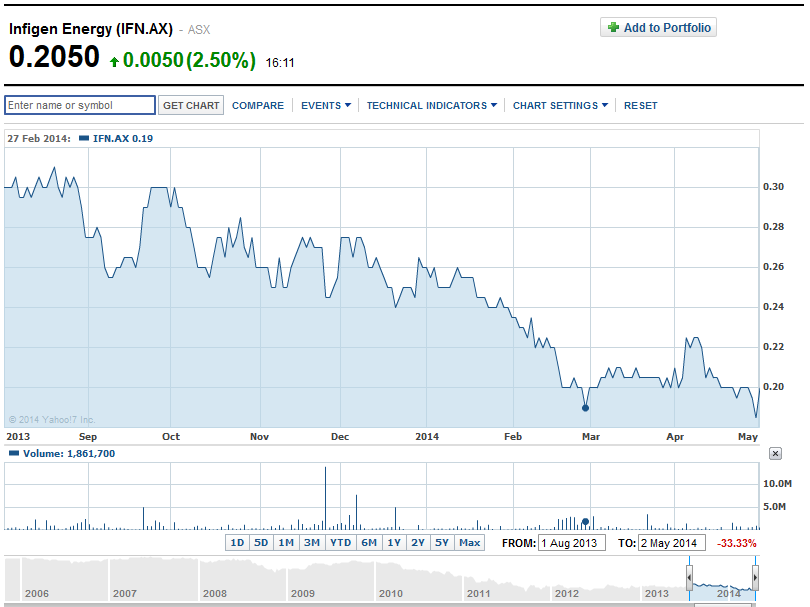
Reflecting its fading fortunes, Infigen’s share price has taken a pounding in the last 8 months (if the graphs below look fuzzy, click on them, they’ll open in a new window and look crystal clear):

Infigen 1.8.13-5.5.14

Note the drop after the Coalition took office in September; the dive after the RET Review was announced in January; and the plummet in April, when the Panel defined what its mission was about, as it called for submissions (see our post here).

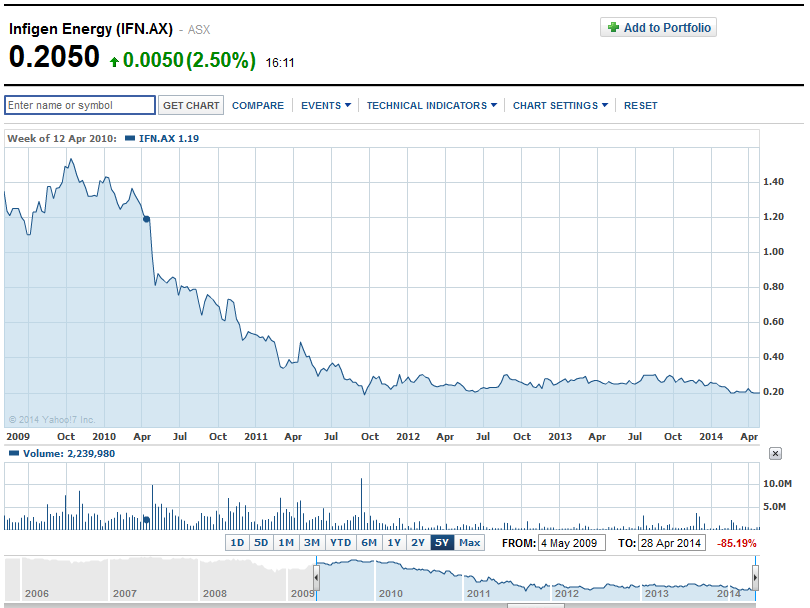
The drop seen above – from the year high of $0.32 (in August 2013) to $0.20 (now) – represents a 36% loss for investors who bought in at the top of the market this financial year. But spare a thought for those that bought in back in 2009 – when Infigen emerged from the ashes of Babcock and Brown:

Infigen 2009-5.5.14

The early movers have seen their shares freefall from over $1.40 to $0.20 – representing an 80% loss. Ouch!

The collapse in Infigen’s share price simply highlights our warning to bankers and investors. Remember this is an outfit that used to be called Babcock and Brown – which collapsed spectacularly in 2009 – taking $10 billion of investors’ and creditors’ money with it on the way out (see this story). Get set for a replay.

Consider this STT’s fair warning to anyone with exposure to wind power companies – be it shareholders, bankers or those who face exposure through their super fund’s investments – grab your money and get out while you can.

please-take-a-moment-and-look-around-and-find-the-nearest-exit

Wind Turbines would NEVER pass a Cost/Benefit Analysis!

Special report: The true cost of our wind farms

BY BEN ROBINSON4 MAY 2014 11.00AM.

The true cost of the massive expansion of wind farms in England can today be revealed by a special Sunday Post investigation.

Staggering new figures show turbine operators have been handed taxpayer-funded subsidies of £7 billion in just over a decade. That means an average of £1,211 has been paid from the public purse every MINUTE since 2002.

The eye-watering costs are recouped by being added to fuel bills, leaving each household £178 worse off.

Now there is concern at the size of the subsidies being siphoned off for renewables at a time when 2.4 million people in England are living in fuel poverty.

The revelations come in the wake of Prime Minister David Cameron’s announcement that the Conservatives will end their support for onshore wind farms if they win the next election.

Tory MP Philip Davies who represents Shipley in West Yorkshire, said: “Not only are they a blight on the landscape, they are the most expensive, inefficient and unreliable form of energy.

“Many people are struggling to pay their energy bills and the dash for wind energy unnecessarily adds a considerable amount on to everyone’s bills in order to line the pockets of rich landowners.

“It is Robin Hood in reverse — taking money from the poorest in order to line the pockets of the richest.

“It is also making our manufacturers extremely uncompetitive when they are up against other firms based abroad who enjoy much cheaper energy bills.”

European law dictates the UK must achieve 15% of its energy consumption from renewable sources by 2020, which has sparked heavily subsidised incentives for large wind farms and individual turbines to be built.

We can reveal between 2002 and December 2013 wind farm owners received £7bn under the renewables obligation scheme which subsidises large-scale green energy production.

Introduced by the Labour Government to encourage investment in renewables, the money is recouped via a supplement added to all domestic and commercial electricity bills.

According to the Renewal Energy Foundation, since 2002 the levy supporting English renewables has added about £178 to the average UK household’s cost of living, with £89 of that in electricity charges alone.

These subsidies have bankrolled 259 operational wind farms with around 850 turbines.

Our probe has found northern England is bearing the brunt of the drive for renewables by hosting half the country’s wind farms. Using Government planning statistics, the Renewable Energy Foundation looked at the number of wind farms in operation or with planning permission across England.

It found Northumberland has the largest wind farm capacity of any county, with around 155 turbines spread over 19 farms, generating up to 302 megawatts (MW).

East Yorkshire is second highest, while Lancashire is sixth, Durham seventh and Cumbria eighth.

Don Brownlow, from Berwick-Upon-Tweed, who has battled a series of large-scale wind farms in Northumberland, claimed developers see the region as an easy target.

He said: “Contrary to popular belief this is not about the region being windy. Most of Northumberland outside the national park is fairly poor for that. The reason, first and foremost among developers, is landowner compliance.

“A lot of wind development in Northumberland has been old estates being broken up which means landowners have borrowed a lot of money to buy them and they see the opportunity to reduce their debts. We are also seen as having compliant local planning authority.”

Across the North West, North East and Yorkshire and the Humber there are 129 wind farms containing around 500 turbines already in operation — half of the entire country’s wind energy capacity.

But planning permission has been given for another 100 farms to be built which will add another 330 turbines to the landscape.

It means residents in the north will see a massive 70% increase in the number of turbines, while a further 150 turbines are in the planning system.

Dr John Constable, director of Renewable Energy Foundation, a UK charity publishing data on the energy sector, said: “The northern counties of England are bearing a disproportionate share of the national onshore wind burden.

“Not all of this focus can be explained by better wind conditions.

“Northumberland in particular is relatively windless. I’m afraid the explanation is that developers have picked on the rural north because it lacks the resources to defend itself in the planning system.

“Extremely high subsidies have overheated and corrupted the wind industry; site choice has been poor and little respect has been shown to the opinions of rural populations, whose local environments have too often been significantly damaged.”

A Department of Energy and Climate Change spokesperson said: “As you would expect, there are more wind farms where there is more wind.

“Wind farms will only get planning permission where the impacts – including visual impact, cumulative impact and impact on heritage sites – are acceptable.

“We have also changed the law to require wind farm developers to consult with local people before they put in a planning application.”

Top 10 counties with most wind farms

1. Northumberland Onshore wind capacity 311MW – Sites 19 – Approximate turbines 155

2. East Yorkshire – 302MW – sites 49 – turbines 151

3. Lincolnshire* – 281MW – sites 22 turbines – 141

4 Cambridgeshire – 273MW – sites 32 -turbines – 136

5. Northamptonshire – 185MW – sites 20 – turbines 92

6. Lancashire – 177MW – sites 23 – turbines – 88

7. Durham – 168MW – sites 24 – turbines – 84

8. Cumbria – 158MW – sites 38 – turbines – 79

9. Devon – 133MW – sites 22 – turbines – 66

10. Cornwall – 130MW – sites 86 – turbines – 65

*Historic county of Lincolnshire, comprised of Lincolnshire, North Lincolnshire and North East Lincolnshire.

A Horrific Waste of Time and Money – Renewable Energy Scam!

Renewable Energy in Decline, Less than 1% of Global Energy

Oil-Refinery-Pump-ImageThe global energy outlook has changed radically in just six years. President Obama was elected in 2008 by voters who believed we were running out of oil and gas, that climate change needed to be halted, and that renewables were the energy source of the near future.

But an unexpected transformation of energy markets and politics may instead make 2014 the year of peak renewables.

In December of 2007, former Vice President Al Gore shared the Nobel Peace Prize for work on man-made climate change, leading an international crusade to halt global warming. In June, 2008 after securing a majority of primary delegates, candidate Barack Obama stated, “…this was the moment when the rise of the oceans began to slow and our planet began to heal…” Climate activists looked to the 2009 Copenhagen Climate Conference as the next major step to control greenhouse gas emissions.

The price of crude oil hit $145 per barrel in June, 2008. The International Energy Agency and other organizations declared that we were at peak oil, forecasting a decline in global production. Many claimed that the world was running out of hydrocarbon energy.

Driven by the twin demons of global warming and peak oil, world governments clamored to support renewables. Twenty years of subsidies, tax-breaks, feed-in tariffs, and mandates resulted in an explosion of renewable energy installations. The Renewable Energy Index (RENIXX) of the world’s 30 top renewable energy companies soared to over 1,800.

Tens of thousands of wind turbine towers were installed, totaling more than 200,000 windmills worldwide by the end of 2012. Germany led the world with more than one million rooftop solar installations. Forty percent of the US corn crop was converted to ethanol vehicle fuel.

But at the same time, an unexpected energy revolution was underway. Using good old Yankee ingenuity, the US oil and gas industry discovered how to produce oil and natural gas from shale. With hydraulic fracturing and horizontal drilling, vast quantities of hydrocarbon resources became available from shale fields in Texas, North Dakota, and Pennsylvania.

From 2008 to 2013, US petroleum production soared 50 percent. US natural gas production rose 34 percent from a 2005 low. Russia, China, Ukraine, Turkey, and more than ten nations in Europe began issuing permits for hydraulic fracturing. The dragon of peak oil and gas was slain.

In 2009, the ideology of Climatism, the belief that humans were causing dangerous global warming, came under serious attack. In November, emails were released from top climate scientists at the University of East Anglia in the United Kingdom, an incident christened Climategate. The communications showed bias, manipulation of data, avoidance of freedom of information requests, and efforts to subvert the peer-review process, all to further the cause of man-made climate change.

One month later, the Copenhagen Climate Conference failed to agree on a successor climate treaty to the Kyoto Protocol. Failures at United Nations conferences at Cancun (2010), Durban (2011), Doha (2012), and Warsaw (2013) followed. Canada, Japan, Russia, and the United States announced that they would not participate in an extension of the Kyoto Protocol.

Major climate legislation faltered across the world. Cap and trade failed in Congress in 2009, with growing opposition from the Republican Party. The price of carbon permits in the European Emissions Trading System crashed in April 2013 when the European Union voted not to support the permit price. Australia elected Prime Minister Tony Abbott in the fall of 2013 on a platform of scrapping the nation’s carbon tax.

Europeans discovered that subsidy support for renewables was unsustainable. Subsidy obligations soared in Germany to over $140 billion and in Spain to over $34 billion by 2013. Renewable subsidies produced the world’s highest electricity rates in Denmark and Germany. Electricity and natural gas prices in Europe rose to double those of the United States.

Worried about bloated budgets, declining industrial competitiveness, and citizen backlash, European nations have been retreating from green energy for the last four years. Spain slashed solar subsidies in 2009 and photovoltaic sales fell 80 percent in a single year. Germany cut subsidies in 2011 and 2012 and the number of jobs in the German solar industry dropped by 50 percent. Renewable subsidy cuts in the Czech Republic, Greece, Italy, Netherlands, and the United Kingdom added to the cascade. The RENIXX Renewable Energy Index fell below 200 in 2012, down 90 percent from the 2008 peak.

Once a climate change leader, Germany turned to coal after the 2012 decision to close nuclear power plants. Coal now provides more than 50 percent of Germany’s electricity and 23 new coal-fired power plants are planned. Global energy from coal has grown by 4.4 percent per year over the last ten years.

Spending on renewables is in decline. From a record $318 billion in 2011, world renewable energy spending fell to $280 billion in 2012 and then fell again to $254 billion in 2013, according to Bloomberg. The biggest drop occurred in Europe, where investment plummeted 41 percent last year. The 2013 expiration of the US Production Tax Credit for wind energy will continue the downward momentum.

Today, wind and solar provide less than one percent of global energy. While these sources will continue to grow, it’s likely they will deliver only a tiny amount of the world’s energy for decades to come. Renewable energy output may have peaked, at least as a percentage of global energy production.

We need a Conservative Majority to Repair Liberal Damage to this Province!

Tim Hudak woos voters with job creation plan

Progressive Conservative Leader Tim Hudak says the economy will be the focus of his campaign as he looks to win support for June 12 vote.

Progressive Conservative Leader Tim Hudak painted the June 12 vote as a choice between his party’s economic plans on one side or the scandal-plagued Liberals, whose minority government was propped up by the NDP.</p>
<p>

BRUCE CAMPION-SMITH / TORONTO STAR

Progressive Conservative Leader Tim Hudak painted the June 12 vote as a choice between his party’s economic plans on one side or the scandal-plagued Liberals, whose minority government was propped up by the NDP.

OTTAWA—Progressive Conservative Leader Tim Hudak heads into his second-chance election hoping to win over voters with promises to curb hydro bills, cut taxes and create thousands of new jobs.

“I’m going to get Ontario working again,” he said. “I have got a laser-like focus on job creation.”

Hudak painted the June 12 vote as a choice between his party’s economic plans on one side or the scandal-plagued Liberals, whose minority government was propped up by the NDP until Friday.

“If you want more spending, higher hydro rates and want to stay on the path that we’re on, good news is you’ve two choices, the Liberals and NDP . . . you can’t tell them apart these days,’ Hudak said.

A relaxed-looking Hudak used a town hall meeting Friday afternoon to preview the themes his party plans to take on the campaign trail, notably the pledge to curb electricity rates.

“If we don’t get our hydro bills under control and our taxes down, we’re going to lose a lot of small businesses in this province. We’ve already lost far too many jobs,” he said.

“My plan is not simply to make a small change. It’s a fundamental change in the way we address energy policy, make it focused on jobs,” he said.

At the heart of his campaign platform will be the strategy first unveiled in January to create one million jobs over eight years.

“Employers don’t want to open up in a province with the highest hydro rates and worst debt in Canada. I intend to turn that around and turn it around fast,” Hudak said.

He also repeated his vow to scrap the Ontario College of Trades, dismissing the self-regulating college as a “new bureaucracy run by the special interests.”

Hudak’s scheduled townhall took on added profile Friday, happening soon after Liberal Premier Kathleen Wynne visited Lieutenant Governor David Onley to seek dissolution of the legislature.

It’s the second provincial campaign for Hudak since taking over the party leadership in 2009 and while his campaign will centre on job creation, the reality is that Hudak’s own job as leader could rest on the outcome of the June 12 vote.

Asked how he intends to win over voters who were wary about his leadership last time around, Hudak said

“If you’re looking for who is going to be the best actor on the stage, if you’re looking for someone who is running a popularity contest . . . then vote for the Liberal leader and the NDP leader,” he said.

“But if you want someone who has got a turn-around plan to get Ontario working again, look at me,” Hudak said.

Joe Hockey points out the Futility of Wind Turbines!

Joe Hockey keen to scrap Infigen’s “utterly offensive” Lake George Wind Farm

joe hockey 2

In our last post we covered the Alan Jone’s interview with Federal Treasurer Joe Hockey that’s sent the wind industry and its parasites into a tailspin.

Apart from the fact that Joe detests the very sight of these things, the Treasurer made it abundantly clear that when the Coalition talks about ending the “age of entitlement” it includes the fat pile of subsidies in the form of Renewable Energy Certificates being gouged from unwilling (or, rather, unknowing) Australian power consumers – and set to be delivered to wind power generators for another 17 years.

The mandatory RET/REC scheme started operation in 2001. RECs are issued to wind power generators from the moment a turbine starts delivering power to the grid – and will (under the current legislation) continue to be issued until 2031. So, there are giant fans that went up in 2001 that have the potential to collect RECs every year for 30 years – 1 for every MW delivered to the grid: 30 years is clearly “ages” of “entitlement”.

STT is hard pressed to think of any “infant” industry subsidy (and that’s what it was pitched as) that’s paid at precisely the same rate for more than a generation. That’s probably why we call the mandatory RET the most ludicrous energy policy ever devised. It is inherently unsustainable – and any policy that’s unsustainable is doomed to fail.

Anyway, back to the reaction to Joe’s comments. The Fairfax press have gone ballistic – resorting to the standard tactic of calling Joe a “climate change denier”. Once upon a time, it used to be called “global warming” but the inconvenient fact that the World’s thermometers haven’t budged for 17 years has seen that label drop off the radar.

Although, the grand prize for abusing the English language has to go to shadow Climate Change Minister, Labor’s Mark Butler – who, in theWeekend Australian was quoted as saying that Joe Hockey: “had joined the ranks of the Coalition’s caucus of climate deniers”.

Now, clearly, that’s a far more serious charge than simply questioning the true cause(s) of “climate change” – whatever that is. However, we’re pretty sure that Joe Hockey – and all other members of the Coalition will grudgingly concede that there is such a thing as the “climate”.

The continued efforts of Labor and the hard-green-left to paint giant fans as the only “solution” to “global warming” or “climate change” (call it what you will) are, of course, infantile nonsense.

We’ll return to this theme in a moment. But, first, here is an uncharacteristically objective piece from the ABC covering Joe Hockey’s full frontal assault on the wind industry.

Joe Hockey says wind turbines ‘utterly offensive’, flags budget cuts to clean energy schemes
ABC Online
Latika Bourke
2 May 2014

Government sources have moved to reassure the energy sector that they have no plans to close down the Clean Energy Regulator, despite Treasurer Joe Hockey saying it is in the Government’s sights.

Mr Hockey made the comment while launching an attack on wind farms, saying he finds the giant turbines “utterly offensive” but is powerless to close down those operating outside Canberra.

Speaking to Macquarie Radio, Mr Hockey was being asked about whether the Government would target clean energy programs in its quest for massive spending cuts.

“Well, they say get rid of the clean energy regulator, and we are,” he said.

He then mounted an attack on wind farms, specifically the wind turbines operating outside the national capital.

“If I can be a little indulgent please, I drive to Canberra to go to Parliament, I drive myself and I must say I find those wind turbines around Lake George to be utterly offensive,” he said.

“I think they’re just a blight on the landscape.”

Infigen Energy, which owns the turbines, says the farm is capable of producing 189 megawatts of wind power, which is used to supply Sydney’s desalination plant.

It falls in the electorate of Hume, which is represented by the Liberal MP Angus Taylor.

He has told the ABC he does not support wind farms either but for different reasons.

“The economics don’t work. Right now wind requires massive subsidies over and above other means of reducing carbon emissions,” he told the ABC.

“This is not about their appearance; this about their cost and we all pay.”

Asked if he would cut Government subsidies to wind farms, in line with the Government’s stance on corporate welfare, Mr Hockey said he could not stop the Bungendore wind turbines from spinning.

“We can’t knock those ones off because they’re into locked-in schemes and there is a certain contractual obligation I’m told associated with those things,” he said.

But Mr Hockey hinted new climate and green energy schemes could be on the chopping block come budget night.

“You will see in the budget that we have addressed the massive duplication that you have just talked about and the vast number of agencies that are involved doing the same thing,” he said.

“We are addressing that in the budget, [and] we are considering that very carefully.”

But a Government source has told the ABC that the Clean Energy Regulator [CER] will not be one of them.

The CER will oversee and enforce the Coalition’s Direct Action policy.

The Government is abolishing other climate change programs and schemes, including the Clean Energy Finance Corporation and Climate Commission.
ABC Online

Nice work there from Angus “the Enforcer” Taylor – precisely what you’d expect from a Rhodes Scholar with a love of hard numbers and a hatred of “corporate welfare” that matches his hatred of giant fans.

But we can’t let this comment from our favourite whipping boys, Infigen go unnoticed:

Infigen Energy, which owns the turbines, says the farm is capableof producing 189 megawatts of wind power, which is used to supply Sydney’s desalination plant.

The wind farms which Joe Hockey finds so “utterly offensive” and “a blight on the landscape” – and being referred to by Infigen in the extract above – are “Capital” and “Woodlawn” on the shores of Lake George, north of Canberra. So let’s have a quick look at their last Report Card to see that they’re really “capable of”.

REPORT CARD: CAPITAL & WOODLAWN

Dear Mr and Mrs Infigen,

Please find below our assessment of your children’s performance for Term 1. As Capital and Woodlawn have worked jointly, we have assessed their performance jointly.

ASSESSMENT – GRADE:

We have included several pieces of their recently submitted assessable work. This work was drawn from work set over the last month to date: April/May 2014.

Capital’s performance is shown by the red line; Woodlawn’s performance is shown by the purple line; and their combined performance is shown by the grey line. If you have any trouble reading their work, click on the graph – it will pop up in a new window, use your magnifier to enlarge it and all will become clear.

Capital 8.4.14

GRADE: Fail.

COMMENT: When power was needed most in the middle of the day, Capital and Woodlawn showed no interest in their set task, instead annoying grid managers with a couple of spurts of less than 20 MW of their combined capacity of 188 MW.

Captital 9.4.14

GRADE: Fail.

COMMENT: Again, Capital and Woodlawn appear to have no interest in applying themselves. A momentary spurt of 30 MW – which is no more than 16% of what they claim to be capable of – is totally unsatisfactory. And by choosing to work late at night or in the early hours of the morning, yet again, they are simply disrupting others trying to enjoy their homes and sleep.

Capital 16.4.14

GRADE: Fail.

COMMENT: A marginally better effort, but at 1am, as they know, there is no demand for their output and all they are doing is sending the dispatch price towards zero and engaging in “predatory pricing” – punishing the diligent students (coal, gas and hydro) who are always prepared to work around the clock.

Capital 17.4.14

GRADE: Fail.

COMMENT: As per above. Two brief and tiny spurts of 8 MW is simply nuisance value for grid managers, forced by the RET to take those insignificant efforts ahead of base-load power; they have been repeatedly warned about destabilizing the grid by this kind of behaviour.

Captial 19.4.14

GRADE: Fail.

COMMENTS: Sporadic efforts like this make a mockery of the claims made by Capital and Woodlawn to be serious substitutes for coal, gas and hydro power. They have been asked to provide a report explaining where the power came from on this occasion – and the hundreds of other occasions – when they failed to apply themselves: they are yet to provide any sensible explanation.

Captital 1.5.14

GRADE: Fail.

COMMENT: Capital and Woodlawn continue to frustrate with their poor attitude to carrying out set tasks. Two fleeting spurts of less than 8 MW is totally unsatisfactory. They have been spoken to many times about their failure to perform even the simplest tasks required of them. This pitiful effort takes to 6 the number of times in less than 24 days when Capital and Woodlawn have completely failed in their set tasks.

ATTITUDE & BEHAVIOUR:

Capital and Woodlawn are on their final warning concerning their poor attitude and unsettling behaviours. They have been repeatedly warned about telling lies, half-truths and spreading misinformation about their performance; and their relationships with other students leaves much to be desired.

Despite repeated warnings, Woodlawn keeps claiming that it “powers” 32,000 homes and saves over 138,000 tonnes of CO2 emissions every year (here is a note seized in class). It is evident from Woodlawn’s continued and repeated failure to perform (as summarised above) that these wild claims are nothing but complete fiction.

As Woodlawn well knows, its persistent failure to deliver any meaningful power to those homes – hundreds of times each year – has threatened to leave their owners freezing (or boiling) in the dark.

Woodlawn is also well aware that while it was slacking off, the power it failed to deliver was all made up by “spinning reserve” from base-load gas and coal thermal generators and highly inefficient Open Cycle Gas Turbines – which spew out 3-4 times the CO2 per unit of power generated, compared to a modern coal-fired plant. These simple and unassailable facts mean that its claims about reducing CO2 emissions are patent nonsense. We sent these notes home last month about spinning reserve and OCGTs.

Capital has performed no better.

Capital continues to claim that it “powers” the Sydney Desalination Plant (this was found scrawled on the blackboard).

As Capital well knows it fails to “power” so much as a kettle for hours and days on end, hundreds of times each year – the abysmal examples above make that plain.

And, despite repeated warnings about lying, Capital is acutely aware that its claims about “powering” the Sydney Desalination Plant are doubly wrong.

First, because any power Capital has bothered to produce is dispatched into the same Eastern Grid – along with power from every other generation plant connected to that grid: an electron produced by a coal-fired plant and Capital is indistinguishable. Any power generated by Capital is simply lost in the system and, therefore, its claim to be the exclusive provider of “power” to the Sydney Desalination Plant is simply nonsense.

And second, because the Sydney Desalination Plant has not produced a single drop of desalinated water since July 2012 it, therefore, has had no need for Capital’s power for almost 2 years (another helpful student sentus this report on the mothballed Desal plant – see the section headed “Operation”).

All of which raises the question of what Capital is “powering” when it finds itself bothered to apply itself to its assigned task?

Capital and Woodlawn have also demonstrated a range of unsettling and anti-social behaviours. They continue to falsely claim that the noise they generate is no louder than listening to a refrigerator 500m away (for an example of what they really sound like – when they’re working – click here).

Because of their erratic work habits – generating most of their power at night-time when there is simply no demand for it – they continue to disturb and annoy other students trying to sleep and enjoy their homes. This behaviour, in particular, demonstrates a lack of empathy and emotional intelligence (for just one example of the impact Capital and Woodlawn’s thoughtless behaviour is having on others – click here).

In an effort to correct their behaviour in this regard, we recommend that both Capital and Woodlawn attend the counselling sessions that the school has previously offered to them.

Capital and Woodlawn have also been repeatedly warned about stealing people’s lunch money. Their excuse that it is not really “money” because they’re only taking Renewable Energy Certificates is unsatisfactory.

Whenever challenged, they continue to lie about the cost of the power they do (on rare occasions) manage to produce by pointing to the dispatch price – which is totally irrelevant to power consumers, who – thanks to under-performers like Capital and Woodlawn – now pay among the highest retail power prices in the world (see page 11).

And they refuse to mention at all the rates paid under their Power Purchase Agreements with retailers – which are 3-4 times higher than the diligent and consistent students, coal, gas and hydro. Capital and Woodlawn also ignore the cost of coal/gas thermal generators maintaining spinning reserve (wasting mountains of coal and gas every year) and the cost of running insanely expensive OCGTs – both needed to keep the power flowing to customers when Capital and Woodlawn continually fail to deliver – costs which are all ultimately added to power consumers’ bills, crippling energy intensive businesses and harming poor and vulnerable families.

Capital and Woodlawn continue to disappoint with their erratic performance; their continued lies, half-truths and misinformation about their performance; and the callous way that they treat their neighbours trying to sleep at night time. We find their repeated promises to perform better next time hollow and tiresome.

OVERALL ASSESSMENT:

FAIL.

LAKE GEORGE HIGH SCHOOL

Principal: A. Power-Consumer

May 2014.

report-card