WIND TURBINE WOES: “DOWNWIND” DOCUMENTARY FROM SUN NEWS
Click on image to go to Sun News page to watch video:

Click on image to go to Sun News page to watch video:
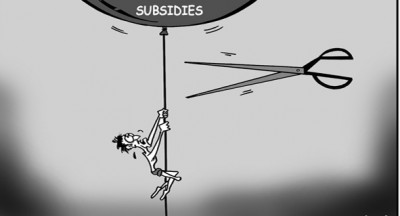
With Australia’s wind industry gasping its last breath, their hired spruikers at the Clean Energy Council have taken to peddling the incredible tale that wind power has led to a REDUCTION in our power bills.
Trouble is that wind power generation (the product of the mandatory RET- which has been in operation since 2001) has been a key contributor to Australian household electricity costs rising 110 per cent in the past 5 years (see our post here). But the way the CEC plays it, it’s as if we hadn’t noticed.
But step back a moment. Assume that the CEC is not speaking with “forked tongue”.
If it were true – as the CEC asserts – that wind power was in fact delivering power at prices equal to or less than conventional generation sources – so as to lower retail power prices – then why the need for the mandatory RET?
Why the need for Renewable Energy Certificates? Why the need for the shortfall charge (fine) of $65 per MWh for every MW the retailer falls short of the mandated RET, which “encourages” (we mean “forces”) retailers to enter Power Purchase Agreements and, thereby, purchase RECs from wind power generators? Why the need for unsecured, taxpayer underwritten loans from the Clean Energy Finance Corporation?
If there was a shred of substance to the CEC’s spin, then surely, wind power generators wouldn’t need any extra pennies from hard pressed power punters – in the form of RECs, or at all; nor would they need to have inbuilt threats to retailers to purchase RECs; and there would be no need for “soft money” to back their projects.
Hell, retailers and power consumers would be knocking each other over in the rush to get the cheapest power around; and, what with all those willing customers for wind power, there wouldn’t be any need for taxpayer subsidised loans from the CEFC – commercial lenders would be piling in to wind power projects, ready to reap the returns.
Call us just a tad “cynical” – but STT for one doesn’t buy it.
The hint that there’s something rotten in Denmark is in the “die in a ditch” efforts the CEC and its wind industry clients are currently making to retain the mandatory RET at its current 41,000 GWh annual target – and to, therefore, preserve the REC price, at all costs.
So which is it?
Is wind power really competitive with conventional generation sources? If so, then there’s simply no need for a mandated target at all – this stuff will sell itself.
Or is wind power simply the product of ideological nonsense – a power generation source which can only ever be delivered at crazy, random intervals – requiring 100% of its capacity to be backed up 100% of the time by fossil fuel generation sources, including ridiculously expensive OCGTs (with that exorbitant, additional and unnecessary cost borne by power consumers) – and which, for wind power generation to be commercial, has to be sold to retailers at guaranteed rates 3-4 times the cost of conventional sources, as stipulated in Power Purchase Agreements with retailers?
Call us “suspicious”, but STT thinks that it’s only ever been about a guaranteed stream of other peoples’ money. But on that score, we’ll leave the final word to America’s most successful corporate investor (see below).
Staying with the US, the Americans are catching on quick that their political betters have signed them up to a future of crippling power prices through the exorbitant subsidies guaranteed to wind power generators.
America’s equivalent to our Clean Energy Council is the American Wind Energy Association (AWEA). Lately, they’ve been singing from the same hymn sheet – both claiming that power prices are falling, thanks to wind power.
Where the CEC ignores the cost of the REC as a direct subsidy to wind power generators (and its concomitant cost as a tax on power consumers) its American doppelganger, the AWEA ignores the Production Tax Credit (PTC) – which, in substance and effect, is precisely the same thing.
Here’s a neat little summary from Ohio.
Wind farms come with big cost
limaohiho.com
Dawn Davis Contributing Columnist
17 April 2014
Don’t believe claims that wind energy does not cost Ohio a penny. Although the fuel is free, this industry has an addiction to subsidies. Subsidies do cost someone.
The Wind Production Tax Credit is a federal subsidy given to the wind industry which amounts to $0.022/kWh for electricity produced. It was designed, in 1992, to help a new industry grow. Is an industry still an infant after 20 years? This subsidy has been renewed eight times, with this year being the 9th. The U.S. Senate, with the help of five Republicans (including Sen. Rob Portman), recently, agreed to renew this credit. A two-year extension will cost our children $12 billion in additional debt, not including interest. After 20 years, the entire renewable industry generates less than 5 percent of our nation’s electricity.
Despite their low output, renewables were given 75 percent of the energy subsidies in 2013. Wind is currently being subsidized more than 80 times that of conventional fossil fuels, per unit of energy production. The American Tradition Institute hired analysts George Taylor and Thomas Tanton to calculate the cost of wind generation, as a FULL-time replacement. Their analysis shows wind costs $0.15/kWh if natural gas is the back-up and $0.192/kWh if coal is the back-up. What do you pay per kWh?
Our Energy Information Administration estimates that federal subsidies, alone, give the wind industry $56.29/MW hour. This is so high that it allows wind producers to pay the grid to take their electricity even when it is not needed, so they can claim the federal credit. Foreign-owned companies are making a huge profit, at our expense, despite selling their product at a loss, because our tax dollars make up the difference; meanwhile, wind interrupts the efficient operation of our traditional plants.
We are frequently told these incentives make the market fair since coal, gas, and nuclear receive subsidies; however, wind requires the constant back-up from those fossil fuel burning power plants because their energy output looks like a polygraph test. It forces fossil fuel plants to ramp up and down as wind speeds vary every moment across a region. Not only does this require fossil fuel plants to remain fully operational, but it makes their electricity more expensive. Wind facilities in Ohio have not, annually, even produced 30 percent of their advertised potential. Ohio wind speeds at 100 meters average a mere 6m/s, which does not place even place us in the top 20 states for wind generation potential.
Yet, current Ohio law mandates the purchase and generation of renewable energy. When wind comes to a town, county commissioners are asked to approve a payment-in-lieu-of-taxes which allows developers to pay up to $9,000/turbine. Their payments create an annual media frenzy, with big checks given to local governments and schools. If they abided by the rules of the Ohio tax code, though, they would pay, an estimated, $45,000/turbine annually. County commissioners give them an 80 percent tax reduction when they say yes to a PILOT.
History tells us that these handouts will, eventually, cost each of us in our electric bills.
Denmark has more turbines, per capita, than any place in the world, and their electric bills have tripled in the past 20 years.
Germany has announced that renewable subsidies will be slashed because electricity rates have increased more than 80 percent since 2000. They are building 10 coal plants to be completed in the next two years.
Last year, England paid wind developers 32.6 million pounds to turn OFF because their energy was produced when it wasn’t needed. Their rates have risen 50 percent. In Scotland, 80 million pounds have been paid to wind producers to shut them OFF and 40 percent of their residents live in fuel poverty.
Spain recently announced slashes to their wind subsidies. In 2009 a Spanish economics professor claimed that each green MW of energy destroyed 5.39 jobs in the private sector and each green job cost them $774,000. These events have driven wind developers here, where the subsidies are still flowing.
China is home to some of the largest turbine manufacturers in the world. They also have 90 percent of the world’s Neodymium, required for every industrial wind turbine. They produce a mere 0.23 percent of their energy from renewables. We sell them a lot of coal, though.
In the USA, electricity rates are rising in 9 out of 11 of the top wind power consumption states. According to the Energy Information Administration, the rates are: Colorado up 14 percent, Idaho up 33 percent, Iowa up 17 percent, Kansas up 29 percent, Minnesota up 22 percent, North Dakota up 24 percent, Oklahoma down 1 percent, South Dakota up 26 percent, Texas down 19 percent. Many economists agree that Texas rates are dropping because of deregulation, not because of the wind.
Electricity rates affect the cost of everything Ohio produces, sells, buys, and consumes. According to the steel manufacturers association, the industry employs 60,000 people and spends $18 billion on electricity annually. A 10 percent increase in electricity rates translates to $30,000/year/employee. Timken, a steel company in Ohio, estimates spending $2 million this year just for our renewable energy riders.
Last year, for the first time, the American Wind Energy Association hosted an Ohio Wind Energy Summit. They are here because of our mandates, our generous PILOT, and our vast land. In addition to our two operational wind sites, the Ohio Power Siting Board has certified eight more to begin construction. Ohio Senate Bill 310, being debated now, will freeze our mandates. Encourage our senators to support it. Ohio Senator Cliff Hite is an obstacle.
Do you remember what, then U.S. Sen. Barrack Obama, said about his energy policy? Under his policy, electricity rates will necessarily skyrocket. Get ready, Ohioans, someone is getting ready to pay a lot more for energy.
limaohio.com
The equation detailed above holds the world over – a subsidy paid to any firm supplying goods or services to households has to picked up by someone else. Where the subsidy is levied directly against household power bills (as the REC is) it’s householders that pay the subsidy, adding to the cost they would otherwise pay for power. That inescapable fact is simply Economics 101 – and provides a perfect explanation for spiralling power prices – wherever giant fans have sprung up.
And subsidies – like the REC and PTC – provide the ONLY explanation for the wind industry – as recognised by the “Sage of Omaha”, billionaire Warren Buffett – whose company Berkshire Hathaway has invested $billions in wind power in order to get at federal subsidies – namely the PTC – which is worth US$23 per MW/h for the first 10 years of operation.
A subsidiary of the Buffett-owned MidAmerican Energy Holdings owns 1,267 turbines in the US with a capacity of 2,285 MW – eventually when the company’s Wind VIII expansion is finished, MidAmerican will own 1,715 turbines with a capacity of 3,335 MW. Buffett has piled into giant fans for one reason only: to lower the tax rate paid by Berkshire Hathaway.
As Buffett recently put it at his annual investor jamboree in Omaha, Nebraska:
“I will do anything that is basically covered by the law to reduce Berkshire’s tax rate. For example, on wind energy, we get a tax credit if we build a lot of wind farms. That’s the only reason to build them. They don’t make sense without the tax credit.”
There, Warren Buffett said it, not us.
At least he had the honesty and integrity to explain the only conceivable basis for the greatest rort of all time. And isn’t it so much better when those that profit from it chose not to speak with “forked tongue”. Maybe the CEC and AWEA can take a leaf out of Warren’s book?


Photo via Creative Commons
While the controversy swirling around wind turbines in Ontario may be a ticking time bomb in the just-begun election campaign, Toronto human-rights lawyer Julian Falconer may have lit the fuse Monday night at a meeting organized by a Plympton-Wyoming community group near Sarnia, a city in southwest Ontario.
Speaking to around 400 people in a community hall, Falconer challenged all three political parties to declare a moratorium on turbine construction until a comprehensive study is completed by the federal health ministry. “None of these parties has done the right thing. A courageous, responsible political leader would put a halt to any more turbine construction, until the Health Canada study is completed,” he told the approving crowd.
Falconer was asked to the meeting by the organizers of a local group fighting plans by energy company Suncor to build 46 wind turbines in their area. The group has convinced their local council to fight Suncor by demanding turbines be placed at least two kilometers (1.2 miles) apart, as opposed to only 550 meters (600 yards), as decreed by Ontario’s Green Energy Act. Suncor took the municipality to court last winter to stop the by-law, claiming the provincial legislation trumps local by-laws. A decision is expected soon, the local mayor told the meeting.
Since the Green Energy Act came into force in 2009, wind developments have sprouted around southern Ontario, and local opposition groups have been fighting them tooth and nail. The Act, meant to promote the growth of alternative energy sources, has created a political backlash which has been credited with partially reducing the governing Liberal party to minority status in 2012. With more than 50 citizen action groups across the province listed on the website of Ontario Wind Resistance, an umbrella organization for wind opponents, the protesters are stepping up for an even bigger fight as a new election gets underway.
Challenging that law on behalf of wind power opponents, even as far as the Supreme Court of Canada, is Falconer’s goal. “It may be ‘a novel argument’ to use the Charter of Rights and Freedoms for this purpose, but if people don’t challenge the Liberal government in court, these turbines will be everywhere,” he told the audience. Section seven of the Charter protects Canadians’ rights to security of the person, and “the courts have recognized that health issues can be one means of being protected,” Falconer told VICE in an interview after his speech.

Julian Falconer in the crowd. Photo via the author
To effectively challenge turbine construction in Ontario, one has to prove turbines will cause “serious harm to human health,” according to Falconer. Building turbines without clear understanding of health effects is like the government saying, ”if you want to avoid swallowing this pill we’re giving you, you have to prove it won’t kill you,” he said. He hopes to continue building support for the Charter challenge by appealing to other anti-wind groups across the province to join in the coming months.
Wayne Couture, living just south of the Kincardine province of Ontario, told the audience he has been forced to leave his home every day for a year by the effects of living near turbines: dizziness and ringing in his ears. “You have to shut them [turbines] down. You are the guinea pigs,” he warned the group.
Health effects are at the heart of opposition to wind turbines, believes Carman Krough, co-author of a recent article in the Canadian Journal of Rural Medicine that reviewed previous health effects studies. The study found that, if placed too close to residents, industrial wind turbines can negatively affect the physical, mental, and social well-being of people, and that there is sufficient evidence to support the conclusion that noise from turbines is a potential cause of health effects. Formal studies from around the world point to symptoms that repeat, she says—sleep disturbance, feeling of vibrations, tinnitus (ringing in the ears), and vertigo.
These studies, along with the personal stories of individuals, leaves Krogh with “no doubt” the effects are real. “You don’t pack up and leave your home lightly,” she says. With a background in “vigilance monitoring” of adverse effects of pharmaceuticals, Krogh found herself applying the same techniques in monitoring people who reported effects from living near turbines, when she experienced headaches after being near the giant towers, she tells VICE.
The effects on children are especially worrying, Krogh says, as they have not been studied very well. There is some evidence that conditions in children such as autism, asthma, migraine, or epilepsy can be affected by turbine noise, and that such effects could possibly by irreversible, she told the audience.
There is “credible scientific support” for a link between noise from turbines and health effects,according to a report commissioned by the Ontario Environment Ministry, Krogh claims—the same ministry that is approving wind projects across the province.
Joining Falconer’s challenge will not come cheaply for the town of Plympton-Wyoming. The group is hoping to raise $300,000 to count themselves in. With a donation of $20,000 from Lambton County Council, and their municipal council already paying legal bills to defend against Suncor, the group is asking the 7,500 residents to dig deep in their own pockets.
They’re hoping the money will give them a chance to avoid the noise and breeze of the wind turbines, while at the same time, they also hope the election will force politicians to feel the wind down their own necks.N’T
Credit: By Steven Goetz, Kincardine News | Tuesday, May 6, 2014 | www.shorelinebeacon.com ~~
The Environmental Review Tribunal (ERT) dismissed an appeal filed against the approved Armow Wind project, rejecting claims the project will cause serious harm to human health.
But instead of backing down, a local group of anti-wind activists — Huron-Kinloss Against Lakeside Turbines (HALT) — will take the fight to divisional court and beyond.
“We have always seen this as having the potential to go all the way to the Supreme Court,” said HALT’s Kevin McKee in a telephone interview on May 2.
McKee said the group never expected to win at the ERT, but had to file the appeal before divisional court would consider their legal challenge.
“We weren’t surprised by the result,” he said. “Citizen groups like our own have been 0-for-25 at these ERT hearings. It is nearly impossible to win.”
“By their standard, it would be hard to prove asbestos would cause harm,” he said.
Barring intervention from a court, the April 22 decision clears the way for Samsung-Pattern to erect a 92-turbine, 180-megawatt wind farm in the Municipality of Kincardine, on land northeast of the North Line and Highway 21.
The appeal was organized and funded by HALT and its partners, but filed on behalf of Ken and Sharon Kroeplin — whose 100-acre family farm is located within 600 metres of one of the planned turbines.
The ERT dismissed their claims, writing in its lengthy decision that the Kroeplins “failed to establish, on a balance of probabilities” that the project “will cause harm to human health.”
In its findings, the ERT wrote that it wasn’t enough for the Kroeplins to show “the potential for harm,” but the onus was on them to “prove that a project will cause harm.”
The ERT wrote that so-called “post-turbine witnesses” — people who have reported health conditions and symptoms they believe have been caused or exacerbated by living near wind turbines — did not prove that turbines were the cause of their ailments during their testimony at the nine days of hearings held on Kincardine.
[rest of article available at source]
1) Lennart Bengtsson: He Knows How Little We Know
Basler Zeitung, 7 May 2014
Hans Jörg Müller
One of the most eminent climate scientists, the Swede Lennart Bengtsson, has defected to the camp of climate sceptics. For the climate debate, this could have beneficial effects.

How the global climate will develop in coming years and decades, and what influence mankind has upon the climate, is a question that has been discussed with almost religious fervor until a few years ago. That is, there were no discussions really; rather, one of the two parties declared the other insane: “climate denier“ was the term used for those who were of the opinion that global warming does not take place or that it may be warming less rapidly as most scientists believed. In any case, the human impact on climate change was far from proven.
The similarity between “climate denier” and Holocaust denier was intentional: the term should insinuate that anyone who deviated from the widely prevailing consensus was a crank, possibly driven by sinister motives. Above all, very few climate sceptics were leading experts, and this was probably the alarmists’ strongest argument. While climatologists and meteorologists warned and warned, those who were becalming and moderate were often economists. As one of the leading climate sceptics, one ex-politician stood out: Nigel Lawson, Britain’s former Chancellor of the Exchequer and the chairman of the Global Warming Policy Foundation (GWPF).
Thaw
Gradually, however, the ice seems to be melting – if not at the polar caps, then at least in the climate debates: for the first time, a widely recognized expert has changed camps. Lennart Bengtsson , the Swedish climatologist, meteorologist and former director of the Max Planck Institute for Meteorology in Hamburg, has now joined the GWPF’s academic advisory council.
After his decision was announced Bengtsson was attacked, says Lawson, which shows what kind of emotions the issue can still generate. The reason cited by the 77-year-old scientist for his decision comes in a bone-dry scientific language: The relationship between greenhouse gases and global warming was “complex and only partially understood,” Bengtsson wrote in a commentary for the Swiss newspaper Neue Zürcher Zeitung.
Apart from that, all empirical observations showed that global warming has been “no serious problem up to now.” How the climate would develop in the future only model simulations could show, and these were rather “problematic”.
Nothing is settled
Bengtsson’s conclusion: “It would be wrong to conclude from the IPCC report and similar reports that the science is settled.” Against this background, so the professor, it would be wrong to undertake any energy transition hastily.
Bengtsson’s arguments do not sound like the radicalism of old age. Rather, he exhorts his colleagues to be more prudent and empirical. For the uninitiated, this approach may be comforting, because the climate debate has long been a highly complex issue. Now, for the first time, an expert like Bengtsson admits that he and others like him fare little better: how the world’s climate will develop in coming years and decades remains pure speculation.
Translation Philipp Mueller
2) Dispute Over Global Warming: Respected Meteorologist Joins Climate Sceptics
Spiegel Online, 5 May 2014

A delicate academic matter has disrupted the climate science community: One of the most respected climatologists, Emeritus Max Planck Director Lennart
Bengtsson, has switched to the camp of climate sceptics. In this SPIEGEL ONLINE interview he explains his surprising decision.
One of the most renowned climatologists has changed sides. Lennart Bengtsson, former director of the Max Planck Institute for Meteorology in Hamburg, one of the world’s leading climate research centres, has joined the Academic Advisory Council of theGlobal Warming Policy Foundation (GWPF)…
Bengtsson has always been known for his moderate viewpoints during the hot climate debates of the 1990s. In a SPIEGEL ONLINE interview, he explained his move into the camp of skeptics.
About the person
The meteorologist Lennart Bengtsson, born in 1935, was director of the European Centre for Medium-Range Weather Forecasts from 1981 to 1990, then director of the Max Planck Institute for Meteorology in Hamburg, one of the world’s leading climate research centers. Since his retirement in 2000, he has worked as a professor at the University of Reading in England. He has been given many awards, among them the German Environmental Award of the Federal Foundation for the Environment. He has dealt mainly with the modeling of climate and weather.
SPIEGEL ONLINE: Mr. Bengtsson, why have you joined the climate sceptic Global Warming Policy Foundation?
Bengtsson: I think it is important to enable a broad debate on energy and climate. We urgently need to explore realistic ways to address the scientific, technical and economic challenges in solving the energy problems of the world and the associated environmental problems.
SPIEGEL ONLINE: Why do you think the lobby (sic) group GWPF is particularly suitable?
Bengtsson: Most members of the GWPF’s Academic Advisory Council are economists, and this is a chance for me to learn from some of these highly qualified experts in areas outside my own expertise. I want to contribute there through my meteorological knowledge to open the debate.
SPIEGEL ONLINE: But the people at GWPF do not have the reputation of reconsidering their opinions. Have you also become a so-called climate sceptic?
Bengtsson: I have always been a skeptic, and I think that is what most scientists really are.
SPIEGEL ONLINE: But were you not one of the alarmists 20 years ago? Do you think your position at that time was wrong?
Bengtsson: I have not fundamentally changed my opinion in this area. And I have never considered myself an alarmist, but as a scientist with a critical eye. In this sense, I have always been a skeptic. I have used most of my career to develop models for predicting the weather. I have learned the importance of forecasting validation, i.e. the verification of predictions with respect to what has really happened. So I am a friend of climate forecasts. But the review of model results is important in order to ensure their credibility.
SPIEGEL ONLINE: And here you see a demand for climate research?
Bengtsson: It is frustrating that climate science is not able to validate their simulations correctly. The warming of the Earth has been much weaker since the end of the 20th century compared to what climate models show.
SPIEGEL ONLINE: But the IPCC report discusses these problems in detail.
Bengtsson: Yes, but it does not do so sufficiently critical. I have great respect for the scientific work that goes into the IPCC reports. But I see no need for the endeavor of the IPCC to achieve a consensus. I think it is essential that there are areas of society where a consensus cannot be enforced. Especially in an area like the climate system, which is incompletely understood, a consensus is meaningless.
SPIEGEL ONLINE: You complain about the strong tendencies towards politicisation in climate research. Why do you join now a political (sic) organisation?
Bengtsson: I was fascinated my whole life by predictions and frustrated by our inability to make forecasts. I do not think it makes sense to think for our generation that we will solve the problems of the future – for the simply reason that we do not know future problems. Let us do a thought experiment and go back to May 1914: Let us try from the perspective of that point in time to make an action plan for the next hundred years – it would be pointless!
SPIEGEL ONLINE: Do you suggest we should carry on with business as usual just because forecasts are complicated?
Bengtsson: No, but I think the best and perhaps only sensible policy for the future is to prepare society for adaptation and change. In 25 years the world will have nine to ten billion people. This will require twice as much primary energy as today. We need to foster new science and technology. We need a more open approach, especially here in Europe, which includes the issues of nuclear energy and genetic engineering, in order to supply the growing world population with energy and food.
Translation Philipp Mueller
3) Judith Curry: U.S. National Climate Assessment Report
Climate Etc., 6 May 2014
My main conclusion from reading the U.S. National Climate Assessment Report report is this: the phrase ‘climate change’ is now officially meaningless. The report effectively implies that there is no climate change other than what is caused by humans, and that extreme weather events are equivalent to climate change. Any increase in adverse impacts from extreme weather events or sea level rise is caused by humans. Possible scenarios of future climate change depend only on emissions scenarios that are translated into warming by climate models that produce far more warming than has recently been observed.
Some of the basic underlying climate science and impacts reported is contradictory to the recent IPCC AR5 reports. Pat Michaels and Chip Knappenberger have written a 134 page critique of a draft of the NCADAC report [link].
Even in the efforts to spin extreme weather events as alarming and caused by humans, Roger Pielke Jr. has tweeted the following quotes from the Report:
An interesting feature of the report is Traceable Accounts – for each major conclusion a Traceable Account is given that describes the Key Message Process, Description of evidence base, New information and remaining uncertainties, Assessment of confidence based on evidence. The entertainment value comes in reading the description of very substantial uncertainties, and then seeing ‘very high confidence’. This exercise, while in principle is a good one, in practice only serves to highlight the absurdity of the ‘very high confidence’ levels in this report.
White House
Apparently President Obama is embracing this Report, and the issue of climate change, in a big way, see this WaPo article For President Obama A Renewed Focus On Climate. Motherboard has an interesting article How extreme weather convinced Obama to fight climate change.
In an interesting move, Obama Taps TV Meteorologists to Roll Out New Climate Report, which describes how Obama is giving interviews to some TV weathermen. It will be interesting to see how this strategy plays out, since TV weathermen tend to be pretty skeptical of AGW.
The politics on this are interesting also, see especially these two articles
White house set to lay out climate risks as it touts U.S. energy boom
Podesta: Congress can’t stop Obama on global warming
JC reflections
While there is some useful analysis in the report, it is hidden behind a false premise that any change in the 20th century has been caused by AGW. Worse yet is the spin being put on this by the Obama administration. The Washington Post asks the following question: Does National Climate Assessment lack necessary nuance? In a word, YES.
The failure to imagine future extreme events and climate scenarios, other than those that are driven by CO2 emissions and simulated by deficient climate models, has the potential to increase our vulnerability to future climate surprises (see my recent presentation on this Generating possibility distributions of scenarios for regional climate change). As an example, the Report highlights the shrinking of winter ice in the Great Lakes: presently, in May, Lake Superior is 30% cover by ice, which is apparently unprecedented in the historical record.
The big question is whether the big push by the White House on climate change will be able to compete with this new interview with Monica Lewinsky 🙂
4) We Can Easily Adapt To Sea Level Changes, New Report Says
Breitbart London, 7 May 2014
James Delingpole
Attempts to stem sea level rises by reducing CO2 levels in order to “combat” global warming are a complete waste of time says a new report by two of the world’s leading oceanographic scientists.
Over the last 150 years, average global sea levels have risen by around 1.8 mm – a continuation of the melting of the ice sheets which began 17,000 years ago.
Satellite measurements (which began in 1992) put the rate higher – at 3mm per year. But there is no evidence whatsoever to support the doomsday claims made by Al Gore in 2006 that sea levels will rise by 20 feet by the end of the century, nor even the more modest prediction by James Hansen that they will rise by 5 metres.
Such modest rises, argue oceanographer Willem P de Lange and marine geologist Bob Carter in their report for the Global Warming Policy Foundation, are far better dealt with by adaptation than by costly, ineffectual schemes to decarbonise the global economy.
They say:
No justification exists for continuing to base sea-level policy and coastal management regulation upon the outcomes of deterministic or semi-empirical sea-level modelling. Such modelling remains speculative rather than predictive. The practice of using a global rate of sea-level change to manage specific coastal locations worldwide is irrational and should be abandoned.
It is irrational not least because it is based on a complete misunderstanding of the causes and nature of sea-level rises. There are parts of the world where the sea level is rising, others where it is falling – and this is dependent as much on what the land is doing (tectonic change) as on what the sea is doing.
In other words – a point once made very effectively by Canute – it is absurdly egotistical of man to imagine that he has the power to control something as vast as the sea. The best he can hope to do is to adapt, as previous generations have done, either by deciding to shore up eroding coastal areas or abandon them and move further inland.
And for those still in doubt, here is what Vincent Courtillot, Emeritus professor of geophysics at Paris Diderot University has to say in his introduction to the report:
Sea level change is a naturally occurring process. Since the last glacial maximum, some 18,000 years ago, de-glaciation has taken place and this natural global warming has led to sea-level rise of on average 120 m or so. At some times, pulses of melt water coming from large peri-glacial lakes led to rates of sea level rise as high as 3 m per century. The rate slowed down some 7000 years ago and since then has been naturally fluctuating by only a few metres. The remaining global sea-level rise has been about 20 cm in the 20th century. Has this led to global disasters? The answer is no. If the projected rise over the 21st century is double what was seen in the 20th, is it likely that it will result in global disasters? Again, the answer is most likely no; human ingenuity, innovation and engineering, and the proper material and financial resources should solve local problems if and when they arrive, as they have in the 20th century.

As STT’s loyal followers know, Australia is all set to decouple itself from the international economic suicide pact entered when gullible and unwitting governments all over the world signed up to ludicrously expensive and utterly pointless renewables policies.
The Coalition are itching to scrap the Renewable Energy Target – and the RET Review Panel appear more than ready to give them the ammunition to do so.
The Panel formerly called for submissions on 5 April 2014 (see this document) – setting out the terms of reference and the criteria that submissions should meet (see our post here).
The closing date for submissions is 16 May 2014 and STT hears that it’s about to be inundated by submissions from Australia’s top energy market economists and Australia’s leading power retailers all slamming the lunacy of the mandatory RET. However, the opportunity to make submissions is open to one and all – so don’t just leave it to the boffins – why not make a submission yourself?
STT contains a welter of facts, evidence and information detailing the greatest economic and environmental fraud of all time – piecing that together in a cogent argument as to why the RET simply must go is something that anyone with a computer and time on their hands can do. Remember though, submissions have to address the terms of reference set out in the document linked above – and that, with less than 10 days to go, you’ll need to get cracking.
Set out below is one very solid example put together by STT Champion, Dr Alan Watts. STT recommends it as a basis and template for anyone making their own submissions to the Panel. Although, we have a few comments of our own aimed at strengthening Alan’s arguments – matters of emphasis, really – and which should assist in preparing your own submissions (see below).
Review of the Renewable Energy Target
Expert Panel
RETReview@pmc.gov.au
Re: ‘Renewable Energy Target Review Expert Panel Call for Submissions, Commonwealth of Australia 2014’.
SUBMISSION
This submission deals primarily with the RET as it relates to wind power energy production, LRECs and the effects of these on electricity pricing and production efficiency.
The Call for Submissions summarises the objects of the REE Act as being:
a) to encourage the additional generation of electricity from renewable sources;
b) to reduce emissions of greenhouse gases in the electricity sector; and
c) to ensure that renewable energy sources are ecologically sustainable.
The RET has succeeded in its first object to promote the roll out of renewable energy, particularly translated to the construction of an increasing number of industrial wind turbine (IWT) installations.
The RET has totally failed in its other two objects, i.e. it has failed to reduce emissions of greenhouse gases in the electricity sector and the renewable energy sources have not been shown to be ecologically sustainable.
The RET has as a consequence of renewable energy promotion created a great deal of damaging social and economic effects and has caused in the case of IWTs enormous damage to the Australian nation and way of life by the reckless promotion of:-
1. A system of unpredictable, inefficient and intermittent electricity generation which by every measure is not fit for purpose and therefore is totally without merit;
2. An industry which has a degree of government protection like no other;
3. A system when idle, due to lack of or excessive wind, requireselectricity for maintenance and for restart;
4. A system incapable of base load power generation;
5. A system which does not in any meaningful way lessen greenhouse gas emissions;
6. A system which has not and cannot reduce our foreseeable coal dependency;
7. A system which requires constant coal or gas fired back up running at almost full capacity (stated 90%) due to the very variable and unreliable nature of wind. This represents the most wasteful, inefficient and expensive use of coal and gas;
8. Electrical generation costing at least three times that of coal;
9. A system which has contributed to a lowering of Australia’s standard of living and comfort, especially for those Australians of lower socioeconomic means, due to increased electricity bills;
10. A system which has destroyed Australia’s once comparative manufacturing advantage due to cheap electricity and with it our ability to compete internationally;
11. A system of visual blight due to industrialisation of the rural landscape;
12. A system that causes untold harm and destruction of wild life and unique remnant bushland (important because much of the original vegetation has disappeared from the Tablelands areas and locations favourable to the wind industry);
13. An industrial development resulting in significant reduction in rural land valuation and agricultural land usage especially cropping, fertilizer application, weed control, fencing and farm based disease containment;
14. A system with inherent industrial problems of hazardous fire (and the inherent difficulties of fighting both turbine fire and bushfires), blade throw, flicker and glint as well as dangers to all forms of flight;
15. A development which has serious legal consequences for land owners because of access, disease spread, sale and subdivision rights. And also by “gag” clauses incorporated into IWT contracts effectively removing any host’s freedom of speech;
16. An industrial structure which requires one tonne of a rare earth, Neodymium, to increase the magnetic strength and which is sourced primarily from China (Inner Mongolia which has 95% of the world’s resource). Its extraction process involves boiling sulphuric acid which is highly toxic to both the environment and the operators;
17. An industrial complex with commonly disputed ownership at the time of decommissioning which is typically 120,000 hours or 15-25 years, although international research now estimates the functional life of an industrial wind turbine may be closer to 12-15 years;
18. IWT decommissioning and disassembly that does not remove the huge concrete foundations and which will remain forever present;
19. An electrical system which legally requires the farmer host to decommission and remove the wind towers at the end of their functional life if a legal entity cannot be located with provable ownership. There are international examples of derelict “wind farms” with disputed ownership being left to rot, in excess of 14,500 in California alone;
20. A system where payment of a decommissioning bond by the proponents has been strenuously fought by them, again indicating the fragile economic nature and in some cases the insolvency of this transient industry;
21. A system of electrical generation with such fragile economics that frequent change of ownership is common. This adds to the legal confusion as to who has most direct responsibly for decommissioning and removal of these structures;
22. A system which has produced social disharmony, family destruction and economic hardship in rural communities rivalling only that of coal mining and coal seam gas extraction, and war;
23. A system which has polarised debate to such an extent and level that truth and fairness are now completely compromised;
24. A system based on myth, greed, ignorance, subsidy and institutional deceit that has generated such wealth that there now exists no honourable or honest return from these entrenched self-interested opinions;
25. An industry so inefficient that it is entirely dependent on taxpayer subsidy to exist and without it, it would cease to exist;
26. A system which has captured all irrational thought, concentrated greed, distorted science, befriended the gullible and has ransomed genuine research with the assistance of the politically naïve;
27. A system which has deflected energies and funding away from what can only be described as the most sensible renewable source of energy on earth, namely geothermal. Geothermal is infinite, clean, truly green and possible, as in Iceland. The largest natural nuclear power source on earth is beneath the Earth’s crust as molten magma, an unimaginable source of heat. Geothermal energy is the only renewable energy on earth capable of providing base load power and as such cannot in any way be compared to any other renewable energy source.
28. A system of production which is totally unique to the Australian political landscape and which enjoys political and legislative protection like no other.
Initially conceived by the Coalition Government, the Australian Green-Labor alliance allowed this industry in Australia to flourish and in so doing created a scam that was:
a. Totally and completely devoid of any merit, green, environmentally or climatically;
b. Subsidised to ensure survival;
c. Ineffectual and inefficient;
d. Providing an end product that energy suppliers were required to compulsory purchase, with legislated penalties for noncompliance;
e. Ensuring its future with increasing and possibly endless targets;
f. Artificially supported with industry forward payments and prepayments;
g. Supported with undeclared tax concessions;
h. Overseeing contracts that currently have no Australian companies involved in turbine manufacture of any consequence;
i. Currently operating beyond their legal guidelines;
j. Currently operating beyond conditions of consent with no financial penalty for illegal operation;
k. Placing the Australian Government in a position of implicit state sponsored fraud;
l. Causing adverse health effects (AHE) to Australian families which are disgracefully ignored;
m. Devoid of significant Australian content, ensuring expatriation of Australian funds off shore via foreign companies.
It is now the responsibility of the current Coalition Federal Government to reverse this despicable fraud, remove the RET and withdraw the Recs.
Further, I have been requesting, along with other concerned Australians:
1. A moratorium on further installation of these structures until their safety has been established by;
2. Independently conducted research which justly requires that the industrial wind proponents fund since they alone profit from the establishment of Industrial Wind Turbines; and
3. That all 7 recommendations proposed by the June 2011 Federal Senate Community Affairs References Committee on the Social and Economic Impact of Rural Wind farms, which have not been introduced by any Federal, State or Local Government anywhere in Australia, be implemented immediately.
The previous Labor Federal Government’s 20/20 renewable energy target (RET) and generous taxpayer subsidies are driving an enormous amount of foreign company investment in industrial wind turbines of very dubious effectiveness and efficiency.
While the environmental and social impacts of non-renewable energy production (eg. coal and gas mining, and the production of energy from these sources) are not dismissed lightly, it is counter-intuitive to attempt to replace them with renewable sources of energy which research has shown SAVE VERY LITTLE IF ANY CO2 (see paper by Le Pair et al – attached file). We leave aside the question of whether increasing CO2 poses any sort of threat and whether it is economically viable or necessary to expend large sums of money nationally and internationally for nil or little result.
Your “Call for Submissions” sets out very well the current position with respect to the RET and some of the problems related to it. Worth emphasising however is the fact that the RET scheme including the feed-in tariffs for roof-top solar already adds 7 per cent to the cost of electricity to households, a cost that will more than double on present policies. By 2020 the scheme, if unchanged, will add over 40 per cent to the wholesale cost of electricity and largely negate the benefits from the demise of the carbon tax (should that occur).
The impact on households will increase. Energy poverty is defined as requiring to pay more than 10% of household income on energy and a recent finding states that already 20 per cent of Australian households are now energy poor (Chester, 2013 – see attached file). As the cost of energy inevitably rises – caused in no small way by the contribution of unaffordable renewable energy subsidies (both direct and indirect) – this figure of 20% must increase in tandem.
Concomitantly is the situation where major energy intensive industries are departing Australia in large part because our electricity prices have risen to be among the highest in the world; this from the enviable position of being one of the lowest less than a decade ago.
Whatever else the Review of the RET does it must address the problems of electricity affordability both for Australian households, and for the manufacturing and industrial sectors which implacably hold the key to national prosperity. With prosperity comes the prospect of being better able to address National social and environmental problems.
A fresh approach is undoubtedly required. Firstly there must be a recognition that, to paraphrase the title of the by Le Pair et al, “Wind turbines are as yet unsuitable as electricity providers”. The paper sets out many of the problems attached to the production of energy by IWT and reinforces the insanity of pouring money into an industry which is not and, at the moment, cannot produce energy in an economic, reliable, efficient, non- health adverse, environmentally and socially acceptable manner. Where is the sense?
Good governance demands the overdue withdrawal of RECs from this industry. If the wind industry is correct when it says it is a mature industry and that it is viable, then let it pay its own way and let it stand alone without the buttress of the RET.
If government (i.e. tax payers’) money is to be spent it would be better directed towards:
a. Ensuring that research and development of “true” renewables is the focus and that forthcoming and future sources of energy are tested and matured before being foisted on a hapless public;
b. Ensuring that mining and electricity production from non-renewable sources (which is often forgotten will still be responsible for 80% of our electricity production) are conducted with improving levels of environmental impacts, health consequences, and minimisation of community disruption. Air and water pollution problems in particular require dedicated monitoring and reduction.
The deployment of industrial wind turbines is often met with support because they are considered “clean and green” and will “save the planet” through the claimed reduction of CO2 emissions. But what if they don’t? One is reminded of the fairy story of the Emperor with no clothes! Expensive clothes at that.
Le Pair’s conclusion therefore bears repeating:
“Quantifying the decrease in efficiency of the electric power system and the extra fuel consumption induced by wind developments is by no means a simple matter. To our knowledge there are presently not sufficient data in the public domain to substantiate a definite answer to the question how much fuel and CO2 emission is saved. It depends on the actors, the equipment, the kind of fuel, the amount of wind penetration, the behaviour of the regional wind, the amount of storage, the interconnection of regional grids etc.
“Decisions to install large-scale wind-powered electricity generation are based more on the expectation to save significant amounts of fossil fuel and CO2 emission than on any evidence that this is indeed the case.
“Wind technology is not suited for large-scale application without a good buffer and storage system. We propose to stop spending public money on large-scale use of wind. This money should be spent on R&D of future power systems. We expect that wind will not play an important role in these future systems.”
Yours faithfully,
Dr. Alan C. Watts OAM
Here are links to the papers referred to in Alan’s submission:
Le Pair et al -Wind turbines as yet unsuitable as electricity providers
Chester – Impacts_Consequences_Low_Income_Households_Rising_Energy-Bills_Oct2013
Alan’s submission is characteristically passionate, but still conveys the scale and scope of the economic and environmental fraud that is wind power.
In our view, submissions should seek to emphasise the following matters:
The panel must refute any claims by the wind industry that it has (or is capable of) reducing CO2 emissions in the electricity sector in the absence of actual data which has been independently peer reviewed. Any such data must include CO2 emissions from all power generation sources in order to capture the increased emissions caused by base-load coal and gas thermal plants holding increased “spinning reserve” – and the increased use of highly inefficient Open Cycle Gas Turbines – which are both needed in order to compensate for the intermittency of wind power.
The panel must refute claims by the wind industry that wind power has reduced power prices for consumers, as claimed by the Clean Energy Council. The Panel must call for the production of Power Purchase Agreements between wind power generators and retailers in order that the prices fixed under those agreements are known to the Panel and its consultants, ACIL Allen. The wind industry and its advocates refuse to make these agreements public and refer only to wholesale prices, which do not determine the price retailers pay for wind power; whereas, the terms of Power Purchase Agreements do. The impact of the prices set by PPAs with wind power generators is a critical part of any analysis of the impact of the RET on retail power prices.
The panel must consider the impact that the intermittent delivery of wind power and its inherent unreliability has on retail power prices. The cost of maintaining spinning reserve – and building capacity in fast start-up generation sources, principally OCGTs – is ignored by the wind industry. So too is the impact on retail power prices from using high cost OCGTs as backup for a substantial proportion of installed wind power capacity. The panel must, therefore, consider the cost of delivering power using fast start-up generation sources, including OCGTs, which are critical to maintaining grid integrity and power supply when wind power output falls to insignificant levels every day – and on hundreds of occasions each year. There have been numerous occasions when wind power output has collapsed across the entire Eastern Grid and, as a result, dispatch prices have soared from the normal average of $30-40 per MWh to reach the regulated cap of $12,500 per MWh (and many occasions when the dispatch price has reached 8-10 times the average – ie $280-300 per MWh, which is the price range needed for OCGT operators to break even and at which they commence supplying power to the grid). These costs are directly attributable to wind power generation – costs ultimately borne by power consumers – and which must, therefore, be included in any consideration of the cost impacts of the RET on retail power prices.
More generally, STT finds it hard to fault anything appearing in Alan’s well structured and detailed argument. However, we disagree with his point 27 when he says that geothermal is the only base-load renewable alternative. Geothermal has tremendous prospects and has, under the current RET policy, clearly been starved of the investment needed to develop it (see our post here). However, with respect, Alan overlooks hydro power.
STT is a huge fan of hydro power – as we have made plain on a number of occasions (see our posts here and here).
Hydro is not only the original renewable, it also satisfies the principal objective of the mandatory RET – as it does not produce CO2 emissions when generating power – and, because it is reliable and always availableon-demand, it does not require backup from fossil fuel generation sources. Accordingly, hydro does in fact reduce CO2 emissions in the electricity sector by actually displacing fossil fuel generation sources and/or properly supplementing those sources – which is as simple as turning on the sluice gate.
Hydro can be used to deliver “base-load” power, but in the Australian energy market is largely used these days as “intermediate power” – balancing the grid during periods of peak demand. The critical point is that hydro is available on demand – whereas wind power will never be.
The Snowy Hydro scheme is – and remains – the greatest and most beneficial renewable energy system in Australia.
Moreover, without it, long-term water management in the Murrumbidgee and Murray River systems (the life-blood for NSW, Victoria and SA) would be impossible: Adelaide would have died of thirst during periods of drought at least a dozen times without the Snowy scheme.
There is huge potential for further investment in hydro power in Australia – all up and down the Great Divide – bringing with it the ability to harvest huge volumes of water in times of flood – and to beneficially manage that water during periods of drought. However, the perverse nature of the mandatory RET provides every advantage to unreliable and costly wind power at the expense of hydro power: the former takes a matter of months to construct and begin earning revenue; whereas the latter takes years and sometimes decades to complete and for investors to start earning a return. Investors looking for a quick return on their cash have simply plumped for the soft option and piled in to wind power, with disastrous results on every level.
The Snowy Hydro scheme was Nation building stuff and took a generation. It should be repeated and policies put in place to ensure that it is, which means the current RET legislation must be amended or repealed.
But, all that is to quibble, Alan’s submission is a great starting point – so use it to best advantage – get cracking and let the RET Review Panel know precisely what you think of the greatest fraud of all time.

With the Ontario election officially kicking off Wednesday, remember one thing as we head to the polls on June 12.
Premier Kathleen Wynne and the Liberals are going to talk about everything other than the only thing that counts — their record.
The Liberals don’t want to talk about their political corruption in the gas plants scandal — how they wasted up to $1.1 billion of public money to buy five Liberal seats in the last election and then tried to hide the enormity of what they’d done.
We’ll leave it to the police to decide if criminal charges are warranted by what the Liberals did by allegedly destroying government documents.
What we’re saying is that regardless of whether their actions were criminal, the Liberals used public money not to benefit the people of Ontario, but for the political benefit of the electoral fortunes of the Liberal Party of Ontario. That’s the definition of political corruption.
The Liberals don’t want to talk about the fact their 11-year regime started with a lie — former premier Dalton McGuinty’s signed election promise in 2003 not to raise taxes, followed by the largest single tax grab in Ontario history after the election.
Given that, how can any Liberal promise in this election be taken seriously?
We’ve seen that the Liberals will say anything to get elected, then reverse themselves after winning power.
The litany of billion-dollar Liberal boondoggles — the gas plants scandal, the eHealth scandal, the green energy scandal, the Ornge scandal (the latter giving the Liberals the dubious distinction of being under not one, but two police investigations as we head to the polls) all indicate the same thing.
After 11 years in power the Liberals can’t be trusted to operate government honestly or efficiently.
Their tax-and-spend policies have turned Ontario, once the engine of the Canadian economy, into a financial basket case.
Ontario, riddled with record debt and rising deficits (two years in a row under Wynne) is now a “have not” province.
Manufacturing jobs are fleeing because of high energy costs.
Similarly, seniors on fixed incomes are being forced into fuel poverty, which makes Wynne’s promise to create an Ontario pension plan all the more absurd.
Simply put, it’s time to throw these bums out.

America’s wind farms are actually slaughtering millions of birds and bats annually
By Mark Duchamp
 The Obama administration is issuing 30-year permits for “taking” (killing) bald and golden eagles. The great birds will be legally slaughtered “unintentionally” by lethal wind turbines installed in their breeding territories, and in “dispersion areas” where their young congregate (e.g. Altamont Pass).
By chance (if you believe in coincidences), a timely government study claims wind farms will kill “only” 1.4 million birds yearly by 2030. This new report is just one of many, financed with taxpayers’ money, aimed at convincing the public that additional mortality caused by wind plants is sustainable. – It is not.
Dr. Shawn Smallwood’s 2004 study, spanning four years, estimated that California’s Altamont Pass wind “farm” killed an average of 116 Golden Eagles annually. This adds up to 2,900 dead “goldies” since it was built 25 years ago. Altamont is the biggest sinkhole for the species, but not the only one, and industry-financed research claiming that California’s GE population is stable is but a white-wash.

Eagles are not the only victims. Smallwood also estimated that Altamont killed an average of 300 red-tailed hawks, 333 American kestrels and 380 burrowing owls annually – plus even more non-raptors, including 2,526 rock doves and 2,557 western meadowlarks.
In 2012, breaking the European omerta on wind farm mortality, the Spanish Ornithological Society (SEO/Birdlife) reviewed actual carcass counts from 136 monitoring studies. They concluded that Spain’s 18,000 wind turbines are killing 6-18 million birds and bats yearly.
Extrapolating that and similar (little publicized) German and Swedish studies, 39,000 U.S. wind turbines would not be killing “only” 440,000 birds (USFWS, 2009) or “just” 573,000 birds and 888,000 bats (Smallwood, 2013), but 13-39 million birds and bats every year!
However, this carnage is being covered up by self-serving and/or politically motivated government agencies, wind industry lobbyists, environmental groups and ornithologists, under a pile of misleading studies paid for with more taxpayer money.
Wildlife expert Jim Wiegand has documented how areas searched under wind turbines are still confined to 200-foot radiuses, even though modern monster turbines catapult 90% of bird and bat carcasses much further. Windfarm owners, operating under voluntary(!) USFWS guidelines, commission studies that search much-too-small areas, look only once every 30-90 days, ensuring that scavengers remove most carcasses, and ignore wounded birds that happen to be found within search perimeters. (Details at MasterResource.org)
These research protocols are designed to guarantee extremely low mortality statistics, hiding the true death tolls – and the USFWS seems inclined to let the deception continue. In addition, bird mortality data are now considered to be the property of windfarm owners, which means the public no longer has a right to know.
Nevertheless, news has leaked that eagles are being hacked to death all across America. This is hardly surprising, as raptors are attracted to wind turbines. They perch on them to rest or scan for prey. They come because turbines are often built in habitats that have abundant food (live or carrion) and good winds for gliding.

Save the Eagles International (STEI) has posted photographs of raptors perched on nacelles or nonmoving blades, and ospreys building a nest on a decommissioned turbine. Moving blades don’t deter them either: videos show a turkey vulture perched on the hub of a spinning turbine, and a griffon vulture being struck. Birds perceive areas traveled by spinning blades as open space, unaware that blade tips are moving at up to 180 mph. Many are focused on prey. These factors make wind turbines “ecological death traps,” wherever they are located.
By 2030, the United States plans to produce 20% of its electricity from wind. That’s nearly six times as much as today, from three or four times as many turbines, striking more flying creatures due to their bigger size (even the mendacious study predicting 1.4 million bird kills recognizes this). Using the higher but still underestimated level of mortality published by Smallwood in 2013, by 2030 our wind turbines would be killing over 3 million birds and 5 million bats annually.
But this is shy of reality by a factor of ten, because 90% of casualties land outside the search perimeter and are not counted. We are thus really talking about an unsustainable death toll of 30 million birds and 50 million bats a year – and more still if we factor in other hide-the-mortality tricks documented by STEI.
This carnage includes protected species that cars and cats rarely kill: eagles, hawks, falcons, owls, condors, whooping cranes, geese, bats and many others. The raptor slaughter will cause rodent populations to soar. Butchery of bats, already being decimated by White Nose Syndrome, will hammer agriculture.
The U.S. Geological Survey says the value of pest-control services to US agriculture provided by bats ranges from $3.7 billion to as much as $53 billion yearly. These chiropters also control forest pests and serve as pollinators. A Swedish study documents their attraction from as far as nine miles away to insects that swarm around wind turbines. Hence the slaughter.
Wind lobbyists claim they need “regulatory certainty.” However, eagle “take” permits will also ensure extinction certainty – and ecological, agricultural, economic and social disasters that America cannot afford.
____________
Mark Duchamp is president of Save the Eagles International, a nonprofit conservation organization:www.SaveTheEaglesInternational.org and Chairman of WCFN, the World Council for Nature – www.wcfn.org
(Image at top of page: Red kites agonizing under wind turbines, State of Navarre, Spain. – courtesy of the association of ecologists GURELUR, Navarre, Spain)
Credit: By Lee Michaels on May 6, 2014 | blackburnnews.com ~~
Over 600 people tried to cram into the Camlachie Community Centre last night with the overflow standing outside.
We’re Against Industrial Turbines hosted a town-hall meeting to ramp up opposition to Suncor’s 46-turbine Cedar Point Wind Power Project.
WAIT is now trying to raise $300,000 to hire prominent Canadian lawyer Julian Falconer to help challenge the Ontario government’s policy on industrial turbines under the Canadian Charter of Rights and Freedoms.
Falconer was a guest speaker at last night’s meeting.
He tells Blackburn News that any suggestion there’s no impact on peoples’ health is “Alice in Wonderland fantasy.”
And he’s skeptical the June 12 Ontario election will change anything.
Falconer says the constitutional challenge that’s been mounted questions the appropriateness of government subjecting its citizens to projects without knowing the health effects currently under study by Health Canada.
He says the cash grab by wind companies has been extreme and the financial genie that’s been let out of the bottle is very difficult to control.
Demonstrating daily that diversity is not strength!
All Things Related To The Family
defrock.org's principal concern is the environmental and human damage of industrial wind turbines on rural communities
The truth shall set you free but first it will make you miserable
Breaking Political News, Election Results, Commentary and Analysis
Canadian Common Sense - A Unique Perspective from Grassroots Canadians
a wind energy debacle
The Law and its Place in Society
Edgar County Watchdogs
My thoughts...my life...my own way.
Proposed Wind Project on Rocky Ridge
by Steve McIntyre
Trying to stop climate change is like trying to stop the seasons from changing. We don't control the climate; IT controls US.
Wandering Words
WIND WARRIOR
Global Warming/Climate Change is not a problem
 "Mothers Against Wind Turbines™" Phoenix Rising...