Wind Turbine Torture….World-wide

Germany’s Wind Farm Noise Victims Detail Their Daily Misery

insomnia

****

One of the myths pedalled by Australia’s self-appointed wind farm noise, sleep and health ‘expert’ (a former tobacco advertising guru) is that the known and obvious adverse health impacts from incessant turbine generated low-frequency noise and infrasound are a cooked-up “phenomenon”, exclusive to the English speaking world. Trouble with that little tale is that’s been scotched by the Danes:

Vestas’ Danish Victims Lay Out the FACTS

Denmark Calls Halt to More Wind Farm Harm

And the Germans:

German Medicos Demand Moratorium on New Wind Farms

And the Tawainese:

Winning Taiwanese Hearts and Minds?

And the Turks:

Turkish Court Shuts Down 50 Turbines: Yaylaköy Residents Delighted at 1st Chance to Sleep in Years

Now, back to Germany where – in the video below (it comes with English subtitles) – Heimke and Pieter Hogeveen lay bare their family’s daily despair at being unable to sleep in their very own home.

Ground down by incessant turbine generated low-frequency noise and infrasound, these people have constructed a ‘bedroom’ in their cellar in an attempt to escape their sonic torment; and sent their children to a boarding school in Denmark for the same reason. Clearly fighters, Hiemke and Pieter have enlisted two lawyers in an action against the wind power outfit responsible.

More Evidence of the Wind Scam!

Wind Power: Not ‘Cheap’, Not ‘Clean’ and Not ‘Green’

steel in turbine

The central, endlessly repeated lie upon which the wind industry seeks to ‘justify’ the colossal and endless subsidies upon which it critically depends; the destruction of wind farm neighbours’ health, wealth and happiness; and the slaughter of millions of birds and bats, is that wind power causes substantial reductions of CO2 emissions in the electricity sector.

STT has been slamming that myth since we cranked into gear nearly 3 years ago. It’s a topic that attracts plenty of interest.

Our post – How Much CO2 Gets Emitted to Build a Wind Turbine? – has clocked over 11,000 hits; and still attracts plenty of attention.

One petulant retort is that building a coal-fired power plant (or, heaven forbid, a skyscraper) using thousands of tonnes of concrete and steel adds mountains of CO2 gas (incidentally, an odourless, colourless naturally occurring trace gas, essential for all life on Earth) to a soon to incinerate atmosphere. Ah, but the distinction, lost on these ‘wits’ is that those building meaningful power generation sources (or high-rise buildings in densely packed cities) don’t make any claims to reduce/abate CO2 emissions in the electricity sector, or at all.

Out on its own, the wind industry claims – as the ‘justification’ for the $billions in endless subsidies and the excuse for the fact that it is meaningless as a power source – simply because it cannot be delivered on demand – that wind power makes very substantial reductions in CO2 emissions, when, in fact it does no such thing.

This little piece from Christine Whitaker shows that the ‘wind power is saving the planet’ mantra has lost whatever persuasive power it may once have had, save amongst infants and the intellectually lazy and/or dishonest.

Wind power as a form of “green energy” is far from green
Leader-Post
Christine Whitaker
29 November 2015

We are climbing on the wind power bandwagon just as other countries are jumping off.

As suggested by recent announcements by Premier Brad Wall and SaskPower, we are likely to see more wind farm projects in Saskatchewan in the near future.

There are many reasons why wind power has fallen into disrepute. It is not the most reliable source of electricity. Turbines are only 30 per cent efficient at best and they must be taken offline in adverse weather conditions, which cause malfunctions. At one wind farm in Britain, diesel-powered generators are on standby to cut in when the turbines are shut down.

diesel generators UK

Wind power is also extremely expensive. Governments have poured millions of dollars into the construction of wind farms, in the form of subsidies and other incentives, resulting in high power bills for consumers — as Ontario residents know well.

Turbine blades are very efficient killers of bats and birds. One British environmentalist claims that 200,000 bats are killed every year in Germany; tens of thousands of eagles in America. As Saskatchewan is on a major flight path of migrating birds, we should consider the consequences to species such as whooping cranes and many others.

eagle at waterloo

The main reason, however, is that this form of “green energy” is far from green.

The manufacture and construction of wind farms contributes more to global CO2 emissions than they will save in their useful life (which is approximately between 15 and 20 years).

turbine base1

The construction of one typical turbine involves the use of heavy equipment to create roads to the site; dig a hole 10 feet deep and 100 feet wide. Into this are deposited 53 truckloads of concrete and 96,000 lbs of steel rebar.

Then eight truckloads of components arrive: a base tower weighing 87,450 lbs; a mid-section of 115,500 lbs; a top tower of 104,167 lbs, and then the rotor assembly and blades.

The transportation and erection of these components require the use of heavy machinery and large cranes. These facts are taken from a video produced by a wind energy company. The total CO2 emissions to build one turbine is estimated at 241.85 tons.

The supreme irony is that in Baoding, China’s most polluted city, the major industry is the production of turbine towers and blades. The power for this industry is supplied by several large coal-fired plants. By attempting to cut Canadian emissions (currently 1.6 per cent of global totals), we are adding to China’s emissions, at 24.1 per cent and growing.

china rare earth toxic lake

A Leader-Post article (Nov. 21) promotes the advantages of wind power, as perceived by its supporters. One refers to all the “space” in Saskatchewan where turbines could be built. I live in rural Saskatchewan, and can look at this space through every window of my home. Rather than seeing a place for wind farms. I see land that produces essential food ingredients, such as wheat, barley, lentils and canola, and pastures where cattle graze.

Many of my rural neighbours are opposed to the destruction of our agricultural land and the desecration of our landscape by hosts of monstrous engines striding across the countryside like white giants with arms flailing wildly.

There are many other problems for those living near wind turbines. There are the emotional and physical effects of listening to the constant hum, 24/7. There is also the depreciation of property values.

lake winds

Nobody will buy a home or farm close to turbines. There are well-documented cases of rural Ontario residents who have walked away from their property because they can no longer live with the effects of the wind farms on their health — but cannot sell their homes.

Landowners who signed leases to allow turbines on their property eventually will discover that when the useful life of the wind farm is over, nobody is responsible for dismantling the turbines and hauling them away. Instead, these towers will remain as eroding monuments to the misguided energy policies that put them there in the first place.

Christine Whitaker is a freelance writer from Edgeley.
Leader-Post

Vestas turbine on fire

Falmouth Liars! Same Corrupt Behaviour In Ontario!!

FALMOUTH HID NOISE LETTER 5 YEARS TO AVOID ABUTTER NOTIFICATIONS

The 2010 Vestas noise warning letter kept secret for 5 years. It is clear public officials always knew the turbines were too loud.
FALMOUTH HID NOISE LETTER 5 YEARS TO AVOID ABUTTER NOTIFICATIONS

FALMOUTH HID NOISE LETTER 5 YEARS TO AVOID ABUTTER NOTIFICATIONS AND SPECIAL PERMITS WHICH WOULD REQUIRE ADDITIONAL NOTIFICATIONS

Section 240-166 incorporates by reference the Bylaw’s general special permit requirements and also states that the ZBA shall consider adverse impacts on the neighborhood including noise. The ZBA has the power to impose conditions on the grant of a windmill permit.

THE TOWN FAILED TO FILE THE SPECIAL PERMITS TO AVOID ABUTTER NOTIFICATIONS & SPECIAL PERMITS

The Town of Falmouth has never posted or made public the Vestas 2010 wind turbine noise letter.

Falmouth public officials owe it to the public to explain why they hid the letter for 5 years.

After 5 years of noise complaints why didn’t at least one public official come forward.

Thousands of certified written noise complaints have been made.

The letter warned the town that the Vestas wind turbines they were purchasing were 6 decibels higher than the smaller General Electric turbines used in prior noise study models.

The public-duty doctrine holds that the government and its officials owe a legal duty to the public at large. Why was the letter omitted and when do omissions become lies ?

Federal prosecutors have weapons to prosecute public corruption, especially with respect to state and local corruption, where the pertinent statutes empowers them to challenge almost any unlawful, questionable or unethical conduct of a public official, subject to the prosecutor’s exercise of sound discretion.

More from Falmouth Patch

RICO prosecutions give prosecutors even more discretionary prosecution power.

The Town of Falmouth never applied for Special Permits for their two town owned wind turbines.

The turbines are named Falmouth Wind 1 and Falmouth Wind 2.

Prior to the installations a private company conducted flawed acoustic noise models using 1.5 megawatt General Electric wind turbines that generate a maximum of 104 decibels of noise.

The original flawed tests “mistakes” were admitted by the Massachusetts Clean Energy Center three years after the installation of Falmouth Wind 1. The admission date came in a memo from MassCEC staff to the MassCEC Board of Directors on April 2, 2013

The private wind testing company actually prepared Special Permit applications under the Town of Falmouth wind turbine bylaws. The Town of Falmouth never filed Special Permits for either turbine.

In the past few months information has come to light that shows why the Town of Falmouth never filed “ Special Permits.”

The Town of Falmouth ignored its own wind turbine bylaw 240 -166 because the bylaw would require additional wind studies, notifications and additional time to install the Vestas wind turbines with a high rating of 110 decibels of noise .

Recently through a FOIA, Freedom of Information Request it has been found the Town of Falmouth was holding back a year 2010 warning letter from Vestas wind company that the wind turbines being installed generated up to 110 decibels of noise. This is 6 decibels higher than the Falmouth Community Wind Project Site Screening Report November 2005.

Special Permits would never have been issued under the Falmouth wind turbine bylaw 240 -166 with turbines that generated 110 decibels of noise. Under the Special Permit process additional notifications and time may have alerted local residents. There were NO noise studies for Falmouth Wind II. There were NO studies for a combination of Falmouth Wind 1 and Wind II.

The town hid the embarrassing letter from public view. The town has never posted the letter on its website or mentioned the letter at any public meeting.

The town while in possesion of the August 2010 letter made abutters to the wind turbines file elaborate certified written notifications to the town that the turbines were too loud. The town had always know the turbines were too loud. Vestas wind company told them in writing . It’s in Black and White !

Falmouth Town Meeting Members and the public in general are being kept in the dark over this letter while the town spends hundreds of thousands of dollars on a legal defense that is indefensable.

Taxpayers are paying litigation fees for up to eleven types of ongoing litigation including nuisance, bylaw. permitting and appeals while the Town of Falmouth sat on this letter for five years.

The Town of Falmouth was aware the turbines were 7 Decibels higher that the manufactures specifications. Every 3 DCB increase is a doubling of sound and acoustic power to the human ear and that is simply an intolerable increase.

In the following letter Vestas wind company reiterates in writing that the Town of Falmouth had been previously warned the turbine generates up to 110 decibels


“The Town has previously been provided with the Octave Band Data / Sound performance for the V82 turbine. This shows that the turbine normally operates at 103.2dB but the manufacturer has also stated that it may produce up to 110dB under certain circumstances.”

August 3, 2010
Mr. Gerald Potamis
WasteWater Superintendent
Town of Falmouth Public Works
59 Town Hall Square
Falmouth, MA 02540

RE: Falmouth WWTF Wind Energy Facility II “Wind II”, Falmouth, MA
Contract No. #3297

Dear Mr. Potamis,

Due to the sound concerns regarding the first wind turbine installed at the wastewater treatment facility, the manufacturer of the turbines, Vestas, is keen for the Town of Falmouth to understand the possible noise and other risks associated with the installation of the second wind turbine.

The Town has previously been provided with the Octave Band Data / Sound performance for the V82 turbine. This shows that the turbine normally operates at 103.2dB but the manufacturer has also stated that it may produce up to 110dB under certain circumstances. These measurements are based on IEC standards for sound measurement which is calculated at a height of 10m above of the base of the turbine.

We understand that a sound study is being performed to determine what, if any, Impacts the second turbine will have to the nearest residences. Please be advised that should noise concerns arise with this turbine, the only option to mitigate normal operating sound from the V82 is to shut down the machine at certain wind speeds and directions. Naturally this would detrimentally affect power production.

The manufacturer also needs confirmation that the Town of Falmouth understands they are fully responsible for the site selection of the turbine and bear all responsibilities to address any mitigation needs of the neighbors.

Finally, the manufacturer has raised the possibility of ice throw concerns. Since Route 28 is relatively close to the turbine, precautions should be taken in weather that may cause icing.

To date on this project we have been unable to move forward with signing the contract with Vestas. The inability to release the turbine for shipment to the project site has caused significant [SIC] delays in our project schedule. In order to move forward the manufacturer requires your understanding and acknowledgement of these risks. We kindly request for this acknowledgement to be sent to us by August 4, 2010, as we have scheduled a coordination meeting with Vestas to discuss the project schedule and steps forward for completion of the project.

Please sign in the space provided below to indicate your understanding and acknowledgement of this letter. If you have any questions, please do not hesitate to call me.

Sincerely,

(Bruce Mabbott’s signature)
___________________
Bruce Mabbott Gerald Potamis
Project Manager Town of Falmouth

CC: Sumul Shah, Lumus Construction, Inc.
(Town of Falmouth’s Wind-1 and Wind-2 Construction contractor)

Stephen Wiehe, Weston & Sampson
(Town of Falmouth’s contract engineers)

Brian Hopkins, Vestas
(Wind-1, Wind-2’s turbine manufacturer, and also Webb/NOTUS turbine)

http://www.windaction.org/posts/41357-vestas-raises-concerns-about-turbine-noise-letter#.Ve9oyhFVikp

Note #

The specific problems with location of wind turbines near human populations are as follows:

1.) Health of nearby residents at serious risk: Sleep deprivation from wind turbine low frequency noise (thumping and rumbling heard and felt inside the homes of neighbors) have caused problems for many families.

2.) Turbine malfunctions, fires, ice throw sudden catastrophic blade failures: Wind turbine manuals detail that workers should “run upwind” a minimum distance of 1640 feet from a wind turbine which is on fire or in danger of blade failure to avoid the danger of flying debris.

Common Law Being Used to Fight Wind Turbine Noise

****

Bourne health board seeks injunction against Plymouth wind farm
Cape Cod Wicked Local
Paul Gately
19 November 2015

BOURNE

The Future Generation wind turbine project at cranberry grower Keith Mann’s Head of the Bay tract in South Plymouth may be hauled into superior court, likely in Barnstable.

The Bourne Board of Health is asking selectmen to authorize Town Counsel Robert S. Troy to request a court injunction — expressly to halt wind-farm construction.

The request comes from neighboring Morning Mist Lane residents in Buzzards Bay. They say they will be “directly impacted” by at least one of four turbines now going up.

The residents cite concerns related to flicker, noise, harmonics and low-frequency impacts and the health board has listened, even as Future Generation attorney Jon Fitch of Sandwich argues the Bourne board cannot apply its turbine review bylaw to a Plymouth project.

If there is an enemy for the group, it is time. One turbine can already be seen from the Route 25 connector and Head of the Bay Road.

Bourne Health Board Chairman Kathy Peterson said members are “following the best option left open to us,” notably a court injunction ordering turbine construction to cease and desist while possible impacts are sorted out.

Peterson said Future Generation has sidestepped all board requests to file for Bourne variance review under the town’s turbine bylaw. “We’ve asked repeatedly for sound data to review about what’s being put up but we haven’t received it,” she said Nov. 18.

Peterson told the Buzzards Bay residents that, even if Troy is directed to seek injunctive relief against Future Generation, it would still take time to prepare a case and “get before a judge.” Meanwhile, construction continues.

“They have an attorney guiding everything they do,” Peterson said. “We don’t have that.”

Fitch attended the Nov. 18 discussion with the health board but he did not comment on unfolding developments.

It was unclear when selectmen might meet again to discuss the health board request. An injunction to the extremely spending-conscious board may not seem so modest an objective. The health panel will continue its wind farm discussions Dec. 9.

The Mann-tract wind farm plan has caused a stir in Bourne to an extent that the selectmen’s vote to permit nightly turbine-equipment transport through Buzzards Bay Village via trucks was 3-2, with board members Peter Meier and Michael Blanton opposed to what was a detailed and straightforward – if not routine – special permit application.

In another respect, an injunction — should it be granted — might serve to shift some Cape Cod anti-turbine sentiment from Falmouth to Bourne. Indeed, a Falmouth resident urged the Bourne health board on Nov. 18 not to let the Head of the Bay wind farm happen.
Cape Cod Wicked Local

Good to see Future Generation playing the role of responsible corporate citizen there! Obviously falling over itself to cooperate with the body charged with looking after the health of citizens.

Deliberately withholding evidence that unequivocally demonstrates their guilt, is only one part of the wind industry’s arsenal, when it comes to destroying neighbour’s rights to live in, use, sleep in and otherwise enjoy the comfort of their very own homes. Although, when the evidence is about to sink them, they’re usually pretty quick to get their pet acoustic consultants to rewrite their (unhelpful) reports; and to ‘replace’ them with completely fabricated versions – in order to avoid pesky planning controls and having their subsidy entitlements revoked:

Pacific Hydro & Acciona’s Acoustic ‘Consultant’ Fakes ‘Compliance’ Reports for Non-Compliant Wind Farms

The wind industry, its parasites and spruikers have known all about the problem of incessant turbine generated low-frequency noise and infrasound over 30 years and have been lying about it and covering it up ever since:

Three Decades of Wind Industry Deception: A Chronology of a Global Conspiracy of Silence and Subterfuge

The ‘standards’ written by the wind industry hold all the integrity of VW’s diesel emissions control ‘technology’ – and will end with the same raft of litigation against those responsible:

VW Mk II: Wind Industry’s Acoustic Consultants Caught In Noise ‘Standard’ Scandal

What the wind industry fears most are actions like those being taken by the Bourne Board of Health and individuals out to protect their common law rights to live free of interference from turbine noise and vibration.

What is fairly obvious to any human being gifted with our good friends ‘logic’ and ‘reason’ is that if you deprive someone of sleep over an extended period, their health will suffer.

Even after one ‘rough night’, you don’t ever hear the sufferer bubbling about how much better they felt in the morning. No, the usual response is about telling those around them to keep out of their way for the day, or there’ll be trouble (often in terms too ‘blue’ to print). However, that ‘trouble’ manifests as a danger not just to the sufferer and his nearest and dearest, but to a range of others who might end up tangling with the insomniac, as their sleep-deprived day draws on:

Wind Turbine Noise Deprives Farmers and Truckers of Essential Sleep & Creates Unnecessary Danger for All

Alive to the critical importance of regular, quality sleep to health, the common law has recognised a person’s right to a decent night’s sleep in their own home for over two centuries.

STT’s Nuisance “In-a-Nutshell”

Nuisance is a long recognised tort (civil wrong) at common law based on the wrongful interference with a landowner’s rights to the reasonable use and enjoyment of their land.

Negligence is not an element of nuisance, although aspects of the former may overlap with the latter.  Where, as here, the conduct is intentional (ie the operation of the wind turbines is a deliberate act) liability is strict and will not be avoided by the defendant showing that it has taken all reasonable steps to avoid the nuisance created.  Indeed, the conduct of the defendant is largely irrelevant (unless malice is alleged); the emphasis is on the defendant’s invasion of the neighbouring landowner’s interests.

A defendant will have committed the tort of nuisance when they are held to be responsible for an act indirectly causing physical injury to land or substantially interfering with the use or enjoyment of land or of an interest in land, where, in the light of all the surrounding circumstances, this injury or interference is held to be unreasonable.

The usual remedy for nuisance is an injunction restraining the defendant from the further creation or continuance of the nuisance.  Injunctions are discretionary, in all cases, and will not be granted unless the nuisance caused is significant.

Where interference with the enjoyment of land is alleged, the interference must be “substantial” and not trivial.

Interference from noise will be substantial, even if only temporary in duration, if it causes any interference with the plaintiff’s sleep.

The loss of even one night’s sleep through excessive noise has been repeatedly held to be substantial and not trivial in this sense (seeAndreae v Selfridge & Co [1937] 3 All ER 255 at 261, quoted with approval in Munro v Dairies Ltd [1955] VLR 332 at 335; Kidman v Page [1959] St R Qd 53 at 59; see also Halsey v Esso Petroleum Co Ltd [1961] 1 WLR 683 at 701: “a man is entitled to sleep during the night in his own house”).

It is not a defence for the party creating the nuisance to claim that he is merely making a reasonable use of his property.  The defendant’s conduct may well be otherwise lawful, but still constitute actionable nuisance.  The activity engaged in by the defendant may be of great social utility or benefit, but that has been repeatedly held as being “insufficient to justify what otherwise would be a nuisance” (see For example, Munro v Dairies Ltd [1955] VLR 332 at 335; see also Halsey v Esso Petroleum Co Ltd [1961] 1 WLR 683)

Halsey’s case is well worth a read – a real “David and Goliath” battle, as described by the trial Judge: “This is a case, if ever there was one, of the little man asking for the protection of the law against the activities of a large and powerful neighbour.”  And just like David’s epic battle with a thuggish giant, the little bloke won!

Here’s a link to the case: Halsey v Esso Petroleum [1961] 1 WLR 683

Precisely the same principles were at work in the case pursued by Julian and Jane Davis, who successfully obtained a £2 million out of court settlement from a wind farm operator, for noise nuisance; and the resultant loss of property value (the home became uninhabitable due to low-frequency noise, infrasound and vibration).

The Particulars of Julian and Jane Davis’ Claim are available here: Davis Complaint Particulars of Claim

And Jane Davis’ Statement (detailing their unsettling experiences and entirely unnecessary suffering) is available here: davis-noise-statement

The common law also recognises the ability to prevent a neighbour from building a noise generation source that will inevitably cause nuisance (with what is called a quia timet injunction). The rule is based on the common sense principle that it’s easier and fairer to keep wild horses corralled, than it is to round them up once they’ve bolted.

One pertinent example is Grasso v Love [1980] VR 163 (available here).

The Full Court of the Supreme Court of Victoria upheld the trial judge’s decision to grant a quia timet injunction to prevent the construction of a Drive-in Theatre which a developer was planning to build right next to the plaintiffs’ home. The injunction was granted on the basis that the noise created by the Drive-in at night-time (noise from the speakers, loud voices, banging car doors, engines starting and tooting horns) would be heard within the plaintiffs’ home and, therefore, cause a very substantial degree of interference with the use and enjoyment of their home. On the basis of the noise likely to be created, the threat of nuisance to the plaintiffs was substantial and, accordingly, they were entitled to an injunction stopping the developer from building his Drive-in, as proposed.

What the growing band of individuals – like Julian and Jane Davis – are relying upon to protect their health, wealth and happiness are the rights that citizens of civilised societies have fought over centuries to establish and maintain (think Magna Carta and all that).

STT is heartened that outfits like the Bourne Board of Health are in there fighting to protect those very same rights. As an observer of the manner in which governments and those within its organs who are paid handsomely to do just that have, instead, sided with the wind industry in wantonly destroying those rights and, worse still, derided its victims, STT says about jolly time.

But don’t expect the venal who supp from the same subsidy trough to take up the cudgels on your behalf any time soon. Oh no, the only guaranteed defender of your own rights is you.

Freedom from noise nuisance (and the ability to sleep in your own home) isn’t a “concern”; it’s a hard-won legal “right” – that’s been upheld against the mighty, rich and powerful for close to 200 hundred years.

The wind industry is – with knowing assistance from your very own governments – more than prepared to simply trample on those rights and, in doing so, to literally steal what’s yours from under you. Don’t let them take what’s rightfully yours without a fight; and don’t sit back and leave it to someone else. These are your homes, your families and your rights – fight for them. There’s a judge just waiting to hear from you.

judges-gavel

Windpusher’s Noise Studies Have Fatal Flaws…..Not Surprising!

Major Flaw Massachusetts : Wind Turbine Health Impact Study 2012

Vestas, is keen for the Town of Falmouth to understand the turbines produce up to 110 decibels of noise. Twice the written specifications.
Major Flaw Massachusetts : Wind Turbine Health Impact Study 2012

Major Flaw Massachusetts : Wind Turbine Health Impact Study 2012

Falmouth turbines110 decibels not 103.5 decibels

The Massachusetts expert panel reviewed literature and public media sources and met three times.

During 2012 the time of the Massachusetts wind health impact study it was assumed the Vestas V-82 commercial wind turbine in Falmouth had a manufacturers specification of a maximum output of 103.5 decibels.

The expert panel was unaware that in 2004 NEG Micon was a former Danish wind turbine manufacturer of the V-82 turbine and had merged with Vestas wind company. The V 82 generates up to 110 decibels before the cut out speed.

A University of Massachusetts overview of the ” 2012 Wind Turbine Health Impact Study” highlights chest pounding at 110 decibels.

The Massachusetts expert panel had no knowledge in 2012 the Vestas V 82 wind turbine generated 110 decibels.

Recently the Town of Falmouth released a warning letter from Vestas Wind Company in 2010 that stated the Vestas V 82 does in fact produce 110 decibels of noise. See letter bottom of page.
………………………………………………………………………………………………………………………………..

The Study :

Massachusetts : Wind Turbine Health Impact Study: Report of Independent Expert Panel January 2012 Prepared for: Massachusetts Department of Environmental Protection Massachusetts Department of Public Health ;http://www.mass.gov/eea/docs/dep/energy/wind/turbine-impact-study.pdf
—————————————————————————————————————————————————
The Overview

Overview: Wind Turbine Health Impact Study. MA, 2012. Overview of. Wind Turbine Health Impact Study: Report of Independent Expert Panel. James Manwell. Department of Mechanical and Industrial Engineering. UMass

Slide 1
webcache.googleusercontent.com

http://webcache.googleusercontent.com/search?q=cache:VB0rwexXu_AJ:https://www.umass.edu/windenergy/sites/default/files/downloads/mwwg/Wind_Turbine_Health_Impact_Study_Panel_Presentation_2-1-12.pptx+&cd=3&hl=en&ct=clnk&gl=us

See this section under scroll down the page to infrasound and see section about 110 decibels
MA, 2012
Noise and Vibration –

Infrasound (less than 20 Hz)
can be heard if at very high level (> 110 dB)
can be felt (chest pound) if at very high level (> 110 dB)

More Proof that Proximity to Wind Turbines, Affects Sleep & Quality of Life

Scientific Proof: Wind Turbine Noise Causes Wind Farm Worker’s Sleep & Health to Suffer

Proof

Among the growing list of what’s getting to the wind industry, its parasites and spruikers is the fact that – despite their relentless efforts to cover up both the work and the results – highly skilled people are working flat out around the world to discover the precise mechanism that causes the adverse health effects from incessant turbine generated low-frequency noise and infrasound, including sleep deprivation, vertigo and the like.

It’s not only the fact of their rather obvious conclusions that has wind-spinners in apoplexy, it’s the fact that they’re looking at all.

You see, the line being run is that there is NO problem – a tobacco advertising guru said so – so why on earth should anyone be looking?

For the wind industry and its parasites, the problem is, that there IS a problem: teams of highly skilled scientific investigators don’t generally devote their every waking hour to chase answers and solutions, when there’s nothing to chase.

Here’s just another example of what properly qualified people can do when looking for answers to real problems.

This time the victims are Iranian wind farm workers, who, funnily enough, suffer precisely the same negative health consequences as everyone else who has the miserable misfortune to be exposed to the insidious and intolerable noise and vibration generated by these things. Here’s a summary of the study.

Impact of wind turbine sound on general health, sleep disturbance and annoyance of workers: a pilot-study in Manjil wind farm, Iran
15 October 2015

Authors: Abbasi, Milad; Monazzam, Mohammad Reza; Akbarzadeh, Arash; Zakerian, Seyyed Abbolfazl; and Ebrahimi, Mohammad Hossein

Background: The wind turbine’s sound seems to have a proportional effect on health of people living near to wind farms. This study aimed to investigate the effect of noise emitted from wind turbines on general health, sleep and annoyance among workers of Manjil wind farm, Iran.

Materials and methods: A total number of 53 workers took part in this study.

Based on the type of job, they were categorized into three groups of maintenance, security and office staff.

The persons’ exposure at each job-related group was measured by eight-hour equivalent sound level (LAeq, 8 h).

A Noise annoyance scale, Epworth sleepiness scale and 28-item general health questionnaire was used for gathering data from workers. The data were analyzed through Multivariate Analysis of variance (MANOVA) test, Pillai’s Trace test, Paired comparisons analysis and Multivariate regression test were used in the R software.

Results and discussion: The results showed that, response variables (annoyance, sleep disturbance and health) were significantly different between job groups.

The results also indicated that sleep disturbance as well as noise exposure had a significant effect on general health.

Noise annoyance and distance from wind turbines could significantly explain about 44.5 and 34.2% of the variance in sleep disturbance and worker’s general health, respectively.

General health was significantly different in different age groups while age had no significant impact on sleep disturbance. The results were reverse for distance because it had no significant impact on health, but sleep disturbance was significantly affected.

Conclusions: We came to this conclusion that wind turbines noise can directly impact on annoyance, sleep and health. This type of energy generation can have potential health risks for wind farm workers.

The hard-hitting team behind the paper were:

Milad Abbasi, Mohammad Reza Monnazzam, Seyyed Abolfazl Zakerian, Department of Occupational Health Engineering, School of Public Health, Tehran University of Medical Sciences, Tehran, Iran. Arash Akbarzadeh, Department of Epidemiology and Biostatistics, School of Public Health, Tehran University of Medical Sciences, Tehran, Iran. Mohammad Hossein Ebrahimi Department of Occupational Health Engineering, School of Public Health, Shahroud University of Medical Sciences, Shahroud, Iran.

The full paper is available here: Impact of wind turbine sound on general health, sleep disturbance and annoyance of workers: a pilot-study in Manjil wind farm, Iran

manjil wind farm

Wind Industry Thugs….Destroying Lives, With Impunity. (Gov’t sanctioned)

Fighting a Monstrous & Cruel Industry: Ireland Declares War on the Great Wind Power Fraud

1397574371-dublin-thousands-gather-to-protest-against-pylons-and-wind-turbines_4479876

****

What kills the wind industry is facts; including the fact that rural communities are fighting back, simply because THESE THINGS DON’T WORK at any level. Here’s a tale from the Emerald Isle that combines just about every pertinent fact, of the kind that spells inevitable doom for the wind industry and its parasites, everywhere.

Families forced to move out of homes due to industrial monster wind turbines
Irish Mirror
Henry Fingleton
9 October 2015

Prolonged exposure to this low frequency noise causes insomnia, headaches, nosebleeds, anxiety and a general inability to function normally

turbines pylons

****

A war is taking place in rural Ireland. Not one with guns, bullets or bombs but with wind turbines and pylons.

Families are being forced to move out of their homes due to the negative health impacts of these giant industrial monsters.

The enormous turbines make so much noise, people who live near them cannot sleep.

Prolonged exposure to this low frequency noise causes insomnia, headaches, nosebleeds, anxiety and a general inability to function normally. Children are especially vulnerable.

Were you ever in the toilets of a night club and noticed how you could feel the base drum in your chest – that’s low frequency noise.

Imagine your children trying to sleep with that sensation.

Shortly after a turbine was built 1.6km from their home, one Co Cork family noticed their kids falling asleep at breakfast. This quickly became a rush to hospital with severe headaches and nosebleeds.

This family was forced to move from their home.

Thankfully, once at a safe distance away, they eventually returned to full health.

The wind developers denied liability and are facing legal action.

Meanwhile, this family can’t live in their home and can’t sell it because once a windfarm is built near a home, the value plummets.

Families are effectively being evicted by these developers.

But who can they turn to for help? Who is protecting our families, our children?

Alan Kelly is Environment Minister and it is his department’s job to make sure proper guidelines are in place to protect us.

But the wind industry is a cruel business and is forcing the Government to ignore the problem.

These turbines are so big – up to 185m. If you laid this out flat in Croke Park it wouldn’t fit in the stadium.

Labour Minister Alex White certainly isn’t helping.

He has been heavily lobbied by the wind industry not to publish guidelines so they have effectively blocked any measures that would help prevent this terrible situation where families all over the country are being made so sick they have to leave their homes.

Mr White says we can’t put anything in place that might impinge on wind developers because it’s the only way to meet renewable energy targets.

But opponents point to a fully-costed and assessed plan to convert Moneypoint power station in Co Clare from coal to sustainable biomass as a viable alternative.

If this was done, there would be no need for the massive grid upgrade with towering pylons snaking through the countryside to carry the power from the wind farms.

And we would save the country almost €3.5billion.

That’s almost €2,000 for every single worker in Ireland – €2,000 of your taxes wasted on pylons we don’t need.

But it gets worse. You also have to pay for the expensive electricity created by all these wind farms.

Look at your next ESB bill, see the PSO levy – most of it is meant for the wind developers.

Another way of taking money out of your pocket.

Converting Moneypoint could be done for a tenth of the cost of the Government’s plans for all the turbines and pylons.

Mr White admits, incredibly, they’ve never even looked at this alternative.

Besides the tragedy of families having to move from their homes, all of us have to pay huge electricity prices.

We have the third highest in Europe, mainly because of the cost of wind energy.

Contrary to popular belief, it turns out wind farms are not even good for the environment, giving us tiny CO2 savings.

So much for the “green, clean” image – turns out it’s a marketing slogan churned out by public relations gurus.

If there’s one thing this country can be really proud of is our truly world-class racehorses and stud farms.

Ann Marie O’Brien of world-renowned Ballydoyle racing stables says: “Wind turbines and pylons are incompatible with racehorses.”

This energy policy will destroy our bloodstock industry which directly employs 15,000 people.

That would be a devastating loss for our country.

Government energy policy is to turn our beautiful country into a pin cushion of massive industrial wind turbines, pylons and power lines.

And ALL for what?

No benefit for the economy, no benefit for the environment, and definitely no benefit for the ordinary working people.

It’s time this Government called a halt to the marching terror these wind farms and pylons are bringing to all corners of the country.

Time to stop the war that is being waged on our landscape.

Until that happens, nowhere is safe.
Irish Mirror

armed robber

There’s Much Going On, That Government’s Are Covering Up! We Have the Right To Know!

#NOAAgate latest – gag order by Obama on NOAA staff

It’s too late for me to check this news from geoengineering in detail, but it looks like #NOAAgate is just the tip of the iceberg with growing discontent in various agency staff, which has got to end up in a leak somewhere by a real scientist fed up with the Climate Extremists who seem to run these agencies under Obama:

The power structure is beginning to panic as the public wakes up to the criminal climate engineering insanity. The growing police state is completely out of control and becoming unimaginably blatant with their actions. In recent weeks Washington has placed “gag orders” on the following agency employees, “The National Weather Service”, the “National Oceanic and Atmospheric Administration”, and the “US Department of Commerce”. This is a massive red flag that should trigger alarm bells everywhere.

Bill Hopkins, the executive vice president for the National Weather Service employees organization (NWSEO) said this:

“As a taxpayer, I find it highly disturbing that a government agency continues to push gag orders to hide how they operate. This is the work of the American government, owned by the American public, and should be open to the American public.”

Jeff Ruch, the executive director “PEER” (Public Employees for Environmental Responsibility) said this about the “gag orders”.

“The National Weather Service is about the last place where national security-style secrecy rules need to be enforced,” Ruch noted that the broad scope of the gag orders put much of what goes on inside the agency under wraps.  “Everyone is free to talk about the weather except for the people working inside the National Weather Service. Go figure.”

Some time ago I personally spoke to an NOAA scientist that said “we all know it is going on (climate engineering) but we are afraid to speak out, we have no first amendment protection”. The new “gag order” is a further muzzling of the NWS and NOAA. It is likely there are many in the National Weather Service and NOAA that have had enough of lying about what is really going on in our skies.

Southern Australians Suffering Due to Foolish Adoption of Wind Turbine Agenda…

Wind Power Disaster Unfolds: SA Facing Total Blackouts, Rocketing Power Prices & Thousands More Chopped from the Grid

jay weatherill

****

To call what South Australia’s Labor government has ‘gifted’ their constituents an energy ‘policy’, is to flatter it as involving some kind of genuine ‘design’. It’s an economic debacle, pure and simple.

The current mess started under former Premier, Mike Rann –  a former spin-doctor, whose relatives lined up at the wind power subsidy trough from the get-go.

Under its current vapid leader, Jay Weatherill, SA’s Labor government has been talking up a wind powered future for months now; swanning off to Labor’s fantasy world, where the wind blows and the sun shines 24 x 365; and the power is, of course, totally “free” – with his claims that SA can ‘enjoy’ more than 50% of its power from the sun and the wind, with just a little (more) government “help”.

Back in ‘harsh reality land’, however, Jay’s presiding over the worst unemployment in the Nation, at 8% – and soon to rocket – worse still than perpetual basket case, Tasmania. Here’s In Daily on the latest dole queue figures.

SA jobless down but still worst in nation
In Daily
15 October 2015

sa unemployment

South Australia unemployment figures experienced a slight drop of 0.2 per cent in September, but the state still has the highest jobless rate in Australia.

Date released by the Australian Bureau of Statistics on Thursday morning show the SA jobless rate fell from 7.9 to 7.7 per cent, seasonally adjusted, the second biggest fall after Tasmania (down 0.4 per cent).

However, more South Australians are also leaving the job search.

SA had the largest decrease in the seasonally adjusted participation rate (down 0.8 percentage points), followed by Western Australia (down 0.6 percentage points) and Tasmania (down 0.5 percentage points).

Seasonally adjusted figures for September show SA had 864,200 people in jobs, with 66,400 people looking for work.

Victoria was the only state with an increase in the seasonally adjusted unemployment rate, up 0.1 per cent.

The trend rate for South Australia increased to 8 per cent.

National unemployment figures remained at 6.2 per cent (seasonally adjusted).

Employment, Higher Education and Skills Minister Gail Gago said the State Government had directed its focus on struggling South Australians.

“We recognise the difficult road ahead for many workers as we transition from the old economy to the new economy.

“Last week, we saw Alinta announce it will close its coal-fired power station by March next year.

“We are also seeing a downturn in resources jobs across the nation as a result of a global collapse in commodity prices.”

Gago said diversifying the economy while investing in new and growing industries were part of the government’s long-term structural reform.
In Daily

With economics ‘maestros’ like Gail Gago focusing on ‘struggling South Australians’, they’re in for a bumpy ride on her “difficult road”; to be sure. That the road was laid by megalomaniacs like Mike Rann and ‘serviced’ by the completely ‘Clueless’ Jay Weatherill, seems to be lost on Gail Gago, much to the miserable disadvantage of those they pretend to govern.

You see, most with the slightest grip on the basics of economics pick up on the fact that producers of widgets (and the like) are driven by profits (a motive lost on Labor/Green apparatchiks), which, in turn depend upon input costs. For widget makers, butchers, bakers and the like, drive up input costs and, all things equal, their profits will fall; and their ability to invest in their business and employ people will drop off, too.

Where the item is high on the list of inputs, a jump in its cost may see that business, or even whole industries, collapse; as they end up insolvent.

As just the most glaring example, where the input is electricity, industries that use stacks of it – like manufacturers, miners and mineral processors – have been literally crushed, as power prices have skyrocketed; thanks to wind power subsidies and the additional and unnecessary costs of peaking power to back it up when it disappears every day:

Britain’s Economic Nightmare Unfolds: Wind Power Costs Killing Thousands of REAL Jobs

South Australia’s economic debacle is, in no small part, due to its diabolical wind power policy; that’s led to South Australians paying the highest power costs in the Nation – if not (on a purchasing power parity basis) the highest in the world.

The fact that SA is an economic train wreck (see our posts here and here) is clearly lost on the likes of Gail Gago, when she talks about a “transition from the old economy to the new economy” – a place where, apparently, the rules of economics are permanently suspended, with skyrocketing power prices having no effect on investment, growth in incomes or employment. Maybe Weatherill & Co’s heralded “new economy” runs on moonbeams and fairy dust?

It’s going to need to – SA ‘relies’ on 17 wind farms and their ‘notional’ installed capacity of 1,477MW. However, its faith in the Wind Gods, pixies and the like seems to disappoint more than deliver:

May 2015 SA

We covered the dismal data from SA depicted above and more besides here:

The Wind Power Fraud (in pictures): Part 1 – the South Australian Wind Farm Fiasco

That woeful missive drew focus on the pathetic performance of the 17 wind farms that have led to SA being known as ‘Australia’s wind farm capital’: it has the greatest number of turbines per capita of all States – and the highest proportion of its generating capacity in wind power by a country mile. But that tag is far more a curse than a blessing, as the following pieces attest.

SA renewables use may lead to blackouts
Australian Financial Review
Ben Potter
29 October 2015

South Australia’s rising share of renewable power could cause blackouts if the Australian Energy Market Operator doesn’t intervene, the agency’s chief executive, Matt Zema, said.

SA’s rooftop solar panels could meet electricity demands during the middle of some days by 2024-25 if uptake continued at the current rate, he said, but this would lead to more volatility and less reliability, and a greater reliance on the interconnector, with the large eastern state generators to keep power flowing on some days.

The warning is relevant for the federal Labor opposition, which has called for 50 per cent of Australia’s electricity to come from renewable sources by 2030. An interconnector is a high-capacity transmission line connecting two electricity markets.

Mr Zema said prices are becoming more volatile in SA because of the withdrawal of coal power plants and the strong uptake in solar energy.

Prices have hit the National Electricity Market limit of $13,800 a megawatt hour several times in the state in recent months. That makes industrial users uneasy and has led to speculation the government may have to pay thermal-coal generators to provide standby capacity. “The signal in that market is you actually need more thermals in reserve,” Mr Zema told a Committee for Economic Development of Australia lunch in Melbourne.

He said rather than Germany, which has a large share of renewable generation and is fretting over security of supply, SA is “more like Portugal – it’s at the end of the grid”. “So if they are going to go completely renewable, they are going to rely more and more on the interconnectors for system security.”

Mr Zema said the Energy Market Operator was intervening to balance the market to avoid blackouts in SA while the interconnector is upgraded, causing outages and complaints.

Peter Dobney, the head of energy and resources at packaging company Orora, told the lunch SA “has become a basket case for large industry energy users” and the outages were costing industry millions of dollars.

But Mr Zema said the upgrade had to be completed before the summer of 2016-17 because Alinta will close its Northern and Playford B thermal power stations in 2016, dropping 15 per cent of current capacity in SA.

He said the Energy Market Operator was purchasing frequency controlled ancillary services or FCAS “to stop SA actually going black if the interconnector drops out”. “How much do you want to pay for system security in SA? Because that’s what we are buying,” Mr Zema asked. “If we don’t buy FCAS and the system trips, we lose the whole state.”

Mr Zema said Germany, Spain and Italy were dealing with a similar problem by relying on interconnectors with France, which has a large surplus of nuclear power.
Australian Financial Review

elephant-in-the-room1

****

Hmmm… Not a single mention of SA’s wind farm fleet from the Fin Review. How curious? Could it just be the result of a little ‘group-think’ over at Fairfax?

True it is that the struggling Fairfax rags run with a maniacal cult-like veneration of wind power (see our post here).

But to head up an article as ‘SA renewables use may lead to blackouts’; and to avoid mention of wind power altogether (especially where wind power capacity in SA ‘outshines’ solar capacity by a whopping margin), smells like Ben Potter was deliberately directed to avert his eyes from the enormous, economy-destroying ‘elephant in the room’.

No, revealing that pesky-pachyderm was left to The Australian which, funnily enough, while covering exactly the same AEMO report, managed to draw reference to SA’s woefully wanting wind farms (or ‘wind’/’wind generation’) no less than 6 times (8, including the headline and the caption to its photo of a turbine: “The AEMO report will reignite debate about wind farms”); and referred to solar panels, just once.

SA ‘risks power shortfalls’ because of wind farm dependence
The Australian
Annabel Hepworth
26 October 2015

South Australia could experience electricity supply shortfalls as it becomes more reliant on wind farms and imports from Victoria, a new report finds.

The report by the Australian Energy Market Operator finds the closure of Alinta’s Northern Power Station by the end of March next year could have an impact in “extreme” conditions over the next three years.

The document, to be released today, is likely to reignite debate over wind farms just as the renewables industry hopes for more support after the change of prime minister.

Malcolm Turnbull’s backing for a carbon trading scheme contributed to him being toppled as opposition leader in 2009, while Environment Minister Greg Hunt has recently suggested that criticism of wind farms was confined to “views expressed by particular individuals”.

Under Tony Abbott the Coalition scaled back the renewable energy target, directed the $10 billion Clean Energy Finance Corporation not to invest in wind farms, and axed the carbon tax.

According to the new AEMO report, the planned closure of the Northern Power station will impact the balance of demand and supply in South Australia over the next three years, increasing the state’s reliance on wind and on imports from Victoria.

“When high demand coincides with low wind generation, plant outages, or low levels of imports, South Australia may experience supply shortfalls,” the report says.

In July, Alinta said it would close its Flinders operation in South Australia’s Port Augusta, which comprises the Northern and Playford B power stations and the nearby Leigh Creek mine, by March 2018, if not as early as March 2016.

Alinta boss Jeff Dimmery attributed the decision to policies aimed at supporting renewables and falling power demand that had led to a glut of power in South Australia. Earlier this month, the company confirmed the closure would be next year.

AEMO has produced its new report on the impacts of the Northern closure because it is considered significant enough for AEMO to update its yearly ­guidance on the adequacy of power generation in the National Electricity Market for the next decade.

Overall, the report finds the earlier withdrawal of Northern would not impact the point at which South Australia could breach the “reliability standard”, which says that just 0.02 per cent of power can go unserved in an area in a year.

AEMO has previously forecast that South Australia could breach the standard in 2019-20 and 2024-25, with the potential uptake of solar rooftop panels alleviating the situation in the years between.
The Australian

Could it be that Fairfax hacks have been engaged in a little ‘cherry-picking’, in order to keep spinning its ‘wonders-of-wind’ editorial line? Same AEMO report being covered, but an entirely different story. George Orwell generated a whole lingua franca – including terms such as “newspeak”; “doublespeak”; and “doublethink”- to capture what Fairfax considers should pass for ‘journalism’, these days (see our post here).

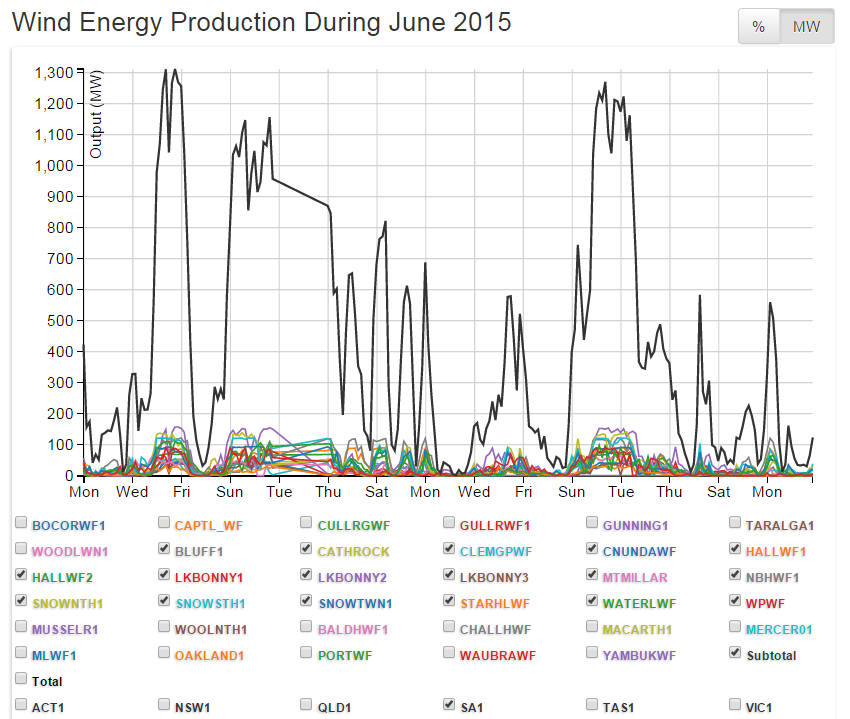
When the AEMO report talks about times when: “high demand coincides with low wind generation, plant outages, or low levels of imports, South Australia may experience supply shortfalls” it’s referring to data like this from June this year (the graph above is from May), showing the chaos that is wind power generation in South Australia:

June 2015 SA

In the AFR piece it talks about occasions when: “Prices have hit the National Electricity Market limit of $13,800 a megawatt hour several times in the state in recent months”.

But, for some strange reason, the AFR fails (or refuses) to join the dots: those occasions – when the spot price paid to generators goes from around $70 per MWh to the market cap of $13,800 per MWh perfectly coincide with sudden (and often, complete) wind power output collapses, as detailed here:

South Australia’s Unbridled Wind Power Insanity: Wind Power Collapses see Spot Prices Rocket from $70 to $13,800 per MWh

The cost of SA’s insane wind power policy is borne, of course, by its beleaguered (remaining) businesses; and struggling households (think old-age pensioners and the thousands of unemployed).

This is a State where some 50,000 homes have been disconnected from the grid – families simply no longer able to pay their power bills; who’ve been reduced to lighting their homes with candles, and, unable to power a fridge, using Eskies (coolers) to keep their perishables – cooking on wood stoves and trying to keep warm using barbeques.

With the fall-out from its wind power fiasco unfolding fast, hundreds of businesses will hit the wall; and thousands more households will soon get to join the tens-of-thousands, already sitting freezing (or boiling) in the dark.

SA power prices to surge by $150 a year, report warns
The Advertiser
David Nankervis
22 October 2015

POWER prices will surge up to $150 a year for hundreds of thousands of householders under controversial changes to electricity charges, an investigative report warns.

The SA Council of Social Services report also says small businesses face a 50 per cent rise in power costs and that this could force some to close.

The findings are based on a SACOSS investigation into the impact of rule changes by the Australian Electricity Market Commission.

The change is designed to shift the demand for power away from peak periods to take pressure off the network.

In response to the new rules, SA Power Networks has proposed introducing a monthly network charge calculated on a customer’s highest half-hour of energy use between 4pm and 9pm on any given day.

This will provide a “pricing signal” to customers to ration the use of appliances, SAPN spokesman Paul Roberts said.

“That means not turning on all major appliances at once during peak periods such as tea time on a hot day, instead delaying using the dishwasher or washing machine until later,” he said.

But SACOSS executive director Ross Womersley said the changes, beginning as early as 2017, would see half of all householders worse off.

“It would be madness for this to proceed and any changes should be deferred for at least a few years,” he said.

“And this new system should be introduced only on a voluntary basis, which would allow people to opt in only if they believe they will be better off.

“This is because people on low income and many other householders would be worse off.”

According to the SACOSS report, which will be submitted to SAPN as part of the network company’s consultation process:

APPROXIMATELY 50 per cent of householders would be worse off

THE biggest bill increases could reach $150 a year

THE biggest savings could be just $10 a year

HALF of small businesses would be worse off

ALMOST one-in-five small business would face a 50 per cent increase in energy costs

The report also said there was “limited (public) support” for the changes to the billing system.

SACOSS research revealed consumers were concerned about big variation in bills amounts, making it more difficult to budget for electricity costs.

The report said this would have a serious impact on low-income households over summer.

Mr Roberts said SAPN invited “consultation” on its proposed billing changes earlier this month because “we know people care about electricity prices”.

“We’re not only consulting on the detail of the changes, but also an appropriate transition that protects the interests of customers and gives them time to adjust to the changes.
The Advertiser

studying candle

Wind Weasels Have No “Concern”, for Anything But MONEY!

Deadly Aircraft/Turbine Disaster at Highland Wind Farms ‘Just a matter of time’

plane wind-farm-scotland

****

A couple of weeks back, we looked at a report on how the RAF’s best of the best have been involved in dozens of near misses with these things in the UK, unnecessarily risking their lives every time they hit the skies:

RAF’s Top Guns Call Wind Farms a ‘Disaster in the Making’ for Flyers

The predictably glib and callous response from the wind industry and its parasites is that the risk of life and limb to flyers is just another one of those pesky “concerns” to be glossed over with a PowerPoint presentation, some soothing words and promises to fully “consult” stakeholders. Provided the consultation of “stakeholders” includes air crash investigators, paramedics and mortuary owners, then the wind industry will have truly covered the field.

You see, the risks to flyers are not merely “concerns”, they’ve become deadly reality. In the post above were referred to a pilot and his three passengers killed in a light plane in South Dakota, as it struck a turbine blade in foggy conditions; and we also referred to a highly experienced Ag pilot who was killed when his plane slammed into a wind farm MET tower.

Following on from the fears of the RAF’s Top Guns, light aircraft pilots in Scotland are predicting the obvious, inevitable and thoroughly unnecessary disaster, that’s just waiting to happen.

Pilots warn of a disaster as wind farms flourish
Sunday Express
Paula Murray
4 October 2015

Light aircraft pilots have warned it is “just a matter of time” before wind farms cause a “disastrous” accident in Scotland.

Small planes along with helicopters, gliders, microlights and other hobbyists make up the biggest user group of the UK airspace in terms of low level flying and contribute some £3billion to the economy supporting close to 40,000 jobs.

Member organisations admit the fast-growing renewables sector has created some “fairly significant” issues which they have fought hard to resolve.

Their main concerns relate to downwind turbulence from the turbine blades plus problems with visibility especially in poor conditions.

The fast pace of development mean maps and charts are often well behind of the size of existing farms and new developments with anenometer masts springing up to scout potential development sites.

Last month this newspaper revealed RAF pilots had reported a catalogue of near misses with wind farms and are making over 1,000 manual corrections to their charts every month to try and keep up with the changes.

However, general aviation industry is also struggling with the pace of development.

Last night the Light Aircraft Association (LAA) warned there was potential for a mid-air disaster.

LAA inspector Neil Geddes, of Bridge of Weir, Renfrewshire, said: “Certainly there is a risk.

“You only really understand how cluttered parts of Scotland are with wind turbines when you are flying a light aircraft – you won’t really get the picture tens of thousands of feet high on board a passenger plane.

“They cause downwind turbulence which can be an issue but at least we can spot them and take evasive action.

“It is the anenometer masts put up to measure wind speed and such like that are the real problem. They are practically impossible to see because they are so tall and slim. If you don’t know there is one on your flight path – and lets face it, it takes maps a year to catch up and by then there will be more of them – there is little you can do.

“In certain weather and light conditions they will be impossible to detect. It’s only a matter of time before we have a disastrous accident in our hands.”

Microlight aircraft instructor Colin MacKinnon, who operates Scotland’s oldest airfield in Strathaven, Lanarkshire, near to Whitelee wind farm which is among the largest in Europe, said new developments had the potential to put people out of business unless they were willing to put up a fight.

He added: “For about four years, I spent at least one day a week to respond to wind development planning applications and despite promises of community benefits we never received a penny of any funds, which is a bit frustrating.

“If Whitelee decided to expand eastward and was given the planning permission to do so we’d be out of business.

“While millions of pounds have been spent to investigate the impact and guarantee the safety of commercial aviation such as relocating radars to avoid problems with readings, very little has been done for the general aviation sector which is us.

“One of the issues is turbulence. There is no research done as to how close to a turbine it will be safe to fly. We do not have the resource to fund such studies unlike the wind industry which has millions.

“So we err in the side of caution. None of us is brave or stupid enough to be a test pilot to see how close to a turbine you can fly before your plane is ripped to shreds.

“I think we are among the most experienced in the world when it comes to flying safely in the vicinity of turbines with Whitelee so near to us.”

Over the past five years there have been around 10,000 applications to construct approximately 24,000 turbines across the UK.

With prime locations already in use developers are looking at alternative sites, many of which are closer to population and activity centres.

A UK Government report to general aviation from earlier this year admitted some airfields had their operations threatened by wind turbine developments.

The LAA also admitted some energy companies were eyeing “inappropriate” spots for their structures.

CEO Stephen Slater said: “I would say that more than 90 per cent of the turbines run no aviation issues.

“The general aviation sector is the main user of low level air space. It’s not just light aircrafts we are talking about but also helicopters, gliders, microlights, parachuters and so on.

“But we do have certain factors that have to be considered. There is the risk of potential collision especially in poor, deteriorating conditions when turbines or masts near an airfield may limit the pilot’s options of approach and we know of the radar issues with turbines interfering with readings.

“We are also aware of the concerns over turbulence with anecdotal evidence from pilots.

“But I would say that over the years we have developed a good working relationship with the wind energy industry to mitigate any problems that may occur.”

Meanwhile campaigners opposing wind farms have drawn information from abroad to highlight issues to aviation.

Christine Metcalfe, of Loch Avich, Argyll, has requested confirmation under Freedom of Information legislation from Civil Aviation Authority that turbines and turbulence from them do not impact emergency landings at airports such as Prestwick in Ayrshire and Glasgow after receiving evidence from Australia, USA and Europe on safety issues.

She raised concerns Whitelee was constructed without appropriate safeguards in place and now wants to know what sort of radar and safety impact studies were carried out prior the vast development went up.

Ms Metcalfe also wants to know why there has been no studies into the effect turbulence from wind farms has on planes when the organisation itself said in 2012 there was an “urgent need” for an assessment.

CAA has issued guidance to aerodrome operators saying a “large number of turbines in an area” will have a cumulative effect that is “of far more significant concerns” but it is yet to respond to the FoI request in more detail.

The anti-wind farm campaigner said: “I have learned that during the early 90s the management of the CAA were very supportive of the campaign involving resistance wind turbines as they had real and valid concerns even then. It is a great pity that times appear to have changed somewhat – almost certainly due to governmental pressures.

“Without the overall checks and balances in place for this technology, if such pressures were applied they are being proven to be misguided at best and at worst contributing to dangerous decisions being made.”
Sunday Express

plane_new_crop_t607-665x385

Frauds, Crooks and Criminals

Demonstrating daily that diversity is not strength!

Family Hype

All Things Related To The Family

DeFrock

defrock.org's principal concern is the environmental and human damage of industrial wind turbines on rural communities

Gerold's Blog

The truth shall set you free but first it will make you miserable

Politisite

Breaking Political News, Election Results, Commentary and Analysis

Canadian Common Sense

Canadian Common Sense - A Unique Perspective from Grassroots Canadians

Falmouth's Firetower Wind

a wind energy debacle

The Law is my Oyster

The Law and its Place in Society

Illinois Leaks

Edgar County Watchdogs

stubbornlyme.

My thoughts...my life...my own way.

Oppose! Swanton Wind

Proposed Wind Project on Rocky Ridge

Climate Audit

by Steve McIntyre

4TimesAYear's Blog

Trying to stop climate change is like trying to stop the seasons from changing. We don't control the climate; IT controls US.

Wolsten

Wandering Words

Patti Kellar

WIND WARRIOR

John Coleman's Blog

Global Warming/Climate Change is not a problem