Wind and Solar….Nothing more than Unaffordable Novelty Energy!

Top Danish Economist Bjoern Lomborg Declares Wind And Solar Energies A “Fata Morgana” …”Powerless And Expensive”!

LomborgThe German online Die Welt here has a commentary on wind energy by Danish economist Bjorn Lomborg. The title of his guest commentary: “Wind energy, powerless and expensive“.

Hat-tip Peter H at Facebook.

Wind and sun energy are often viewed by fossil fuel critics as the go-to green energies. But careful analyses show that these energies are in reality impractical due to their haphazard supply and very poor efficiency. Most wind installations fail to reach 20% of their rated capacities; sun only provides power when it’s daytime and not cloudy. The figures that Lomborg presents are sobering, inconvenient and totally discouraging for wind and sun power proponents.

Citing the International Energy Agency, Lomborg writes so far today only 0.4% of global energy comes from wind and sun, despite the tens of billions of dollars invested in the energy sources. He adds:

Even in 2040, if all governments stick to their promises, sun and wind will cover only 2.2 percent of the world’s energy by 2040.”

Lomborg says that the reason why sun and wind will be “no decisive solution against climate change” is the energies’ inability to be effectively stored. He calls the belief that the energies are cheaper than fossil fuels a “Fata Morgana”.

The problem remains that storage technologies today are cumbersome, horrendously expensive and thus unfeasible. Wind and sun remain a luxury for the rich. Lomborg explains to readers how wind energy are dependent on subsidies, and that without them they make no sense. The Danish star economist points out that not only do wind and sun need subsidies, but now also so do fossil fuel plants so that they can remain on standby when the wind and sun go AWOL. He also says that wind and sun only save about half of the claimed CO2 emissions, and that under some circumstances they actually cause greater emissions.

$131 trillion for 1°C less warming

He writes the planned expansion of green energies by the year 2040 will cost 2.3 trillion dollars and result in only in a mere 0.o175 °C less temperature rise by the end of the century (using the climate forcing figures provided by the climate models).

That means 1°C of theoretical less warming would cost 131 trillion dollars! If there ever was a new definition for insanity, that’s it.

– See more at: http://notrickszone.com/2015/10/25/top-danish-economist-bjoern-lomborg-declares-wind-and-solar-energies-a-fata-morgana-powerless-and-expensive/#sthash.BcQQl393.SHzlouYB.dpuf

Renewable Energy is Unaffordable, Unreliable, and Not Fit for Commercial Use…

Tom Steyer: Wrong on the facts, economics and morality… And “all in for 2016.”

Guest post by David Middleton

If being green was a mental illness, this guy would be the poster child…

HOME | NEWS | POLICY | ENERGY ENVIRONMENT
Dem mega-donor all in for 2016

Billionaire environmentalist Tom Steyer plans to invest at least as aggressively in the 2016 presidential election as he did last year, when he became the biggest individual donor on either side of American politics.

[…]

Steyer is undeterred by critics who say he squandered more than $75 million of his own money supporting Democratic candidates who promised tough action on climate change — half of whom lost — during the 2014 election cycle.

The California-based former hedge fund manager, who said recently that he had quit investing “cold turkey” to focus full-time on climate change, refutes this charge of failure. He points out that last year was “an absolutely terrible” one for the Democratic Party, which lost control of the Senate to Republicans.

[…]

Steyer sees the 2016 presidential election as his greatest opportunity yet to turn more Americans into climate change activists and to pressure candidates to present detailed plans to reach his target of getting 50 percent of U.S. power from clean energy sources by 2030.

[…]

Steyer has already spent at least $5 million this campaign cycle to convince voters to pressure politicians on climate change. That’s a major investment at this early stage that puts him on pace with the biggest super-PAC donors on the Republican side.

Last week he announced a “seven-figure” advertising campaign in early-voting states, and his super-PAC NextGen Climate is investing heavily in digital technology and has opened offices in four key states: Iowa, New Hampshire, Florida and Ohio.

[…]

NextGen ran ads attacking the Koch brothers in the midterm election season, but asked whether he would do so again, Steyer said he is now less interested in negativity and more concerned about telling a positive story about why people should care about climate change.

“Their influence is gigantic,” Steyer said of the Kochs.

[…]

“They’re much bigger. They have much more money,” Steyer added. “Of course that’s important. … [But] we have to rely on the fact that the facts are on our side, the morality is on our side and the economics are on our side.

“And, you know if that weren’t true, we wouldn’t have a chance in hell.”

Hey Tom! It ain’t true…

“We have to rely on the fact that the facts are on our side”…

World Surface Temperature Index -vs- Atmospheric Carbon Dioxide Concentration since 1997 to present

The facts are:

  1. There has been no global warming since the late 20th century.
  2. The climate is far less sensitive to changes in atmospheric CO2 than the so-called consensus says it is.
  3. Your “50 by 30” delusion would not affect the Earth’s climate in any statistically significant manner.

“The economics are on our side.”

The economics are on the side of natural gas and nuclear power.

“The morality is on our side.”

WSJ_Lomborg

OPINION COMMENTARY
This Child Doesn’t Need a Solar Panel
Spending billions of dollars on climate-related aid in countries that need help with tuberculosis, malaria and malnutrition.

By BJORN LOMBORG
Oct. 21, 2015 6:36 p.m. ET

In the run-up to the 2015 U.N. Climate Change Conference in Paris from Nov. 30 to Dec. 11, rich countries and development organizations are scrambling to join the fashionable ranks of “climate aid” donors. This effectively means telling the world’s worst-off people, suffering from tuberculosis, malaria or malnutrition, that what they really need isn’t medicine, mosquito nets or micronutrients, but a solar panel. It is terrible news.

[…]

http://www.wsj.com/articles/this-chi…nel-1445466967

The morality is on your side?

The Utterly Futile Experiment with Wind Power, is Showing Signs of Collapse.

Britain’s Insanely Expensive & Utterly Pointless Wind Power Fiasco Exposed

ICU Respiratory_therapist

****

When it comes to their demand for electricity, the power consumer has a couple of basic needs: when they hit the light switch they assume illumination will shortly follow and that when the kettle is kicked into gear it’ll be boiling soon thereafter. And the power consumer assumes that these – and similar actions in a household or business – will be open to them at any time of the night or day, every day of the year.

For conventional generators, delivering power on the basic terms outlined above is a doddle: delivering base-load power around the clock, rain, hail or shine is just good business. It’s what the customer wants and is prepared to pay for, so it makes good sense to deliver on-demand.

But for wind power generators it’s never about how much the customer wants or when they want it, it’s always and everywhere about the vagaries of the wind. When the wind speed increases to 25 m/s, turbines are automatically shut-off to protect the blades and bearings; and below 6-7 m/s turbines are incapable of producing any power at all.

It’s no wonder that the Brits have noticed that wind power is nothing more than a sick joke.

Even with the most geographically widespread grid-connected set of wind farms in the world (the 3,669 MW of wind power capacity connected to Australia’s Eastern grid across SA, Victoria, Tasmania and NSW) there are dozens of occasions each year when total wind power output struggles to top 2% of installed capacity – and hundreds when it fails to muster even 5%:

The Wind Power Fraud (in pictures): Part 1 – the South Australian Wind Farm Fiasco

The Wind Power Fraud (in pictures): Part 2 – The Whole Eastern Grid Debacle

And see our posts here and here and here.

May 2015 National

Now, if the power consumer was given advance warning of when these total output failures were going to occur, they might simply reconsider their selfish demands of having illumination after dark or that hot cuppa in the morning. That way, they might still consider wind power as some kind of “alternative” for conventional power?

But, so far, power consumers remain stubbornly selfish; wedded to the idea that when they hit the switch, their power needs will be satisfied that very instant (the cheek, hey?).

And that’s where the myth about wind power being some kind of “alternative” falls in a heap.

Unless you’re prepared to live like stone-age hermits, power delivered at the whim of mother nature (which in practical terms means no power at all, hundreds of times each year) is NO alternative for power delivered on-demand; anytime of the day or night; every single day of the year – and in volumes sufficient to satisfy all consumers connected to the same network, at the same time.

It was only a matter of time before the data (you know, the stuff that ‘inconvenient’ facts are made of) came to light and exposed the great wind power fraud for what it is: Britain, no exception.

Derek Partington has been perusing the woeful numbers over the last few years and produced the dismal results in this paper: Intermittency of UK Wind Power Generation 2013 and 2014

Derek has a degree in Physics; was formerly a Chartered Engineer and a member of both the Institute of Physics and the Institute of Measurement and Control. He worked for British Steel for 30 years and Local Government for 10 years, in both cases as a Project Manager and Business Analyst; and has been undertaking research into wind turbines for over 6 years.

Here’s the thrust of Derek’s wind industry killing paper.

Intermittency of UK Wind Power Generation 2013 and 2014
Grid, UK
Derek Partington
April 2015

Executive Summary:

This summary covers the principal findings of an analysis of electricity generation from all the UK wind turbines farms which are metered by National Grid, covering the period from January 2013 to December 2014.

The analysis shows:

Monitored wind turbine output (as measured by the National Grid) increased from 5,894MW to 8,403MW over the period.

The average capacity factor of all monitored wind turbines, onshore and offshore, across the whole of the UK, was 29.4% in 2013 and 28.8% in 2014.

The monthly average capacity factor varied from 11.1% (June 2014) to 48.8% (February 2014).

The time during which the wind turbines produced less than 10% of their rated capacity totalled 3,278 hours or 136.6 days over the two year period.

The time during which the wind turbines produced less than 5% of their rated capacity totalled 1,172 hours or 48.8 days over the same period.

Minimum wind turbine outputs averaged 132MW (1.8% of capacity) in 2013 and 174MW (2.1%) in 2014 as measured over 30 minute intervals.

Variations in output of 75 to 1 have been observed in a single month.

Maximum rise and fall in output over a one hour period was about 1000MW at the end of 2014 with a trend increase of about 250MW per year as measured over four years.

There is no correlation between UK wind turbine output and total UK electricity demand, with output often falling as demand rises and vice-versa.

The conclusions to be drawn from the analysis are that the increase in nominal capacity:

Does not increase the average wind turbine capacity factor.

Does not reduce the periods of low (less than 10% of installed capacity) or very low (less than 5%) output.

Does not reduce intermittency as measured by average monthly minimum output.

Does not reduce intermittency or variability as measured by maximum rise and fall in output over one hour period.

Does not indicate any possibility of closing any conventional, fossil-fuel power stations as there is no correlation between variations in output from wind turbines and demand on the Grid.

Therefore, based on the above, there is no case for a continued increase in the number of wind turbines connected to the Grid, or for the associated subsidies for wind energy, since this is an ineffective route to lower carbon dioxide emissions.

In April 2013 The Scientific Alliance published my analysis of electricity generation from all the UK wind turbines which are metered by National Grid, covering the period from January 2011 to December 2012.

This analysis showed:

The average capacity factor of all monitored wind turbines, both onshore and offshore, across the UK was 33.2% in 2011 and 30.7% in 2012

The average capacity factor in any given month varied from 16.2% to 50.8%.

The time during which the wind turbines produced less than 10% of their rated capacity totalled 3,165 hours and the time during which the wind turbines produced less than 5% of their rated capacity totalled 1,200 hours.

The output from wind turbines was extremely intermittent with variations by a factor of 10 occurring over very short periods.

Despite the fact that wind turbines only operate at about 30% of rated capacity on average and are exceedingly variable in their output, leading to long periods of very low output, the wind turbine fleet in the UK has increased significantly since 2012, driven entirely by government policy.

On 5 January 2015 renewableUK (the organisation representing the wind industry) headlined “Electricity needs of more than a quarter of UK homes powered by wind in 2014”.

They said that official statistics from National Grid showed that record amounts of electricity were generated by wind power in 2014:

Wind generated enough electricity to supply the needs of more than 6.7 million UK households last year; a 15% increase on the amount generated in 2013 (up from 24.5 terawatt hours to 28.1TWh in 2014) – just over 25% of all UK homes all year round.

Wind farms feeding into the grid, as well as smaller sites connected to local networks, provided 9.3% of the UK’s total electricity supply in 2014, up from 7.8% in 2013.

Other records were broken in December, with a new monthly high of 14% of all UK electricity generated by wind, beating the previous record of 13% set in December 2013, as well as a new quarterly record of 12% of electricity from wind in the last 3 months of 2014, breaking the previous record of 11% set in Q1 of 2014.

renewableUK continue to state on the Onshore Wind page of their website, “Onshore wind farms reduce CO2 emissions, provide energy security, and contribute to the local and national economy.

“The page also states, “Onshore wind works well in the UK because of the excellent wind resource. It has also become one of the most cost effective forms of renewable energy, providing over 5,000MW of capacity. A modern 2.5MW (commercial scale) turbine, on a reasonable site, will generate 6.5 million units of electricity each year – enough to make 230 million cups of tea.”

On 12 January 2015, the renewableUK home page gave figures “Powered by Wind”: Energy Produced 29,190,769 MWh, powering the equivalent of 6,963,447 homes and giving CO2 reductions (pa) of 12,552,031 tonnes.

These are very impressive figures if taken at face value, but what are the facts behind these statements – can we rely on wind turbines to power our homes and offset the annual release of carbon dioxide from conventional coal and gas burning power stations?

My previous report showed that this could only be true if the wind blew constantly but it does not, it blows very intermittently.

I have continued to analyse the output from the UK wind turbine fleet during 2013 and 2014, as measured by the electricity fed into the grid, in order to determine whether more turbines being brought into operation:

Improves average capacity factors

Reduces the periods of low or very low output

Reduces intermittency

Makes it possible to close any conventional, fossil-fuel power stations by making up for additional demand on the grid at peak times and, based on the analysis, to conclude whether wind turbines in the UK are making any significant contribution to a reduction in CO2 emissions.

Installed and Monitored Capacity

The installed capacity of wind turbines in the UK was quoted as 11,978MW by renewableUK on 12 January 2015 (7,936MW onshore and 4,042MW offshore). By comparison, on the same date the NETA (New Electricity Trading Arrangements) website quoted a capacity connected to the grid of 8,403MW, i.e. only 70% of the total installed capacity quoted by renewableUK.

This ratio has not changed over the years – at the end of 2011 the installed capacity of wind turbines in the UK was quoted as 5,772 MW whereas the monitored capacity, i.e. that monitored by the National Grid, was 4,006 MW. The equivalent figures for the end of 2012 were installed 7,777 MW, monitored 5,705 MW.

This analysis uses the NETA data throughout – the capacity connected to and monitored by the grid.

From the data on the NETA website, it is not possible to distinguish between onshore or offshore wind generation, or that from different parts of the UK. However, as this report covers the overall generation picture across the UK and does not break it down by region, this is of no consequence.

Do more wind turbines improve average output?

The average monitored capacity in 2011 was 3,340MW and the average output was 1,109.5MW giving a 33.2% capacity factor. In 2012 the equivalent figures were 4,696MW monitored by the grid, with an average output of 1,439.5MW or a capacity factor of 30.7%. The data points for each 30-minute period as monitored by the grid are averaged over the full month and a figure for output as a percentage of monitored power is calculated.

DP1

The figures show a significant variation in the average monthly capacity factor. The July average was 13.7% and that of December 46.7%. So even monthly averages vary by a factor of more than 3, a similar figure to that noted for 2011 and 2012.

DP2

Again the figures show a significant variation from month to month, the June figure being the lowest at 11.1% and February the highest at 48.8% – an increase in variation from month to month of almost 4.4 to1. Therefore from the data analysed the answer is “No, more wind turbines do not, on average, improve the average output.”

This despite there being 2.5 times increase in the installed (average) capacity from 2011 to 2014.

In fact, month to month variation, even in output averaged over the month, has increased significantly in 2014 compared with the previous three years.

If this is to be expected, simply because the installed capacity has increased, then the variation in output may be expected to increase still further as more turbines are added to the Grid, although at this stage we could equally well assume that this is primarily an artifact of the inherent variability of the wind resource.

Do more wind turbines reduce periods of low or very low output?

I have taken low output as being less than 10% of installed capacity and very low output as being less than 5% of installed capacity. Any percentage could have been chosen, but I believe that these are reasonable figures if one is to place any reliance on a sustainable source of supply.

In 2011 there were a total of 485.5 hours, or 20.2 days when output from the total UK wind turbine fleet fell to less than 5% of monitored capacity. The equivalent figures for 2012 were 714.5 hours or 29.8 days.

In 2011 there were a total of 1,370 hours, or 57.1 days when output from the total UK wind turbine fleet fell to less than 10% of monitored capacity. The equivalent figures for 2012 were 1795.5 hours or 74.8 days.

The table below gives the same data for 2013 and 2014, i.e. the total hours per month and per year where total output fell to less than 5% and less than 10% of installed capacity.

DP3

The data show no significant difference between the 2011 and 2013 periods and the 2012 and 2014 periods.

It can be seen that there are significant deviations from month to month. In the “worst” month, September 2014, the output from the total UK turbine fleet was less than 5% of their installed capacity for almost 25% of the time. In the same month the turbines failed to reach 10% of their capacity for over 62% of the time.

The graph for September 2014 is given below.

DP4

Over the 2-year period there was a total of 1,172 hours, or 48.8 days, when the output was less than 5% of nominal installed capacity.

This compares with 50 days over 2011 and 2012.

Looking at where output was less than 10% of installed capacity, for the two year period this was 3,278 hours , or 136.6 days compared with 131.9 days over 2011 and 2012.

It should be noted that 136.6 days is well over 4 months in total over the 24 month period.

Therefore from the data analysed the answer is “No, more wind turbines do not reduce periods of low or very low output”. (Note: low output is a function of natural variation in the strength of the wind – which, of course, is not influenced by having more wind turbines).

Do more wind turbines reduce intermittency?

The Oxford English Dictionary defines intermittent as “occurring at irregular intervals; not continuous or steady”. It is obvious that wind in the UK intermittent. It is not steady – sometimes the wind blows strongly, sometimes weakly and sometimes not at all. But here we are not concerned with the strength of the wind but its effect on the output of the UK wind turbine fleet.

To demonstrate the intermittency I have plotted the total UK wind turbine output for every month over the 24 months studied.

The graph on the following page shows data from a typical month, from March 2014.

It can be seen that during March 2014, the wind was always blowing somewhere in the UK as the output from all the wind turbines feeding the National Grid never fell to zero. However, the output varied dramatically from day to day, with a minimum output of 75MW and a maximum of 5,582MW – a variation of almost 75-fold.

DP5

This graph is quite typical and detailed graphs, with additional data, are given for each of the 24 months analysed in the appendix.

Intermittency can also be presented as daily minima and maxima in any month as shown in the bar chart below for August 2014. This is again a typical month where the average capacity factor was 27.5%.

DP6

On a single day, 2nd August, the variation from minimum to maximum is almost 30-fold.

The following table gives the minimum output during each month over the 2 years for which the data was analysed.

DP7

Therefore the assumption that the wind is always blowing somewhere in the UK may be true, but at times it is barely blowing enough to generate any significant energy.

In 10 out of the 24 months monitored, the minimum output dropped to 1% of capacity or less at some time. It should also be noted that the minimum output levels have not significantly changed since 2011, even with more wind turbines being installed. The equivalent average minima for 2011 and 2012 were 2.1% and 1.5% respectively.

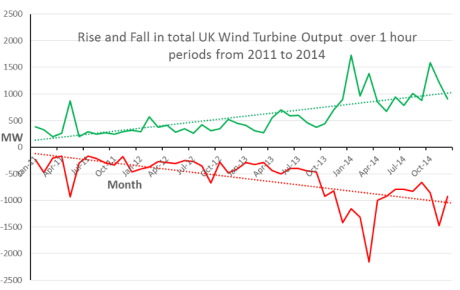
As can be seen the maximum rise and fall has increased significantly as operational capacity has increased. This is the variation which the grid has to cope with, bringing in conventional fossil fuelled stations when output falls and taking them off line when it rises.

The above data can be plotted to give a trend showing the year on year increase.
DP8

It can be seen that The National Grid is now having to cope with variations in output (intermittency) of over 1,100MW over one hour periods. It can also be seen that this variation is increasing by about 250MW per year.

It should also be noted that 1,100MW is 13% of the installed capacity and is over 40% of the average monthly output in 2014.

The peak fall over one hour was 2,153MW in March 2014, a figure which is likely to be exceeded as more turbines are connected to the grid.

Therefore, from the data analysed the answer is “No, more wind turbines do not reduce intermittency. In fact using two alternative measures, minimum output during the month and variation in output over 1 hour, then more turbines increase the impact of intermittency”.

Do more wind turbines make it possible to close any conventional, fossil-fuel power stations by making up for additional demand on the grid on peak times?

If the variation in output matched the increase or decrease in demand on the grid, then there would be no need for back-up in the form of conventional, fossil-fuel power stations.

In order to see if output from wind turbines in any way matches demand, the total output has been plotted against demand on the grid over the last seven months of 2014. In order to fit the graphs on the same scale, UK wind turbine output has been plotted alongside grid demand divided by ten.

A typical week, from October 2014, is shown below. As expected, there is no correlation between output and demand. The output varied over the week from a high of 6,000MW on 6 October to a low of 200MW on 12 October with no form of repetitive pattern in between.

DP9

The graph above does show a pattern on some days where output from wind turbines falls as demand rises and vice versa, which is not atypical. In fact over Christmas Day 2014, if wind were relied on to cook the turkey, then there would have been a public outcry as output dropped steadily from over 6,000MW on Christmas Eve to under 200MW on Boxing Day.

DP10

Therefore, from the data analysed the answer is “No, more wind turbines do not make it possible to close any conventional fossil fuel power stations”.

As expected, analysis shows that there is no correlation between variations in output from wind turbines and demand on the Grid. Often the opposite is true – when demand rises, output from wind turbines falls and vice versa. This has a significant negative effect as back-up has to be provided from conventional, fossil-fuel power stations not only to cater for increase in demand on the Grid at peak times but also to cover for any possible fall in output from the UK wind turbine fleet at the same time. (It is understood that fossil-fuel generators being run in stop-start mode to provide this back up are very inefficient and may be producing significant additional carbon dioxide than when operating in their designed steady state.) So, taking some of the renewableUK statements:

“Electricity needs of more than a quarter of UK homes powered by wind in 2014” – should this be “Electricity needs of more than a quarter of UK homes powered by wind in 2014 some of the time”?

“Wind farms feeding into the grid … provided 9.3% of the UK’s total electricity supply in 2014” – should this read “Wind farms feeding into the grid … provided 9.3% of the UK’s total electricity supply in 2014 when averaged over the year.”

“Other records were broken in December, with a new monthly high of 14% of all UK electricity generated by wind” – should this be counterbalanced by “but in June 2014 electricity generated by wind was only one quarter of this figure”.

“Onshore wind farms reduce CO2 emissions, provide energy security….”. Taking the analysis in this report, and the previous one, there is no basis for this statement.

There is patently a need to provide back-up for wind turbines which are feeding into the Grid and therefore CO2 emissions may possibly be increased rather than decreased as conventional, fossil-fuel power stations have to be operated inefficiently in order to provide this back up. Similarly there is no energy security if output can fall from over 6,000MW to under 200MW over a 42 hour period as it did over Christmas 2014.

Based on the above, I would like to see evidence that any conventional power station has been able to be closed down as a result of the introduction of over 8,000MW of wind turbine capacity feeding into the National Grid. Similarly I would like to see evidence of reductions in CO2 emissions through the introduction of wind turbines where a holistic approach to meeting the demand on the Grid is taken into consideration.

Conclusions

Over the period studied, January 2013 to December 2014 inclusive, wind turbine operational capacity connected to the UK Grid has increased from 5,894MW to 8,403MW. The operational capacity in January 2011 was 2,490MW; therefore there has been an increase of almost 3.4x over the four year period.

The conclusions to be drawn from the data analysis are:

An increase in the operational capacity does not improve average output. In fact the average monthly capacity factor has fallen over the periods studied, dropping from 33.2% in 2011 to 28.8% in 2014.

An increase in the operational capacity does not reduce the periods of low or very low output as measured by the number of hours per year when output was low (less than 10% of installed capacity) or very low (less than 5% of installed capacity). There is a variation from year to year but no pattern emerges. The mean low output over the four years was 1,617 hours/year with a standard deviation of 197 hours/year and the mean very low output was 599 hours with a standard deviation of 96 hours.

An increase in the operational capacity does not reduce intermittency. If taken as a measure of intermittency, the average monthly minimum expressed as a percentage of installed capacity was 1.9% with no significant variation from year to year.

Taking maximum rise and fall in output over one hour period as a further measure of intermittency, the National Grid is now having to cope with variations in output of over 1,100MW over one hour periods, with this variation increasing by about 250MW per year.

This is very significant as it represents the changes in output which the Grid has to cope with and which has to be compensated by conventional fossil fuelled power stations.

An increase in the operational capacity does not indicate any possibility of closing any conventional, fossil-fuel power stations as there is no correlation between variations in output from wind turbines and demand on the Grid. Often the opposite is true – when demand rises, output from wind turbines falls and vice versa.

This has a significant negative effect as back-up has to be provided from conventional, fossil-fuel power stations not only to cater for increase in demand on the Grid at peak times but also to cover for any possible fall in output from the UK wind turbine fleet at the same time.

Therefore, taking the four criteria above, there is no case for a continued increase in the number of wind turbines connected to the Grid.

As stated in my previous report, it is incumbent upon the Government to ensure that the British consumer is getting value for money from industrial wind turbine installations and that they are not just paying subsidies to developers and operators (through ROCs) whilst getting nothing back in return in terms of CO2 emission reductions through the supplanting of fossil-fuelled power generation.

Based on the results of this and my previous analysis I cannot see why any policy for the continued increase in the number of wind turbines connected to the Grid can be justified.
Derek Partington

Derek’s previous paper can be found here: Intermittency of UK Wind Power Generation 2011 and 2012


turbine-2_3153749b

Wind Power Shares Plummeting… “Green” Jobs Axed!

US Wind Power Outfits’ Shares Plummet – Hundreds of ‘Green’ Jobs Axed

share traders

****

Remember all those stories about the wind industry providing millions of groovy, well-paid ‘green’ jobs – as secure as Fort Knox?

No?

Sure, you’ll hear mention of loads of promised wind industry jobs – in fictional retellings from wind industry spruikers – as they wail about dreaded ‘uncertainty’ – causing bankers to baulk and investors to flee; and as they demand (with menaces) that governments maintain essential, massive and endless subsidies until the end of time.

But, as is almost always the case with wind industry drivel, dreams and reality fast become an ugly amalgam, of what passes for wind industry ‘truth’.

When economists scroll through the books, however, claims about wind industry employment evaporate like snowflakes in summer – and, instead, the hard numbers show that the places where these things proliferate, are suffering from declining employment in real industries, particularly those with the tendency to use more than just a little power in the processes of production:

Wind Power Subsidies Crushing Families & Killing Thousands of Real Jobs

The Wind Industry’s Jobs Bonanza Myth Smashed, Again

It’s a confusing paradox, to be sure.

You see, on the one hand we’re told that the wind industry delivers a product, that customers can’t get enough of (at prices starting somewhere near “free” – and getting cheaper all the time), but, strangely, the merest mention or even hint that wind power subsidies might be trimmed or, heaven forbid, chopped, has wind industry parasites descending into a fixed state of apoplexy.

During their descent, wind industry spinners shout even louder about millions of new jobs, that are always just beyond the horizon; attainable – but if, and only if, the massive subsidies presently in place are set in stone. Here are a couple of pieces peppered with precisely that type of self-serving and deluded ranting.

Panel seeks to extend freeze on Ohio green energy targets
Associated Press
Julie Carr Smyth
1 October 2015

Government requirements for the use of solar, wind and other forms of renewable energy by Ohio power companies would be suspended indefinitely under recommendations released Wednesday by a legislative panel. The Energy Mandates Study Committee’s report cites legal uncertainty and a need for “greater clarity” surrounding proposed federal clean power rules among reasons for the recommendation.

COLUMBUS, Ohio — Government requirements for the use of solar, wind and other forms of renewable energy by Ohio power companies would be suspended indefinitely under recommendations released Wednesday by a legislative panel.

The Energy Mandates Study Committee’s report cites legal uncertainty and a need for “greater clarity” surrounding proposed federal clean power rules among reasons for the recommendation. The suggestion drew swift criticism from environmental groups, alternative energy businesses, Democrats and Gov. John Kasich.

Committee chairman Troy Balderson, a Zanesville Republican, said the report represents a starting point for debate as legislation proposing changes to Ohio’s mandates is drafted.

“Look, I know what the headline on the report’s going to be. There’s more to it than that,” he said. “And there will continue to be more to it than that. Now we have to go through the legislative process.”

The panel’s additional recommendations include ultimately switching from mandates to an incentive system to encourage use of renewables and efforts toward energy efficiency; expediting the regulatory process for approving utilities’ energy-efficiency plans; and ensuring advanced-energy projects receive maximum credit.

The panel was charged with reviewing an Ohio law requiring utilities to generate 25 percent of electricity from alternative and advanced sources by 2025 and to meet certain energy efficiency targets.

The committee was created as part of a compromise brokered by Kasich amid efforts to repeal the targets outright. The deal placed a two-year freeze on phasing in existing mandates while the issue was studied. If legislators fail to act, the law would resume as planned in 2017.

The administration signaled dissatisfaction with extending the freeze any further.

“A continued freeze of Ohio’s energy standards is unacceptable and we stand willing to work with the Ohio General Assembly to craft a bill that supports a diverse mix of reliable, low-cost energy sources while preserving the gains we have made in the state’s economy,” Kasich spokesman Joe Andrews said.

Ohio is among states that have sued over the Environmental Protection Agency’s Clean Power Plan, which sets targets for carbon dioxide emissions for existing power plants as a means of reducing emissions from 2005 levels by 32 percent by 2030. Kasich has written to President Barack Obama asking him to hold off on implementing the plan until questions are resolved by the courts.

“The US EPA, by promulgation of the proposed CPP, seeks to change the energy landscape significantly across the United States,” the report states.

Senate President Keith Faber said lawmakers and the governor — who was represented in deliberations over the report — may have to “agree to disagree.”

“I know their EPA director has gone and urged everybody to be cautious until we see the implementation of what the president’s new proposals are,” he said. “And so at this point, I’d like to hear their proposal if they think what we’re putting forward is unacceptable.”

Proponents argue that Ohio’s targets were creating jobs and benefiting the environment before they were frozen, and that the state would continue to do so if allowed to proceed.

State Rep. Michael Stinziano, a Columbus Democrat who sat on the Republican-dominated study committee, said the report’s recommendations ignore expert testimony by a number of witnesses “who attested to the positive impacts these standards had on the state until frozen.”

Senate Democrats called on Kasich to fight for restoration of the mandates.

“Allowing the clean energy industry to prosper could result in better products, a healthier population, cheaper prices, and more jobs over time,” they wrote.

Samantha Williams, attorney and energy policy advocate at the Natural Resources Defense Council, said Ohio’s momentum as “a clean energy trailblazer” has stalled.

“Any policies that block progress to regain Ohio’s leadership will only grow the mountain of missed opportunities and keep the state lagging behind its neighbors that are moving forward with clean energy to create jobs, boost their economy and protect public health,” she said in a statement.
Associated Press

The usual grab bag of nonsense is predictably pitched up by Samantha Williams – about wind power being a “clean energy” source; and a serious source of lasting jobs. Although, when the term “lasting” is used, we tend to think of jobs that don’t disappear with the merest hint of reining in a pointless subsidy.

Then there’s the claims about these things generating a “healthier population”!?!. Here’s a few from our archive that tend to suggest the opposite:

SA Farmers Paid $1 Million to Host 19 Turbines Tell Senate they “Would Never Do it Again” due to “Unbearable” Sleep-Destroying Noise

Labor’s Bill Shorten Publicly Ridicules Joanne Kermond – a Victim of Pacific Hydro’s Non-Compliant Cape Bridgewater Wind Farm

Wind Turbine Infrasound: What Drives Wind Farm Neighbours to Despair

Dr Bruce Rapley Slams Australian Medical Association as Totally Unqualified Wind Industry Propagandists

Audacity is the very essence of propaganda; taking patent nonsense, wrapping it in myth and pitching it up with a straight face, has been the core competence of the wind industry from the get go – it’s a skill that will follow it to its already dug and waiting grave.

Here’s another view of a panicked industry on the run, from Oklahoma.

Bill introduced to end wind tax credit
Washington Examiner
Kyle Feldscher
7 October 2015

A senator from the windswept state of Oklahoma wants to remove a tax credit for wind energy from the tax code.

Republican Sen. James Lankford introduced a bill Wednesday, titled the PTC Elimination Act, that would remove the Production Tax Credit from the tax code entirely. The credit expired at the end of 2014, but a renewal is attached to a tax extenders package making its way through Congress.

Lankford, echoing oil industry groups who spoke against the credit last month, said wind energy has become self-sustaining and no longer needs to be subsidized federally.

“I am a fan of an all-of-the-above energy strategy, and I certainly support wind as a large part of that goal,” he said.

“There is no need for the taxpayer to continue to subsidize a wind start-up tax credit.”

In addition to wind, the Production Tax Credit is tied to 11 other sources of renewable energy.

For wind, the tax credit is 2.3 cents per kilowatt-hour for the first 10 years of a facility’s existence. Lankford estimates the tax credit would cost taxpayers $10.5 billion during the next 10 years.

Right now, projects that began before Jan. 1 still qualify for the tax credit. Under Lankford’s bill, the last day any company could receive funds from the credit would be Dec. 31, 2026.

Lankford has campaigned in the past on relying more on fossil fuels, such as natural gas, instead of renewable sources.

Observers say it’s unlikely the bill will make much progress.

Oklahoma is a major player in wind energy. In 2014, the state was ranked fourth for installed wind capacity, according to the American Wind Energy Association.

There are 2,614 wind turbines in Oklahoma that produced about 17 percent of all electricity produced there in 2014, according to the association.

Lankford contends the tax credit has outlived its usefulness and is a redundancy since 37 states already provide incentives for wind energy production. He said wind generation has grown 5,000 percent since the tax credit was instituted in 1992.

Some business groups disagree.

On Monday, 580 companies working in clean energy from around the country signed a letter urging Congress to extend the credit. Meanwhile, 2,000 businessmen and women signed a letter that also called on Congress to extend the tax credit, according to the wind trade group.

The Senate Finance Committee passed the extension of the credit 23-3. That included yes votes from senators on both sides of the aisle.

Rob Gramlich, senior vice president of government and public affairs at the American Wind Energy Association, said he’s hopeful that, contrary to Lankford’s bill, the wind tax credit will be renewed by the end of 2015.

“Hundreds of American businesses employing American workers have also made it clear extending these incentives is critical to plan their business and keep their doors open,” he said. “We will continue to educate all members of Congress about all of wind energy’s benefits to our economy.”
Washington Examiner

Good to see that the same rubbish pitched up by Samantha Williams in Ohio, being recycled by the AWEA’s Rob Gramlich – eerily familiar stuff; as you’d expect from people chanting the same mantra, from the same playbook.

Now, why would wind industry parasites like Samantha Williams and Rob Gramlich be fighting tooth-and-nail to ensure that the wind power subsidy trough is replenished from now until Armageddon?

Here’s a little clue.

After buying binge, SunEdison to cut 15% of workforce
Energy Wire
David Ferris
6 October 2015

SunEdison Inc., the world’s largest renewable energy developer, plans to cut 15 percent of its personnel after a yearlong spending spree and a precipitous drop in its stock price.

The cuts among the company’s 7,300 staff are even deeper than what was originally reported yesterday by Greentech Media. The board of the company decided a week ago to carry out the layoffs in the face of a slowing market and to eliminate redundancies among its many new arms, according to a document filed yesterday with the Securities and Exchange Commission.

SunEdison plans a phone call with investors tomorrow to provide more details.

In the past month, nervous investors have pushed two of the most ambitious and acquisitive clean-energy companies — SunEdison and NRG Energy Inc. — to trim their plans. Both companies have plowed their moneymaking assets into yieldcos, a new investment vehicle that Wall Street loved a few months ago but has now soured on.

The core business of U.S.-based SunEdison is putting together large, complex solar- and wind-energy projects around the world, with operations as far-flung as India, Brazil, England and Massachusetts. In the past year, those operations became more complicated as the company entered new markets and bought up competitors around the globe.

Last November, the company expanded from solar into wind energy with a $2.4 billion purchase of First Wind. In June it bought Continuum Wind Energy, a wind developer in India, for about $620 million, according to Livemint. That same month, SunEdison snapped up a leading wind and solar developer in Central America. In July, it acquired Vivint Solar, a major U.S rooftop solar developer, for $2.2 billion.

Also this year, SunEdison created two yieldcos, which are essentially holding companies for the company’s completed projects. Since those projects are contracted to last decades, yieldcos were meant to provide investors with a long-term, dependable payback in the unpredictable renewable energy business, while giving their parent companies a cheap supply of capital.

Since 2013, at least 10 yieldcos have been created in the renewable energy sphere and received enthusiastic investment until midsummer, when confidence ebbed.

“The business model for many yieldcos is to issue equity, acquire projects and pay out cash flow. When the equity prices go down, that raises their finance cost, which jeopardizes the business model,” said Travis Miller, director of utilities equity research at Morningstar, a research firm.

This week’s news echoes that of NRG Energy, a company with a portfolio that is both different from and similar to SunEdison’s.

NRG’s principal business is operating one of the country’s largest fleets of traditional power plants running on coal and natural gas. In the past several years, the firm has bought its way into a diverse portfolio of clean energy projects, including large wind and solar farms, a rooftop solar installation business and a network of electric vehicle chargers (EnergyWire, Sept. 9, 2014).

NRG has seen its stock drop from a 52-week high of $32 to $18 per share a few weeks ago and a corresponding slide in its yieldco, called NRG Yield.

Three weeks ago, CEO David Crane announced that the company’s clean energy holdings would be reshuffled into a “GreenCo” that stands apart from the company’s traditional businesses (EnergyWire, Sept. 21). NRG hoped its intentions would increase confidence, but the stock has dropped further, to $14.

Growth, abated

At the time of the Vivint acquisition, SunEdison’s CEO, Ahmad Chatila, told Bloomberg that adding a major rooftop solar installer to the portfolio would give the company “unabated growth for 20 years.”

The firm continued to express confidence in its strategy, even as it took on heavy debt from its new purchases and its stock prices sank.SunEdison stock plunged from a high of $31 in mid-July to $9 at market close yesterday. Its two yieldcos, TerraForm Power and TerraForm Global, have experienced similar declines.

One analyst suggested the company’s bold, deal-making approach to energy projects may have not prepared it for the level of financial restraint it needed when participating in financial markets with its yieldcos.

John Hempton of Bronte Capital wrote in a blog post last week that Chatila ought to step down in favor of “someone whose job it is to ensure — and be seen to ensure — that bad projects are not funded.”

“Mr Chatila has built an institution for which he is profoundly unsuitable to run,” Hempton wrote.

Also yesterday, the man at SunEdison who will presumably carry out the layoffs — head of human resources Stephen Cerrone — acquired stock options worth $360,000, according to an SEC document.
Energy Wire

panic-disorder-971

NRG the outfit that has seen “its stock drop from a 52-week high of $32 to $14” in a few weeks, is among a number of wind power outfits blaming its precarious finances on, of all things, the weather:

US Wind Power Outfits Curse ‘El Niño’ for Massive & Mounting Losses

Wind Power Ponzi Scheme Running Out of Puff

SunEdison – also suffering a “precipitous drop” in its share price, from $31 to $9 – is all set to lay off 15% of its 7,300 employees, which, on STT’s maths, translates to almost 1,100 people.

Now, what was all that talk from Samantha Williams and Rob Gramlich about the wind industry creating millions of well-paid, stable jobs that will outlast religion?

And what ever happened to the spruikers’ claims that, investing in wind power was not only groovy and ‘green’, but a solid, one-way bet?

There’s one thing for sure, and that’s that the wind industry, its parasites and spruikers will never be accused of consistency. But, internal inconsistency and blatant hypocrisy is precisely the stuff that wind industry propaganda is made of.

At its base level, this is all about separating fools from their money. As PT Barnum said: “every crowd has a silver lining”. Make sure you’re not part of this crowd.

dirtyrottenscoundrelsoriginal

Why Wynne Pushes Wind…..Follow the Money Trail!

Wind Industry Welfare: How Crony Capitalism Drives the Great Wind Power Fraud

 crony-capitalism

‘Wind PTC Action Hub’: Time to End Energy Cronyism
Master Resource
Robert Bradley Jr.
9 October 2015

“Without the PTC, any mandated wind generation would be an even bigger political problem because its cost inflation would be exposed. The wind-is-competitive-with-fossil-fuels hyperbole would be refuted in real time.”

Congress enacted the Wind Production Tax Credit (PTC) in 1992 as a temporary measure for an “infant” industry.

Decades and nine extensions later, it is time to eliminate the PTC.

Subsidized wind power inflates electricity costs, compromises taxpayers, and destabilizes the electric grid (wind-generated electricity is intermittent).

The huge tax credit allows pricing that ruins the economics of steady, conventional generation sources. Wind power, indeed, is the perfect imperfect energy.

The PTC It is most beneficial to wealthy wind developers who are able to reduce their tax rate at the expense of the rest of us. It is past time to end corporate welfare for this mature, and in their own words,competitive, wind industry.

Obama Needs the PTC

President Obama and the EPA’s aggressive regulation of existing power plants amounts to a federal takeover of the electricity system. One of the goals of this regulation is to shift electricity from affordable and dependable sources like coal toward expensive and unreliable sources like wind. (On-grid solar does the same thing.)

Without the PTC, any mandated wind generation would be an even bigger political problem because its cost inflation would be exposed. The wind-is-competitive-with-fossil-fuels hyperbole would be refuted in real time.

Extending the Wind PTC helps Obama/EPA get away with this phase of their forced energy transformation. It is past time to let wind producers stand on their own merit.

In short, a vote for the PTC is a vote for the President’s federal energy takeover.

To this end, the American Energy Alliance has launched a Wind PTC Action Hub. Yesterday’s press release follows:

WASHINGTON — Today, the American Energy Alliance launchedwww.EndWindWelfare.org—a resource and activist hub aimed at eliminating the wind Production Tax Credit (PTC).

With this new tool, which includes a legislative tracker and an action center, AEA will encourage lawmakers to support efforts to end this taxpayer-funded handout. One feature of the hub is a video illustrating how the PTC is tied to President Obama’s new carbon dioxide regulation.

The goal of this regulation is to shift electricity generation from affordable and dependable sources like coal toward expensive and unreliable sources like wind. Obama’s plan will unavoidably raise electricity rates – hurting poor and middle class families the most. But without the PTC, mandating industrial wind power is a much more difficult task, as wind power needs handouts to survive.

Thus, Congress can take meaningful action against the Obama’s administration’s anti-energy agenda by eliminating the PTC. Watch the video below:

****

****

The hub’s legislative tracker shows which representatives have publicly taken a stand against the PTC, allowing Americans to thank their elected leaders for opposing this handout, or hold them accountable for supporting wind welfare.

Our action center will also serve as a resource for policymakers and activists by providing recent reports, blog posts and ongoing advocacy efforts on the PTC.
Master Resource

In Australia, exactly the same forces are at work, driven by wind industry plants inside Environment Minister, Greg Hunt’s office, like Patrick Gibbons – who just happens to be very best mates with Vesta’s little darling, Ken McAlpine.

One of STT’s operatives recently stumbled across a cache of documents – recording a mass of work done by Gibbons, McAlpine and Miles George – of near-bankrupt wind power outfit, Infigen – back then known as Babcock and Brown. This mountain of documents – including internal memos, emails, press releases and presentations given to their political targets, like then Labor leader, Mark Latham – detail efforts by the trio to downplay any likely obstacles to their plans; and to blow the claimed ‘benefits’ of Babcock and Brown’s wind farms – and a planned Vesta’s blade manufacturing plant – out of all proportion with the truth.

Babcock and Brown’s investors, shareholders and creditors all ended up more than just a little worse for wear (to the tune of about $10 billion) as a result of precisely that kind of spin-doctoring shenanigans (see our post here).

In recent times, Gibbons is still working overtime to protect the wind industry by, among other skulduggery, rigging the terms of reference for the new wind farm commissioner in his benefactors’ favour; and appointing one of their own – a former renewable industry crony – as the commissioner.

Gibbons was also in there stacking the expert panel on wind farm noise emissions with hand-picked wind industry pets, like Kym Burgermeister – a noise ‘expert’ who has been defending his wind industry clients in the usual way for years.

Gibbon’s efforts to ‘fix’ it for his wind industry mates, by derailing the work done by the Senators on the Inquiry into the great wind power fraud, has left the Senate Cross-benchers – including STT Champion, David Leyonhjelm – furious.

Wind farm watchdog’s powers ‘not enough’ for crossbench senators
The Australian
Graham Lloyd
10 October 2015

The federal government has been accused of “reneging” on its commitment to crossbench senators regarding the powers of a scientific panel established to monitor wind turbine noise and health.

Australia’s renewable energy industry has promised to co-operate with a new wind farm commissioner and independent scientific committee appointed yesterday to handle complaints, and provide advice on health concerns and low frequency noise monitoring.

Environment Minister Greg Hunt said the appointments honoured a deal between the government and crossbench senators after a long Senate committee investigation earlier this year.

But senator David Leyonhjelm, who was on the committee, said the government had fallen short of its promise made to ensure passage of its renewable energy target legislation.

“I welcome the appointments of both the wind commissioner and the members of the expert scientific panel,” Senator Leyonhjelm said. “However, Minister Hunt has substantially strayed from the commitment he gave to crossbench senators on 23 June in the terms of reference for the expert scientific panel released today.

“Mr Hunt has reneged on his commitment, and it is difficult to see how the crossbench will be able to believe any of his undertakings in future.”

Crossbench senators had expected the panel to have greater investigatory powers.

But under the terms of reference the committee’s role will be to “improve science and monitoring of the potential impacts of sound from wind turbines (including low frequency and infrasound) on health and the environment’’. It will provide advice on the development of Australian methodologies and frameworks in sound measure­ment and standards for wind farms, including in the field of infra­sound and low frequency sound.

Mr Hunt appointed Andrew Dyer as National Wind Farm Commissioner for three years. Mr Dyer is a former chairman of the Telecommunications Industry Ombudsman Council and has worked in the renewable energy industry.

The independent scientific panel will be chaired by RMIT adjunct professor Jon Davy.
The Australian

Patrick Gibbons has been the captain of crony wind industry capitalism inside the (purportedly) Conservative Coalition; and has fought tooth-and-nail to ensure that the most colossal industry subsidy scheme in the history of the Commonwealth – that will cost all Australian power consumers $3 billion a year in higher power prices – all of which will be directed to Gibbon’s wind industry mates – is maintained:

Out to Save their Wind Industry Mates, Macfarlane & Hunt Lock-in $46 billion LRET Retail Power Tax

Thankfully, Australian banks and power retailers aren’t having a bar of it:

Let the Sun Shine In: Australia’s BIGGEST Power Retailer Determined to Kill Wind Power

Wind Industry Still Wailing About ‘Uncertainty’ as Australian Retailers Continue to Reject Wind Power ‘Deals’

Which means that Gibbons’ plans to destroy Australia’s economic future, on behalf of his mates at Infigen & Co, will eventually come to a shuddering halt:

Australia’s Most Notorious Wind Power Outfit – Infigen – Blames $304 Million Loss on the WIND

Wind Power ‘Investors’ Cut & Run from Australia as Ponzi Scheme Implodes

Any policy that is unsustainable – as America’s PTC and Australia’s LRET most clearly are – will inevitably collapse under its own weight; or be ignominiously scrapped by those that created it. And that is a fact of economic and political life.

turbine fintona 4jpg

Corruption in the Wind Industry, is NO secret!

US Justice Dept Takes on Wind Power Outfits’ Bribery & Corruption

judges-gavel

****

Lies, treachery and deceit are the hallmarks of the wind industry – fraud of all manner of descriptions is de rigueur for wind power outfits; and whether it’s bribery and fraud; vote rigging scandals; tax fraud; investor fraud or REC fraudcrooks and corruption rule.

These boys are the grand masters of fleecing customers andshareholders; and hood-winking rural communities alike – see our postshere and here and here.

Bribery is standard practice; deployed to get unwilling locals and venal council members on-side:

UK Wind Industry Turns to Bribery as it Fails to “Win Brit’s Hearts & Minds”

However, as anger turns to fury, not only are rural communities refusing to be bought off with trinkets and blankets, they’ve called the wind industry’s efforts to ‘grease’ the wheels of ‘democracy’ for precisely what it is: corruption. Much to the wind industry’s horror.

Wind energy projects opponents try new tactic
The Whig: Kingston Whig-Standard
Elliot Ferguson
20 September 2015

DENBIGH — A group fighting proposed wind energy projects in Lennox and Addington County filed a complaint with the United States Justice Department against the project’s American parent companies.

The complaint was filed earlier this month by John Laforet of the public relations firm Broadview Strategy Group Inc. and supported by the group Bon Echo Area Residents Against Wind Turbines (BEARAT).

The complaint alleged that Florida-based NextEra Energy and Colorado-based Renewable Energy Systems Americas violated the United States’ Foreign Corrupt Practices Act when their Canadian subsidiaries offered financial compensation in exchange for resolutions of municipal support.

“I was taken fairly aback by the money-for-votes approach that both NextEra and RES Canada took when dealing with councils,” said Laforet, who was president of Wind Concerns Ontario from 2000 to 2011.

“Unlike community benefit or vibrancy agreements that exist elsewhere in Ontario, these are being negotiated as a condition of a support resolution which will then benefit the proponent in receiving a contract from the provincial government.

“It’s no longer a goodwill measure, its a transaction. Money for support.”

The U.S. Department of Justice declined to comment about Laforet’s complaint.

Steve Stengel, a spokesperson for NextEra Energy Canada, said in an email to the Whig-Standard that the Justice Department complaint will not stand up to scrutiny.

“The claims of Mr. Carruthers and Mr. Laforet are completely without merit,” Stengel said. “NextEra Energy, Inc. and its affiliates work tirelessly to ensure that all contracts with local municipalities, entities, and individuals fully adhere to all Canadian and U.S. laws.”

Peter Clibbon, senior vice-president with RES Canada, said in an email that the company has not received a copy of the complaint.

“As a matter of policy, the company does not comment on pending litigation,” he said.

Provisions of the Foreign Corrupt Practices Act prohibit officials with American companies from making “payments to foreign government officials to assist in obtaining or retaining business.”

Laforet said that law should apply to American companies’ Canadian subsidiaries.

Protests and petitions by community groups across Ontario have failed to prevent wind energy projects from being built, said Ashby Lake resident Dan Carruthers, co-chair of the Bon Echo Area Residents Against Wind Turbines.

The Justice Department complaint is an effort to try something that hadn’t been tried before, he said.

“What we wanted to do was stay on step ahead of the proponents,” he said.

“We need to have a very novel approach to this problem, something that hasn’t been tried, something that will put these proponents off guard but is going to be effective.”

Carruthers said the complaint is meant to make the projects too unattractive for the Independent Electricity System Operator to approve.

“We want to make the North Frontenac-Addington Highlands proposals stink so much, just so toxic from a political and public relations point of view, that they are just going to say ‘We don’t want to touch this, we’re just going to stick it to the bottom of the pile. There are easier ones to pick,’” Carruthers said.

A community benefits package are fairly common with large renewable energy projects like these, said Queen’s University geography professor Warren Mabee, and are a good way to compensate the community and give residents a sense of ownership.

But Mabee said the justice department complaint is a tactic that he has never seen from an anti-turbine group.

“It could get very sticky,” said Mabee, director of Queen’s University’s Institute for Energy and Environmental Policy. “In all likelihood this is totally innocent and it is just a strategy by the companies to drive these projects forward with as few bumps as possible but it may backfire on them.”

Ontario’s Independent Electricity System Operator in the coming months is to award about 565 megawatts of new renewable energy contracts, including 300 megawatts of wind energy.

IESO spokesperson Alexandra Campbell said there are certain mandatory requirements that companies must meet in order for an application to be considered, including holding a public meeting and making sure local residents are informed about the project.

Community benefit agreements are not considered part of the mandatory process, she said.

“In terms of the project proponents’ discussions or engagements with either individuals or the municipality, we don’t have rules or are involved in those,” Campbell said.

“If a proponent and a municipality have met, talked about needs or there have been agreements, that is not something we are a part of. We sort of say ‘Do you have community support? Show us the documentation.’ And that is kind of the end of our role.”

NextEra and RES-Canada are among more than 40 companies approved to bid for the renewable energy contracts from the Ontario government.

RES-Canada is proposing to build 170-megawatt Denbigh Wind LP and NextEra Energy Canada is proposing its 200-megawatt Northpoint II project in Addington Highlands Township.

According to the minutes of the June 15 township council meeting, Stephen Cookson of RES-Canada told councillors the company would provide $25,000 in bursaries, $30,000 a year during development and an ongoing community benefit fund of $2,000 per megawatt in the project.

In a June 5 presentation to council, a delegation from NextEra Energy Canada told councillors the company would offer annually $1,750 per megawatt produced.

Both companies asked for a resolution of support from council, which would strengthen their applications to the Independent Electricity System Operator.

Addington Highlands Township council voted 3-2 in favour of supporting both projects on July 20.
The Whig

dirtyrottenscoundrelsoriginal

Thanks to STT for Almost 3 Years of Educating the Public About the Wind Scam!

Costly & Pointless Wind Power Subsidies Slammed by Australia’s National Party

turbine fire 6

****

When STT cranked into gear in December 2012, hammering the wind industry was a fairly lonely occupation: hardly fashionable; a bit like wearing yellow to a funeral, really.

Back then, openly questioning the “wonders” of wind power was a guaranteed dinner party showstopper. Nervous hosts – choking on their organic pinot gris – would seek to segue to another less contentious topic – the joys of dancing cat videos, say; tempers might flare, among raised voices one of the more passionate would shout something about: “the science is settled man”.

The protagonist asserting that dreaded CO2 gas was an obvious planet killing “problem”; to which the only “solution” was carpeting the world in an endless sea of bat-chomping, bird slicing, blade-chucking, pyrotechnic,sonic-torture devices – not that the wound-up wind power advocate would have ever presented, let alone dealt with, minor issues like those, as part of his “we’ve gotta save the planet” manifesto.

But that was then, this is now.

Now, people with a modicum of intelligence – anything like an inquisitive nature; and gifted with a shred of logic – are able to unpick the fraud in several easy steps. Indeed, in discourse among those with an adult’s mental capacity it’s no longer a mortal sin these days to express the bleeding obvious: THESE THINGS DON’T WORK.

On the contrary, calling the great wind power fraud for what it is has become fashionable: for want of a better phrase it’s “the new black”.

For another look at the latest fashion trend, we’ll cross to a report on a motion to support the greatest economic and environmental fraud of all time – foolishly pitched to members of Australia’s National Party (the minority Party that forms the Federal Coalition government).

Nats Reject Renewables
The Land
Colin Bettles
17 September 2015

THE Federal National party’s weekend conference rejected a controversial motion calling for support of the renewable energy sector and the federal government to back related projects based in regional centres.

The motion was moved and spoken for strongly mostly by delegates from Western Australia who raised concerns about excessive costs and access to power generation in regional areas.

The WA delegation also expressed concerns the party must be progressive through a statement of support for renewable energy projects and seeking to capture future economic opportunities.

But a rear-guard action – spearheaded by former long-serving Queensland Senator Ron Boswell and current Queensland Hinkler MP Keith Pitt – saw the motion eventually defeated by a 43-34 vote.

Opponents of the motion, including Queensland National Party Womens’ president Theresa Craig, argued that renewable energy projects like wind farms were heavily subsidised by taxpayer funds which they opposed.

Ms Craig said, as a scientist and a regional person “I’d love to support this but I can’t because the facts do not add up”.

“Unfortunately the Green propaganda has not given us the facts,” she said.

“Today, 5 per cent of clean energy adds an extra 15pc to our utility bill; reference Queensland University of Technology.”

Ms Craig said research by the Heartland Institute had also said that every job created by the renewable energy sector meant two to three jobs were lost.

“Renewable energies are the way of the future but right at the moment it’s being subsidised,” she said.

“What we need to do is put the support into getting renewable energies that can stand on their-own two feet.

“We as farmers, don’t we have to stand on our own two feet?

“We have to do it by ourselves, so this needs to be done the same way for the renewable energy people.”

Young WA Nationals president Lachlan Hunter said he majored in agricultural science studies at UWA and believed the conference should “get over the semantics” and consider the motion’s intent.

Mr Hunter said the motion wasn’t saying coal should be “cut out” or remove the way energy is traditionally produced in Australia.

He said it was “simply saying we support the renewable energy sector and to have those projects based in regional centres”.

“Don’t get hung up on the words ‘renewable energy’ just because it’s related to the Greens,” he said.

“I think we can be proactive in this space and actually support it if the science does prove that it’s out there and it’s a sustainable industry.”

Newly elected WA Nationals president James Hayward also spoke strongly for the motion saying its critics had strayed “well beyond what it’s about”.

He said the reality was, “sustainable energy is something that we need to embrace in some form”.

“Windmills that chop up birds are perhaps not the answer,” he said.

“This motion does not say (renewable energy) is the answer; it says this space needs to be part of who we are and what we do.

“We cannot allow the Greens or Labor to take responsibility for looking after our space, our environment.

“We’ve got a generation of younger people growing up and those people, for whatever reason, are simply more connected to the idea of looking after the environment and we need to grasp and get hold of that.

“This motion doesn’t talk about offering financial incentives.

“It just says it’s on the radar for us and we know that technology is out there and part of the future and we need to embrace it.”

But Mr Boswell returned fire with an impassioned plea saying he was “vehemently” against the motion.

“Whichever way you cut and dice this motion the motion goes out that says you support renewable energy,” he said.

Mr Boswell said his advice to Mr Hayward, gained by serving a number of years in federal parliament, was “don’t ever try and be a Green”.

“Don’t ever try and be one (a Green) because you are neither the Nationals or a Green and you just lose everyone so let’s be distinct about what we stand for,” he said.

Mr Boswell said subsidies on renewable energy were impacting energy prices and adding to agricultural production or processing costs in areas like beef, grains and dairy.

“You are paying through the nose for this renewable energy,” he said.

“Rural Australia is probably paying more than anyone else for it.

“It will only work if it’s subsidised and who’s going to pay for it, you are.”

WA Mining and Pastoral Region MLC Dave Grills said those in favour of the motion were asking the Nationals Australia to support renewable energy and were not asking for billions and billions of dollars in taxpayer dollars.

“We’re asking for your support to do it because economically, it suits regional WA,” he said.

Another speaker, representing Wide Bay in Queensland said, “I’m totally over it with my tax dollars paying for subsidies for renewable energy windmills”.

“I resent my birds in this nation being chopped sliced and diced by these devices.”

Mr Pitt said there was a place for renewables for remote power generation but that decision should be made by those who distribute it.

He said under the current agreed, Renewable Energy Target ET of 33,000 gigawatt hours, as much capacity as has been produced in last 15 years, will need to be built in five years.

Mr Pitt said renewable energy certificates on an average of $47 would, over the next 15 years, cost electricity users $24 billion – but could go as high as $93 costing $43 billion.

“Every single job in renewables is subsidised to the tune of $200,000,” he said.

Queensland LNP speaker Rohan McPhee said the purpose of the motion had been misconstrued.

“We’re not calling for the federal government to go out and start paying for wind farms in regional towns,” he said.

“This is just encouraging innovation and investment in renewable energy.

“Whether or not you believe in climate change – and we can debate that for days – but the fact of the matter is the world consensus is it’s here and whether we like it or not we have to get with the program.

“We’re going to be left behind.

“Australia has such a great landscape for innovation in this area we’ve got so much space – we’ve got sun and wind and we’ve got so much potential to develop new technologies in the renewable energy sector.

“It’s a global market and the renewable energy market is growing every day for new technology.

“The fear I have is that if we don’t support this motion we don’t send a message to potential businesses that can grow and innovate new technology and we get left behind.”
The Land

An obvious battle for common sense there, but, thankfully they got there in the end. STT always cringes when arguments are peppered with nineties-inanities like “proactive” and “sustainable”. It’s a sign that the protagonist hasn’t really got anything to say, but is keen to be heard, just the same.

Ron Boswell

****

The ‘meat and potatoes’, was helpfully dished up by long-time STT Champion, Ron Boswell and relative new-comer, Keith Pitt.

Ron targeting the cost of the wind power debacle to real, productive industries; and Keith Pitt ripping into the insane cost of the single largest corporate welfare scheme ever devised.

Keith Pitt – an electrical engineer – gets it. His speech to Parliament back in June is clearly worth a re-run. Here it is.

Mr PITT (Hinkler) (18:34): I will not be supporting the Renewable Energy (Electricity) Amendment Bill 2015 that is currently before the Australian parliament. In my view, the renewable energy target—the RET, the deal the coalition has been forced into with Labor—will achieve only three things. It will increase the cost of electricity for those who can least afford it, Australian taxpayers will have spent billions of dollars subsidising private enterprise, and, come 2020, environmentalists will have little more to show for it than a warm and fuzzy feeling.

Let me explain. When I entered parliament in 2013 I was still a registered professional electrical engineer in the state of Queensland, and I promised to be a common-sense voice for the people of Hinkler and regional Australia. Over the past 18 months the issue raised most often with my office has been the spiralling cost of electricity—and for good reason. The median personal income in Hinkler is just $411 a week—just $411. A substantial number of pensioners call Hinkler home, and we have one of the highest unemployment rates in the country. Unfortunately, many of Hinkler’s major employers are making workforce decisions based on the cost of energy—local foundries, farmers and manufacturers all say their overheads are rising at an unsustainable rate. Any relief businesses and households might have felt with the repeal of Labor’s carbon tax quickly turned to dismay when Queensland electricity retailers substantially increased their tariffs. The end result was a net price increase of about five per cent. It is no coincidence that in 2013-14 the number of households in regional Queensland disconnected for debt or non-payment rose 87 per cent to 12,454. The Fraser Coast Chronicle last week reported that the local Meals on Wheels electricity bill jumped from $5,700 to $12,200 in just one year. The not-for-profit organisation says it has only two choices if it is to remain viable: to either increase the price of the meals or find $85,000 to buy solar panels.

What is the solution? I have heard politicians on both sides tell people to shop around for the best rate. That might be possible in the capital cities, but there is generally only one retailer in most regional communities. The lack of market competition will only worsen if the Queensland Labor government proceeds with its plan to merge state-owned corporations Ergon, Energex and Powerlink. The merger, combined with already high electricity prices, falling energy consumption and the renewable energy target, will result in substantial job losses in the energy sector. We heard a lot from the Electrical Trades Union during the January 2015 state election, but why aren’t they out there actively fighting for their members’ jobs right now?

In his second reading speech to this bill, the Minister for the Environment, Greg Hunt, said the renewable energy target introduced by the Rudd government resulted in:

… new subsidised capacity … being forced into an oversupplied electricity market …

I appreciate the government is trying to put the RET on a sustainable footing, but, in my view, this current legislation will still result in an increase in power prices, paid for by the people who can least afford it. Australians are using less electricity now than they were 10 years ago. The AEMO Electricity statement of opportunities report in August 2014 stated:

More than 7,500 MW would need to be removed from the market to affect supply-adequacy in 2014-15.

There is potentially between 7,650 MW and 8,950 MW of surplus capacity across the NEM in 2014-15.

Under any risk scenario, no additional capacity is required for at least 10 years. It also states that approximately 90 per cent of this excess is in New South Wales, Queensland and Victoria. Furthermore: As operational consumption grows, the level of surplus capacity decreases. However, even with 10 years of consumption growth, by 2023-24 between 1,100 MW and 3,100 MW of capacity could still be withdrawn from each of New South Wales, Queensland, and Victoria without breaching the reliability standard.

The problem is that forecast consumption is expected to fall by 1.1 per cent per year at a minimum.

Current renewable technologies like wind and solar do not reliably generate power on a constant basis, and so the baseload coal or gas fired power stations still have to maintain capacity for peak use times when the sun is not shining and the wind is not blowing. Most of that peak occurs in the evening, after dark and, in many locations, when it is calm. Without some type of affordable storage system, there is no option but to maintain baseload power, and that will continue to force up the price of electricity. Put simply, if your running costs remain the same and you are selling less product, the next logical step is to increase the price of the product to be able to maintain your operations.

However, the Australian Energy Regulator, the AER, has advised of its plans to restrict Ergon Energy’s proposed revenue by 27 per cent over the next five years, well below the $8.24 billion that Ergon requested. The measure is expected to save Ergon customers between $16 and $44 in network charges on their bills each year. The savings would have been substantially higher if not for the exorbitant feed-in tariff offered to solar users by the former Queensland Labor government. In very simple terms, the AER makes its decisions based on how much the businesses need to spend delivering electricity prudently through the distribution network, putting an end to the so-called ‘gold-plating’ that occurred in the Beattie years. The AER says any costs above efficient levels are to be funded by the network owners and not the customers. On the one hand, federally we are trying to keep power prices down for consumers by reducing the operating expenses and revenue of electricity companies; but, on the other hand, our current environmental policies are inflating the price of electricity because, without baseload power, you have to start turning the lights off.

The public expects coal fired energy companies to maintain the same availability and readiness, but the renewable energy target encourages people to use more renewables in an already oversupplied market. To give you a simple example, I spoke with a pensioner in my electorate last week. He gets up in the middle of the night, each and every night, to turn off his refrigerator so he does not use as much electricity. He relies on his rooftop solar to power the fridge during the day, and he would rather risk food poisoning than run up an electricity bill that he cannot afford to pay.

I would support the move towards renewable energy if wind, solar and battery technology actually worked—meaning if it were capable of reliably supplying electricity during peak periods to replace traditional baseload power generators. Plus, the cost at this point in time is astronomical.

Under this bill, $15 billion will be spent over the next five years on infrastructure that will run concurrently with coal fired generators, supplying into a market that is excessively supplied. Broad estimates by the department indicate that renewable energy certificates from 2015 to 2030, at an average of $47 per certificate, will cost $24 billion. If the RECs are allowed to reach penalty at $93, the cost to users will be $43 billion. Can you imagine the response if we went to the Australian people and said they needed to contribute an additional $43 billion through their electricity pricing as a surcharge? To meet the target, Australia will need to build as many renewable generators in five years as we have built over the past 15—all of which will need to be replaced in the short to medium term, when the technology outdates and the equipment deteriorates. Putting aside the cost of building the infrastructure, renewable energy is extremely expensive to generate. Coal fired power costs about $36 per megawatt hour to produce, compared to $190 per megawatt hour for solar and up to $120 for wind. If renewable energy were a sound investment, governments would not need to subsidise private businesses with renewable energy certificates.

I find it absurd that we on the conservative side of politics have abandoned the stated belief in the free market to reach a deal with Labor. Labor’s recalcitrance will only hurt the very people they always purport to represent, and that is the poor. The Coalition’s Direct Action Plan costs around $14.50 per tonne of carbon abated at its first auction. That is compared to $25 under Labor’s carbon tax and a whopping $95 to $175 per tonne of carbon abated through the renewable energy target for the small systems scheme. Rather than subsidising jobs in private renewable energy businesses to the tune of almost $200,000 each over the period 2015 to 2030, we should be spending taxpayers’ funds on research to advance renewable technologies that have real promise—growing our fuel, finding cheap and effective storage sources and ensuring ongoing jobs in Australian manufacturing through competitive energy pricing. The enormous buckets of money thrown at renewable research by Labor was haphazard and predominantly unsuccessful in large-scale trials.

I have personally worked in hydro power stations that have been operational for more than 50 years and they will continue to work into the future. These plants provide a multiplying effect into the local economy, providing water storage, generating capacity and long-term infrastructure with real benefits. They are a true renewable, with their energy source replenished every time it rains. The greatest of these installations is, of course, the Snowy hydro scheme. Hydros can be used as peakers. They are flexible and can be run up quickly, and at night, when there is no wind or sun, they still work.

If you really want to do something about emissions, we need to be having a proper debate about zero-emission next-generation nuclear technology. If you want renewables, we should consider growing the fuel source. Spend money on research for natural fuel sources such as biomass, where every year 100 per cent of the fuel supply can be regrown, providing long-term jobs. There is a proposal floating around for loans for irrigators to install solar pumps. Unfortunately, they will only be able to irrigate when the sun is shining—and it is back to the bad old days of watering in the middle of the day, when evaporation is at its highest. All of those years of water-use efficiency and capital installation down the drain. Typically, irrigation only occurs during times of low rainfall and drought, when water is scarce, but it is either be killed by electricity bills or invest in capital.

The public perception is that we have not done enough with respect to renewable energy. In fact, there was a large amount of capacity before the target was even set. The price of installing rooftop PV solar has fallen substantially. In terms of installed capacity, that is, gigawatts, rather than generation, that is, gigawatt hours, coal is currently only providing around 50 per cent of the energy mix. To even come close to meeting the target set in this bill, around 1,500 to 2,000 wind turbines would need to be built. Wind turbines are intrusive, ineffectual and always best placed in your neighbour’s property, and out of view of your own. The remaining sites capable of having any chance of even 30 per cent utilisation for wind turbines are very limited, because you need a location where the wind blows consistently, of which there are not that many. And it should be close to where the energy is used.

Do I honestly think they can install the capacity needed to meet the reduced target? My answer is no. We will be back having this debate again in two or three years’ time, when it becomes apparent that even huge subsidies will not be enough to get sufficient facilities built. If you want to subsidise businesses, subsidise exporters that create long-term jobs. Do not subsidise businesses that devalue and destroy assets already predominantly owned by the taxpayer.

Every business owner in my electorate would like to have the upper hand against their competitors. They would love to receive a guaranteed price for the products they produce, regardless of need, subsidised by someone else. If—and I say if—Australia meets its 2020 renewable energy target, it will not be because we have created an economically self-sustaining, reliable source of renewable energy. People will be using less coal-fired electricity for one reason only: they simply cannot afford it.

Hansard, 2 June 2015

keith pitt

Dr. Pamela Kenny Talks About the Health Effects From Wind Turbines!

Wind Turbines Make People Ill: Fact not Fiction Dr. Pamela Kenny Would I say this?: “Hundreds of thousands of people around the world live near and work at operating wind turbines without health effects. Wind energy enjoys considerable public support, but wind energy detractors have publicized their concerns that the sounds emitted from wind turbines cause adverse health effects. These allegations of health-related impacts are not supported by science. Studies show no evidence for direct human health effects from wind turbines.” It is certainly not me talking. It is the claim of The American Wind Energy Association (AWEA), the national trade association for the U.S. wind industry. Wind power developers and their lobby groups around the world are shouting the same message – that the noise and vibration (infrasound, sound pressure, and low frequency noise) produced by large-scale wind turbines produce no direct health effects. In reality, their claim is a lie. There is an ocean of documented evidence to support the assertions of anti-wind campaigners that the noise and vibration from wind turbines causes a range of health problems in significant numbers of people. If you search for just a couple of hours online, you can find personal stories by the thousand, and also numerous highly technical research papers by eminent medics and scientists detailing, amongst others, these symptoms:  Chronic sleep deprivation  Sleep disturbance  Increased blood pressure  Increased blood sugar (dangerous for diabetics)  Poor concentration and memory  Depression  Headaches and migraines  Dizziness, unsteadiness, ear pain and vertigo  Vibration in the body, particularly the chest  Nausea / “seasickness”  Tinnitus  Sensations of pressure or fullness in the ear  Stress  Panic  Annoyance, anger and aggression  Increase in agitation by those with Autistic Spectrum Disorder, and ADD / ADHD Some of these symptoms can be attributed to sleep deprivation. It is increasingly clear from peerreviewed medical papers that night noise interrupting sleep has an adverse effect on both cardiovascular health and stress levels. Interrupted sleep can also have serious effects on daytime concentration leading, potentially, to increased risk of industrial accidents and road traffic collisions. As these problems are likely to occur at locations remote from the cause of the interrupted sleep they are difficult to attribute to their actual cause. Dr. Christopher Hanning, a now-retired Consultant in Sleep Disorders Medicine to the University Hospitals of Leicester NHS Trust, writes: In the short term… deprivation of sleep results in daytime fatigue and sleepiness, poor concentration and memory function. Accident risks increase. In the longer term, sleep deprivation is linked to depression, weight gain, diabetes, high blood pressure and heart disease. 1 I do not pretend to be an expert in the effects of noise, but I do know that in over 30 years as a GP I have seen countless patients presenting with the effects of insomnia, and shift workers in particular suffer far more than the general population with the effects of disturbed sleep. What I find astonishing is that the noise regulations for the wind industry permit MORE noise to be generated by the turbines at night than during the day. This is completely contrary to noise pollution legislation, World Health Organisation (WHO) guidelines – and common sense. Other symptoms listed above are likely to be a response to exposure to infrasound (sound with a frequency of less than 20 Hz) and low frequency noise (sound with a frequency of less than 200 Hz) produced by the turbines. Both low frequency noise and infrasound occur naturally in the environment (for instance, from household appliances and machinery in the case of low frequency noise, and ocean waves in the case of infrasound). In periods when the wind is blustery, large wind turbines generate both very low frequency sounds and infrasound which can travel much greater distances than audible sound. These sounds are not audible to the human ear, but our brains certainly detect them and some susceptible people suffer some of the unpleasant symptoms I have listed, such as tinnitus, ear pain and vertigo. If you feel up to reading some technical, but very interesting, research on this subject, take a look at Wind-Turbine Noise. What Audiologists Should Know by Punch, James and Pabst, published in the American publication Audiology Today in 2010.2 Other reasons why people experience health impacts from wind turbines include the swishing or thumping of the blades, which is highly annoying as the frequency and loudness varies with changes in wind speed and local atmospheric conditions. This is not at all like the sound of a passing train, aeroplane or tractor which moves on rapidly to be replaced by less intrusive background sounds. The noise of wind turbines has been likened to a “passing train that never passes” which may explain why it is prone to cause sleep disruption. Some of those with heightened sensitivity to specific repetitive stimuli, such as those with Autistic Spectrum Disorder, Attention Deficit Disorder or Attention Deficit Hyperactivity Disorder (ADD / ADHD), can be seriously affected by the noise. Consultant clinical psychologist Dr. Susan Stebbings, from the Lincolnshire Partnership NHS Trust, said more research was needed into wind turbine noise and these disorders: Because it is clear from our clinical knowledge of the condition of autism that the sensory difficulties individuals can have are possibly going to be impacted on by the presence of such large sensory objects in their environment. 3 Indeed, there is at least one case on record of a wind farm application being turned down because of the proven impact on children with autism.4 Then there is shadow flicker or strobing which occurs when the rotating blades periodically cast shadows through the windows of properties. This can be truly unpleasant to live with and can trigger

1 http://www.algonquinadventures.com/waywardwind/docs/Hanning-sleep-disturbance-wind-turbinenoise.pdf 2 http://docs.wind-watch.org/AudiologyToday-WindTurbineNoise.pdf 3 http://www.bbc.co.uk/news/uk-england-lincolnshire-19374360 4 http://news.bbc.co.uk/1/hi/england/humber/8646326.stm

migraine and – much more rarely – epileptic fits in those suffering from photosensitive epilepsy. 5 At night, the red warning lights on the tops of some turbines can cause blade glint and strobing effects, so it is not just a daytime phenomenon. Then there is the effect of stress. If you live in a tranquil rural area like ours, where the daytime and night time noise levels are almost always very low, you may well suffer varying levels of stress from the imposition of industrial-scale wind turbines into the landscape. The stress can occur long before the turbines are erected: during the planning process; during the noise and disruption of the construction; when you see the turbines for the first time and cannot believe the scale of them; and, then, during their operation when your sleep is disrupted and other physical and mental symptoms present themselves. The effects of wind turbine noise have been known for several years now. In February 2007, a Plymouth GP, Dr. Amanda Harry, published a report Wind Turbines, Noise and Health.6 The report documents her contacts with 39 people living between 300 metres and 2 kilometres from the nearest turbine of a wind farm. She discovered symptoms such as those I have outlined experienced by people living up to 1.6 kilometres from the wind farms. The wind industry has repeatedly tried to discredit Dr. Harry’s report, and another – published in 2009 – by a leading American Pediatrician Dr. Nina Pierpont, who coined the phrase “Wind Turbine Syndrome” to cover the range of health problems she investigated over five years in the US, the UK, Italy, Ireland and Canada.7 The global wind industry also spends vast sums attempting to discredit scientifically sound research studies, and the papers of experts in the physiology of the ear that prove infrasound can have adverse effects despite it not being audible. It is true that both Dr. Harry’s and Dr. Pierpont’s research is largely anecdotal and does not reach the high standards needed for statistical validity. However, that also applied to reports on the association between lung cancer and smoking, and asbestos and asbestosis, in the early days. We have now reached the stage in the debate when there can be no reasonable doubt that industrial wind turbines – whether singly or in wind farms – generate sufficient noise to disturb the sleep and impair the health of those living nearby.8 In fact, our own Government has long been fully aware of the problems, as demonstrated in a 2008 Economic Affairs Committee Memorandum by Mr Peter Hadden, which concludes:9 …onshore wind turbines built within 2km of homes offer no benefits and should not be part of a plan to provide the UK with a viable, secure, predictable supply of electricity. Indeed, onshore wind turbines ensure an unpredictable energy supply, by the very nature of the wind, with a long list of adverse impacts that diminish their supposed usefulness. Other renewables, such as solar and hydropower, offer more options and more predictability, especially combined with the still necessary (and technologically advancing) conventional sources of energy. I find it unbelievable that the wind industry is permitted to inflict health nuisance such as sleep disturbance, stress, and headaches on our communities – let alone more serious health issues such

5 http://www.ncbi.nlm.nih.gov/pubmed/18397297 6 http://www.savewesternny.org/pdf/wtnoise_health_2007_a_barry.pdf 7 http://www.windturbinesyndrome.com/wind-turbine-syndrome/ 8 http://www.noiseandhealth.org/article.asp?issn=1463- 1741;year=2012;volume=14;issue=60;spage=237;epage=243;aulast=Nissenbaum 9 http://www.publications.parliament.uk/pa/ld200708/ldselect/ldeconaf/195/195we34.hm

as depression, and heart and diabetes problems. To suggest, as the wind industry does, that there is “no problem” when faced with the huge body of evidence from around the world is perverse. What sums up this entire problem for me is the quote below. It is by Dr. Noel Kerin of the Occupational and Environmental Medical Association of Canada. He was attending the First International Symposium on Adverse Health Effects and Industrial Wind Turbines, held in Canada in October 2010. He was shocked by the overwhelming evidence on the harmful effects of wind turbines: First we had tobacco, then asbestos, and urea formaldehyde, and now wind turbines. Don’t we ever learn? Our public health system should be screaming the precautionary principle. The very people who are sworn to protect us have abandoned the public.10 My extensive reading into the harmful effects of wind turbines leaves me in no doubt that, to protect our community, we need to oppose the erection of three 125 metre turbines on Berry Fen. Quite aside from the damage to our beautiful landscape, our tranquillity, our tourism industry, and wildlife, this wind farm would have serious implications for the health of many who live and work here for the entire 25-year life of the wind farm, and well beyond. There is still time to object to the planning application. You do not have to write a long letter – just a couple of points outlining why you object will be perfect, and every single person in your household should write individually as the number of objections will make a difference. Whichever method you choose, please include your name and full postal address, and the Planning Application Number 14/00728/ESF:  Send your objection by email to plservices@eastcambs.gov.uk  Or write to: Mrs Penny Mills, Planning Officer, East Cambs District Council, The Grange, Nutholt Lane, Ely, CB7 4EE  Or drop off to the following addresses: Simon Monk, Dunelm House, 4d The Borough, Aldreth and Ian Munford, 4 Orchard Way, Haddenham. About Dr. Pamela Kenny MB.BS.,MRCS.LRCP.,FIMC RCSEd. Dr. Pamela Kenny was a founder of the current Haddenham and Stretham GP surgeries in 1986. She retired from practice there in 2006, but continued to work in Cottenham and St Ives and is a Trustee of the emergency medical service MAGPAS. Dr. Kenny has always had an interest in how lifestyle factors affect patient’s health, and continues to do so in the interests of the community. She has immense sympathy with anyone who might be affected by any form of flicker as she has always suffered from flicker-induced migraine. She also has the kind of hearing that is super-sensitive to both high and very low sound.

Photo credit: http://www.publicdomainpictures.net/view-image.php?image=82819&picture=woman 10 http://www.windvigilance.com/international-symposium/wind-turbines-linked-to-sick-building-syndrome

Novelty Wind Energy….Not Enough Power to Keep the Lights ON!

UK’s Wind Power Debacle to Dish Up Another ‘Winter of Discontent’

blackout_2360833b

***

Electricity network in ‘uncharted territory’ as blackouts loom
The Telegraph
Andrew Critchlow
5 September 2015

As Britain loses one more power station, experts argue the grid has been left too exposed.

Picture a cold and dark wintery evening in November and millions of householders across the country are switching on their kettles at the same time after a long day at work but suddenly there is a big problem.

Another creaking coal-fired power station has been shut down and with barely a breeze blowing to fire up the thousands of wind turbinesthat Britain has increasingly relied upon to keep the lights turned on, the entire electricity network has become overloaded.

Suddenly, the doomsday scenario of a nationwide energy blackout and power curfews on a scale not seen since the bleak winter of enforced economic hardship of 1979 becomes reality.

This is the fear of experts like Anthony Price, director of Electricity Storage Network, who argues that policymakers have allowed the system to become too vulnerable to outages, which could cost the economy billions of pounds in lost output and productivity.

“As a society we run the risk of paying the price eventually for running everything with the very minimum of spare capacity available,” said Mr Price. “If something does go wrong with the existing generating system we really have no where to run to meet demand.”

His concerns were brought into sharper focus last week with the announcement that the Eggborough power station in Yorkshire would close in March 2016. The plant generates around 4pc of the UK’s electricity and its shutdown at the end of the winter will place a further squeeze on the safety cushion for avoiding a blackout across large areas of the country.

Conventional fossil-fuel burning power stations like Eggborough and the Longannet coal-fired plant in Fife that is also due to close in March are still the most reliable means to produce electricity for the grid, despite the dramatic shift over the last decade towards renewables such as wind or solar.

However, there are growing concerns that such a change to generating more of the country’s 85 gigawatts of power from renewables has left the grid dangerously exposed.

According to analysts at the investment bank Jefferies, the closure of Eggborough will mean that over 16 gigawatts of coal-fired capacity – which is enough to provide electricity for a dozen large cities – will have been shut down over the last four years. At the same time, Britain has installed only 6,000 megawatts of new easily “dispatchable” generation capacity to meet any potential shortfalls that may arise.

Although renewables accounted for a record 22.3pc of the UK’s total electricity generation in the first quarter of this year, conventional coal, gas-fired and nuclear plants remain the backbone of the country’s energy supply infrastructure. Coal burning plants still provide around 40pc of the UK’s electricity. Unlike wind turbines, fossil-fuel burning plants like Eggborough, which the government appears so keen to see phased out, can be turned on or off with the flick of a switch.

“Things are moving into uncharted territory in terms of security of supply,” said Peter Atherton, utilities equity analyst at Jefferies. “We have never had such a low ratio of conventional power plant capacity compared with renewables and the problem is going to get worse.”

The announcement in May by SSE that it would be closing the giant Ferrybridge power station in Yorkshire by March 2016 has also raised the stakes for regulators who are duty bound to ensure Britain has enough power. Based on the recent closures, power supply levels published by Ofgem show that Britain will be perilously close to blackouts by the winter of 2016 if wind levels prove to be too low to generate adequate electricity for the grid.

According to Mr Atherton the problem started with the Labour government under the former Prime Minister Tony Blair which committed Britain to unachievable targets for building renewable energy capacity.

The suspicion is that Mr Blair went into European climate talks in 2007 not even knowing the difference between energy – which covered everything from transportation to home insulation – and electricity. Almost a decade later, this possible schoolboy error by Mr Blair and his negotiating team could lead to blackouts for the “first time in living memory”, Mr Atherton believes.

“Germany and Spain for example don’t have the same security of supply problem as we do. We are unique in that we have a problem with supply and affordability of power,” he said.

The Coalition and the new Conservative Government have essentially continued along with the same unrealistic policy which has committed Britain to generating around 80pc of its power from renewables and nuclear by 2030. Another problem according to Mr Atherton is the need to build more latency into the renewable network.

He estimates that to replace 1 gigawatt of conventional coal or gas generated power capacity it requires the equivalent of around 3.5 gigawatts of renewables.

“The problem is that the closure programme for conventional plants like Eggborough is running to time but the new build programme is now about four years behind schedule. There is a big mismatch between what is getting shut down and what is getting built to replace it,” said Mr Atherton.

With conventional fossil-fuel burning plants expected to simply serve as back up for renewables and nuclear from 2030 onwards, the cost of construction is also an issue, according to John Feddersen, chief executive officer of Aurora Energy Research based in Oxford. He estimates that the cost of constructing a new combined-cycle gas turbine electricity plant capable of producing around 1,000 megawatts of power is around £700m in the UK, which is expensive given that these plants will increasingly be used as standby facilities.

“There has been less construction than expected because of this,” he said. Mr Feddersen questions whether it is economically feasible to maintain a 5pc capacity buffer to ensure the security of supply given the cost of construction and maintenance.

Further uncertainty is being caused by the potential delay of the landmark £24.5bn Hinkley Point nuclear plant. Originally earmarked to start producing electricity by 2023 its developer EDF has recently rowed back on the date for when the plant will actually open. Construction work on the nuclear facility is being held up by delays to taking a final investment decision on the project, which is vital to meeting the UK’s power needs beyond 2020.

***

illustration_2016020b

***

EDF and its Chinese investment partners have so far failed to secure additional funding for the project from investors. The scheme is also being bogged down by negotiations with the Government over potential subsidies and a protracted EU enquiry into state aid.

Ultimately, National Grid is responsible for ensuring that the country has enough power to meet demand in any eventuality. It has been mandated to buy what it describes as “balancing services” from suppliers. As of July the grid had procured at a cost of £36m an additional 2.56 gigawatts of power, which means it will have a margin of 5.1pc spare capacity with which to balance the network.

Although this should be enough of a buffer to avoid a shortfall, or the imposition of emergency measures such as requiring some industrial users to shutdown during peak load periods, the system remains vulnerable to unforeseen plant shutdowns and adverse winter weather conditions. Nuclear plant operator EDF was forced at the end of last year to take its reactors at Haysham and Hartlepool down for safety reasons.

The grid is currently in the final stages of conducting a public consultation before it published its closely-watched winter outlook report, which will provide the latest figures on the state of supply and demand. Although few experts expect a shortfall this winter there is growing concern that blackouts could be unavoidable by the end of 2016. “There is never a 100pc guarantee of keeping the lights on but the margins are manageable this winter,” said a spokesperson for National Grid.

Of course any blackouts can be avoided by the National Grid and the Government by paying suppliers to keep plants open that were scheduled to be shutdown. Eggborough’s owners have already said that the plant will need £200m in fresh funding to remain open for another few years but that is unlikely to be forthcoming.

Mr Atherton said: “The National Grid has a legal duty to make sure the lights stay on in the winter.”

A DECC spokesman said: “Our number one priority is to ensure that hardworking families and businesses have access to secure, affordable energy supplies they can rely on. In the short term, we have ensured that National Grid have everything they need to manage the system and meet sudden increases in demand.

“In the longer term, we are investing in infrastructure and sensible policies to improve energy security. The UK Government and EDF are continuing to work together to finalise Hinkley Point C project. The deal must represent value for money and is subject to approval by Ministers.”
The Telegraph

Fear has a habit of focussing the mind, but where it’s the direct result of a policy drawn up by certifiable lunatics, it usually manifests as a form of panic, bordering on hysteria.

Before we deal with Britain’s pending – self-inflicted – gloom, we feel obliged to cover the suggestion by Peter Atherton, that Germany doesn’t have “the same security of supply problem as” Brits do.

Not so. The chaos delivered by wind power (or rather arising from the total, and totally unpredictable, failure of wind power to deliver at all) has German grid managers tearing their hair out, too:

Germany’s Wind Power Chaos to Leave them Freezing in the Dark

Germany’s Wind Power Debacle Escalates: Nation’s Grid on the Brink of Collapse

Britain’s insane wind power policy has been accompanied with all the usual stuff: an unstable grid, with increased risk of widespread blackouts; subsidy-soaked, institutional corruption; spiralling power costs;splattered birds and bats; and divided and angry rural communities.

With the previous government, Brits were lumbered with the lunatics from the Department of Energy and Climate Change – headed up by Lib-Dem, Ed Davey – who couldn’t tell a reliable Megawatt from his elbow; a ‘team’ wedded to the delusion that Britain could run on millions of these things and a whole lot of luck (see our post here).

After the Tories’ thumping win, Britain’s power policy is finally being restored to some kind of sanity. But, the scale of the damage already done will, no doubt, see Britons stocking up on candles and blankets this coming winter:

Wind Power Goes AWOL Right When Freezing Brits Need It Most

UK’s Wind Power Debacle Deepens: Widespread Winter Blackouts Forecast

Like Dad, after an all-night bender; or kids coming down from a chocolate-infused sugar-rush, the consequences of momentary lapses of reason tend to punish the silly and willful.  And, so it is, with backing the greatest economic and environmental fraud of all time.

Notwithstanding David Cameron’s brilliant efforts to kill the rort, so far, its side-effects are going to see Britain experience more Winters of Discontent – for years to come.

now-is-the-winter-of-our-discontent

Renewable Energy Claims are Unsustainable

Renewables also hurt the poor through higher prices

Renewable energy claims are unsustainable

  • dung

groWhereas “renewable energy” conjures up visions of wind, solar, and tidal power, “clean” energy sources that will last forever to power the world into a “green,” sustainable future, it won’t happen without an Orwellian restructuring of the world’s social and economic fabric as envisioned by the UN’s Commission on Environment and Development more commonly known as the Bruntland Commission.

Chaired in the late 1980s by Gro Harlem Brundtland, a former prime minister of Norway, the commission set about to advance what appeared to be a noble and desirable cause.

Its foundational report, titled Our Common Future, stated: “Humanity has the ability to make development sustainable in order to ensure that it meets the needs of the present without compromising the needs of future generations.” So far, it seems pretty hard to argue with a goal like that.

Unfortunately, while it would be great if wind and solar power could accomplish this, their potential capacities and reliabilities just aren’t there.

As for tidal power, applications for utility scale power generation are both unproven and doubtful. Ditto for geothermal, which is another geographically and capacity-limited source.

In other words, none of these “renewables” offer anything remotely close to a sustainability panacea . . . either now or likely ever. Nuclear power, breeder reactors in particular, come much nearer to making a real difference, yet never seem to get the same credit.

As Roger Andrews observes in his August 26 Energy Matters: Environment and Policy blog, the Brundtland Commission went on to link sustainable development objectives to eradicating world poverty . . . again something that sounds really good. Its report stated: “Poverty is not only an evil in itself, but sustainable development requires meeting basic needs of all and extending to all the opportunity to fulfill their aspirations for a better life. A world in which poverty is endemic will always be prone to ecological and other catastrophes.”

Sure, let’s all agree that poverty is a truly tragic condition.

The big rub here is that eradicating poverty won’t be accomplished by depriving desperate world populations of access to affordable and buildingthegridreliable energy — those who now depend upon animal dung fuel for heating, cooking, and water purification — people who lack electricity essential for refrigeration to keep perishable food safe or provide periodic lighting.

And that’s exactly what is happening through international lending programs that emphasize costly and anemic “renewables” while denying vital funds needed to develop abundant local fossil fuel resources.

So the Bruntland Commission offered another condition. In order to raise underdeveloped countries out of poverty, “Sustainable global development requires that those who are more affluent adopt lifestyles within the planet’s ecological means — in their use of energy, for example.” In other words, the solution is for rich countries to send money and become subordinate to a U.N.-run world government which will ensure equal distribution of financial and natural resources.

Needless to say, that world government would also decide what common lifestyle levels and ecological means are acceptable.
Such decisions must include social engineering to control optimum population size. As Our Common Future admonishes: “Sustainable development can only be pursued if population size and growth are in harmony with the changing productive potential of the ecosystem.”

genocideIf any of this sounds familiar, you might understand that the Brightland Commission’s sustainable development mantra provided the foundation for the UN’s Agenda 21 program, which calls for reorienting lifestyles away from consumption, encouraging citizens to pursue free time over wealth, resource-sharing through co-ownership, and global wealth redistribution — beginning with ours.

A 1993 UN report, titled Agenda 21: The Earth Summit Strategy to Save Our Planet, proposes “a profound reorientation of all human society, unlike anything the world has ever experienced — a major shift in the priorities of both governments and individuals and an unprecedented redeployment of human and financial resources.”

The report emphasizes that “this shift will demand a concern for the environmental consequences of every human action be integrated into individual and collective decision-making at every level.”

Last year President Obama’s Council on Sustainable Development was organized to develop recommendations for incorporating sustainability into the U.S. federal government. Predictably, grant programs issued through HUD, the EPA, and nearly every other alphabet agency will spread their Kool-Aid policies throughout the nation.

As Tom DeWeese forewarns in a “Reality News Media” blog, while such grants will be represented as voluntary, expect ongoing restrictions on energy use, development, building material, plumbing and electric codes, land use and water controls, public transportation, and light rail subsidies, and pressures for communities to impose politically correct and economically disastrous and socially unsustainable Agenda 21 development plans.

Welcome to life in the ant colony they have in mind.

A version of this article also appears at: http://www.newsmax.com/LarryBell/Climate-Change-United-Nations-Barack-Obama-Global-Warming/2015/09/08/id/678545/#ixzz3lHNUoowU

– See more at: http://www.cfact.org/2015/09/09/renewable-energy-claims-are-unsustainable/?utm_source=CFACT+Updates&utm_campaign=60afca75a3-Lights_out_9_16_2015&utm_medium=email&utm_term=0_a28eaedb56-60afca75a3-270346293#sthash.WELUHMdk.dpuf