We Must Fight Back Against Government-Induced Climaphobia! Our lives depend upon it…

OP/Ed: The climate scare’s ‘useful idiots’

firefighters-fire
Industry leaders must stop feeding the fires that are burning down their homes

By Tom Harris

A useful idiot is someone who supports one side of a philosophical debate while unaware of the overarching agenda driving the ideology they promote.

The term was used during the Cold War to describe communist sympathizers in the West. They were accused of viewing themselves as standing for benign socialism and allies of the Soviet Union, when they were actually scorned by the Soviets who used them as tools to help weaken democratic nations.

Climate activists undoubtedly regard many industry leaders as useful idiots on the climate front. Although seriously threatened by the global warming movement, most energy and manufacturing organizations try to appease campaigners by using biased and misleading language that unwittingly supports climate alarmism, destroys jobs, and impairs the well-being of millions.

Here are some examples.

The U.S. Chamber of Commerce, the world’s largest business federation, sensibly opposes the Obama administration’s Clean Power Plan (CPP). Yet the Chamber inadvertently promotes it on its website, asserting, “We support efforts to reduce greenhouse gas [GHG] emissions through a comprehensive legislative solution that does not harm the economy, recogniz[ing] that the problem is international in scope…”

The Chamber cites findings by Cato Institute climate experts Chip Knappenberger and Patrick J. Michaels that the new EPA rule would result in “an estimated 0.018 degrees Centigrade reduction by the year 2100.” The Chamber correctly concludes, “it’s essentially undetectable.”

So why would it advocate “a comprehensive legislative solution” to GHG emissions? The CPP will have no discernible impact on climate and yet, according to Chamber President and CEO Thomas J. Donohue, will “impose tens of billions in annual compliance costs, and reduce our nation’s global competitiveness.” That means any carbon dioxide (CO2) reduction plan that might have significant climatic impact would almost certainly destroy the U.S. economy. A “solution that does not harm the economy” undoubtedly does not exist.

The Chamber’s contention that the “the problem is international in scope” is true only if climate change is being driven by humanity’s GHG emissions. If it isn’t—and the Chamber should do nothing to promote the idea that it is—then climate change is obviously a regional problem, and each region should adapt to whatever is happening in their area, independent of global trends.

Similarly, the 35,000-member United Mine Workers of America (UMWA) officially opposes the CPP but unintentionally supports it in the points they suggest mine workers bring up in their own letters to newspapers and government representatives. For example, the union suggests workers write, “No one can deny that greenhouse gas emissions represent a problem that needs to be addressed.”

The reports of the Nongovernmental International Panel on Climate Change demonstrate that thousands of climate experts dispute the idea that CO2 emissions are a serious problem. UMWA executives are not qualified to judge these scientists wrong, and it clearly sabotages their members’ interests to do so.

Duke Energy, the largest electric power company in the United States, says on its website that it is “committed to finding new ways to confront one of our industry’s biggest challenges – global climate change.” While regulations to restrict CO2 emissions present serious challenges to the industry, trends in an imaginary “global” climate have no impact on the sector.

Yet Lynn Good, Duke’s President and CEO, promised to work with state officials to keep moving toward “a lower carbon future” and said in her April 15 open letter to stakeholders that the company is “advocating for climate change policies that reduce emissions.”

While all corporations must follow applicable government regulations, they are under no obligation to encourage them. Considering that a significant fraction of the power Duke generates comes from natural gas and coal, both significant CO2 sources, it makes no sense for the company to urge tighter CO2 controls. While coal is the primary target of the EPA right now, gas will undoubtedly come under increasing attack as the new rules eliminate coal power.

Arch Coal, one of the world’s largest coal producers and marketers, also has clear reasons to fear the consequences of the global warming scare. Yet in its August 3 press release Senior Vice President of Strategy and Public Policy Deck Slone said, “To truly address the threat of climate change, these [developing] countries will need low-cost, low-carbon mitigation tools for fossil fuels.” Talk about shooting yourself in the foot.

While these groups have obviously decided that it is not in their interests to contest the official excuse for the CPP—the supposed threat of CO2 emissions—it is a serious strategic mistake for them to promote it. Effective leaders know that you can never satisfy those whose ultimate agenda includes eliminating you.

Industry must stop acting as useful idiots who feed the fires burning down their homes.


Tom Harris is executive director of the Ottawa, Canada-based International Climate Science Coalition.

– See more at: http://westmorelandtimes.com/news/17081/17/oped-the-climate-scares-useful-idiots/#sthash.WxjlfBS0.dpuf

Wind Turbines….Nothing More than “Novelty Energy”!

Wind Power: Just an Ugly ‘Hood Ornament’ on the Conventional Power System

hood ornament

****

As time marches on, the ability of the wind industry to ‘hood’-wink power punters is running into a deluge of ‘unhelpful’ facts: here’s some more from Michigan Capitol Confidential’s Jack Spencer.

Renewables Just a Hood Ornament on Fossil Fuel Power System
You can’t have renewable energy without fossil fuels backing it up
CapCon
Jack Spencer
4 September 2015

General Electric Co. and the Environmental Protection Agency know better than most that renewable energy sources — which are the recipients of billions of dollars of taxpayer largesse in many forms — are in the end dependent on fossil fuels. In a document submitted to the EPA on June 25, 2012, GE urged the agency to keep this fossil fuel dependency in mind when considering emissions standards:

“However, if flexible generation assets, such as gas turbines, are not available, these renewable technologies will not be deployed. In other words, gas turbines are an essential component of renewable energy sources’ ability to penetrate the market.”

Nevertheless, the public remains mostly unaware of the degree to which the heavily subsidized or mandated renewable energy sources, including wind and solar, rely on fossil fuels. More than half the electric generation nominally credited to wind power is actually produced by fossil fuels, mostly natural gas. And on the rare occasions when renewable energy advocates are forced to admit the fossil fuel dependency, they refer to it as only “backing up” the renewable source.

GE, the huge multinational corporation, has been described as President Barack Obama’s “favorite corporation.” It has contributed heavily to Obama’s political campaigns. And like all other large corporations it is vulnerable to the administration’s regulatory arms. So it is not a company one would expect to state so unambiguously facts that the administration would prefer to downplay, such as descriptions of why renewables are dependent on fossil fuels.

Nevertheless, here’s another example from the GE document:

“Renewable power, especially from wind and solar, will be expected to fluctuate hourly and even minute-to-minute with changes in wind speed, cloud cover, and other environmental factors. With this generation mix, electric supply must be available to quickly compensate for the combined variability of demand and fluctuation in the renewable supply.”

The GE document is titled: “Comments of the General Electric Company: Proposed standards of performance for greenhouse gas emissions for new stationary sources: Electric utility generating units.” The document includes a great deal of technical information and is available for public viewing.

However, as is typical of such documents, it omits the percentage of electricity attributed to the “renewables” that is actually generated by the fossil fuel component. When this information is repeatedly denied to the public it is fair to ask: “What are they trying to hide?”
CapCon

Jack Spencer is on the right track, but the missing answer as to GE’s love of wind power is staring him in the face – as his following pieces detail.

GE isn’t backing the wind power fraud to sell wind turbines – these things are being slapped together in workshops in China and India at a fraction of the cost of the American built GE units.

GE’s real interest in wind power is about selling thousands of fast-start-up Open Cycle Gas Turbines (OCGTs) – which are being rolled out any where that there is any significant wind power capacity.

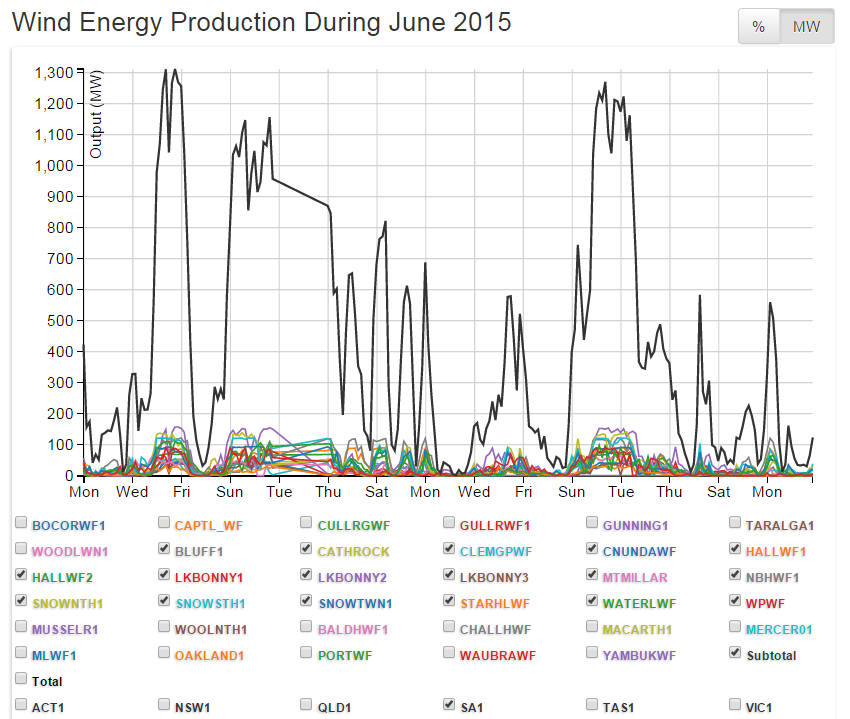
OCGT peaking plants are essential to covering the inevitable, but wholly unpredictable collapses in wind power output that occur almost every day, and for days on end (see our posts here and here).

Whether or not GE sells wind turbines (and it hasn’t sold many in Australia) – as long as these things are being speared into rural communities, GE still gets to sell OCGTs – a market in which it dominates.

In an effort to flog its gas turbines, GE advertised heavily in The Guardian – under the banner “Powering People” and in The Australian – where, earlier this year, GE “sponsored” numerous “features” under its banner “Powering Australia” (see our post here).

OCGTs are used – along with gazillions of gallons of gas, diesel or kerosene that run them – to plug the ‘gaps’ in wind power output around the globe: they’re a daily occurrence; total; and totally unpredictable.

June 2015 SA

We’ll let Jack off the leash again, as he homes in on the fact that wind power’s really just a ‘gas’.

How Wind Energy Creates More Dependence on Fossil Fuels
‘Any informed student of wind energy … understands that’
CapCon
Jack Spencer
2 March 2015

Truth has a habit of emerging from unexpected places. An article in the Daily Kos about the desire to end dependence on fossil fuels for energy needs reveals a “nasty little secret” about wind energy: It relies on fossil fuels. That’s a message wind energy opponents in Michigan have been trying to get across to the news media and the public over the past few years.

The article is part of a series titled “Getting to Zero,” by Keith Pickering, and is written with the premise that global warming is a dire and immediate threat. It states, “If civilization is to survive, we need to get to zero emission of fossil carbon, and we need to get there rapidly.” Overall it paints a pessimistic portrait of efforts to reduce carbon emissions from human sources.

A major aspect of the article’s pessimism about actually “getting to zero” pertains to wind energy. The following paragraphs serve as an example:

Wind farms are dependent on the weather to work, and most of the time they’re sitting idle or underperforming because the wind isn’t strong enough to turn the blades. The capacity factor (CF) for wind varies by location, but Iowa is pretty good, so let’s assume a CF of 35 [percent]. Nuclear has no such dependency and can operate around the clock.

In the [U.S.], nuclear plants have an average CF of 90 [percent].

So when we factor CF into those prices … most of wind’s advantage is wiped out by just that factor alone.

Over the long term it gets even worse for wind, because nuclear plants today are engineered for a 60-year lifetime, and wind generators are engineered for a 20 or 25 year lifetime. … That means that wind is cheaper than nuclear in the short term, but more expensive in the long term. Then there’s the backup problem. … When the wind dies, the lights still have to stay on. Right now that’s done with natural gas. …”

According to Kevon Martis, director of the Interstate Informed Citizens Coalition, a non-profit organization concerned about the construction of wind turbines in the region, what the Daily Kos article shows is that people knowledgeable about the technology understand that wind energy depends more on fossil fuels than on wind, no matter their views on contentious issues like global warming.

“Any informed student of wind energy, regardless of whether they are on the left or the right politically, understands that, far from freeing Michigan ratepayers from fossil-fueled electricity, wind energy actually binds us to fossil fuels at roughly a two-parts-fossil one-part-wind ratio,” Martis said. “Properly understood, wind energy should always be called ‘fossil-wind.’ What’s sad is that the vast majority of Michigan residents and probably members of the news media as well are not aware of this information. That situation needs to be remedied.”

In its assessment of wind energy, the Daily Kos article states: “Wind-plus-gas-backup is certainly better than gas alone, but it’s not the endpoint of a fossil-free grid, and it never will be.”

One of the strongest arguments against wind energy is the assertion that “natural gas alone” would produce fewer emissions than when it is combined with wind. That’s because having to switch natural gas generation on and off, literally at the whim of the way the wind blows, is less efficient and therefore less clean.

However, a news media and public that mistakenly believe wind energy is just wind, rather than two-thirds fossil fuels, cannot be expected to comprehend or participate in such a debate. Restricting important facts or (as some still insist) “alleged facts” about wind energy to the province of “experts only” is an affront to transparency and an obstacle to open public discourse. The Legislature owes the people of Michigan a hearing or series of hearings on this issue.

David Wand, deputy director of strategic communications with the American Wind Energy Association, did not return a phone call offering him the opportunity to comment.
CapCon

coal-seam-gas

****

Natural Gas to Wind Energy: You’re Nothing Without Me
Energy from windmills is mostly backed up by fossil fuels
CapCon
Jack Spencer
11 April 2015

Wind energy in Michigan is approximately two-thirds fossil fuels (predominantly natural gas) used in a less than efficient way, coupled with one-third wind. Most people are unaware of that reality and misinformation flourishes as a result.

Case in point: a new study claims to provide comparisons between wind and natural gas by treating them as if they were two totally separate and distinct forms of energy generation.

The University of Michigan and Lansing-based consulting firm 5 Lakes Energy are touting a joint study based on a “model” produced at the university. The stated purpose of the study is to provide policymakers with a “tool” to help them choose between wind and natural gas. Unfortunately the model upon which the study was based is so flawed that the only “tool” it brings to mind is a toy hammer used in an attempt to force a square peg into the proverbial round hole.

The outputs of the model and resulting study attempt to justify the expansion of wind energy (the term “renewables” is used — but that means wind) in Michigan to meet energy demands resulting from the impending closure of coal plants. Its main argument is that wind energy would be a wise choice because natural gas prices are likely to fluctuate.

The idea here is that wind energy should be seen as a hedge against the possibility that natural gas prices could increase. It is basically an attempt to use the old “don’t put all your eggs in one basket” analogy. This is persuasive only when one ignores the fact that wind energy is 65 percent natural gas, which is precisely what the model does.

For those who understand that a dependable blend which includes wind energy must contain mostly natural gas, the analogy of “not putting all your eggs in one basket” used to promote the study is ludicrous.

“The operative word is ‘or,’” said Tom Stacy, an electricity generation analyst and independent regulatory and policy consultant who signs his correspondence “Ohioan for Afford Electricity.” He explains that the “eggs in one basket” warning doesn’t make sense. “There is no ‘or.’ It is either 100 percent gas or 65 percent gas plus 35 percent wind.”

“The catch,” he continued, “is that compared to the cost of the natural gas basket, consumers are forced to pay triple for baskets because the wind basket costs twice what the gas basket does, yet the gas basket is still required to hold 65 percent of the eggs.” He continued, “The end result: For our dozen eggs, we pay for three baskets when we could have paid for one. In exchange we get four free eggs. The problem is the extra baskets cost far more than the eggs.”

Although fortified with the usual officious-sounding phrases and sprinkled with expert-speak acronyms, the 5 Lakes study is rooted in the popular, but inaccurate, fantasy that wind energy is what wind supporters wish it could be, rather than what it actually is. At one point the study report reveals its imaginary basis with the following statement: “If we choose the natural gas path and natural gas prices rise, we may regret that we are stuck using expensive natural gas when we could have had free wind or solar fuel.”

Free wind? That phrase alone seems contrived to deceive the uninitiated and validate the green faithful. Again, since wind is so unreliable, wind energy has to be backed up by natural gas 65 percent of the time. Under that circumstance — obviously — the cost of wind energy will always largely reflect the price of natural gas. What’s more, the impact of any natural gas price change on wind energy is really more that 65 percent, because natural gas, when hooked up to wind energy, is put to a less efficient use. This is due to the requirement that it be constantly adjusted for when the wind is or is not blowing or not blowing enough. It is exactly the same dynamic that takes place with an automobile’s use of gasoline when driving in city traffic as compared to coasting down the open highway.

In the real “power pool,” wind is not physically paired with just natural gas; it is also paired with coal. The example used in this article gives wind the benefit of the doubt by only using natural gas, and not coal, as the balancing source in the hybrid. The average emissions intensity of coal plus wind is far higher than for gas plus wind. In other words, coal gets terrible “city mileage MPG” compared to natural gas and the pairing of wind with coal results in the excessive inefficiency of stop and go traffic.

The flawed and dishonest premise of the 5 Lakes Energy Study marks it as just the latest attempt by wind energy advocates to promote their product by masking wind energy’s true nature. Wind energy is a less than 30 percent add-on to natural gas. Its effect on emissions, as compared to just natural gas alone, is debatable and at best minimal. The failure of the study to acknowledge this spoils all of its conclusions and suggestions.

A glance at a list of 5 Lakes Energy principle founders reveals more than one official from the administration of former Gov. Jennifer Granholm. Michigan Capitol Confidential emailed the following questions to Douglas Jester, the author of the report on the study, and later to other 5 Lakes Energy officials. They were: Are you denying that wind energy is primarily fueled by natural gas? Why does your study appear to have not accounted for this reality? Is there something we are missing here that you should make us aware of?

Thus far, there has been no response to these questions.
CapCon

yacht

Europeans Regret….Wind Energy is a Bad Deal, No Matter Where You Go!

Europeans Lament their Wind Power Fiasco

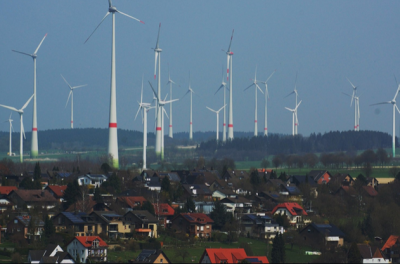
German wind farm

The colossal, hugely expensive windfarms that are spread across huge areas of Europe’s land and sea, which are projected to drive up household energy bills by more than 50 per cent in coming years, have achieved … almost nothing in terms of reducing EU carbon emissions.

We here on the Reg energy desk only noticed this particularly this week because of a chirpy press release that flitted past us just the other day, claiming that “wind energy provides 8 per cent of Europe’s electricity.”

Hey, we thought, that sounds almost like it’s getting somewhere! So we looked into it. The eight per cent figure comes from the latest Wind Status Report (pdf) from the EU Joint Research Centre, and sure enough, it’s claimed therein that all those massive wind farms produced no less than 238 terawatt-hours of the 2,942 TWh of ‘leccy used in the EU nations last year.

That’s eight per cent, right enough – and that’d be a noticeable bite out of EU carbon emissions, maybe even one worth tying an energy-prices ball and chain round the ankles of the European economies.

Except it isn’t, of course. Like most developed economies, the EU nations use the great bulk of their energy in non-electric forms: we burn fuels to run transport, to provide heating and cooking and hot water, to power most of our industry. And this accounts for most of our energy use and carbon emissions.

By the most recent figures available, in fact, the EU is using around 1,666 million-tonnes-of-oil-equivalent of energy from all sources every year:that’s 20,710 TWh. Wind electricity makes up just over one measly percentage point of that. Solar? About half that again, for a total renewable-‘leccy contribution of around 1.5 per cent and a roughly corresponding CO2 reduction.

The large majority of the “renewable energy” figure claimed by the EU is produced by optimistic accounting on biomass and renewable-waste, much of which is dubiously renewable at best. Even the proper renewable electricity figures are not to be relied on, particularly in southern Italy where the Mafia is well known to be heavily involved in the industry.

Actual renewables, despite their horrific expense, are not even scratching the surface of real-world modern civilisation’s energy requirements.

Comment

It really is getting clearer and clearer. Bill Gates is right: top Google engineers are right: global-warming high priest James Hansen is right: theUN IPCC is wrong. The renewable energy technologies of today simply cannot provide the power needed to keep the lights on, not at any cost.

Anybody who thinks that carbon emissions are a big threat to humanity – or alternatively, anybody who thinks that becoming ever more dependent on Russian gas and Middle Eastern oil is a bad idea, for instance – needs to get their head around this and move on. The current, cripplingly expensive schemes which crank up the price of energy and channel the resulting cash to windfarms and solar panels need to be scrapped – they will never achieve anything useful.

Perhaps the money saved could be spent on R&D instead, to find some new source of low-carbon energy. But in fact, such a source already exists; the problem is really one of public understanding, rather than a lack of low-carbon energy in the world.
The Register

turbine collapse 9

Tom Harris, Exec. Director of Int. Climate Science Coalition, Talks to John Counsell, of CFRA, in Ottawa.

Tom Harris speaks on Radio, to John Counsell, of CFRA Radio Stn., in Ottawa

I believe this is one of the all time biggest frauds perpetrated on people world-wide. Wealth transference, from rate payers, to governments and rich investors. We are not improving our environment, in any way. There is no net benefit to wind or solar, over traditional energy sources, burned cleanly, especially hydro and nuclear, which are rejected in favour of this “novelty energy”! The corruption inherent in this incestuous relationship between governments and the renewables industry, has to be investigated. It is a scam! We are being robbed blind. Energy poverty is a reality for many people.  Shellie Correia

Eric Jelinski – A Canadian Energy Engineer, Tells the Truth About Wind Turbines….

Top Canadian Energy Engineer – Eric Jelinski – Slams the Great Wind Power Fraud

engineering-image-4

Provided they haven’t got their trotters in the wind industry subsidy trough, engineers are quicker than most, when it comes to rumbling the great wind power fraud.

Practically minded, and with heads for real numbers, engineers are able to pick apart the complete pointlessness of trying to rely on an energy source that will NEVER be available on demand (can’t be stored) – is entirely dependent upon the weather – and is, therefore, not a generation “system” at all: “chaos” and “system” are words that come from completely different paddocks; and which mean completely different things (see our post here).

And engineers, who build “systems”, don’t like “chaos”.

Google’s top engineers – Stanford PhDs, Ross Koningstein and David Fork – came out and recently tipped a bucket on the nonsense of attempting to run 21st Century economies using a ‘technology’ that was dumped way back in the 19th Century (see our post here).

Now, one of Canada’s leading energy engineers, Eric Jelinski has come out swinging too.

An Engineer Speaks
Windfarm Action
27 January 2015

The following was written by Eric Jelinski, P. Eng., a Canadian engineer who specializes in energy production. Gas plants. Nuclear plants. Wind & solar energy. He explains to his township (Clearview Township, Ontario) why wind energy is folly.

Jelinski

I am writing to express my objections to the installation of Industrial Wind Turbines in Clearview Township, Ontario, Canada.

My wife and I moved here to retire on 50 acres, building a house, market garden, as well as taking many other initiatives to become part of the vital social fabric.

It is bad enough that under Ontario Premier McGuinty, the social fabric in big cities like Toronto is in need of repair, as it happens, in part because those “50,000 jobs” in renewable energy have not materialized, and there is little productive activity for many of the youth in the cities. Guns and drugs are very much part of the social fabric in some neighbourhoods.

What gives McGuinty, with his Toronto constituent Members of the Provincial Parliament (MPP’s), the moral right to tell us in Clearview that we must accept wind turbines “or else”?

One way to stop the wasted energy and environmental impact of urban sprawl is for big city MPP’s to clean up their own yard and make cities safer and more habitable. While they listen to those who object to new gas plants, and cook up a new “plan of the month” for public transport, why do they ignore the issues with wind turbines?

My background is nuclear and chemical engineering, with over 30 years combined working at each of the nuclear plants in Ontario. I teach nuclear engineering at University of Toronto and Georgian College (Power Engineering) in Owen Sound for the purpose of training the next generation of staff who will design plants and work them safely.

I know nuclear reactors and how e=mc2 gets us the energy. I know chemical reactors, e.g. to make gasoline from crude oil, and refining metals. I know solar and wind energy going back to the 1970’s, as energy and exergy are my major fields of study.

The application of Ontario’s “Green Energy Act” is in violation of principles in engineering, where we teach engineers to anticipate unintended consequences and not proceed with implementation until consequences and risks are taken into account.

The Green Energy Act is an abomination that is creating a living hell for almost everybody in rural Ontario, and the provincial government is ignoring the data of emerging health issues, property value issues, setbacks and zoning, impacts on fowl, fauna, and fish, impacts on local weather such as the dew point and foliar uptake by plants that is important in particular to alleviate heat stress on biota.

I have seen firsthand one of my neighbours from the 1980’s near Ripley forced out of his farm home due to wind turbines in Huron Township. Others are putting up with the impacts.

The energy available from wind in Ontario is borderline minimal compared to other countries and areas of the world. 25% to 30% is the capacity factor.

The wind is not available when we need energy the most, i.e. summer air-conditioning and winter heating. The shoulder seasons have the most wind here, yet this is when air-conditioning and heating demands are minimal.

The power equation for wind results in 8 times the energy for a doubling of wind speed, and the excess energy has to be “dumped.” Storage systems are available, but prohibitively expensive. Hythanation is possible, but wind turbines are not economic for hydrogen production given the added infrastructure relative to the cost of natural gas.

Wind turbines use 5 to 7 times the amount of concrete and steel vs. say a nuclear plant on a per Megawatt basis. It will require some 10,000 wind turbines to replace the ~ 6000 MW of coal generation at 25% CF (capacity factor). Back-up gas fired plants have to be added like plug-ins everywhere because the wind is not reliable.

The pastoral scene of a field of wind turbines slowly turning in almost still air has environmentalists dreaming in technicolour.

The truth is that these wind turbines need about 8 km/hour of wind before they will start generating electricity. Any rotation of the blades at wind speeds below 8 km/hour is accomplished by taking power from the grid to get the wind turbine started in anticipation that the wind may pick up.

The economy of scale that has historically brought competitive energy prices in Ontario is not available, given the thousands of wind turbines, and that will also become a maintenance nightmare as machines and contracts approach end of life. Why do we not refuel Nanticoke, Lakeview, Lambton, Lennox and complete Wesleyville to run on natural gas?

What makes McGuinty et al. think they can impose industrial wind turbines on Clearview and all of rural Ontario? Is Clearview thinking of becoming part of this scheme of waste?

This scheme of waste is happening not just by government order, but it is happening because of the salacious relationship between government and the developers.

The most telling example is the head of the Federal Liberal Party is a wind developer. The activity surrounding the recent cancelled “gas plant” in order to preserve seats, and thus preserve the Green Energy Act, is also telling.

We also have the government using engineers from wind developers making recommendations on health impacts. As a P. Eng. I can say that engineers are not the authority on health. The conflict of interest between the engineer being paid for engineering work, vs. the same engineer as proponent and key advisor to the government is quite apparent.

The set-back of 550 meters has no scientific basis. Noise from wind turbines has been measured up to 10 kilometers away in some locations. Medical doctors have noted the health impacts, yet they are being ignored by the Ontario government.

The Feed-in Tariff takes billions of dollars out of communities, out of the province, and out of the country. This is money that is very much needed for healthcare, for schools and teachers, and to replace aging infrastructure and to build much needed new infrastructure such as public transit.

For the first time in decades (I don’t think it ever took place), Ontario is taking equalization payments from the Federal Government, and this points to not only the unsustainability of Ontario as an economy, it is dragging down the rest of the country. It would be different if we owned everything, did local planning, and used a process that garnered respect.

The Ontario government is following the advice of foreign countries and foreign companies to give our money away to them irrespective of the advice of many MP’s. It is most interesting to note that one of the political parties with a labour platform appears in complete agreement with giving away the work and the money and the surplus electricity.

Japan is restarting its nuclear fleet. Russia, China, India, Britain, the US, and even the United Arab Emirates are building or planning to nuclear reactors for electric generation. What is the purpose and value of Ontario energy policy? Every product we buy in Ontario that is made someplace else (most items, can you name one thing that is made here?) has a nuclear energy component in that product.

It is time to stop being altruistic or hypocritical about our energy. There is no rational reason for the 50% cap on nuclear in Ontario. Are we on some unwitting “race to the bottom” being orchestrated by some competitor countries wanting to control us? Having ample low cost energy is crucial to sovereignty, internal peace, and security.

As such, there is no respecting McGuinty, Bentley et al. for this indictment. There is also no need to respect any wind developers as they have already indicated their respect for us. I commented last year on WPD, and sent comments to their consultant as requested, and they have not replied, and their silence speaks volumes. I have sent many an e-mail to the government recommending a moratorium and have not been given the courtesy of any reply.

The purpose of the developer is to make money, i.e. take our money as allowed for by the government, and with minimum effort on their part. This speaks to the quality of the public meetings and their answers to our concerns. The public meetings are a sham.

There are quite a number of lawsuits already taking place and others pending. I thank the Federal government for the recent announcement on the health study. It is also pivotal to learn today that the Ministry of Health is being forced to testify.

My recommendation is for Clearview to take the high road and avoid complicity in matters that are before the courts, and who knows, but it is quite possible (I hope) that the renewed call for a moratorium may take hold for good reasons posted here.

A moratorium in Clearview is very appropriate.

While the WPD wind turbines west of Stayner are quite a few km from our place, they are likely the thin edge of the wedge planned for coming into Clearview. Let me remind you, we came here because this is a good place to live with good opportunities for business. All of that changes if wind turbines are allowed to disrupt the neighbourhood. And 10,000 wind turbines and solar farms are not the answer to Ontario’s energy needs.

As I said before, a province-wide moratorium is needed, and I believe this will come as a matter of time because the inconvenient truth about wind turbines is too big for McGuinty’s carpet. The track record for dictatorial governments throughout history is that all dictatorships eventually capitulate. A moratorium in Clearview would be a “made in Clearview” solution to stop the waste sooner than later.

Eric Jelinski, P. Eng.

What is interesting is that this is not only a UK or European problem and the US and Canada predates much of our wind fleet. But the problems are endemic in the industry and the political myopia of the issues and problems of wind a mystery to the other 97% of the population!
Windfarmaction

wind turbine Screggah-wind-turbine-Padraig-McNulty-2-460x345

Windpushers Want Guarantees, That Their Scam Will be Allowed to Continue!

Wind Industry Still Wailing About ‘Uncertainty’ as Australian Retailers Continue to Reject Wind Power ‘Deals’

June 2015 SA

[Could it be something about the ‘product’, maybe?]

Back in February this year, STT covered the unassailable fact that Australia’s Large-Scale Renewable Energy Target (LRET) – then set at a colossal 41,000 GWh – was completely unsustainable on every level – economic, political and social:

LRET “Stealth Tax” to Cost Australian Power Punters $30 BILLION

Our little analysis came at a time when a debate was underway about not whether, but by how much, the ultimate annual target needed to be cut to preserve a little of the wind industry’s furniture.

You see – with the ultimate target set at 41,000 GWh for 2020 – barely 16,000 GWh of power available from eligible renewable sources – and no new wind power capacity being built and none likely to be built – the imposition of the whopping $65 per MWh “shortfall charge” was then looming fast.

The actual cost to consumers of what is, pure and simple, a Federally mandated fine on electricity retailers – which will be recovered from all Australian power consumers – is around $93 per MWh, which is added to the average wholesale price of around $35 per MWh.

The Coalition’s wind industry front man, young Gregory Hunt calls it his “massive $93 per tonne carbon tax”. Its particular political toxicity was what focused the minds of our political betters in Canberra; and resulted in the first cut to the LRET’s ultimate annual target from 41,000 GWh to 33,000 GWh.

The principal logic that drove both the Coalition and Labor to slash the LRET target being fear of a power consumer (read “voter”) backlash – a revolt that will inevitably result when power consumers receive spiralling bills spelling out the fact that they are being hit with a mammoth, Federal electricity stealth tax.

Politicians of all hues know it – and, more importantly, Australia’s major electricity retailers know it: there is absolutely no way that – in an economy about to start going backwards – struggling businesses, manufacturing industries and cash-strapped households will tolerate the imposition of an enormous (and utterly pointless) Federal tax on electricity consumption.

Remember, this is the same electorate that smashed Julia Gillard over her ‘carbon tax’ – which, as another Federally mandated tax on electricity, was seen by voters as economically ‘toxic’; and gifted government to Tony Abbott’s Coalition 2 years ago.

After a lot of huffing and puffing – and shenanigans in the Senate – the reduced LRET target passed in June. At the time, the wind industry, its parasites and spruikers were howling one minute about the attack on “wonderful wind”; and breathing a collective sigh of relief that the dreaded “uncertainty” about the target was finally over.

Well, the trouble is that certain “certainties” still, and will always exist, in relation to the greatest economic and environmental fraud of all time: THESE THINGS DON’T WORK.

The retailers are about selling power on demand; not according to the vagaries of the wind.

Now, our favourite wind-worship cult-commanders – the Climate Spectator’s Tristan Edis (see this piece of wishful thinking) and ruin-economy’s Giles Parkinson – are furious about the fact that – despite the ‘agreement’ that settled on the latest LRET target – Australia’s retail power companies have absolutely NO interest in signing up to buy a “product” that can only ever be delivered at crazy random intervals, if at all. A product that brings total chaos for grid managers and allows peaking power operators to scoop up $millions in minutes:

South Australia’s Unbridled Wind Power Insanity: Wind Power Collapses see Spot Prices Rocket from $70 to $13,800 per MWh

The Wind Power Fraud (in pictures): Part 1 – the South Australian Wind Farm Fiasco

The Wind Power Fraud (in pictures): Part 2 – The Whole Eastern Grid Debacle

On top of that, the Senate Inquiry’s report (see our post here) into the great wind power fraud concluded that the adverse health effects caused by incessant turbine generated low-frequency noise and infrasound – such as sleep deprivation – are real; and not the product of some BIG COAL plot.

With 200 pages setting out the evidence of victims like SA turbine hosts, Clive and Trina Gare (see our post here), retailers are fully alive to the fact that it’s a matter of when, not if, wind farm neighbours start suing wind power outfits for $millions in damages. ‘Slam dunk’ common law claims in nuisance for the loss of the use of their homes; loss of property values etc, are brewing up as we speak. The outcome of which is that the $2 outfits used as fronts for the likes of Infigen will be insolvent, as soon as the victims file their claims:

Potential Wind Farm Neighbour Finds Idyllic Property is Now ‘Unsaleable’ at Any Price

Brits to Force £2 Wind Power Outfits to Hold £Millions in Reserve to Pay Damages to Victims & for Decommissioning

Bankers, retailers and anyone else with real skin-in-the-game hate risk – of any description. Signing up to lend money to – or buy wind power from – an outfit liable to go under in heartbeat is bad enough, but where the wind power outfit in question is in the gun for $millions in liability claims for nuisance or negligence, then it’s RISK that only the crazy-brave would take on.

But it’s risk of a different kind that has poor old Giles Parkinson almost turning on the waterworks in this, his latest lament: Renewable investment drought to continue as utilities extend buyers’ strike

Giles cites Miles George – head of Australia’s most notorious wind power outfit, Infigen (aka Babcock and Brown) – as he rails against the fact that Australia’s 3 biggest retailers – Origin, EnergyAustralia and AGL – have no intention of entering power purchase agreements with wind power outfits, which means they will never obtain the finance needed to build any new wind power capacity, anywhere FULL STOP.

Although never one quick to join the dots, Giles fails to make the (fairly obvious) connection between the unwillingness of $billion outfits – like Origin – to contract with near-bankrupt Infigen – even though Giles focuses on Infigen’s latest whopping $304 million annual loss: ever heard of ‘due diligence’, Giles?

In the mother of all ironies, Infigen, again blames its latest financial disaster on ….. wait for it …. “PARTICULARLY POOR WIND CONDITIONS”.

Oh, mother!

But should Miles and the gang really be complaining? After all, the wind is – as they repeatedly tell us – “FREE”. Which calls to mind that old chestnut about “getting precisely what you pay for”.

We’ll pick up Infigen’s latest ‘be-calmed-cash-loss-calamity’ in another post, shortly.

The ONLY reason power retailers do any business with cowboys like Infigen and union backed thugs like Pacific Hydro, is to obtain renewable energy certificates (RECs); and, thereby, avoid the imposition of the shortfall penalty. However, the likes of Giles and Tristan are unable to recognise that power retailers do, in fact, have a ‘choice’, in that respect.

They do not need to purchase RECs at all – power retailers are perfectly entitled to pay the fine and collect it from their customers. Which brings us back to ‘pending political toxicity’.

The big retailers know full well that Australian power consumers will not tolerate being lumbered with fines that will add close to $22 billion to their power bills, over the life of the LRET scheme. Here’s the calculus of what no-one – on either side of government – is willing to reveal, let alone prepared to ‘sell’, to voters.

The LRET target is set by s40 of the Renewable Energy (Electricity) Act 2000 (here). At the present time, the total annual contribution to the LRET from eligible renewable energy generation sources is 16,000 GWh; and, because commercial retailers have not entered PPAs with wind power outfits for well over 2½ years – and have no apparent intention of doing so from hereon – that’s where the figure will remain.

In the table below, the “Shortfall in MWh (millions)” is based on the current, total contribution of 16,000,000 MWh, as against the current 33,000 GWh target, set out as the “Target in MWh (millions)”.

A REC is issued for every MWh of eligible renewable electricity dispatched to the grid; and a shortfall penalty applies to a retailer for every MWh that they fall short of the target – the target is meant to be met by retailers purchasing and surrendering RECs. As set out below, the shortfall charge kicks in this calendar year. Given the impact of the shortfall charge, and the tax treatment of RECs versus the shortfall charge, the full cost of the shortfall charge to retailers is $93. Using that figure, here is the cost of the shortfall penalty.

Year Target in MWh (millions) Shortfall in MWh (millions) Penalty on Shortfall @ $65 per MWh Minimum Retailers recover @ $93
2015 18.85 2.85 $185,250,000 $265,050,000
2016 21.431 5.431 $353,015,000 $505,083,000
2017 26.031 10.031 $652,015,000 $932,883,000
2018 28.637 12.637 $821,405,000 $1,175,241,000
2019 31.244 15.244 $990,860,000 $1,417,692,000
2020 33.85 17.85 $1,160,250,000 $1,660,050,000
2021 33 17 $1,105,000,000 $1,581,000,000
2022 33 17 $1,105,000,000 $1,581,000,000
2023 33 17 $1,105,000,000 $1,581,000,000
2024 33 17 $1,105,000,000 $1,581,000,000
2025 33 17 $1,105,000,000 $1,581,000,000
2026 33 17 $1,105,000,000 $1,581,000,000
2027 33 17 $1,105,000,000 $1,581,000,000
2028 33 17 $1,105,000,000 $1,581,000,000
2029 33 17 $1,105,000,000 $1,581,000,000
2030 33 17 $1,105,000,000 $1,581,000,000
Total 490.043 234.043 $15,212,795,000 $21,765,999,000

The almost $22 billion in fines payable by power consumers will sit on top of the $22-23 billion worth of RECs that will also be added to power bills (see our post here).

Now, while Giles Parkinson’s article misses the point, his headline, which includes the words “buyers’ strike” touches on the “golden rule”: whoever has the gold, makes the rules.

When we first looked at this issue in February, we drew the analogy with another Federal government backed producer subsidy scheme, which also imploded due to a “buyers strike”.

With Giles, among others, struggling to come to terms with the “golden rule”, we think that it would be rude not to give that analysis another run.

In a little case of déjà vu, STT thinks that there are some significant parallels and important lessons to be learnt from how the Australian wool industry saw its Federally mandated subsidy scheme implode during the 1990s; all but killing the industry and costing growers and taxpayers tens of billions of dollars.

The wool industry’s “cause of death” was the Federally backed Reserve Price Support scheme (RPS), which set a guaranteed minimum price for all Australian wool.

A little background on the RPS

For over 150 years, Australia happily rode on the sheep’s back: until the 1970s the wool industry was, for the Australian economy, the “goose that laid the golden egg”; textile manufacturers from all over the world clamoured for the fibre; which was, for most of that time, the largest single commodity export by value; Australia produces over 80% of the world’s apparel wool. However, as fashions changed (the three-piece wool suit became, well, so “yesterday”) and new synthetics began to eat into its market share, the dominance of Australian apparel wool was no longer a certainty.

Against the backdrop of increasing competition, for the wool industry there was always the perennial issue, not only of fluctuating demand, but also of wildly fluctuating swings in production. Dorothea McKellar’s land of “droughts and flooding rains” meant that a few years of meagre production (and favourable, and even phenomenal, wool prices) would be soon eclipsed by sheds and wool stores overflowing with fibre ready for market (sending prices and woolgrower profits plummeting).

The response to these (often climate driven) marketing “swings and roundabouts”, was the establishment of the Australian Wool Corporation (AWC) and the RPS in 1973.

The RPS would set a minimum price for all types of wool, guaranteeing woolgrowers a minimum return; such that if supply exceeded demand, the AWC would purchase any wool being offered, if it failed to reach the minimum price set (referred to as the “floor price”).

Wool being offered at auction that failed to meet the floor price was purchased by the AWC and “stockpiled” (ie stored), until such time as either supply fell or demand conditions improved; at which point the AWC would offer stockpiled wool to the trade. The aim being the smooth and more orderly marketing of wool over the supply and demand cycle; with higher average returns to growers; and less risk for buyers and sellers along the way.

The scheme worked swimmingly (as designed and intended) until the late 1980s.

The reserve price set under the RPS was fixed in Australian dollar terms. However, with the float of the Australian dollar in 1983 (resulting in a massive 40% depreciation of the dollar between February 1985 and August 1986), maintaining the reserve price without reference to the terms of trade and fluctuations in trading currencies (particularly the US dollar) set the scheme up for a spectacular failure; simply because what goes down can just as easily go up.

During the 1980s, there was a solid increase in demand for wool, driven by demand from the USSR, a then fast growing Japan, buoyant Europeans, and a newly emergent China, as a textile manufacturer and consumer. However, that surge in demand occurred in the context of an Australian dollar trading in a range around US$0.55-75.

During the 1980s, under pressure from wool grower lobby groups, the floor price was continually increased: from 1986 to July 1988 the floor price jumped 71% to 870 cents per kilogram.

That did not, in itself, create any problems: a general surge in demand, relatively low production and a plummeting Australian dollar generated auction room sale prices well above the rising floor price, which reached their zenith in April 1988: the market indicator peaked at 1269 cents per kg, and the market continued its bull run for most of that year, well above the 870 floor price set in July.

However, as international economic conditions worsened, Australian interest rates soared (the consequence of Paul Keating’s “recession that we had to have”) and the value of the Australian dollar with it (hitting US$0.80 by early 1990), the market indicator headed south and, over the next few years, the AWC was forced to purchase over 80% of the Australian wool clip at the 870 cent per kg floor price. Adding to the AWC’s difficulties was a massive surge in production; driven by growers responding to the high and “guaranteed” floor price; and a run of exceptional growing seasons (1989 being a standout across Australia). Production went from 727 million kg in 1983/84 to over 1 billion kg in 1990/91.

Despite worsening market conditions, the AWC, under pressure from wool grower lobby groups, was forced to maintain the 870 cent per kilogram floor price.

However, from around August 1989, international wool buyers simply sat on their hands in auction sale rooms (in May 1990 the AWC bought 87.5% of the offering); and waited for the RPS to implode.

Knowing that the system was unsustainable, the last thing that buyers wanted was to be caught with wool purchased at prices above the floor price which, when the floor price was cut or collapsed, would immediately be worth less than what they had paid for it. Moreover, traders were dumping stock as fast as they could to avoid the risk of a collapse in the RPS and, therefore, a collapse in the price of any wool they happened to hold.

The RPS was ultimately backed by the Federal government. With the buying trade sitting on their hands, those responsible for maintaining the floor price ended up in a staring competition, the only question was, who would blink first: the AWC (or, rather, the government underwriting the RPS); or the buyers?

With the AWC purchasing millions of bales of wool at the floor price the cost of supporting the RPS was running into the billions of dollars: primarily the support came from a grower levy on sales, but, at the point which that soon became insufficient to support the RPS (despite upping the levy from 8% to 25%), support came from $billions in mounting government debt; the buyers had no reason to blink.

Instead, in May 1990, the government announced its decision to retreat to a new floor price of 700 cents per kilogram, and directed the AWC to fight on in support of the reduced floor price. The Minister for Primary Industry, John Kerin boldly asserting that the 700 cent floor price was “immutable, the floor price will not be reduced”.

But, having blinked once, the buyers largely continued to sit on their hands and simply waited for the government to blink again. The stockpile continued to balloon; and with it government debt: by February 1991 the stockpile reached 4.77 million bales (equivalent to a full year’s production); the accrued government debt stood at $2.8 billion; and the cost of storing the stockpile was over $1 million a day.

Faced with the inevitable, the government blinked, again: John Kerin was forced to eat his words about the floor price being “immutable”; on 11 February 1991, announcing the suspension of the floor price. The RPS had totally collapsed; the buyers had won.

The wool industry’s saga is beautifully, if tragically, told by Charles Massy in “Breaking the Sheep’s Back” (2011, UQP), which should be required reading for any of our political betters pretending to know more than the market (eg, the power market).

Which brings us to the lessons and parallels.

The LRET effectively sets the price for RECs: the minimum price is meant to be set by the shortfall charge of $65 per MWh (rising to $93 when account is given to the tax benefit), as the penalty begins to apply on the shortfall (as detailed above). That equation is based on an ultimate 33,000 GWh target.

In the event that the cost of the shortfall charge was reduced, there would be a commensurate fall in the REC price. Likewise, if the LRET target was further reduced: the total number of MWhs which would then attract the shortfall charge if RECs were not purchased would fall too; also resulting in a fall in the REC price.

In addition, any reduction in the LRET would simply result in a reduction in the demand for RECs overall: fewer RECs would need to be purchased and surrendered during the life of the LRET; again, resulting in a fall in the REC price. Of course, were the LRET to be scrapped in its entirety, RECs would become utterly worthless.

The retailers, are alive to all of this, hence their reluctance to enter PPAs for the purpose of purchasing RECs; agreements which run for a minimum of 15 years.

In December last year, Ian “Macca” Macfarlane and his youthful ward, Greg Hunt started running around pushing for a target of 27,000 GWh; and their boss made clear that he wanted to kill it outright. There followed overtures from the Labor opposition pitching for a target around 35,000 GWh.

Whether they knew it or not – with their public debate on what an amended target should be – in the staring competition with retailers – these boys blinked.

Faced with the inevitable political furore that will erupt when power consumers (ie, voters) realise they are being whacked with the full cost (and some) of the shortfall charge (being nothing more than a “stealth tax” to be recovered by retailers via their power bills), the pressure will mount on both sides of politics to slash the LRET – once again.

That both Labor and the Coalition have already blinked (in obvious recognition of the brewing political storm in power punter land over the inevitable imposition of the shortfall charge) is not lost on the likes of Grant King from Origin, and all of Australia’s other electricity retailers.

And for retail power buyers the choice of sticking with permanent recalcitrance has been made even easier: Tony Abbot making it plain that he would have cut the LRET even harder, were it not for a hostile Senate; and Labor’s Bill Shorten pushing for an entirely ludicrous 50% LRET – that would require a further 10,000 of these things to be speared all over Australia’s rural heartland. Where there was once ‘bipartisan’ support for these things, the major parties are diametrically opposed.

Grant King

****

With the politics of the LRET already on the nose, like wool buyers sitting on their hands in sale rooms during 1990, waiting for the floor price to collapse, electricity retailers need only sit back and wait for the whole LRET scheme to implode.

Like wool buyers refusing to buy above the floor price and carry stock with the risk of the RPS collapsing, why would electricity retailers sign up for 15 year long PPAs with wind power outfits in order to purchase a stream of RECs over that period, knowing the value of those certificates depends entirely upon a scheme which is both economically and politically unsustainable?

However, the similarities between the wool market and the market for wind power end right about there.

There is, and always was, a natural market for Australian wool; the only issue during the late 80s and early 90s was the price that had to be paid by buyers to beat the floor price, set artificially under the RPS.

Wind power has no such market.

Available only in fits and spurts, and at crazy, random intervals, at a price which is 3-4 times that of conventional generation, retailers have no incentive to purchase it.

In the absence of the threat of the $65 per MWh fine (the stick), coupled with the promise of pocketing $93 as a subsidy in the form of a REC (the carrot), electricity retailers would not touch wind power with a barge pole: it simply has no commercial value.

Moreover, with an abundance of conventional generation capacity in Australia at present, retailers are very much in a “buyers’ market”. Overcapacity, coupled with shrinking demand (thanks to policies like the LRET that are killing mineral processors, manufacturing and industry) means that retailers can expect to see wholesale prices decline over the next few years, at least. And, for the first time in almost 20 years, a sharply declining Australian economy is a fast looming reality: unemployed households have an even tougher time paying rocketing power bills.

With those fundamentals in mind, electricity retailers will simply opt to pay the shortfall charge and recover it from power consumers, knowing that that situation will not last for very long.

Sooner or later, the Federal government (whichever side is in power) will have to face an electorate furious at the fact that their power bills have gone through the roof, as a result of a policy that achieved absolutely nothing.

Tony Abbott’s chances of leading his Coalition to a second term are tied to fundamental ‘mum and dad’ policies like electricity costs. Power prices matter; and in a battle between Australia’s Big 3 Retailers and the LRET, STT’s money is firmly on commercial self-interest.

STT hears that the big retailers are planning to wait until they look like exhausting the pile of RECs that they’re sitting on at present. At which point they’ll build some large-scale solar power facilities, in order to obtain the RECs needed to avoid the shortfall charge; for as long as it takes for the politics to turn gangrenous. As soon as the LRET gets scrapped, the plan is to sell the panels back into the residential roof-top market.

The cost of the LRET – and all that comes with it – to retail customers is at the heart of what’s driving retailers’ efforts to crush the LRET; and the wind industry with it.

This might sound obvious, if not a little silly: electricity retailers are NOT in the business of NOT selling power.

Adding a $45 billion electricity tax to retail power bills can only make power even less affordable to tens of thousands of households and struggling businesses, indeed whole industries, meaning fewer and fewer customers for retailers like Origin, AGL and EnergyAustralia.

The strategy adopted by retailers of refusing to ‘play ball’ by signing up for PPAs will, ultimately, kill the LRET; it’s a strategy aimed at being able to sell more power, at affordable prices, to more households and businesses.

And it’s working a treat, so far.

The wind industry’s incessant daily whining about “uncertainty”, is simply a signal that the retailers’ have already won. Once upon a time, the wind industry and its parasites used to cling to the idea that the RET “has bi-partisan support“, as a self-comforting mantra: but not anymore. And it’s the retailers refusal to sign PPAs that’s thrown the spanner in the wind industry’s works.

While the likes of Tristan, Giles and Miles will continue to work themselves into a lather about their inevitable fate, in the meantime, retailers, like Origin, AGL and EnergyAustralia, can simply sit back, watch the political fireworks, and wait for the inevitable and complete collapse of the LRET; and, with it, the Australian wind industry.

wind turbine Screggah-wind-turbine-Padraig-McNulty-6-460x345

Wind Turbines causing a “World of Trouble”!

Turbine protests: Green Energy Act under fire

Credit:  Kingston, ON, Canada / CKWS TV | CKWS Newswatch | September 03, 2015 | www.ckwstv.com ~~

Whether you like them or not, wind and solar panel farms are going up in an area near you. The Liberal government is approving wind and solar farms across the province, most recently here on Amherst Island.

“They continue to approve these wind turbines, they’re doing it in Prince Edward County, they’re doing it on Amherst Island, they’re doing it in Addington Highlands, they’re doing it all across South Western Ontario, it’s not providing a reliable source of electricity and an affordable source.”

The Green Energy Act and the province’s Hydro policy were slammed during a public meeting hosted by MPP Todd Smith in Prince Edward County. About fifty concerned residents from across the region attended the roundtable discussion where Senator Bob Runicman talked about the steps anti-wind turbine groups could take to quash the act …like challenging it in a court of law and calling for a judicial inquiry.

“I think we’ve got to find ways to raise funds to be able to do this and at the very least try and delay it until the next provincial election and hopefully we’ll have a change in government with a different approach.”

Parker Gallant, a writer with the Financial Post and Green Energy Act critic says electricity costs are forcing people to make a tough choice, heat or eat.

“We have just a mess in our electricity sector it’s probably the most complex in all of North America.”

“It’s nothing short of insanity but they continue down that path and we have to fight them with every possible tool available.”

Smith says the green energy act is to blame.

“It’s taken Ontario from having the lowest cost electricity to the highest in North America in just a couple of years.”

“And it’s not only affecting homeowners. Goodyear decided not to expand it’s Napanee location. One of the reasons…rising electricity costs. A recent report from the Ontario Chamber of Commerce suggests that one in 20 Ontario Businesses will close their doors in the next five years due to rising electricity prices. Morganne Campbell CKWS Newswatch Prince Edward County.”

People All Over the World are Fighting Back Against the Wind Scam!

Forces Marshall in International Revolt Against the Great Wind Power Fraud

storming_the_bastille1-e1318690559144

***

Across the Globe – wherever these things things have been threatened upon rural communities – or the threat has been realised – outrage follows.

One line spun is that the hostility is an entirely English speaking phenomenon. That piffle was firmly skewered by Lilli-Anne Green (an American researcher and documentary film-maker, who has spoken to hundreds of victims around the World) – when she appeared before the Australian Senate:

Lilli-Anne Green – no ‘Green’ Dupe – tells Senate: Wind Farm Health Impacts ‘Universal’

And STT has picked up plenty of examples to the same effect:

Winning Taiwanese Hearts and Minds?

Turkish Court Shuts Down 50 Turbines: Yaylaköy Residents Delighted at 1st Chance to Sleep in Years

Germany’s Wind Power ‘Dream’ Becomes a Living Nightmare

Vestas’ Danish Victims Lay Out the FACTS

Now, that’s not to overlook the fact that the English themselves are just as hostile to the concept of massive streams of government mandated subsidies, being filched from power consumers and taxpayers and used by wind power outfits to literally steal peoples’ homes.

This ripping little website shows just how switched on our British counterparts are – going head-to-head with the most polished band of liars and fraudsters ever assembled in the same tent:http://www.aswar.org.uk/

The site is a cracker; and leaves no room for error about what is – to those gifted with our good friends ‘logic’ and ‘reason’ – patently obvious: THESE THINGS DON’T WORK – on any level.

Here’s a sample of the unassailable from its pages – in relation to an effort by RES to destroy another idyllic part of Ol’ Blighty:

The subsidy farming McAlpine/RES, the same massive group who the BBC’s Panorama accused of setting up the illegal blacklist in the building trade, have put in another application to build four wind turbines in the Warwickshire heritage and wildlife beauty spot of the Upper Swift Valley.

Home-page-no-appeal-2012-banner

This new application, along with bribes for the NIMBYs, will not only receive the same degree of local rejection on the same grounds as the earlier proposal was unanimously rejected but with the encroachment of an intense windfarm landscape in the last two years, there are even more planning reasons now for rejection.

There is no rational energy or economic reason in favour of these wind turbines that steal some 15% of everybody’s bills and stuff the subsidies into the pockets of speculators and rent-seeking landowners – 10% (33% by 2020) in green taxes plus a proportion of the new infra-structure cost of linking turbines to the grid.

ASWAR-Town-Hall.400

How can it be right for companies to be paid twice to three times the going rate for electricity when they are damaging the environment and communities?

The alarmist propaganda in favour of wind turbines relies on the argument that they reduce the UK’s 2% of the world’s man-made CO2 emissions and thereby infinitesimally reduce global warming.

But actually the intermittency of wind makes it necessary to have fossil-fuel back-up spinning the whole time for the National Grid to maintain an even voltage; (electricity cannot be stored) therefore wind turbines don’t even save CO2 anyway. (also the scientists say that GW has not increased since 1997 – seventeen years of stand-still).

aswar-community-rally-250613-660

Mr Lorne Smith from ASWAR (Against Subsidised Windfarms Around Rugby) said:

“The community around Churchover/Cotesbach turned out in force to show their dislike at being victims of the windfarm scam for a second time. With each windfarm job in the UK being subsidised by £100,000 from our electricity bills, and 10 McAlpine/RES staff supporting their propaganda exhibition, there was £1 million of our money walking around Churchover today!”

It is surprising that anybody can support this energy policy that is making this nation globally uncompetitive, driving manufacturing jobs overseas and ordinary people into fuel poverty (a record number of people died from cold last winter), while attacking the asset values of innocent property owners and killing birds and bats (scientists say 900,000 bats are killed by wind turbines every year).

“Surprising”, indeed!

In the latter stages of 2015 – with the scale and scope the fraud laid bare for all to see – continuing ‘support’ for wind power can’t be explained by simple, seasoned ignorance. As Ben Franklin put it:

“We are all born ignorant, but one must work hard to remain stupid”.

Those that parade as ‘journalists’ – especially at wind-worship cult-compounds – like The Guardian, the BBC – and here at Fairfax and the ABC – they’re clearly working very hard; with obvious success.

But – despite long, sweaty sessions inside their editorial bunkers, aimed at ensuring the public remain blissfully ignorant, too – the FACTS keep bubbling to the surface.

Facts like the obvious impacts caused to health – like constant sleep deprivation – from incessant turbine generated low-frequency noise and infrasound, that leads to homes being uninhabitable and, therefore, worthless:

Brits to Force £2 Wind Power Outfits to Hold £Millions in Reserve to Pay Damages to Victims & for Decommissioning

Along with every other sensate being on the face of the Earth, the Poles have long-since had enough of being treated as wind industry “road-kill”, too. Hence, this promise made in April this year, by Presidential hopeful, Andrzej Duda:

“… if I am elected to be the President of Poland, I will propose a legislative initiative to introduce safe setbacks of wind parks from people’s dwellings…”

Andrzej_Duda

***

Andrzej Duda
Candidate in the Polish Presidential Elections
Zabkowice Slaskie, 8 April 2015

Fellow Poles!

The recent weeks have brought many intense encounters with people across Poland in the context of this presidential campaign. There have also been numerous opportunities to discuss the maladies encountered by citizens and their everyday worries. It has become apparent that the siting of wind farm developments gives rise to frequent protests, which are heard in hundreds of municipalities in our country.

Poles complain that their voices are being ignored, and large wind turbines that are placed excessively close to dwellings not only ruin the landscape, but also cause a serious reduction in the value of their properties. Furthermore, they bring attention to numerous procedural irregularities. These were also identified by the Supreme Audit Office (NIK) in its July 2014 report. I am sorry to say that the governing coalition of the Civic Platform and Polish Peasants’ Party have successfully prevented, during the last several years, the adoption of measures intended to properly regulate the matter of where wind farms are located.

I do recognise the importance of the issues addressed here. Therefore, I declare that, if I am elected to be the President of Poland, I will propose a legislative initiative to introduce safe setbacks of wind parks from people’s dwellings, ban such developments in municipalities where no zoning plans are currently in place, and, most importantly, to ensure effective participation of society in ongoing administrative proceedings.

Yours faithfully,

Andrzej Duda

[original in Polish available here]

Setting out with a sensible policy, built on common sense and human compassion, Mr Duda was duly elected. No surprises there.

STT hears that hundreds of Australian rural communities are gearing up, too.

The Coalition’s LRET policy is designed by its instigator and head wind industry spruiker – young Gregory Hunt – to see another 2,500 of these things speared into thousands of backyards across the Country. Labor’s insane 50% RET would up the ante, by carpeting the best, most productive and densely populated regions with more than 10,000:

Labor’s Renewable Target is Pure Insanity: the Coalition’s Target is Simply Madness

Given that our political betters are encumbered with ‘tin ears’ and ‘flat feet’, it’s now down to every man, woman and child to fight for what’s rightfully theirs: the ability to live, sleep in and otherwise comfortably use their very own homes.

revolution

WINDWEASELS….and How They Intend to Steal Your Home & Your Property Rights….

How Wind Farm Subsidies are Used to Steal People’s Homes

money pit

***

In two well-drawn pieces, Jamin Hübner throws light on the greatest economic and environmental fraud of all time. His insight and clarity of expression are notable; and so is his particular focus on the fact that the massive and endless subsidies being thrown at wind power outfits (to make ‘possible’, the otherwise impossible) has the insidious and unjustified result of destroying the value of neighbours’ properties; or as Jamin puts it – “wind energy is one of the most efficient ways of depreciating land“.

Some might call it ‘appropriation by stealth’, we call it ‘state-sponsored theft’.

Wind farms the worst idea since Cash for Clunkers
The Daily Republic
Jamin Hübner
29 April 2015

Remember Cash for Clunkers? That 2009 government program that spent $6 billion to save $1 billion? Imagine walking up to a person and saying, “I want to save some money; I’ll give you six dollars if you give me one dollar back.” Genius. Leave it to Congress to devise (and enact) such brilliance.

There are dozens of government programs like these — all failures. The reason why is easy to understand: the government has no money of its own. It can only take from others and “give” some of it back. A full return is impossible, since this process of organized theft costs money itself. The end result is a net loss — regardless of how many jobs were temporarily created.

Wind farms is another such program. I didn’t realize this at first when witnessing their construction near Tripp (and soon to be Bon Homme County, where I was raised).

I used to think wind farms were about electricity … until I realized:

  1. Few, if any, wind farms bring electricity to an area that does not already have it. It’s too much work and money to build an entire electrical grid from the ground up. Wind energy is “supplemental,” not essential.
  2. Wind farms are subsidized by the government precisely because they generate a loss. Wind farms have to be paid to operate. People, uncoerced and unbribed, do not want wind farms because if they did, they would build them on their own like any other product in the free market.
  3. Wind farms function as a tax deduction for the wealthy — which is why they are built in the first place. Warren Buffett says it best: “I will do anything that is basically covered by the law to reduce Berkshire’s tax rate … on wind energy, we get a tax credit if we build a lot of wind farms. That’s the only reason to build them. They don’t make sense without the tax credit.” Exactly. Wind energy is a siphoning mechanism that offsets taxes and puts federal money into political and corporate pockets. Electricity and lease-agreement royalties are only a byproduct (and a great public cover). Proof of this is that wind farm production nearly stops every time the production credit gets suspended or canceled by Congress.

I use to think wind farms were “green energy” … until I realized:

  1. Hundreds of thousands of birds (and even more bats) die each year from wind turbines.
  2. At 450 to 500 feet tall, wind farms are a pilot’s nightmare (recall the death of four air passengers near Highmore last year). Crop dusting has now become a risky and complicated agricultural venture.
  3. Wind turbines are made of heavy gauge metal and concrete — transported across the nation with the heaviest gas-guzzlers of machinery. While not as bad as Al Gore’s private jet, the carbon footprint is anything but green.
  4. Local soils are depleted because of underground vibrations, audible and inaudible low-frequency noise (“infrasound”) and electromagnetic radiation from power cables that drive away earthworms and other local organisms, the same way loud marine motors drive away fish.
  5. Wind energy cannot be stored (e.g., batteries) and can only harness wind speeds within a tight range.
  6. Chances are, there will be no incentive to remove the turbines once the temporary government funds disappear. Massive steel towers rusting over decades in agricultural fields are not very “green.”

I used to think wind farms supported local energy … until I realized:

  1. A substantial percentage of wind farms are owned by overseas investors/corporations. This is not evident until the initial developers literally “sell the farm” after having built it.
  2. Wind turbines are typically not built by local construction workers and materials.
  3. Because of noise, adverse health effects (e.g., loss of sleep), visual pollution (bright red lights at night and shadow-flicker during mornings/evenings) and all other related liabilities (e.g., shoddy 30- and 65-year wind right contracts), wind energy is one of the most efficient ways of depreciating land.
  4. Small communities are divided, not united, over wind farm projects. One only has to read the Avon Clarion editorials for March and April to witness such intensity and strife. This isn’t to mention the deceptive methods of obtaining wind rights (wind developers put snake-oil salesmen to shame).

At the end of the day, it is not politics or science that determine how wind farms should develop. It is the right to private property. If some people don’t care about the noise, shadows and flashing lights, no problem. But for those who do, they should be justly compensated to the extent that their rights are violated. As Supreme Court Justice Andrew Napolitano observed in “It’s Dangerous to Be Right When the Government is Wrong,” “If you lived in a very crowded area, would the government be justified in preventing you from blaring extraordinarily loud music at midnight, or at least requiring you to pay “damages” to your neighbors for doing so?

“Certainly, by playing obnoxious music, you are diminishing your neighbors’ natural right to the use and enjoyment of their property. And over time, if you were habitually noisy, then most likely would decrease the market value of their property. Thus, although the government could not criminalize this kind of expression, it would be more than justified in making it actionable, or in other words, the basis for lawsuit.”
The Daily Republic

Dr Jamin Hubner

***

Let’s talk about money and wind farms
The Daily Republic
Jamin Hübner
14 August 2015

On April 29, The Daily Republic published my column, “Wind Farms: The Worst Idea Since Cash for Clunkers.” Since then, there have been several local responses to both my article and to criticism of wind energy in general. Allow me to briefly focus on two items.

I reminded readers that (all things considered) government programs cost greater than what such programs “produce.” Subsidies equal (inherently inefficient) income redistribution. The government cannot “pull a rabbit out of a hat.” In a May 14 column for The Daily Republic, Anthony Rezac essentially reached into a hat and proclaimed, “oh yes it can.” I will leave him to that imaginary world.

By June 8, the CEO of American Wind Association finished crafting a remarkably misleading piece of political prose for the Sioux Falls Argus Leader. Like Rezac and others, the majority of anti-wind concerns were casually dismissed while strings of dollar bills were lowered into readers’ faces and swung repeatedly (perhaps this would silence the critics). But, no—no fires were put out, and I might suggest that waving a dismissive hand at South Dakotans as if they were too gullible to care is not a particularly good strategy.

So, since all that pro-wind advocates seem capable of consistently conversing about is money, let’s talk about money and wind farms.

First, to repeat, wind farms have to be subsidized because they generate such a huge financial loss, and no one in the free market is silly enough to build them from their own resources. In Buffett’s words, “they don’t make sense without the tax credit.” It is precisely because of this monetary loss that pro-wind advocates have to resign to exaggerated estimates, numerical figures, and macro-level statistics (absent of micro-level realities) in the first place. They are on the defensive for good reasons.

Second, by comparison, wind energy is the most financially wasteful government-sponsored energy program in existence. This was ably demonstrated in a 2010 study conducted by Simmons et. al. for Utah State University. One key finding was, “In 2010 the wind energy sector received 42 percent of total federal subsidies while producing only 2 percent of the nation’s total electricity. By comparison, coal receives 10 percent of all subsidies and generates 45 percent and nuclear is about even at about 20 percent.”

These figures have not significantly improved today. And yet we are supposed to believe Tom Kiernan’s claim that wind energy will soon “compete” with other sources of energy? Like a tricycle in Nascar.

Third, claiming American wind energy helps the American economy by being distinctively “local” is absurd. Between 75-90 percent of wind farms are owned by foreign corporations/investors, and more than 60 percent of wind turbines are manufactured by foreign companies, according to Choma. American wind energy is as American as a pair of shoes labeled “Made in China.”

Fourth, property owners who have sold their wind rights may never earn their royalties fast enough to cover the loss in property values from owning them. In other words, those who are supposed to be making millions, don’t. (You can find this out yourself simply by asking around.) None of the financial figures produced by the AWA or — to my knowledge, by any pro-wind advocate — takes into full account this central negative factor: depreciation of land. This is significant not only because of the amount of depreciation for land near and under wind farms (which is high), but because of the ever-increasing value of land (amplifying the losses).

More than a half-dozen independent studies conducted by appraisers and university-sponsored groups in the last decade found a 15-59 percent decrease in property values on or near wind farms (see McCann Appraisal LLC, summaries). (Predictably, pro-wind studies creatively generate data with lower estimates).

Combined with 30-40 percent income tax on earnings from wind royalties, shoddy contracts often not inflation-adjusted and dependent on Washington’s empty wallet (and irrational politics), certain land-owners with wind farms ultimately earn pennies instead of millions over the long haul. (This is what you won’t hear when signing a 30- or 60-year contract.) Even for the lucky few in better situations, the profits still don’t add up to the glorious estimates because of these losses.

Fifth, because of this liability, investors will go elsewhere to invest their money (as will families in local communities). Few want to live on or near a wind farm, and no investor wants to invest in land that has any potential for significant depreciation. (And this is true whether land actually depreciates or not; ambiguity is enough to stop investors).

Sixth, as mentioned above, wind-farm developers’ numbers (whether royalty estimates, long term sales, “bringing money to the community,” etc.) are so out of touch with reality that it’s hard to even keep a straight face. Speaking of, Kiernan in his article even claims wind energy will contribute to the prevention of “a total of 22,000 premature deaths by mid-century” via cleaner air. What’s next? The vibration from turbines will cure constipation? Happy day, Farmer Joe.

Space does not allow for seventh, eighth, etc. But, wind energy advocates should at least pause before mindlessly regurgitating monetary figures in public and proclaiming everyone a financial winner with wind farms. Nothing is free, and the monstrous costs of wind energy are coming to the light year after year.
The Daily Republic

thief

Global Warming is Socialism, Through the Back Door! Don’t Fall For It!

George Will: “Global Warming Is Socialism By The Back Door”

George Will sits down with The Daily Caller‘s Jamie Weinstein.

GEORGE WILL: Global warming is socialism by the back door. The whole point of global warming is that it’s a rationalization for progressives to do what progressives want to do, which is concentrate more and more power in Washington, more and more Washington power in the executive branch, more and more executive branch power in independent czars and agencies to micromanage the lives of the American people — our shower heads, our toilets, our bathtubs, our garden hoses. Everything becomes involved in the exigencies of rescuing the planet.

Second, global warming is a religion in the sense that it’s a series of propositions that can’t be refuted. It’s very ironic that the global warming alarmists say, “We are the real defenders of science,” and then they adopt the absolute reverse of the scientific attitude, which is openness to evidence. You cannot refute what they say.

I own a house in Kiawah Island, South Carolina, facing the Atlantic, where the hurricanes come from. After Katrina, the global warming people said, “This is just a sign of the violent weather that’s going to become more common because of global warming.” Well, that certainly interested me. Of course, since then, there’s been a collapse of hurricane activity.

I was a columnist in the 1970s when Newsweek, Time, all sorts of media outlets said the real problem is global cooling. I remember the Washington Post reporting that the armadillos were going south to escape the coming chill, the threat of glaciation over northern Europe. We’ve been through this before. You say, “What happened to global cooling?” They say, “Well, our models were wrong.” Now we’re supposed to risk several trillion dollars of global growth and spending on new models that might be wrong?

One other thing, the Intergovernmental Panel on Climate Change produced a report. The New Yorker, which is impeccably alarmed about global warming, the writer being their specialist began her story something like this: “In a report that should be but unfortunately will not be viewed as the final word in climate science.” Now, just think about that. The final word in microbiology, the final word in quantum mechanics. There are no final words in science. But there you have the deeply anti-scientific temper of the global warming advocacy groups: Final words.