People Worldwide are Waking Up to the Reality of the Wind Scam!

Top US Energy Economist Takes the Scalpel to the Great Wind Power Fraud

surgeon-with-scalpel-page1

****

One of the great mysteries behind the lunacy that is the great wind power fraud is how and why so many governments launched into mandating massive and endless subsidies (filched from unwitting power consumers and/or taxpayers) for an utterly meaningless power generation source – WITHOUT ever having carried out a cost/benefit analysis?

You know, the kind of analysis that economists put together on a daily basis; and which are used to give the thumbs up (or down) to government policies BEFORE they’re set rolling like unstoppable locomotives; especially where, as here, they involve massive streams of corporate welfare.

runaway train lone ranger

****

In a better late than never move, economists the world over are now taking the scalpel to the wind industry and, especially, its wilder claims about being “competitive” with conventional generation sources. Of course, if there was a shred of truth in that ripping yarn, the wind industry and its parasites wouldn’t need to spend every waking hour on the rent-seeker trail; bleating about the need for Renewable Energy Targets (written in stone), and the need to keep the subsidy gravy train rolling, interminably.

As the myth, fantasy and fallacy gets sliced away to reveal the true costs of wind power, the number crunchers are finding that wind power simply doesn’t measure up, on any score. Here’s Newsweek with one such dissection.

What’s the True Cost of Wind Power?
Newsweek
Randy Simmons
11 April 2015

As consumers, we pay for electricity twice: once through our monthly electricity bill and a second time through taxes that finance massive subsidies for inefficient wind and other energy producers.

Most cost estimates for wind power disregard the heavy burden of these subsidies on US taxpayers. But if Americans realized the full cost of generating energy from wind power, they would be less willing to foot the bill – because it’s more than most people think.

Over the past 35 years, wind energy – which supplied just 4.4% of US electricity in 2014 – has received US$30 billion in federal subsidies and grants. These subsidies shield people from the uncomfortable truth of just how much wind power actually costs and transfer money from average taxpayers to wealthy wind farm owners, many of which are units of foreign companies.

Financial advisory firm Lazard puts the cost of generating a megawatt-hour of electricity from wind at a range of $37 to $81. In reality, the true price tag is significantly higher.

This represents a waste of resources that could be better spent by taxpayers themselves. Even the supposed environmental gains of relying more on wind power are dubious because of its unreliability – it doesn’t always blow – meaning a stable backup power source must always be online to take over during periods of calm.

But at the same time, the subsidies make the US energy infrastructure more tenuous because the artificially cheap electricity prices push more reliable producers – including those needed as backup – out of the market. As we rely more on wind for our power and its inherent unreliability, the risk of blackouts grows. If that happens, the costs will really soar.

NW1

Many government agencies are in the wind business these days. GAO

Where the subsidies go

Many people may be familiar with Warren Buffet’s claim that federal policies are the only reason to build wind farms in the US, but few realize how many of the companies that benefit most are foreign. The Investigative Reporting Workshop at American University found that, as of 2010, 84% of total clean-energy grants awarded by the federal government went to foreign-owned wind companies.

More generally, the beneficiaries of federal renewable energy policies tend to be large companies, not individual taxpayers or small businesses. The top five recipients of federal grants and tax credits since 2000 are: Iberdrola, NextEra Energy, NRG Energy, Southern Company and Summit Power, all of which have received more than $1 billion in federal benefits.

Iberdrola Renewables alone, a unit of a Spanish utility, has collected $2.2 billion in federal grants and allocated tax credits over the past 15 years. That’s equivalent to about 6.7% of the parent company’s 2014 revenue of $33 billion (in current US dollars).

President Obama’s proposed 2016 budget would permanently extend the biggest federal subsidy for wind power, the Production Tax Credit (PTC), ensuring that large foreign companies continue to reap most of the taxpayer-funded benefits for wind. The PTC is a federal subsidy that pays wind farm owners $23 per megawatt-hour through the first ten years of a turbine’s operation. The credit expired at the end of 2013, but Congress extended it so that all projects under construction by the end of 2014 are eligible.

In all, Congress has enacted 82 policies, overseen by nine different agencies, to support wind power.

I explained in December why Congress shouldn’t revive the PTC, which expired at the end of 2014. In this article, I’m adding up the true cost of wind power in the US, including the impact of the PTC and other subsidies and mandates. It’s part of a study I’m doing of other energy sources including solar, natural gas, and coal to determine how much each one actually cost us when all factors are considered.

NW2

As Warren Buffett has said, there wouldn’t be a wind industry without the PTC. UCS, DOE, AWEA

Tallying the true costs of wind

Depending on which factors are included, estimates for the cost of wind power vary wildly. Lazard claims the cost of wind power ranges from $37 to $81 per megawatt-hour, while Michael Giberson at the Center for Energy Commerce at Texas Tech University suggests it’s closer to $149. Our analysis in an upcoming report explores this wide gap in cost estimates, finding that most studies underestimate the genuine cost of wind because they overlook key factors.

All estimates for wind power include the cost of purchasing capital and paying for operations and maintenance (O&M) of wind turbines. For the studies we examined, capital costs ranged from $48 to $88 per megawatt-hour, while O&M costs ranged from $9.8 to $21 per megawatt-hour.

Many estimates, however, don’t include costs related to the inherent unreliability of wind power and government subsidies and mandates. Since we can’t ensure the wind always blows, or how strongly, coal and natural gas plants must be kept on as backup to compensate when it’s calm. This is known as baseload cycling, and its cost ranges from $2 to $23 per megawatt-hour.

This also reduces the environmental friendliness of wind power. Because a coal-fired or natural gas power plant must be kept online in case there’s no wind, two plants are running to do the job of one. These plants create carbon emissions, reducing the environmental benefits of wind. The amount by which emissions reductions are offset by baseload cycling ranges from 20% to 50%, according to a modeling study by two professors at Carnegie Mellon University.

While the backup plants are necessary to ensure the grid’s reliability, their ability to operate is threatened by wind subsidies. The federal dollars encourage wind farm owners to produce power even when prices are low, flooding the market with cheap electricity. That pushes prices down even further and makes it harder for more reliable producers, such as nuclear plants, that don’t get hefty subsidies to stay in business.

For example, the Kewaunee Nuclear Plant in Wisconsin and the Yankee Nuclear Plant in Vermont both switched off their reactors in 2013. Dominion Energy, which owned both plants, blamed the artificially low prices caused by the PTC as one of the reasons for the shutdown.

As more reliable sources drop off and wind power takes their place, consumers are left with an electrical infrastructure that is less reliable and less capable of meeting demand.

Lost in transmission

Another factor often overlooked is the extra cost of transmission. Many of America’s wind-rich areas are remote and the turbines are often planted in open fields, far from major cities. That means new transmission lines must be built to carry electricity to consumers. The cost of building new transmission lines ranges from $15 to $27 per megawatt-hour.

In 2013, Texas completed its Competitive Renewable Energy Zone project, adding over 3,600 miles of transmission lines to remote wind farms, costing state taxpayers $7 billion.

Although transmission infrastructure may be considered a fixed cost that will reduce future transmission costs for wind power, these costs will likely remain important. Today’s wind farms are built in areas with prime wind resources. If we continue to subsidize wind power, producers will eventually expand to sub-prime locations that may be even further from population centers. This would feed demand for additional transmission projects to transport electricity from remote wind farms to cities.

The final bill comes to…

Finally, federal subsidies and state mandates also add significantly to the cost, even as many estimates claim these incentives actually reduce the cost of wind energy. In fact, they add to it as American taxpayers are forced to foot the bill. According to Giberson, federal and state policiesadd an average of $23 per megawatt-hour to the cost of wind power.

That includes the impact of state mandates, which end up increasing the cost of electricity on consumer power bills. California is one of the most aggressive in pushing so-called Renewable Portfolio Standards (RPS), requiring the state to consume 33% of its electricity from renewables by 2020. Overall electricity prices in states with RPS are 38% higher than those without, according to the Institute for Energy Research, a non-profit research group that promotes free markets.

The best estimate available for the total cost of wind power is $149 per megawatt-hour, taken from Giberson’s 2013 report.

It is difficult to quantify some factors of the cost of wind power, such as the cost of state policies. Giberson’s estimate, however, includes the most relevant factors in attempting to measure the true cost of producing electricity from wind power. In future reports, Strata will explore the true cost of producing electricity from solar, coal, and natural gas. Until those reports are completed, it is difficult to accurately compare the true cost of wind to other technologies, as true cost studies have not yet been completed.

Blowing in the wind

The high costs of federal subsidies and state mandates for wind power have not paid off for the American public. According to the Mercatus Center at George Mason University, wind energy receives a higher percentage of federal subsidies than any other type of energy while generating a very small percentage of the nation’s electricity.

In 2010 the wind energy sector received 42% of total federal subsidies while producing only 2% of the nation’s total electricity. By comparison, coal receives 10% of all subsidies and generates 45% and nuclear is about even at about 20%.

NW3

Wind gobbles up the largest share of subsidies yet produces little power. EIA

But policymakers at the federal and state level, unfortunately, have decided that the American people will have renewable energy, no matter how high the costs. As a result, taxpayers will be stuck paying the cost of subsidies to wealthy wind producers.

Meanwhile, electricity consumers will be forced to purchase the more expensive power that results from state-level mandates for renewable energy production. Although such policies may be well intended, the real results will be limited freedom, reduced prosperity and an increasingly unreliable power supply.

Randy Simmons is professor of political economy at Utah State University. Megan Hansen, a Strata policy analyst, co-authored this article, which first appeared on The Conversation. Full disclosure: Randy Simmons receives funding from the U.S. Department of Energy (grant has been completed and there is no current funding) and Strata, a 501 (c)3 non-profit organization. Megan Hansen, a Strata policy analyst, co-authored this article.

Newsweek

randysimmons

Wonderful News! The Blanding’s Turtle Will Be Protected After All!

Turtle beats turbine

Mon, Apr 20th, ’15

Blandings-road-800x600

An endangered species has won the power struggle over Ostrander Point as Ontario’s top court has ruled in favour of the Blanding’s turtle over turbines.

In a historic ruling the Ontario Court of Appeal overturned a provincial court decision in relation to the Renewable Energy Approval of Gilead Power’s nine turbine project.

Prince Edward County Field Naturalist President Myrna Wood.

Lawyer Eric Gillespie says this case represents the first time ever that the Environmental Review Tribunal said that their would be serious and irreversible harm to the Blanding’s Turtle and the Ontario Court of Appeal chose appropriately to uphold that decision.

Gillespie says Gilead now has a couple of options going forward one of them being to ask the Supreme Court of Canada in Ottawa to hear the case. He says there’s no automatic right to do that you need leave or permission from the Supreme Court.

Gillespie says the other way that this is definitely going to play out is the Environmental Review Tribunal has been asked by the Ontario Court of Appeal to hear some further submissions on what the solution to this situation should be.

Gillespie chuckled anyone who has ever been to Ostrander Point knows there’s all kinds of ways to get into the point and a a simple gate across a road isn’t going to stop people visiting that site. He says unless there is something completely new that nobody has heard of yet it would be somewhat certainly surprising to our clients if the ERT does anything different than what they originally decided.

PECFN member Cheryl Anderson says the naturalists are more than willing to show the Tribunal how putting gates on the very access roads, which will cause the irreversible harm, is no remedy at all.

The Ministry of Environment says it hasn’t decided how to proceed as of yet.

Gilead Power hasn’t responded to our requests for comment on whether or not they plan to ask for permission to escalate this to the Supreme Court of Canada.

To read the full judgement click here.

Wind Industry Ponzi Scheme Collapsing: Pacific Hydro’s “Downfall”

The Wind Industry is in a Tail-spin….Wonderful!

stopthesethings's avatarSTOP THESE THINGS

turbine-2_3153749b It’s not just gravity that’s against them.

****

Pacific Hydro is a name synonymous with wind industry skulduggery in Australia: the merciless treatment of its victims at Cape Bridgewater has been added to the annals of Australian corporate infamy, right up there with Aussie asbestos pedlar, James Hardie (see our post here).

Pac Hydro has copped a pasting for riding roughshod over the rights of its neighbours’ lawful rights to live in and otherwise enjoy their – now practicably unliveable – homes from the Senators on the Inquiry into the great wind power fraud.

We have already covered the evidence given by Steven Cooper, the author of the groundbreaking study into the harm caused by Pacific Hydro’s Cape Bridgewater disaster, as well as the brilliant report on the Inquiry by Today Tonight’s Rodney Lohse:

Senate’s Wind Farm Inquiry: Steven Cooper’s Evidence on his Groundbreaking Study

Today Tonight Reports on…

View original post 1,290 more words

Climate Models Never Reflect Reality…..Reality Must be Wrong???

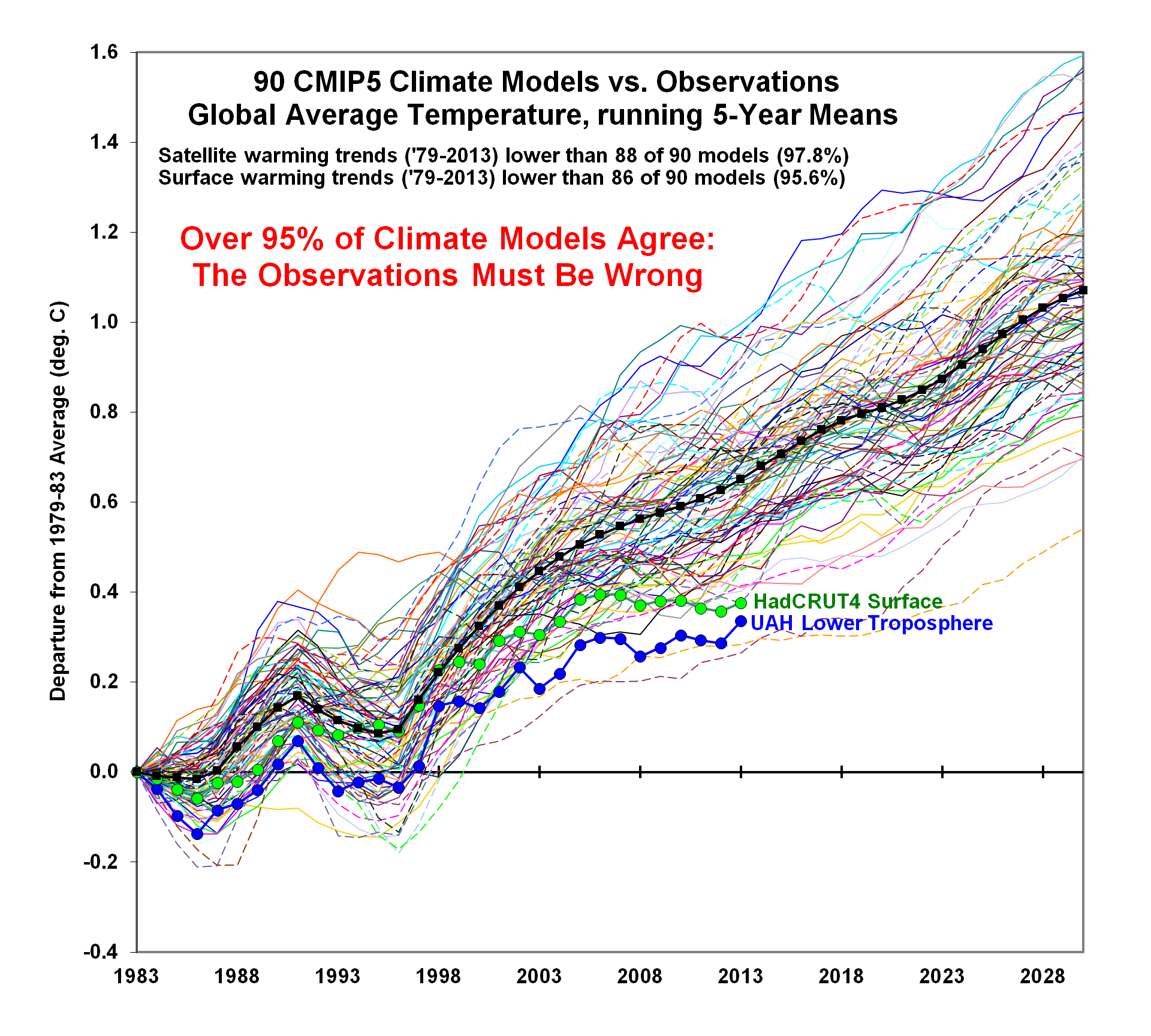
95% of Climate Models Agree: The Observations Must be Wrong

Roy W. Spencer, Ph. D.

I’m seeing a lot of wrangling over the recent (15+ year) pause in global average warming…when did it start, is it a full pause, shouldn’t we be taking the longer view, etc.

These are all interesting exercises, but they miss the most important point:the climate models that governments base policy decisions on have failed miserably.

I’ve updated our comparison of 90 climate models versus observations for global average surface temperatures through 2013, and we still see that >95% of the models have over-forecast the warming trend since 1979, whether we use their own surface temperature dataset (HadCRUT4), or our satellite dataset of lower tropospheric temperatures (UAH):

CMIP5-90-models-global-Tsfc-vs-obs-thru-2013

Whether humans are the cause of 100% of the observed warming or not, the conclusion is that global warming isn’t as bad as was predicted. That should have major policy implications…assuming policy is still informed by facts more than emotions and political aspirations.

And if humans are the cause of only, say, 50% of the warming (e.g. our published paper), then there is even less reason to force expensive and prosperity-destroying energy policies down our throats.

I am growing weary of the variety of emotional, misleading, and policy-useless statements like “most warming since the 1950s is human caused” or “97% of climate scientists agree humans are contributing to warming”, neither of which leads to the conclusion we need to substantially increase energy prices and freeze and starve more poor people to death for the greater good.

Yet, that is the direction we are heading.

And even if the extra energy is being stored in the deep ocean (if you have faith in long-term measured warming trends of thousandths or hundredths of a degree), I say “great!”. Because that extra heat is in the form of a tiny temperature change spread throughout an unimaginably large heat sink, which can never have an appreciable effect on future surface climate.

If the deep ocean ends up averaging 4.1 deg. C, rather than 4.0 deg. C, it won’t really matter.

Why Does Wynne’s Granddaughter Deserve Protection, But NOT My Son???

The SELFISH Granny…
Kathleen Wynne is not your friend. She says she wants to let you buy beer in the grocery store and save her granddaughter Olivia from Climate Change but she is not your friend.
Here is how I know.
My son Joey has a diagnosed neurological condition which has made his young life a great trial. He is extremely sensitive to noises and visual stimulations which can trigger seizures and cause serious harm to his health.
His neurological Specialist composed a letter for me to give to Kathleen Wynne describing his condition which I did have delivered to her and to the Minister of Energy Bob Chiarelli.
All say that they are concerned and that their ministry will make green energy to protect human health and that they are sure he will be ok. But they can’t say this. And they never tell the wind company not to come to your area because your son will have debilitating health problems for the rest of his life.
We moved to quiet rural area to protect Joey’s health. He has grown up here and at 14 making him leave our home will be devastating to his sense of safety and comfort. He will lose his school friends who have accepted him the way he is. His familiar surrounding will disappear.
Ms. Wynne though, only cares about her granddaughter Olivia. But I wonder what Olivia would say if she knew this? Would this make her feel good about her granny?
Like most innocent children I am sure Olivia would be very upset if she knew that this young boy Joey was going to have an impossible struggle to survive if he had to live surrounded by giant wind turbines at home and at school all day and all night? Where does he go?
I have had no help from my premier. But I have received some kind advice form an unlikely source. The Environmental Review Tribunal coordinator Eva Petrysik – a rare civil servant who seems to actually care suggested I write a pleading letter to the Mr. Dennis Maloney  lawyer for the wind developer at Tory’s LLP.
My son’s personal safety matters. There are thousands of special needs and autistic kids in rural Ontario who will be chronically exposed to wind turbine emissions both noise and visual effects. So which ones does our devoted granny select to protect?  Would you like to make this choice? Is unreliable, low performing, costly and harmful wind energy good enough to ruin these kids’ lives? We have international treaties and organizations to protect children from harm but your premier does not care. She is abusing her power and my son.

Sign a Wind Lease in Haste, Repent at Your Leisure!

Wind Leaseholders May Be On The Hook For Billions

global-landgrabA recent visit by members of the Ontario Landowners Association to the Land Registry Office in Goderich (Service Ontario) has revealed the registration of a one billion dollar encumbrance by K2 Wind Ontario Inc. on 100 wind leaseholder properties in Ashfield-Colborne-Wawanosh (ACW), home of the 140 turbine K2 Wind Project. They were looking for the original deed for a property and stumbled on K2 Wind’s charge. Certified publicrecords indicate that some properties may be encumbered at twenty times their farm land value, or more.

“We don’t know the full ramifications of what we have discovered this week”, stated Dave Hemingway, President of the Huron Perth Landowners Association. “We know that K2 Wind is not the only wind company following this practice but we don’t know at this point just how many others are involved.” Mr. Hemingway went on to say, “This raises some serious questions. Have the wind developers been smooth talkers and have rural leaseholders been too naïve and trusting? This might very well impact leaseholders’ ability to borrow money for their farming operations.”
Mr. Hemingway states that this discovery could have a profound effect on a leaseholders’ ability to borrow money, sell the farm or otherwise do what he/she sees fit with their own land.

The Ontario Landowners Association has been promoting the concept of property rights for landowners and has been encouraging them to make application for their Crown Land Patent. As part of this program the association encourages property owners to get a copy of the original deed for when the property was transferred from the Crown to private ownership. In the Huron Perth area, this happened from around 1830. The Crown sold the land to the Canada Company which then sold parcels to the local landowners of the time. The Huron Perth Landowners Association has published a Crown Letters Patent booklet to explain what a Crown Letters Patent is and how to get one for your own property. The association also recommends getting the original deed for one’s property which sets out the terms under which the first individual landowner received the property rights which have subsequently becomes the current owner’s property rights.
For further information, contact Dave Hemingway at 519-482-7005 or davehemingway@gmail.com.

Climate Change Fraud is Much Bigger Than it Seems!

The Great Wind Power Fraud: Just the Tip of the Climate Change Hysteria Spending Iceberg

turbine fire 6

****

The tip of the climate spending iceberg
CFACT
Paul Driessen
31 March 2015

Lockheed Martin, a recent Washington Post article notes, is getting into renewable energy, nuclear fusion, “sustainability” and even fish farming projects, to augment its reduced defense profits. The company plans to forge new ties with Defense Department and other Obama initiatives, based on a shared belief in manmade climate change as a critical security and planetary threat.

It is charging ahead where other defense contractors have failed, confident that its expertise, lobbying skills and “socially responsible” commitment to preventing climate chaos will land it plentiful contracts and subsidies.

As with its polar counterparts, 90% of the titanic climate funding iceberg is invisible to most citizens, businessmen and politicians. The Lockheed action is the mere tip of the icy mountaintop.

The multi-billion-dollar agenda reflects the Obama Administration’s commitment to using climate change to radically transform America. It reflects a determination to make the climate crisis industry so enormous that no one will be able to tear it down, even as computer models and disaster claims become less and less credible – and even if Republicans control Congress and the White House after 2016. Lockheed is merely the latest in a long list of regulators, researchers, universities, businesses, manufacturers, pressure groups, journalists and politicians with such strong monetary, reputational and authority interests in alarmism that they will defend its tenets and largesse tooth and nail.

Above all, it reflects a conviction that alarmists have a right to control our energy use, lives, livelihoods and living standards, with no transparency and no accountability for mistakes they make or damage they inflict on disfavored industries and families.

And they are pursuing this agenda despite global warming again beingdead last in the latest Gallup poll of 15 issues of greatest concern to Americans: only 25% say they worry about it “a great deal,” despite steady hysteria; 24% are “not at all” worried about the climate. By comparison, 46% percent worry a great deal about the size and power of the federal government.

But Climate Crisis, Inc. is using our tax and consumer dollars to advance six simultaneous strategies.

1) Climate research. The US government spends $2.5 billion per year on research that focuses on carbon dioxide, ignores powerful natural forces that have always driven climate change, and generates numerous reports and press releases warning of record high temperatures, melting icecaps, rising seas, stronger storms, more droughts and other “unprecedented” crises. The claims are erroneous and deceitful.

They are consistently contradicted by actual climate and weather records, and so alarmists increasingly emphasize computer models that reinvent and substitute for reality. Penn State modeler Michael Mann has collected millions for headline-grabbing work like his latest assertion that the Gulf Stream is slowing – contrary to 20 years of actual measurements that show no change. Former NASA astronomer James Hansen received a questionable $250,000 Heinz Award from Secretary of State John Kerry’s wife, for his climate crisis and anti-coal advocacy. Al Gore and350.org also rake in millions. Alarmist scientists and institutions seek billions more, while virtually no government money goes to research into natural forces.

2) Renewable energy research and implementation grants, loans, subsidies and mandates drive projects to replace hydrocarbons that are still abundant and still 82% of all US energy consumed. Many recipientswent bankrupt despite huge taxpayer grants and loan guarantees. Wind turbine installations butcher millions of birds and bats annually, but are exempt from Endangered Species Act fines and penalties.

Tesla Motors received $256 million to produce electric cars for wealthy elites who receive $2,500 to $7,500 in tax credits, plus free charging and express lane access. From 2007 to 2013, corn ethanol interests spent$158 million lobbying for more “green” mandates and subsidies – and $6 million in campaign contributions – for a fuel that reduces mileage, damages engines, requires enormous amounts of land, water and fertilizer, and from stalk to tailpipe emits more carbon dioxide than gasoline.

General Electric spends tens of millions lobbying for more taxpayer renewable energy dollars; so do many other companies. The payoffs add up to tens of billions of dollars, from taxpayers and consumers.

3) Regulatory fiats increasingly substitute for laws and carbon taxes thatCongress refuses to enact, due to concerns about economic and employment impacts, and because China, India and other countries’ CO2 emissions dwarf America’s. EPA’s war on coal has already claimed thousands of jobs, raised electricity costs for millions of businesses and families, and adversely affected living standards, health and welfare for millions of families. The White House and EPA are also targeting oil and gas drilling and fracking.

Now the Obama Administration is unleashing a host of new mandates and standards, based on arbitrary “social cost of carbon” calculations that assume fossil fuel use imposes numerous climate and other costs, but brings minimal or no economic or societal benefits. The rules will require onerous new energy efficiency and CO2 emission reduction standards that will send consumer costs skyrocketing, while channeling billions of dollars to retailers, installers, banks and mostly overseas manufacturers.

As analyst Roger Bezdek explains, water heaters that now cost $675-1,500 will soon cost $1,200-2,450 – with newfangled exhaust fans, vent pipes and condensate removal systems. Pickup trucks with more fuel efficiency and less power will nearly double in price. Microwaves, cell phones, vacuum cleaners, hair dryers, toasters, coffee pots, lawn mowers, photocopiers, televisions and almost everything else will cost far more. Poor and middle class families will get clobbered, to prevent perhaps 5% of the USA’s 15% of all human CO2 emissions toward 0.04% of atmospheric CO2, and maybe 0.00001 degrees of warming.

4) A new UN climate treaty would limit fossil fuel use by developed countries, place no binding limits or timetables on developing nations, and redistribute hundreds of billions of dollars to poor countries that claim they have been harmed by emissions and warming due to rich country hydrocarbon use. Even IPCC officials now openly brag that climate policy has “almost nothing” to do with protecting the environment – and everything to do with intentionally transforming the global economy and redistributing its wealth.

5) Vicious personal attacks continue on scientists, businessmen, politicians and others who disagree publicly with the catechism of climate cataclysm. Alarmist pressure groups and Democrat members of Congress are out to destroy the studies, funding, reputations and careers of all who dare challenge climate disaster tautologies. At President Obama’s behest, even disaster aid agencies are piling on.

New FEMA rules require that any state seeking disaster preparedness funds from the Federal Emergency Management Agency must first assess how climate change threatens their communities. This will mean relying on discredited, worthless alarmist models that routinely spew out predictions unrelated to reality. It likely means no federal funds will go to states that include or focus on natural causes, historical records or models that have better track records than those employed by the IPCC, EPA and President.

6) Thought control. In addition to vilifying climate chaos skeptics, alarmists are determined to control all thinking on the subject. They are terrified that people will find realist analyses and explanations far more persuasive. They refuse to debate skeptics, respond to NIPCC and other studies examining natural climate change and carbon dioxide benefits to wildlife and agriculture, or even admit there is no consensus.

They want the news media to ignore us but cannot put the internet genie back in the bottle. The White House is trying, though. It even sent picketers to FCC Chairman Tom Wheeler’s home, to demand that he knuckle under and apply 1930s’ telephone laws to the internet, as a first step in content control States must refuse to play the climate crisis game.

Through lawsuits, hearings, investigations and other actions, governors, legislators, AGs and other officials can delay EPA diktats, educate citizens about solar and other natural forces, and explain the huge costs and trifling benefits of these draconian regulations.

Congress should hold hearings, demand an accounting of agency expenditures, require solid evidence for every climate claim and regulation, and cross-examine Administration officials on details. It should slash EPA and other agency budgets, so they cannot keep giving billions to pressure groups, propagandists and attack dogs. Honesty, transparency, accountability and a much shorter leash are long overdue.
CFACT

Tip of the iceberg

EU’s Green Policies. An Example That No One Should Follow!

EU’s green energy debacle shows the futility of climate change policies

A wind turbine spins at a wind farm on February 19, 2015 near Zaragoza, Spain.

David Ramos/Getty ImagesA wind turbine spins at a wind farm on February 19, 2015 near Zaragoza, Spain.

Ontario will follow the EU at its peril — power rates will soar while industries depart

As the Ontario government announces new unilateral climate policies, Canadian policymakers would be well advised to heed the lessons of Europe’s self-defeating green energy debacle.

The European Union has long been committed to unilateral efforts to tackle climate change. For the last 20 years, Europe has felt a duty to set an example through radical climate policy-making at home. Political leaders were convinced that the development of a low-carbon economy based on renewables would give Europe a competitive advantage.

European governments have advanced the most expensive forms of energy generation at the expense of the least expensive kinds. No other major emitter has followed the EU’s aggressive climate policy and targets. As a result, electricity prices in Europe are now more than double those in North America and Europe’s remaining and struggling manufacturers are rapidly losing ground to international competition. European companies and investors are pouring money into the U.S., where energy prices have fallen to less than half those in the EU, thanks to the shale gas revolution.

Although EU policy has managed to reduce CO2 emissions domestically, this was only achieved by shifting energy-intensive industries to overseas locations without stringent emission limits, where energy and labour is cheap and which are now growing much faster than the EU.

Most products consumed in the EU today are imported from countries without binding CO2 targets. While the EU’s domestic CO2 emissions have fallen, if you factor in CO2 emissions embedded in goods imported into EU, the figure remains substantially higher.

Of all the unintended consequences of EU climate policy perhaps the most bizarre is the detrimental effect of wind and solar schemes on the price of electricity generated by natural gas. Many gas power plants can no longer operate enough hours. They incur big costs as they have to be switched on and off to back-up renewables.

Most products consumed in the EU today are imported from countries without binding CO2 targets

This week, Germany’s energy industry association warned that more than half of all power plants in planning are about to fold: Even the most efficient gas-fired power plants can no longer be operated profitably.

Every 10 new units worth of wind power installation has to be backed up with some eight units worth of fossil fuel generation. This is because fossil fuel plants have to power up suddenly to meet the deficiencies of intermittent renewables. In short, renewables do not provide an escape route from fossil fuel use without which they are unsustainable.

Gas-fired power generation has become uneconomic in the EU, even for some of the most efficient and least carbon-intensive plants. At the end of 2013, 14 per cent of the EU’s installed gas-fired plants stood still, had closed or were at risk of closure. If all gas plants currently under review were to close, this would amount to 28 per cent of current capacity by 2016. Almost 20 per cent of gas power plants in Germany have already become unprofitable and face shutdown as renewables flood the electricity grid with preferential energy.

To avoid blackouts, the government has to subsidize uneconomic gas and coal power plants. Already half of the 28 EU countries have in place or are planning to subsidize fossil fuel power plants to keep the lights on.

Germany’s renewable energy levy, which subsidizes green energy production, rose from 14 billion euros to 20 billion euros in just one year as a result of the fierce expansion of wind and solar power projects. Since the introduction of the levy in 2000, the electricity bill of the typical German consumer has doubled.

As wealthy homeowners and business owners install wind turbines on their land and solar panels on their homes and commercial buildings, low-income families all over Europe have had to foot the skyrocketing electric bills. Many can no longer afford to pay, so the utilities are cutting off their power. The German Association of Energy Consumers estimates that up to 800,000 Germans have had their power cut off because they were unable to pay the country’s rising electricity bills.

The EU’s unilateral climate policy is absurd. First consumers are forced to pay ever increasing subsidies for wind and solar energy; secondly they are asked to subsidize nuclear energy too; thirdly, they are forced to pay for increasingly uneconomic coal and gas plants to back up power needed by intermittent wind and solar energy; fourthly, consumers are additionally hit by multi-billion subsidies that become necessary to upgrade the national grids; fifthly, the cost of power is made even more expensive by adding a unilateral Emissions Trading Scheme. Finally, because Europe has created such a foolish scheme that is crippling its heavy industries, consumers are forced to pay even more billions in subsidizing almost the entire manufacturing sector.

In the last few years, major economies such as Canada, Australia and Japan have begun to realize the futility of going it alone and have retreated from unilateral policies and targets. Now even the EU has decided to walk away and has adopted a conditional climate pledge. It has burdened European taxpayers and businesses with astronomical costs while shifting its heavy industry and CO2 emissions to other parts of the world. Europe’s climate policy failure demonstrates beyond doubt that its unilateralism has been a complete fiasco. The lessons of this self-defeating debacle are clear: Don’t make the same mistakes or you will face the same fiasco.

Benny Peiser is the director of the London-based Global Warming Policy Forum. The text is based on written evidence he gave to the Committee on Environment and Public Works of the U.S. Senate.

More on the Climate Change Scam, From a Real Climate Scientist!

Judith Curry on Mark Levin–I think she’s pissed

Who am I, but a man of experience and intelligence, to consider the reason why Judith Curry, climate scientist and Chair of Enviro Science at Georgia Tech would go on the Mark Levin Radio Show at 6:30 pm on 4-15-15 to talk about her testimony before congress in the previous 24 hours, condemning the warmer hype?

I think that Raul (the wart hog) Grijalva’s inquiries into her travel and funding and the general problem of an inquisition Boxer and others on the left in congress, have raised the lady’s hackles.

I like that. My hackles are perpetually raised because of the lies of the EPA funded junk scientists and their running dog allies in the press and the congress.

So today Dr. Curry showed up to talk to Mark Levin, not a shrinking violet as a conservative, and she told the story of why she is where she is on the warming battle.

May I remind you of what she did in testimony the past 24 hours and what she has done in the past.

It’s not like we have not noticed her courage and integrity before.

today before the Levin show:

http://junkscience.com/2015/04/15/judith-curry-moves-to-becoming-a-pariah-in-the-house-that-green-built/

In the past you might have thought I was considering sainthood for Curry–take a look:

http://junkscience.com/?s=judith+curry

Frauds, Crooks and Criminals

Demonstrating daily that diversity is not strength!

Family Hype

All Things Related To The Family

DeFrock

defrock.org's principal concern is the environmental and human damage of industrial wind turbines on rural communities

Gerold's Blog

The truth shall set you free but first it will make you miserable

Politisite

Breaking Political News, Election Results, Commentary and Analysis

Canadian Common Sense

Canadian Common Sense - A Unique Perspective from Grassroots Canadians

Falmouth's Firetower Wind

a wind energy debacle

The Law is my Oyster

The Law and its Place in Society

Illinois Leaks

Edgar County Watchdogs

stubbornlyme.

My thoughts...my life...my own way.

Oppose! Swanton Wind

Proposed Wind Project on Rocky Ridge

Climate Audit

by Steve McIntyre

4TimesAYear's Blog

Trying to stop climate change is like trying to stop the seasons from changing. We don't control the climate; IT controls US.

Wolsten

Wandering Words

Patti Kellar

WIND WARRIOR

John Coleman's Blog

Global Warming/Climate Change is not a problem