Testimony of a Wind Turbine Sufferer…

It is finally time

This very sad, but now all too common letter discussing wind turbine impacts is published here with the permission of the author.

After being awakened for the ump-teenth time by these grinding, screeching, humming, squealing, house vibrating, jet sounding, phone interrupting, television disturbing, internet interfering, shadow flickering, environmental impacting, property value lowering, aesthetic degrading, red light blaring obtrusive monsters, known as Industrial wind  turbines, (IWT),  thrust upon us without our permission.

It is finally time to thank the uninformed, seemingly uncaring, self-serving, publicly elected officials, for having the audacity to vote in favor of a project that they knew so little about which would forever change the lives of so many people that they are supposed to work to protect, all because a smooth tongued, representative from a less than ethical company, (which person admitted he would not live near turbines), was able to pull the wool over their eyes by making promises of untold booty with undoubtedly, falsified studies of sound, resident acceptance and environmental impact.

I would hope that these publicly elected officials are realizing how their actions have affected the residents of northeastern Tipton County, IN. Thanks to them our lives have changed forever, not for the better but for a lifetime of interruptions, inconveniences not only in the daytime but 24 hours a day. This is not an issue that you can spend an hour or two or a day in the area and comprehend the negative impact it is having upon our lives.

You have to be here for extended periods of time because there will be instances that the wind doesn’t blow yet the humming and screeching will continue as the IWTs search for wind. It was stated that residents would adjust, getting used to these monsters but alas this is not happening when you are awakened at two or three AM by something that sounds as if it is in your house and upon investigating you find that it is an IWT. It has been suggested that we move, however finding anyone to purchase our property for the true value it had before the IWTs were present is impossible.

As I realize this will serve no purpose to alleviate the situation in Tipton County, IN

I would hope it could inform others of the irritating intrusions of IWTs, these monsters have absolutely no place in a community as populated as Tipton County.

Also hoping it would lead elected officials to better investigative procedures before signing on the dotted line.

Although I have not read nor have I seen it, I understand that one of those responsible officials has written some form of apology or regret about their actions. This would show the great character and respect of that person to the citizenry, however it does nothing to alleviate the intrusions.

Respectfully,
Fred McCorkle
Windfall, IN


APR212016

Environmentalists Finally Catching on to the Windscam!

German Greens Turn Against Wind Power Too

Protest poster against the construction of wind turbines in Hamburg, Germany, Europe

****

German opposition to these things grows by the day. And, just like everywhere else, criminals, shysters and chancers cloak themselves in groovy ‘green’ credentials and help themselves to $billions in subsidies filched from power consumers and/or taxpayers: all for the ‘good of the planet’ –  or, perhaps, not.

Corruption, lies treachery and deceit are the benchmark for the wind industry and Germany is no different.

Now, the less gullible among Germany’s Greens have worked out that wind power is the greatest economic and environmental fraud of all time.

Spiegel Puts Spotlight On Germany’s “Green Sleaze” … Wind Industry’s “Corruption Of Greens, Environmental Groups, Local Pols…”
No Tricks Zone
Pierre Gosselin
7 April 2016

The latest hardcopy issue of flagship news magazine Der Spiegel reports how Germany’s green energy revolution has bitterly divided the country’s environmental movement.

Enoch zu Guttenberg, one of Germany’s most prolific environmentalists has become an outspoken critic of wind energy in Germany, and believes children in the future will be able to see Germany’s idyllic landscape only in paintings as developers clear hill-top forests to make way for skyscraper-size industrial wind turbines.

Guttenberg, a symphony conductor, told Spiegel the movement against wind turbines has exploded over the past months and years and that his speeches against wind turbines are attracting ever larger crowds: “When I started 60 or 70 would come, now there are more than 1000.”

Moreover Guttenberg talks of “hundreds of local citizens’ initiatives” that are now mobilizing against wind projects. Spiegel writes of a whole “new quality” of resistance that governments now need to confront as many traditional environmentalists now rail against what they view as a “corruption of green party members, environmental groups, local politicians and city councils“.

So divided the environmentalists have become that Germany’s powerful BUND (Friends of the Erath Germany) launched a slander lawsuit against Guttenberg after he accused the organization of having “merged” with the Wind Lobby. BUND later dropped the suit.

Since then Guttenberg has compared the BUND directors to Judas and accused them of having sold out the environmental philosophy for a “dish of lentil”. Leading environmental activists today are now saying: “The color of sleaze is no longer black, rather it is green.”

The environmental movement has become so disunified, Spiegel writes, that once diehard nuclear energy opponents have now switched to protesting wind turbines, as many planning boards ignore concerns of the citizens and attempt to steamroll projects through against the public will.

Often the projects are politically explosive, involving a good old boys network. A typical pattern, Spiegel writes:

Town mayor, local pols, city directors, who at the same time happen to be the managing directors of wind parks and whoPROFIT from them. A dubious mesh of community and electricity interests.”

This is how it works at many communities, Spiegel describes. Often the nearby residents and citizens pay heftily through lost property values, health issues from infrasound, and high electricity prices. Invariably only very fewBENEFIT at all.

Planners often shoot back and claim nothing is illegal about the business deals. But the public is not having it. Spiegel adds:

Indeed in the meantime resistance is growing. ‘The mood has flipped because people are noticing that it is all about business,’ says anti-wind activist [Manfred] Knake”

At the end of the article Guttenberg, Spiegel writes, calls it the “capitialistic injustice of the Energiewende“.

TheMONEY of the little guy, who has to pay billions for renewables, is diverted into the pockets of some large property owners.”

No Tricks Zone

dirtyrottenscoundrelsoriginal

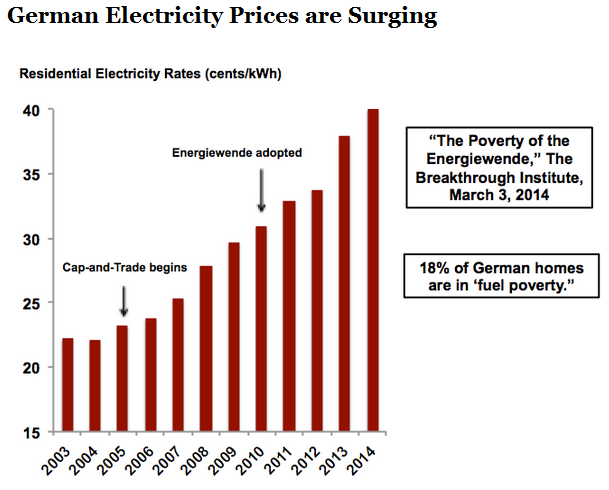
As Germany’s Energiewende Implodes, China Plans to Export Affordable Power to Power-Starved Germans

Novelty Energy CANNOT Keep the Lights On!!

stopthesethings's avatarSTOP THESE THINGS

German power prices

Famously, in 1793 the Emperor Qianlong penned a letter for the benefit of the entourage led by English Ambassador, Lord George McCartney, informing him and his King, George III that “we possess all things. I set no value on objects strange or ingenious, and have no use for your country’s manufactures.”

Things have moved on a little since then, and rather than a hermit kingdom, China has become the one to watch in matters of international import.  On energy matters, the Chinese have hoodwinked plenty in the West into believing that it’s ad idem with UN backed AGW ideologues, when it comes to wind powering it into a ‘super-clean energy’ future.

Inscrutable, as always, the Chinese aren’t about to follow the example set by the likes of Germany: a country that has spent more than €200 billion on its Energiewende and, thereby, sent its power prices through the roof and…

View original post 2,369 more words

Wind Turbine Projects, a Breach of Human Rights!

March 2016Australia

Human Rights and Wind Energy Projects

This document is a review of the possible breaches by wind energy projects of various of the human rights of people living in the vicinity of a wind project.

It identifies and considers a number of potential breaches of varying impact and of differing ease or difficulty of establishing. In this context the rights to health, safe working conditions and property may be the simplest to establish whether breaches have or have not occurred.

Readers of this document need to understand that it is not in any way a legal argument and that whilst all reasonable steps have been taken in its construction the author makes no representation that the information is complete nor that the analysis and conclusions are correct.

Those interested in the subject should obtain their own advice before proceeding with a formal complaint.

Prepared by:
Peter R Mitchell AM, BChe
March 2016

Index

  1. Summary
  2. Introduction
  3. The Relevant Facts
  4. Has the Wind IndustryPROVEN Its Machines Are Safe?
  5. Level of Disturbance
  6. Human Rights Legislation
  7. Major Breaches of Human Rights
    1. Cruel, Inhuman and Degrading Treatment
    2. Discrimination
    3. Arbitrary Interference
    4. Working Conditions
    5. Family
    6. Children
    7. Physical and Mental Health
    8. Homes and Other Assets
  8. Obligations of Civil Servants

Appendices

Each Appendix repeats relevant articles from the Declaration and Convenants with comments in italics on their applicability to the problems discussed in the memorandum.

  1. Universal Declaration of Human Rights (UDHR)
  2. International Covenant on Economic, Social and Cultural Rights (ICESCR)
  3. International Covenant on Civil and Political Rights (ICCPR)
  4. Covenant on the Rights of the Child (CRC)
  5. Convention Against Torture and other Cruel, Inhuman and Degrading Treatment or Punishment (CAT)

A. Summary

IndustrySPIN and uncritical but determined admirers of wind energy have encouraged the political and public view of the wind industry as beyond criticism and critical analysis. In contrast people living in the vicinity of Wind Energy Projects (WEPs) have been suffering both mentally and physically since turbines have appeared in their previously quiet, peaceful and healthy environments.

Some high quality work by US scientistsi in the 1980s uncovered a wind turbine sound profile (signature) that included infrasound and low frequency sound (ILFN). This signature was unlike that of any other source of sound. ILFN at very low and specific frequencies was identified as the cause of health problems in humans. The industry and their favoured acousticians “forgot” this work; but recent field workii in Australia has confirmed the unique sound profile and the cause and effect. Advances in instrumentation are allowing more work to be undertaken in victims’ homes by privately funded acousticians independent of the wind industry.

Characteristically the victims have no funds to seek legal relief or advice but that may become easier as the findings are repeated. Meanwhile the victims continue to endure what they claim are intolerable bodily impacts with their personal sensitivity increasing with timeiii.

Whilst the industry currently feels secure against court action, it has occurred to some that the industry and government regulatory authorities are quite possibly causing major breaches of certain of the victims’ human rights; and that this is an avenue that should, and can, be diligently pursued with a minimum outlay of scarce funds.

Matching of thePROVEN impacts with defined and accepted human rights is the purpose of this document.

Matching shows that rights involving:

  • Cruel, Inhuman and Degrading Treatment
  • Discrimination
  • Arbitrary Interference
  • Working Conditions
  • Family
  • Children
  • Physical and Mental Health
  • Homes and Other Assets

are seemingly being both ignored, and breached.

It is not necessary that every one of the above identified rights is breached. One alleged breach against one person at one wind project is enough to trigger the obligations of the Human Rights Commission.

B. Introduction

The Clean Energy Council website states that: “Australia had 1866 wind turbines spread across 71 wind farms at the end of 2014. Three wind farms with a combined power generation capacity of 566.7 megawatts (MW) were completed in 2014 and a further five wind farms remained in progress early in 2015 and are expected to be completed in 2015”.

Individual turbine size (rated capacity) ranges from less than 1MW to about 3.3MW.

Changes to the Renewable Energy Target will require additional renewable energy capacity to be built, most of which can be expected to be wind derived.

There are a variety of problems with wind energy that are unlikely to be rectified soon. This document is concerned solely with the physiological and psychological impact on families and farm workers living within 10km of a WEP.

The purpose of WEPs is to produce power from a sustainable source without producing carbon dioxide. It may or may not be that the planet is facing disastrous global warming; it may or not be that carbon dioxide produced from fossil fuels is a, or perhaps the, major cause. Many believe (but may not actually know) the answers to the above options are in the affirmative. Political parties and members of State and Federal parliaments have, with some exceptions, accepted the affirmative view. The Commonwealth, through the Renewable Energy Act, has directed that power consumers pay large subsidies for renewable energy in order for wind energy and some other renewable energies to become viable. Thus the wind industry operates with aGUARANTEED PROFIT at a level which is very attractive to some investors who increasingly are foreign.

The wind industry’s interest is to protect and enhance its cash flows. Capitalism has a poor record if its product or service is damaging to the public and the environment. In these circumstances it commonly does not seek to change its product but to defend its continuation. Unfortunately this reaction includes tactics of denial and dissembling, refusing to undertake sufficient research on its own products, delaying research by others and attacking those who see problems with the product and are prepared to say so. An expensive campaign of denial andSPINis progressively developed and practised.

Those convinced of the need to reduce carbon dioxide emissions see wind energy as a win-win solution (both sustainable and reducing carbon dioxide). However, in the matter of its more carefully defined purpose, that being the net reduction of carbon dioxide per unit of power produced, it is a failure.iv This is mentioned here so that readers may realise that wind energy is not the saviour first thought, and that there is no question of “wind power or we perish”.

However this document does not make the argument about wind being not fit for purpose. Others have done and continue doing that. The purpose here is to consider whetherPROVEN impacts on residents constitute transgression of their human rights.

The following facts relating to the generation of power from wind are drawn from published research and unpublished field work, much of which is available on websites such as the Waubra Foundation, National Wind Watch, etc. website. These are discovered and researched facts, not unfounded assertions nor the output of “post modern” science.

Matching of these facts with defined and accepted human rights is the purpose of this document.

C. The Relevant Facts

An understanding of the nature of the sound pressure wavesv emitted by turbines and the impacts of that energy upon neighbours is essential to any assessment of the possible breaching of human rights. Facts vital to this evaluation follow.

  • Wind turbines produce sound (airborne pressure waves) across the infrasound, low frequency and audible ranges.
  • Sound in the very low frequency spectrum (0.1 hertz to 20 hertz) characterised as infrasound, as well as excessive low frequency noise (20 to 200 Hz) causes serious physiological and psychological impacts on some or all of the residents in a significant number of houses up to at least 10 km from the nearest turbine.
  • Residents do not become accustomed to these pressure waves, but become sensitised, so that the impact becomes increasingly damaging with ongoing exposure.(See Endnote ii)
  • A major impact of these sound waves is chronic sleep deprivationvi often associated with waking suddenly and regularly in a panicked state; but other primary or secondary health problems such as tinnitus, vertigo and balance problems, tachycardia, nausea, migraine, exacerbation of chronic medical conditions such as heart disease, and concentration problems, as well as physiological and psychological stress are also common.(See Endnote ii) Chronic sleep deprivation is classified by the World Health Organisation as a contributor to diseasevii.
  • Many residents find their formerly peaceful homes are rendered sonically toxic and ultimately uninhabitable and, on full disclosure to possibly interested buyers, unsaleable.
  • Young children are unable to understand or express their discomfort, which is often extreme, old people are unable to move for various reasons including financial; and all ages suffer declining health and cognitive power and are increasingly at risk in operating farm machinery, fixed machines and even cars and trucks.

D. Has the Wind Industry Proven Its Machines Are Safe?

The information to support the above facts is readily available and mounting. Whilst the wind industry and its variously motivated supporters deny any evidence exists, and discredit the motives and background of the whistleblowers, the industry has never been inclined or required to prove that their ever larger turbines are safe, or to prove another source that has any scientific credibility for the health impacts that arise around wind turbineINSTALLATIONS.

E. Level of Disturbance

Please read on

Prepared by Peter R Mitchell | March 2016

Wind Projects Destroy Farming Communities!

Want Hate-Filled Communities? Then Just Add Wind Farms

farm protest

The wind industry, its parasites and spruikers keep telling us that rural communities are falling over themselves to get in on some wind farm action. However, as usual, theirSPIN and the reality on the ground are miles apart.

Nancy Tips details how wind farms destroy the trust and faith that make vibrant and prosperous rural communities tick.

Lessons about community from Windham
Burlington Free Press
Nancy Tips
7 April 2016

It has become a cliche to say, towns targeted for industrial wind installations are torn apart by the experience. If it’s an experience you haven’t had, you might well wonder what’s behind the cliche. If you really want to understand, you might start by asking the question, what is the nature of the bonds that hold a community together in the first place?

I don’t know about your small town, but in ours, neighborly bonds tend to be of the feel-good type: I do you a kindness and we both benefit. You break your leg? I plow your drive. Your weed whacker is in the shop? I lend you mine. Your brother dies? I go to the funeral, even if I didn’t know him. What a dandy fellow I am, and everyone knows it.

These small acts of kindness do indeed build a sense of community. But as with other relationships, you don’t really know your community until the chips are down.

You don’t know what “for better or for worse” means until you get to the “worse” part. You quickly find out, when a wind developer comes knocking on your community door.

It’s very bad times, at least for some people. And the fact that people are differently affected depending on where they live is, it turns out, at the heart of what you learn about “community.”

You learn when the friend from over the way regards you with a steely gaze when you tell him, “My home, and my family’s home, are a half mile from five 500-foot tall wind turbines.” “I feel for you,” says your friend, quickly changing the subject.

You learn when you try to explain that your fear and sadness are keeping you awake. “All my family’s wealth is in our family farm, which would lie less than 3,000 feet from five 40-story wind turbines. We won’t be able to live here, and the land owner and developer have said they wouldn’t compensate anyone for lost use of their property.” “Please,” chuckles your friend, “it won’t be that bad.”

You learn when you look at the people who are fighting as hard as you are to stop the wind turbine project and realize that the project will probably not affect them so personally, but that they care about their neighbors who will be harmed. And you know they will be next to you, blocking the road, if the day comes when the unimaginably huge trucks arrive with wind turbine parts.

In our little town, we’ve spent nearly four years watching the company reps of the wind developer, an immense multi-national, mosey about on our ridgeline, trying to answer their precious question, is the “wind resource” on your pristine ridgeline enough for us to make lots of money by putting turbines here?

But we have a question too, and although we’ve looked equally hard for the answer, we can’t find it.

Our question is, what will happen to us, as individuals and as a community, if the developer does decide we’re good enough to “host” their project? Who will care for our tattered community, and our damaged lives?

That there is no answer to, or even interest in, our question does not feel good – it feels abusive, unjust. It feels vicious, violent. It feels as if Vermont, my entire family’s beloved adopted home, were the most dangerous place in the world for me and my family to live.

So the days go on, lessons abounding. I learn  about mercy, for instance, when I hear my husband on the phone with a “friend,” explaining that turbine noise at a distance of less than half a mile stands a good chance of affecting the development of my infant grandson’s brain. Then I hear my husband, suddenly fierce, say, “I’m not asking you to feel sorry for me!”

Well you know what, my friend? I am asking you to feel sorry for me. I am asking you, god forbid, to have pity on me. I am asking for your mercy. Your answer will tell me something very important about “community.”
Burlington Free Press

protesters

Want to Destroy Your Economy? Then Follow the World’s Wind Powered Leaders: Germany & South Australia

The Wind Scam Cripples Economies….World-Wide!

stopthesethings's avatarSTOP THESE THINGS

German power prices

As any student of that dismal science will tell you: for businesses, input costs matter. While wind-cultists claim that their beloveds wouldn’t hurt a fly, let alone wreck whole industries, the reality is a long way removed from eco-fascist fantasy. Jack up power prices and, all things equal, an energy hungry firm’s profits must fall and, along with profits, employment must fall too.

South Australia, Australia’s ‘Wind Power Capital’ has seen power prices rocket (the forward price, at $90 per MWh is more than double its neighbour Victoria’s) and unemployment with it: worse is yet to come, on both scores. Then there’s the grid instability and state-wide blackouts that come with routine, total and totally unpredictable wind power output collapses.

One of its power hungry businesses, Whyalla’s Arrium Steel Works has just been placed into administration, with 3,000 jobs under immediate threat, in a town that will become…

View original post 1,406 more words

Ontario’s Wind Power Nightmare: Crippling Power Prices & Rising CO2 Emissions

Ontario’s Wind Energy Fiasco!

stopthesethings's avatarSTOP THESE THINGS

Ontarios-Electricity-Supply-Mix 2014

Ontario is the place where the most bizarre energy policy in the world has seen thousands of these things speared into the backyards of homes – in the most agriculturally productive part of Canada. When we say “bizarre” we mean completely bonkers.

Canada has one of the “cleanest” power generation mixes on the planet, with the vast bulk of its electricity coming from zero emissions sources such as nuclear and hydro.

Adding to the lunacy is the fact that wind power outfits are guaranteed to reap fat profits despite market conditions.

Where the wholesale market price for power in Ontario is between $30-50 per MWh, wind power generators pocket a fixed price of $135 MWh – even if there is absolutely no market for it and the Province literally has to pay neighbouring US States to take it.

Now, adding insult to injury, the much vaunted claims about wind power…

View original post 828 more words

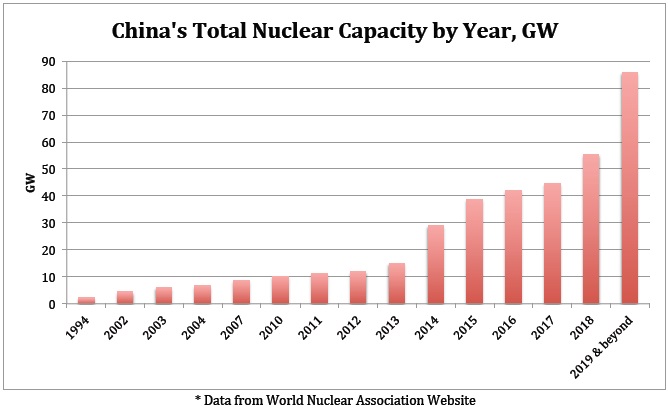
China Won’t Waste Its Time on Wind Power

China wants to Avoid “Energy Poverty”!

stopthesethings's avatarSTOP THESE THINGS

china-nuke-chart2

With the wind industry taking a belting around the planet – its spruikers are left clinging to any vestige of hope, with the anxious zeal of shipwreck survivors happening upon that last piece of flotsam.

One such “hope”, is their belief that China provides the perfect example of what wind power outfits can do when immune from the pesky little obstacles like free power markets and democratic rights.

The line they spin is that China is leading the world in the roll-out of these things; and is well on the way to a 100% wind powered future. But, as with almost everything that the wind industry tosses up as self-justification, the facts tell a somewhat different story – in China:

20% or more of China’s wind power capacity isn’t even connected to the grid (talk about idle gestures);

grid operators aren’t about to change that equation, simply because they’ll lose…

View original post 1,654 more words

Governor’s Wind Farm Push Brings Community Backlash in Upstate New York

Fighting the Wind Turbine Scourge!!

stopthesethings's avatarSTOP THESE THINGS

andrew cuomo NY Gov. Andrew Cuomo thinks it’s ‘my way or the highway’.

****

The wind industry rides roughshod over rural communities wherever it goes, and Upstate New York is no exception. New York’s Governor, Andrew Cuomo is another of the wind industry’s willing ‘enablers’ who seems to believe that arrogance and malice are a political virtue.

Crash or crash through is a style long associated with those that are wedded to spearing these things into the hearts of thriving and prosperous rural communities. However, Cuomo & Co have well and truly underestimated the simmering rage that communities harbour for the wind industry; and the political puppets that, at their benefactor’s bidding, seek to ram wind power down their throats.

Sucking wind in the fight for renewable energy
New York Post
Robert Bryce
28 March 2016

Gov. Cuomo wants New York to be getting 50 percent of its electricity from “renewables” by…

View original post 686 more words