Ontario’s Liberal Government Ignores, and Denies, Health Effects of Wind Turbines…

Ontario’s Wind Powered Health Calamity

sleepingOntario is the scene of a perfectly avoidable and entirely unnecessarypublic health disaster.

The rights of people to live peaceful, healthy lives in rural Ontario have been trampled under the jackboots of Kathleen Wynne’s Liberals – a solid team of hard-‘green’-left eco-fascist nutjobs, responsible for the most bizarre, pointless and costly energy policy on Earth (see our posts hereand here and here)

The scale and scope of the disaster was laid bare in the brilliant documentary, Down Wind (see our post here) and has been pursued with proper journalistic zeal by Sun News’ investigative reporter, Rebecca Thompson (see our posts here and here).

A couple of weeks back, Wynne’s puppets at her Health Department (laughably called “Health Canada”) threw together yet another half-baked, wind industry approved pile of tosh parading as “research” on the known and obvious impacts of turbine generated low-frequency noise and infrasound.

Ever since, properly qualified people have been slamming it for the sloppiness of the work and the wild assumptions upon which its undercooked “conclusions” rest.

Two of them – Carmen Krogh and Bob McMurtry penned the piece below.

carmen krogh

Carmen Krogh, BScPharm (retired), is a peer reviewed IWT health researcher and former Director of Publications and Editor-in-Chief of the CPS.

bob mcmurtry

RY “Bob” McMurtry is Professor Emeritus (Surgery) of Western University (formerly University of Western Ontario). Dr. McMurtry was also an ADM at Health Canada 2000-02.

Health Canada and Wind Turbines: Too little too late?
CMAJ
28 November 2014

Industrial wind turbines (IWTs) are being erected at rapid pace around the world. Coinciding with the introduction of IWTs, some individuals living in proximity to IWTs report adverse health effects including annoyance, sleep disturbance, stress-related health impacts and reduced quality of life. [i],[ii],[iii],[iv],[v],[vi],[vii],[viii],[ix],[x],[xi],[xii] In some cases Canadian families reporting adverse health effects have abandoned their homes, been billeted away from their homes or hired legal counsel to successfully reach a financial agreement with the wind energy developer.[xiii]

To help address public concern over these health effects Health Canada (HC) announced the Health Canada Wind Turbine Noise and Health Study(HC Study) 2 years ago and brought forth preliminary results November 6, 2014.

Here we briefly comment on the HC Study results and provide some historical context.

Acknowledgement of IWT adverse health effects is not new. The term “annoyance” frequently appears when discussing IWT health effects.

In a 2009 letter the Honourable Rona Ambrose, disclosed:

“Health Canada provides advice on the health effect of noise and low-frequency electric and magnetic fields from proposed wind turbine projects…To date, their examination of the scientific literature on wind turbine noise is that the only health effect conclusively demonstrated from exposure to wind turbine noise is an increase of self-reported general annoyance and complaints (i.e., headaches, nausea, tinnitus, vertigo).” [xiv]

In 2009, the Canadian Wind Energy Association (CanWEA) sponsored a literature review which acknowledges the reported symptoms such as headaches, nausea, tinnitus, vertigo and state they “… are not new and have been published previously in the context of “annoyance”…” and are the “… well-known stress effects of exposure to noise …”[xv]

In 2011, a health survey of people exposed to IWTs in Ontario reported altered quality of life, sleep disturbance, excessive tiredness, headaches, stress and distress. [xvi]

In the same year, CanWEA posted a media release which advised those impacted by wind turbine annoyance stating “The association has always acknowledged that a small percentage of people can be annoyed by wind turbines in their vicinity. … When annoyance has a significant impact on an individual’s quality of life, it is important that they consult their doctor.”[xvii]

It turns out it’s not a small percentage of people annoyed by wind turbines. An Ontario Government report concluded a non-trivial percentage of persons are expected to be highly annoyed.

The December 2011 report prepared by a member of CanWEA for the Ontario Ministry of Environment states in the conclusions:

“The audible sound from wind turbines, at the levels experienced at typical receptor distances in Ontario, is nonetheless expected to result in a non-trivial percentage of persons being highly annoyed. As with sounds from many sources, research has shown that annoyance associated with sound from wind turbines can be expected to contribute to stress related health impacts in some persons.”[xviii]

The World Health Organization (WHO) acknowledges noise induced annoyance to be a health effect [xix] and the results of WHO research “…confirmed, on an epidemiological level, an increased health risk from chronic noise annoyance…”[xx]

HC also acknowledges noise induced annoyance to be an adverse health effect. [xxi],[xxii] The Principal Investigator of the recent HC Study also states “noise-induced annoyance is an adverse health effect”. [xxiii]

Canadian Government sponsored research has found statistically significant relationships from IWT noise exposure.

A 2014 review article in the Canadian Journal of Rural Medicine reports:

“In 2013, research funded by the Ontario Ministry of the Environment indicated a statistically significant relation between residents’ distance from the turbine and the symptoms of disturbed sleep, vertigo and tinnitus, and recommended that future research focus on the effects of wind turbine noise on sleep disturbance and symptoms of inner ear problems.” [xxiv]

Recently on November 6, 2014, HC posted on its website preliminary results of its HC Study[xxv]. Wind turbine noise “…. annoyance was found to be statistically related to several self-reporting health effects including, but not limited to, blood pressure, migraines, tinnitus, dizziness, scores on the PSQI, and perceived stress” as well as related to “measured hair cortisol, systolic and diastolic blood pressure.”

These troubling results come as no surprise. Since at least 2007 HC employees including the Principal Investigator of the HC Study recommended wind turbine noise criteria which they predict will result in adverse health effects. (i.e. result in an increase percentage highly annoyed).[xxvi],[xxvii],[xxviii]

Then turbines were built and HC spent 2.1 million dollars to find out it appears to have under predicted the impact of IWT noise. HC’s IWT noise criteria does not use a dose response based on IWT noise but rather road noise. But of course IWTs are not cars and peer-reviewed studies consistently document that IWTs produce sound that is perceived to be more annoying than transportation or industrial noise at comparable sound pressure levels. [xxix],[xxx]

IWT noise annoyance starts at dBA sound pressure levels in the low 30s and rises sharply at 35 dBA as compared to road noise which starts at 55 dBA. These findings are further supported by the HC Study’s preliminary results. [xxxi]

IWT noise characteristics that are identified as plausible causes for reported health effects include amplitude modulation, audible low- frequency noise (LFN), infrasound, tonal noise, impulse noise and night-time noise. [xxxii]

The logical solution would be to develop IWT noise criteria which will protect human health but that would present a barrier to wind energy development. Noise limits impacts IWT siting, cost of energy produced[xxxiii] and by extension corporate profits. The wind energy industry has actively lobbied governments to be granted IWT noise exposure limits which benefit their industry.

Canadians trying to understand this should be mindful the Government of Canada has invested and distributed significant amounts of public money to attract and support the wind energy industry. [xxxiv],[xxxv],[xxxvi],[xxxvii],[xxxviii],[xxxix],[xl],[xli] In addition to providing funding, the Government of Canada in collaboration with wind industry stakeholders has developed the Wind Technology Road Map (Wind TRM) [xlii] which Natural Resources Canada defined to be an “…industry-led, government supported initiative that has developed a long-term vision for the Canadian wind energy industry …”.[xliii]

Canada’s Wind TRM states “Members of the Steering Committee, government and our industry will be using this roadmap to direct the actions that are necessary for Canada to develop its vast wind resources.”[xliv] HC is a member of the Interdepartmental Wind Technology Road Map Committee [xlv] which was created to assist in the implementation of Canada’s Wind TRM. [xlvi] One of the “key action items” detailed in the Wind TRM calls for Government and Industry collaboration to develop and maintain government documents that address concerns raised about wind energy projects including that of noise, infrasound and other. [xlvii]

Some jurisdictions are trying to take action to protect their residents. For example, several municipalities in Ontario are trying to establish bylaws that protect from IWT noise. In Wisconsin, on October 14, 2014 the Brown County Board of Health unanimously approved a motion to declare the IWTs at a local project a Human Health Hazard. [xlviii]

It would appear HC’s research effort is too little too late. A non-trivial percentage of Canadians continue to experience adverse health effects. HC now has additional scientific evidence of the “conclusively demonstrated” effects from exposure to IWT noise. It is time for HC to take action to help Canadians maintain and improve their health. (for the references, see below)
CMAJ

Bob and Carmen aren’t the only qualified experts dumping on the woeful “methods” and flawed assumptions of the Health Canada “research”.

john harrison

John Harrison, a Queen’s University professor emeritus in physics, slammed the “research”, saying that: “the Health Canada study is more politics than science“.

John Harrison is joined by Denise Wolfe – a highly experienced clinical trial research auditor – who has taken a well-honed axe to the “study” – hammering it for:

  • hiding and fudging the raw data;
  • failing to meet the study design’s own sample size criteria;
  • only taking its noise samples during summer, when there is little or no wind;
  • inherent inconsistencies between the data relied on and the arguments presented in the report;
  • incomplete and inconsistent noise modelling;
  • excluding children – the most vulnerable group – from the study altogether;
  • failing to point out that annoyance of the kind identified by the study (which includes sleep deprivation) is defined by the WHO as an adverse health effect (refer to its Night-time Noise Guidelines for Europe – the Executive Summary at XI to XII covers the point);
  • failing to even bother analysing the infrasound data gathered;
  • and, having failed to even analyse the infrasound data, making wholly unsupported conclusions about its impact on sleep and health;
  • in relation to its flawed noise data modelling, relying on wind speed data up to 50km away from the residences involved;
  • making the bogus claim that the study has been published in a peer-reviewed journal (it hasn’t);
  • misleading verbiage (ie waffle and gobbledygook);
  • prematurely publishing what is a piece of political propaganda, based on incomplete and deliberately misleading and inconsistent information; and
  • failing to disclose links between those that worked on the study and their wind industry backers.

sleeping baby

References (to the CMAJ article)

[i] Pedersen E, Persson KW. Perception and annoyance due to wind turbine noise–a dose response relationship. Journal of the Acoustical Society of America. 2004; 116: 3460-70.

[ii] Harry A. Wind turbines, noise and health. 2007, February. Availablehere

[iii] Pedersen E, Persson Waye K. Wind turbine noise, annoyance and self-reported health and well being in different living environments. Occupational and Environmental Medicine. 2007;64:480-86.

[iv] Phipps R, Amati M, McCoard S, Fisher R. Visual and noise effects reported by residents living close to Manawatu wind farms: Preliminary survey results. 2007. Available here

[v] Pedersen E, Bakker R, Bouma J, van den Berg F. Response to noise from modern wind farms in the Netherlands. Journal of the Acoustical Society of America, 2009; 126: 634-43.

[vi] Pierpont N. Wind turbine syndrome: A report on a natural experiment. Santa Fe, NM: K-Selected Books. 2009. Available here

[vii] Krogh C, Gillis L, Kouwen N, Aramini J. WindVOiCe, a self-reporting survey: Adverse health effects, industrial wind turbines, and the need for vigilance monitoring. Bulletin of Science Technology & Society. 2011; 31: 334-45.

[viii] Shepherd D, McBride D, Welch D, Dirks KN, Hill EM. Evaluating the impact of wind turbine noise on health-related quality of life. Noise Health. 2011;13:333-9.

[ix] Thorne B. The problems with noise numbers for wind farm noise assessment. Bulletin of Science, Technology & Society. 2011;31:262-90.

[x] Rand R., Ambrose S, Krogh C. Wind turbine acoustic investigation: infrasound and low-frequency noise–a case study, Bulletin of Science Technology & Society. 2012;32:128–41

[xi] Falmouth Health Department. Letter to Massachusetts Department of Public Health. June 11, 2012. Available on request.

[xii] Nissenbaum M, Aramini J, Hanning C. Effects of industrial wind turbine noise on sleep and health. Noise Health. 2012;14:60:237-43.

[xiii] Roy D. Jeffery, Carmen Krogh, and Brett Horner Industrial wind turbines and adverse health effects

[xiv] Can J Rural Med 2014;19(1):21-26

[xiv] Krogh – Correspondence from the Honourable Rona Ambrose, June 30, 2009. Available on request.

[xv] Colby, W. D., Dobie, R., Leventhall, G., Lipscomb, D. M., McCunney, R. J., Seilo, M. T., & Søndergaard, B., Wind Turbine Sound and Health Effects: An Expert Panel Review, Washington, DC: American Wind Energy Association and Canadian Wind Energy Association. (2009). Available here

[xvi] Krogh C, Gillis L, Kouwen N, Aramini J. WindVOiCe, a self-reporting survey: Adverse health effects, industrial wind turbines, and the need for vigilance monitoring. Bulletin of Science Technology & Society. 2011; 31: 334-45.

[xvii] The Canadian Wind Energy Association, The Canadian Wind Energy Association Responds To October 14, 2011 Statement By Wind Concerns Ontario, Media Release (2011, October 14) PDF Available on request.

[xviii] Howe Gastmeier Chapnik Limited. (2010, December 10). Low frequency noise and infrasound associated with wind turbine generator systems: A literature review (Rfp No. Oss-078696). Mississauga, Ontario, Canada: Ministry of the Environment.

[xix] World Health Organization, Guidelines for Community Noise,1999 Available here

[xx] Niemann H, Bonnefoy X, Braubach M, Hecht K, Maschke C, Rodrigues C, Robbel N. Noise-induced annoyance and morbidity results from the pan-European LARES study. Noise Health 2006;8:63-79

[xxi] Health Canada, Community Noise Annoyance, It’s Your Health, (2005, September). [cited 2014 Nov 25]. Available here

[xxii] Health Canada, Useful Information for Environmental Assessments, (2010), Published by authority of the Minister of Health. [cited 2014 Nov 25]]. Available here

[xxiii] Michaud, D. S., Keith, S. E., & McMurchy, D., “Noise Annoyance in Canada”, Noise Health, 7, 39-47, (2005)

[xxiv] Roy D. Jeffery, Carmen Krogh, and Brett Horner Industrial wind turbines and adverse health effects

[xiv] Can J Rural Med 2014;19(1) Available here

[xxv] Health Canada, Wind Turbine Noise and Health Study: Summary of Results, November 6 2014. Available here

[xxvi] Keith SE, Michaud DS, Bly SHP. A justification for using a 45 dBA sound level criterion for wind turbine projects. N.D.

[xxvii] Keith SE, Michaud DS, Bly SHP. A proposal for evaluating the potential health effects of wind turbine noise for projects under the Canadian Environmental Assessment Act. Second International Meeting on Wind Turbine Noise, Lyon France September 20 -21 2007

[xxviii] Keith SE, Michaud DS, Bly SHP. A proposal for evaluating the potential health effects of wind turbine noise for projects under the Canadian Environmental Assessment Act. J Low Freq Noise. 2008:27:253-65.

[xxix] Pedersen E, Persson KW. Perception and annoyance due to wind turbine noise–a dose response relationship. Journal of the Acoustical Society of America. 2004; 116: 3460-70.

[xxx] Pedersen E, Bakker R, Bouma J, van den Berg F. Response to noise from modern wind farms in the Netherlands. Journal of the Acoustical Society of America, 2009; 126: 634-43.

[xxxi] Health Canada, Wind Turbine Noise and Health Study: Summary of Results, November 6 2014. Available here

[xxxii] Jeffery RD, Krogh CME, and Horner B, [Review] Industrial wind turbines and adverse health effects Can J Rural Med 2014;19(1), 21-26. Available here

[xxxiii] Canadian Wind Energy Association [website]. Letter to Neil Parish re: sound level limits for wind farms. Ottawa, ON: Canadian Wind Energy Association; 2004. Available on request.

[xxxiv] Government of Canada, Natural Resources Canada, EcoEnergy for Renewable Power, web update June 1 2009 Improving Energy Performance in Canada an ecoACTION initiative. Available here

[xxxv] Government of Canada Natural Resources Canada: Government of Canada Announces $9.2 Million for Alberta Wind Energy Project. July 07, Available here

[xxxvi] Minister of Natural Resources Lisa Raitt (Thursday, 10 Sept 2009) MEDIA RELEASE -Renewable Energy Expands in Ontario. Available here

[xxxvii] Government of Canada, Natural Resources Canada. ecoENERGY for Renewable Power Program Power Program Date Modified: 2011-02-25 Available here

[xxxviii] Government of Canada, Natural Resources Canada. About Renewable Energy

[xxxix] Government of Canada, Natural Resources Canada. ecoENERGY for Renewable Power Program, Available here

[xl] Government of Canada, Natural Resources Canada. ecoENERGY for Renewable Power Program Power Program. Available here

[xli] The Honourable Joe Oliver, Minister of Natural Resources Canada, Letter of correspondence August 10, 2012. Available on request.

[xlii] Access to Information and Privacy Request (ATIP) Briefing Note to the Ministers Office, Update on the Development of Federal-Provincial-Territorial Guidelines on Wind Turbine Noise

[xliii] Government of Canada, Natural Resources Canada (NRCAN) Wind Energy | Canada’s Wind TRM (Technology Road Map). Available here

[xliv] Government of Canada, Natural Resources Canada (NRCAN) Wind Energy | Canada’s Wind TRM (Technology Road Map). Available here

[xlv] Health Canada, (2012) Health Canada Policy and Research Approach for Wind Turbine Noise – A presentation to the Science Advisory Board, February 2, 2012 Available here

[xlvi] Government of Canada, Natural Resources Canada. Wind Technology Road Map. Next Steps. Available here

[xlvii] Government of Canada, Natural Resources Canada (NRCAN) Wind Energy | Canada’s Wind TRM (Technology Road Map). Available here

[xlviii] Proceedings of the Brown County Board of Health, Meeting, Tuesday, October 14, 2014 Available here (see page 13)
CMAJ
Data Tampering the Cause of Much Global Warming…

The End Game In US Data Tampering

A lack of transparency is a huge political advantage

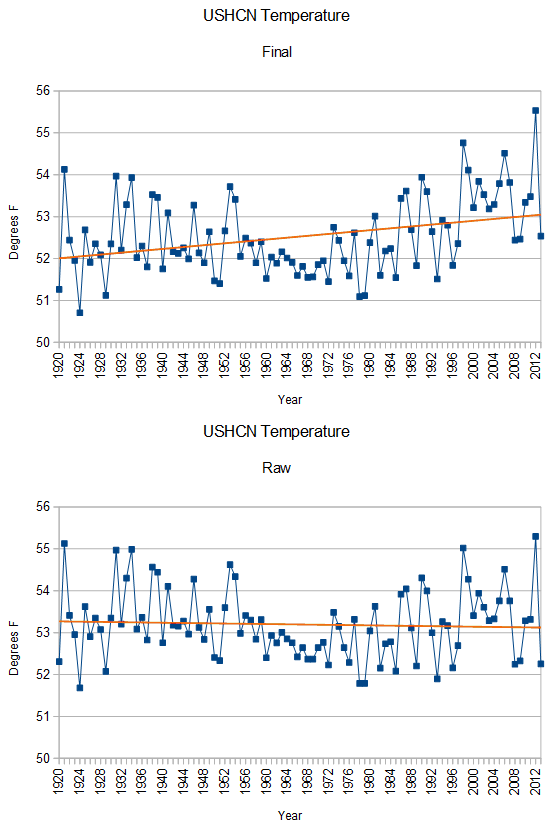
The animation below flashes between raw (measured) US thermometer data, and the final version which is reported to the public. The thermometers show no warming over the past 95 years – all of the reported warming is Mann-made by government employeestampering with data.

USHCNRawVFinal

A big part of this data tampering is implemented by making up monthly temperatures at stations where USHCN says they have no thermometer data. The amount of fabricated data is increasing exponentially, and at current rates of fabrication 100% of the data will be fake by the year 2035 – i.e. there will be no actual thermometer data used after that date. NCDC says that their software which does this, is working “as expected.”

ScreenHunter_4791 Nov. 25 09.21

The next graph shows the total adjustments NCDC are making to the US temperature record. They knock about one degree off of older temperatures, and add a few tenths of a degree on to recent temperatures. Extrapolating out to the year 2035 when 100% of reported temperatures will be fake, the total upwards adjustment will be about one degree, making for a total adjustment of about two degrees.

ScreenHunter_4802 Nov. 25 09.49

The global warming agenda depends on a belief that temperatures are warming, so the fake graphs and press releases released by government agencies about warming and “record temperatures” are critical for perpetuating the big lie about climate.

Aussies Set to Hold an Inquiry Into the “Great Wind Power Fraud”!!!

Australian Wind Industry in a Tailspin as Senate Sets Up Inquiry Into the Great Wind Power Fraud & Cross-Benchers Lay Out Plans for the LRET

tailspin spiraling

STT recently covered a motion proposed by cross-bench Senators Leyonhjelm, Madigan, Day, Xenophon; with the support of the Coalition, through their Deputy Government Whip in the Senate, STT Champion, WA Senator, Chris Back to establish a wide-ranging inquiry into the wind industry in Australia (see our post here).

It gives us much pleasure to report that the Senate voted to establish the inquiry, as moved by David Leyonhjelm on Monday.

THE SENATE
PROOF
COMMITTEES
Wind Turbines Committee Appointment
SPEECH
Monday, 24 November 2014

SPEECH Speaker Leyonhjelm, Sen David

Senator LEYONHJELM (New South Wales) (16:46): I, and also on behalf of Senators Madigan, Day, Xenophon and Back, move:

(1) That a select committee, to be known as the Select Committee on Wind Turbines be established to inquire into and report on the application of regulatory governance and economic impact of wind turbines by 24 June 2015, with particular reference to:

(a) the effect on household power prices, particularly households which receive no benefit from rooftop solar panels, and the merits of consumer subsidies for operators;

(b) how effective the Clean Energy Regulator is in performing its legislative responsibilities and whether there is a need to broaden those responsibilities;

(c) the role and capacity of the National Health and Medical Research Council in providing guidance to state and territory authorities;

(d) the implementation of planning PROCESSES in relation to wind FARMS, including the level of information available to prospective wind farm hosts;

(e) the adequacy of monitoring and compliance governance of wind farms;

(f) the application and integrity of national wind farm guidelines;

(g) the effect that wind towers have on fauna and aerial operations around turbines, including firefighting and crop management;

(h) the energy and emission input and output EQUATIONS from whole-of-life operation of wind turbines; and

(i) any related matter.

(2) That the committee consist of 7 SENATORS, 2 to be nominated by the Leader of the Government in the SENATE, 1 to be nominated by the Leader of the Opposition in the Senate, 1 to be nominated by the Leader of the Australian Greens in the Senate, and 3 to be nominated by other parties and independent senators.

(3) That:

(a) participating members may be appointed to the committee on the nomination of the Leader of the Government in the Senate, the Leader of the Opposition in the Senate or any minority party or independent senator;

(b) participating members may PARTICIPATE in hearings of evidence and deliberations of the committee, and have all the rights of members of the committee, but may not vote on any questions before the committee ;and

(c) a participating member shall be taken to be a member of the committee for the purpose of forming a quorum of the committee if a majority of members of the committee is not present.

(4) That 4 members of the committee constitute a quorum of the committee.

(5) That the committee may proceed to the dispatch of business notwithstanding that all members have not been duly nominated and appointed and notwithstanding any vacancy.

(6) That the committee elect as chair and deputy chair a member nominated by the minority PARTIES and independent senators.

(7) That the deputy chair shall act as chair when the chair is absent from a MEETING of the committee or the position of chair is temporarily vacant.

(8) That the chair, or the deputy chair when acting as chair, may appoint another member of the committee to act as chair during the temporary absence of both the chair and deputy chair at a meeting of the committee.

(9) That, in the event of an equality of voting, the chair, or the deputy chair when acting as chair, has a casting vote.

(10) That the committee have power to appoint subcommittees consisting of 3 or more of its members, and to REFER to any such subcommittee any of the matters which the committee is empowered to examine.

(11) That the committee and any subcommittee have power to send for and examine persons and documents, to move from place to place, to sit in public or in private, notwithstanding any prorogation of the Parliament or dissolution of the House of Representatives, and have leave to report from TIME to time its proceedings, the evidence taken and such interim recommendations as it may deem fit.

(12) That the committee be provided with all necessary staff, facilities and resources and be empowered to appoint persons with specialist knowledge for the purposes of the committee with the approval of the President.

(13) That the committee be empowered to print from day to day such documents and evidence as may be ordered by it, and a daily Hansard be published of such proceedings as take place in PUBLIC.

I seek leave to make a SHORT statement.

The PRESIDENT: Leave is granted for one minute.

Senator LEYONHJELM: I understand that Senate resources are limited in relation to select committees. We acknowledge that. And I understand that at least one other select committee will need to be wound up in order for this to have the full amount of resources. We accept that that is the case. The worst case is that this will operate on limited resources until March, when the inquiry into the activities of the Queensland GOVERNMENT is concluded. Furthermore, if Senator Day is appointed chairman of the committee, he has suggested he may consider relinquishing his fees as chairman to contribute to the committee’s costs.

DIVISION
Ayes 33
Noes 32
MAJORITY 1

Here’s how the SENATORS voted:

AYES, 33

Back Fawcett Madigan Ronaldson
Bernardi Fierravanti-Wells McGrath Ruston
Birmingham Fifield McKenzie Ryan
Bushby (Teller) Heffernan Nash Seselja
Canavan Johnston O‘Sullivan Sinodinos
Cash Lambie Parry Smith
Colbeck Leyonhjelm Payne WILLIAMS
Day Macdonald Reynolds Xenophon
EDWARDS

NOES, 32

Bilyk Gallacher McLucas Siewert
BROWN Hanson-Young Milne Singh
Bullock Ketter Moore Urquhart (Teller)
CAMERON Lazarus O‘Neill Wang
Collins Lines Peris Waters
Dastyari Ludlam Polley Whish-Wilson
Di Natale Ludwig Rhiannon Wong
Faulkner McEwen Rice Wright

Hawthorn v Geelong 1989

Sure, it was a close-run thing, but many a grand final has been won by a single kick.

Predictably, the wind industry, its PARASITES and spruikers have gone into a tailspin – wailing about the dreaded malady of “uncertainty” – of the kind that everyone else gets to face on a daily basis in every aspect of life and business – but from which the wind industry must be protected at all times.

But the Senate INQUIRY is just the beginning of the wind INDUSTRY’s many woes.

Crossbench working on RET plan
Sky News
24 November 2014

A key Senate crossbencher is warning household ELECTRICITY PRICEScould skyrocket unless a political impasse over the renewable energy target is resolved.

Liberal Democrat David Leyonhjelm is in discussion with other crossbenchers about a plan to scale back the RET after talks between the government and LABOR failed.

He fears for households if parliament can’t reach a compromise.

“The record high energy bills that people have been experiencing will seem tame by comparison,” he told AAP.

The government wants to slash the target of 41,000 gigawatt hours to around 27,000, claiming that figure will represent 27 per cent of energy use by 2020 instead of bipartisan level of 20 per cent.

Labor quit negotiations over a new target which has led to further industry uncertainty.

While the Palmer United Party opposes any CHANGES to the RET, Senator Leyonhjelm believes PUP defector Jacqui Lambie may be open to a compromise.

“If the hydro industry was given the ability to generate RENEWABLE ENERGY CERTIFICATES, it would give a badly needed economic boost to Tasmania to the tune of around $120 million per year,” he said.

Senator Lambie has pledged to vote against all government legislation until a defence force pay deal is reconsidered.

However, she could SUPPORT a private bill initiated by one of her crossbench colleagues.

Fellow independents Nick Xenophon and John Madigan both have concerns about wind turbines and have joined forces with other senators to set up an inquiry into the industry.
AAP

STT hears that the cross-benchers are acutely aware that if radical changes aren’t made to the Large-Scale RET pronto, then Australian power consumers will be walloped with fines (the $65 per MWh “shortfall charge”) for every MWh that retailers fall short of the escalating annual LRET target – a figure that will reach more than $1 billion by 2020 and continue at that level until 2031 – simply because the LRET target will never be met (see our posts here and here).

STT also hears that the cross-benchers are currently thrashing out a plan that will avoid that politically disastrous PROSPECT (for a copy of the plan click here).

One aspect of the plan is to include “old” hydro (hydro generation built prior to 1998 that is excluded from the LRET and which is ineligible to receive RECs) and use that output to help SATISFY the shortfall (see our post here).

Another is to bring in rooftop solar output generated in excess of the 4,000 GWh annual “expectation” set by the Small Scale Renewable Scheme (SRES): small-scale SOLAR GENERATION is currently between 8,000-9,000 GWh annually and still growing fast. By 2020, rooftop solar is expected to GENERATE more than 14,000 GWh annually, blitzing the original 4,000 GWh annual expectation. The plan being thrashed out now would use all of that “excess” solar generation to satisfy the LRET.

Bear in mind that all rooftop SOLAR INSTALLED under the SRES gets a fat pile of subsidies by way of “small-scale technology certificates” (STCs), which are paid up front at a guaranteed price of $40. The cost of issuing STCs is paid for by the Federal government to solar installers and recouped from all taxpayers. So it only seems fair that solar does its bit to avoid power consumers being whacked with $billions in fines for failing to meet the LRET: thus avoiding a power and tax bill “double-whammy”.

STT hears Jacqui is working very closely with her fellow cross-benchers to ensure that Tasmania’s “old” hydro gets included in the LRET, with RECs GOING to Tasmanian hydro generators (for a taste of Jacqui’s fury, seeher press release here). In that event, Tasmania would SATISFY the target in a heartbeat.

STT hears that Jacqui’s PLAN to use “old” hydro – along with the plan to use rooftop solar – to satisfy the LRET gets is fast gaining traction amongst the cross-bench Senators.

Including “old” hydro and solar in excess of the SRES “expectation” in order to satisfy the LRET and avoid $billions in fines under the shortfall charge sounds like a common sense outcome to STT – and just the kind of thing one might EXPECT to come from members of a group now known as the Coalition of Common Sense.

muir, xenophon and lambie

John Madigan

Windweasels Torture Residents Living Near Industrial Wind Projects!

Wind Farm Victims – Ocotillo, California: Wind Turbine Noise is a “Horror Beyond Words”

when-is-wind-energy-noise-pollution

Ocotillo RESIDENTS say Wind Turbine Noise Creates “LIVING HELL”
eastcountymagazine.org
14 November 2014

“It’s a HORROR beyond words; something you have to live to understand. Something must be done to stop the noise.” – Ocotillo RESIDENT PARKE Ewing

November 14, 2014 (Ocotillo) – Residents in Ocotillo say that during windy conditions in early November, noise from wind turbines is making their LIVES unbearable.

Jim Pelley captured the loud noise on videotape (see below), juxtaposed with footage of Pattern Energy’s Glenn Hodges SELLING the project to supervisors in Imperial Valley by claiming that noise would not be an issue due to setbacks. “The project was sold on the understanding to be five miles from the community of Ocotillo,” Pelley wrote on a Youtube post. “We have turbines as close as 1/2 mile, we are now forced to live with the horrible noise of 112 turbines when the wind blows.”

****

 ****

His neighbor, Parke Ewing, says his COMPLAINTS to Imperial County and Bureau of Land Management officials, as well as Pattern Energy, have fallen on deaf ears, with no meaningful responses.

“The turbines have created a living hell to us as we try to CONTINUE on with our lives after the Ocotillo Wind Facility was constructed over our objections,” he wrote in a November 1st letter sent to officials at those entities.” Turbines 176 and 169 and others are so loud when the wind blows that they disrupt everything. We can’t enjoy our property. The turbines are even more disruptive to our lives than even we could have IMAGINED. It’s a horror beyond words; something you have to live to understand.

Something must be done to stop the noise. We are one of several families that have homes obviously too close to the turbines. The turbines located near my home need to be removed or relocated. We can’t go on trying to live our lives around the turbine noise. No body, including people that have OBJECTED to Ocotillo Wind, should have to live with the noise when the wind blows. We just can’t do it any longer…”

Ewing asked the County, BLM and Pattern to mitigate the problem, noting that the sound is much louder than Pattern’s description of a DISHWASHER in the next room. “Whoever’s idea of using that term as an adequate description of the noise we would experience has obviously never lived near a turbine in their life.. Let alone 112 “dishwashers” all running at the same time in the next room,” Ewing observed, adding that no officials have taken steps to measure the decibels, let alone measurements such as low-frequency infrasound.

“The turbine noise is creating a high degree anxiety in our lives. We don’t believe it is lawful for this to continue,” the beleaguered Ocotillo resident concluded. “I invite any of you to visit our property when the wind blows and stay awhile. Live the experience as we do- try to talk across your yard over the crashing sound of 336 blades turning and listening to the turbines as they generate their very irritating noise, nobody should be forced to endure this torture.”

Update November 15, 2014: After our story ran, we received this UPDATE from Parke Ewing the next morning, which reads in part:

“Believe it or not, of all days, after I contacted the site manager for Ocotillo Wind today, two representatives visited my HOME today for the first TIME. They listened for awhile, as today was one of those very loud turbine days, their only comment after I asked was, TBD (To Be Determined). Still no return calls or letters from the County of Imperial or BLM. A general manager for Pattern Energy, a Samuel Tasker, quit returning generic answers to me and Jim’s questions and concerns. Carrie Simmons at BLM turned us over to him after we questioned one of her comments regarding the oil leaks and a few other issues. (not noise)

Interestingly, I stood a hundred feet or so in front of a wind turbine yesterday and the noise was very much greater than standing underneath a turbine or even behind the turbine. I assumed that the noise would blow away from me, not into me against the wind, just the opposite of what we would expect. So since our home is in front of turbines 176 and 169 when the wind is coming from the WEST south west, we hear the turbines much more loudly than Jim Pelley, which is down wind. Then when wind is coming from the east we hear turbine 174 more, because we are in front of that one, weird how that works.”
eastcountymagazine.org

kurtz_thth_anr_101220_460w

Why Do Global Warming Alarmists Want to Scare us, and Why Are They Lying To Us?

People Starting To Ask About Motive For Massive IPCC Deception

Guest Opinion: Dr.Tim Ball

Skeptics have done a reasonable JOB of explaining what and how the IPCC created bad climate science. Now, as more people understand what the skeptics are saying, the question that most skeptics have not, or do not want to address is being asked – why? What is the motive behind corrupting science to such an extent? Some skeptics seem to believe it is just poor quality scientists, who don’t understand physics, but that doesn’t explain the amount, and obviously deliberate NATURE, of what has been presented to the public. What motive would you give, when asked?

The first step in understanding, is knowledge about how easily large-scale deceptions are achieved. Here is an explanation from one of the best proponents in HISTORY.

“All this was inspired by the principle – which is quite true in itself – that in the big lie there is always a certain force of credibility; because the broad masses of a nation are always more easily corrupted in the deeper strata of their emotional nature than consciously or voluntarily; and thus in the primitive simplicity of their minds they more readily fall victims to the big lie than the small lie, since they themselves often tell small lies in little matters but would be ashamed to resort to large-scale falsehoods. It would never come into their heads to FABRICATE colossal untruths, and they would not believe that others could have the impudence to distort the truth so infamously. Even though the facts which prove this to be so may be brought clearly to their minds, they will still doubt and waver and will continue to think that there may be some other explanation. For the grossly impudent lie always leaves traces behind it, even after it has been nailed down, a fact which is known to all expert liars in this world and to all who conspire together in the art of lying. These people know only too well how to use falsehood for the basest purposes.”

————————–

Do these remarks explain the comments of Jonathan Gruber about legislation for the AFFORDABLE CARE ACT, aka Obamacare? Do the remarks fit the machinations of the founders of the Intergovernmental Panel on Climate Change (IPCC) and the activities of the Climatic Research Unit (CRU) disclosed in their 6000 leaked emails? It is instructive to know that Professor Gruber’s health care models are inaccessible, protected as proprietary.

The author of the quote was a leader whose lies and deceptions caused global disaster, including the deaths of millions of people. In a complex deception, the IPCC established a false result, the unproven hypothesis that human CO2 was causing global WARMING, then used it as the basis for a false premise that justifies the false result. It is a classic circular argument, but essential to perpetuate the phony results, which are the basis of all official climate change, energy, and environmental policies.

They successfully fooled the majority and even though many are starting to ask questions about contradictions, the central argument that CO2 is a demon gas destroying the planet through climate change, remains. There are three phases in countering what most people understand and convincing them of what was done. First, you have to explain the SCIENTIFIC METHOD and the hypothesis they tried to prove, instead of the proper method of disproving it. Then you must identify the fundamental scientific flaws, in a way people understand. Third, you must anticipate the next question, because, as people grasp what is wrong and what was done, by understanding the first two stages, they inevitably ask the basic question skeptics have not answered effectively. Who did it and what was the motive? You have to overcome the technique so succinctly portrayed in the cartoon (Figure 1).

The RESPONSE must counteract all the issues detailed in Adolf Hitler’s cynical comments, but also the extremely commendable motive of saving the planet, used by the IPCC and alarmists.

clip_image001

Figure 1

There are several roadblocks, beyond those Hitler identified. Some are inherent to individuals and others to society. People want to believe the best in people, especially if they have certain positions in society. Most can’t imagine scientists would do anything other than honest science. Most assume scientists avoid politics as much as possible because science is theoretically apolitical. One argument that is increasingly effective against this CONCERN is funding. Follow the money is so basic, human greed, that even scientists are included.

Most find it hard to believe that a few people could fool the world. This is why the consensus argument was used from the start. Initially, it referred to the then approximately 6000 or so involved directly or indirectly in the IPCC. Later it was converted to the 97 percent figure concocted by Oreske, and later Cook. Most people don’t know consensus has no relevance to science. The consensus argument also marginalized the few scientists and others who dared to speak out.

There were also deliberate efforts to marginalize this SMALL GROUP with terminology. Skeptics has a different meaning for science and the public. For the former they are healthy and necessary, for the latter an irritating non-conformist. When the facts contradicted the hypothesis, namely that temperature stopped rising while CO2 continued to INCREASE, a more egregious name was necessary. In the latter half of the 20thcentury, a denier was automatically associated with the holocaust.

Another form of marginalizing, applied to minority groups, is to give them a unique label. In climate, as in many other areas where people keep asking questions for which they receive inadequate answers, they are called conspiracy theorists. It is why I prefer the term cabal, a secretive political clique or faction, named after the initials of Clifford, Arlington, Buckingham, Ashley and Lauderdale, ministers to Charles II. Maurice Strong referred to the cabal when he speculated in 1990,

What if a small group of these world leaders were to conclude the principal risk to the earth comes from the actions of the rich countries?…In order to save the planet, the group decides: Isn’t the only hope for the planet that the industrialized civilizations collapse? Isn’t it our responsibility to bring this about?

The motive emerged from the cabal within the Club of Rome around the themes identified by their founder, scientist Alexander King, in the publication The First Global Revolution. They took the Malthusian argument that the population was outgrowing food resources and said it was outgrowing all resources. The problem overall was bad, but was exacerbated and accelerated by industrialized nations. They were later identified as the nations in Annex 1 of the Kyoto Accord. The objective to achieve the motive was to reduce industrialization by identifying CO2 as causing global warming. It had to be a human caused variable that transcended national boundaries and therefore could only be resolved by a world government, (the conspiracy theory). Two parallel paths required political control, SUPPORTED by scientific “proof” that CO2 was the demon.

All this was achieved with the political and organizational skills of Maurice Strong. Neil Hrab explains how Strong achieved the goal.

How has Strong promoted concepts like sustainable development to consume the world’s attention? Mainly by using his prodigious skills as a networker. Over a lifetime of mixing private sector career success with stints in government and international groups, Strong has honed his networking abilities to perfection. He can bring presidents, prime ministers and potentates from the world’s four corners to big environmental conferences such as the 1992 Rio Summit, an environmental spectacle ORGANIZED by Strong and attended by more than 100 heads of state.

Here is a simple FLOW CHART of what happened at Rio.

clip_image003

The political structure of Agenda 21 included the environmental catch-all, the precautionary PRINCIPLE, as Principle 15.

In order to PROTECT the environment, the precautionary approach shall be widely applied by States according to their capabilities. Where there are threats of serious or irreversible damage, lack of full scientific certainty shall not be used as a reason for postponing cost-effective measures to PREVENT environmental degradation.

What reads like a deep concern for doing good, is ACTUALLY a essentially a carte blanche to label anything as requiring government intervention. The excuse for action is the unassailable “protect the environment”. Who decides which State is capable? Who decides what is “serious” or “irreversible”? Who decides what “lack of full scientific certainty” means?

Maurice Strong set out the problem, as he saw it, in his keynote speech in Rio in 1992.

“Central to the issues we are going to have to DEAL with are: patterns of production and consumption in the industrial world that are undermining the Earth’s life-support systems; the explosive increase in population, largely in the developing world, that is adding a quarter of a million people daily; deepening disparities between rich and poor that leave 75 per cent of humanity struggling to live; and an economic system that takes no account of ecological costs or damage – one which views unfettered growth as progress. We have been the most successful species ever; we are now a species out of control. Our very success is leading us to a dangerous future.”

The motive was to protect the world from the people, particularly people in the industrial world. Measure of their damage was the amount of CO2 their industry produced. This was required as scientific proof that human CO2 was the cause.

From its inception, the IPCC focused on human production of CO2. It began with the definition of climate change, provided by the UNFCCC, as only those changes caused by humans. This effctively sidelined natural causes. The computer models produced the pre-programmed results and everything was amplified, and exaggerated through the IPCC Summary for Policymakers. The deception was very effective because of the cynical weaknesses Hitler identifies, the natural assumption that nobody could deceive, on such an important issue, and on such a scale, but also because most didn’t know what was being done.

People who knew, didn’t think to question what was going on for a variety of reasons. This situation makes the statement by German meteorologist and physicist Klaus-Eckert Puls even more important.

“Ten years ago I simply parroted what the IPCC told us. One day I started checking the facts and data – first I started with a sense of doubt but then I became outraged when I discovered that much of what the IPCC and the media were telling us was sheer nonsense and was not even supported by any scientific facts and measurements. To this day I still feel shame that as a scientist I made presentations of their science without first checking it.”

Puls commented on the scientific implications of the deception when he said,

“There’s nothing we can do to STOP it (climate change). Scientifically, it is sheer absurdity to think we can get a nice climate by turning a CO2 adjustment knob.”

Now, as more and more people learn what Puls identifies, they WILL start to ask, who did it and what was the motive. When you understand what Adolf Hitler is saying in the quote from “Mein Kampf” above, you realize how easy it was to create the political formula of Agenda 21 and the scientific formula of the IPCC. Those responsible for the formation, structure, research, and FINAL Reports, easily convinced the world they were a scientific organization making valid scientific statements. They also quckly and easily marginalized skeptics, as the leaked CRU emails exposed.

Do you have another or better explanation of a motive?

Wind Energy makes NO Sense…No Gain, Only Pain!

The Economics of WIND ENERGY
Local Business & Economics Professor Urges Huntington County Plan Commission to Not Allow Wind Farms


James O'Donnell The following are the remarks of Jim O’Donnell, Professor Emeritus of Business and Economics, Huntington University.  This presentation on “The Economics of WIND ENERGY” was given to the Huntington County Planning Commission, on Wednesday, November 12, 2014.  His remarks are published here, in their entirety, with his permission.


“Greetings and thanks.”

“I’m speaking tonight as an adopted son of Huntington Co. But as that adopted son, I have struggled to understand why my chosen homeland would develop WIND ENERGY in the southeast part of the county. I guess it’s for the tax revenue, the few jobs that will come with it, and the lease payments to the severalfarmers who will permit turbines on their land. But as an investor and economist, I feel a little like the auto mechanic who’s being shown a car that a good customer wants to buy. Mechanically and economically, the purchase makes no sense to me, the mechanic, at all, but the buyer insists that he’ll get so many credits for buying the car that even if it never starts, he’ll make a bundle.”

Warren Buffett is no auto mechanic or USED CAR salesman, but his name is known by many as a great investor. He’s chairman of Berkshire Hathaway and makes enormous bets on companies we all know, companies like Coca Cola, Wells Fargo, GEICO INSURANCE, Fruit of the Loom, Heinz Ketchup, Dairy Queen, and many more. He’s very smart and is, arguably, the most successful investor alive, maybe of all time.”

“He’s made about $15 billion dollars of investments in wind and solar energy in Iowa and Wyoming, according to financial publisher Bloomberg. He’s planning on INVESTING $15 billion more elsewhere in America. Soon.”

“His wind investments, he says, have treated him especially well. But they’ve treated his tax liabilities even better.”

“The June 4th, The Wall St. Journal quoted him before an audience in his hometown of Omaha, Nebraska. He said, “I will do anything that is basically covered by the law to reduce Berkshire’s tax rate. For example, on wind energy, we get a tax credit if we build a lot of wind farms. That’s the only reason to build them. They don’t make sense without the tax credit.””

“Those are not the words of, say, Sally and Joe living in Huntington County. No, Buffett is one of the richest men in the world, one of the shrewdest investors in the world, too, whose team has analyzed wind energies economic and investment possibilities with a fine-toothed comb. And he finds WIND ENERGY, essentially, an economic wasteland, save for the tax credits. Now if Buffett thinks that, why would Huntington be making investments in WIND ENERGY? Because the county will increase its tax revenues, even if only by benefiting from tax breaks to the very rich, paid for my ordinary taxpayers. It simply does not make sense. I don’t even think it’s right. But it makes sense for Buffett and for Huntington County because their bottom line is increased.”

“Let’s try to understand Buffett’s and other very wealthy people’s attitudes towards “the tax credits” from wind energy? If we understand, then we’ll understand why Huntington Co. might be willing to help rich people take more from the government breast at taxpayers’ expense.”

“Back in 1992, Congress created the Wind Production Tax Credit, or the “PTC,” a small tax credit of about 2c per kilowatt hour that today is an even smaller $23 per megawatt of wind electricity generated, to nurture energy production in the then-infant wind energy industry. Earlier, government supported those who build structures, not energy production. Today, at least the incentive is the production of energy. Government incentives, like the PTC, are often used to promote young but crucial industries. That’s not the problem with the PTC.”

“The history of the PTC has been an off and on credit, renewed since 1992 by Congress for a year or two at a time. Then, it expires and fans of wind [no pun intended] get it renewed. It expired again last Dec. 31st. If we were to look at an honest graph of investments made in wind, we would see that it rises with the credit and collapses with its expiration. Moreover the infant industry it is meant to encourage is now more than 30 years old, kept alive by U.S taxpayers who keep paying to make it attractive for rich investors.”

“It’s important, too, to realize that the PTC can only be taken against “passive income” – that is, income from other investments by rich people and big companies. Wall St. bankers put together investors who want tax write-offs, which are provided by the PTC. Recall Buffett’s words: “we get a tax credit if we build a lot of wind farms. That’s the only reason to build them.””

“Approximately $24 billion of Federal subsidies have poured into wind energy since its beginning over 30 years ago. These credits limit funds that might help find really viable sources of alternative energy. In other words, as an investor myself, I’m saying the PTC is a misplaced bet. The PTC actually blocks funding for other green energy technologies that hold more promise. Rather than helping another infant, but worthy technology, the PTC is a handout to rich people and WALL STREET.”

“But government largesse does NOT end with the PTC. Not by a long shot. Not in a government as friendly to green energy and as hostile to fossil fuels as the Obama administration is. In fact, rarely has a multi-decade old infant industry enjoyed such disproportionate favoritism. Even though the wind industry produces currently only about 3.5 to 4% of the country’s electricity, it receives 42% of the federal government’s electrical financial support.”

“Combined with other targeted incentives, the federal government, in fact, gives wind producers $56.29 per megawatt-hour, according to the federal government’s own Energy Information Administration – the “EIA”. By comparison, natural gas, oil, and coal power generation only get 64 cents per megawatt, while nuclear power receives $3.14.”

“Seemingly innocuous, the PTC gives wind companies $23 in subsidies for each megawatt-hour of electricity they produce. This money adds up quickly; it costs taxpayers billions of dollars every year; while wind energy also creates huge problems, too, with sound, noise, landscape blight, bird kill, bat kill and intermittentcy. On average, wind turbines are SPINNING only about 30% of the time and, ironically, can’t spin at all in high winds (Detroit Edison, DTE, to cite only one utility, turns their turbines off when winds exceed 45 mph.)”

“In addition to the support that wind power gets at the federal level, it gets huge support at many state levels, too. Currently, 30 state governments enforce mandatory purchases of wind, solar, or other green energies under so-called Renewable Portfolio Standards that require utilities to buy a certain percentage of their electricity from green sources, whatever the cost. This, of course, jacks up consumer’s electric rates.”

“We’ve all heard the saying, “there is no such thing as a free lunch,” and that APPLIES to government subsidies, too. When lawmakers give special tax breaks to their friends and favorite industries, they shift the tax burden onto everybody else left in the tax base. While subsidies may allow wind turbine makers to pump up their payrolls, such as putting a few people to work in Huntington Co., the rest of the economy suffers. Government subsidies divert labor and capital away from more productive areas of the economy, to those where cronies get richer, which slows overall economic growth – something I would think Hoosiers don’t like.”

“The PTC, when combined with federal and state benefits gives wind producers a great advantage over other energy producers. In fact, it exceeds half of electricity’s wholesale price in many areas of the country. True, more wind energy is being produced each year, and its cost, relative to other forms of electricity is becoming more competitive. But only because of massive subsidies and higher rates for consumers.”

“Federal and state subsidies are so high that they lead many wind farms to sell their electricity at a substantial loss, just to collect the tax credits. Many wind producers are literally paying utilities to buy their product — and yet they’re still turning a profit because the taxpayer foots the bill by providing credits and subsidies.”

“I have no ax to grind against the rich, but I don’t think their gains should come as a loss to great numbers of Americans through higher energy costs.”

“While wind’s tax credits may be great for Warren Buffet and his bottom line, it’s harmful for American taxpayers and very expensive to America’s energy consumers.”

“I really wish wind energy worked better. Many people, including me, think alternative energy, in time, will offer huge environmental benefits for our children and those who come after us. But right now, wind is a museum specimen of a government boondoggle, a monument to crony capitalism’s, a favor to the rich and powerful over the little guy or the average person.”

“Huntington Co. can MAKE MONEY on this, no doubt. We’ll get tax revenue, a few jobs, and a few farmers get lease payments for turbines on their property. Living off the government breast is just not how I want to make money and I think such activities fly in the face of Indiana’s character and Huntington’s, too, as a place that favors freedom and honest work. It’s won a reputation of late for free markets, low taxes, and for encouraging growth in the private sector. Indiana is and Hoosiers are enemies of senseless, wasteful spending. And Warren Buffett sees wind energy as senseless right now, except for the tax benefits it offers its investors. As conscientious, publicly-minded citizens of Huntington Co. who give of your own time and talents to consider what’s best for our county’s land, its people and its future, please don’t allow wind energy’s horrible economics to find a place to make a home.”

James O'Donnell James O’Donnell
Executive-in Residence, emeritus standing

James M. O’Donnell received his UNDERGRADUATE DEGREE from Brown University and his MBA from Columbia University. Professor O’Donnell is a certified public accountant and spent many years as an executive in the FINANCIAL SERVICES INDUSTRY with such firms as Fidelity Investments and the Dreyfus Corporation in Boston and New York, respectively.

Wynne and Her Merry Band of Miscreants, Robbing us Blind!

One month and one billion dollars more wasted…

CleanLicencePlate_wynne_windmill

I have to ask… where is the main stream media?

Kudos to the Toronto Sun for posting the story by Parker and Lufts who run the blog Wind Concerns Ontario.  And of course Sun News for trying to get this across to the people of Ontario.

Are you aware that it only took 30 days for the Liberals to piss away yet ANOTHER ONE billion dollars (yes with a B! for Billion) in order to over pay for hydro production?

30 days and 1 billion dollars GONE!  Pfffsst gone!  If it’s any conciliation, for the previous 30 day period of September 2014, they only pissed away 800 million dollars to pay more than the actual market value of said produced electricity.

Wynne and her gang of liberal marauders have now successfully created a billion dollar a month money funnel, in order to fund their green energy scheme.

Can we predict November’s numbers?  Another billion?  Safe bet.  And December?  Another Billion?  Yep.  And on and on it will go.

Not ONE penny of that endless cycle of monthly missing billions per month will go to benefit the Ontario resident. NOT ONE PENNY!

Are you queasy yet?  Or hopefully you are angry.

No money for sick kids, no money for diabetics, no money for road infrastructure and no money for non Liberal causes.  LOTS AND LOTS of billions though for the sucking black hole of grossly expensive and unnecessary green energy projects and their owners.

We can no longer continue to give these slugs a free pass while we are being robbed blind by this Green Energy disaster.  Who’s with me?

Feel free to link or share via social media.  Please do not alter.  Thanks.

No More Free Ride for Windweasels in the US!

Republican Mid-Term Victory Spells Doom for US Wind Industry

wind_turbine_fire

The US has just been through its mid-term elections, which saw sweeping gains by the Republican Party in the Senate, House, and in many gubernatorial elections, as well as state and local races.

The Republicans gained control of the Senate for the first time since 2006, and increased their majority in the House. The Republicans also gained several seats in governors’ races, defeating one incumbent Democrat and picking up three seats vacated by retiring Democrats. Counting continues with the Republicans set to pick up a number of seats in the House, and, possibly the Senate.

With Republicans firmly in control of Congress, the smooth subsidy-sailing enjoyed by the US wind industry (until now) is about to hit stormy waters.

John Boener, Mitch McConnell

Those US States that piled into wind power in a big way have seen power prices rocket, with some seeing increases of over 34% (Idaho). From 2008-2103, the top 10 wind power states saw their electricity prices rise an average of 20.7%, which is seven-fold higher than the national electricity price increase of merely 2.8% over the same period (see our post here). The cost of wind power is so uncompetitive that Nebraska has just knocked-back a long-term wind power deal because it was “just too expensive” (see our post here).

The adverse economic impacts of propping up the wind industry with exorbitant fixed priced State Feed-In-Tariffs and the Federal Production Tax Credit aren’t lost on Republicans. Here’s a wrap up on where America’s wind industry is headed.

It May be Lights Out for the Wind Industry Come the Midterms
FOXBusiness
Chris Versace
27 October 2014

The International Energy Agency recently cut its forecasts for oil demand growth for this year. Nevertheless, production in North America is exploding led by the shale oil boom. Already, the U.S. has become the world’s largest producer of oil and natural gas.

For energy products like oil and natural gas operating in the marketplace, this excess production means lower costs for consumers. Lower prices have their own consequences for the industry as well. Analysts at Sanford C. Bernstein & Co recently released a report revealing that current at prices as much as one-third of U.S. shale oil production will be “uneconomic” to harvest.

For government-backed industries such as wind energy, the relationship is directly the opposite – the more they produce, the more it costs ratepayers and taxpayers. Recent analysis shows that states with the largest use of wind power have the highest electricity bills. Such factors have caused private investors to largely bypass wind companies and leave them largely dependent upon the government for their survival.

Wind energy companies rely heavily upon a government construct known as the “Production Tax Credit” (PTC) to support their bottom lines. The PTC is a federal program that provides billions of dollars annually to subsidize renewable energy facilities such as wind farms. Generally speaking a clean technology facility receives a tax credit for 10 years after the date the facility is placed in service with the tax credit amount ranging from $0.23 per kilowatt-hour (kWh) for wind to $0.011 per kWh for qualified hydroelectric.

Looking at the International Journal of Sustainable Manufacturing, researchers concluded that “in terms of cumulative energy payback, or the time to produce the amount of energy required of production and installation, a wind turbine with a working life of 20 years will offer a net benefit within five to eight months of being brought online.” This raises the question as to why any tax credit for wind energy would span more than just a few years at most let alone 10 years after the facility is up and running.

Congressional support for the PTC is largely split along party lines. Fifty-five Members of the House led by Rep. Mike Pompeo, (R-Kan.), have written a letter to the tax writing committee demanding an end to the wind energy subsidies. The letter stated:

We offer our full support of the current process undertaken by the House Committee on Ways and Means that will allow the most anti-competitive and economically harmful tax provisions, specifically the wind energy production tax credit (PTC), to expire. Ensuring that our nation’s patchwork tax code undergoes significant reform is a noble goal and, as part of this process, we believe Congress should stop picking winners and losers and finally end the wind PTC.”

It is presumed that a GOP controlled Congress would see the PTC on the chopping block in 2015 and a Democrat-controlled Congress will fight for renewal.

It would be an understatement to say that the outcome of the 2014 elections is important for wind energy producers. In an effort to see PTC friendly Harry Reid as Majority Leader, the wind industry has essentially turned the League of Conservation Voters (LCV) into their own personal Trojan horse.

Much of the LCV leadership has deep ties to the wind energy:

  • Tom Kiernan, CEO of the American Wind Energy Association (AWEA) serves as the Treasure of the LCV.
  • Peter Mandelstam, former AWEA board member and founder of Green Sails wind energy company also serves on the LCV board.

Unsurprisingly, much of the LCV’s campaign activities have been aimed squarely at renewal of the PTC. The organization brags that it will spend over $25 million supporting pro PTC candidates and attacking their opponents before November elections.

Should LCV’s campaign fail, loss of the PTC could prove fatal to some wind companies. As Warren Buffet recently told his loyal investors, “I will do anything that is basically covered by the law to reduce Berkshire’s tax rate. For example, on wind energy, we get a tax credit if we build a lot of wind farms. That’s the only reason to build them. They don’t make sense without the tax credit.”

The outcome of the elections remain far from certain as does the fate of the PTC under any election outcome scenario and Washington D.C.’s capacity for cronyism should never be underestimated.

That said, it should leave investors holding off if not second-guessing the potential of First Trust ISE Global Wind Energy ETF (FAN) shares or its holdings that include Capstone Turbine Holdings (CPST), Otter Tail Corp. (OTTR), NextEra Energy (NEE) and others. Especially if the Republicans take control of Congress as expected, and run a full tally of their friends and enemies during this election cycle, it may well be lights out for the wind energy industry sooner than anyone expects.
FOXBusiness

storm tossed ship

The Truth Has Been Out There a Long time…Why Won’t the Gov’t Listen?

Unreliables cannot provide energy security or enhance natural environment

My new word for the energy sources popularly known as “renewables” is “unreliables”. Though there may be some tiny exceptions, the general characteristic is that they are all diffuse sources that cannot actually be controlled by humans or automated control systems.

One of the main reasons that energy has been a huge political topic since about World War I is that it plays a major role in the economic security posture of any nation. With accessible sources of energy that can be focused and exploited in a short period of time, a nation literally has the “power” to do great things for its population or to do very nasty things to others. It is a matter of choice as to how that power (energy per unit time) is deployed.

One of the issues that caused Japan to attack Pearl Harbor was a desire to protect sea lines of communication to secure sources of energy in the South Pacific. One of the main reasons that Hitler pressed into Russia was a desire to access energy sources in the Caspian region. A primary purpose of Rommel’s move through North Africa was gaining access to oil. Though there were other factors, America’s secure Texas, California, Oklahoma and Louisiana oil fields were a major factor in our ability to deploy sufficient power to defeat the Axis nations.

Throughout my military career, which lasted 33 years from the time I first entered the Naval Academy, I studied the importance of energy in our foreign policy actions. When I learned about Henry Kissenger’s famous statement “America doesn’t have friends. America only has interests.” it was in the context learning about efforts to secure access to energy resources that could supply our economy, ships, aircraft, trucks and tanks.

In the name of energy security, there are some people, like T. Boone Pickens, who try to sell the idea that unreliables like wind and solar energy can make a contribution. As a trained military man, that whole concept makes no sense. A diffuse source of energy that cannot be called on when needed is not a source of power; it is a source of impotency. It turns people into passive recipients of nature’s largess instead of being able to establish control and decision making authority.

Ready for Appalachian Trail
Please do not get me wrong; I like the natural environment. I simply do not agree with the notion that building massive collecting systems to harness energy from nature has anything to do with improving national security or providing power to the people. It does not enable development, but forces a reduction in living standards that is often portrayed as some kind of admirable “conservation”. The act of “doing without” might bring some kind of inner pleasure to some, but for a nation it brings poverty vice economic prosperity.Finally, I want to point out that many advocates of unreliables will attempt to point out that nuclear energy does not replace oil since we do not use oil in the continental United States to operate our power grid anymore. My response is multidimensional.

  • The operative word regarding oil on the electrical grid is “anymore”. Until nuclear pushed oil out of the market, it provided as much as 17% of our power. We burned it at the rate of a million barrels of oil per day in 1978.
  • Solar, wind, geothermal, waves, and ocean thermal energy cannot directly power cars and trucks either.
  • We do use a lot of oil for process heat. Nuclear energy can provide reliable heat as well as electricity.
  • Nuclear energy can push natural gas out of the electricity market and force well capitalized oil and natural gas companies to invest in compressed natural gas infrastructure to open up a new market in vehicles.

Most of the time, unreliables advocates get impatient with me before I finish the first bullet.

A contact suggested that blogging on Atomic Insights and engaging in discussions in a group called Nuclear Safety might be limiting the conversation to those who already agree with me. At his advice, I joined the “Sierra Club” group on LinkedIn. (The group is not affiliated or sponsored by the Sierra Club, but it includes individual members and other people who are interested in the Sierra Club.)

Some views can only be accessed by walking
That contact had started a conversation thread about nuclear energy and attracted some rather pointed commentary. Here is my first contribution to that discussion, which had already included almost two dozen comments.

Please allow me to politely join the conversation.

I am not a Sierra Club member, but I wish I could be one. I respect the organization’s long record of wilderness preservation achievements and agree with about 90% of the organization’s goals. I have studied its history in the roots of Ansel Adams (no relation) and John Muir and its epic struggles to prevent filling priceless canyons with water held back by enormous hydroelectric and flood control dams.

Though I am a life-long suburban dweller, I have spent many of the best hours of my life practicing “no trace” camping and hiking in eastern mountains in Georgia, North Carolina, Virginia, Maryland and Pennsylvania. I have been driving a 40+ MPG car since 2001, but even before that I always bought cars with as high a gas mileage as possible.

The reason I cannot join the Club is that I cannot come to terms with the illogic of its shift, dating back more than 30 years, from an official policy of “Atoms Not Dams” to a strong and inflexible antinuclear stance. I call myself a hard headed BHL; I learned that from my dad, the guy who taught me to appreciate camping in National Forests as being a lot more fun than the trips to Disney World that most of our neighbors took during their vacations.

Dad was an electrical engineer who was firmly rooted in rational approaches to problem solving. When I was about 8 years old, he came home from work and told me about the amazing new power plants that his company was building at Turkey Point, Florida that did not even need any smoke stacks.

We talked a lot more about nuclear power and by the time I was ready to go to college, I had decided I would become a nuclear engineer. I got detoured slightly; I actually majored in English, but I did it at a school where English majors were still required to take 4 semesters of calculus and post calculus math, 2 semesters of physics, 2 semesters of chemistry, 2 semesters of thermodynamics, a semester of basic propulsion systems and 2 semesters of electrical engineering.

When I graduated, I entered into the Navy nuclear power training pipeline and eventually served as the Engineer Officer on a submarine. When you have lived in a completely closed environment with a nuclear reactor as your sole source of power, it becomes very difficult to see why there is so much concern about the technology. We had clean air, all the clean fresh water we could want, air conditioning, and refrigeration. Our computers did not contribute to global warming.

The 9,000 ton ship I was on operated for about 14 years on a quantity of fuel that weighed just a little bit more than I do. Every used core that the Navy has produced since starting to operate the USS Nautilus is stored in a single, modestly sized building with an indoor pool in Idaho.

That almost magical technology is built on an incredible gift from god (mother nature if you prefer) that packs as much energy into a pound of uranium as it packed into 2 MILLION pounds of oil. I cannot understand why an organization that was founded on protecting as much of the natural environment and heritage as possible would prefer to cover vast quantities of it with industrial scale wind turbines built by some of the world’s largest and least admirable corporations. I do not understand why the Club supports projects like the Abengoa solar project that will cover hundreds to thousands of acres in the Mohave desert with shiny mirrors aimed at hazardous heat transfer liquids for no more than 50% of the day and predictably become idle monstrosities every single night.

Finally, and most illogically, I cannot understand why the national club, supported by Carl Pope’s strong statements over a number of years, is ignoring the feedback from local chapters in Pennsylvania who have seen first hand the full scale of the environmental destruction that comes with the industrial process of extracting methane gas using horizontal drilling and hydraulic fracturing.

(Note: BHL – Bleeding Heart Liberal)

I’ll let you know if any interesting conversation develops. During my twenty years of Internet conversations – dating back to Prodigy, USENET and AOL – I have had the sometimes disheartening experience of making the last comment in an interesting thread.

Wind Turbines Get the Green Light, to Slaughter Birds & Bats…NOT GREEN!

It just gets worse:

[…] Wildlife consultant Jim Wiegand has written several articles that document these horrendous impacts on raptors, the devious methods the wind industry uses to hide the slaughter, and the many ways the FWS and Big Green collude with Big Wind operators to exempt wind turbines from endangered species, migratory bird and other laws that are imposed with iron fists on oil, gas, timber and mining companies. The FWS and other Interior Department agencies are using sage grouse habitats and White Nose Bat Syndrome to block mining, drilling and fracking. But wind turbines get a free pass, a license to kill.

Big Green, Big Wind and Big Government regulators likewise almost never mention the human costs – the sleep deprivation and other health impacts from infrasound noise and constant light flickering effects associated with nearby turbines, as documented by Dr. Sarah Laurie and other researchers.

In short, wind power may well be our least sustainable energy source – and the one least able to replace fossil fuels or reduce carbon dioxide emissions that anti-energy activists falsely blame for climate change (that they absurdly claim never happened prior to the modern industrial age). But of course their rants have nothing to do with climate change or environmental protection.

The climate change dangers exist only in computer models, junk-science “studies” and press releases. But as the “People’s Climate March” made clear, today’s watermelon environmentalists (green on the outside, red on the inside) do not merely despise fossil fuels, fracking and the Keystone pipeline. They also detest free enterprise capitalism, modern living standards, private property … and even pro football!

They invent and inflate risks that have nothing to do with reality, and dismiss the incredible benefits that fracking and fossil fuels have brought to people worldwide. They go ballistic over alleged risks of using modern technologies, but are silent about the clear risks of not using those technologies. And when it comes to themselves, Big Green and the Billionaires Club oppose and ignore the transparency, integrity, democracy and accountability that they demand from everyone they attack.

Read it all …

Typical of the political green class, and ‘Big Media’. Hypocrites. Climate Change was just the line needed to cover their extortion.