Windweasels are Definitely a Despicable Bunch of Miscreants!

Scottish Council Demands Copy of Noise Report for Non-Compliant Wind Farm & Its Operator Predictably Runs for Cover

RUN-HIDE-logo_crop

****

One of the slickest moves wind weasels ever made was to have their team write the so-called “wind farm noise guidelines” – which deliberately exclude all reference to the real bane of wind farm neighbours – incessant turbine generated low-frequency noise and infrasound:

Wind Turbine Infrasound: What Drives Wind Farm Neighbours to Despair

Three Decades of Wind Industry Deception: A Chronology of a Global Conspiracy of Silence and Subterfuge

And the next slickest was to write the planning ‘rules’ – designed to have the operators themselves cook up the so-called “compliance data”, which they then hand over to the gullible country bumpkins that work on local Councils; untrained dimwits who simply accept whatever’s dropped on their dreary little desks, by the operator’s highly-paid, pet acoustic consultants.

Fox

****

Some might liken it to handing over security detail at your backyard hen-house to ‘Le Renard & Co’.

That wind power outfits might pull just one or two punches in their obvious commercial interest, might come as a shock to some. However, the same malevolent approach to the manufacture of helpful ‘evidence’ – and the deliberate concealment of the unhelpful stuff – has been adopted all around the globe.

In Australia, Spanish wind conquistadors, Acciona have been turning in fabricated noise data, ever since its Waubra wind farm kicked into gear in 2010.

The operator knows full well that it cannot, and will never, comply with the noise conditions of its planning consent; so does the local Council and the Victorian Planning Department – all of which are sitting on a damming document prepared by an independent consultant, Heggies – which they steadfastly refuse to hand over to their dozens of victims, for obvious reasons:

Victorian Planning Department involved in Waubra Wind Farm Non-Compliance Cover Up

The same ‘method’ has been applied to two other Victorian public health disasters: Macarthur and Cape Bridgewater.

Here’s more of the same from the Highlands of Scotland.

Angus Council may pull plug on Ark Hill windfarm
The Courier
Graham Brown
5 September 2015

Angus planners are on the brink of instigating enforcement action against the operators of the district’s largest windfarm.

The patience of council chiefs is running out over a demand for a noise monitoring report for the eight-turbine Ark Hill windfarm, near Glamis, where the 266-foot structures have been operational since spring of 2012.

A deadline of Friday was set for operators Green Cat Renewables to give an update on the noise monitoring report previously requested by the authority last November.

Residents in the area around the Strathmore site have complained about turbine noise since the windfarm became operational and they said the company was “giving Angus Council the run around”.

Following crunch council discussions within the past week, concerned residents were told that the close of business on Friday was set as the deadline for the operators to give a firm indication of when they plan to submit the monitoring report, or face enforcement action.

The ultimate sanction available to the council is to shut down the windfarm.

One resident said: “These problems have gone on since the turbines went up and they affect our lives, our pets and livestock in the fields around Ark Hill.

“There are so many things which can make a difference to the noise from the turbines, and quite often it is when there is little or no wind.

“People in the area suffering health problems are starting to link them to the windfarm and yet all this time we are still waiting on this noise report.

“The council are not at fault here, they have asked Green Cat for the report and it has not been produced — they are being given the run around.

“No-one can say that there’s not a problem here and it needs to be sorted.”

A council spokesperson said: “Angus Council understands that the wind turbine operator has completed noise monitoring and data gathering at the site and is in the process of preparing a finalised report.

“We have requested a clear timescale for the submission of that report and hope to have clarity on the matter shortly.”

Green Cat Renewables were contacted but made no comment.
The Courier

What? A non-compliant wind farm’s operator running for cover? Who ever heard of such a thing?

Wind Industry RUNS & HIDES as World Wakes Up to the Great Wind Power Fraud

The fact that wind weasels and inconvenient truths are unlikely to appear on the same stage anytime soon, is – these days – pretty much common knowledge – as the following comments to the article above attest.

Anonymous

Green Cat has been dragging its feet for months producing the monitoring report. What have they got to hide?

If anyone has any doubts about the excessive noise visit the site and listen for yourselves.

Disgraceful behaviour from this company.

A public apology from Green Cat would be appropriate. While residents suffer – some without a good night’s sleep – they have dragged their feet in resolving the noise problem.

An appalling stare of affairs.

Concerned Observer

How stupid is this. Has Angus Council learned nothing from the Seed Crushers fiasco in Arbroath?

Asking the offender to provide information is like asking someone to jail themselves – stupid, just plain stupid.

The correct way for noise monitoring is:

1 – the council commission an independent noise monitoring report before any development takes place for which the applicant pays the council.

2 – the noise level above that, then established ambient level, is included in the planning consent as a condition and included in the Environmental Impact Assessment.

3 – the operator is required to keep a noise monitoring log at pre-determined times as part of the planning consent (something like a set date of each month).

4 – any breach is checked against that log.

5 – any continual complaints are investigated by the council, once again commissioning an independent noise monitoring report chargeable to the owners of the site.

6 – any breach of the planning conditions are then rectified by the issuing of an enforcement notice.

Angus Council is at fault here for not applying strict rules to the planning consent and relying on the owners to hang themselves. SEPA who are equally as useless operate in the same way as the council.

It is about time the Scottish government clamped down on the shoddy practices of enforcement and to lackadaisical planning conditions, without any firm pre permission conditions and agreed methods of implementation. Green Cat are at fault, Angus Council are at fault, the Scottish government are at fault. Good luck to the residents but honestly – you are not going to get anywhere now the turbines are up and running and the operator remains responsible for providing evidence.

brave_shield3

Tom Harris, Exec. Director of Int. Climate Science Coalition, Talks to John Counsell, of CFRA, in Ottawa.

Tom Harris speaks on Radio, to John Counsell, of CFRA Radio Stn., in Ottawa

I believe this is one of the all time biggest frauds perpetrated on people world-wide. Wealth transference, from rate payers, to governments and rich investors. We are not improving our environment, in any way. There is no net benefit to wind or solar, over traditional energy sources, burned cleanly, especially hydro and nuclear, which are rejected in favour of this “novelty energy”! The corruption inherent in this incestuous relationship between governments and the renewables industry, has to be investigated. It is a scam! We are being robbed blind. Energy poverty is a reality for many people.  Shellie Correia

Eric Jelinski – A Canadian Energy Engineer, Tells the Truth About Wind Turbines….

Top Canadian Energy Engineer – Eric Jelinski – Slams the Great Wind Power Fraud

engineering-image-4

Provided they haven’t got their trotters in the wind industry subsidy trough, engineers are quicker than most, when it comes to rumbling the great wind power fraud.

Practically minded, and with heads for real numbers, engineers are able to pick apart the complete pointlessness of trying to rely on an energy source that will NEVER be available on demand (can’t be stored) – is entirely dependent upon the weather – and is, therefore, not a generation “system” at all: “chaos” and “system” are words that come from completely different paddocks; and which mean completely different things (see our post here).

And engineers, who build “systems”, don’t like “chaos”.

Google’s top engineers – Stanford PhDs, Ross Koningstein and David Fork – came out and recently tipped a bucket on the nonsense of attempting to run 21st Century economies using a ‘technology’ that was dumped way back in the 19th Century (see our post here).

Now, one of Canada’s leading energy engineers, Eric Jelinski has come out swinging too.

An Engineer Speaks
Windfarm Action
27 January 2015

The following was written by Eric Jelinski, P. Eng., a Canadian engineer who specializes in energy production. Gas plants. Nuclear plants. Wind & solar energy. He explains to his township (Clearview Township, Ontario) why wind energy is folly.

Jelinski

I am writing to express my objections to the installation of Industrial Wind Turbines in Clearview Township, Ontario, Canada.

My wife and I moved here to retire on 50 acres, building a house, market garden, as well as taking many other initiatives to become part of the vital social fabric.

It is bad enough that under Ontario Premier McGuinty, the social fabric in big cities like Toronto is in need of repair, as it happens, in part because those “50,000 jobs” in renewable energy have not materialized, and there is little productive activity for many of the youth in the cities. Guns and drugs are very much part of the social fabric in some neighbourhoods.

What gives McGuinty, with his Toronto constituent Members of the Provincial Parliament (MPP’s), the moral right to tell us in Clearview that we must accept wind turbines “or else”?

One way to stop the wasted energy and environmental impact of urban sprawl is for big city MPP’s to clean up their own yard and make cities safer and more habitable. While they listen to those who object to new gas plants, and cook up a new “plan of the month” for public transport, why do they ignore the issues with wind turbines?

My background is nuclear and chemical engineering, with over 30 years combined working at each of the nuclear plants in Ontario. I teach nuclear engineering at University of Toronto and Georgian College (Power Engineering) in Owen Sound for the purpose of training the next generation of staff who will design plants and work them safely.

I know nuclear reactors and how e=mc2 gets us the energy. I know chemical reactors, e.g. to make gasoline from crude oil, and refining metals. I know solar and wind energy going back to the 1970’s, as energy and exergy are my major fields of study.

The application of Ontario’s “Green Energy Act” is in violation of principles in engineering, where we teach engineers to anticipate unintended consequences and not proceed with implementation until consequences and risks are taken into account.

The Green Energy Act is an abomination that is creating a living hell for almost everybody in rural Ontario, and the provincial government is ignoring the data of emerging health issues, property value issues, setbacks and zoning, impacts on fowl, fauna, and fish, impacts on local weather such as the dew point and foliar uptake by plants that is important in particular to alleviate heat stress on biota.

I have seen firsthand one of my neighbours from the 1980’s near Ripley forced out of his farm home due to wind turbines in Huron Township. Others are putting up with the impacts.

The energy available from wind in Ontario is borderline minimal compared to other countries and areas of the world. 25% to 30% is the capacity factor.

The wind is not available when we need energy the most, i.e. summer air-conditioning and winter heating. The shoulder seasons have the most wind here, yet this is when air-conditioning and heating demands are minimal.

The power equation for wind results in 8 times the energy for a doubling of wind speed, and the excess energy has to be “dumped.” Storage systems are available, but prohibitively expensive. Hythanation is possible, but wind turbines are not economic for hydrogen production given the added infrastructure relative to the cost of natural gas.

Wind turbines use 5 to 7 times the amount of concrete and steel vs. say a nuclear plant on a per Megawatt basis. It will require some 10,000 wind turbines to replace the ~ 6000 MW of coal generation at 25% CF (capacity factor). Back-up gas fired plants have to be added like plug-ins everywhere because the wind is not reliable.

The pastoral scene of a field of wind turbines slowly turning in almost still air has environmentalists dreaming in technicolour.

The truth is that these wind turbines need about 8 km/hour of wind before they will start generating electricity. Any rotation of the blades at wind speeds below 8 km/hour is accomplished by taking power from the grid to get the wind turbine started in anticipation that the wind may pick up.

The economy of scale that has historically brought competitive energy prices in Ontario is not available, given the thousands of wind turbines, and that will also become a maintenance nightmare as machines and contracts approach end of life. Why do we not refuel Nanticoke, Lakeview, Lambton, Lennox and complete Wesleyville to run on natural gas?

What makes McGuinty et al. think they can impose industrial wind turbines on Clearview and all of rural Ontario? Is Clearview thinking of becoming part of this scheme of waste?

This scheme of waste is happening not just by government order, but it is happening because of the salacious relationship between government and the developers.

The most telling example is the head of the Federal Liberal Party is a wind developer. The activity surrounding the recent cancelled “gas plant” in order to preserve seats, and thus preserve the Green Energy Act, is also telling.

We also have the government using engineers from wind developers making recommendations on health impacts. As a P. Eng. I can say that engineers are not the authority on health. The conflict of interest between the engineer being paid for engineering work, vs. the same engineer as proponent and key advisor to the government is quite apparent.

The set-back of 550 meters has no scientific basis. Noise from wind turbines has been measured up to 10 kilometers away in some locations. Medical doctors have noted the health impacts, yet they are being ignored by the Ontario government.

The Feed-in Tariff takes billions of dollars out of communities, out of the province, and out of the country. This is money that is very much needed for healthcare, for schools and teachers, and to replace aging infrastructure and to build much needed new infrastructure such as public transit.

For the first time in decades (I don’t think it ever took place), Ontario is taking equalization payments from the Federal Government, and this points to not only the unsustainability of Ontario as an economy, it is dragging down the rest of the country. It would be different if we owned everything, did local planning, and used a process that garnered respect.

The Ontario government is following the advice of foreign countries and foreign companies to give our money away to them irrespective of the advice of many MP’s. It is most interesting to note that one of the political parties with a labour platform appears in complete agreement with giving away the work and the money and the surplus electricity.

Japan is restarting its nuclear fleet. Russia, China, India, Britain, the US, and even the United Arab Emirates are building or planning to nuclear reactors for electric generation. What is the purpose and value of Ontario energy policy? Every product we buy in Ontario that is made someplace else (most items, can you name one thing that is made here?) has a nuclear energy component in that product.

It is time to stop being altruistic or hypocritical about our energy. There is no rational reason for the 50% cap on nuclear in Ontario. Are we on some unwitting “race to the bottom” being orchestrated by some competitor countries wanting to control us? Having ample low cost energy is crucial to sovereignty, internal peace, and security.

As such, there is no respecting McGuinty, Bentley et al. for this indictment. There is also no need to respect any wind developers as they have already indicated their respect for us. I commented last year on WPD, and sent comments to their consultant as requested, and they have not replied, and their silence speaks volumes. I have sent many an e-mail to the government recommending a moratorium and have not been given the courtesy of any reply.

The purpose of the developer is to make money, i.e. take our money as allowed for by the government, and with minimum effort on their part. This speaks to the quality of the public meetings and their answers to our concerns. The public meetings are a sham.

There are quite a number of lawsuits already taking place and others pending. I thank the Federal government for the recent announcement on the health study. It is also pivotal to learn today that the Ministry of Health is being forced to testify.

My recommendation is for Clearview to take the high road and avoid complicity in matters that are before the courts, and who knows, but it is quite possible (I hope) that the renewed call for a moratorium may take hold for good reasons posted here.

A moratorium in Clearview is very appropriate.

While the WPD wind turbines west of Stayner are quite a few km from our place, they are likely the thin edge of the wedge planned for coming into Clearview. Let me remind you, we came here because this is a good place to live with good opportunities for business. All of that changes if wind turbines are allowed to disrupt the neighbourhood. And 10,000 wind turbines and solar farms are not the answer to Ontario’s energy needs.

As I said before, a province-wide moratorium is needed, and I believe this will come as a matter of time because the inconvenient truth about wind turbines is too big for McGuinty’s carpet. The track record for dictatorial governments throughout history is that all dictatorships eventually capitulate. A moratorium in Clearview would be a “made in Clearview” solution to stop the waste sooner than later.

Eric Jelinski, P. Eng.

What is interesting is that this is not only a UK or European problem and the US and Canada predates much of our wind fleet. But the problems are endemic in the industry and the political myopia of the issues and problems of wind a mystery to the other 97% of the population!
Windfarmaction

wind turbine Screggah-wind-turbine-Padraig-McNulty-2-460x345

Green Energy Ponzie Scheme Lands Clinton’s Buddies in “Hot Water”…

Green Energy Execs Praised by Clinton Foundation Indicted for $54M Ponzi Scheme

Bill Clinton / AP

Bill Clinton / AP

BY: http://platform.twitter.com/widgets/follow

_button.e5e892aa8b

44a208190cd018a89499d8.en.html#_=1441655616597&dnt=false&id=twitter-widget-i1441655616516692086&lang=en&screen_name=lachlan&

show_count=false&show_screen_name=true&size=m
September 5, 2015 2:37 pm

Executives of a Pennsylvania green energy company singled out for praise by Bill Clinton were arrested on fraud charges on Thursday in connection with an alleged Ponzi scheme.

The individuals are facing charges of wire fraud, securities fraud, and conspiracy over their roles in running a green energy company that authorities say was an elaborate $54 million Ponzi scheme, the Associated Press reported.

Prosecutors said the trio lied to investors that their “biochar” technology and “carbon-negative” housing in Tennessee made millions, but they had almost no earnings and used the money to repay earlier investors and for themselves.

The scam allegedly ran from 2005 until 2009, even after the Securities and Exchange Commission filed a civil lawsuit against Wragg and Knorr’s Mantria Corp. They were ordered in 2012 to pay $37 million each. […]

Two months before the SEC civil lawsuit, the company was publicly recognized for its stated commitment to “help mitigate global warming” by former President Bill Clinton’s Clinton Global Initiative. The company was cited for its plans to develop the biochar technology that it said would sequester carbon dioxide and reduce emissions in developing countries. Wragg appeared on stage with Clinton at the event in September 2009.

Praise for Mantria remains on the website of the Bill, Hillary, and Chelsea Clinton Foundation:

Mantria Corporation commits to help mitigate global warming through the use of its Carbon Fields site, where Mantria will perform trials on their product BioChar, a carbon-negative charcoal, to prove how this product can sequester carbon dioxide, improve soil quality when buried, and reduce emissions in developing countries.

Windpushers Want Guarantees, That Their Scam Will be Allowed to Continue!

Wind Industry Still Wailing About ‘Uncertainty’ as Australian Retailers Continue to Reject Wind Power ‘Deals’

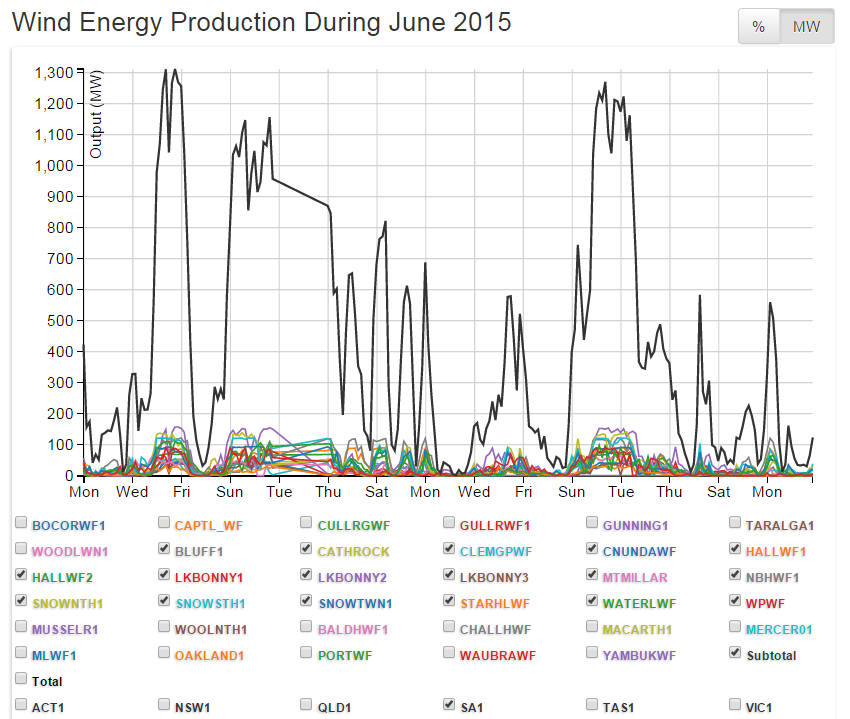
June 2015 SA

[Could it be something about the ‘product’, maybe?]

Back in February this year, STT covered the unassailable fact that Australia’s Large-Scale Renewable Energy Target (LRET) – then set at a colossal 41,000 GWh – was completely unsustainable on every level – economic, political and social:

LRET “Stealth Tax” to Cost Australian Power Punters $30 BILLION

Our little analysis came at a time when a debate was underway about not whether, but by how much, the ultimate annual target needed to be cut to preserve a little of the wind industry’s furniture.

You see – with the ultimate target set at 41,000 GWh for 2020 – barely 16,000 GWh of power available from eligible renewable sources – and no new wind power capacity being built and none likely to be built – the imposition of the whopping $65 per MWh “shortfall charge” was then looming fast.

The actual cost to consumers of what is, pure and simple, a Federally mandated fine on electricity retailers – which will be recovered from all Australian power consumers – is around $93 per MWh, which is added to the average wholesale price of around $35 per MWh.

The Coalition’s wind industry front man, young Gregory Hunt calls it his “massive $93 per tonne carbon tax”. Its particular political toxicity was what focused the minds of our political betters in Canberra; and resulted in the first cut to the LRET’s ultimate annual target from 41,000 GWh to 33,000 GWh.

The principal logic that drove both the Coalition and Labor to slash the LRET target being fear of a power consumer (read “voter”) backlash – a revolt that will inevitably result when power consumers receive spiralling bills spelling out the fact that they are being hit with a mammoth, Federal electricity stealth tax.

Politicians of all hues know it – and, more importantly, Australia’s major electricity retailers know it: there is absolutely no way that – in an economy about to start going backwards – struggling businesses, manufacturing industries and cash-strapped households will tolerate the imposition of an enormous (and utterly pointless) Federal tax on electricity consumption.

Remember, this is the same electorate that smashed Julia Gillard over her ‘carbon tax’ – which, as another Federally mandated tax on electricity, was seen by voters as economically ‘toxic’; and gifted government to Tony Abbott’s Coalition 2 years ago.

After a lot of huffing and puffing – and shenanigans in the Senate – the reduced LRET target passed in June. At the time, the wind industry, its parasites and spruikers were howling one minute about the attack on “wonderful wind”; and breathing a collective sigh of relief that the dreaded “uncertainty” about the target was finally over.

Well, the trouble is that certain “certainties” still, and will always exist, in relation to the greatest economic and environmental fraud of all time: THESE THINGS DON’T WORK.

The retailers are about selling power on demand; not according to the vagaries of the wind.

Now, our favourite wind-worship cult-commanders – the Climate Spectator’s Tristan Edis (see this piece of wishful thinking) and ruin-economy’s Giles Parkinson – are furious about the fact that – despite the ‘agreement’ that settled on the latest LRET target – Australia’s retail power companies have absolutely NO interest in signing up to buy a “product” that can only ever be delivered at crazy random intervals, if at all. A product that brings total chaos for grid managers and allows peaking power operators to scoop up $millions in minutes:

South Australia’s Unbridled Wind Power Insanity: Wind Power Collapses see Spot Prices Rocket from $70 to $13,800 per MWh

The Wind Power Fraud (in pictures): Part 1 – the South Australian Wind Farm Fiasco

The Wind Power Fraud (in pictures): Part 2 – The Whole Eastern Grid Debacle

On top of that, the Senate Inquiry’s report (see our post here) into the great wind power fraud concluded that the adverse health effects caused by incessant turbine generated low-frequency noise and infrasound – such as sleep deprivation – are real; and not the product of some BIG COAL plot.

With 200 pages setting out the evidence of victims like SA turbine hosts, Clive and Trina Gare (see our post here), retailers are fully alive to the fact that it’s a matter of when, not if, wind farm neighbours start suing wind power outfits for $millions in damages. ‘Slam dunk’ common law claims in nuisance for the loss of the use of their homes; loss of property values etc, are brewing up as we speak. The outcome of which is that the $2 outfits used as fronts for the likes of Infigen will be insolvent, as soon as the victims file their claims:

Potential Wind Farm Neighbour Finds Idyllic Property is Now ‘Unsaleable’ at Any Price

Brits to Force £2 Wind Power Outfits to Hold £Millions in Reserve to Pay Damages to Victims & for Decommissioning

Bankers, retailers and anyone else with real skin-in-the-game hate risk – of any description. Signing up to lend money to – or buy wind power from – an outfit liable to go under in heartbeat is bad enough, but where the wind power outfit in question is in the gun for $millions in liability claims for nuisance or negligence, then it’s RISK that only the crazy-brave would take on.

But it’s risk of a different kind that has poor old Giles Parkinson almost turning on the waterworks in this, his latest lament: Renewable investment drought to continue as utilities extend buyers’ strike

Giles cites Miles George – head of Australia’s most notorious wind power outfit, Infigen (aka Babcock and Brown) – as he rails against the fact that Australia’s 3 biggest retailers – Origin, EnergyAustralia and AGL – have no intention of entering power purchase agreements with wind power outfits, which means they will never obtain the finance needed to build any new wind power capacity, anywhere FULL STOP.

Although never one quick to join the dots, Giles fails to make the (fairly obvious) connection between the unwillingness of $billion outfits – like Origin – to contract with near-bankrupt Infigen – even though Giles focuses on Infigen’s latest whopping $304 million annual loss: ever heard of ‘due diligence’, Giles?

In the mother of all ironies, Infigen, again blames its latest financial disaster on ….. wait for it …. “PARTICULARLY POOR WIND CONDITIONS”.

Oh, mother!

But should Miles and the gang really be complaining? After all, the wind is – as they repeatedly tell us – “FREE”. Which calls to mind that old chestnut about “getting precisely what you pay for”.

We’ll pick up Infigen’s latest ‘be-calmed-cash-loss-calamity’ in another post, shortly.

The ONLY reason power retailers do any business with cowboys like Infigen and union backed thugs like Pacific Hydro, is to obtain renewable energy certificates (RECs); and, thereby, avoid the imposition of the shortfall penalty. However, the likes of Giles and Tristan are unable to recognise that power retailers do, in fact, have a ‘choice’, in that respect.

They do not need to purchase RECs at all – power retailers are perfectly entitled to pay the fine and collect it from their customers. Which brings us back to ‘pending political toxicity’.

The big retailers know full well that Australian power consumers will not tolerate being lumbered with fines that will add close to $22 billion to their power bills, over the life of the LRET scheme. Here’s the calculus of what no-one – on either side of government – is willing to reveal, let alone prepared to ‘sell’, to voters.

The LRET target is set by s40 of the Renewable Energy (Electricity) Act 2000 (here). At the present time, the total annual contribution to the LRET from eligible renewable energy generation sources is 16,000 GWh; and, because commercial retailers have not entered PPAs with wind power outfits for well over 2½ years – and have no apparent intention of doing so from hereon – that’s where the figure will remain.

In the table below, the “Shortfall in MWh (millions)” is based on the current, total contribution of 16,000,000 MWh, as against the current 33,000 GWh target, set out as the “Target in MWh (millions)”.

A REC is issued for every MWh of eligible renewable electricity dispatched to the grid; and a shortfall penalty applies to a retailer for every MWh that they fall short of the target – the target is meant to be met by retailers purchasing and surrendering RECs. As set out below, the shortfall charge kicks in this calendar year. Given the impact of the shortfall charge, and the tax treatment of RECs versus the shortfall charge, the full cost of the shortfall charge to retailers is $93. Using that figure, here is the cost of the shortfall penalty.

Year Target in MWh (millions) Shortfall in MWh (millions) Penalty on Shortfall @ $65 per MWh Minimum Retailers recover @ $93
2015 18.85 2.85 $185,250,000 $265,050,000
2016 21.431 5.431 $353,015,000 $505,083,000
2017 26.031 10.031 $652,015,000 $932,883,000
2018 28.637 12.637 $821,405,000 $1,175,241,000
2019 31.244 15.244 $990,860,000 $1,417,692,000
2020 33.85 17.85 $1,160,250,000 $1,660,050,000
2021 33 17 $1,105,000,000 $1,581,000,000
2022 33 17 $1,105,000,000 $1,581,000,000
2023 33 17 $1,105,000,000 $1,581,000,000
2024 33 17 $1,105,000,000 $1,581,000,000
2025 33 17 $1,105,000,000 $1,581,000,000
2026 33 17 $1,105,000,000 $1,581,000,000
2027 33 17 $1,105,000,000 $1,581,000,000
2028 33 17 $1,105,000,000 $1,581,000,000
2029 33 17 $1,105,000,000 $1,581,000,000
2030 33 17 $1,105,000,000 $1,581,000,000
Total 490.043 234.043 $15,212,795,000 $21,765,999,000

The almost $22 billion in fines payable by power consumers will sit on top of the $22-23 billion worth of RECs that will also be added to power bills (see our post here).

Now, while Giles Parkinson’s article misses the point, his headline, which includes the words “buyers’ strike” touches on the “golden rule”: whoever has the gold, makes the rules.

When we first looked at this issue in February, we drew the analogy with another Federal government backed producer subsidy scheme, which also imploded due to a “buyers strike”.

With Giles, among others, struggling to come to terms with the “golden rule”, we think that it would be rude not to give that analysis another run.

In a little case of déjà vu, STT thinks that there are some significant parallels and important lessons to be learnt from how the Australian wool industry saw its Federally mandated subsidy scheme implode during the 1990s; all but killing the industry and costing growers and taxpayers tens of billions of dollars.

The wool industry’s “cause of death” was the Federally backed Reserve Price Support scheme (RPS), which set a guaranteed minimum price for all Australian wool.

A little background on the RPS

For over 150 years, Australia happily rode on the sheep’s back: until the 1970s the wool industry was, for the Australian economy, the “goose that laid the golden egg”; textile manufacturers from all over the world clamoured for the fibre; which was, for most of that time, the largest single commodity export by value; Australia produces over 80% of the world’s apparel wool. However, as fashions changed (the three-piece wool suit became, well, so “yesterday”) and new synthetics began to eat into its market share, the dominance of Australian apparel wool was no longer a certainty.

Against the backdrop of increasing competition, for the wool industry there was always the perennial issue, not only of fluctuating demand, but also of wildly fluctuating swings in production. Dorothea McKellar’s land of “droughts and flooding rains” meant that a few years of meagre production (and favourable, and even phenomenal, wool prices) would be soon eclipsed by sheds and wool stores overflowing with fibre ready for market (sending prices and woolgrower profits plummeting).

The response to these (often climate driven) marketing “swings and roundabouts”, was the establishment of the Australian Wool Corporation (AWC) and the RPS in 1973.

The RPS would set a minimum price for all types of wool, guaranteeing woolgrowers a minimum return; such that if supply exceeded demand, the AWC would purchase any wool being offered, if it failed to reach the minimum price set (referred to as the “floor price”).

Wool being offered at auction that failed to meet the floor price was purchased by the AWC and “stockpiled” (ie stored), until such time as either supply fell or demand conditions improved; at which point the AWC would offer stockpiled wool to the trade. The aim being the smooth and more orderly marketing of wool over the supply and demand cycle; with higher average returns to growers; and less risk for buyers and sellers along the way.

The scheme worked swimmingly (as designed and intended) until the late 1980s.

The reserve price set under the RPS was fixed in Australian dollar terms. However, with the float of the Australian dollar in 1983 (resulting in a massive 40% depreciation of the dollar between February 1985 and August 1986), maintaining the reserve price without reference to the terms of trade and fluctuations in trading currencies (particularly the US dollar) set the scheme up for a spectacular failure; simply because what goes down can just as easily go up.

During the 1980s, there was a solid increase in demand for wool, driven by demand from the USSR, a then fast growing Japan, buoyant Europeans, and a newly emergent China, as a textile manufacturer and consumer. However, that surge in demand occurred in the context of an Australian dollar trading in a range around US$0.55-75.

During the 1980s, under pressure from wool grower lobby groups, the floor price was continually increased: from 1986 to July 1988 the floor price jumped 71% to 870 cents per kilogram.

That did not, in itself, create any problems: a general surge in demand, relatively low production and a plummeting Australian dollar generated auction room sale prices well above the rising floor price, which reached their zenith in April 1988: the market indicator peaked at 1269 cents per kg, and the market continued its bull run for most of that year, well above the 870 floor price set in July.

However, as international economic conditions worsened, Australian interest rates soared (the consequence of Paul Keating’s “recession that we had to have”) and the value of the Australian dollar with it (hitting US$0.80 by early 1990), the market indicator headed south and, over the next few years, the AWC was forced to purchase over 80% of the Australian wool clip at the 870 cent per kg floor price. Adding to the AWC’s difficulties was a massive surge in production; driven by growers responding to the high and “guaranteed” floor price; and a run of exceptional growing seasons (1989 being a standout across Australia). Production went from 727 million kg in 1983/84 to over 1 billion kg in 1990/91.

Despite worsening market conditions, the AWC, under pressure from wool grower lobby groups, was forced to maintain the 870 cent per kilogram floor price.

However, from around August 1989, international wool buyers simply sat on their hands in auction sale rooms (in May 1990 the AWC bought 87.5% of the offering); and waited for the RPS to implode.

Knowing that the system was unsustainable, the last thing that buyers wanted was to be caught with wool purchased at prices above the floor price which, when the floor price was cut or collapsed, would immediately be worth less than what they had paid for it. Moreover, traders were dumping stock as fast as they could to avoid the risk of a collapse in the RPS and, therefore, a collapse in the price of any wool they happened to hold.

The RPS was ultimately backed by the Federal government. With the buying trade sitting on their hands, those responsible for maintaining the floor price ended up in a staring competition, the only question was, who would blink first: the AWC (or, rather, the government underwriting the RPS); or the buyers?

With the AWC purchasing millions of bales of wool at the floor price the cost of supporting the RPS was running into the billions of dollars: primarily the support came from a grower levy on sales, but, at the point which that soon became insufficient to support the RPS (despite upping the levy from 8% to 25%), support came from $billions in mounting government debt; the buyers had no reason to blink.

Instead, in May 1990, the government announced its decision to retreat to a new floor price of 700 cents per kilogram, and directed the AWC to fight on in support of the reduced floor price. The Minister for Primary Industry, John Kerin boldly asserting that the 700 cent floor price was “immutable, the floor price will not be reduced”.

But, having blinked once, the buyers largely continued to sit on their hands and simply waited for the government to blink again. The stockpile continued to balloon; and with it government debt: by February 1991 the stockpile reached 4.77 million bales (equivalent to a full year’s production); the accrued government debt stood at $2.8 billion; and the cost of storing the stockpile was over $1 million a day.

Faced with the inevitable, the government blinked, again: John Kerin was forced to eat his words about the floor price being “immutable”; on 11 February 1991, announcing the suspension of the floor price. The RPS had totally collapsed; the buyers had won.

The wool industry’s saga is beautifully, if tragically, told by Charles Massy in “Breaking the Sheep’s Back” (2011, UQP), which should be required reading for any of our political betters pretending to know more than the market (eg, the power market).

Which brings us to the lessons and parallels.

The LRET effectively sets the price for RECs: the minimum price is meant to be set by the shortfall charge of $65 per MWh (rising to $93 when account is given to the tax benefit), as the penalty begins to apply on the shortfall (as detailed above). That equation is based on an ultimate 33,000 GWh target.

In the event that the cost of the shortfall charge was reduced, there would be a commensurate fall in the REC price. Likewise, if the LRET target was further reduced: the total number of MWhs which would then attract the shortfall charge if RECs were not purchased would fall too; also resulting in a fall in the REC price.

In addition, any reduction in the LRET would simply result in a reduction in the demand for RECs overall: fewer RECs would need to be purchased and surrendered during the life of the LRET; again, resulting in a fall in the REC price. Of course, were the LRET to be scrapped in its entirety, RECs would become utterly worthless.

The retailers, are alive to all of this, hence their reluctance to enter PPAs for the purpose of purchasing RECs; agreements which run for a minimum of 15 years.

In December last year, Ian “Macca” Macfarlane and his youthful ward, Greg Hunt started running around pushing for a target of 27,000 GWh; and their boss made clear that he wanted to kill it outright. There followed overtures from the Labor opposition pitching for a target around 35,000 GWh.

Whether they knew it or not – with their public debate on what an amended target should be – in the staring competition with retailers – these boys blinked.

Faced with the inevitable political furore that will erupt when power consumers (ie, voters) realise they are being whacked with the full cost (and some) of the shortfall charge (being nothing more than a “stealth tax” to be recovered by retailers via their power bills), the pressure will mount on both sides of politics to slash the LRET – once again.

That both Labor and the Coalition have already blinked (in obvious recognition of the brewing political storm in power punter land over the inevitable imposition of the shortfall charge) is not lost on the likes of Grant King from Origin, and all of Australia’s other electricity retailers.

And for retail power buyers the choice of sticking with permanent recalcitrance has been made even easier: Tony Abbot making it plain that he would have cut the LRET even harder, were it not for a hostile Senate; and Labor’s Bill Shorten pushing for an entirely ludicrous 50% LRET – that would require a further 10,000 of these things to be speared all over Australia’s rural heartland. Where there was once ‘bipartisan’ support for these things, the major parties are diametrically opposed.

Grant King

****

With the politics of the LRET already on the nose, like wool buyers sitting on their hands in sale rooms during 1990, waiting for the floor price to collapse, electricity retailers need only sit back and wait for the whole LRET scheme to implode.

Like wool buyers refusing to buy above the floor price and carry stock with the risk of the RPS collapsing, why would electricity retailers sign up for 15 year long PPAs with wind power outfits in order to purchase a stream of RECs over that period, knowing the value of those certificates depends entirely upon a scheme which is both economically and politically unsustainable?

However, the similarities between the wool market and the market for wind power end right about there.

There is, and always was, a natural market for Australian wool; the only issue during the late 80s and early 90s was the price that had to be paid by buyers to beat the floor price, set artificially under the RPS.

Wind power has no such market.

Available only in fits and spurts, and at crazy, random intervals, at a price which is 3-4 times that of conventional generation, retailers have no incentive to purchase it.

In the absence of the threat of the $65 per MWh fine (the stick), coupled with the promise of pocketing $93 as a subsidy in the form of a REC (the carrot), electricity retailers would not touch wind power with a barge pole: it simply has no commercial value.

Moreover, with an abundance of conventional generation capacity in Australia at present, retailers are very much in a “buyers’ market”. Overcapacity, coupled with shrinking demand (thanks to policies like the LRET that are killing mineral processors, manufacturing and industry) means that retailers can expect to see wholesale prices decline over the next few years, at least. And, for the first time in almost 20 years, a sharply declining Australian economy is a fast looming reality: unemployed households have an even tougher time paying rocketing power bills.

With those fundamentals in mind, electricity retailers will simply opt to pay the shortfall charge and recover it from power consumers, knowing that that situation will not last for very long.

Sooner or later, the Federal government (whichever side is in power) will have to face an electorate furious at the fact that their power bills have gone through the roof, as a result of a policy that achieved absolutely nothing.

Tony Abbott’s chances of leading his Coalition to a second term are tied to fundamental ‘mum and dad’ policies like electricity costs. Power prices matter; and in a battle between Australia’s Big 3 Retailers and the LRET, STT’s money is firmly on commercial self-interest.

STT hears that the big retailers are planning to wait until they look like exhausting the pile of RECs that they’re sitting on at present. At which point they’ll build some large-scale solar power facilities, in order to obtain the RECs needed to avoid the shortfall charge; for as long as it takes for the politics to turn gangrenous. As soon as the LRET gets scrapped, the plan is to sell the panels back into the residential roof-top market.

The cost of the LRET – and all that comes with it – to retail customers is at the heart of what’s driving retailers’ efforts to crush the LRET; and the wind industry with it.

This might sound obvious, if not a little silly: electricity retailers are NOT in the business of NOT selling power.

Adding a $45 billion electricity tax to retail power bills can only make power even less affordable to tens of thousands of households and struggling businesses, indeed whole industries, meaning fewer and fewer customers for retailers like Origin, AGL and EnergyAustralia.

The strategy adopted by retailers of refusing to ‘play ball’ by signing up for PPAs will, ultimately, kill the LRET; it’s a strategy aimed at being able to sell more power, at affordable prices, to more households and businesses.

And it’s working a treat, so far.

The wind industry’s incessant daily whining about “uncertainty”, is simply a signal that the retailers’ have already won. Once upon a time, the wind industry and its parasites used to cling to the idea that the RET “has bi-partisan support“, as a self-comforting mantra: but not anymore. And it’s the retailers refusal to sign PPAs that’s thrown the spanner in the wind industry’s works.

While the likes of Tristan, Giles and Miles will continue to work themselves into a lather about their inevitable fate, in the meantime, retailers, like Origin, AGL and EnergyAustralia, can simply sit back, watch the political fireworks, and wait for the inevitable and complete collapse of the LRET; and, with it, the Australian wind industry.

wind turbine Screggah-wind-turbine-Padraig-McNulty-6-460x345

Wind Turbines causing a “World of Trouble”!

Turbine protests: Green Energy Act under fire

Credit:  Kingston, ON, Canada / CKWS TV | CKWS Newswatch | September 03, 2015 | www.ckwstv.com ~~

Whether you like them or not, wind and solar panel farms are going up in an area near you. The Liberal government is approving wind and solar farms across the province, most recently here on Amherst Island.

“They continue to approve these wind turbines, they’re doing it in Prince Edward County, they’re doing it on Amherst Island, they’re doing it in Addington Highlands, they’re doing it all across South Western Ontario, it’s not providing a reliable source of electricity and an affordable source.”

The Green Energy Act and the province’s Hydro policy were slammed during a public meeting hosted by MPP Todd Smith in Prince Edward County. About fifty concerned residents from across the region attended the roundtable discussion where Senator Bob Runicman talked about the steps anti-wind turbine groups could take to quash the act …like challenging it in a court of law and calling for a judicial inquiry.

“I think we’ve got to find ways to raise funds to be able to do this and at the very least try and delay it until the next provincial election and hopefully we’ll have a change in government with a different approach.”

Parker Gallant, a writer with the Financial Post and Green Energy Act critic says electricity costs are forcing people to make a tough choice, heat or eat.

“We have just a mess in our electricity sector it’s probably the most complex in all of North America.”

“It’s nothing short of insanity but they continue down that path and we have to fight them with every possible tool available.”

Smith says the green energy act is to blame.

“It’s taken Ontario from having the lowest cost electricity to the highest in North America in just a couple of years.”

“And it’s not only affecting homeowners. Goodyear decided not to expand it’s Napanee location. One of the reasons…rising electricity costs. A recent report from the Ontario Chamber of Commerce suggests that one in 20 Ontario Businesses will close their doors in the next five years due to rising electricity prices. Morganne Campbell CKWS Newswatch Prince Edward County.”

People All Over the World are Fighting Back Against the Wind Scam!

Forces Marshall in International Revolt Against the Great Wind Power Fraud

storming_the_bastille1-e1318690559144

***

Across the Globe – wherever these things things have been threatened upon rural communities – or the threat has been realised – outrage follows.

One line spun is that the hostility is an entirely English speaking phenomenon. That piffle was firmly skewered by Lilli-Anne Green (an American researcher and documentary film-maker, who has spoken to hundreds of victims around the World) – when she appeared before the Australian Senate:

Lilli-Anne Green – no ‘Green’ Dupe – tells Senate: Wind Farm Health Impacts ‘Universal’

And STT has picked up plenty of examples to the same effect:

Winning Taiwanese Hearts and Minds?

Turkish Court Shuts Down 50 Turbines: Yaylaköy Residents Delighted at 1st Chance to Sleep in Years

Germany’s Wind Power ‘Dream’ Becomes a Living Nightmare

Vestas’ Danish Victims Lay Out the FACTS

Now, that’s not to overlook the fact that the English themselves are just as hostile to the concept of massive streams of government mandated subsidies, being filched from power consumers and taxpayers and used by wind power outfits to literally steal peoples’ homes.

This ripping little website shows just how switched on our British counterparts are – going head-to-head with the most polished band of liars and fraudsters ever assembled in the same tent:http://www.aswar.org.uk/

The site is a cracker; and leaves no room for error about what is – to those gifted with our good friends ‘logic’ and ‘reason’ – patently obvious: THESE THINGS DON’T WORK – on any level.

Here’s a sample of the unassailable from its pages – in relation to an effort by RES to destroy another idyllic part of Ol’ Blighty:

The subsidy farming McAlpine/RES, the same massive group who the BBC’s Panorama accused of setting up the illegal blacklist in the building trade, have put in another application to build four wind turbines in the Warwickshire heritage and wildlife beauty spot of the Upper Swift Valley.

Home-page-no-appeal-2012-banner

This new application, along with bribes for the NIMBYs, will not only receive the same degree of local rejection on the same grounds as the earlier proposal was unanimously rejected but with the encroachment of an intense windfarm landscape in the last two years, there are even more planning reasons now for rejection.

There is no rational energy or economic reason in favour of these wind turbines that steal some 15% of everybody’s bills and stuff the subsidies into the pockets of speculators and rent-seeking landowners – 10% (33% by 2020) in green taxes plus a proportion of the new infra-structure cost of linking turbines to the grid.

ASWAR-Town-Hall.400

How can it be right for companies to be paid twice to three times the going rate for electricity when they are damaging the environment and communities?

The alarmist propaganda in favour of wind turbines relies on the argument that they reduce the UK’s 2% of the world’s man-made CO2 emissions and thereby infinitesimally reduce global warming.

But actually the intermittency of wind makes it necessary to have fossil-fuel back-up spinning the whole time for the National Grid to maintain an even voltage; (electricity cannot be stored) therefore wind turbines don’t even save CO2 anyway. (also the scientists say that GW has not increased since 1997 – seventeen years of stand-still).

aswar-community-rally-250613-660

Mr Lorne Smith from ASWAR (Against Subsidised Windfarms Around Rugby) said:

“The community around Churchover/Cotesbach turned out in force to show their dislike at being victims of the windfarm scam for a second time. With each windfarm job in the UK being subsidised by £100,000 from our electricity bills, and 10 McAlpine/RES staff supporting their propaganda exhibition, there was £1 million of our money walking around Churchover today!”

It is surprising that anybody can support this energy policy that is making this nation globally uncompetitive, driving manufacturing jobs overseas and ordinary people into fuel poverty (a record number of people died from cold last winter), while attacking the asset values of innocent property owners and killing birds and bats (scientists say 900,000 bats are killed by wind turbines every year).

“Surprising”, indeed!

In the latter stages of 2015 – with the scale and scope the fraud laid bare for all to see – continuing ‘support’ for wind power can’t be explained by simple, seasoned ignorance. As Ben Franklin put it:

“We are all born ignorant, but one must work hard to remain stupid”.

Those that parade as ‘journalists’ – especially at wind-worship cult-compounds – like The Guardian, the BBC – and here at Fairfax and the ABC – they’re clearly working very hard; with obvious success.

But – despite long, sweaty sessions inside their editorial bunkers, aimed at ensuring the public remain blissfully ignorant, too – the FACTS keep bubbling to the surface.

Facts like the obvious impacts caused to health – like constant sleep deprivation – from incessant turbine generated low-frequency noise and infrasound, that leads to homes being uninhabitable and, therefore, worthless:

Brits to Force £2 Wind Power Outfits to Hold £Millions in Reserve to Pay Damages to Victims & for Decommissioning

Along with every other sensate being on the face of the Earth, the Poles have long-since had enough of being treated as wind industry “road-kill”, too. Hence, this promise made in April this year, by Presidential hopeful, Andrzej Duda:

“… if I am elected to be the President of Poland, I will propose a legislative initiative to introduce safe setbacks of wind parks from people’s dwellings…”

Andrzej_Duda

***

Andrzej Duda
Candidate in the Polish Presidential Elections
Zabkowice Slaskie, 8 April 2015

Fellow Poles!

The recent weeks have brought many intense encounters with people across Poland in the context of this presidential campaign. There have also been numerous opportunities to discuss the maladies encountered by citizens and their everyday worries. It has become apparent that the siting of wind farm developments gives rise to frequent protests, which are heard in hundreds of municipalities in our country.

Poles complain that their voices are being ignored, and large wind turbines that are placed excessively close to dwellings not only ruin the landscape, but also cause a serious reduction in the value of their properties. Furthermore, they bring attention to numerous procedural irregularities. These were also identified by the Supreme Audit Office (NIK) in its July 2014 report. I am sorry to say that the governing coalition of the Civic Platform and Polish Peasants’ Party have successfully prevented, during the last several years, the adoption of measures intended to properly regulate the matter of where wind farms are located.

I do recognise the importance of the issues addressed here. Therefore, I declare that, if I am elected to be the President of Poland, I will propose a legislative initiative to introduce safe setbacks of wind parks from people’s dwellings, ban such developments in municipalities where no zoning plans are currently in place, and, most importantly, to ensure effective participation of society in ongoing administrative proceedings.

Yours faithfully,

Andrzej Duda

[original in Polish available here]

Setting out with a sensible policy, built on common sense and human compassion, Mr Duda was duly elected. No surprises there.

STT hears that hundreds of Australian rural communities are gearing up, too.

The Coalition’s LRET policy is designed by its instigator and head wind industry spruiker – young Gregory Hunt – to see another 2,500 of these things speared into thousands of backyards across the Country. Labor’s insane 50% RET would up the ante, by carpeting the best, most productive and densely populated regions with more than 10,000:

Labor’s Renewable Target is Pure Insanity: the Coalition’s Target is Simply Madness

Given that our political betters are encumbered with ‘tin ears’ and ‘flat feet’, it’s now down to every man, woman and child to fight for what’s rightfully theirs: the ability to live, sleep in and otherwise comfortably use their very own homes.

revolution

Love those Aussies! They are Tearing Down the Windweasel’s Fortress!

Senators Back & Leyonhjelm Keep Hammering the Great Wind Power Fraud

Ali Vs Patterson

***

Following almost 6 months of solid graft, 8 hearings in 4 States and the ACT, dozens of witnesses and almost 500 submissions, the Senate Inquiry into the great wind power fraud delivered its ‘doorstop’ final report, which runs to some 350 pages – available here: Senate Report

The first 200 pages are filled with facts, clarity, common sense and compassion; the balance, labelled “Labor’s dissenting report”, was written by the wind industry’s parasites and spruikers – including the Clean Energy Council (these days a front for Infigen aka Babcock & Brown); theAustralian Wind Alliance; and Leigh Ewbank from the Enemies of the Earth.

Predictably, Labor’s dissenting report is filled with fantasy, fallacy and fiction – pumping up the ‘wonders’ of wind; completely ignoring the cost of the single greatest subsidy rort in the history of the Commonwealth; and treating the wind industry’s hundreds of unnecessary victims – of incessant turbine generated low-frequency noise and infrasound – with the kind of malice, usually reserved for sworn and bitter foreign enemies.

And the wind industry’s stooge on the Inquiry, Anne Urquhart – is still out their fighting a faltering, rearguard action – long after the battle for wind power supremacy was lost – a bit like the tales of ragged, 80 year old Japanese soldiers that kept fighting the Imperial War, until they were dragged out of the jungle and into the 21st Century. Nevermind the facts, when delusion will do!

japanese soldier

****

Among those Senators on the Committee – who pulled no punches in getting the truth out – were Liberal Senator from WA, Chris Back and STT Champion, Liberal Democratic Party Senator, David Leyonhjelm from NSW.

While the wind industry and its parasites have been praying to the Wind-Gods that the whole thing might just ‘blow over’, those Senators on the Inquiry – not in thrall of Infigen, Vestas & Co – are still in there fighting for a fair-go for rural communities, across the Country; and power consumers, everywhere.

Always pleased to disappoint the beleaguered and dwindling band of wind worshippers in this country, STT is delighted that Chris Back and David Leyonhjelm show no sign of letting up.

Here they are giving the wind industry another whipping in the Senate (video and Hansard transcript)..

****

****

THE SENATE
PROOF
COMMITTEES
Wind Turbines Select Committee
Report
SPEECH
Thursday, 13 August 2015

Senator BACK (Western Australia) (18:11): History will record that Senator Urquhart’s words will come back home to haunt her in the future, as indeed will many of those who have so derisively commented adversely on the outcomes of this report. Let me put on the record that I am very much in favour of aspects of renewable energy. I proudly ordered and had constructed the largest number of small-scale solar units, hot water systems—some 240—ever in Western Australia. I also had responsibility for the first wind turbine in Western Australia. It failed; in fact, the first four all failed. That is history.

I also want to place on the record my strong support for hydroelectricity in your state, Senator Urquhart, and in the Snowy Mountains. When you can generate in the high peak periods and when you can use off-peak periods to pump water back up to generate again the next time it is needed surely has to be the ultimate value of renewable energy. I do not think wind turbines are a renewable energy source.

I reflected on this driving back from Sydney on Sunday. I happened to be looking at the wind turbines just out of Canberra and thought to myself that I want to look at this in both environmental terms and economic terms. I said to myself, ‘What is the environmental benefit of wind turbines?’ Of course, the benefit would be greenhouse gases forgiven during the generation process. I said, ‘That’s good.’ So that is a positive benefit. What are the negatives? What do you have to take off that greenhouse gas forgiven? Firstly, you have to take off the massive cost of greenhouse gases, the carbon dioxide, used in the construction—the original iron ore, the steel, the transportation and the tens of thousands of tonnes of concrete that go into each of these.

The committee had evidence—and Senator Urquhart did not like it much—from Mr Hamish Cumming, whom I found to be a very credible witness, that about 16 years of the use of a wind turbine would be necessary before you would actually get back to the cost-benefit of the greenhouse gases forgiven as a result of the construction.

Secondly, what do you take off that greenhouse gas benefit?

You take off the cost of the baseload generated electricity, the carbon dioxide, required when you need coal, gas or whatever other form of baseload generation you need in reserve, because when the wind does not blow and the ship does not go you do need another form of baseload power. Then something that will have a profound effect on people who are hosting wind turbines—and local governments around this country—will be the environmental cost of decommissioning these wind turbines at the end. So I suspect there is very little, if any, actual environmental benefit.

I then looked at economic benefits. The benefit from wind turbines would be the value of the power generated, but from that what do you deduct? You have got to deduct the huge costs of the renewable energy certificates that are quaintly absorbed and the burden on consumers. Funnily enough, consumers are also taxpayers—isn’t that amazing? This is not a tax, the renewable energy certificate; it is a ‘cost to the consumer’.

Somehow or other I do not think they are different people. Again, in an equation you must take away the dollar value of the baseload power that is sitting there doing nothing in case the wind blows or does not blow. In the future I hope we see effective, valuable battery storage. Whether we do or not, nevertheless it still comes at a cost. If you want to look at the economic benefits of these wind turbines, then it is one of the costs. And again you have the dollar value of the decommissioning process.

I admire that Senator Urquhart and indeed, in Cairns, Deputy President Senator Marshall attended each one of the hearings. That is to their credit. I have got to say that unfortunately the Greens political party—despite the fact that Senator Siewert chaired the inquiry in 2009—chose not to participate at all in this inquiry. I do not think that is to their credit.

Senator Urquhart mentioned the Canadian study, which has been put out there as a very credible study—until you get some advice from other credible Canadian scientists, who told us that when the data was collated, this mass of Canadian data, they just happened to reject, with no reasons given, the majority of the data that was captured and collated. They decided to ignore it—no reasons given.

The other interesting thing is that they also decided to eliminate all people under the age of 18 and older than 79 years. No reason was given; they just dropped them off. Under 18 and over 79—they do not count. In the days when I was around as a scientist if without explanation somebody were to produce international results and ask for them to be credited I would expect them to give some explanation as to why they would wipe out a significant proportion of the population and indeed a significant amount of the dataset.

Our dear friend Professor Chapman speaks of the nocebo effect. This is the effect that you think you are going to get sick from wind turbines, or you think you are going to get sick going out in a boat, so you do. Initially Professor Chapman would always say, ‘I’ve never ever heard of a host who, if he or she is making money out of these, got sick.’

The first ones, unfortunately for dear old Professor Chapman, were Mr and Mrs Mortimer. Mr Mortimer is a retired naval officer whose sphere of influence happened to be the movement of waves through solids, liquids and gases, so he knew a little bit about this. Mortimer was the first person to stand up and say, ‘Despite the fact that the income we are getting from these couple of turbines is enormously important to our retirement income, we can’t live on our farm.’ Funnily enough, they could not see the turbines but they knew when they were on. When they went away from their home for a week or so, strangely enough the nocebo effect seemed to disappear.

The other interesting case was that of a Mr and Mrs Gare, who appeared before us in Adelaide. Mr and Mrs Gare make $200,000 a year from hosting wind turbines. Mr and Mrs Gare said to us, ‘If we could have our time over again, if we could get rid of these wind turbines and get rid of the $200,000 so that we could go back to living on our farm and working on our farm, we would do it tomorrow.’ I do not know where the nocebo effect came in there, Professor Chapman.

In the time available left to me, all I will do is ask this question. I ask it of Senator Urquhart and I ask it of others who spoke before us. Why do these people carry on the way they do?

The case down at Cape Bridgewater—five generations of the family have lived on their farm, so what is in it for them to walk away from their community? People say that they are not really sick at all, that it is just in their heads. It is in their heads. You are quite right. Nausea, anxiety, annoyance and sleeplessness are sure as hell in your head. The question is: why would that family walk away? Why would their children not be able to go to school? Do they get compensation like in the old RSI days? No, they do not; there is no compensation out there. There is no hope of any reward for carrying on like this. They lose their friends in their communities. We know that in many rural communities it tears communities apart.

I have said before in this place that we have circumstances now in my home state of Western Australia where bushfire brigade members do not turn out if there happens to be a fire on the farm of someone they are opposed to on this. CWA members—and they are the two pillars of rural communities: bushfire brigades and CWAs. People are not going. They are not shopping in the towns. Why is that? Is it that they all of a sudden woke up one day and, as Senator Urquhart said, they are not sick at all?

The value of their properties—we learnt all over Australia that their properties are effectively worthless. They have not just gone down significantly. People who moved into the Barossa Valley for their change of lifestyle, the tree change, are now in a situation where they have had to walk away. So what is in it for them? Generally there has got to be a motivator if you are going to change your whole lifestyle, if you are going to walk away from your friends—you bet your life. Do not worry about Senator Urquhart going on about English speaking—Germany, Finland. Why did the Prime Minister of the UK go into the election saying he is going to stop subsidising on-land turbines and win the election? There is a long way to go in this story. I assure you it is not finished.

Chris Back

***

***

Senator Leyonhjelm (New South Wales) (18:21): Today I take the opportunity to inform the Senate about the final report of the Senate Select Committee on Wind Turbines, as the previous two speakers have done, and why I moved to establish the inquiry. I wish to highlight three critical inquiry findings. First, there is no dispute that wind turbines emit infrasound; second, since 2009 the federal government has known and reported that inappropriate levels of infrasound cause adverse health impacts, whatever the source; and, third, wind farm guidelines and regulations do not require the measurement or restraint of infrasound levels.

As a distant observer of the debate on wind farms, I came to the inquiry with an open mind. I was opposed to the subsidies, but otherwise had no firm views. What prompted me to establish an inquiry was a meeting in my electorate office with half a dozen people from various rural communities. These were ordinary, down-to-earth people, people you would be pleased to have as neighbours. What became apparent was that something was terribly wrong with the planning and regulatory regime governing wind farms. I listened to their concerns with a growing sense of unease as they documented a litany of failures by government and the wind industry to address, or even acknowledge, what seemed like genuine issues.

I read the reports and the recommendations from the 2011 and 2012 Senate inquiries into wind farms and excessive sound, and noted that these all-party inquiries had recommended health and acoustical studies be undertaken as a priority.

At the time of the 2011 inquiry report, the Clean Energy Council welcomed these recommendations for medical research. But these recommendations were never acted upon, either by the Gillard government or the National Health and Medical Research Council, at least not prior to the establishment of the select committee.

The NHMRC only undertook backward looking literature reviews. They failed to commission research into the claimed link between wind turbine sound emissions and adverse health impacts. The NHMRC is the primary oversight body for medical research. Planning and health ministers, local councils, local GPs, the media and the wind industry all look for authoritative guidance from the NHMRC when responding to those complaining of being affected. The fact is that the NHMRC has been sitting on this issue for the best part of a decade. This has led to unnecessary anguish for many affected residents.

During the course of the inquiry, the NHMRC announced the first research grants to study wind farm sound emissions. Their grants are for a total of $2.5 million over five years. This is almost certainly entirely inadequate.

In evidence, acoustician Dr Bob Thorne noted this amount ‘would barely scratch the surface’. In fact, the NHMRC behaviour could be summarised as follows: ignore the problem as long as you can, equivocate when asked for guidance, and then grudgingly allocate a paltry sum stretched over five years to almost guarantee a non-result.

The inquiry report noted that ‘senior public health figures have also recognised that the quality of research of the NHMRC’s systemic review was sub-optimal’. In evidence, prominent New Zealand pyschoacoustician Dr Daniel Shepherd stated how surprised he was at how politicised the conduct of the NHMRC had been, to the point where health and medicine had been sidelined.

The wind industry also relies on the Australian Medical Association, the AMA. The committee found the AMA’s position statement lacked rigour. It described the AMA actions as ‘irresponsible and harmful’, and noted that the AMA ‘received pointed criticism’ for its position. Speaking for myself, I do not understand why the doctors’ union should be taken more seriously than any other union. They are not experts in anything.

One of the stand-out contributions to the inquiry was the evidence by acoustician Steven Cooper about his study of the Cape Bridgewater wind farm, commissioned by developer Pacific Hydro.

This was the first time a wind farm operator had cooperated in this type of study by providing wind speed data and allowing the stop and start of wind turbines. Cooper’s study demonstrated a correlation between certain phases of wind turbine operation and impacts felt by residents—some severe. His work was hailed as ground breaking by prominent acousticians from around the world.

Cooper’s report provides a platform from which health professionals can launch further research to determine definitively whether there is a causal link between turbine operations and adverse health impacts. This is a game-changer in providing researchers with an informed place to start their research. But it requires other wind turbine operators to cooperate, as Pacific Hydro did, and release their operating data. That indeed was the reason for the recommendations in the interim and final reports.

The inquiry heard many truly distressing stories of people driven from their homes by sound emitted from wind turbines. Residents told how, when they could take no more and left their homes for respite, they would recover, but when they returned, if the turbines were operating, they again suffered adverse impacts.

The inquiry heard from turbine hosts who receive $200,000 a year in rent and regret they ever agreed to host turbines. Senator Back has just referred to them. These people were previously enthusiastic supporters of wind power generation, but now would not live within 20 kilometres of a wind farm. It beggars belief that people who were so supportive of wind power and so financially rewarded now oppose the establishment of wind farms too close to residences, unless they suffer real rather than imagined effects on their lives.

Committee senators witnessed firsthand the callous indifference of some wind farm operators and their cheerleaders, who ridiculed and denigrated those who they described as ‘nutty anti-wind activists’. Wind farm operators argued that if they conformed to regulations, shown to be manifestly inadequate in protecting residents, they owed no further duty of care. This is eerily similar to evidence many years ago from tobacco companies, and I suspect the same fate awaits them.

The planning and regulatory governance for wind farms in every state was also shown to be shambolic, incompetent and not fit for purpose. The Victorian government cannot decide who should give approval for wind farms and who should monitor ongoing compliance. In the last few years this has gone from controlling at a state level to devolving it to local councils, and now the state government is taking back the approval stage while leaving compliance with councils.

Councillors and council officers gave evidence of incompetent state regulators providing little technical assistance to poorly resourced local councils which were responsible for assessing and approving billion dollar wind projects. Ongoing compliance monitoring costs tens of thousands of dollars, and this needs to be funded by ratepayers in financially strapped rural shires.

This inquiry report—the third in the last five years—is the most comprehensive in its recommendations and addresses the festering issues arising from the abject failure of the states to provide an appropriate planning and governance regime.

The states are rightly responsible for these matters, but the federal government, through the Renewable Energy Target and the large subsidies available to turbine operators, has driven the growth of the wind industry. If state governments choose not to have a robust governance regime for the wind industry they must expect to forgo the benefits of those subsidies flowing to their state, as per the recommendations of this inquiry.

I commend the inquiry report to the Senate, and urge the government to bring an end to this long, sorry saga by adopting the report’s recommendations. I seek leave to continue my remarks.

Leave granted; debate adjourned.

Hansard, 13 August 2015

Senator David Leyonhelm

****

For more background on some of the topics canvassed above tap into the following:

SA Farmers Paid $1 Million to Host 19 Turbines Tell Senate they “Would Never Do it Again” due to “Unbearable” Sleep-Destroying Noise

Unwilling Turbine Hosts Tell Senate: Australia’s Most Notorious Wind Power Outfit – Infigen – a Team of Bullies, Liars & Thugs

Wind Industry’s CO2 Abatement Claims Smashed by Top Physics Professor – Dr Joe Wheatley

Angry Wind Farm Victims Pull the Trigger: Turbines Shot-Up in Montana and Victoria

Wind Industry’s Propaganda King – Simon Chapman Forced to Apologise to Dr Sarah Laurie for False & Malicious Taunts

David Mortimer, Turbine Host: An “Inconvenient” Wind Industry Fact

Dr Bruce Rapley Slams Australian Medical Association as Totally Unqualified Wind Industry Propagandists

The Snowy Scheme: Time to Do it Again

snowy hydro

WINDWEASELS….and How They Intend to Steal Your Home & Your Property Rights….

How Wind Farm Subsidies are Used to Steal People’s Homes

money pit

***

In two well-drawn pieces, Jamin Hübner throws light on the greatest economic and environmental fraud of all time. His insight and clarity of expression are notable; and so is his particular focus on the fact that the massive and endless subsidies being thrown at wind power outfits (to make ‘possible’, the otherwise impossible) has the insidious and unjustified result of destroying the value of neighbours’ properties; or as Jamin puts it – “wind energy is one of the most efficient ways of depreciating land“.

Some might call it ‘appropriation by stealth’, we call it ‘state-sponsored theft’.

Wind farms the worst idea since Cash for Clunkers
The Daily Republic
Jamin Hübner
29 April 2015

Remember Cash for Clunkers? That 2009 government program that spent $6 billion to save $1 billion? Imagine walking up to a person and saying, “I want to save some money; I’ll give you six dollars if you give me one dollar back.” Genius. Leave it to Congress to devise (and enact) such brilliance.

There are dozens of government programs like these — all failures. The reason why is easy to understand: the government has no money of its own. It can only take from others and “give” some of it back. A full return is impossible, since this process of organized theft costs money itself. The end result is a net loss — regardless of how many jobs were temporarily created.

Wind farms is another such program. I didn’t realize this at first when witnessing their construction near Tripp (and soon to be Bon Homme County, where I was raised).

I used to think wind farms were about electricity … until I realized:

  1. Few, if any, wind farms bring electricity to an area that does not already have it. It’s too much work and money to build an entire electrical grid from the ground up. Wind energy is “supplemental,” not essential.
  2. Wind farms are subsidized by the government precisely because they generate a loss. Wind farms have to be paid to operate. People, uncoerced and unbribed, do not want wind farms because if they did, they would build them on their own like any other product in the free market.
  3. Wind farms function as a tax deduction for the wealthy — which is why they are built in the first place. Warren Buffett says it best: “I will do anything that is basically covered by the law to reduce Berkshire’s tax rate … on wind energy, we get a tax credit if we build a lot of wind farms. That’s the only reason to build them. They don’t make sense without the tax credit.” Exactly. Wind energy is a siphoning mechanism that offsets taxes and puts federal money into political and corporate pockets. Electricity and lease-agreement royalties are only a byproduct (and a great public cover). Proof of this is that wind farm production nearly stops every time the production credit gets suspended or canceled by Congress.

I use to think wind farms were “green energy” … until I realized:

  1. Hundreds of thousands of birds (and even more bats) die each year from wind turbines.
  2. At 450 to 500 feet tall, wind farms are a pilot’s nightmare (recall the death of four air passengers near Highmore last year). Crop dusting has now become a risky and complicated agricultural venture.
  3. Wind turbines are made of heavy gauge metal and concrete — transported across the nation with the heaviest gas-guzzlers of machinery. While not as bad as Al Gore’s private jet, the carbon footprint is anything but green.
  4. Local soils are depleted because of underground vibrations, audible and inaudible low-frequency noise (“infrasound”) and electromagnetic radiation from power cables that drive away earthworms and other local organisms, the same way loud marine motors drive away fish.
  5. Wind energy cannot be stored (e.g., batteries) and can only harness wind speeds within a tight range.
  6. Chances are, there will be no incentive to remove the turbines once the temporary government funds disappear. Massive steel towers rusting over decades in agricultural fields are not very “green.”

I used to think wind farms supported local energy … until I realized:

  1. A substantial percentage of wind farms are owned by overseas investors/corporations. This is not evident until the initial developers literally “sell the farm” after having built it.
  2. Wind turbines are typically not built by local construction workers and materials.
  3. Because of noise, adverse health effects (e.g., loss of sleep), visual pollution (bright red lights at night and shadow-flicker during mornings/evenings) and all other related liabilities (e.g., shoddy 30- and 65-year wind right contracts), wind energy is one of the most efficient ways of depreciating land.
  4. Small communities are divided, not united, over wind farm projects. One only has to read the Avon Clarion editorials for March and April to witness such intensity and strife. This isn’t to mention the deceptive methods of obtaining wind rights (wind developers put snake-oil salesmen to shame).

At the end of the day, it is not politics or science that determine how wind farms should develop. It is the right to private property. If some people don’t care about the noise, shadows and flashing lights, no problem. But for those who do, they should be justly compensated to the extent that their rights are violated. As Supreme Court Justice Andrew Napolitano observed in “It’s Dangerous to Be Right When the Government is Wrong,” “If you lived in a very crowded area, would the government be justified in preventing you from blaring extraordinarily loud music at midnight, or at least requiring you to pay “damages” to your neighbors for doing so?

“Certainly, by playing obnoxious music, you are diminishing your neighbors’ natural right to the use and enjoyment of their property. And over time, if you were habitually noisy, then most likely would decrease the market value of their property. Thus, although the government could not criminalize this kind of expression, it would be more than justified in making it actionable, or in other words, the basis for lawsuit.”
The Daily Republic

Dr Jamin Hubner

***

Let’s talk about money and wind farms
The Daily Republic
Jamin Hübner
14 August 2015

On April 29, The Daily Republic published my column, “Wind Farms: The Worst Idea Since Cash for Clunkers.” Since then, there have been several local responses to both my article and to criticism of wind energy in general. Allow me to briefly focus on two items.

I reminded readers that (all things considered) government programs cost greater than what such programs “produce.” Subsidies equal (inherently inefficient) income redistribution. The government cannot “pull a rabbit out of a hat.” In a May 14 column for The Daily Republic, Anthony Rezac essentially reached into a hat and proclaimed, “oh yes it can.” I will leave him to that imaginary world.

By June 8, the CEO of American Wind Association finished crafting a remarkably misleading piece of political prose for the Sioux Falls Argus Leader. Like Rezac and others, the majority of anti-wind concerns were casually dismissed while strings of dollar bills were lowered into readers’ faces and swung repeatedly (perhaps this would silence the critics). But, no—no fires were put out, and I might suggest that waving a dismissive hand at South Dakotans as if they were too gullible to care is not a particularly good strategy.

So, since all that pro-wind advocates seem capable of consistently conversing about is money, let’s talk about money and wind farms.

First, to repeat, wind farms have to be subsidized because they generate such a huge financial loss, and no one in the free market is silly enough to build them from their own resources. In Buffett’s words, “they don’t make sense without the tax credit.” It is precisely because of this monetary loss that pro-wind advocates have to resign to exaggerated estimates, numerical figures, and macro-level statistics (absent of micro-level realities) in the first place. They are on the defensive for good reasons.

Second, by comparison, wind energy is the most financially wasteful government-sponsored energy program in existence. This was ably demonstrated in a 2010 study conducted by Simmons et. al. for Utah State University. One key finding was, “In 2010 the wind energy sector received 42 percent of total federal subsidies while producing only 2 percent of the nation’s total electricity. By comparison, coal receives 10 percent of all subsidies and generates 45 percent and nuclear is about even at about 20 percent.”

These figures have not significantly improved today. And yet we are supposed to believe Tom Kiernan’s claim that wind energy will soon “compete” with other sources of energy? Like a tricycle in Nascar.

Third, claiming American wind energy helps the American economy by being distinctively “local” is absurd. Between 75-90 percent of wind farms are owned by foreign corporations/investors, and more than 60 percent of wind turbines are manufactured by foreign companies, according to Choma. American wind energy is as American as a pair of shoes labeled “Made in China.”

Fourth, property owners who have sold their wind rights may never earn their royalties fast enough to cover the loss in property values from owning them. In other words, those who are supposed to be making millions, don’t. (You can find this out yourself simply by asking around.) None of the financial figures produced by the AWA or — to my knowledge, by any pro-wind advocate — takes into full account this central negative factor: depreciation of land. This is significant not only because of the amount of depreciation for land near and under wind farms (which is high), but because of the ever-increasing value of land (amplifying the losses).

More than a half-dozen independent studies conducted by appraisers and university-sponsored groups in the last decade found a 15-59 percent decrease in property values on or near wind farms (see McCann Appraisal LLC, summaries). (Predictably, pro-wind studies creatively generate data with lower estimates).

Combined with 30-40 percent income tax on earnings from wind royalties, shoddy contracts often not inflation-adjusted and dependent on Washington’s empty wallet (and irrational politics), certain land-owners with wind farms ultimately earn pennies instead of millions over the long haul. (This is what you won’t hear when signing a 30- or 60-year contract.) Even for the lucky few in better situations, the profits still don’t add up to the glorious estimates because of these losses.

Fifth, because of this liability, investors will go elsewhere to invest their money (as will families in local communities). Few want to live on or near a wind farm, and no investor wants to invest in land that has any potential for significant depreciation. (And this is true whether land actually depreciates or not; ambiguity is enough to stop investors).

Sixth, as mentioned above, wind-farm developers’ numbers (whether royalty estimates, long term sales, “bringing money to the community,” etc.) are so out of touch with reality that it’s hard to even keep a straight face. Speaking of, Kiernan in his article even claims wind energy will contribute to the prevention of “a total of 22,000 premature deaths by mid-century” via cleaner air. What’s next? The vibration from turbines will cure constipation? Happy day, Farmer Joe.

Space does not allow for seventh, eighth, etc. But, wind energy advocates should at least pause before mindlessly regurgitating monetary figures in public and proclaiming everyone a financial winner with wind farms. Nothing is free, and the monstrous costs of wind energy are coming to the light year after year.
The Daily Republic

thief

Wind Industry Shill, Simon Chapman, Forced to Apologize for Attacking Dr. Sarah Laurie…

Wind Industry’s Propaganda King – Simon Chapman Forced to Apologise to Dr Sarah Laurie for False & Malicious Taunts

self_immolation_0119

***

Australia is blessed with a former tobacco advertising guru who is paid a packet by wind power outfits – like near-bankrupt Infigen – to pedal a story that the adverse health impacts caused by incessant turbine generated low-frequency noise and infrasound (such as sleep deprivation) are the product of “scare-mongering” – which, on his story, affects only English-speaking “climate deniers”; and that never, ever affects those farmers paid to host turbines.

This grab bag of nonsense is pitched up under the tagline “nocebo”. Now, that doesn’t sound altogether scientific, but nor does the term “anti-wind farm wing-nut”, used by the guru as part of his efforts to diagnose (without clinical consultation, mind you) those said to be suffering from “nocebo”. We think he uses a magic stethoscope mounted in an orbiting satellite to reach his long-distance, infallible medical diagnoses.

Mean, nasty and narcissistic, the guru – and his nonsense ‘nocebo’ story – were repeatedly excoriated by highly qualified experts who appeared before the Senate Inquiry into the great wind power fraud:

Dr Bruce Rapley tells Senate: Wind Farm Nocebo Story “Nefarious Pseudoscience” & an “Insult to Intelligence”

Dr Bruce Rapley Slams Australian Medical Association as Totally Unqualified Wind Industry Propagandists

Dr Malcolm Swinbanks tells Senate: ‘NASA’s 1980s Research on Health Effects from Wind Farm Noise More Relevant Than Ever’

And, after the guru’s hand trembling appearance before the Committee, the Senate’s final report demolished what little remaining credibility he had with its findings (starting at page 18 of the Report) that:

Professor Chapman and his critics

2.1       Professor Simon Chapman AO, Professor of Public Health at the University of Sydney, has been an outspoken critic of those who suffer ill-effects from wind turbines. In both his written and oral submissions, Professor Chapman cited many of his own publications in support for his view that:

…the phenomenon of people claiming to be adversely affected by exposure to wind turbines is best understood as a communicated disease that exhibits many signs of the classic psychosocial and nocebo phenomenon where negative expectations can translate into symptoms of tension and anxiety.

2.2       Several highly qualified and very experienced professionals have challenged this argument. Dr Malcolm Swinbanks, an acoustical engineer based in the United Kingdom, reasoned:

The argument that adverse health reactions are the result of nocebo effects, ie a directly anticipated adverse reaction, completely fails to consider the many cases where communities have initially welcomed the introduction of wind turbines, believing them to represent a clean, benign form of low-cost energy generation. It is only after the wind-turbines are commissioned, that residents start to experience directly the adverse nature of the health problems that they can induce.

2.3       The committee highlights the fact that Professor Chapman is not a qualified, registered nor experienced medical practitioner, psychiatrist, psychologist, acoustician, audiologist, physicist or engineer. Accordingly:

  • he has not medically assessed a single person suffering adverse health impacts from wind turbines;
  • his research work has been mainly—and perhaps solely—from an academic perspective without field studies;
  • his views have been heavily criticised by several independent medical and acoustic experts in the international community; and
  • many of his assertions do not withstand fact check analyses.

2.4       Professor Chapman has made several claims which are contrary to the evidence gathered by this committee. First, he argues that the majority of Australia’s wind turbines have never received a single complaint. There are various problems with this statement:

(i)        wind turbines located significant distances from residents will not generate complaints;

(ii)       many residents suffering adverse health effects were not aware of any nexus between their health and the impact of wind turbines in order to make a complaint;

(iii)      just because residents do not lodge a formal complaint does not mean they are not suffering adverse health effects;

(iv)      data obtained by Professor Chapman from wind farm operators of the numbers of complaints lodged cannot be relied upon; and

(v)       the use of non-disclosure clauses and ‘good neighbour agreements’ legally restricts people from making adverse public statements or complaints.

2.5       Second, Professor Chapman has argued that complaints of adverse health effects from wind turbines tend to be limited to Anglophone nations. However, the committee has received written and oral evidence from several sources directly contradicting this view. The German Medical Assembly recently submitted a motion to the executive board of the German Medical Association calling for the German government to provide the necessary funding to research adverse health effects. This would not have happened in the absence of community concern. Moreover, Dr Bruce Rapley has argued that in terms of the limited number—and concentrated nature—of wind farm complaints:

It is the reporting which is largely at fault. The fact is that people are affected by this, and the numbers are in the thousands. I only have to look at the emails that cross my desk from all over the world. I get bombarded from the UK, Ireland, France, Canada, the United States, Australia, Germany. There are tonnes of these things out there but, because the system does not understand the problem, nor does it have a strategy, many of those complaints go unlisted.

2.6       Third, Professor Chapman has queried that if turbines are said to have acute, immediate effects on some people, why were there no such reports until recent years given that wind turbines have operated in different parts of the world for over 25 years. Several submissions to the committee have stated that adverse health effects from wind turbines do not necessarily have an acute immediate effect and can take time to manifest.

2.7       Fourth, Professor Chapman contests that people report symptoms from even micro-turbines. The committee heard evidence that once people are sensitised to low frequency infrasound, they can be affected by a range of noise sources, including large fans used in underground coal mines, coal fired power stations, gas fired power stations and even small wind turbines. As acoustician Dr Bob Thorne told the committee:

Low-frequency noise from large fans is a well-known and well-published issue, and wind turbines are simply large fans on top of a big pole; no more, no less. They have the same sort of physical characteristics; it is just that they have some fairly unique characteristics as well. But annoyance from low-frequency sound especially is very well known.

2.8       Fifth, Professor Chapman contends that there are apparently only two known examples anywhere in the world of wind turbine hosts complaining about the turbines on their land. However, there have been several Australian wind turbine hosts who have made submissions to this inquiry complaining of adverse health effects. Paragraphs 2.11–2.12 (above) noted the example of Mr Clive Gare and his wife from Jamestown. Submitters have also directed attention to the international experience. In Texas in 2014, twenty-three hosts sued two wind farm companies despite the fact that they stood to gain more than $50 million between them in revenue. The committee also makes the point that contractual non-disclosure clauses and ‘good neighbour’ agreements have significantly limited hosts from speaking out. This was a prominent theme of many submissions.

2.9       Sixth, Professor Chapman claims that there has been no case series or even single case studies of so-called wind turbine syndrome published in any reputable medical journal. But Professor Chapman does not define ‘reputable medical journal’ nor does he explain why the category of journals is limited to medical (as distinct, for example, from scientific or acoustic). The committee cannot therefore challenge this assertion. However, the committee does note that a decision to publish—or not to publish—an article in a journal is ultimately a business decision of the publisher: it does not necessarily reflect the quality of the article being submitted, nor an acknowledgment of the existence or otherwise of prevailing circumstances. The committee also notes that there exist considerable published and publicly available reports into adverse health effects from wind turbines.

2.10     The committee also notes that a peer reviewed case series crossover study involving 38 people was published in the form of a book by American paediatrician Dr Nina Pierpont, PhD, MD. Dr Pierpont’s Report for Clinicians and the raw case data was submitted by her to a previous Australian Senate inquiry (2011) to which Dr Pierpont also provided oral testimony. Further, at a workshop conducted by the NHMRC in June 2011, acoustical consultant Dr Geoffrey Leventhall stated that the symptoms of ‘wind turbine syndrome’ (as identified by Dr Pierpont), and what he and other acousticians refer to as ‘noise annoyance’, were the same. Dr Leventhall has also acknowledged Dr Pierpont’s peer reviewed work in identifying susceptibility or risk factors for developing wind turbine syndrome/’noise annoyance’. Whilst Dr Leventhall is critical of some aspects of Dr Pierpont’s research, he does state:

Pierpont has made one genuine contribution to the science of environmental noise, by showing that a proportion of those affected have underlying medical conditions, which act to increase their susceptibility.

2.11     Seventh, Professor Chapman claims that no medical practitioner has come forward with a submission to any committee in Australia about having diagnosed disease caused by a wind farm. Again, Professor Chapman fails to define ‘disease’. Nonetheless, both this committee, and inquiries undertaken by two Senate Standing Committees, have received oral and written evidence from medical practitioners contrary to Professor Chapman’s claim.

2.12     Eighth, Professor Chapman claims that there is not a single example of an accredited acoustics, medical or environmental association which has given any credence to direct harmful effects of wind turbines. The committee notes that the semantic distinction between ‘direct’ and ‘indirect’ effects is not helpful. Dr Leventhall and the NHMRC describe stress, anxiety and sleep deprivation as ‘indirect’ effects, but these ailments nonetheless affect residents’ health.

2.13     Finally, Professor Chapman queries why there has never been a complainant that has succeeded in a common-law suit for negligence against a wind farm operator. This statement is simply incorrect. The committee is aware of court judgements against wind farm operators, operators making out of court settlements or withdrawing from proceedings, injunctions or shutdown orders being granted against operators, and properties adjacent to wind turbines being purchased by operators to avoid future conflict. The committee also reiterates its earlier point that contractual non-disclosure clauses have discouraged legal action by victims.
Select Committee on Wind Turbines

Not only did the Australian Senate find that the guru and the truth are involved in a somewhat ‘troubled’ relationship, STT Champion Dr Sarah Laurie called him out for falsely and maliciously claiming that she had been ‘struck-off’ by the Medical Board of Australia; in a clear breach ofthe Ninth Commandment.

Sarah has been the voice for rural communities set upon by the wind industry. For over 5 years, she has been advocating for an Australian ‘fair go’ for people trying to get a decent night’s sleep in their own homes; and, to that end, has relentlessly sought to get relevant, meaningful and enforceable noise standards drawn up to cover all industrial noise sources, including wind turbines:

Senate Wind Farm Inquiry – Dr Sarah Laurie says: “Kill the Noise & give Neighbours a Fair Go”

Fortitude, resilience, stoicism, fearlessness, and an overall desire to let right be done: terms that only begin to capture the essence of a remarkable women.

Set upon by the attack dogs that help run media and political interference for the wind industry, Sarah has been subjected to more than her fair share of utterly unwarranted, vilification and abuse. And the lion’s share of that has been generated, or orchestrated, by the guru.

The guru, along with fellow wind power propagandists, Vesta’s, Ken McAlpine, Infigen’s Ketan Joshi and the Sydney Morning Herald’s Peter Hannam sent Tweets to their band of intellectually challenged followers, asserting that Dr Laurie had been “deregistered”; implying that she had engaged in professional misconduct, causing the Medical Board to chop her registration.

For no apparent reason – save malice – Joshi and Hannam sent the malicious Tweet (first sent by McAlpine) around once more during the guru’s appearance before the Senate Inquiry. In a “we’re not going to take it any more” move, in response, Sarah Laurie sent in her legal attack dogs, who forced the guru to eat a very generous serving of humble pie. Here’s The Australian’s Graham Lloyd detailing how far the guru has fallen.

Wind farm advocate Simon Chapman sorry for false allegations
The Australian
Graham Lloyd
19 August 2015

Simon Chapman

Public health professor and wind farm advocate Simon Chapman has published a long apology to ­industrial noise campaigner Sarah Laurie for falsely claiming she had been deregistered as a doctor.

The apology exposes a long-running campaign to discredit Dr Laurie, who has spoken out for residents affected by noise from wind turbines and other industrial ­sources through the Waubra Foundation.

Dr Laurie welcomed the apology but said Professor Chapman’s personal attacks on her professional integrity were “just one example of a broader strategy ­employed by the wind industry to denigrate, marginalise and, therefore, exclude from public and political discourse anyone sincerely investigating a worldwide public health issue’’.

Lawyers for Dr Laurie have threatened action against wind ­industry employees Ken McAlpine, formerly from Vestas, Ketan Joshi from Infigen and Fairfax Media over a tweet first posted by Mr McAlpine in March last year.

Professor Chapman, who is not a medical practitioner, repeated the tweet, which said “NOT DROWNING, RANTING: Deregistered “Dr” Sarah Laurie doesn’t like the medicine dished up by @ama_media Waubrafoundation.org.au/resources/open”.

In his apology, Professor Chapman said the tweet implied that Ms Laurie had given cause to the Medical Board of Australia to deregister her on account of unprofessional conduct, that she was not entitled to use the title “Dr”, and that she did so in contravention of the laws that govern the conduct of medical practitioners.

“These allegations were ­implied without foundation and are entirely false,” Professor Chapman said.

“Ms Laurie is not deregistered and has never been sanctioned by the Medical Board of Australia.’’

Dr Laurie told a Senate committee into wind turbines and health this year that she graduated from Flinders University with a bachelor of medicine and a bachelor of surgery in 1995 and attained a fellowship of the Royal Australian College of General Practitioners in 1998.

Dr Laurie had been a councillor on the South Australian Medical ­Association branch but that was prematurely cut short when she was diagnosed with an illness.

Dr Laurie said she was still ­legally entitled to use the honorific Dr but voluntarily offered not to use it for her work with the ­Waubra Foundation to prevent members of the public from thinking she was currently registered.

Dr Laurie told a Senate committee she had been “very reluctant to accept that there could be anything wrong (with wind ­turbines)”.

“I used to take my children to go and watch wind turbines being built locally near our home,” she said. “I had no idea about any ­adverse health impacts from wind turbines.

“But, when you listen to the ­stories of people affected by noise when they are trying to sleep in their beds at night, it does not matter what the source of the noise is if they cannot sleep and they are having these other very distressing symptoms and deteriorating health.”

Professor Chapman has been widely criticised for his outspoken advocacy for the wind industry and research, which found complaints about wind turbines were due to a “nocebo” effect.

Senator John Madigan told parliament in June last year that Professor Chapman “obtained his PhD from the Department of Preventive and Social Medicine, a self-proclaimed expert in marketing and public manipulation via media sources”.

“He is a person who is not lawfully permitted to conduct any form of medical research or study in relation to human health,” ­Senator Madigan said.

He said Professor Chapman’s undergraduate qualifications were in sociology and his PhD looked into the relationship between cigarette smoke and advertising.

Professor Chapman told the ­recent Senate inquiry he had “a PhD in medicine and I am a fellow of the Academy of the Social ­Sciences in Australia”.

He was awarded an Order of Australia for distinguished service to medical research, particularly in the area of public health policy.

Asked about the offending tweet by the Senate committee, he said: “I would regret having re­tweeted that one, because obviously ‘deregistered’ is incorrect.”

He did not ­respond to The Australian yesterday.
The Australian

Ouch!! How much the very first dose of public humility must have hurt?

And never ones to miss an opportunity to belt a blow-hard when he’s down, here’s the Correction and Apology in full:

CORRECTION & APOLOGY FROM PROFESSOR SIMON CHAPMAN TO SARAH LAURIE

I am a Professor of Public Health at the University of Sydney.

On 20 March 2014, I retweeted the following tweet concerning Sarah Laurie:

NOT DROWNING, RANTING: Deregistered “Dr” Sarah Laurie doesn’t like the medicine dished up by @ama_media Waubrafoundation.org.au/resources/open”

My tweet implied that Ms Laurie had given cause to the Medical Board of Australia to deregister her as a medical practitioner, on account of unprofessional conduct: that she is not entitled to use the title “Dr”; and that she does so in contravention of the laws that govern the conduct of medical practitioners.

These allegations were implied without foundation and are entirely false.

Ms Laurie is not deregistered and has never been sanctioned by the Medical Board of Australia. Sarah Laurie allowed her registration as a medical practitioner to lapse for personal reasons; and accordingly, does not currently practice.

I sincerely apologise to Sarah Laurie for the harm, embarrassment and distress caused by my allegations, which I unreservedly retract.

Professor Simon Chapman
University of Sydney
NSW

And rightly so! Australians that dig in and fight for a ‘fair go’ for all, shouldn’t have to take that kind of malicious and unwarranted abuse from anyone, let alone former tobacco advertising gurus, parading as medical experts.

sarah laurie