Bill Gates Admits that Wind & Solar are Not Suitable As An Energy Source… Spend $ On R&D!

Switch green subsidies into R&D

It is interesting that there is no US media coverage of this perspective from Bill Gates.  This article comes from the UK.  The UK doesn’t utilize direct taxpayer subsidies like the USA, but instead has forced a “Feed-in Tariff” on the grid, forcing electricity costs to skyrocket.  This, in turn, has led to poor and working class people to endure what has been termed “energy poverty” such that they must sacrifice heavily on other things to try to keep the lights on.

Excerpts from the article:

“Retired software kingpin and richest man in the world Bill Gates has given his opinion that today’s renewable-energy technologies aren’t a viable solution for reducing CO2 levels, and governments should divert their green subsidies into R&D aimed at better answers.”

Gates refers to the cost of meeting electricity needs on renewables as “beyond astronomical”

“In Bill Gates’ view, the answer is for governments to divert the massive sums of money which are currently funneled to renewables owners to R&D instead. This would offer a chance of developing low-carbon technologies which actually can keep the lights on in the real world.”

Bill Gates scorns those ideologues who want to end all fossil fuels and run the world on wind & solar power in this interesting article.  Here is the link:

http://www.theregister.co.uk/2015/06/26/gates_renewable_energy_cant…

Courageous Aussies Fighting The Windweasels….and Winning!

Real concerns about turbines left blowing in the wind

Credit:  By Graham Lloyd, Environment Editor | The Australian | June 27, 2015 | www.theaustralian.com.au ~~

Each morning fine-wool grower Ann Gardner broadcasts her wind farm woes to an unreceptive world.

Politicians, shock jocks, journalists and anyone Gardner hopes will listen are included as recipients of uncomfortable missives that outline the “torture” of living next door to Australia’s biggest wind farm at Macarthur, Victoria.

Gardner is used to being ignored, unlike her neighbours, Hamish and Anna Officer, who routinely are quoted as model wind farm devotees.

Last week, as the deadline counted down for the revised renewable energy target agreement to be finally approved in federal parliament, the Officers again were displayed prominently on the front page of Fairfax newspapers rebutting the comments of Tony Abbott that wind farms were noisy.

As the Officers’ immediate neighbour, Gardner thinks she, too, should have been asked by Fairfax papers about the noise.

If she had been, the Fairfax reports could have disclosed that the Officers receive an estimated $480,000 a year for 25 years for hosting 48 turbines.

And, a Senate inquiry has been told, after spending lavishly on renovating their Macarthur homestead the Officers will soon be moving on and leaving their wind turbines behind.

The Officers, no doubt, have good reasons for moving. And the facts can easily be construed to suggest Gardner is simply jealous about the good financial fortune of her neighbours thanks to big wind.

But other evidence to the Senate inquiry from wind turbine hosts Clive and Trina Gare, who say they bitterly regret their decision to host turbines because of noise, undermine the widespread claims that only jealous neighbours have a problem with wind farm noise and health.

Gardner contends the failure to report the plight of the Gares or the full picture for the Officers is typical of the one-sided treatment the wind turbine issue has received.

She says much of the media has shown itself willing to misconstrue findings from the National Health and Medical Research Council and suggest research had cleared wind turbines of ill effects.

In fact, the NHMRC said only limited, poor-quality research was available and the issue of wind farms and health remained an open scientific question.

The NHMRC has called for tenders for targeted research with a particular focus on low-frequency noise and infrasound.

After receiving evidence from more than 500 people, the Senate inquiry, chaired by John Madigan, this month released an interim report recommending urgent steps to improve scientific knowledge about the health effects of wind turbines. This includes the creation of an independent expert scientific committee on industrial sound to provide research and advice to the Environment Minister on the impact on human health of audible noise (including low frequency) and infrasound from wind turbines.

The Senate committee also calls for a national environment protection (wind turbine infrasound and low frequency noise) measure.

It says to get access to the billions of dollars’ worth of renewable energy certificates, wind farm projects would have to adhere not only to the national wind farm guidelines but also with the National Environment Protection Measures.

In its deal to secure passage of the revised RET through the Senate, the federal government agreed to some of the Senate committee’s key interim demands.

Federal Environment Minister Greg Hunt says the agreement with the crossbench senators includes the appointment of a wind farm commissioner to receive complaints, make inquiries and to make appropriate findings.

The Clean Energy Council says it is “disappointed about moves to introduce further red tape on the wind sector, given the stringent and robust regulatory framework already in place for wind energy in Australia”.

However, CEC chief executive Kane Thornton says the industry will “work closely with the gov¬ernment to ensure these measures genuinely improve the regulatory framework and are developed based on credible scientific research by independent expert bodies”.

The issue of wind farms and health is not confined to Australia. The executive board of the German Medical Association is considering a motion from this year’s national congress calling for research on infrasound and low-frequency noise-related health effects of wind farms.

Like the NHMRC, the German Medical Association congress motion says there are no reliable and independent studies.

“Consequently, there is no proof that these emissions are safe from a health perspective,” it says.

Japanese researchers who have measured the brain waves of people exposed to noise from wind turbines have found “the infrasound was considered to be an annoyance to the technicians who work in close proximity to a modern large-scale wind turbine”.

And a new study by researchers from Oxford University’s Centre for Evidence-Based Medicine have found “the odds of being annoyed appear significantly increased by wind turbine noise”.

The research, published in Environment International, has found wind turbine noise significantly increases the odds of experiencing sleep disturbance, and results in lower quality of life scores.

The evidence flies in the face of wind industry claims that complaints have been confined largely to Australia and English-speaking countries where vocal lobby groups have reinforced each other’s dissatisfaction.

In fact, as Australia prepares to ramp up construction of thousands of new wind turbines to satisfy the RET, governments elsewhere are cutting back because of concerns about the cost and social cohesion.

The Finnish Energy Industries Association says the incoming government there effectively has “shut the door” on new wind farms.

Britain’s conservative government has pulled the brake on the UK’s onshore wind industry by closing its subsidy scheme a year early.
The move reportedly will stop about 2500 proposed turbines in 250 projects from being built.

Family First senator Bob Day, deputy chairman of the Senate committee that is undertaking public hearings, says in at least 15 countries people from all walks of life have come forward complaining about the health effects of wind turbines.

The complaints include nausea, blurred vision, vertigo, tachycardia, high blood pressure, ear pressure, tinnitus, headache, exacerbated migraine disorders, sleep deprivation, motion sensitivity and inner ear damage.

Current thinking is that the low-frequency noise impact from wind turbines is felt most acutely by people who are susceptible to motion sickness.

Publicly, the wind industry has an army of supporters ever ready to rubbish claims that wind farms can have any effect on health. But there is evidence the wind industry has known about the impact of infra¬sound for more than two decades.

The first documented complaints were made in 1979 by residents living 3.5km from an old model wind turbine in the US.

The residents described a “feeling” or “presence” that was felt rather than heard, accompanied by sensations of uneasiness and personal disturbance. The “sounds” were louder and more annoying inside the affected homes, they said.

NASA researchers found the wind turbine operation created enormous sound pressure waves and the turbine was redesigned from downwind to upwind, swapping the blade location on the tower.

The author of the NASA research, Neil Kelley, tells Inquirer modern turbines could have the same issues under certain conditions.

In September 1982, the results of NASA research on human impacts was provided to the wind industry. In 1985 the hypothesis was developed for infrasound-induced motion sickness and major NASA research on community annoyance from wind turbines was released.

But over the following decade wind farm noise regulations were developed that specifically avoided measuring low frequency noise.

This is despite the NASA research and the fact the harmful effects of low-frequency noise from other industrial sources have been firmly established and are well understood.

A federal Department of Resources, Energy and Tourism report into airborne contaminants, noise and vibration, published in October 2009, says “sound in the frequency range below 20 hertz is normally defined as ‘infrasound’ and can be heard (or felt) as a pulsating sensation and/or pressure on the ears or chest”.

The common sources of low-frequency noise and infrasound are large pumps, motors or fans and crushing circuits and screens.

The report says low-frequency noise can be particularly annoying and result in complaints many kilometres away from the source.

And because low-frequency noises between 20Hz and 200Hz propagate with minimal attenuation across large distances and transmit easily through building fabric, “it can be quite prominent inside residences”.

The report does not refer to wind turbines but it accurately describes many of the complaints that are being made.

Hunt says the federal government will act in good faith on the Senate inquiry recommendations when the final report is made public in August.
Done properly, the Senate committee recommendations should go to the heart of complaints being made by wind farm neighbours such as Gardner.

They want real-time monitoring of noise, including low frequency and infrasound. And if limits are exceeded they want the turbines shut down, particularly at night.

One thing is certain: when the wind farm commissioner takes up the position there is a good chance they will be receiving plenty of correspondence from Gardner.

The Public is Losing Faith in Science, Due to Bias, and Government Interference!

The Climate Wars’ Damage to Science

The great thing about science is that it’s self-correcting. The good drives out the bad, because experiments get replicated and hypotheses tested — or so I used to think. Now, thanks largely to climate science, I see bad ideas can persist for decades, and surrounded by myrmidons of furious defenders they become intolerant dogmas

cc the factsFor much of my life I have been a science writer. That means I eavesdrop on what’s going on in laboratories so I can tell interesting stories. It’s analogous to the way art critics write about art, but with a difference: we “science critics” rarely criticise. If we think a scientific paper is dumb, we just ignore it. There’s too much good stuff coming out of science to waste time knocking the bad stuff.

Sure, we occasionally take a swipe at pseudoscience—homeopathy, astrology, claims that genetically modified food causes cancer, and so on. But the great thing about science is that it’s self-correcting. The good drives out the bad, because experiments get replicated and hypotheses put to the test. So a really bad idea cannot survive long in science.

Or so I used to think. Now, thanks largely to climate science, I have changed my mind. It turns out bad ideas can persist in science for decades, and surrounded by myrmidons of furious defenders they can turn into intolerant dogmas.

This should have been obvious to me. Lysenkoism, a pseudo-biological theory that plants (and people) could be trained to change their heritable natures, helped starve millions and yet persisted for decades in the Soviet Union, reaching its zenith under Nikita Khrushchev. The theory that dietary fat causes obesity and heart disease, based on a couple of terrible studies in the 1950s, became unchallenged orthodoxy and is only now fading slowly.

What these two ideas have in common is that they had political support, which enabled them to monopolise debate. Scientists are just as prone as anybody else to “confirmation bias”, the tendency we all have to seek evidence that supports our favoured hypothesis and dismiss evidence that contradicts it—as if we were counsel for the defence. It’s tosh that scientists always try to disprove their own theories, as they sometimes claim, and nor should they. But they do try to disprove each other’s. Science has always been decentralised, so Professor Smith challenges Professor Jones’s claims, and that’s what keeps science honest.

What went wrong with Lysenko and dietary fat was that in each case a monopoly was established. Lysenko’s opponents were imprisoned or killed. Nina Teicholz’s book The Big Fat Surprise shows in devastating detail how opponents of Ancel Keys’s dietary fat hypothesis were starved of grants and frozen out of the debate by an intolerant consensus backed by vested interests, echoed and amplified by a docile press.

Cheerleaders for alarm

This is precisely what has happened with the climate debate and it is at risk of damaging the whole reputation of science. The “bad idea” in this case is not that climate changes, nor that human beings influence climate change; but that the impending change is sufficiently dangerous to require urgent policy responses. In the 1970s, when global temperatures were cooling, some scientists could not resist the lure of press attention by arguing that a new ice age was imminent. Others called this nonsense and the World Meteorological Organisation rightly refused to endorse the alarm. That’s science working as it should. In the 1980s, as temperatures began to rise again, some of the same scientists dusted off the greenhouse effect and began to argue that runaway warming was now likely.

At first, the science establishment reacted sceptically and a diversity of views was aired. It’s hard to recall now just how much you were allowed to question the claims in those days. As Bernie Lewin reminds us in one chapter of a fascinating new book of essays called Climate Change: The Facts(hereafter The Facts), as late as 1995 when the second assessment report of the Intergovernmental Panel on Climate Change (IPCC) came out with its last-minute additional claim of a “discernible human influence” on climate, Nature magazine warned scientists against overheating the debate.

Since then, however, inch by inch, the huge green pressure groups have grown fat on a diet of constant but ever-changing alarm about the future. That these alarms—over population growth, pesticides, rain forests, acid rain, ozone holes, sperm counts, genetically modified crops—have often proved wildly exaggerated does not matter: the organisations that did the most exaggeration trousered the most money. In the case of climate, the alarm is always in the distant future, so can never be debunked.

These huge green multinationals, with budgets in the hundreds of millions of dollars, have now systematically infiltrated science, as well as industry and media, with the result that many high-profile climate scientists and the journalists who cover them have become one-sided cheerleaders for alarm, while a hit squad of increasingly vicious bloggers polices the debate to ensure that anybody who steps out of line is punished. They insist on stamping out all mention of the heresy that climate change might not be lethally dangerous.

Today’s climate science, as Ian Plimer points out in his chapter in The Facts, is based on a “pre-ordained conclusion, huge bodies of evidence are ignored and analytical procedures are treated as evidence”. Funds are not available to investigate alternative theories. Those who express even the mildest doubts about dangerous climate change are ostracised, accused of being in the pay of fossil-fuel interests or starved of funds; those who take money from green pressure groups and make wildly exaggerated statements are showered with rewards and treated by the media as neutral.

Look what happened to a butterfly ecologist named Camille Parmesan when she published a paper on “Climate and Species Range” that blamed climate change for threatening the Edith checkerspot butterfly with extinction in California by driving its range northward. The paper was cited more than 500 times, she was invited to speak at the White House and she was asked to contribute to the IPCC’s third assessment report.

Unfortunately, a distinguished ecologist called Jim Steele found fault with her conclusion: there had been more local extinctions in the southern part of the butterfly’s range due to urban development than in the north, so only the statistical averages moved north, not the butterflies. There was no correlated local change in temperature anyway, and the butterflies have since recovered throughout their range. When Steele asked Parmesan for her data, she refused. Parmesan’s paper continues to be cited as evidence of climate change. Steele meanwhile is derided as a “denier”. No wonder a highly sceptical ecologist I know is very reluctant to break cover.

Jim Hansen, recently retired as head of the Goddard Institute of Space Studies at NASA, won over a million dollars in lucrative green prizes, regularly joined protests against coal plants and got himself arrested while at the same time he was in charge of adjusting and homogenising one of the supposedly objective data sets on global surface temperature. How would he be likely to react if told of evidence that climate change is not such a big problem?

Michael Oppenheimer, of Princeton University, who frequently testifies before Congress in favour of urgent action on climate change, was the Environmental Defense Fund’s senior scientist for nineteen years and continues to advise it. The EDF has assets of $209 million and since 2008 has had over $540 million from charitable foundations, plus $2.8 million in federal grants. In that time it has spent $11.3 million on lobbying, and has fifty-five people on thirty-two federal advisory committees. How likely is it that they or Oppenheimer would turn around and say global warming is not likely to be dangerous?

Why is it acceptable, asks the blogger Donna Laframboise, for the IPCC to “put a man who has spent his career cashing cheques from both the World Wildlife Fund (WWF) and Greenpeace in charge of its latest chapter on the world’s oceans?” She’s referring to the University of Queensland’s Ove Hoegh-Guldberg.

These scientists and their guardians of the flame repeatedly insist that there are only two ways of thinking about climate change—that it’s real, man-made and dangerous (the right way), or that it’s not happening (the wrong way). But this is a false dichotomy. There is a third possibility: that it’s real, partly man-made and not dangerous. This is the “lukewarmer” school, and I am happy to put myself in this category. Lukewarmers do not think dangerous climate change is impossible; but they think it is unlikely.

I find that very few people even know of this. Most ordinary people who do not follow climate debates assume that either it’s not happening or it’s dangerous. This suits those with vested interests in renewable energy, since it implies that the only way you would be against their boondoggles is if you “didn’t believe” in climate change.

What consensus about the future?

Sceptics such as Plimer often complain that “consensus” has no place in science. Strictly they are right, but I think it is a red herring. I happily agree that you can have some degree of scientific consensus about the past and the present. The earth is a sphere; evolution is true; carbon dioxide is a greenhouse gas. The IPCC claims in its most recent report that it is “95 per cent” sure that “more than half” of the (gentle) warming “since 1950” is man-made. I’ll drink to that, though it’s a pretty vague claim. But you really cannot have much of a consensus about the future. Scientists are terrible at making forecasts—indeed as Dan Gardner documents in his book Future Babble they are often worse than laymen. And the climate is a chaotic system with multiple influences of which human emissions are just one, which makes prediction even harder.

The IPCC actually admits the possibility of lukewarming within its consensus, because it gives a range of possible future temperatures: it thinks the world will be between about 1.5 and four degrees warmer on average by the end of the century. That’s a huge range, from marginally beneficial to terrifyingly harmful, so it is hardly a consensus of danger, and if you look at the “probability density functions” of climate sensitivity, they always cluster towards the lower end.

What is more, in the small print describing the assumptions of the “representative concentration pathways”, it admits that the top of the range will only be reached if sensitivity to carbon dioxide is high (which is doubtful); if world population growth re-accelerates (which is unlikely); if carbon dioxide absorption by the oceans slows down (which is improbable); and if the world economy goes in a very odd direction, giving up gas but increasing coal use tenfold (which is implausible).

But the commentators ignore all these caveats and babble on about warming of “up to” four degrees (or even more), then castigate as a “denier” anybody who says, as I do, the lower end of the scale looks much more likely given the actual data. This is a deliberate tactic. Following what the psychologist Philip Tetlock called the “psychology of taboo”, there has been a systematic and thorough campaign to rule out the middle ground as heretical: not just wrong, but mistaken, immoral and beyond the pale. That’s what the word denier with its deliberate connotations of Holocaust denial is intended to do. For reasons I do not fully understand, journalists have been shamefully happy to go along with this fundamentally religious project.

Politicians love this polarising because it means they can attack a straw man. It’s what they are good at. “Doubt has been eliminated,” said Gro Harlem Brundtland, former Prime Minister of Norway and UN Special Representative on Climate Change, in a speech in 2007: “It is irresponsible, reckless and deeply immoral to question the seriousness of the situation. The time for diagnosis is over. Now it is time to act.” John Kerry says we have no time for a meeting of the flat-earth society. Barack Obama says that 97 per cent of scientists agree that climate change is “real, man-made and dangerous”. That’s just a lie (or a very ignorant remark): as I point out above, there is no consensus that it’s dangerous.

So where’s the outrage from scientists at this presidential distortion? It’s worse than that, actually. The 97 per cent figure is derived from two pieces of pseudoscience that would have embarrassed a homeopath. The first was a poll that found that 97 per cent of just seventy-nine scientists thought climate change was man-made—not that it was dangerous. A more recent poll of 1854 members of the American Meteorological Society found the true number is 52 per cent.

The second source of the 97 per cent number was a survey of scientific papers, which has now been comprehensively demolished by Professor Richard Tol of Sussex University, who is probably the world’s leading climate economist. As the Australian blogger Joanne Nova summarised Tol’s findings, John Cook of the University of Queensland and his team used an unrepresentative sample, left out much useful data, used biased observers who disagreed with the authors of the papers they were classifying nearly two-thirds of the time, and collected and analysed the data in such a way as to allow the authors to adjust their preliminary conclusions as they went along, a scientific no-no if ever there was one. The data could not be replicated, and Cook himself threatened legal action to hide them. Yet neither the journal nor the university where Cook works has retracted the paper, and the scientific establishment refuses to stop citing it, let alone blow the whistle on it. Its conclusion is too useful.

This should be a huge scandal, not fodder for a tweet by the leader of the free world. Joanne Nova, incidentally, is an example of a new breed of science critic that the climate debate has spawned. With little backing, and facing ostracism for her heresy, this talented science journalist had abandoned any chance of a normal, lucrative career and systematically set out to expose the way the huge financial gravy train that is climate science has distorted the methods of science. In her chapter in The Facts, Nova points out that the entire trillion-dollar industry of climate change policy rests on a single hypothetical assumption, first advanced in 1896, for which to this day there is no evidence.

The assumption is that modest warming from carbon dioxide must be trebly amplified by extra water vapour—that as the air warms there will be an increase in absolute humidity providing “a positive feedback”. That assumption led to specific predictions that could be tested. And the tests come back negative again and again. The large positive feedback that can turn a mild warming into a dangerous one just is not there. There is no tropical troposphere hot-spot. Ice cores unambiguously show that temperature can fall while carbon dioxide stays high. Estimates of climate sensitivity, which should be high if positive feedbacks are strong, are instead getting lower and lower. Above all, the temperature has failed to rise as predicted by the models.

Scandal after scandal

The Cook paper is one of many scandals and blunders in climate science. There was the occasion in 2012 when the climate scientist Peter Gleick stole the identity of a member of the (sceptical) Heartland Institute’s board of directors, leaked confidential documents, and included also a “strategy memo” purporting to describe Heartland’s plans, which was a straight forgery. Gleick apologised but continues to be a respected climate scientist.

There was Stephan Lewandowsky, then at the University of Western Australia, who published a paper titled “NASA faked the moon landing therefore [climate] science is a hoax”, from which readers might have deduced, in the words of a Guardian headline, that “new research finds that sceptics also tend to support conspiracy theories such as the moon landing being faked”. Yet in fact in the survey for the paper, only ten respondents out of 1145 thought that the moon landing was a hoax, and seven of those did not think climate change was a hoax. A particular irony here is that two of the men who have actually been to the moon are vocal climate sceptics: Harrison Schmitt and Buzz Aldrin.

It took years of persistence before physicist Jonathan Jones and political scientist Ruth Dixon even managed to get into print (in March this year) a detailed and devastating critique of the Lewandowsky article’s methodological flaws and bizarre reasoning, with one journal allowing Lewandowsky himself to oppose the publication of their riposte. Lewandowsky published a later paper claiming that the reactions to his previous paper proved he was right, but it was so flawed it had to be retracted.

If these examples of odd scientific practice sound too obscure, try Rajendra Pachauri, chairman of the IPCC for thirteen years and often described as the “world’s top climate scientist”. He once dismissed as “voodoo science” an official report by India’s leading glaciologist, Vijay Raina, because it had challenged a bizarre claim in an IPCC report (citing a WWF report which cited an article in New Scientist), that the Himalayan glaciers would be gone by 2035. The claim originated with Syed Hasnain, who subsequently took a job at The Energy and Resources Institute (TERI), the Delhi-based company of which Dr Pachauri is director-general, and there his glacier claim enabled TERI to win a share of a three-million-euro grant from the European Union. No wonder Dr Pachauri might well not have wanted the 2035 claim challenged.

Yet Raina was right, it proved to be the IPCC’s most high-profile blunder, and Dr Pachauri had to withdraw both it and his “voodoo” remark. The scandal led to a highly critical report into the IPCC by several of the world’s top science academics, which recommended among other things that the IPCC chair stand down after one term. Dr Pachauri ignored this, kept his job, toured the world while urging others not to, and published a novel, with steamy scenes of seduction of an older man by young women. (He resigned this year following criminal allegations of sexual misconduct with a twenty-nine-year-old female employee, which he denies, and which are subject to police investigation.)

Yet the climate bloggers who constantly smear sceptics managed to avoid even reporting most of this. If you want to follow Dr Pachauri’s career you have to rely on a tireless but self-funded investigative journalist: the Canadian Donna Laframboise. In her chapter in The Facts, Laframboise details how Dr Pachauri has managed to get the world to describe him as a Nobel laureate, even though this is simply not true.

Notice, by the way, how many of these fearless free-thinkers prepared to tell emperors they are naked are women. Susan Crockford, a Canadian zoologist, has steadfastly exposed the myth-making that goes into polar bear alarmism, to the obvious discomfort of the doyens of that field. Jennifer Marohasy of Central Queensland University, by persistently asking why cooling trends recorded at Australian weather stations with no recorded moves were being altered to warming trends, has embarrassed the Bureau of Meteorology into a review of their procedures. Her chapter in The Factsunderlines the failure of computer models to predict rainfall.

But male sceptics have scored successes too. There was the case of the paper the IPCC relied upon to show that urban heat islands (the fact that cities are generally warmer than the surrounding countryside, so urbanisation causes local, but not global, warming) had not exaggerated recent warming. This paper turned out—as the sceptic Doug Keenan proved—to be based partly on non-existent data on forty-nine weather stations in China. When corrected, it emerged that the urban heat island effect actually accounted for 40 per cent of the warming in China.

There was the Scandinavian lake sediment core that was cited as evidence of sudden recent warming, when it was actually being used “upside down”—the opposite way the authors of the study thought it should be used: so if anything it showed cooling.

There was the graph showing unprecedented recent warming that turned out to depend on just one larch tree in the Yamal Peninsula in Siberia.

There was the southern hemisphere hockey-stick that had been created by the omission of inconvenient data series.

There was the infamous “hide the decline” incident when a tree-ring-derived graph had been truncated to disguise the fact that it seemed to show recent cooling.

And of course there was the mother of all scandals, the “hockey stick” itself: a graph that purported to show the warming of the last three decades of the twentieth century as unprecedented in a millennium, a graph that the IPCC was so thrilled with that it published it six times in its third assessment report and displayed it behind the IPCC chairman at his press conference. It was a graph that persuaded me to abandon my scepticism (until I found out about its flaws), because I thoughtNature magazine would never have published it without checking. And it is a graph that was systematically shown by Steven McIntyre and Ross McKitrick to be wholly misleading, as McKitrick recounts in glorious detail in his chapter in The Facts.

Its hockey-stick shape depended heavily on one set of data from bristlecone pine trees in the American south-west, enhanced by a statistical approach to over-emphasise some 200 times any hockey-stick shaped graph. Yet bristlecone tree-rings do not, according to those who collected the data, reflect temperature at all. What is more, the scientist behind the original paper, Michael Mann, had known all along that his data depended heavily on these inappropriate trees and a few other series, because when finally prevailed upon to release his data he accidentally included a file called “censored” that proved as much: he had tested the effect of removing the bristlecone pine series and one other, and found that the hockey-stick shape disappeared.

In March this year Dr Mann published a paper claiming the Gulf Stream was slowing down. This garnered headlines all across the world. Astonishingly, his evidence that the Gulf Stream is slowing down came not from the Gulf Stream, but from “proxies” which included—yes—bristlecone pine trees in Arizona, upside-down lake sediments in Scandinavia and larch trees in Siberia.

The democratisation of science

Any one of these scandals in, say, medicine might result in suspensions, inquiries or retractions. Yet the climate scientific establishment repeatedly reacts as if nothing is wrong. It calls out any errors on the lukewarming end, but ignores those on the exaggeration end. That complacency has shocked me, and done more than anything else to weaken my long-standing support for science as an institution. I repeat that I am not a full sceptic of climate change, let alone a “denier”. I think carbon-dioxide-induced warming during this century is likely, though I think it is unlikely to prove rapid and dangerous. So I don’t agree with those who say the warming is all natural, or all driven by the sun, or only an artefact of bad measurement, but nor do I think anything excuses bad scientific practice in support of the carbon dioxide theory, and every time one of these scandals erupts and the scientific establishment asks us to ignore it, I wonder if the extreme sceptics are not on to something. I feel genuinely betrayed by the profession that I have spent so much of my career championing.

There is, however, one good thing that has happened to science as a result of the climate debate: the democratisation of science by sceptic bloggers. It is no accident that sceptic sites keep winning the “Bloggies” awards. There is nothing quite like them for massive traffic, rich debate and genuinely open peer review. Following Steven McIntyre on tree rings, Anthony Watts or Paul Homewood on temperature records, Judith Curry on uncertainty, Willis Eschenbach on clouds or ice cores, or Andrew Montford on media coverage has been one of the delights of recent years for those interested in science. Papers that had passed formal peer review and been published in journals have nonetheless been torn apart in minutes on the blogs. There was the time Steven McIntyre found that an Antarctic temperature trend arose “entirely from the impact of splicing the two data sets together”. Or when Willis Eschenbach showed a published chart had “cut the modern end of the ice core carbon dioxide record short, right at the time when carbon dioxide started to rise again” about 8000 years ago, thus omitting the startling but inconvenient fact that carbon dioxide levels rose while temperatures fell over the following millennia.

Scientists don’t like this lèse majesté, of course. But it’s the citizen science that the internet has long promised. This is what eavesdropping on science should be like—following the twists and turns of each story, the ripostes and counter-ripostes, making up your own mind based on the evidence. And that is precisely what the non-sceptical side just does not get. Its bloggers are almost universally wearily condescending. They are behaving like sixteenth-century priests who do not think the Bible should be translated into English.

Renegade heretics in science itself are especially targeted. The BBC was subjected to torrents of abuse for even interviewing Bob Carter, a distinguished geologist and climate science expert who does not toe the alarmed line and who is one of the editors of Climate Change Reconsidered, a serious and comprehensive survey of the state of climate science organised by the Non-governmental Panel on Climate Change and ignored by the mainstream media.

Judith Curry of Georgia Tech moved from alarm to mild scepticism and has endured vitriolic criticism for it. She recently wrote:

There is enormous pressure for climate scientists to conform to the so-called consensus. This pressure comes not only from politicians, but from federal funding agencies, universities and professional societies, and scientists themselves who are green activists and advocates. Reinforcing this consensus are strong monetary, reputational, and authority interests. The closing of minds on the climate change issue is a tragedy for both science and society.

The distinguished Swedish meteorologist Lennart Bengtsson was so frightened for his own family and his health after he announced last year that he was joining the advisory board of the Global Warming Policy Foundation that he withdrew, saying, “It is a situation that reminds me about the time of McCarthy.”

The astrophysicist Willie Soon was falsely accused by a Greenpeace activist of failing to disclose conflicts of interest to an academic journal, an accusation widely repeated by mainstream media.

Clearing the middle ground

Much of this climate war parallels what has happened with Islamism, and it is the result of a similar deliberate policy of polarisation and silencing of debate. Labelling opponents “Islamophobes” or “deniers” is in the vast majority of cases equally inaccurate and equally intended to polarise. As Asra Nomani wrote in the Washington Post recently, a community of anti-blasphemy police arose out of a deliberate policy decision by the Organisation of Islamic Cooperation:

and began trying to control the debate on Islam. This wider corps throws the label of “Islamophobe” on pundits, journalists and others who dare to talk about extremist ideology in the religion … The insults may look similar to Internet trolling and vitriolic comments you can find on any blog or news site. But they’re more coordinated, frightening and persistent.

Compare that to what happened to Roger Pielke Jr, as recounted by James Delingpole in The Facts. Pielke is a professor of environmental studies at the University of Colorado and a hugely respected expert on disasters. He is no denier, thinking man-made global warming is real. But in his own area of expertise he is very clear that the rise in insurance losses is because the world is getting wealthier and we have more stuff to lose, not because more storms are happening. This is incontrovertibly true, and the IPCC agrees with him. But when he said this on Nate Silver’s FiveThirtyEight website he and Silver were savaged by commenters, led by one Rob Honeycutt. Crushed by the fury he had unleashed, Silver apologised and dropped Pielke as a contributor.

Rob Honeycutt and his allies knew what they were doing. Delingpole points out that Honeycutt (on a different website) urged people to “send in the troops to hammer down” anything moderate or sceptical, and to “grow the team of crushers”. Those of us who have been on the end of this sort of stuff know it is exactly like what the blasphemy police do with Islamophobia. We get falsely labelled “deniers” and attacked for heresy in often the most ad-hominem way.

Even more shocking has been the bullying lynch mob assembled this year by alarmists to prevent the University of Western Australia, erstwhile employers of the serially debunked conspiracy theorist Stephan Lewandowsky, giving a job to the economist Bjorn Lomborg. The grounds were that Lomborg is a “denier”. But he’s not. He does not challenge the science at all. He challenges on economic grounds some climate change policies, and the skewed priorities that lead to the ineffective spending of money on the wrong environmental solutions. His approach has been repeatedly vindicated over many years in many different topics, by many of the world’s leading economists. Yet there was barely a squeak of protest from the academic establishment at the way he was howled down and defamed for having the temerity to try to set up a research group at a university.

Well, internet trolls are roaming the woods in every subject, so what am I complaining about? The difference is that in the climate debate they have the tacit or explicit support of the scientific establishment. Venerable bodies like the Royal Society almost never criticise journalists for being excessively alarmist, only for being too lukewarm, and increasingly behave like pseudoscientists, explaining away inconvenient facts.

Making excuses for failed predictions

For example, scientists predicted a retreat of Antarctic sea ice but it has expanded instead, and nowadays they are claiming, like any astrologer, that this is because of warming after all. “Please,” says Mark Steyn in The Facts:

No tittering, it’s so puerile—every professor of climatology knows that the thickest ice ever is a clear sign of thin ice, because as the oceans warm, glaciers break off the Himalayas and are carried by the El Ninja down the Gore Stream past the Cape of Good Horn where they merge into the melting ice sheet, named after the awareness-raising rapper Ice Sheet …

Or consider this example, from the Royal Society’s recent booklet on climate change:

Does the recent slowdown of warming mean that climate change is no longer happening? No. Since the very warm surface temperatures of 1998 which followed the strong 1997-98 El Niño, the increase in average surface temperature has slowed relative to the previous decade of rapid temperature increases, with more of the excess heat being stored in the oceans.

You would never know from this that the “it’s hiding in the oceans” excuse is just one unproven hypothesis—and one that implies that natural variation exaggerated the warming in the 1990s, so reinforcing the lukewarm argument. Nor would you know (as Andrew Bolt recounts in his chapter inThe Facts) that the pause in global warming contradicts specific and explicit predictions such as this, from the UK Met Office: “by 2014 we’re predicting it will be 0.3 degrees warmer than in 2004”. Or that the length of the pause is now past the point where many scientists said it would disprove the hypothesis of rapid man-made warming. Dr Phil Jones, head of the Climatic Research Unit at the University of East Anglia, said in 2009: “Bottom line: the ‘no upward trend’ has to continue for a total of 15 years before we get worried.” It now has.

Excusing failed predictions is a staple of astrology; it’s the way pseudoscientists argue. In science, as Karl Popper long ago insisted, if you make predictions and they fail, you don’t just make excuses and insist you’re even more right than before. The Royal Society once used to promise “never to give their opinion, as a body, upon any subject”. Its very motto is “nullius in verba”: take nobody’s word for it. Now it puts out catechisms of what you must believe in. Surely, the handing down of dogmas is for churches, not science academies. Expertise, authority and leadership should count for nothing in science. The great Thomas Henry Huxley put it this way: “The improver of natural knowledge absolutely refuses to acknowledge authority, as such. For him, scepticism is the highest of duties; blind faith the one unpardonable sin.” Richard Feynman was even pithier: “Science is the belief in the ignorance of experts.”

The harm to science

I dread to think what harm this episode will have done to the reputation of science in general when the dust has settled. Science will need a reformation. Garth Paltridge is a distinguished Australian climate scientist, who, in The Facts, pens a wise paragraph that I fear will be the epitaph of climate science:

We have at least to consider the possibility that the scientific establishment behind the global warming issue has been drawn into the trap of seriously overstating the climate problem—or, what is much the same thing, of seriously understating the uncertainties associated with the climate problem—in its effort to promote the cause. It is a particularly nasty trap in the context of science, because it risks destroying, perhaps for centuries to come, the unique and hard-won reputation for honesty which is the basis for society’s respect for scientific endeavour.

And it’s not working anyway. Despite avalanches of money being spent on research to find evidence of rapid man-made warming, despite even more spent on propaganda and marketing and subsidising renewable energy, the public remains unconvinced. The most recent polling data from Gallup shows the number of Americans who worry “a great deal” about climate change is down slightly on thirty years ago, while the number who worry “not at all” has doubled from 12 per cent to 24 per cent—and now exceeds the number who worry “only a little” or “a fair amount”. All that fear-mongering has achieved less than nothing: if anything it has hardened scepticism.

None of this would matter if it was just scientific inquiry, though that rarely comes cheap in itself. The big difference is that these scientists who insist that we take their word for it, and who get cross if we don’t, are also asking us to make huge, expensive and risky changes to the world economy and to people’s livelihoods. They want us to spend a fortune getting emissions down as soon as possible. And they want us to do that even if it hurts poor people today, because, they say, their grandchildren (who, as Nigel Lawson points out, in The Facts, and their models assume, are going to be very wealthy) matter more.

Yet they are not prepared to debate the science behind their concern. That seems wrong to me.

Matt Ridley is an English science journalist whose books include The Rational Optimist: How Prosperity Evolves. A member of the House of Lords, he has a website at http://www.mattridley.co.uk. He declares an interest in coal through the leasing of land for mining.

Pointman has a Way of Making Things Clear. Love this Guy’s Blog! >>>Anti-Climate Scam!

Points of Divergence.

by Pointman

Like most people, I’m diplomatic in my everyday dealings with others since it’s only common politeness and makes obvious sense after all. You say whatever but sometimes what you’re actually thinking might be slightly different. Their bum may actually look a bit bigger in that new outfit but you can see they’re really chuffed with it and they’re looking pretty fetching anyway. Once in a blue moon, you’re obliged to be more direct because the particular circumstances won’t allow the latitude for any dissembling.

One of the few luxuries of writing a blog anonymously, but also one that’s temptingly easy to abuse, is that you can speak your mind. Some of the articles here are a bit too full on for some people’s tastes and for a variety of reasons. Possibly they don’t agree with my take on things, the manner in which it’s being expressed or they simply find me objectionable on general principles – all of which are fair enough as far as I’m concerned. Blogging on the skeptic side is after all an unpaid and voluntary activity, despite what the alarmist propagandists say, so don’t start bitching on about it when you start taking some flak. Just lash it back and anyway, you always know where the exit door is.

I started blogging a number of years ago and in that noble skeptic tradition of upsetting people, no doubt upset people. The sensitivities of the alarmists, I couldn’t give a damn about not only because they’re on a permanent victimhood hair-trigger but also they’re irrelevant to why I blog. As they’re impervious to reason or appeals to any vague notion of simple human compassion, I have no interest in interacting with them publically because quite simply it would be a waste of effort. The only use I have for them is ruthlessly utilising their excesses to the detriment of the “cause”. Degüello will always be the bugle call in any of my dealings with them.

They are not and have never been the target demographic of this blog. That has always been what I categorised as persuadable people. I’m looking to snag the passive believers who always assumed the science was as legitimate as one would expect, but have of late begun to entertain some doubts for whatever reason. By the time the might get to here, they’ve usually found the more technical sites and are perhaps looking for a bit more context.

It’s a peculiarity of the climate wars that the road to Damascus and a conversion to climate skepticism appears to be one-way. All the conversions appear to be from passive belief to some degree of climate scepticism, and seemingly never the other way around. Look around the bios of the major skeptics – every man Jack, and the Janes as well, all travelled that road. That’s why aiming at that particular audience demographic is a reasonable use of blogging effort.

If you’re going to be a blogger, and a campaigning one on an issue that isn’t feather weight, you need to think about two things before every putting quill to parchment; who you’re talking to and why are you talking to them. The first one is your target audience. Get a clear image in your head of who they are and then talk to them. Talking to people who already share your viewpoint has a certain egomania about it. The reality cold shower is that almost nobody reads blogs except people with very specialist interests, so you gotta aim to snag the ones you’ve decided to go after – anything else is vanity blogging.

The second one, the why, means you feel you’ve something to say to them that all the other two hundred bloggers of a sort of similar attitude aren’t, otherwise why are you doing it? They are what I call the points of divergence. Depending on how far those points are from the mainstream or the centre of the little fishy pool you’re dealing with, it’s going to be a solitary business. You’ll be on your own with lots of people standing around doing nothing. A few pals may help out but it can be a lot to ask of any friendship. It’s a long game.

This blog is designed, written and aimed at that ordinary person looking for a plain English discussion of not so much the science, but the politics and I say it unashamedly, the ethics over the very real human impact involved in changing our primary allegiance from humanity to some new-age Earth goddess.

In the beginning I feel I made some sections of the skeptic community uneasy, because I was addressing aspects of the thing they were not really comfortable with. Five years ago, making the moral argument for a realistic approach to environmentalism that didn’t involve killing the poor was too alien an argument that nobody wanted to touch. People were happy as Larry with their evening hobby of squabbling over science papers. The murderous collateral damage of environmental politics on the developing world – which the alarmists would never acknowledge – was also out of the skeptic comfort zone. It was all a bit too close to real-world for the skeptics hygienically ensconced behind their keyboards. There’s never any blood spray on a keyboard.

If you’ve read the about me here, you’ll know it’s why I blog and I also happen to think it’s by far the most powerful argument we can make to the ordinary person, because it’s all about real people suffering preventable hardship and death this very day, not some nebulous century in the future. Anybody can relate to that. However, I soon decided to steer clear of any such arguments for a variety of very practical reasons.

The first one was that at the time nobody was actually interested in it, because it was an obsessively inward-looking community. You may disagree with that assessment but that was the reality at the time. The second one is that the community was comfortable with the quantitative arguments against environmentalism in the form of discussing the science, but the qualitative arguments, no matter at what level they were pitched, had absolutely no traction. The third reason was it’d be too easy to get pigeon-holed as some moral supremacist pontificating from atop his blogging holier-than-thou pulpit, and that’s a suit of clothes a Rufus Roughcut like myself wouldn’t get away with for very long.

In short, the time just wasn’t ripe to advance that type of argument. In the last year, I’ve seen the emergence from obscurity of the ethical arguments against environmentalism become mainstream in the sceptic blogosphere. I think that’s a sign of several things; its growing maturity, it’s wider base of representation and the community’s readiness to engage with the real world rather than stay safely embedded in the cyber one.

A very subtle factor that’s concentrated people’s mind on the damage being done to vulnerable people is the growing scourge of fuel poverty on our own poor. Nobody saw that one coming but looking back, it was inevitable. Finding an elderly person fully clothed in bed for the winter in a house they can no longer afford to heat is a real bloody attitude adjuster. All those people raking in their wind farm and solar panel subsidies are freezing the very life blood out of our most vulnerable. I can only hope they one day end up in the same situation.

I bitterly resented being forced off that ball, especially as the skeptic community seemed to have thrown up their hands and ceded without even a decent fight any moral authority to the alarmists, who to my mind were the ones actually rearranging macro-economics in such a way as to bring about the slowmo genocide in the developing world, which would pander to their Malthusian over-population concerns.

A less controversial argument was that the climate wars had little or nothing to do with science – it was all about politics, which is to say power and money. That was never a minority viewpoint but I think it’s a journey that a lot of newly converted skeptics go on. Some skeptics are welded to the “point out the flaws in the science” approach and they’ll do a few mea culpas and amend their ways, as well as retracting all those crap papers. That’s never once happened. Not once, not ever, and it never will either. Yes, they’ve occasionally been forced to do it but it was always against their will.

There is obviously a place for keeping the science honest but by now most skeptics have noticed that slightly OCD aspects of a lot of skeptic activity. Yes, it’s great ripping the ass out of the weird paper by that rather obscure Prof. Okie from the University of Muskogee, or Dr. Oongo of U of Wallawoora or Phil Witless of the University of Easy Access, but seriously, how many years of that loop are we going to do? Like Richard Lindzen said, they’re all third raters – easy meat. Occasionally I do get the feeling that they’re just cannon fodder being fed to the skeptic blogosphere just to keep it busy, rather than doing something effective in the real world.

The last point of divergence, and the one I think hasn’t really budged in the last five years, is the opinion that alarmist climate science is essentially a criminal enterprise.

Now that I’ve got your attention, just hang on to that adjective “alarmist”.

Every time the make some doom-laden claim, they get given more money. As each prediction fails, it gets pushed on twenty years and nobody cares, because everyone knows you can’t go up against the la cosa nostra verdi. Every time they get caught out saying one thing in public but exactly the opposite in private, they weasel out of it. They do a criminal things like identity theft, and appear to be above the law. They intimidate anyone who stands up to them and get away with it too, and if they can’t get you, they’ll go after your family.

Attempt to speak out about them in the media, all the strings get pulled and whatever platform you were silly enough to imagine you had just disappears beneath your feet. You can kiss goodbye to ever getting anything published again. Stand up to them, you’ll lose not only your reputation, career but your livelihood.

Every time we find a flaw in the science, it somehow always seems to err towards a warmer Earth. That could be an honest error but seriously Boys and Girls, we don’t need to be experts in the bell curve to realise something is up. On any reasonable balance of probability, you’d expect something a bit roughly fifty-fifty. You don’t need to be Descartes to see that one. You sit down at a poker table with someone who is crushing all opposition with every hand all night and there’s one thing you know – they’re cheating.

It’s premeditated, deliberate and totally cynical. Science is their whore, they’ll ride her as they see fit.

We’re into end of days with climate science and a few incidents of late should have disabused you of any lingering hope of any fig-leaf attempt at practising anything vaguely recognisable as serious science. The Karl et al paper was quite frankly a reversion to pulling the entrails out of some small animal and reading the portents for the planet. It’s the new paradigm, theory now mugs the facts. How anyone could have put their name to such an abomination is beyond me. Just to top that depth of degradation, the Royal Society on being challenged on why no global warming for nearly two decades, finally conceded but smugly replied the pause would have to extend to fifty years before they started to entertain a doubt.

Get your head straight about these people, they’re nothing better than just cheap hoods in thousand dollar suits pretending to be respectable.

©Pointman

If you Host a Wind Turbine, You’re Part of the Problem! Stop the Wind Scam!

Wind Turbines: The Evil Seed

They came in like a soft silent breeze
Hushing the naïve
Speaking with forked tongues
Proclaiming black is green
Maiming thinkers with corrupt words
Casting a thick cloud of concern
Residing with hidden evils
Leaving a trail of trash
Forever scarred
The stench you see
Smells of decay

What appears above and below is a plea from Michigan. The author quite rightly sees the roll out of giant industrial wind turbines akin to an evil seed – that, like an errant tumour, takes root, multiplies and ends up totally consuming once productive, healthy and happy rural communities.

It all starts with a host – no host, no turbines.

That host may start with good intentions, hoping to be ‘green’, and accepting what they have been told. But the reality is so profoundly different. Many hosts are gagged by the slick and cunning lawyers and can not share their suffering – but some can and do:

SA Farmers Paid 1 Million to host 19 turbines tell Senate they would never do it again due to unbearable sleep destroying noise 

Turbine hosts lament: Hammered by wind power outfits, hated by former friends, relatives, and neighbours

David Mortimer, Turbine Host: An “Inconvenient” Wind Industry Fact

Once turbines are allowed in a community, it becomes easier for the system to bring in more – chasing the stream of subsidies that have caused this perversion in the first place.

This story comes from Tuscola County, in Michigan, in the US, where with no more than a week of notice, the first turbines were approved.

This area, called the Thumb (the shape of the State resembles a mitten protruding into the Great Lakes of North America) is considered the third most fertile agricultural land on earth – the naturally blackened dirt fields are ‘bars of gold’ for farming.

thumb

****

It intersects key bird migration pathways.

flyway

****

Now turbines are everywhere. The views of the Northern lights are replaced with an industrialised red light district.

Red lights

****

And the community is ruined. Community cohesion is gone. All those years of built community friendships are gone.

But the aggressive cancer of turbines progresses unabated. A further 2,700 turbines are planned for the area, with a new transmission line now completed. That number is more than twice the total number of wind turbines in Australia.

And it all starts with a host, who signs away so much, for a tiny sack of silver.

Don’t let the evil seed settle where you live. Please stop these things before they start.

tuscola2

When the Truth is Told, Wind Turbines Are a Wast of Time, Space & Money!

Larry Pickering: on the Quixotic Calamity of Wind

pickering

***

Larry Pickering is a four-time Walkley Award winning political commentator and Churchill Fellow, whose life’s work has been irritating the loopy-left. Here he is slaying the great wind power fraud.

It’s more than a Quixotic Calamity
Larry Pickering
The Pickering Post
20 June 2015

wind3.png

****

The European Renewable Energy Foundation, a Green body supportive of all forms of renewable energy, has carried out research at Edinburgh University involving a look at years of wind farm performance data from the UK and Denmark.

Their conclusion is this:

“Put bluntly, wind turbines onshore and offshore still cost too much and wear out far too quickly to offer the developing world a realistic alternative to coal.”

And these guys are Green renewable energy nuts!

The good news for Australia is that this highly subsidised and ineffective form of Green inspired visual pollution will be non-existent within ten years.

The report [available here] found that by 10 years of age, the output of an average wind turbine will have declined by a third … and by 12 years of age it will be uneconomic to recondition the moving parts.

The bad news for Australia, if they intend to persist with this windmill madness, is that they will all reach their maximum life span at the same time!

Bloody thousands and thousands of these hideous, noisy monstrosities will all need to be replaced at once, and guess what? Investors will have headed for the hills because all those delicious subsidies will have disappeared like Christine Milne and it will cost governments (again you and me) a motza to dismantle and dump the things in the ocean as fish reefs.

They will become worthless bits of metal and plastic no other industry can possibly use. The government of the day will no doubt keep one turbine in a museum somewhere as an artifact so schoolchildren can be shown just how stupid the Greens really are.

South Australia, which has the highest cost of electricity in the nation and the most wind turbines per capita, has saved 4% of their rated capacity in fossil fuels at a cost of $1,484 per ton. That’s roughly $1,474 per ton more expensive than Europe’s current carbon credit price.

The cost of these commercial white elephants, that must eventually be destroyed, is between a highly subsidised $350,000 and $1.3 million each…and the temperature of the globe hasn’t shifted one thousandth of a degree.

Stand underneath a wind turbine that is typically 120 metres tall and try to imagine how our beautiful countryside once looked.

But that’s a visual and noise pollution that will never disadvantage the Greens, oh no, they’ll be happily sipping their lattes in leafy green inner suburbs.

Only two forms of energy can replace the Greens’ hated coal, and neither is wind or solar.

The only freely available clean forms of energy are hydro and nuclear but the Greens refuse to allow dams to be built while frogs need protecting and uranium evokes Green paranoia. Funny eh?
The Pickering Post

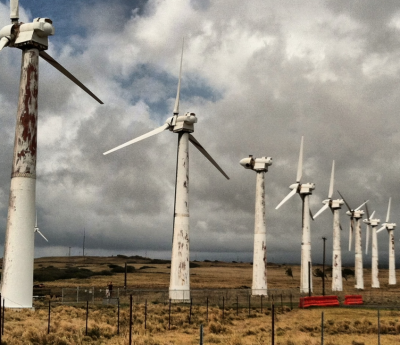
Hawaii rusting turbines

The Wind Industry Lies, and Then Pays Their Useful Idiots to Back Them Up!

Fairfax & the ABC: the Wind Industry’s Useful Idiots; or How “Mantras” Killed Journalism

1984-george-orwell-adaptation-slice

****

Ron and Chris Jelbart, and their son, Peter have come to prominence on these pages once or twice; for all the wrong reasons.

Ron and Peter have given evidence about the debilitating impacts of incessant turbine generated low-frequency noise and infrasound on their ability to sleep and function as a farmer and heavy-vehicle driver:

Tide Turns as Senate Inquiry hears from the Wind Industry’s “Road-Kill”

Peter went on to detail how incessant night-time noise from AGL’s non-compliant Macarthur disaster impacts on his ability to operate safely behind the wheel:

Wind Turbine Noise Deprives Farmers and Truckers of Essential Sleep & Creates Unnecessary Danger for All

Now, Peter has penned a simple but cutting riposte to the useful idiots at Fairfax and the ABC (aka the ‘Ministry of Truth’) that parrot wind industry lies and myths in blind deference to their Overlords. The letter got a run in the local rag, but STT thinks it worthy of much wider distribution.

TO THE EDITOR
Dear Sir,

I am writing in response to the latest media bombardment from the Clean Energy Council, formerly known as the Australian Wind Energy Alliance. This was in response to Tony Abbott’s interview where he said in no uncertain terms that he finds wind turbines visually awful and very noisy.

My radio station of choice is triple j. I listen to this daily at work and on weekends, and enjoy the musical content and lack of commercialisation.

Whilst listening to Dr Karl with Zan Rowe last week a person rang in with a question concerning health impacts from living in the vicinity of wind turbines. The answer that followed by the somewhat funny, often likeable doctor raised questions in my mind. There wasn’t a mutter or stumble, a tangent or a hesitation, no tweets from the audience and no need to refer to google scholar, just a torrent of denial of any sort of health impacts from wind turbines, all in all a very unscientific answer.

The definite nature of the response, although not surprised by his slant, aroused my suspicion. It all clicked after talking to my father on Friday night. This was a posed question with an already written answer, as was “Ian” from Macarthur who spoke to Neil Mitchell Friday morning. “Dennis” from Woodhouse who spoke to 774 ABC was also a suspect caller, again on Friday morning.

The ABC 7:30 report Thursday evening spoke to Mark Butler, the Federal Shadow Minister for Environment, obviously pro Wind Farm. Hamish and Anna Officer appeared in the Sydney Morning Herald, The Age and the Standard, over the course of a couple of days.

What we have seen is the full force of the wind energy sectors Media and HR departments trying to turn the tide after Tony Abbott’s interview, well helped by the heavily Left leaning and gutless Media. The ABC is well known for its allegiance to the Labour side of politics and the Fairfax run Standard is obviously nailing its colours to the mast in no uncertain terms, after the last few days’ stories and editorials.

Whilst the Fairfax Warrnambool Standard does a great job on covering local news, such as school fetes and country football and netball, their coverage on the issue of wind farms has been pathetic. No journalist has sought deeper answers or asked proper questions. It seems they get all they need to cover a story straight from the huge Media departments of the wind farm operators, the same rhetoric always. Any complainant is just a jealous neighbour suffering from Nocebo.

There is a reason that there is a senate inquiry happening at the moment. I spoke briefly at the Portland hearing about the effects of sleep disturbance and deprivation that I suffer as a neighbour of Industrial Wind Turbines, a consequence of being stimulated by low frequency noise and infrasound. Steven Cooper’s research at Cape Bridgewater along with NASA’s research done years ago by Neil Kelley, confirm that infrasound has been known, and hidden by wind farm companies for a very long time.

The noise testing done at home pre and post windfarm is farcical, designed and financed by the wind farm companies to give them the answers they seek, lost data, flat batteries and setting up testing equipment under trees etc to distort and manipulate the truth all part of the game. Low frequency noise and infrasound is not part of the testing.

No one who has not had to live beside a windfarm for an extended period, and who isn’t subject to strict “gag” clauses, such as hosts and other neighbours who receive money for tree screening etc. is qualified to speak on the subject of windfarm noise. The sheer stupidity of the comments from people who pull up under them and say “I can hardly hear them” shows a complete lack of understanding of the infrasound problem and can only be put down to absolute ignorance or complete arrogance.

These visually awful, or “somewhat graceful and beautiful towers of man’s going to save mankind from himself” windmills, depending on your persuasion, apparently blend in a little too well to the landscape for our avian friends. As reported in 2014 “conservative estimates of bird deaths are at 10 per tower per year” and during official searches at AGL’s Macarthur wind farm 64 carcasses were found including falcons, kestrels, shrouded kites and a spotted harrier, as well as 6 Wedge Tailed Eagles. For an individual this bird kill would be disastrous, resulting in prison, fines and (rightly deserved) bad publicity but for a wind farm it’s all in a “day’s work”.

The people who are writing in weekly to papers such as the Standard are not political activists. They are farmers, teachers, secretaries, retirees, Salt of the Earth people. People with far better things to do, but impacted to such a degree that they will fight, they will tell their story and they will pursue the truth. The only thing that keeps them motivated is the fact that they know they have a problem and it’s not just “in their heads”.

They are not the liars, the villains, the cheats, the greedy, or the soft of heart or will.

Peter Jelbart
Hawkesdale

Nice work, Peter.

Although we think him too fair on the wind industry shills that people the struggling Fairfax stable and the ABC.

Pig ignorance, among children and the uninitiated, can be excused for a while, but in the face of insurmountable facts, not forever.

STT has repeatedly clobbered the myth perpetuated by the lunatics of the hard-‘green’-left that wind power is capable of not only displacing, but wholly replacing, conventional generation sources, such as coal, gas and hydro:

Wind Power Myths BUSTED

SA – Australia’s ‘Wind Power Capital’ – Pays the World’s Highest Power Prices and Wonders Why it’s an Economic Basket Case

Why Coal Miners, Oil and Gas Producers Simply Love Wind Power

May 2015 SA

Either our current crop of journos can’t interpret simple graphs or understand basic economics? Or their eyes simply glaze over while they mutter “no, it can’t be true?”

eagle 1

And the same horror and disbelief must grip them when faced with buckets of splattered bats and ute-loads of slaughtered birds:

Bird Carcass Count proves AGL’s Macarthur Wind Farm is an Avian Slaughterhouse

Faced with a few pics of Eagles sliced in two, shaken, they’re reduced to stuttering something about its “all okay because their cat once killed a bird too”.

Then there’s the classic wind industry spin – highlighted by Peter – that: “Any complainant is just a jealous neighbour suffering from Nocebo”.

It’s a wind industry line that was always specious and self-serving, but – in the light of the evidence given by Clive and Trina Gare to the Senate Inquiry – it’s downright dishonest.

Clive and Trina have hosted 19 2.1 MW Suzlon s88 turbines for five years, pocketing over $1 million along the way; and, yet, gave solemn evidence that the incessant low-frequency noise that’s generated at night-time has ruined their ability to sleep in their own home; and that they wouldn’t live within 20 km of a wind farm if they had their choice over again:

SA Farmers Paid $1 Million to Host 19 Turbines Tell Senate they “Would Never Do it Again” due to “Unbearable” Sleep-Killing Noise

While Graham Lloyd from The Australian gave that story a run, don’t expect the ABC or Fairfax to do likewise.

And a little journalistic nouse would have uncovered what the wind industry has known, and worked like demons to cover up, for around 30 years:

Three Decades of Wind Industry Deception: A Chronology of a Global Conspiracy of Silence and Subterfuge

But, no, those kind of facts would never do.

You see, as with any cult, even so much as questioning the mantra is tantamount to heresy – which leads to exclusion, if not expulsion, from the warmth and safety of the compound.

Instead, the chants from acolytes have grown louder, and more shrill, in an effort to maintain their own confidence in their increasingly shaky beliefs.

And so it was, in the last week, that hitherto hard-core heathens started quoting that world renowned long-range weather forecaster, the Pope – as the answer to their apocalyptic prayers and need for self-validation.

Now, with all due respect to His Holiness, directing his congregation in prayer for the poor and needy is a far more sensible use of his time, than prophesying about the temperature in 50 years time.

As that great philosopher, Yogi Berra warned: “It’s tough to make predictions, especially about the future.”

Notwithstanding that sage advice, STT is happy to predict that the Pope will end up with the same level of credibility as Australia’s own long-range weather forecaster, and ABC favourite, Tim Flannery (for a rundown on Tim’s prodigious prognostic skills see our post here).

flummery

****

Not only is the current crop, claiming to call themselves journalists, gullible, they’re nasty too. The ABC’s political cutie pie, Annabel Crabb scooped the gold medal when she called long-suffering wind farm victims “Dick Brains” on ABC radio:

Pacific Hydro Orders ABC’s “Ministry of Truth” to hound Steven Cooper, Graham Lloyd and Channel 7 Over Wind Farm Study

And the same outlets cite, with veneration, a former tobacco advertising guru as their “high priest” on the question of adverse health effects. Notwithstanding that his qualifications are limited to the effect ofadvertising on rates of smoking. The fact that he ridicules and demeans people he’s never met as “wind farm wing-nuts” doesn’t seem to trouble the ABC at all. What’s that stuff in its Charter about “balance” and “objectivity”?

No, what’s dished up from Fairfax and the National Broadcaster can’t be explained by simple, seasoned ignorance. As Ben Franklin put it:

“We are all born ignorant, but one must work hard to remain stupid”.

At Fairfax and the ABC they’re clearly working very hard.

dumb 3

Our “Bonnie” Friends in Scotland, Have Scrapped Wind Subsidies! Congratulations in Order!~

Subsidies Scrapped: Scots Rejoice at Wind Industry’s Demise – Time for a Wee Highland Fling

brave_shield3

****

The Scots are a tenacious bunch; and their history is a pungent mix of romance and tragedy.

Legendary characters like William Wallace – who – single-handed – raised a fearsome Highland revolt – muscled up against the English invaders, time and time again.

Wallace, with Andrew Moray gave a well-trained and drilled English army a drubbing at the Battle of Stirling Bridge in September 1297. However, Wallace, by then Guardian of Scotland, suffered an ignominious defeat in July 1298 at the Battle of Falkirk. Disunity was Wallace’s undoing: his Norman cavalry did a bunk as the battle began; the hero escaping by the skin of his teeth. Seven years later, and the Scots’ great defender was in English chains awaiting a fate worse than simple death.

With Wallace’s mortal remains carved up and spread across the English Realm, Robert de Bruce took up the mantle – giving his internal and external enemies hell, all over the Highlands, from Buchan to Galloway. De Bruce, like Wallace before him, was often a victim of internal intrigues and diabolical disunity. Quarrels with his archrival, John Comyn and his backers, and a defeat at the hands of the English, saw de Bruce relinquish his title as Guardian, flee to the Hebrides and later Ireland.

robert-bruce-statue

****

Reacting to more betrayal by his brethren led to the murder of Comyn by de Bruce, who, having regrouped, went on to hammer Edward II in the battle for Stirling Castle, in June 1314. At the Battle of Bannockburn, de Bruce pulled off the defeat of an English army led by Edward – a force that heavily outnumbered his own: some 7,000 Scots (with a mere 500 mounted) faced 17,000 English troops: 2,000 heavy cavalry and 15,000 infantryman, bristling with longbows.

Victory for de Bruce at Bannockburn became his, and Scottish, legend.

For Scotland, the next four centuries brought a cycle of victories and defeats, as English monarchs variously sought to beguile or crush the Scots at their whim. The last romantic hoorah echoed at the Battle of Culloden in 1746, where Bonnie Prince Charlie’s Jacobite rebellion was ground into the heather and peat, near Inverness.

Through their history, in battle, the Scots were usually outnumbered, but rarely outwitted. However, the tragedy and the romance of that history was always tinged with double-dealing and betrayal. Wind the clock forward, and the same elements came to bear in the battle to keep the Highlands free of bat-chomping, bird slicing, blade-chucking, pyrotechnic,sonic-torture devices.

Sometime back, we likened the efforts to carpet the Highlands in tens of thousands of giant fans with the first waves of the Croft Clearances:

Giant Fans: the new Scottish “Croft Clearers”

Now, thanks to the Tories thumping election win, those North of the Border have won the prospect of respite.

David Cameron – a Scot in name and ancestry – has made it very clear that his government has no intention of advancing a single penny in subsidies to wind power outfits from here on:

Brits’ Wind Power Nightmare to End Soon: Tories Set to Take the Axe to Subsidies

The question is, how Cameron’s election manifesto will play out for Highlanders? Here’s The Telegraph heralding an age of deliverance, if not outright victory.

Rural Scotland’s delight at wind farm subsidy axe
The Telegraph
Simon Johnson
18 Jun 2015

Rural communities have reacted with relief and delight after David Cameron called time on the SNP’s wind farm march across Scotland’s countryside.

Anti-turbine campaigners praised the UK Government’s decision to exclude new onshore wind farms from claiming a key subsidy from April next year, 12 months earlier than expected.

They said the move, which is expected to stop the construction of many developments not yet given planning permission, was a welcome respite for communities “besieged by subsidy chasers” taking advantage of the SNP’s “open door” policy.

But they said it was to the “eternal shame” of the Scottish Government that it was only the Conservatives who had heeded the concerns of rural Scots, with one prominent campaigner stating: “Thank God for Westminster.”

SNP ministers were furious with the decision, even claiming they may challenge it in the courts, with Nicola Sturgeon describing it as “wrong-headed”, “perverse” and “downright outrageous”.

In a letter to Mr Cameron, she warned the wind farm companies may sue the taxpayer for compensation for planned schemes “rendered useless by this decision.” The industry claimed the move would cost consumers up to £3 billion.

However, the John Muir Trust, the eminent environmental protection group, said it was the “right time” to work out an energy mix that is affordable “without damaging our wild and natural landscapes.”

The funding for the subsidy comes from the Renewable Obligation (RO), which is funded by levies added to household bills. The Department of Energy and Climate Change (DECC) said there will be grace period for projects already with planning permission.

Although energy policy is reserved to Westminster, the SNP government in Edinburgh has used its control over the planning system in Scotland to encourage the construction of thousands of turbines across the countryside.

Alex Salmond, the former First Minister, set a target of generating the equivalent of all Scotland’s electricity from renewable sources by 2020, with the vast majority coming from onshore wind.

Amid growing opposition from local communities, Scotland’s most senior planning officials even warned that the countryside risked becoming a “wind farm landscape”.

But the Scottish Government told council planners they had set aside too little land for wind farms and Scotland now hosts more than half the UK’s onshore turbines.

Scotland Against Spin, a national alliance of groups and individuals which campaigns against turbines being built in unsuitable locations, said it was “delighted” the Tories had honoured an election manifesto promise to “end the ludicrously generous subsidies for onshore wind farms.”

Graham Lang, the group’s chairman, said: “Speculative developers from across the world have flocked to Scotland because of the SNP’s open door policy to the wind industry. Scottish communities besieged by subsidy-chasers can at last look forward to some respite.

“Yet to its eternal shame the Scottish Government has ignored the clamour for reform from its own people. There is a terrible irony that the Conservatives at Westminster, not the nationalists at Holyrood, have finally stood up to the wind speculators and put the interests of communities and consumers first.”

Lyndsey Ward said she hoped the decision would stop the construction of 25 turbines near her home just outside of Beauly, in the Scottish Highlands.

She said she was “fairly disgusted” with the Scottish Government as Fergus Ewing, the SNP Energy Minister, had “parroted wind industry propaganda”. She added: “They should be thoroughly ashamed of themselves. Thank God for Westminster.”

Campaigners against a plan to erect 18 410ft-tall turbines in rural Angus, above the Blackwater Reservoir, also welcomed the announcement.

Sue Smith, a spokesman for the Friends of Backwater and Glenisla Against Turbines group, whose husband Maj Gen Martin Smith is Commandant General of the Royal Marines, said: “The removal of obscene levels of financial gain which these subsidies offer should discourage land owners and turbine developers from exploiting irresistible opportunities to make a fast buck, at the expense of local communities and their environments.”

She also praised the UK Government plans to give communities the final say on large wind farm developments south of the Border and attacked the SNP for failing to introduce this in Scotland.

But, speaking at First Minister’s Questions, Ms Sturgeon said the decision was “utterly wrong-headed” and her government would “do everything in our power” to get it changed.

Mr Ewing said repeated the wind farm companies’ claims the move could cost consumers £3 billion, adding: “We have warned the UK Government that the decision, which appears irrational, may well be the subject of a judicial review.”

But Murdo Fraser, Scottish Tory energy spokesman, said: “This is a Conservative Government standing up for communities that the central belt SNP couldn’t care less about.”

He added: “The latest figures show that, with all the wind projects already constructed, those under construction or given consent, we have already met the SNPs 100 per cent target for renewable electricity.”

A DECC spokesman said: “If we’d allowed the RO to stay open longer, we could have ended up with more projects than we can afford – which would have led to either higher bills, or other renewable technologies losing out on support.”
The Telegraph

As with our in-a-nutshell overview of Scottish history above, it will be internal forces, disunity and betrayal that stand as the only obstacle to outright victory for the Scots.

Claims by wind power outfits about suing the government, in order to ensure their ability to obtain massive subsidies until kingdom come, involve little more than the petulant rattling of Claymores.

Hopeful developers are not in any contractual relationship with the government; and have little more than an expectation that government (read taxpayer and power consumer, in their guise as voters) largesse is endless and immutable. Unfortunately for wind power outfits, mere “expectations” based on policy “promises” don’t provide the soundest basis to sue for “damages”.

And Nicola Sturgeon’s huffing and puffing is little more than, well, hot air.

STT’s Highland operatives have previously pointed out that there is absolutely no market for any more intermittent and unreliable wind power in Scotland: that ‘market’ is saturated.

The only hope for Sturgeon and her wind industry backers is to send Scottish sparks south of the Border – in huge volumes – whenever the wind is blowing. However, through quirks of history – some of which we’ve touched on – that’s an area still controlled by David Cameron.

Given Cameron’s resolve, and Sturgeon’s policy and legislative impotence, STT suggests that it would be far from premature for Highlanders to don their kilts and celebrate their victory with a wee Highland fling.

highland fling

Aussies Have Windweasels in Panic Mode!

Wind Farm Senate Inquiry Fallout Continues

atomic-bomb-e1355417893840

****

When the Senate Inquiry into the great wind power fraud kicked off in Portland, Victoria on 30 March, STT predicted that the wind industry was headed for a world of pain, misery and woe (see our post here). Well, not to say we told you so, but things are going from disastrous to catastrophic. Oh dear, how sad, never mind.

To say the wind industry is in a state of panic-filled hysteria is to put it mildly: this week has its parasites and spruikers turning up the dial to apoplectic.

The Senate Inquiry has just issued its Interim Report (available here) – which hasn’t helped calm their thread-bare nerves.

And the shenanigans in Canberra over moves by the Cross-Bench Senators (which includes Senators Madigan, Leyonhjelm, Day and Xenophon who sit on the Inquiry) to extract concessions from the Coalition on a better deal for all Australians – especially those currently affected and/or threatened by the incessant turbine generated low-frequency noise and infrasound – has the usual bunch of Twitter jockeys working over-time, ranting about coal-fuelled conspiracies.

Added to which is fact that two South Australian turbine hosts – who – despite pocketing over $1 million for hosting 19 turbines – gave evidence to the Senate that the “unbearable” noise has ruined their ability to sleep in their own home; so much so that they would never do it again; and that they wouldn’t live within 20km of a wind farm.

That set of damning facts has completely up-ended the rubbish about “nocebo” effects; and all the other drivel pedaled by former tobacco advertising gurus and the like.

While STT had the scoop on that story, it didn’t take long for Australia’s National Daily to pick it up. Over to STT Champion, Graham Lloyd.

Tougher scrutiny on wind farming after crossbench talks
The Australian
Graham Lloyd
18 June 2015

mary-morris

****

Mary Morris, at the Waterloo windfarm north of Adelaide, conducted one of the only studies accepted by the National Health and Medical Research Council.

Wind farms could face greater federal government scrutiny after a last-minute intervention by Tony Abbott ahead of the Senate vote on the revised ­renewable energy target today.

Yesterday, the Prime Minister met four crossbench senators concerned about the cost and possible health impacts of the renewable energy technology.

After the meeting, Environment Minister Greg Hunt was asked to write to senators David Leyonhjelm, John Madigan, Bob Day and Jacqui Lambie setting out the new protections.

A spokesman for Mr Hunt confirmed last night that a letter was being prepared.

The government is hoping a written pledge will avoid amendments to the RET legislation, which is expected to be voted on in the Senate today.

The crossbench senators have raised concerns about a range of issues regarding wind-farm developments and the fact that the revised RET will strongly favour wind.

Mr Abbott has said the reduced RET was designed to limit the number of wind farms built.

A Senate inquiry into wind farms will today release an inte­rim report into its hearings, which have taken evidence from the wind industry, acoustics experts and residents who claim to have been affected.

The wind industry maintains claims that the technology is inefficient or poten­tially harmful to nearby residents have been thoroughly investigated and discounted. But one farm couple who has been paid $1 million to host 19 wind turbines over five years told the Senate inquiry that the noise had been unbearable.

South Australian cattle grazier Clive Gare told a hearing in Adelaide he was initially excited about hosting renewable energy, but now believed “towers should not be any closer than 5km to a dwelling”.

“If we had to buy another property it would not be within a 20km distance to a wind farm. I think that says it all,” Mr Gare said.

The wind industry has said complaints about noise impacts had not been made by people who received lucrative contracts to host them. Wind farm company AGL has paid thousands to insulate the Gare property from the noise of the wind turbines, which are as close as 800m from the house, but Mr Gare and his wife, Trina, told the inquiry they were still impacted.

Mary Morris, who conducted one of the only studies accepted by the National Health and Medical Research Council, said she would welcome any undertakings by the federal government to increase supervision.

Ms Morris became involved in the wind farms initially to support people who claimed to be affected by the Waterloo wind farm in South Australia.

In a speech to the Senate on the federal government’s compromise RET bill, Senator Leyonhjelm said the revised RET would be “no more than a wind industry support fund”.

Jacqui Lambie received support from Coalition senators for a speech in which she criticised reliance on renewable energy.

“Apart from hydro, the only way to de-carbonise energy is to move very quickly to nuclear,” she said. “And it’s about time we move to that option.”
The Australian

graham-lloyd