Why Intermittent Wind Power Can Never Match Power Dispatched On Demand

Wind Energy….just a novelty. It’s Never There When You Need It!

stopthesethings's avatarSTOP THESE THINGS

nuclear-power-a The real deal: there when you need it.

****

There are 3 electricity essentials – that the power source and its delivery to homes and businesses be: 1) reliable; 2) secure; and 3) affordable. Which means that wind power – a wholly weather dependent power source, that can’t be stored and costs 3-4 times the cost of conventional power – scores NIL on all three counts.

Over time, STT has sought to pull together fairly technical aspects of power generation in an effort to demonstrate the patent nonsense of wind power.

Here’s a great effort to do just that by Mark Febrizio, who is a policy associate at the Institute for Energy Research in Washington, DC.

‘Grid Parity’ for Renewables: An Empty Concept (Part I)
Master Resource
Mark Febrizio
21 March 2016

“Coal, natural gas, nuclear, and hydroelectric power are essential because they are predictable and dispatchable resources; conversely, renewables produce…

View original post 2,401 more words

Not a Tear is Shed, When Windweasels Bite the Dust!

Ponzi Power: US Wind Power Company – Sun Edison – Implodes

share traders

****

STT has likened it to the great corporate Ponzi schemes, pointing out, just once or twice, that the wind industry is little more than the most recent and elaborate effort to fleece gullible investors, in a list that dates back to “corporateinvestment classics”, like the South-Sea Bubble and Dutch tulip mania.

In the wind industry, the scam is all about pitching bogus projected returns (based on overblown wind “forecasts”) (see our posts here andhere and here and here); claiming that wind turbines will run for 25 years, without the need for so much as an oil change (see our posts hereand here and here); and telling investors that massive government mandated subsidy schemes will outlast religion (see our posts here andhere and here).

In Britain, Wind Prospect Group stopped paying dividends to its bond holders and prevented them from cashing them in to recover their capital outlay:

Got Money in the Great Wind Power Ponzi Scheme? Then, Grab it & Get Out Now!

In Australia, one of the wind industry’s BIG players – Pacific Hydro – managed to rack up an annual loss of $700 million, in 2014; in circumstances where the subsidy scheme – on which its profits depend – hadn’t changed at all (see our post here).

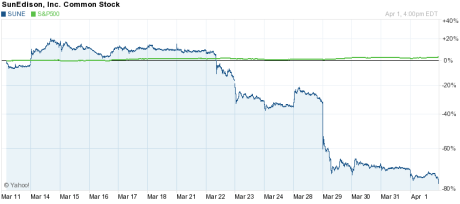
Following that well-established trend is US wind power outfit, Sun Edison; whose shares have plummeted from US$32 to a faction of a single greenback, is on the verge ofbankruptcy. Oh dear, how sad, never mind.

Share Price Plunges for Operator of Maine Wind Farms Amid Bankruptcy Concerns
MPBN News
Fred Bever
29 March 2016
sunedison2

The operator of several wind energy facilities in Maine could be headed for bankruptcy. But Sun Edison officials say the turbines will keepspinning, and providing taxes and other benefits [read misery ed.] to host communities.

Since hitting a high of $32 per share last June, Sun Edison’s stock has been on a downward spiral, and has now dipped well below $1 a share following reports that it faces a substantial risk ofbankruptcy while securities regulators investigate itsbusiness practices.

But even if Sun Edison does file for bankruptcy or is restructured, company spokesman John LaMontagne says that does not pose a risk for host communities in Maine.

That’s because the plants themselves are actually owned by separate entities.

“All of those projects have existing contracts to deliver wind energy to utilities around New England,” he says. “So therefore they have certain revenues which ensure the projects will be able to meet their obligations in terms of community benefits, taxes and whatever else.”

Sun Edison operates six wind plants in Maine, including one under construction in Bingham. It has also proposed two new big projects as part of a major effort to ship new renewable energy to southern New England.

But LaMontagne said he could not comment on how those might be affected by Sun Edison’s financial issues.
MPBN News

Sun edison strengths

****

SunEdison’s Subsidy-Fueled Collapse
National Review
Robert Bryce
4 April 2016

The company burned no fossil fuels but plenty of taxpayer dollars.

Even $1.5 billion in subsidies andloan guarantees can’t save a “clean” energy company frombankruptcy.

That’s the takeaway from the looming failure of SunEdison, a company that touts itself as the “largest global renewable energy development company.” Once a darling of Wall Street and the green Left because of SunEdison’s portfolio of wind and solar projects, the company’s stock is now in free fall. Furthermore, two related companies that were spun off from SunEdison — TerraForm Global and TerraForm Power — also appear to be in financial distress. On March 30, Brian Wuebbels, the CEO of both TerraForm companies, resigned effective immediately. If all that weren’t enough, the company is also under investigation by both the Justice Department and the Securities and Exchange Commission about its finances and the disclosures it made to investors.

Last summer, SunEdison’s shares were selling for more than $30, and famous Wall Street investors, including David Einhorn and Daniel Loeb, were holding the stock. But by Friday afternoon, the company’s shares were trading for about 49 cents apiece, and Bloomberg writer Brian Eckhouse was reporting that the company was “teetering on the verge of bankruptcy.”

Why is SunEdison on the verge of failure? The short explanation is simple: It tried to grow too big, too fast. Over a 19-month period it went on a $2.6 billion acquisition binge. It paid too much for the companies it bought and now it can’t pay back its creditors. SunEdison has twice delayed the release of its 2015 annual report and appears to be intechnical default on at least $1.4 billion inloans and credit facilities.

To be sure, this isn’t a new story. The annals ofbusiness history are filled with companies that failed because they borrowed too heavily and didn’t have enough cash to pay back their creditors. But the remarkable thing about SunEdison is how much cash it was able to get from state and federal taxpayers during its low-emissions trip to bankruptcy court.

Before getting to the subsidies, a quick history. SunEdison was founded in 2003 by solar-energy promoter Jigar Shah, who is no longer an officer or board member at SunEdison. Shah was an early entrant in the domestic solar market, which has since grown at an astonishing rate. In 2003 the U.S. had about 73 megawatts of solar-energy capacity. By 2014, that figure had increased to 18,280 megawatts. During his time at SunEdison, Shah helped the company grow through the implementation of 20-year power-purchase deals that assured investors and buyers of long-term electricity delivery from renewable-energy projects.

Shah deserves some credit as a promoter. He also deserves a smidgen of credit for his new-found belief that solar subsidies should be eliminated. That said, it’s abundantly obvious that his company’s growth was fueled by hefty federal and state subsidies. That can be seen by looking at Subsidy Tracker, a project of Good Jobs First, a Washington, D.C.–based nonprofit that promotes “corporate and government accountability in economic development.” According to Subsidy Tracker, SunEdison has garnered some $650 million in federalgrants and tax credits. SunEdison ranks number 13 on Good Jobs First’s list of the top 100 recipients of grants and tax credits doled out by federal authorities since 2000.

The biggest federal handouts — two of them totaling $200 million — were made in 2010 and 2011 to a subsidiary of SunEdison, First Wind, for the Milford Wind project in Utah. In addition to the federal subsidies, SunEdison got $30 million in subsidies from various state authorities, including $21 million from governmental entities in New York. On top of that, SunEdison also received $846 million in federal loans,loanguarantees, tax-exempt federal bonds, and federal insurance. The total government support for SunEdison comes out to $1.5 billion.

That’s a figure worth considering, given that on Friday, the market capitalization of SunEdison — that is, the value of all of its outstanding stock — was about $176 million. Thus, federal and state taxpayers have shelled out roughly eight times as much money in subsidies andloanguarantees as SunEdison is now worth.

Alas, SunEdison isn’t the only example of how federal taxpayers have helped prop up poor management in the “clean energy” sector. Earlier this week, the Spanish energy company Abengoa SA filed for Chapter 15 protection in U.S.bankruptcy court in Wilmington, Del., claiming some $16.5 billion in debt. Like SunEdison, Abengoa has been a leading promoter of solar projects in the U.S. According to Subsidy Tracker, Abengoa has received $986 million in federalgrants and tax credits, as well as another $7.8 million in state and local subsidies. The bulk of that sum — about $841 million — was for solar projects. But the company has also collected about $122 million in federal grants for biofuel projects in Kansas, Illinois, and Nebraska. Several of Abengoa’s biofuel plants have already been shuttered, including a plant in Hugoton, Kans., that was supposed to be making cellulosic ethanol (that is, alcohol made with non-food feedstocks). Abengoa was able to build the Hugoton plant thanks to a $97 million federal grant and a $132 million federal loan guarantee.

In all, Abengoa got some $2.6 billion in federal loans and loan guarantees as well as $986 million in federal grants and tax credits. Thus, between the collapse of Abengoa and the looming bankruptcy of SunEdison, federal taxpayers have shelled out some $5 billion in direct grants and loan guarantees to lousy management teams in subsidy-dependent businesses that would never have grown to their current size had they not been able to binge on taxpayer cash.

Critics of the federal government’s support for “clean energy” companies have repeatedly claimed that the government shouldn’t be “pickingwinners.” To that, I can only say that the evidence — from the failed solar company Solyndra and failed battery companies like Ener1 and A123 to SunEdison and Abengoa — proves that the government hasn’t in fact, been pickingwinners. Quite the opposite.
National Review

exitsigns

Green/Greed Energy Act, a Travesty in Ontario!

Projects ‘a disaster’

By Elliot Ferguson, Kingston Whig-Standard

PLEVNA — A Brule Lake resident is challenging some of the arguments the Ontario government is using to support its push to build more renewable energy projects.

Chris Albinson responded to Tuesday’s announcement by the Ontario government that it was launching the second phase of its Large Renewable Procurement.

Phase 2 of the Large Renewable Procurement program announced Tuesday called for up to 930 megawatts of green energy to be added to the province.

Contracts for Phase 1 of the program were offered in March and amounted to about 455 megawatts.

In the announcement, the government said green energy projects had created 42,000 jobs since 2003 and reduced carbon dioxide emissions.

Albinson said neither statements are true and the Liberal government’s Green Energy Act has hurt the province’s economy and increased the cost of electricity for residents and businesses.

“The Green Energy Act was a nice idea that has turned into an economic catastrophe through gross mismanagement and corruption,” he wrote in an email to The Whig-Standard.

Albinson said reports from the province’s auditor general show the expectations about the job creation, environmental benefit and economic value of the renewable energy projects in Ontario are greatly overestimated by the Liberal government.

“Any rational government would look at the facts and the auditor general report and stop the program,” he wrote. “In the bizarre thinking of this government, they are doubling the size of the disaster.”

In 2011, then Ontario auditor general Jim McCarter pointed out that while the Green Energy Act promised 40,000 jobs would be created by renewable energy products, most were short term and that estimate did not account for job losses in other sectors.

“However, about 30,000, or 75 per cent, of these jobs were expected to be construction jobs lasting only from one to three years,” McCarter wrote in his 2011 report.

Government estimates of green energy job creation also did not factor in job losses from other sectors of the economy because of higher electricity prices.

“A 2009 study conducted in Spain found that for each job created through renewable energy programs, about two jobs were lost in other sectors of the economy,” McCarter’s report stated.

Another 2009 study from Denmark noted “that a job created in the renewable sector does not amount to a new job but, rather, usually comes at the expense of a job lost in another sector.” The renewable energy job is often heavily subsidized, the study showed.

Albinson also questioned the government’s assertion that the additional renewable energy will reduce the province’s carbon dioxide emissions.

Again, he referred to reports from the auditor general that showed renewable energy sources — mainly wind and solar — rely on unpredictable weather and must bebacked up by electricity from gas-powered generation stations and nuclear power plants.

In her 2015 report, Ontario auditor general Bonnie Lysyk pointed out that the electricity sector in 2012 produced 14.5 metric tons of carbon dioxide, about nine per cent of the province’s total emissions. Transportation and industry produce 34 per cent and 30 per cent, respectively.

“According to the Ontario Society of Professional Engineers, emission reduction is important, but the cost of reducing emissions from the electricity sector should be evaluated against initiatives taken to reduce emissions from other, higher-emitting sectors such as the transportation industry,” Lysyk wrote.

“Reducing emissions from cars and trucks could very well be more cost-effective than reducing emissions through phasing out coal plants and procuring renewable energy at expensive prices.”

“It is almost as if the Ontario Liberal government has adopted a Donald Trump approach — even if you are lying and everyone knows you are lying, you just have to keep saying it long enough and loud enough that people believe you,” Albinson wrote.

Amperage Affected By Proximity to Wind Turbines…


Ontario Farmer   Tuesday, April 6, 2016 Edition  Pg. 7


WIND TURBINES AFFECT AMPERAGE?


Dear editor:

After reading your article on wind turbine health, I felt compelled to pass on something I have observed with the wind turbines.


Whenever I am driving on the 401 between Chatham and Windsor I notice that the amperage needle moves from 15 amps to about 12 amps.  As soon as I get to an area where the turbines are further from the road the amp gauge returns to a normal reading of 15 amps.  It also seems that wind direction and speed has more effect on the amp gauge.  I don’t know whether this information is of any use or value but it’s something I’ve paid attention to every time I travel that route.  The first time I noticed was during a rain; my wipers almost came to a stop.  When I looked at the gauge it was almost into the discharge area and I thought I was having alternator trouble.  When I got home the gauge was reading normal.  This observance may be nothing but I have no other explanation why this happens.

Robert Stewart

More Evidence of Harm From Wind Turbine Noise

Tonic tensor tympani syndrome (TTTS)

There has been a suggestion that this condition is actually part of what some people chronically exposed to wind turbine noise might be experiencing.

Tensor tympani muscle
Tensor tympani and stapedius muscles contract reflexively in response to loud sounds to prevent damage to the hearing receptors.
Noise & HealthApril 9, 2013Australia

Tonic tensor tympani syndrome in tinnitus and hyperacusis patients: a multi-clinic prevalence study

Myriam Westcott et alter

Abstract

Tonic tensor tympani syndrome (TTTS) is an involuntary, anxiety-based condition where the reflex threshold for tensor tympani muscle activity is reduced, causing a frequent spasm. This can trigger aural symptoms from tympanic membrane tension, middle ear ventilation alterations and trigeminal nerve irritability. TTTS is considered to cause the distinctive symptoms of acoustic shock (AS), which can develop after exposure to an unexpected loud sound perceived as highly threatening. Hyperacusis is a dominant AS symptom. Aural pain/blockage without underlying pathology has been noted in tinnitus and hyperacusis patients, without wide acknowledgment.

This multiclinic study investigated the prevalence of TTTS symptoms and AS in tinnitus and hyperacusis patients. This study included consecutive patients with tinnitus and/or hyperacusis seen in multiple clinics. Data collected: Symptoms consistent with TTTS (pain/numbness/burning in and around the ear; aural “blockage”; mild vertigo/nausea; “muffled” hearing; tympanic flutter; headache); onset or exacerbation from exposure to loud/intolerable sounds; tinnitus/hyperacusis severity. All patients were medically cleared of underlying pathology, which could cause these symptoms. 60.0% of the total sample (345 patients), 40.6% of tinnitus only patients, 81.1% of hyperacusis patients had ≥1 symptoms (P < 0.001). 68% of severe tinnitus patients, 91.3% of severe hyperacusis patients had ≥1 symptoms (P < 0.001). 19.7% (68/345) of patients in the total sample had AS. 83.8% of AS patients had hyperacusis, 41.2% of non-AS patients had hyperacusis (P < 0.001). The high prevalence of TTTS symptoms suggests they readily develop in tinnitus patients, more particularly with hyperacusis. Along with AS, they should be routinely investigated in history-taking.

Introduction

The tensor tympani reflex is a startle reflex, which is exaggerated by high stress levels. The tensor tympani muscle contracts immediately preceding the sounds produced during self-vocalisation, suggesting it has an established protective function to loud sounds, assists in the discrimination of low frequency sounds, and is involved in velopharyngeal movements.

Tonic tensor tympani syndrome (TTTS) was originally described by Dr. I. Klockhoff. TTTS is an involuntary condition where the centrally mediated reflex threshold for tensor tympani muscle activity becomes reduced, so it is continually and rhythmically contracting and relaxing. This appears to initiate physiological reactions in and around the ear without objectively measurable dysfunction or pathology. Symptoms consistent with TTTS can include: tinnitus; rhythmic aural sensations such as clicks and tympanic membrane flutter; alterations in ventilation of the middle ear cavity leading to a sense of aural blockage or fullness, a frequent aural “popping” sensation and mild vertigo; minor alterations in middle ear impedance leading to fluctuating symptoms of “muffled” and/or “distorted” hearing; irritation of the trigeminal nerve innervating the tensor tympani muscle, leading to pain, numbness and burning sensations in and around the ear, along the cheek, neck and temporomandibular joint (TMJ) area.

The specific and consistent cluster of physiological symptoms of acoustic shock (AS) is consistent with TTTS, without underlying aural or TMJ pathology. AS can occur involuntarily after exposure to a sudden unexpected loud sound perceived as highly threatening (acoustic incident). AS becomes an acoustic shock disorder (ASD) if symptoms persist. AS was originally identified in call center staff, who arevulnerable to AS because of the increased likelihood of exposure near the ear(s) to an acoustic incident transmitted via a telephone headset. The research on AS has focused on this cohort, however acoustic incidents can occur anywhere.

Symptoms such as aural pain and a sensation of aural blockage/fullness, with no underlying aural or TMJ pathology, have been observed in tinnitus and hyperacusis patients. These symptoms have been linked to TTTS by Jastreboff and Hazell and Westcott. However, these symptoms have not been widely acknowledged or investigated in this patient population. TTTS has been more intensively investigated in temporomandibular disorder (TMD) research, with TTTS considered to be a secondary consequence of TMD and/or TMJ dysfunction, predominantly responsible for referred tinnitus, ear pain and other symptoms in and around the ear.

This multiclinic study aimed to investigate in a sample of tinnitus and hyperacusis patients the prevalence of:

  • Symptoms consistent with TTTS
  • Symptoms consistent with TTTS developing or being exacerbated by intolerable sound exposure
  • AS aetiology triggering the onset of their tinnitus and/or hyperacusis.

[…]

Conclusion

The high prevalence of symptoms consistent with TTTS in this sample suggests they can readily develop as a primary phenomenon in patients with tinnitus, and more particularly in those with hyperacusis. These results support a central relationship between tinnitus, hyperacusis and TTTS, with further research indicated to explore this relationship and the efferent pathway triggering TTTS.

TTTS offers an explanation for the aural pain reported by many hyperacusis patients, often triggered or aggravated by intolerable sound exposure. Symptoms consistent with TTTS are subjective and can cause high levels of anxiety. This can lead to tinnitus escalation, the development and escalation of hyperacusis, and limit the efficacy of tinnitus/hyperacusis therapy. These symptoms should be routinely evaluated in history taking, de-mystified to patients to provide reassurance, and treated accordingly.

These results indicate that AS is a world-wide phenomenon, with significant clinical, medico-legal and military diagnostic/rehabilitation implications. It is recommended that evaluation of an acoustic incident at the time of tinnitus/hyperacusis onset is routinely carried out in history taking with tinnitus and hyperacusis patients.

→ Please read on

Science and sensibility.

Pointman Speaks About Climate Science & “Language Creep”. He definitely has a “Way With Words”.

Pointman's avatarPointman's

In the ordinary way of things, I steer clear of the science debates over global warming. I served my time in those trenches many years ago and though it’s an important part of the overall push back, I concluded I could be of more use elsewhere and in different and perhaps less virtuous ways. However, I do keep an eye on the topical issues by lightly following a few sciency blogs and the twitter feeds of people evenly placed along the way stations to climate skepticism.

It’s just passive sigint, something I monitor. I never get involved and just leave them to handbag away at each other. It gets a tad bitchy at times but mostly they all seem to be enjoying themselves in a dry academic sense and on occasion it’s not a bad spectator sport. It keeps them off the streets and out of trouble, I suppose.

One of the people I keep…

View original post 738 more words

Germany’s Wind & Solar Obsession Killing Industry & Thousands of Real Jobs

Germany Suffering from their “Rush to Wind”…

stopthesethings's avatarSTOP THESE THINGS

Germany-CO2-emissions-and-targets

In Germany, around €190 billion has already been burnt on renewable subsidies; currently the green energy levy costs €56 million every day. And, the level of subsidy for wind and solar sees Germans paying €20 billion a year for power that gets sold on the power exchange for around €2 billion.

Energy poverty is a feature of daily life for hundreds of thousands; the promise of millions of groovy ‘green’ jobs is little more than a cruel hoax; and, adding insult to injury, the pretext for the insanity – the reduction of CO2 emissions in the electricity sector – hasn’t quite panned out as Green edicts predicted: emissions are, instead, rising fast (see above and our post here).

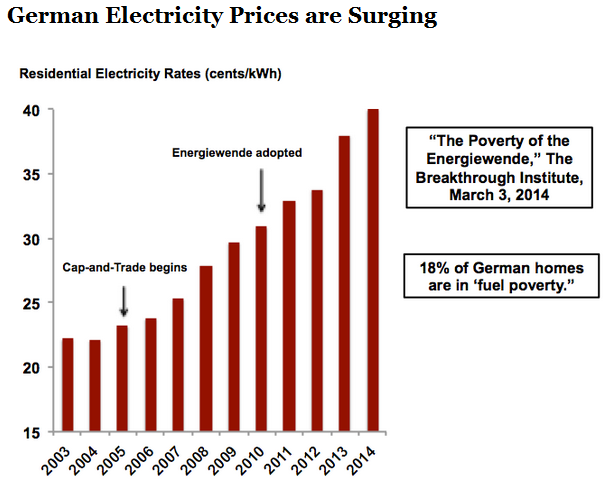
German power prices

Then there’s what perverse market incentives for meaningless power sources have done to prices of an essential input to Germany’s industrial sector. Once the envy of the World, German manufacturers have…

View original post 2,331 more words

Energy Poverty Killing Thousands in Europe…

Europe’s Wind Power Suicide Pact Killing 40,000 a Year

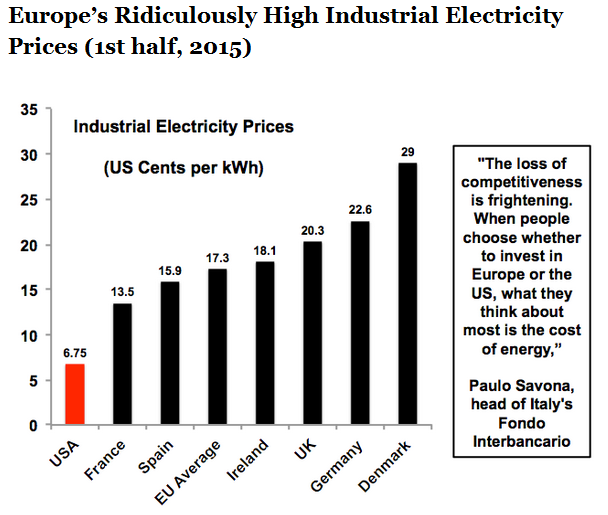
europe power prices 2

Green Europe is killing 40,000 poor a year
Breitbart
Jame Delingpole
30 March 2016

Europe’s suicidal green energy policies are killing at least 40,000 people a year.

That’s just the number estimated to have died in the winter of 2014 because they were unable to afford fuel bills driven artificially high by renewable energy tariffs.

But the real death toll will certainly be much higher when you take into account the air pollution caused when Germany decided to abandon nuclear power after Fukushima and ramp up its coal-burning instead; and also when you consider the massive increase in diesel pollution –  the result of EU-driven anti-CO2 policies – which may be responsible for as many as 500,000 deaths a year.

But even that 40,000 figure is disgraceful enough, given that greenies are always trying to take the moral high ground and tell us that people who oppose their policies are uncaring and selfish.

It comes from an article in the German online magazine FOCUS aboutEnergiewende (Energy Transition) – the disastrous policy I mentioned earlier this week whereby Germany is committed to abandoning cheap, effective fossil fuel power and converting its economy to expensive, inefficient renewables (aka unreliables) instead.

According to FOCUS around ten percent of the European population are now living in ‘energy poverty’ because electricity prices have risen, on average, by 42 percent in the last eight years. In Germany alone this amounts to seven million households.

The article is titled: The grand electricity lie: why electricity is becoming a luxury.

The reason, of course, is that green energy policies have made it that way. Many of these have emanated from the European Union, which in turn has taken its cue from the most Green-infested nation in Europe – Germany.

Germany has long been obsessed with all things environmental. Besides having invented the dodgy ‘science’ of ecology in the 1880s it was also, of course, between 1933 and 1945 the home of Europe’s official “Greenest government ever” – the first to ban smoking on public transport, an enthusiastic supporter of organic food, national parks and population control.

The Greens have also since the early Eighties been arguably the most influential party in Germany. Though their percentage of the vote has rarely risen above the 10 percent mark, they have punched above their weight either as a coalition partner in government or as a pressure group outside it.

For example, the reason that after Fukushima, Chancellor Angela Merkel completely changed Germany’s policy on nuclear power was her terror of the Greens who were suddenly polling 25 percent of the national vote.

It was the Greens too who were responsible for Energiewende – the policy which is turning Germany into the opposite of what most of us imagine it to be: not the economic powerhouse we’ve been taught to admire all these years, but a gibbering basket case.

This becomes clear in an investigation by the German newspaperHandelsblatt, which reports the horrendous industrial decline brought about by green energy policies.

Hit hardest, of course, are the traditional utilities. After all, the energy transition was designed to seal their coffin. Once the proverbial investment for widows and orphans because their revenue streams were considered rock-solid — these companies have been nothing short of decimated. With 77 nuclear and fossil-fuel power plants taken off the grid in recent years, Germany’s four big utilities — E.ON, RWE, Vattenfall and EnBW — have had to write off a total of €46.2 billion since 2011.

RWE and E.ON alone have debt piles of €28.2 billion and €25.8 billion, respectively, according to the latest company data. Losses at Düsseldorf-based E.ON rose to €6.1 billion for the first three quarters of 2015. Both companies have slashed the dividends on their shares, which have lost up to 76 percent of their value. Regional municipalities, which hold 24 percent of RWE’s shares, are scrambling to plug the holes left in their budgets by the missing dividends.

Thousands of workers have already been let go, disproportionately hitting communities in Germany‘s rust belt that are already struggling with blight. RWE has cut 7,000 jobs since 2011. At E.ON, the work force has shrunk by a third, a loss of over 25,000 jobs. Just as banks spun off their toxic assets and unprofitable operations into “bad banks” during the financial crisis, Germany’s utilities are reorganizing to cut their losses.

Why are the Germans enacting such lunacy? Aren’t they supposed to be the sensible ones?

Well yes, up to a point.

As a seasoned German-watcher explains to me, it’s with good reason that one of Germany’s greatest contributions to the world’s vocabulary is the word Angst.

The Germans are absolutely riddled with it – always have been – and it explains the two otherwise inexplicable policies with which Germany is currently destroying itself.

One, of course, is Energiewende caused by a misplaced, but deeply-held neurosis about stuff like diminishing scarce resources and “global warming” and the evils of Atomkraft (Nuclear power).

The other are its similarly insane immigration policies – the result of the neurosis that if it doesn’t replace its declining population with a supposedly healthy influx of immigrant workers, then it will wither and cease to be the great force it was under people like Frederick the Great, Bismarck and that chap in the 1930s and that no one will know or care where Germany is any more.

Ironically, though, if national decline is what the Germans most fear then the two policies they are pursuing to avoid it happening to be the ones most likely to hasten it.

This is sad. Sad for Germany which, for all its faults, has produced some pretty impressive things over the years: Beethoven; Kraftwerk; Goethe; Porsche; autobahns; those two girls on Deutschland 83.

And even sadder for those of us who, through absolutely no fault of our own happen to be shackled politically and economically to a socialistic superstate called the European Union, most of whose rules are decided by Germans over whom we have no democratic control.

Oh and by the way, Greenies: as I never tire of reminding you, you insufferable tossers, not a single one of the “future generations” you constantly cite in your mantras as justification for your disgusting, immoral and anti-free-market environmental policies actually exists.

But the people you’re killing now as a result of those environmental policies DO exist.

Or rather they did, till you choked or froze them to death, you vile, evil, eco-Nazi scumbags.
Breitbart

Fuel-poverty-activi-005

Wind Scam Always Results in “Energy Poverty”….Heat, or Eat!

Wind Power Costs Crush the Poor

German power prices

The rush to ‘power’ modern economies with a Medieval ‘technology’, abandoned Centuries ago for pretty obvious reasons, has brought with it a banquet of consequences: not least, ‘energy poverty’.

That term is one that has only come into common parlance with the soaring cost of electricity, caused by throwing $billions at a wholly weather dependent power source which, but for those massive subsidies, has NO commercial value whatsoever: wind power operators in Australia’s wind power capital, South Australia, literally pay the grid operator to take their chaotically produced power, andmake a profitfrom the RECs they receive.

There’s an irony in there somewhere, as the ‘policies’ that have wrecked power markets and left grids on the brink of collapse, have been pedalled by so-called political ‘progressives’. However, the only ‘progress’ is towards thoroughly avoidable social and economic misery.

The graph above tells of Germany’s self-inflicted catastrophe, the graph below shows the cause as the wind rushes that broke out, not only in Germany, but in Denmark too.

400fig 1europeelectricprice

Now, here’s a piece from Andrew Follett that tallies up the cost for those who can least afford it.

How the poor bear the brunt of Europe’s obsession with global warming
The Daily Caller
Andrew Follett
25 March 2016

European global warming policies are hurting the continent’s poor, according to a Manhattan Institute study published Thursday.

Europe has tried to fight global warming with cap-and-trade schemes and lucrative financial support to green power since 2005. Though well-meaning, the continent’s environmental efforts have only made life harder for Europe’s poor.

“The European Union’s renewable-energy policies have had one very clear result: they’ve dramatically raised electricity prices,” Robert Bryce, a senior fellow at the Manhattan Institute who authored the study, told The Daily Caller News Foundation.

Between 2005, when Europe adopted these policies, and 2014, residential electricity rates on the continent increased by 63 percent according to the study. Over the same period, residential rates in the U.S. rose by 32 percent. Germany, Spain and the U.K, which intervened the most in their energy markets, saw their electricity bills rise the fastest,according to the study.

The poor tend to spend a higher proportion of their incomes on electricity, gasoline, food and other basic needs. Furthermore, when the price of electricity increases, the cost of producing goods and services that use electricity increases too. Thus, high electricity prices effectively increase the price of most basic goods.

European-style global warming policies hurt the poor 1.4 to 4 times more than they hurt the rich, according to a study by the National Bureau of Economic Research.

“Environmental advocates like to claim that Germany is the role model we should emulate, even though Germany’s residential customers are now paying about 40 cents per kilowatt-hour for their electricity,” Bryce continued. “That’s more than three times the average cost of electricity here in the US.”

Brits alone paid a whopping 54 percent more for electricity than Americans in 2014 while energy taxes cost residents roughly $6.6 billion every year. Green energy subsidies in the U.K regularly exceed spending caps and account for roughly 7 percent of British energy bills, according to government study released last July.

Polling indicates that 38 percent of British households are cutting back essential purchases, like food, to pay for high energy bills. Another 59 percent of homes are worried about how they are going to pay energy bills.

“Policymakers in New York and California, as well as more recently, Oregon, have decided to emulate the EU’s mandates,” Bryce concluded. “If they are concerned about poor and low-income constituents, they should be rethinking those mandates.

The study also illustrates that between 2005 and 2014, Europe reduced its carbon-dioxide emissions by 600 million tons per year. Over that same period, the combined emissions of China, India, Indonesia, and Brazil increased by 4.7 billion tons per year, or nearly eight times the reduction achieved in Europe.
Daily Caller

bread and water for dinner

Definition of “Wind Turbines”….from an “Honest Encyclopedia”

Wind turbine:

Wind turbine.jpg

Wind turbine is the modern day windmill which is marketed as a clean energy solution to replace power from fossil fuel plants. The addition of multiple wind turbines in the same geographical location is referred to as a wind farm. The sales pitch…wind turbines power millions of homes with wonderful “free” energy. The truth is a much different story. “The wind power industry claims switching from conventional power to wind power will save consumers money and spur the economy. However, data from the top 10 wind power states show just the opposite.” [1]

Cost breakdown

Wind energy from turbines are power generating losers when compared to other technologies such as coal, hydro, gas and nuclear. One giant downside is no wind, no power generation. Sources say you need at least 10MPH wind speed to generate power and speeds in excess of 50MPH will shut down turbines to prevent damage. [2] Industry promoters often paint a rosy picture of the benefits of wind power when other sources claim as little as 8% of usable generation.

Not widely known but wind turbines actually use electricity from the grid (coal/gas/hydro/nuclear) to power their hydraulic systems that keep the blades facing in the same direction as the wind. In freezing weather conditions, electricity from the grid is used to keep the bladesspinning at low speeds as a method of de-icing.

The misconception is that youinstall a wind turbine and it will pay itself off within a decade. From that point out, it is a net energy gain at a fraction of a cost. Nothing can be further from the truth. Constant costs are involved to maintain these mechanical structures; Overheating bearings, plastic that melts, gallons of brake oil leaking, gallons of hydraulic fluid leaking, [3] blades that fall off, towers that collapse, replacement of yaw gear drives, bearings, gearboxes, and generators. The cost to put out wind turbine fires, some self-extinguish themselves out but others need fire departments to extinguish turbines and put out the brush fires below.

The cost to manufacture wind turbines prevents any offset gained transitioning to a ‘clean’ energy environment. [4]

A two-megawatt windmill contains 260 tonnes of steel requiring 170 tonnes of coking coal and 300 tonnes of iron ore, all mined, transported and produced by hydrocarbons.

Landscape, seascape wildlife costs are a major downside to power from wind. Eagles, bats, birds of all kinds are killed in the thousands by wind blades. Their rotting carcasses litter the ground below. Estimates place the number of birds killed by wind turbines at 30 million per year. [5]

In Ontario Canada, every turbine destroys 3 acres of land, roughly 21,000 acres of farmland. [6]

Wind Turbine Syndrome

Many people living within 2 km (1.25 miles) of thesespinning giants get sick says a peer-reviewed study by the Johns Hopkins University School of Medicine. [7] Low frequency noise and infrasound appear to be the chief disease-causing culprit according to Dr. Nina Pierpont. In Wisconsin, a study showed noise emanating from the turbines was detectable inside homes within a 6.2-mile radius of the industrial wind plant and declared wind turbines a health hazard. [8]

Government Subsidies and Crony Capitalists

Billions of taxpayer dollars are being shoveled into this inefficient scheme in order to promote Global Warming agendas at the expense of real power sources and the tens of thousands of jobs they replace. Government subsidies keep the growth of wind turbine construction alive and keep this technology running afterinstalled. Without government financial involvement, wind turbines become to costly to operate, go idle and start rusting the landscape. Without government funding, investors sell theirinvestments and shelve plans to expand.[9] The UK’s Labour party insists that wind turbines can’tmake a profit without subsidies. [10] Tax credits are given to companies that manufacture, to companies thatinstall/maintain, to municipalities that own the property. The IRS is giving away $13 Billion per year in wind energy subsidies.[11]

The world’s biggest billion dollar corporations, such as General Electric and Siemens, are reaping the investments made in subsidized wind turbine construction. The U.S. government has laid the groundwork for an endless welfare system devoted to big wind companies. [12]

See also

External links

References

  1. Jump up Electricity Prices Soaring In Top Wind Power States, Forbes, October 17, 2014
  2. Jump up AS BRITAIN FREEZES, WIND FARMS TAKE POWER FROM GRID TO PREVENT ICING, Breitbart.com. January 2, 2015
  3. Jump up 2 Year Old Siemens Turbines Falling Apart: Wind Farm Investors, Get Out While You Can, Stopthesethings.com, Febuary 1, 2015
  4. Jump up Carbon Shift: How Peak Oil and the Climate Crisis Will Change Canada (and Our Lives), Author Thomas Homer-Dixon, 2010
  5. Jump up RIP STEFAN THE STORK – ONE OF 30 MILLION BIRDS KILLED BY WIND FARMS EVERY YEAR, Breitbart, August 17, 2015
  6. Jump up Wind Ontario
  7. Jump up Wind Turbine Syndrome
  8. Jump up Wisconsin Wind Turbines Declared Health Hazard, Michigan Capitol Confidential, November 8, 2014
  9. Jump up Wind Energy’s Ghosts, American Thinker, February 15, 2010
  10. Jump up Tories to end onshore windfarm subsidies in 2016, The Guardian,June 18, 2015
  11. Jump up The IRS Is Giving Away $13 Billion A Year In Wind Energy Subsidies, Without Congressional Authorization, Forbes
  12. Jump up What do we have to show for government subsidies of wind power?, TheHill, February 24,2015