Scourge of the WindWeasels, in Australia

How a Band of Criminals, Shysters & Chancers Conjured Up the Wind Industry in Australia

dirtyrottenscoundrelsoriginal

****

Now and again you just get lucky. STT makes no bones about its mission: to destroy the wind industry. So it was with more than just a little delight, that we received a bundle of highly incriminating documents from one of our top-level operatives.

At the risk of sounding a little like the showboats behind WikiLeaks, this stuff is ‘dynamite’.

What we set out below is a few pages from the first tranche of documents sent to us (that entire 47 page bundle is available here as a PDF). And what was sent to us is just the tip of a very stinky iceberg: our operative has secured thousands of pages of documents linking (and showing the dealings between) wind industry lobbyists, MPs and their staffers.

Before we kick off though, it’s both helpful and necessary to identify a few of the characters involved.

First, there’s the convicted criminal, Timothy J Flato.

Back in the 1990s, Tim was a practising attorney and partner at Latham & Watkins. Later on, a number of its partners had a few “billing difficulties”; and were disbarred and/or sent to prison as a result.

But they weren’t the first from the firm to earn a little ‘form’.

Tim, then head of the firm’s project finance practice, admitted to falsifying hundreds of thousands of dollars’ worth of expense reports over a three-year period. Tim’s little billing ‘difficulty’ involved him purchasing airplane tickets, cancelling them, and then submitting the receipts to clients for payment, augmenting his salary by over $100,000 per year. Tim’s accounting fudge amounted to somewhere between $300-400,000; saw him disbarred; and slapped with 6 months home detention for his efforts.

Flato

Having polished up his CV perfectly for the wind industry, Tim Flatohelped set up National Power Company in the US; then headed Downunder and set up another with the mantle ‘National Power Australasia Inc’.

Then there are the shysters and chancers.

Babcock & Brown was absolutely full of them; people like Warren Murphy, Miles George and Adrian Rizza.

These days, Miles & Co head up Infigen, Australia’s most notorious wind power outfit – formerly know as Babcock and Brown – an outfit that was born the bastard child of Enron.

Check out the CVs of the characters in these links here and here and here– a fair number of them brag of ‘solid’ backgrounds with Enron, later lobbed at Babcock and Brown and – when it went into melt-down – scurried off like indestructible cockroaches to hide elsewhere in the wind industry. No surprises there.

During Infigen’s first incarnation as Babcock and Brown, Miles & Co helped to fleece  investors and creditors of something like $10 billion (while its directors pocketed – and somehow managed to retain – 10s of $millions at creditors’ and investors’ expense).

Having spectacularly crashed and burned, Babcock and Brown then shamelessly phoenixed into Infigen – which is about to do it all over again: its losses continue to pile up, it continues to bleed cash and, unable to cut any deals with commercial power retailers or to obtain the finance needed to build any of its threatened projects, it has no hope of surviving its growing mountain of debt (see our post here).

But shysters and chancers like Warren, Miles and Adrian rarely get far without greasing-up helpful political enablers.

In what follows, keep a lookout for the names Patrick Gibbons and Ken McAlpine. Back then, Patrick and Ken were offering up political favours on behalf of Victoria’s Labor Minister for Energy Industries & Resources, Theo Theophanous.

These days, Patrick Gibbons spends every waking hour protecting his mates in the wind industry from inside the Federal Minister for the Environment, Greg Hunt’s office; while his best mate, Ken McAlpine heads up struggling Danish turbine manufacturer, Vesta’s Australian operations (that’s when he’s not spreading malicious falsehoods about Dr Sarah Laurie, or acting like a total prat in front of Federal Senate Committees).

Anyway, that’s probably enough background on the villains.

Let’s take a look at how they cooked up the greatest economic and environmental fraud in history, by first targeting South Australia’s dimwitted Labor government. Oh, and if the images below aren’t so clear, click on them, they’ll pop up in a new window, clear as crystal.

BB1

BB2

BB3

BB4and5

Hmmm…

Now, at the risk of sounding overly critical, what appears above suggests high level ‘imagination’. The protagonists clearly seem to be making it up as they go along.

The ‘XX’s that pepper the document have that second-hand car salesmen’s “pick whatever figure suits you” kind of feel about them. Scratching out the figure of $800 million and replacing it with $1 billion, was clearly aimed at hooking the more gullible fish in the political pond.

However, South Australians (who, as a result of this Memorandum of Understanding and what followed now pay the highest power prices in the Nation – if not the world, on a purchasing power parity basis –  and suffer daily power interruptions and even Statewide wind power blackouts) can only wonder what happened to the promised Vesta’s “blade manufacturing facility”, and the hundreds of ‘groovy-green’ jobs supposed to have been attached to it?

Although we note that the ‘promise’ to establish a blade factory was no “no strings attached” offer; being conditioned on South Australian taxpayers providing “some assistance in establishment costs” with the figure nominated of “XX to cover establishment and other initial non-construction costs associated with” it.

Why beat around the bush with solid XXs? Why not just demand taxpayers hand over an open cheque-book?

Then there’s the fiction about “high winds speeds” at Babcock & Brown’s target site, Lake Bonney.

At Lake Bonney (situated near Millicent in SA’s South-East) winds might occasionally reach ‘high-speeds’. However, the breezes at Lake Bonney are as fickle as anywhere. Infigen’s Lake Bonney operations have a pitiful capacity factor of around 23-25%: Lake Bonney 3 struggles to hit a capacity factor of 23%; and its neighbours produce meaningful power a risible 25% of the time – on AVERAGE.

While Lake Bonney’s performance stats hardly set the world on fire, its Danish-built deadlys have been known to set the ‘country on fire’:

wind turbine fire Lake_Bonney_windfarm

****

Then there’s the furphy about “community support” for wind farms. In fairness, in mid-2002 there weren’t too many South Australians aware of what trying to live with incessant turbine generated low-frequency noise and infrasound is like. That soon changed, once Lake Bonney was up and running.

Far from enjoying community support, Babcock & Brown and later Infigen have spent years trying to deny, ridicule and dismiss constant complaints about turbine noise made by two of its very own contracted turbine hosts, David and Alida Mortimer.

David and Alida (farmers and turbine hosts for Infigen at Lake Bonney) have spent the last few years taking every opportunity to tell the story of their self-inflicted acoustic misery – and to warn rural communities around the globe about the very real impacts on sleep and health caused by incessant turbine generated low-frequency noise and infrasound (see our posts here and here and here).

While the Memorandum of Understanding is littered with waffle and deliberate uncertainty, there can be no uncertainty that the whole rort was premised upon massive taxpayer funded subsidies – as clear as crystal with the statement that: financial assistance by the South Australian government (read ‘taxpayer’) is required in order to facilitate the development of the wind farm proposed by BBWP” (ie Babcock & Brown).

As it always was and continues to be:

The Wind Industry: Always and Everywhere the Result of Massive & Endless Subsidies (Part 1)

The Wind Industry: Always and Everywhere the Result of Massive & Endless Subsidies (Part 2)

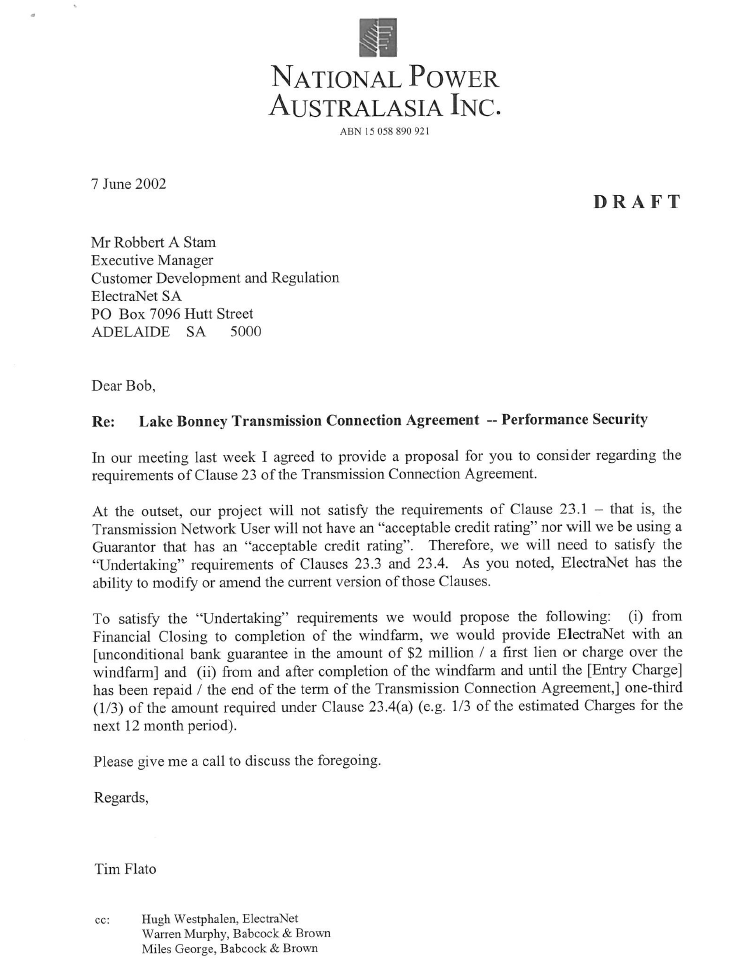
The next item is an effort by Tim Flato to brush aside Babcock & Brown’s perilous financial situation in this letter to the grid operator, ElectraNet SA:

BB6

Audacious and arrogant, the boys at Babcock & Brown were, quite apparently, aware that they would never be able to present financials capable of  earning an “acceptable credit rating”. Probably the only honest statement that ever came out of Babcock & Brown.

When your ‘business’ requires fleecing taxpayers for $billions, there’s the critical need for political endorsement, that has to be ‘engineered’ with a winning mixture of pressure and ‘grease’.

In the next email, note the who’s who cast – including the boys from Babcock & Brown, Pacific Hydro, Patrick Gibbons and Ken McAlpine – all clearly chuffed with their victory in obtaining just such an endorsement in the Communiqué from State Ministers for Energy, that follows.

BB7email

BB8and9

With hindsight, for South Australians, at least, that Communiqué now reads like an economic suicide pact.

The next email exchange shows these boys at their manipulative best, as they set out to scuttle the bid by Forestry Tasmania (referred to as ‘FT’ in the emails) to have the use of forest wood-waste to generate power included in the RET.

BB10and11 email

Note that the reference to ‘Hill’ is a reference to then Federal Minister for the Environment and Heritage, Robert Hill.

While Forestry Tasmania’s bid to include wood waste in the RET had apparent appeal with the Coalition government, Babcock & Brown and the gang were clearly having none of it.

In a piece of ‘astro-turfing’ extraordinaire, the boys from Babcock & Brown set out to have the Greens do their dirty work, correctly anticipating that once they were pointed to the “relevant statutory clauses” they would “go off from there”. And “go off” the Greens most certainly did, mounting a full-scale campaign against inclusion of wood waste in the RET that continues to this day.

The next set of papers are extracts from a powerpoint presentation that details the manner in which Tim Flato’s National Power and Babcock & Brown sought to gloss over its shaky financial footing, while pushing a self-serving strategy built on ever increasing wind power targets and subsidies.

BB12

BB13

BB14

Again, pretty vague on the details, but the critical requirement for massive and endless subsidies in Babcock & Brown’s favour couldn’t be clearer.

If you have ever wondered how the greatest economic and environmental fraud of all time got started in Australia? Well, now you know.

enron guilty

Wind Contracts….Dancing with the Devil!

The Anatomy of a Wind Farm Contract – Part 2

noisy turbines


In my previous blog I explained how a typical wind farm contract consists of two divisible parts, an Option and a Lease. When looking at an Option, I came to the inescapable conclusion that by selling the wind farm developer an Option, the landowner essentially gave up any control over his own land for extended (potentially endless) periods, in return for often trifling sums of money.

.

In this blog I want to start looking at the second part of the contract – the Lease. This part forms the majority of the contract document, and we may need more than one blog to cover it all.

.

These contracts are about money, and clearly we need to know just how much a landowner can make, how quickly he or she can make it, and whether on a purely monetary basis it is a worthwhile exercise for a landowner to consider.

.

So let’s get down to the nitty-gritty. Once the wind farm is up and generating, what sort of money can a landowner make? Remember that as this is now a lease; the landowner is now the “Landlord”, and the wind farm developer is now the “Tenant”:

.

“… the Tenant from the Commencement Date for the Term YIELDING AND PAYING therefore to the Landlord during the first ten years of the Term the Rent of three per cent (3.0 %) of the Gross Operating Proceeds per annum and after the first ten years the Rent of three and a half per cent (3.5%) of the Gross Operating Proceeds subject to the provisions for review as hereinafter contained or €5,000.00 per Megawatt of capacityINSTALLED on the Premises or proportionately in respect of any part of a Megawatt of capacity so installed whichever of (i) or (ii) shall be the higher;

.

The first thing to realise is that the payments made by the developer (the Tenant) to the landowner (the Landlord) are now called ‘Rent’. As the term of contract in my contract is 25 years, what the landowner receives in cold cash is three percent of the Gross Operating Proceeds for ten years, and thereafter three-and-a-half percent of the Gross Operating Proceeds for fifteen years. However, 25 years is actually one of the shorter periods you will find on one of these contracts, so look very carefully at the definition of “Operating Period” when faced with one of these contracts.

.
The first question obviously is: what is meant by ‘Gross Operating Proceeds’? Well, I am not a bookkeeper but I do remember my lessons which told me that “Gross” means all your money as you make it, whilst “Nett” means the money you have left after you have paid what you owe (your “take home”).
.

Wind developers clearly speak a different language compared with the rest of us. Their definition of “Gross Operating Proceeds” is this:

“x-y:
Where x = the gross receipts (excluding VAT or any substituted or similar tax) from electricity sold by the Tenant and generated by the Wind Turbine(s) on the Premises excluding any together with the receipts if any that may arise from the sale of green credits or other similar environmental scheme and;
y = such costs as the Tenant may have to pay in respect of the electricity generated by the Wind Turbine(s) on the Premises but limited to (i) the costs and charges to join and remain a member of the Pooling and Settlement System, if any and; (ii) any non-capital costs or charges associated with the purchase from the Electricity Supply Board or any third party purchaser of electricity for the provision of auxiliary power to the Accommodation Works or the Wind Turbine(s) as certified from time to time by the Auditors Certificate and; (iii) any transmission, metering or distribution costs.”

.

Now that is a different meaning to the “gross” as ordinary people understand it.

“Gross = x-y”.     What?

.

And then when looking at “x”, which is the amount of the so-called “gross receipts”, that is the money received by the developer for electricity actually sold by the developer. If the developer does not sell any electricity, or is forced to dump electricity, that means there is no receipt. And even these ‘receipts’ have deductions made from them, namely tax, green credits, and subsidy payments.

.

And once we reach the nett value of the “gross receipts”, we now have to subtract “y” from those. The value of “y” is essentially all and any operating costs, including the IWEA membership fees, and the cost of electricity to run the back-up power when the wind turbines are not generating their own electricity, which in winter is most of the time as the wind blows too hard and the turbines are shut down, whilst in summer there is little wind.

.

As there is no electricity sold, the landowner loses out. Of course, the developer does not lose out, as it is getting the subsidies (money paid by electricity customers in the form of the PSO Levy) and curtailment payments (money paid to the developer by the taxpayer for not generating). However, as these payments are not for electricity sold, the developer does not have to share that with the landowner. No wonder IWEA are always asking for increased subsidies, and no wonder, in countries other than Ireland, when the subsidies have been withdrawn, the “green” developers have vanished into thin air.

.

Wow! Is there anything left of this “gross” after that? And the landowner gets a measly 3% for the first ten years, at which stage the turbines are probably burnt out and need to be replaced (given what we now know about the life cycle of these giant turbines – you are lucky if you get ten years out of them – more likely three to six years), which in turn means massive operating costs = more money taken off the so-called “gross” amount.

.

I would guess that because of this creative bookkeeping, most landowners will be plumping for the €5000.00 per MWINSTALLED option.

.

Interestingly enough, the word INSTALLED” is not defined in the contract. If something is not specifically defined in a contract, it is given its ordinary meaning. I would suggest thatINSTALLED means up and running and connected to the grid (as opposed to ‘erected’), which might mean more delays before the landowner actually sees some of that cold hard cash.

.
“… and where no turbines are installed on the Premises the following payments will be made:
10,000EURO per annum for a site sub-station and ancillary equipment;
5,000EURO per annum for a Grant of Deed of Right of Way and Wayleave;
2,500EURO per annum for a consent to erect turbines on neighbouring premises and where such consent is needed because of reduced distance to neighbouring boundaries only;
all of which payments shall be exclusive of any Value Added Tax which may from time to time be properly chargeable and charged thereon by the Landlord clear of all deductions save those required by law.”

.

This clause confused me. If these payment options do apply to the landowner that is actually hosting the wind farm, one would think that the host-landowner wouldMAKE MORE MONEY by not having the turbines built, as the Gross Operating Proceeds don’t seem to be enough to feed the dog, let alone make a nice living without all the hard work that constitutes farming (assuming that most landowners that host wind farms will be farmers or at least owners of rural land / farm land).

.
However, It is doubtful that the wind developer is going to enter into the Lease before the wind farm is up and running – that is what the Option is for, and the developer will rather pay you your tenEURO (a year, hopefully) for the Option for as long as the developer can stretch that Option out.

.

One would imagine that the developer will only enter into the Lease with the landowner who is accommodating the actual wind farm when the wind farm is definitely going up, and the Option is exhausted. Otherwise the landowner will be strung along, essentially at the mercy of the developer.

.

I am therefore guessing that these other forms of payment are for landowners with land adjoining the wind farm premises. This might be the landowner hosting the wind farm, where their land is big enough to also take a sub-station, or where the wind farm is situated in the middle of the property, in which case a right of way might be necessary. I am guessing that this contract is a ‘one-size-fits-all’, and can accommodate those landowners who agree to have a wind farm built on their land, but can also be used to bind those landowners that own land adjoining the host property, assuming that they are willing to contract. Of course they might have no choice if their opposition to planning permission was fruitless, and the wind farm is now destroying their health and their livelihood. These secondary payments will only need to occur once the wind farm is built and operating, and not before.

.

€2500.00 per year as compensation for being driven crazy by the noise and flicker from the neighbouring wind farm? Count me out.

.

print money

The final sting in the tail concerning payment?

.

Well, going back to the assumption that theVAST majority of landowners that host wind farms will be farmers or owners of agricultural land, there is the issue of the effect on the zoning of that land.

.

After waiting for ten years, the Option is exhausted and the farmer is now looking to cash in on these larger payments of €5000.00 perINSTALLED MW.

.

Firstly, these payments are fully taxable as rental income, which cannot be set off against ordinary agricultural costs.

.

Secondly, there is the question of agricultural land tax-reliefs. Some lease agreements do say that the wind-farm company will compensate farmers for the loss of certain farm reliefs. These are usually written in such a way that they cover the farm reliefs that exist at the time of signing. They do not cover subsequent or amended farm reliefs that may be introduced in the future. Again, when we consider that I have seen wind farm lease agreements lasting 60 years, many farmers that have entered into these agreements with wind developers must now accept that the loss of future farm reliefs and payments, coupled with the fully taxable nature of the wind-farm payments that they will receive, will mean that they will be in a financially worse position than they are at the moment. Many struggling farmers grabbed the wind farm option with both hands (encouraged all the way by the IFA). Some of these stories might have very sad endings.

.

Thirdly, Revenue has made it clear that farmers may no longer qualify for the significant agricultural tax-relief on their lands should they wish to transfer their lands by gift or inheritance. A wind farm turns your land into an industrial site, which means that you are no longer a ‘farmer’ as defined byTAX LAW, and your lands may fail to satisfy the definition of ‘agricultural land’ under the capital acquisitions tax legislation.

.

While you might getTAX RELIEF as a business, this is a more restricted capital acquisitions tax relief, as the family home does not qualify for business relief. When we consider that most farms and homes are passed through generations of farming families, using the vehicle of the substantial agricultural reliefs available, farmers face a scary future prospect of not being able to afford to remain on their farms if these taxation reliefs are jeopardised. That means that unless the wind developer is paying you more money than you were getting when you qualified for all the agricultural tax relief that is currently available, you are making a nett loss. When the wind farm leaves, it will be a long time before you can have your land rezoned as agricultural land so as to restore those tax reliefs.

.

It is for that reason that I would plead with farmers to obtain good and sound legal advice before entering into one of these wind farm contracts.

.

All that glitters is most definitely not gold.

the Harsh Reality Of Wind Turbines, as an Electricity Source….

SA’s Wind Farm Fiasco: $Millions in Subsidies Thrown at GDF Suez to Reopen Mothballed Gas-Fired Power Plant

May 2015 SA

South Australia has the dubious honour of being referred to as “Australia’s wind farm capital”. That ‘accolade’ has brought with itrocketing power prices, an unstable grid and routine blackouts.

As to the latter, South Australians are learning to live with daily ‘load-shedding’, that even its premier academic institutions have to suffer, along with thousands of other businesses and households.

This telling little email from UniSA’s management was flicked to us by one of our SA operatives (who just happens to be an engineer):

email ML

The source of the “failure to the incoming electricity supply” is, as our engineer contact informs us, all about ‘grid instability’, caused by SA’s chaotic, intermittent and unreliable wind power supply.

Our contact also tells us that UniSA’s Mawson Lakes campus (located north of Adelaide and south of Salisbury) has been experiencing frequent supply ‘interruptions’ and wholesale blackouts for months now. Air-conditioners no longer function; lectures get cancelled; the campus goes into “lock-down”; and the power surges and erratic supply have damaged electrical equipment and appliances, as well as distribution systems on campus.

The cost of repairing or replacing appliances, equipment or electrical systems – due to erratic wind power supplies (and the power surges, grid instability and consequent grid management chaos that comes with intermittent wind power) – is just another cost that gets brushed aside by one-eyed wind-worshippers. Wind power blackouts are, of course, a little harder for the wind-cultist to hide.

On 1 November last year, a sudden and total collapse in SA’s wind power output saw almost the entire State plunged into Stone Age darkness:110,000 homes and businesses were left without power for hours, with their owners in the dark and operators fuming.

SA 1 Nov 15

Business operators, like Port Pirie’s Nyrstar smelter went on the war path and dragged Labor’s Energy Minister, Tom Koutsantonis into a crisis meeting about average spot power prices that are now double those of neighbouring Victoria; and the fact that, no matter how much generators chisel out of householders and businesses, SA’s power supply will never again be called reliable or secure.

Having given up on the idea of ever having affordable power again, SA’s hapless Labor government has been reduced to throwing $millions of taxpayers dollars at the French owner of a mothballed Combined Cycle Gas Turbine (CCGT) power plant in an effort to ensure the lights stay on (at least for now).

Here’s the AFR’s Ben Potter (who’s fast gaining a grip on the scale and scope of the wind power fraud) detailing Labor’s costly, panicked – throw $millions of taxpayers’ money at it – response to SA’s wind farm fiasco.

Gas-fired power station bids for SA ‘low carbon’ contract
Australian Financial Review
Ben Potter
10 February 2016

Adelaide wants to become the world’s first carbon-free city, but the South Australian government is open to giving a gas-fired power station a “low carbon”ELECTRICITY CONTRACT.

The bid by GDF Suez, French owner of the partly mothballed Pelican Point gas power station, angered renewable energy advocates. The contract is worth about $50 million a year.

“If the government was serious about limiting carbon dioxide emissions, the tender would be limited to renewable energy projects only,” said Mark Parnell, Greens energy spokesman and leader in the SA Parliament.

GDF Suez confirmed Pelican Point was a bidder for the contract to supply up to 481 megawatt hours of low-carbon electricity a year to the government. Gas-fired power stations have roughly half the carbon dioxide emissions of coal-fired power stations, while wind and solar power have virtually zero emissions.

The SA Labor government sought expressions of interest for the contract in November as industry alarm mounted at soaring electricity prices in the struggling state.

Treasurer and Energy Minister Tom Koutsantonis this week emailed industry participants at a December 15 crisis meeting on the electricity market, saying the government aimed to ensure a smooth transition to a low-energy future by inviting a broad range of energy technologies to bid for the contract, and stipulating that bids should not harm energy security or push up prices.

Price spikes

The SA government has celebrated the state’s nation-leading penetration of wind and solar power. But large industrial energy users blame its spasmodic weather-dependent supply patterns for sharp spikes inSPOT MARKET prices and contract prices to levels far above neighbouring Victoria and NSW.

Although described as a “low-carbon electricity supply” contract, the document specified that electricity with an average CO2 emissions intensity of up to 400 kilograms per megawatt hour would be considered.

This is just above the level of a relatively efficient gas-fired power station like Pelican Point. GDF Suez withdrew half of Pelican Point’s 479-megawatt capacity two years ago as SA’s rapidly increasing share of renewable power pushed more costly “mid-market” suppliers to the sidelines.

This and other withdrawals left the stateVULNERABLE to sharp electricity price spikes to more than $2000 an hour when the wind didn’t blow and the sun didn’t shine, and heavily reliant on Victorian brown coal power delivered via high-transmission interconnectors.

“The state is primarily interested in wholesale electricity supply solutions which reduce the emissions associated with the state’s energy use. In the past, the state has sought proposals for GreenPower to achieve this objective,” the document says.

“In this process, however, the state is focused on solutions which maximise economic benefits for South Australia.”

Mr Parnell said Mr Koutsantonis “is very wedded to the future of gas, so it doesn’t surprise me that they are trying to place a gas-fired power station in the low-carbon category”.
Australian Financial Review

How delicious! The SA Green’s Muppet-in-Chief, Mark Parnell accusing Tom Koutsantonis of being “very wedded to the future of gas”, whereas Parnell is simply “wedded” to the delusion that a wholly weather dependent power source – that requires 100% of its capacity to beBACKED UP 100% of the time by conventional generation sources – provides for a reliable and secure electricity supply, delivered at an affordable price.

Always keen to express his sweaty-palmed, adolescent love of these things, Parnell has been known to bunk up in a tent underneath one of these things with SA’s other high-priest of the dwindling wind-worship cult, Crystal Brook’s favourite ‘fan-tasist’, Dave Clarke.

Throwing $50 million a year of South Australian taxpayers’ money at GDF Suez to keep its Pelican Point CCGT plant running around the clock, is like a dog chasing its tail.

GDF Suez stopped operating its Pelican Point plant as a direct consequence of the market perversion caused by the Federal Government’s Large-Scale RET.

Wind power is already heavily subsidised under the LRET, which, as we detail below, allows wind power outfits to flood the market when the wind is blowing, literally payingTHE GRID manager to take it – which knocks conventional generators out of the market, leaving them burning coal or gas (and incurring constant expense), but with little revenue (or no revenue whatsoever) to offset that cost (let alone turn a profit).

In short, wind power outfits collect the same amount of revenue, irrespective of theSPOT PRICE. However, conventional generators receive the prevailing price – and, unlike wind power outfits, do not receive any form of subsidy for what they dispatch: the market perversion driven by the LRET and subsidies for wind power is what has caused SA’s conventional generators to become unprofitable; and it’s that lack of profitability that led to Alinta’s decision to close its Port Augusta plant; and led to GDF Suez mothballing half of its Pelican Point CCGT plant 2 years ago (until now, due to the market distortions caused by wind power subsidies, its working half still only gets a return when wind power isn’t being given away).

The Power Purchase Agreements (PPAs) struck between wind power outfits and retailers (which you’ll never see the likes of Infigen or Trustpower talk about publicly) are built around the massive stream of subsidies established by the Large-Scale Renewable Energy Target (LRET) – which is directed to wind power generators in the form ofRENEWABLE ENERGY CERTIFICATES (RECs aka LGCs).

Under PPAs, the prices set guarantee a return to the generator of between $90 to $120 per MWh for every MWh delivered toTHE GRID.

In a company report last year, AGL (in its capacity as a wind power retailer) complained about the fact that it is bound to pay $112 per MWh under PPAs with wind power generators: these PPAs run for at least 15 years and many run for 25 years.

Wind power generators can and do (happily) dispatch power toTHE GRID at prices approaching zero – when the wind is blowing and wind power output is high; at night-time, when demand is low, wind power generators will even payTHE GRID manager to take their power (ie the dispatch price becomes negative)(see our post here). In recent times, wind power outfits in SA have been paying the grid operator up to $20 per MWh to take power with, quite obviously, no commercial value.

However, the retailer still pays the wind power generator the same guaranteed price under their PPA – irrespective of the dispatch price: in AGL’s case, $112 per MWh.

PPA prices are 3-4 times the cost that retailers pay to conventional generators; retailers can purchase coal-fired power from Victoria’s Latrobe Valley for around $25-35 per MWh.

Underlying the PPA is the value of the RECs that are issued to wind power generators and handed to retailers as part of the deal.

The issue and transfer of RECs under the LRET sets up the greatest government mandated wealth transfer seen in Australian history: the LRET is – without a shadow of a doubt – the largest industry subsidy scheme in the history of the Commonwealth. That transfer – which comes at the expense of the poorest and mostVULNERABLE; struggling businesses; and cash-strapped families – is effected by the issue, sale and surrender of RECs. As Origin Energy chief executive Grant King correctly puts it:

“[T]he subsidy is the REC, and the REC certificate is acquitted at the retail level and is included in the retail price of electricity”.

It’s power consumers that get lumped with the “retail price of electricity” and, therefore, the cost of the REC Subsidy paid to wind power outfits. The REC Tax/Subsidy has already added $9 billion to Australian power bills, so far.

Between 2015 and 2031, the mandatory LRET requires power consumers to pay the cost of issuing 490 million RECs to wind power generators. With the REC price currently $82 – and tipped toTRADE around $93 as retailers get hit with the shortfall penalty set by the LRET – the wealth transfer from power consumers to the Federal Government (as retailer penalties) and/or to the wind industry (as REC Subsidy) will be somewhere between $40 billion and $50 billion, over the next 16 years:

What Kills the Australian Wind Industry: A $45 Billion Federal Power Tax

With more wind power capacity per head than any other State, South Australians are going to be lumbered with a disproportionate share of the ludicrous cost of the REC Tax/Subsidy, set by the LRET.

A cost that is already forcing major employers like Nyrstar to consider shutting up shop – with the immediate loss of 750 jobs in economically depressed Port Pirie. And that has already led to more than 50,000 SA households suffering along without any power at all (see our post here).

Now, adding State-subsidy-insult to Federal-subsidy-injury, South Australians are about to be Royally screwed twice: once by being forced to throw $93 per MWh (in REC Tax/Subsidy) at wind power outfits (whenever the wind blows); and, on top of that, being forced to stump up $50 million a year to cover the fact that the former will never amount to a meaningful power source. And then there is all of the commercial and domestic electrical repairs required as a result of such a high penetration of intermittent power sources.

South Australians have Premier Jay Weatherill and his merry band of Labor lunatics to thank for, what can only be described as, an ‘energy debacle’.

Notwithstanding the scale and scope of SA’s brewing economic disaster – and its latest move to subsidise its way out of trouble – Labor still seems wedded to pushing the wind industry’s barrow.

Having directed planning panels all over the State to keeprubberstamping wind farm applications – and otherwise encouraging more of these things to be speared into the heart of thriving rural communities; like those situated in the Eastern Mount Lofty Ranges and on Yorke Peninsula – Labor seems simply incapable of retreating from the brink.

Albert Einstein’s definition of “insanity” springs to mind: “doing the same thing over and over again and expecting different results”.

Backing the likes of New Zealand’s Trustpower or the cowboys behindSenvion (aka REPower, aka Suzlon) in their bids to carpet South Australia’s most agriculturally productive regions with hundreds more of these whirling wonders beggars belief.

What South Australians need is reliable, secure and affordable power – of the kind to be delivered by GDF Suez’s Pelican Point CCGT plant, that – but for the power market perversion caused by the LRET’s massive REC Tax/Subsidy for wind power – would have been happily delivered without costing SA’s taxpayers a red cent.

The very last thing South Australians need is any more of the same.

Not that Weatherill, Koutsantonis & Co will admit it publicly, but the deal done with GDF Suez (using other peoples’ money) to guarantee the 24/365 availability of 479MW of dispatchable (ie ‘controllable’) power, is a monumental concession that SA’s too-long held dream of being powered by the wind has just gone up in smoke.

turbine fire 6

Novelty Energy, Like Wind & Solar, will NOT Keep the Lights ON!

India’s Quest for ‘24/7 Reliable Power’ Means Munching More Coal, Not Praying for the Wind to Blow

poverty india

****

Among the selfish conceits peddled by the wind industry, its parasites and spruikers is the notion that a wholly weather dependent power source – which is 4 times the cost of coal-fired power and which will always require 100% of its capacity to be backed up, 100% of the time by conventional generation sources – represents the ‘salvation’ of nations like India, where some 250 million people have no power at all; and, accordingly, live in Stone Age poverty, cooking on twigs and dung and otherwise living a life of misery.

The pontificators that assembled in Paris, and sought to impose what Indians quite rightly regard as “fake electricity”, couldn’t care less about the world’s huddled masses and are, instead, happy to destine them to a world of eternal darkness and poverty. However, thankfully, India’s Power Minister, Piyush Goyal has other ideas.

India’s challenge is 24/7 electricity for all
The Australian
Greg Sheridan
13 February 2016

Piyush Goyal is a name you haven’t heard. But this week he has made one of the most important interventions of any foreign politician in an Australian political debate.

He is India’s Minister for Power, Coal and Renewable Energy. He is a big success politically and in line for more promotion.

I’ll give you his direct quotes in a moment. But let’s cut to the chase. Here are the important things he said in a lengthy interview with The Australian.

India will increase coal imports from Australia. Quite independently from that, if the Adani mine in Queensland goes ahead it is an integrated project and will be its own main customer, so India’s efforts to increase its coal production would not reduce the viability of the Adani project.

India is passionately committed to caring for the environment but also to economic development. That means a huge increase in coal-fired power stations as well as coal’s role in making steel.

The Indian government wants 24/7 reliable energy for all its people. Some 300 million Indians will move from rural to urban living in the next couple of decades. They will be on proper power grids. India’s baseload power will be provided by coal.

India will expand its renewable energy sector but, as the minister says, renewables have never provided baseload power for anyone.

India also will expand nuclear power and keep its gas power stations at roughly their current level.

The massive urbanisation in India means a surging demand for steel. Goyal says coking coal exports from Australia will increase particularly strongly. (Thermal coal goes to power stations, coking coal makes steel). Already nearly a third of India’s coal imports are coking coal.

Goyal’s remarks could not be more clear. Every Greens spokesman and climate-change jihadist who argues on the ABC that India is turning away from coal is inverting reality. Far from coal being a “dying industry”, as Geoff Cousins argued in a ludicrous article, the International Energy Agency forecasts Indian coal imports more than doubling by 2040.

Goyal does want to crank up India’s domestic production of coal but its coastal power stations are geared to take imported coal and that will continue, he tells me.

Now, dear reader, if you ever again hear anyone on the ABC claim that India is moving away from coal, or that Australian coal is not essential to get hundreds of millions of Indians out of poverty, you will know they are talking pure moonshine.

No one more consistently misrepresents what is happening all over Asia than the green lobby. The general ignorance of Asia among journalists allows these claims to be aired uncritically, especially on the ABC.

So let’s take up the Indian story in Goyal’s own words: “The first challenge of our government is to make sure that all Indians get 24/7 reliable power. We will expand the total energy output significantly.

“We are a very environmentally friendly country. We have been for generations. India is one country that has respected and even worshipped nature. So we will give renewed thrust to our renewable energy program. We are scaling it up massively, from 34 giga­watts to 175GW over the next six years. This is the world’s largest renewable energy rollout in the history of mankind.”

It is statements like this that green propagandists sometimes misuse to pretend renewable will replace coal in India. Nothing could be less true.

Gas power, Goyal says, will remain roughly where it is. But: “We will be expanding our coal-based thermal power. That is our baseload power. All renewables are intermittent. Renewables have not provided baseload power for anyone in the world.

“After all, solar works when the sun is shining, wind works when the wind is blowing, hydro works when there is water in the rivers. You must have coal.” Goyal says India will expand its nuclear power but this is a slow process and although nuclear will increase in absolute terms and as a percentage of India’s power overall, he continually comes back to the expansion of coal and its irreducible part in development.

“India does have certain development imperatives which we expect the world to accept. All ourINVESTMENT in coal is either supercritical power stations or ultra-super critical.” These produce about half the greenhouse emissions per unit of power as do older coal-fired power stations.

He refuses to accept lecturing from the West on India’s environmental responsibilities: “The people of India want a certain way of life. They want jobs for their children, schools and colleges, hospitals with uninterrupted power. This needs a very large amount of baseload power and this can only come from coal.

“I do wish people would reflect on the justice of the situation. Europe and America and Australia have messed up the world and the planet, and they’re saying to us, we’re sorry but you Indians can only have power for eight hours a day. The rest of the time you must live in darkness.

“We are fortunate that countries like Australia and Canada enter into serious agreements and we can rely on an uninterrupted flow of fuel.”

India is the fastest growing substantial economy, with a growth rate above 7 per cent in an anaemic global economy. This growth will be central to global economics. Goyal believes India will hit double-digit growth next year or the year after and stay there for a decade. If he is right, the development, and the economic opportunity this offers for Australia, is enormous, beyond anything that has yet entered the Australian imagination.

He says: “In the next couple of decades, imagine 300 million people moving from rural to urban centres. As we improve productivity in agriculture, the population will shift to manufacturing and services. Energy consumption will go up in agriculture itself with greater use of technology. There will be increased energy use in infrastructure. The government wants decent homes for every Indian by 2022; that means millions of homes will be built.” He points out that India’s per capita energy consumption is still below that of the US in the middle of the 19th century and says it will increase for decades.

India will not commit to a year when its greenhouse emissions will peak. This is “immaterial”, he says. On China’s commitment to such a year, his polite scepticism is robust: “We’ve all seen the reliability of that data. It’s up to you to judge what is optical and what is real.”

He is pro-Australian and wants the warmest relationship, but is utterly unimpressed with lectures from Australians about global warming: “Australia’s power consumption is coming down now anyway. Its economy is not growing, manufacturing is moving overseas, your economy is moving to services. You have jobs for everyone and a society satiated with energy. It’s easy for you to nominate a peak year. We have 250 million Indians without energy now. We have years and decades of growth ahead.”

Every word he says is true. It would be good if Australians listened.
The Australian

piyush goyal

Wind Turbine Scam Destroys Power Supplies in Britain!

UK’s Wind Power Gamble Ends in Power Supply Bankruptcy

roulette-table-2

Until David Cameron’s Conservatives took full control of the UK Parliament, Britain had lumped every last chip on wind power: apparently hoping that a wholly weather dependent power source, that requires 100% of its capacity to beBACKED UP 100% of the time by conventional (dispatchable) power sources, would come up trumps and lead to oodles of secure, reliable and affordable electricity.

After more than just a fewSPINS of the energy wheel, it seems that Britain is blessed with the punter’s curse: a dwindling bag of cash and no hope of better ‘luck’ anywhere in sight.

Government energy policy will hike bills and lead to power supply gap
The Northern Echo
Sandy Richardson
26 January 2016

DAVID Cameron’s decision to close coal-fired electricity stations and scale back nuclearINVESTMENT will lead to massive power shortages and hike energy bills over the next decade, industry leaders have warned.

Growing electricity demand will leave the UK facing a 40 per cent to 55 per cent electricity supply gap, according to a new report by the Institution of Mechanical Engineers.

It says plans to plug the gap by building Combined Cycle Gas Turbine (CCGT) plants are unrealistic, as the UK would need to build about 30 such plants in less than 10 years.

The UK has built just four CCGTs in the last 10 years, closed one as well as eight other power stations. In 2005 twenty nuclear sites were listed for decommissioning, leaving a significant gap to be filled.

According to the report, the country has neither the resources nor enough people with the right skills to build this many power stations in time. It is already too late for any other nuclear reactors to be planned and built by the coal shut-off target of 2025, other than Hinkley Point C.

The report also highlights that a greater reliance on imported electricity from Scandinavia and the Continent is likely to lead to higher electricity costs and leave Britain at the mercy of foreign suppliers.

Dr Jenifer Baxter, Head of Energy and Environment at the Institution of Mechanical Engineers, and Lead Author of the report said:

“The UK is facing an electricity supply crisis. As the UK population rises and with the greater use of electricity use in transport and heating it looks almost certain that electricity demand is going to rise.

“However with little or no focus on reducing electricity demand, the retirement of the majority of the country’s ageing nuclear fleet, recent proposals to phase out coal-fired power by 2025 and the cut in renewable energy subsidies, the UK is on course to produce even less electricity than it does at the moment.

“Currently there are insufficient incentives for companies toINVEST in any sort of electricity infrastructure or innovation and worryingly even the Government’s own energy calculator does not allow for the scenarios that new energy policy points towards. Under current policy, it is almost impossible for UK electricity demand to be met by 2025.

“Government needs to take urgent action to work with industry to create a clear pathway with time frames and milestones for new electricity infrastructure to be built including fossil fuel plants, nuclear power, energy storage and combined heat and power. With CCS now out of the picture, new low carbon innovations must be supported over the course of the next 10 years.”
The Northern Echo

consequences

Spain First to Eliminate the Wind Pushers.

Spain’s Subsidy Cut sees Wind Industry Collapse: NO Capacity Installed Since 2014

Bullfighter

****

The Spanish wind industry faces its coup de grâce for the very same reason that the wind industry is on the ropes in the UK, Germany, the US, here and elsewhere: either the massive subsidies that have driven the greatest fraud of all time have actually been cut; or there’s the inevitable prospect that they will be, very soon.

In Spain’s case, its government worked out long-ago that pouring never ending €billions into a meaningless power source – that has no commercial value – was never going to end well, on any level – political, social or economic.

While the wind industry – wherever it plies its subsidy soakedTRADE – deludes itself that the principles of economics are suspended in relation to it, once the massive (and seemingly endless) subsidies go, so does the interest of power retailers, bankers and investors. Funny about that …

SpainINSTALLED No Wind Power for First Time Since 80s in 2015
Bloomberg
Alex Morales
26 January 2016

Spain didn’tINSTALL a single megawatt of wind power capacity in 2015, the first time the industry has had a dead year since the 1980s.

TotalINSTALLED capacity stalled at 22,988 megawatts, with wind covering 19 percent of power demand in Spain last year, the Spanish Wind Energy Association, known by its Spanish initials AEE, said Tuesday in a statement. Just 27 megawatts of new capacity has beenINSTALLEDsince 2013, when a new payments system was introduced.

Spanish renewable energy companies that once reaped Europe’s biggest subsidies have looked abroad for projects since the domesticMARKETstagnated following a moratorium on support for new wind farms and solar parks in 2012. The standstill has left Spain needing an additional 6,400 megawatts of wind energy capacity by 2020 in order to meet binding European renewables targets, according to the association.

“TheINSTALLATION of more than 6,000 megawatts of wind power in four years has been done in Spain before thanks to regulations that favored it,” the association said. “If certain aspects of the regulations were modified to give confidence back to investors and ease access to financing, it could be attempted again.”

The industry group called on the government to consult with the wind sector on changes to auctioning arrangements, after an initial 500-megawatt auction yielded no subsidy for the technology. It said that was an “unexpected result that brought even more uncertainty to the already complicated situation of the wind sector.”

The association called for an end to provisions in rules that allow the government to change the reasonable returns for projects every six years. It also said the government should hold auctions for the remaining 5,900 megawatts of wind power it needs as soon as possible.
Bloomberg

Remember all that wind industry guff about the world hungering for wind power; how it’s free and getting cheaper all the time; and how it’s the ‘plug and play’ solution to our future electricity needs?

No? It seems Spaniards have forgotten it too.

spain_bullfighting_2

When Windweasel Lies Meet Reality!

Wind Power Will Never Keep the Lights On: Propaganda Obscures Truth About Where Your Power Really Comes From

mythbusters2

Claims and delivery are a gulf apart, when what’s put up by the wind and solar crowd is measured up against the hard cold facts that reside in ‘reality-land’.

With every new wind farm proposal we’re told how this operation would ‘power’ a hundred thousand homes (for ‘free’) – although these days it’s a line that accompanies moaning by wind power outfits about their inability to obtain power purchase agreements with retailers and, therefore, finance from banks to carry out their threats.

This story highlights the fact that talk about a wind and solar powered future is just that: ‘talk’.

The truth about our electricity supply is too hot to handle
The Australian (BusinessSpectator)
Keith Orchison
26 January 2016

How ordinary Australians are kept informed about arguably their most essential service, electricity supply, is a big issue for companies and competing lobbyists in a game where literally many billions of dollars are at stake.

If it is true that most Australians under 30 get their news from social media rather than newspapers or TV and radio — so claimed by Graham Richardson in a recent op-ed in The Australian — then what appears in the traditional media is no longer the dominant source of public information. (I’m from an era where too many PR types used to present their ‘success’ to their employers via column inches published in newspapers.)

We have had an example of the modern idiom in recent days with a minor hullabaloo about the promise of large-scale solar power based on the official commissioning of the two AGL Energy PV farms near Broken Hill, but not a syllable anywhere about the single biggest issue of the same moment for all electricity consumers: how supply has been sustained as a nasty heatwave baked the east coast.

That our community needs electricity big-time to cope with 40-degree temperatures and high humidity is beyond debate. For day after recent day, the east coast load neared or exceeded 30,000 megawatts, something it hasn’t done often in the past five years as prices (and, in the case of manufacturers, other factors too) pulled down demand.

That the delivery system, so often derided in the recent past as ‘gold-plated’, stood up well to the pressure is obvious. The dozen or so failures of supply (affecting 70,000 homes in one case) were attributable to big storms that ripped down houses and trees as well as poles and wires.

That the network operators have thrown emergency repair crews into the fray to bring back supply as quickly as possible has received little media mention. It’s a given — not that this will stop the networks getting kicked about their charges when the next revenue row arises.

For me, it is particularly notable and regrettable that what is wholly missing from mainstream media coverage is the breakdown of how the much-needed electrons have been generated.

This is not secret engineers’ business. The information is readily available — it’s just not passed on, even briefly, to the hot and sweaty public.

Take New South Wales as an example. It’s home to the largest number of consumers, whether we are talking households (just on three million, or roughly a third of the national total) or business (more than 400,000, also a third of the total).

NSW plus Victoria and Queensland account for roughly 90 per cent of national electricity customers, and on a typical midafternoon in January the trio’s consumers were getting some 73 per cent of their power (by committed capacity) from black and brown coal, with gas turbines accounting for another 11.8 per cent. Hydro-electric capacity (a critical resilience factor on high-demand days for NSW and Victoria) was contributing another 7.5 per cent.

In this situation, the green activists’ love children, wind and solar, accounted for 7.5 per cent of operating capacity, of which rooftop PVs met 5 per cent, a testament to the extra-ordinary emergence of household self-generation in response to public aggravation over retail power bill spikes and over-the-top political largesse (since cut back sharply), demonstrating how fast a fad can become a useful accessory in our affluent society.

Coming back to NSW specifically, at the peak of one of the heatwave days, the state’s generation load pushed past 12,200 megawatts at noon: met by almost 7,500 MW of black coal plant, 1,300 MW of gas plant, almost 2,500 MW of hydro-electric plant, 520 MW of wind power and nearly as much (428 MW) of rooftop solar plus 50 MW of large-scale solar. (The usefulness of rooftop solar, of course, fell away at dusk while, if anything, the heatwave’s grip was being felt more acutely by householders.)

It’s terribly easy to get tendentious about this stuff — you can find the types who do so hard at work all over the media space — but the real bottom line is twofold.

First, the biggest state in the Commonwealth (population, commercially, industrially, economically) would be stuffed without conventional power generation (coal, gas, hydro).

Second, replacing the coal elements of this reliable supply system is a great deal easier to talk about than to do.

Take the two Broken Hill solar farms, officially commissioned with federal and state ministers in attendance and lots of green trumpet blowing. Between them, their 155 megawatts of capacity is expected to produce 259,000 megawatt hours of electricity annually.

By comparison, AGL Energy’s 2,640 MW Bayswater black coal operation sends out 15,000 gigawatt hours a year.

One gigawatt hour is equal to a thousand megawatt hours.

It would take 58 sets of the Broken Hill solar twins to match Bayswater’s output. All the coal plants in the state deliver more than 50,000 GWh a year.

Without doubt, we are in a power transition period where new technology will play an increasing role. To what extent, over what time period and at what cost (in terms of capital outlays, taxpayer subsidies and consumer bills) is a very big question.

An even bigger one, perhaps, is just how much damage can be done to a supply system we take from granted via the posturing of ideologists and rent-seekers, the naivety of politicians and the energy illiteracy of the community?

More than 50 years ago I went to a high school that had as its motto ‘festina lente’ — Latin for “make haste slowly.” Perhaps it should be carved above the entry of our parliament houses and painted on the office walls of ministers (alongside ‘it’s the economy, stupid’).

Keith Orchison, director of consultancy Coolibah Pty Ltd and editor of OnPower, was chief executive of two national energy associations from 1980 to 2003. He was made a Member of the Order of Australia for services to the energy industry in 2004.
The Australian

turbine fire Trent-Wind-Farm

The Wind Turbine Disaster in South Australia…

Wind Power Disaster: South Australians Grapple with Rocketing Power Prices, an Unstable Grid & Rolling Blackouts

koutsantonis

****

In Australia’s wind farm capital, South Australia the terms ‘chaos’ and ‘crisis’ are used to describe the aftermath of an energy policy ‘designed’ on desktops by dimwits, who haven’t got the faintest clue about how power generation works (or much else, for that matter).

Wind power collapses and blackouts are now part of South Australian life: Wind Industry’s Armageddon: Wind Farm Output Collapse Leaves 110,000 South Australian Homes & Businesses Powerless

The Genesis of the wind power debacle was pretty well captured by Leo Smith in our recent post – Why Weather Dependent, Intermittent & Unreliable Wind Power is as ‘Useful as a Chocolate Teapot’ – and summed up as follows:

There is, above all, one salient feature that emerges across the board. Sanity and rationalism have been cast aside, and the whole arena is now a political and ideological battleground whose main protagonists understand little or nothing about the industry they seek to bend to suit their ideological (and possibly commercial) needs.

In short the world is full of people who have an opinion about power generation, who understand nothing about how it actually works or even what actually works. …

Rational scientific analysis shows conclusively that renewable energy cannot ever deliver on the very basis that it has been sold to the public. It’s not cheap, it’s anything but free, it’s not environmentally desirable, it offers no energy security, and it cannot exist in isolation from other technologies that are either even more costly than it itself is or have grave risks associated with them.

What we find when we analyse the intermittency problem, is that intermittent non-dispatchable power actually carries very little value at all. What society requires, is dispatchable power – power that can be on tap when it’s required, and turned off when it’s not, and it requires in addition a large component of cheap baseload power, that never needs to be turned off. What it does not require is wilful power that’s here today and gone tomorrow.

Just like SA’s 17 wind farms’ ‘efforts’ during May 2015:

May 2015 SA

And it’s the erratic delivery of ludicrously expensive wind power ($110 per MWh versus $40 per MWh for the reliable stuff) – and the insane cost of paying operators of highly inefficient Open Cycle Gas Turbines that their owners refuse to fire up until the spot price rockets to over $2,000 per MWh, when the wind drops – that has journos using ‘chaos’ to describe SA’s power market and ‘crisis’ to describe the economic aftermath meted out on struggling business, like Nyrstar’s Port Pirie Smelter.

The thing that kills the wind industry is the cost of attempting to integrate a wholly weather dependent power source (abandoned in the 19th Century, for obvious reasons) into a modern power system – where that cost, as it manifests in ever-rocketing power prices, simply can’t be hidden from the voting public.

Here’s another take on the South Australian wind power debacle from Richard Blandy (Adjunct Professor of Economics in the School of Management at the University of South Australia Business School) who – unlike the hacks at Adelaide’s The Advertiser – has a very solid head for numbers, due his background in that dismal science.

Oh, and to help illustrate Richard’s piece we’ve added a few pics courtesy of the boys over at Aneroid Energy – showing the output from SA’s 17 wind farms (with a notional capacity of 1,477MW) on the occasions referred to.

Crunching the numbers on SA’s high electricity prices
InDaily
Richard Blandy
19 January 2016

South Australia has set its energy sights on a renewable future but, asks Richard Blandy, at what cost?

On Christmas Day, according to the average price tables published by the Australian Energy Market Operator (AEMO), the Regional Reference Price (average spot price) for a megawatt hour of electricity in South Australia was $91.67.

SA 25 Dec 15

The corresponding prices in New South Wales, Victoria and Queensland were $37.33, $20.38 and $36.20.

SA DEC 15

The average daily spot price for a megawatt hour of electricity in December 2015 was $62.19 in South Australia, $43.37 in New South Wales, $46.84 in Victoria and $42.08 in Queensland.

SA 17 Dec 15

On December 17, the average spot price for a megawatt hour of electricity in South Australia was $259.59, while on December 26 it was only $5.06.

SA 26 Dec 15

It is clear that South Australia has the most expensive and most variable power on the eastern states grid.

The reason for the high (and extremely variable) price of electricity in South Australia is our very high dependence on solar and wind generation compared with the other states.

This results from the rapid expansion of renewable energy generation in South Australia.

According to a Deloitte Access Economics study recently released by the Energy Supply Association of Australia, South Australia’s solar and wind generation capacity per head of population is already more than three times that of any other state or territory.

A new Climate Change Strategy for South Australia was released by Premier Jay Weatherill and Minister for Climate Change, Ian Hunter, on November 29. The strategy was conveniently (if implausibly) rebadged as an economic development initiative.

In it they said to realise the benefits, we need to be bold. That is why we have said that by 2050 our state will have net zero emissions. We want to send a clear signal to businesses around the world: if you want to innovate, if you want to perfect low carbon technologies necessary to halt global warming – come to South Australia.

South Australia can be a low carbon electricity powerhouse. We have the ability to produce almost all of our energy from clean and renewable sources and export this energy to the rest of Australia.

But people want electricity to be available when they want it, and for it to stay on, with a steady current, while they want it – not just when the wind is blowing or the sun is shining.

The trouble with solar and wind generation is that it only generates electricity intermittently. Covering this intermittency is expensive in terms of idling standby plant.

Generators with the required flexibility (peaking generators using natural gas) produce expensive electricity, but are becoming more and more needed as the penetration of wind and solar in our energy generation mix increases. This is why electricity prices have risen in South Australia.

Wind farms and other renewable-energy generators also undercut the prices offered by efficient, base-load, coal and gas power plants, because they receive guaranteed, non-market, returns from selling Generation Certificates to electricity retailers under the Commonwealth Government’s Renewable Energy Target (RET) Scheme.

Under RET, electricity retailers must buy enough certificates to demonstrate their compliance with the RET scheme’s ever-increasing annual targets.

The revenue earned by each wind farm from the sale of certificates is additional to the revenue received, if any, from its sale of electricity to the electricity market.

The yearly RET targets imply significant annual investment in wind farms, while the sale of certificates to retailers is designed to guarantee a return to wind farms sufficient to justify the required investment, irrespective of the return they receive from actually selling electricity to the market. Well done, wind farm lobby.

If sales of electricity are growing only slowly (as they are in South Australia’s slow-growing economy), the subsidised market share of wind farms and other renewables will rise and the sale of electricity from conventional base-load power plants will fall.

At some point the coal and gas-fired conventional power plants will become unable to contribute towards their fixed costs, and they will go out of business. This is what has happened in South Australia.

But this is the whole point of renewables in climate change terms – to knock off CO2-producing coal and gas-fired power plants, thereby helping to save the planet from climate change.

The Port Augusta power station is closing because of Commonwealth and South Australian Government policy to expand renewable energy generation. This is not an accident. To save the planet, it was always intended to have this effect, but maybe not next year. Leigh Creek is shutting down as an unintended consequence.

Pelican Point has been mothballed and Torrens Island is also slated for closure.

If the demand for electricity is low – on a public holiday, say – while the wind is blowing and the sun is shining, the price of electricity in South Australia will be low. Conventional generators will make losses, while the market losses of the renewable generators will be covered by their sale of Generation Certificates.

If the demand for electricity is high – a heat wave on a working day, say – and it is a still, overcast day, the price of electricity in South Australia will be high, because it will be mostly produced by high-cost, back-up, peaking generators.

The high cost of maintaining back-up generation capacity (sufficient, essentially, to duplicate the generation capacity of the renewables) means that the average price of electricity produced in a system dominated by renewables will always be expensive without strong interconnection, such as in Denmark, to large, inexpensive, electricity-producing regions nearby, that produce most of their electricity from coal, gas or nuclear sources.

We are not in that fortunate position. According to Deloitte, South Australia’s interconnectors with Victoria are able to supply only 23 per cent of South Australia’s peak demand (although their capacity is presently being increased).

According to a report in the Australian Financial Review in December, South Australian Treasurer and Energy Minister Tom Koutsantonis called a meeting of energy users and suppliers to deal with the sharp rises and falls in wholesale electricity prices that, in particular, threaten the economics of the lead and zinc smelter at Port Pirie operated by Dutch company, Nyrstar.

South Australian businesses face electricity prices in 2016-18 of between $87 and $90 per megawatt hour, compared with $37-$41 in Victoria and $43-$48 in New South Wales.

South Australian irrigators are said to be facing electricity price increases of more than 100 per cent next year.

According to the AFR, forward electricity prices in South Australia are far higher than when Nyrstar signed up in May.

Further, the threat of disruption of supplies if the inter-connectors to Victoria fail, or become inadequate to meet the demand for electricity in South Australia on peak days, are of understandable concern to the company. Nyrstar is scheduled to start operations in mid-2016.

Options for the Government to stop Nyrstar quitting all look expensive.

In the short run, the Government’s main option could be to cover the extra anticipated cost of electricity and the cost of any supply disruptions with a further subsidy to Nyrstar over and above the $291 million it has already promised. This subsidy could be substantial.

In the long run, the Government’s main option could be to pay for even more interconnection to Victorian, New South Wales or Queensland coal or gas-powered electricity generators.

It will have to do so to protect the stability of the electricity grid in South Australia soon, anyway, as well as to put a cap on wholesale prices (the price of base load electricity interstate plus the cost of shipping it here through an interconnector). This will also be costly.

The high price of electricity in South Australia is eating away at our economic competitiveness. The probability that we will become, sometime in the distant future, a “low carbon electricity powerhouse” looks extremely low.

As often happens with Government initiatives in South Australia, significant Government subsidies are likely to be offered to appropriate companies to locate here, so that the Government’s aspirations appear to be vindicated.

Richard Blandy is an Adjunct Professor of Economics in the Business School at the University of South Australia.
In Daily

nyrstar port pirie

Wind Pushers Losing Popularity!

Wind Industry Still Wailing About ‘Uncertainty’ as Construction Finance ‘Drought’ Hits

banshee

Wind power outfits have now cottoned on to the fact (slow learners that they are) that Australia’s big power retailers have turned their backs on the wind to face the Sun, instead.

The former second-hand car salesmen that front the wind industry are still coming to grips with the recalcitrance of commercial retailers (we don’t count the ACT Government) who continue to refuse entering Power Purchase Agreements with wind power outfits (holding that stance since November 2012).

The big operators have absolutely no interest in wind power; and every interest in killing off the Large-Scale RET that created, and for the time being sustains, the wind industry.

As pointed out previously, the retailers’ switch to large-scale solar is a canny, but fleeting move – designed to avoid the shortfall penalty for the few years it takes for the LRET to collapse; as the political and economic toxicity of the policy escalates over the next year or two.

It is, after all, a pointless $3 billion a year power tax that runs until 2031 – for no other reason than to subsidise the production of insanely expensive and wholly unreliable wind power; at a time when Australia’s grid is swamped with oodles of the reliable, secure and affordable stuff.

Without PPAs with retailers, wind power outfits haven’t a hope in hell of obtaining bank finance to build any new wind farm capacity, as this ‘sackcloth and ashes’ piece from the SMH confirms.

Yass Valley Wind Farm recommended for approval, but retailer’s strike persists
Sydney Morning Herald
Lucy Cormack
4 February 2016

Financiers are yet to gain confidence that the legislative underpinning for renewable energy projects is going to be stable.

The state government has recommended approval for what could be one of Australia’s biggest wind farms, but continued uncertainty in the renewables sector may see the project added to the 6000 megawatt-strong “pile of wind farms” currently approved, but stalled, industry figures say.

The recommendation for approval of the Epuron Yass Valley Wind Farm by the NSW Department of Planning and Environment clears the way for the Planning and Assessment Commission to make its final decision on the wind farm.

While industry figures say the news is positive, it does not mean the wind farm will be built.

“This approval just adds to the 6000-megawatt pile of wind farms currently stalled:” Ric Brazzale, managing director …

“This approval just adds to the 6000-megawatt pile of wind farms currently stalled:” Ric Brazzale, managing director Green Energy Trading said of the Yass Valley Wind Farm.

“We’ve lost count of these announcements,” said Ric Brazzale, managing director of Green Energy Trading.

“It’s an important part of the process, but this approval just adds to the 6000-megawatt pile of wind farms currently stalled.”

The battle for new projects is obtaining finance and power purchase agreements: contracts with energy companies to sell electricity and large-scale generation certificates (LGCs).

Large-scale generation certificates are used by Renewable Energy Target-liable entities to meet compliance obligations based on the volume of electricity they purchase each year.

Mr Brazzale said the difficulty in sealing power purchase agreements is tied to the long-embattled context of renewable energy in Australia.

“They can’t raise finance because banks and financiers don’t want to go anywhere near these contracts unless they are contracted with energy retailers,” he said.

“So, why don’t financiers do it? The reason is, they are yet to gain confidence that the legislative underpinning is going to be stable,” he said. “We’ve heard from Greg Hunt and that helps, but if you want retailers and financiers to change, you need the Prime Minister to come out and say unequivocally, ‘We are not going to reduce the target.’”

Solar Council chief executive John Grimes agreed that any “drought” in renewables investment will only be reversed with increased positive sentiment from the government.

“Large scale projects are all built on policy, stability and confidence, but the entire renewable energy market has been massively disrupted by the federal government’s review and slashing of the Renewable Energy Target.”

Mr Grimes’ concern is that, despite having a new Prime Minister, “nothing has changed”.

“No moves have been made by the federal government to ensure that certainty and policy stability is returned to the sector,” he said. “It’s a double-edged sword. If power companies don’t build projects they will be slugged with a charge equivalent, which has a real post-tax value of $93 per large-scale generation certificate.”

Mr Grimes said liable entities are using that fact to go back to the government and say they cannot build the projects to meet the target in the time permitted.

“Their argument will be, if the federal government doesn’t slash the Renewable Energy Target again, then that price will be passed through to consumers and everyone will be paying for capacity that was never built,” he said.

At its proposed capacity of 124 turbines, the Yass Valley Wind Farm would have the capacity to power more than 130,000 homes each year, however the government’s recommendation suggests a significant reduction in the project’s scale, down to 79 turbines.

Epuron executive director Martin Poole said despite the recommended reduction “attitudes everywhere have improved” towards wind energy, since Prime Minister Malcolm Turnbull took the leadership.

“It is important that NSW demonstrates its commitment to maximising the local jobs and expertise that flow from the transition to a cleaner electricity sector.”

Mr Brazzale estimates that processes contracting for large-scale generation certificates in the ACT, Western Australia, South Australia and Victoria suggest “there are probably more than 1000 megawatts of projects that could be committed over the next year or so.”

Despite being enough to power around 430,000 homes annually, Mr Brazzale said that figure is nowhere near enough to meet the large-scale renewable energy target by 2018.

“We need four times that level to ensure we meet the 2018 target, which obviously we’re not going to achieve. That’s why the LGC price is high, because it’s reflecting that the market is not going to meet the target.”
Sydney Morning Herald

The usual fawning starry-eyed ‘analysis’ from Fairfax there – with bunkum about a pie-in-the-sky wind farm one day “powering more than 130,000 homes”. Unless those households are prepared to sit freezing or boiling in the dark around 70% of the time, they will, in fact, be ‘powered’ by coal, gas and hydro (in that order).

That journalists are still pushing that kind of wind industry propaganda in 2016 is not just dumb, it’s lazy. A quick glance at Aneroid Energy debunks that myth. Here’s SA’s 17 wind farms (notional capacity of 1,477MW) ‘powering’ not so much as a kettle on 3 May 2015:

3 May 2015 SA

The other line that escapes any sensible criticism from Fairfax is what John Grimes says about the looming and massive cost of the LRET

“It’s a double-edged sword. If power companies don’t build projects they will be slugged with a charge equivalent, which has a real post-tax value of $93 per large-scale generation certificate.” …

“Their argument will be, if the federal government doesn’t slash the Renewable Energy Target again, then that price will be passed through to consumers and everyone will be paying for capacity that was never built,”

The cost of the LRET to power consumers will actually be lower if further wind power capacity is NOT built, than if it is. Retailers will get hit with the shortfall penalty (what Grimes calls ‘a charge equivalent’) and the cost of the REC – from here, the combined cost of which will exceed $3 billion a year, all recovered as a Federal Tax on all power consumers:

What Kills the Australian Wind Industry: A $45 Billion Federal Power Tax

What Grimes leaves out, of course, is that the wind power capacity that Epuron, Infigen & Co are so desperate to build (in order to keep their Ponzi scheme from collapsing, as it has with Pacific Hydro) – will cost at least a further $80-100 billion, in terms of extra turbines and the duplicated network costs needed to hook them up to the grid: all requiring fat returns to investors; costs and returns that can only be recouped through escalating power bills:

Ian Macfarlane, Greg Hunt & Australia’s Wind Power Debacle: is it Dumb and Dumber 2, or Liar Liar?

In the post above we looked at the additional costs of building the wind power capacity needed to avoid the shortfall penalty – including the $30 billion or so needed to build a duplicated transmission grid.

That is, a network largely, if not exclusively, devoted to sending wind power output from remote, rural locations to urban population centres (where the demand is) that will only ever carry meaningful output 30-35% of the time, at best. The balance of the time, networks devoted to carrying wind power will carry nothing – for lengthy periods there will be no return on the capital cost – the lines will simply lay idle until the wind picks up.

The fact that there is no grid capacity available to take wind power from remote locations was pointed to by GE boss, Peter Cowling in this article, as one of the key reasons that there will be no new wind farms built in Australia (see our post here).

But let’s return to wailing about the requirement for policy ‘certainty’. What that wailing is really about, is a plea for the Federal government (read ‘taxpayer and power consumer’) to underwrite a politically toxic policy, that has already been slashed from an ultimate annual target of 41,000GWh to 33,000GWh, for precisely that reason.

In 2015, faced with the fact that the target could never be met, both Labor and the Coalition were forced to cut the target before the shortfall penalty inevitably took effect. But that was simply to stall the LRET’s ultimate collapse: the same factors Epuron moan about above are still in play. There will be no increase in wind power capacity; the shortfall penalty will apply; and the Federal government will be forced to cut the target, once again.

It’s the fact it was cut once that has bankers and retailers refusing to lend or sign PPAs. And, as with any ‘business’ that relies for its very existence on a piece of policy, what the government once did, can be just as easily undone – in full.

What kills the LRET – and the wind industry with it – is the same set of forces that led to the demise of the Australian wool industry. The lessons and parallels drawn from the implosion of its Federally mandated subsidy scheme during the 1990s – all but killing the industry and costing growers and taxpayers tens of billions of dollars – are worth repeating.

The wool industry’s “cause of death” was the Federally backed Reserve Price Support scheme (RPS), which set a guaranteed minimum price for all Australian wool.

A little background on the RPS

For over 150 years, Australia happily rode on the sheep’s back: until the 1970s the wool industry was, for the Australian economy, the “goose that laid the golden egg”; textile manufacturers from all over the world clamoured for the fibre; which was, for most of that time, the largest single commodity export by value; Australia produces over 80% of the world’s apparel wool. However, as fashions changed (the three-piece wool suit became, well, so “yesterday”) and new synthetics began to eat into its market share, the dominance of Australian apparel wool was no longer a certainty.

Against the backdrop of increasing competition, for the wool industry there was always the perennial issue, not only of fluctuating demand, but also of wildly fluctuating swings in production. Dorothea McKellar’s land of “droughts and flooding rains” meant that a few years of meagre production (and favourable, and even phenomenal, wool prices) would be soon eclipsed by sheds and wool stores overflowing with fibre ready for market (sending prices and woolgrower profits plummeting).

The response to these (often climate driven) marketing “swings and roundabouts”, was the establishment of the Australian Wool Corporation (AWC) and the RPS in 1973.

The RPS would set a minimum price for all types of wool, guaranteeing woolgrowers a minimum return; such that if supply exceeded demand, the AWC would purchase any wool being offered, if it failed to reach the minimum price set (referred to as the “floor price”).

Wool being offered at auction that failed to meet the floor price was purchased by the AWC and “stockpiled” (ie stored), until such time as either supply fell or demand conditions improved; at which point the AWC would offer stockpiled wool to the trade. The aim being the smooth and more orderly marketing of wool over the supply and demand cycle; with higher average returns to growers; and less risk for buyers and sellers along the way.

The scheme worked swimmingly (as designed and intended) until the late 1980s.

The reserve price set under the RPS was fixed in Australian dollar terms. However, with the float of the Australian dollar in 1983 (resulting in a massive 40% depreciation of the dollar between February 1985 and August 1986), maintaining the reserve price without reference to the terms of trade and fluctuations in trading currencies (particularly the US dollar) set the scheme up for a spectacular failure; simply because what goes down can just as easily go up.

During the 1980s, there was a solid increase in demand for wool, driven by demand from the USSR, a then fast growing Japan, buoyant Europeans, and a newly emergent China, as a textile manufacturer and consumer. However, that surge in demand occurred in the context of an Australian dollar trading in a range around US$0.55-75.

During the 1980s, under pressure from wool grower lobby groups, the floor price was continually increased: from 1986 to July 1988 the floor price jumped 71% to 870 cents per kilogram.

That did not, in itself, create any problems: a general surge in demand, relatively low production and a plummeting Australian dollar generated auction room sale prices well above the rising floor price, which reached their zenith in April 1988: the market indicator peaked at 1269 cents per kg, and the market continued its bull run for most of that year, well above the 870 floor price set in July.

However, as international economic conditions worsened, Australian interest rates soared (the consequence of Paul Keating’s “recession that we had to have”) and the value of the Australian dollar with it (hitting US$0.80 by early 1990), the market indicator headed south and, over the next few years, the AWC was forced to purchase over 80% of the Australian wool clip at the 870 cent per kg floor price. Adding to the AWC’s difficulties was a massive surge in production; driven by growers responding to the high and “guaranteed” floor price; and a run of exceptional growing seasons (1989 being a standout across Australia). Production went from 727 million kg in 1983/84 to over 1 billion kg in 1990/91.

Despite worsening market conditions, the AWC, under pressure from wool grower lobby groups, was forced to maintain the 870 cent per kilogram floor price.

However, from around August 1989, international wool buyers simply sat on their hands in auction sale rooms (in May 1990 the AWC bought 87.5% of the offering); and waited for the RPS to implode.

Knowing that the system was unsustainable, the last thing that buyers wanted was to be caught with wool purchased at prices above the floor price which, when the floor price was cut or collapsed, would immediately be worth less than what they had paid for it. Moreover, traders were dumping stock as fast as they could to avoid the risk of a collapse in the RPS and, therefore, a collapse in the price of any wool they happened to hold.

The RPS was ultimately backed by the Federal government. With the buying trade sitting on their hands, those responsible for maintaining the floor price ended up in a staring competition, the only question was, who would blink first: the AWC (or, rather, the government underwriting the RPS); or the buyers?

With the AWC purchasing millions of bales of wool at the floor price the cost of supporting the RPS was running into the billions of dollars: primarily the support came from a grower levy on sales, but, at the point which that soon became insufficient to support the RPS (despite upping the levy from 8% to 25%), support came from $billions in mounting government debt; the buyers had no reason to blink.

Instead, in May 1990, the government announced its decision to retreat to a new floor price of 700 cents per kilogram, and directed the AWC to fight on in support of the reduced floor price. The Minister for Primary Industry, John Kerin boldly asserting that the 700 cent floor price was “immutable, the floor price will not be reduced”.

But, having blinked once, the buyers largely continued to sit on their hands and simply waited for the government to blink again. The stockpile continued to balloon; and with it government debt: by February 1991 the stockpile reached 4.77 million bales (equivalent to a full year’s production); the accrued government debt stood at $2.8 billion; and the cost of storing the stockpile was over $1 million a day.

Faced with the inevitable, the government blinked, again: John Kerin was forced to eat his words about the floor price being “immutable”; on 11 February 1991, announcing the suspension of the floor price. The RPS had totally collapsed; the buyers had won.

The wool industry’s saga is beautifully, if tragically, told by Charles Massy in “Breaking the Sheep’s Back” (2011, UQP), which should be required reading for any of our political betters pretending to know more than the market (eg, the power market).

Which brings us to the lessons and parallels.

The LRET effectively sets the price for RECs: the minimum price is meant to be set by the shortfall charge of $65 per MWh (rising to $93 when account is given to the tax benefit), as the penalty begins to apply on the shortfall (as detailed above). That equation is based on an ultimate 33,000 GWh target.

In the event that the cost of the shortfall charge was reduced, there would be a commensurate fall in the REC price. Likewise, if the LRET target was further reduced: the total number of MWhs which would then attract the shortfall charge if RECs were not purchased would fall too; also resulting in a fall in the REC price.

In addition, any reduction in the LRET would simply result in a reduction in the demand for RECs overall: fewer RECs would need to be purchased and surrendered during the life of the LRET; again, resulting in a fall in the REC price. Of course, were the LRET to be scrapped in its entirety, RECs would become utterly worthless.

The retailers, are alive to all of this, hence their reluctance to enter PPAs for the purpose of purchasing RECs; agreements which run for a minimum of 15 years.

In December 2014, Ian “Macca” Macfarlane and his youthful ward, Greg Hunt started running around pushing for a target of 27,000 GWh; and their boss, Tony Abbott made clear that he wanted to kill it outright. There followed overtures from the Labor opposition pitching for a target around 35,000 GWh.

Whether they knew it or not – with their public debate on what an amended target should be – in the staring competition with retailers – these boys blinked.

Faced with the inevitable political furore that will erupt when power consumers (ie, voters) realise they are being whacked with the full cost (and some) of the shortfall charge (being nothing more than a “stealth tax” to be recovered by retailers via their power bills), the pressure will mount on both sides of politics to slash the LRET – once again.

That both Labor and the Coalition have already blinked (in obvious recognition of the brewing political storm in power punter land over the inevitable imposition of the shortfall charge) is not lost on the likes of Grant King from Origin, and all of Australia’s other electricity retailers.

And for retail power buyers the choice of sticking with permanent recalcitrance has been made even easier: with the previous PM Tony Abbot making it plain that he would have cut the LRET even harder, were it not for a hostile Senate; and Labor’s Bill Shorten pushing for an entirely ludicrous 50% LRET – that would require a further 10,000 of these things to be speared all over Australia’s rural heartland. Where there was once ‘bipartisan’ support for these things, the major parties are diametrically opposed.

Grant King

****

With the politics of the LRET already on the nose, like wool buyers sitting on their hands in sale rooms during 1990, waiting for the floor price to collapse, electricity retailers need only sit back and wait for the whole LRET scheme to implode.

Like wool buyers refusing to buy above the floor price and carry stock with the risk of the RPS collapsing, why would electricity retailers sign up for 15 year long PPAs with wind power outfits in order to purchase a stream of RECs over that period, knowing the value of those certificates depends entirely upon a scheme which is both economically and politically unsustainable?

However, the similarities between the wool market and the market for wind power end right about there.

There is, and always was, a natural market for Australian wool; the only issue during the late 80s and early 90s was the price that had to be paid by buyers to beat the floor price, set artificially under the RPS.

Wind power has no such market.

Available only in fits and spurts, and at crazy, random intervals, at a price which is 3-4 times that of conventional generation, retailers have no incentive to purchase it.

In the absence of the threat of the $65 per MWh fine (the stick), coupled with the promise of pocketing $93 as a subsidy in the form of a REC (the carrot), electricity retailers would not touch wind power with a barge pole: it simply has no commercial value.

Moreover, with an abundance of conventional generation capacity in Australia at present, retailers are very much in a “buyers’ market”.

Overcapacity, coupled with shrinking demand (thanks to policies like the LRET that are killing mineral processors, manufacturing and industry) means that retailers can expect to see wholesale prices decline over the next few years, at least. And, for the first time in almost 20 years, a sharply declining Australian economy is a fast looming reality: unemployed households have an even tougher time paying rocketing power bills.

With those fundamentals in mind, electricity retailers will simply opt to pay the shortfall charge and recover it from power consumers, knowing that that situation will not last for very long.

Sooner or later, the Federal government (whichever side is in power) will have to face an electorate furious at the fact that their power bills have gone through the roof, as a result of a policy that achieved absolutely nothing.

Current PM, Malcolm Turnbull might mouth platitudes about ‘renewables’ and ‘innovation’, but his chances of leading the Coalition to a second term in power are tied to fundamental ‘mum and dad’ policies like electricity costs.

Power prices matter; and in a battle between Australia’s Big 3 Retailers and the LRET, STT’s money is firmly on commercial self-interest.

STT hears that the big retailers plan to exhaust the pile of RECs that they’re sitting on at present, while building a few large-scale solar power facilities, in order to obtain the RECs needed to avoid the shortfall charge; and to wait for the politics to turn gangrenous. As soon as the LRET gets scrapped, the plan is to sell the panels back into the residential roof-top market.

The cost of the LRET – and all that comes with it – to retail customers is at the heart of what’s driving retailers’ efforts to crush the LRET; and the wind industry with it.

This might sound obvious, if not a little silly: electricity retailers are NOT in the business of NOT selling power.

Adding a $45 billion electricity tax to retail power bills can only make power even less affordable to tens of thousands of households and struggling businesses, indeed whole industries, meaning fewer and fewer customers for retailers like Origin, AGL and EnergyAustralia.

The strategy adopted by retailers of refusing to ‘play ball’ by signing up for PPAs will, ultimately, kill the LRET; it’s a strategy aimed at being able to sell more power, at affordable prices, to more households and businesses.

And it’s working a treat, so far.

The wind industry’s incessant daily whining about “uncertainty”, is simply a signal that the retailers have already won. Once upon a time, the wind industry and its parasites used to cling to the idea that the RET “has bi-partisan support“, as a self-comforting mantra: but not anymore. And it’s the retailers’ refusal to sign PPAs that’s thrown the spanner in the wind industry’s works.

While the likes of Epuron and Infigen will continue to work themselves into a lather about their inevitable fate, in the meantime, retailers, like Origin, AGL and EnergyAustralia, can simply sit back, watch the political fireworks, and wait for the inevitable and complete collapse of the LRET; and, with it, the Australian wind industry.

In this ‘drought’ only the retailers have the capacity to survive.

drought-2004

Germans Gear Up to Fight the Windweasels, Politically!

German Opposition to Wind Farms Spawns New Political Party

German wind farm

Remember all the guff about Germans loving wind power to bits?

And stories about how Germany is the wind power pioneer, and that its cheerful rural volk are 100% behind having thousands of these things speared all over their bucolic homeland?

No? We’ve forgotten them too.

German wind farm neighbours suffer from incessant turbine generated low-frequency noise and infrasound – just as they do all around the World:

Germans Driven from their Homes by Wind Turbine Generated Infrasound

So, it’s no surprise that there are more than 500 well-organised groups fighting back against ‘green’/left lunancy – in an effort to protect their homes, their health and their families.

What, to date, has been a reactionary force sprouting up in regions set upon by the wind industry, has now coalesced into a full-blown system of political opposition; and has just given rise to a political party aimed at bringing the great German wind power fraud to an end. Here’s another story you won’t see in the mainstream press from NoTricksZone.

Rapidly Evolving Protest: German Wind Energy Opponents Form Political Party In Response To A Deaf System
NoTricksZone
Pierre L. Gosselin
25 January 2016

Not a single one of Germany’s established political parties officially opposes the construction of wind parks despite all the proof of their inefficiency, hazard to health and wildlife, ugliness, and lack of economy.

As a consequence, a growing number of citizens are becoming fed up with a political system that has become deaf to the concerns of citizens. Some 10 years ago what once began as a huge welcome of “green and clean” wind energy, has since turned into fierce protest – and is now developing into organized political opposition.

North Germany’s online daily nordkurier.de here reports how in the state of Mecklenburg Western Pomerania citizen initiative groups against ugly wind parks are taking their protest activity to a whole new level: the formation of a political party to be on the ballot in September’s state elections. In summary environmentalist citizens have had it with the green-preaching parties who refuse to listen and have allowed themselves to be corrupted by Big Wind.

The name of the citizens’ initiative, which comprises some 50 smaller initiatives statewide, is called “Freier Horizont” (Free Horizon) and it plans to be on the ballot under the same name in this fall’s election.

Deaf political system

The reason the Freier Horizont is forming a political party? The nordkurier.de quotes initiative’s chairman Norbert Schumacher:

Currently there is no democratic party which rejects the uncontrolled expansion of wind power that people can elect.”

The hardest hit of course will be the region’s Green Party as disenchanted environmentalist realize that the Greens have long sold out to profiteering wind energy opportunists. The movement led by the Freier Horizont is taking on formidable dimensions. The nordkurier.de writes:

“Schumacher sees voter potential foremost in the countryside. At many places citizens have had the experience that there voices against wind turbines carry no weight with the deciding committees. Last year the protest group gathered more than 22,000 signatures in a short time in support of a citizens’ initiative calling for greater distances between turbines and homes and coastlines. The state parliament rejected the initiative.”

Initiative leaders tell the nordkurier.de that it was never their intention to form a party. However, elected officials simply just don’t listen anymore.
NoTricksZone

angry german kid