Windpushers Cover Up the Truth About Wind Turbines!

Why Wind Turbine Noise is Just So Incredibly Annoying to Wind Farm Victims

insomnia

‘Annoyance’ is a term much used, and frequently abused, in relation to the acoustic torture caused by incessant turbine generated low-frequency noise and infrasound.

Those that abuse the term, including a former tobacco advertising guru, claim that the known and obvious effects of being immersed in thumping waves of pulsating air pressure (ie noise and vibration), night after merciless night (such as sleep deprivation) are all the product of fertile imaginations and/or scaremongering.

Unfortunately for the guru and his shameful ilk, cases such as Clive and Trina Gare put paid to that lie. The Gares are cattle graziers with their home property situated between Hallett and Jamestown and, since October 2010, have played host to 19, 2.1MW Suzlon s88 turbines, which sit on a range of hills to the West of their stately homestead. Under their contract with AGL they receive around $200,000 a year; and have pocketed over $1 million since the deal began.

On 10 June 2015, the Gares gave evidence to the Senate Inquiry into the great wind power fraud during its Adelaide hearing: [Hansard from the hearing is available here as HTML and here as a PDF (the Gare’s evidence commencing at p55)].

Their evidence destroys the wind industry lie that turbine hosts never, ever complain; and the propaganda that it’s only “jealous” wind farm neighbours who complain about wind turbine noise, “jealous” because they’re not getting paid, apparently. The Gares pocket $200,000 a year for the ‘pleasure’ of hosting 19 of these things; and, yet, make it very clear that it was the worst decision of their lives.

In their evidence they describe the noise from turbines as “unbearable”; requiring earplugs and the noise from the radio to help them get to sleep at night; and the situation when the turbines first started operating in October 2010 as “Crap, to put it honestly” – evidence which is entirely consistent with the types of complaints made routinely by wind farm neighbours who don’t get paid, in Australia and around the world. Despite AGL spending tens of thousands on noise “mitigation” measures – double glazing, sound deadening insulation and the like, the noise from turbines continues to ruin their ability to sleep in their own home, as Trina Gare put it:

No, they were waking me up on the weekend. You wake up to the thumping. This is with all the soundproofing in the house. As I said, I sleep with the radio on every night. If they are really cranked up I have to turn the volume up, so I will probably just go slowly deaf.

In her evidence Trina Gare stated, in the same terms as her husband Clive, that:

In my opinion, towers should not be any closer than five kilometres to a dwelling. If we had to buy another property, it would not be within a 20-kilometre distance to a wind farm. I think that says it all.

For more on the Gare’s experience, see our post here.

As to the real meaning of the term ‘annoyance’ – in the realm of acoustics (which is what matters here) it has nothing to do with whether wind farm neighbours detest the look these things; and is all to do with hard-wired and involuntary neurological responses to a man-made stimuli received and processed in the brain.

Waking up to a clap of thunder or the screaming siren of a smoke alarm is an integral part of a biological system designed to respond to unseen, nocturnal threats and to, thereby, keep itself alive.  So far, so obvious.

For a properly qualified expert’s view on annoyance, here’s what Dr Bob McMurtry told the Senate Inquiry last year:

First, adverse health effects have been reported globally in the environs of wind turbines for more than 30 years with the old design and the new.

Second, the wind energy industry has denied adverse health effects, preferring to call it ‘annoyance’ even though annoyance, however, is an adverse health effect. Certainly it is a non-trivial effect when sustained because it results in ‘sleep disruption’, ‘stress’ and ‘psychological distress’— those are direct quotes from others’ research.

Third, annoyance is recognised and was treated by the World Health Organization as an adverse health effect, which is a risk factor for serious chronic disease including cardiovascular and cancer.

Fourth, experts retained by the wind energy industry have preferred the diagnosis of nocebo effect to explain the adverse health effects, but the claim does not withstand critical scrutiny as there is a dose-response effect and nocebo does not have a dose-response effect. And there is a clear correlation between exposure and adverse health effects. Researchers have talked about dose-response. I should also comment that making that diagnosis without a comprehensive evaluation of a person or patient would qualify as non-practice, and I know that has been said in this committee before.

One question though is what it is about wind turbine noise emissions, that makes them just so incredibly annoying?

That question was taken up by a team of American researchers and the answer was published last month in the Journal of the Acoustic Society of America.  This time, the work was done in the lab, with volunteers exposed for half-a-minute; rather than on unwilling victims subjected to a life-time of relentless sonic torture.

We have picked out the thrust of the study below and the whole paper is available in PDF here: Short-term annoyance reactions to stationary and time-varying wind turbine and road traffic noise

To the wind industry’s countless victims, the results will come as no surprise.

Short-term annoyance reactions to stationary and time-varying wind turbine and road traffic noise
Journal of the Acoustic Society of America  139, 2949 (2016)
Beat Schäffer, Sabine J. Schlittmeier, Reto Pieren, Kurt Heutschi, Mark Brink, Ralf Graf and Jürgen Hellbrück
24 May 2016

Abstract
Current literature suggests that wind turbine noise is more annoying than transportation noise. To date, however, it is not known which acoustic characteristics of wind turbines alone, i.e., without effect modifiers such as visibility, are associated with annoyance.

The objective of this study was therefore to investigate and compare the short-term noise annoyance reactions to wind turbines and road traffic in controlled laboratory listening tests. A set of acoustic scenarios was created which, combined with the factorial design of the listening tests, allowed separating the individual associations of three acoustic characteristics with annoyance, namely, source type (wind turbine, road traffic), A-weighted sound pressure level, and amplitude modulation (without, periodic, random).

Sixty participants rated their annoyance to the sounds. At the same A-weighted sound pressure level, wind turbine noise was found to be associated with higher annoyance than road traffic noise, particularly with amplitude modulation.

The increased annoyance to amplitude modulation of wind turbines is not related to its periodicity, but seems to depend on the modulation frequency range. The study discloses a direct link of different acoustic characteristics to annoyance, yet the generalizability to long-term exposure in the field still needs to be verified.

What they did

In this study the researchers recruited 60 participants (ages 18-60; median age 35 years; self reporting that they had normal hearing and felt well at the time of the experiment) and asked them to listen to 30 sounds (each 25 second long recordings) in a semi-sound proof room.

participant

While listening to each of the individual sounds, separated only by a second, they were asked to respond (using a computer) to this question:

When you imagine that this is the sound situation in your garden, what number from 0 to 10 represents best how much you would be bothered, disturbed or annoyed by it?”

The sounds had been synthesized to represent wind turbine noise or road traffic noise of equivalent A weighted sound pressure levels. Comparisons were made over a range of sound pressure levels and with different types of amplitude modulation.

source

‘Without amplitude modulation’ corresponds to a stationary noise. Wind turbine noise with periodic amplitude modulation represent situations with high-frequency swishing (normal amplitude modulation) as well as low-frequency thumping sounds (other amplitude modulation). Random amplitude modulation is more typical of road traffic noise on streets with low or intermediate traffic density. The authors acknowledged that because that some of these noises (such as periodic traffic noise) would not necessarily occur in nature but were included for completeness in the study.

sound amplitude modulation

At all sound pressure levels tested, the participants found that wind turbine noise was more annoying that its road traffic noise equivalent.

They even looked at how long it took for the participants to record their annoyance – and in all tests wind turbine noise was found to be more annoying and at a much earlier time, when compared to road traffic noise. In fact, as participants listened to more samples of wind turbine noise they became increasingly more annoyed and formed their opinion quicker as they became accustomed to just how annoying wind turbine sounds could be.

box plots

As part of their study they tried to prove that the characteristics of the participants were not playing a role in how annoying they were finding wind turbine noise. They were able to eliminate gender, age, how sensitive the person was annoyance in general, as well as their attitude towards the sources (wind turbine noise or road traffic noise). Wind turbine noise was just more annoying to everyone.

They pooled the results and compared annoyance to the A weighted equivalent continuous sound pressure level with and without the different types of amplitude modulation. Periodic and random modulation of wind turbine noise increased the annoyance, but the same pattern could not be seen in road traffic noise. They concluded that the increased annoyance reaction to amplitude modulation of wind turbine noise was not related so much to the period, but more on the modulation frequency range.

pooled results

While the study has plenty of obvious limitations – subjects were only exposed to a short sound grab of 25 seconds – by way of comparison with road traffic noise, it vindicates wind farm victims and provides yet more objective proof to reject the wind industry’s nocebo nonsense, if any more was needed.

Oh, and if the factor of human fallibility in this experiment troubles scientific types, why not check out the ‘experiment’ being conducted with Britain’s Badgers Wind in the Gallows: Study Shows Badgers Suffer Merciless Stress & Torment from Wind Turbine Noise & Vibration

Pretty hard to suggest that badgers suffering immune system destroying stress for the very same reasons – exposure to incessant wind turbine noise and vibration – are, somehow, victims of ‘suggestibility’ or their aesthetic take on these things.

Slowly, but surely, the evidence supplants the lies and the myths.

Proof

Former Labor Treasurer – Keith De Lacy: ‘Wind Power Simply Don’t Work – Not Here, Not Anywhere’

Time to vote out the windpushers!

stopthesethings's avatarSTOP THESE THINGS

Bill

Electricity Bill Shorten: Existential Threat to Workers & the Poor.

****

As Australians contemplate which box to tick in this coming Saturday’s Federal election, STT thinks it’s time to pause and consider the potential consequences of those actions.

Once upon a time, the Australian Labor Party could rightly call itself “the workers’ party”.

The ALP had its beginnings during a shearers’ strike in the 1890s and – as myth and legend has it – was born in the shade of a ghost gum at Barcaldine in western Queensland in 1891.  The Labor Party was, thereafter, seen as the champion of the worker; and its shady birthplace earned the tagline of the “Tree of Knowledge”.

For nearly a century the ALP stuck close to its political and botanical roots.  The party attracted shearers – like Clyde Cameron and Mick Young – and one of its most revered sons, Ben…

View original post 1,980 more words

Wind Farms: A Guarantee of Hatred & Community Division

Windweasels Destroy Communities!

stopthesethings's avatarSTOP THESE THINGS

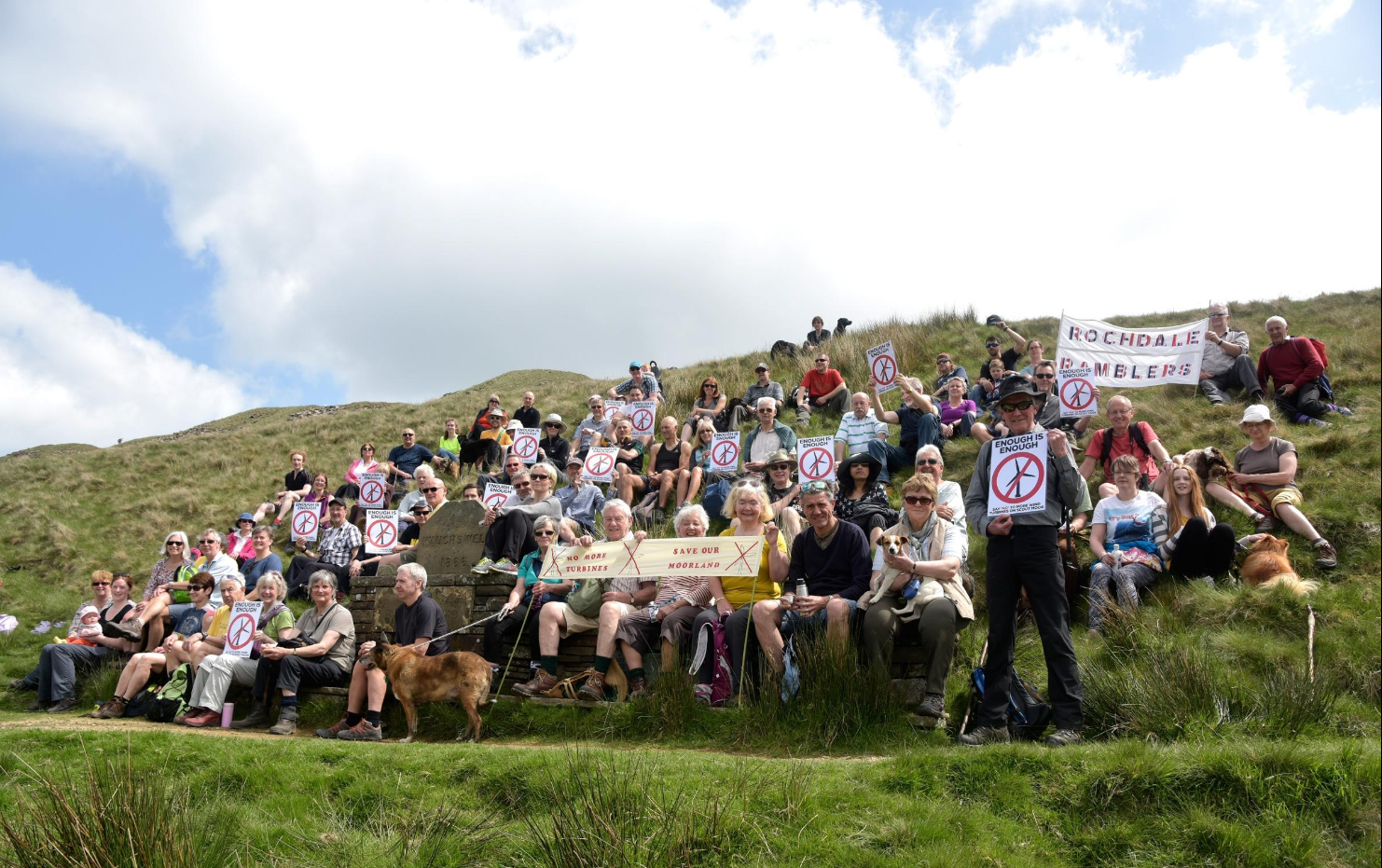
Scoutmoor protest Don’t be fooled by their smiles: these people are furious.

***

The following pieces – the first from Lancashire, England, the second from Charlotte, upstate New York – are permeated with a sense of seething rage.

While the wind industry, its parasites and spruikers still attempt the line that rural communities are falling over themselves to get in on some wind farm action, as usual, the spin and the reality are paddocks apart.

Here’s what really happens when these things are threatened upon peaceful and prosperous rural communities.

Protest walk over wind farm attracts over 100 people
Bury Times
4 June 2016

A PROTEST walk over controversial plans to build an extra 16 wind turbines at a Rossendale wind farm attracted over 100 people.

Adults, children, babies and dogs came together for the walk from Cowpe Road in Waterfoot along the Pennine Bridleway to Waugh’s Well.

The walkers had protest…

View original post 1,166 more words

Poles Apart: New Turbine Setback Rules Threaten Doom for Polish Wind Industry

The Polish Government has the Right Idea!

stopthesethings's avatarSTOP THESE THINGS

polish wind farm

Over-run by these things, faced with thousand of furious neighbours demanding an end to the onslaught, and spiralling power costs, Poland has mounted an enormous about face: where the wind industry was the flavour of the month for a year or two, it’s just been hit with the first salvo in an effort to give Poles back a little peace and quiet.

Like the Bavarians, the Poles have determined to put some distance between these things and houses: 10 times the height, which, with turbine tips topping 160m, means a gap of 1.6km or more.

That, of course, is nowhere near enough to protect humans; or anything else that lives and breathes, for that matter (see our post here).

However, in closely populated territory, like Poland and Bavaria, a setback of 1.6-2km has the practical effect of scuttling plenty of proposed developments.

To make them anything like…

View original post 543 more words

Lessons from Denmark: Danes Slash Wind Power Subsidies to Salvage Economy

When the wind doesn’t blow, wind energy sucks, (which is most of the time)!

stopthesethings's avatarSTOP THESE THINGS

Electricity-prices-europe

The wind industry is mounted on myth and fuelled by fantasy.

In Australia, its parasites and spruikers must believe that we are still cut off from the known world (suffering from what was referred to as the “tyranny of distance”) when they peddle stories about Europeans still being wedded to wind power.

On that score, one of the Australian wind cult’s “pinup girls” has always been Denmark. No doubt aided by struggling Danish turbine maker, Vestas (the High Church for wind worshippers) the gullible and naïve still believe that Denmark has achieved a wind powered Nirvana. (The hard-hitting Danish docu-drama, Follow the Money – screening on SBS – with Vestas played by ‘Energreen’ – has knocked some of the varnish off, though.)

In the cultists’ eyes wind power can, of course, do no wrong.  Moments when the wind blows, and these things produce more than their usual piddling fraction of…

View original post 1,395 more words

South Australians Locked in Wind Power Price Disaster: Retail Prices Jump Another 12%

Unaffordable Renewables!

stopthesethings's avatarSTOP THESE THINGS

koutsantonis SA’s Treasurer, Tom Koutsantonis: plays deaf to economic reality.

***

South Australia is an economic basket case, thanks, in no small part, to its obsession with wind power.

Power prices are spiralling out of control. Back in March SA’s businesses were belted with a 90% hike in their bills, that left manufacturers, miners and other power hungry businesses reeling: Wind Power Costs Crushing South Australian Businesses: Firms Hit with 90% Price Hike

Now residential customers have just been whacked by AGL, with a 12% power price hike (with a whole lot worse to come).  What passes for journalism in SA pitched up the following half-baked ‘analysis’ on the causes of what portends to be a social and economic disaster (STT fills in the gaps a little later).

State’s largest energy retailer, AGL, set to hike electricity bill prices
The Advertiser
David Nankervis
15 June 2016

AGL customers will be hit…

View original post 6,594 more words

Wind Industry Makes Absurd Claim that Wind Power Lowers Retail Power Prices

Windweasels and their Lies!!!

stopthesethings's avatarSTOP THESE THINGS

lies

Wind industry propaganda is an artform, which works on the adage, once employed by a crazy little German with a funny mustache, that: “If you tell a big enough lie and tell it frequently enough, it will be believed.”

The latest wind industry wheeze is to turn black into white, by claiming that occasionally adding wind power to an electricity grid (weather permitting, of course) lowers retail power prices. Here’s Alan Moran unpacking the latest furphy.

Black is white: and wind generators drive down electricity prices, too …
Catallaxy Files
Alan Moran
8 June 2016

Wind industry lobbyists Pitt and Sherry, and their journal, RenewEconomy, jubilantly produced the following table as proof that wind energy lowers prices.

They pointed out that in May wind enjoyed its biggest ever month, with 8.5 per cent of the National Electricity Market supply and argued that this had led to prices falling. They…

View original post 1,162 more words

Wind Power Investors Fleeced: Teenage Turbines Falling Apart in Donegal

Wind Scam Bad for Investors…

stopthesethings's avatarSTOP THESE THINGS

hepburn wind2 Hepburn Wind’s maintenance team applying scheduled hugs.

****

Wind power outfits still make wild claims about these things running on the smell of an oily rag and lasting for 25 years or more, needing little more than a hug from time to time. However, the operations and maintenance cost of these things is around $25 per MWh – hardly the zero marginal cost claimed by wind cultists (see our post here).

Gearbox, bearing, generator and blade failures are common features of wind turbine operation; and the cost of replacing and repairing these things has the potential to wipe out profits and shareholder value in a veritable heartbeat, just ask Australia’s most notorious wind power outfit, Infigen (see our post here).

The truth is that wind turbines are lucky to have an economic life of anything more than 10 years (see our post here).

Proof of that fact…

View original post 451 more words

UK’s Wind Power Nightmare Hits High Farce: Having Wrecked Everything, Wind Industry Now Says ‘Britain Not Windy Enough’

Too little, too late? Tear ’em all down!

stopthesethings's avatarSTOP THESE THINGS

kites

Wind is an occasional ally in all sorts of recreational pursuits: sailing, kite surfing, puffing on a ready-to-burst dandelion and watching their parasol seeds drift skywards, and the childish delight of sending kites aloft. But it’s taken a special breed of Muppet to turn a source of sporadic fun into a ridiculously expensive, sometime source of electricity.

In our recent post on the comparative debacles of South Australia and the UK we picked up on the line dropped by Britain’s head wind spinner, Hugh McNeal (RenewableUK) who – now that the subsidy trough has been emptied – says there is no chance of any more of these things blighting Blighty as: ‘The wind speeds don’t allow for it.’

After that (stating the bleeding obvious) admission, the few among Britain’s journos that get it had a field day.

After years of being fed a myth about the wind ‘powering’ Britain for…

View original post 1,346 more words

The Windscam, built on O.P.M….

US Wind Industry ‘Built’ on $176 Billion of Other Peoples’ Money

burning-dollar

If recycling is an environmental ‘good’, then the wind industry can proudly wear its ability to recycle hundreds of $Billions of other peoples’ money as a badge of honour.

Take a product which – as it can only ever be delivered at crazy random intervals and can’t be economically stored – has NO commercial valueand you’ll tend to find willing buyers few and far between.

In Australia’s wind power capital, South Australia, thanks to REC subsidies worth more than double what conventional power costs to produce, wind power outfits actually pay the grid manager (up to $20 per MWh) to take their skittish wares (see our post here). That market perversity has left SA with the highest retail power prices in Australia (by a factor of 2) and a grid on the brink of collapse (see our post here).

But the wind industry’s ‘recycling’ efforts can only take effect where the useful idiots that pretend to govern us enshrine massive subsidy schemes as ‘immutable’ laws, that must necessarily outlast religion: even the merest hint of threat to which kills ‘investment’ in wind power stone dead (see our post here).

The cost of feeding the subsidy-sucking freak that is the wind industry has already cost taxpayers and power consumers hundreds of $Billions around the Globe; and, as Robert Bryce spells out, will – if left unchecked – cost Americans hundreds of $Billions more.

Wind-Energy Sector Gets $176 Billion Worth of Crony Capitalism
National Review
Robert Bryce
6 June 2016

It takes enormous amounts of taxpayer cash to make wind energy seem affordable.

Last month, during its annual conference, the American Wind Energy Association issued a press release trumpeting the growth of wind-energy capacity. It quoted the association’s CEO, Tom Kiernan, who declared that the wind business is “an American success story.”

There’s no doubt that wind-energy capacity has grown substantially in recent years. But that growth has been fueled not by consumer demand, but by billions of dollars’ worth of taxpayer money. According to data from Subsidy Tracker — a database maintained by Good Jobs First, a Washington, D.C.–based organization that promotes “corporate and government accountability in economic development and smart growth for working families” — the total value of the subsidies given to the biggest players in the U.S. wind industry is now $176 billion.

That sum includes all local, state, and federal subsidies as well as federal loans and loan guarantees received by companies on the American Wind Energy Association’s board of directors since 2000. (Most of the federal grants have been awarded since 2007.)

Of the $176 billion provided to the wind-energy sector, $2.9 billion came from local and state governments; $9.4 billion came from federal grants and tax credits; and $163.9 billion was provided in the form of federal loans or loan guarantees.

General Electric — the biggest wind-turbine maker in North America — has a seat on AWEA’s board. It has received $1.6 billion in local, state, and federal subsidies and $159 billion in federal loans and loan guarantees. (It’s worth noting that General Electric got into the wind business in 2002 after it bought Enron Wind, a company that helped pioneer the art of renewable-energy rent-seeking.)

NextEra Energy, the largest wind-energy producer in the U.S., has received about 50 grants and tax credits from local, state, and federal entities as well as federal loans and loan guarantees worth $5.5 billion.

That’s more than what the veteran crony capitalist Elon Musk has garnered. Last year the Los Angeles Times’s Jerry Hirsch reported that Musk’s companies — Tesla Motors, Solar City, and Space Exploration Technologies — have collected subsidies worth $4.9 billion. NextEra’s haul is also more than what was collected by such energy giants as BP ($315 million) and Chevron ($2.2 billion).

About $6.8 billion in subsidies, loans, and loan guarantees went to foreign corporations, including Iberdrola, Siemens, and E.On. Those three companies, and five other foreign companies, have seats on AWEA’s board of directors.

Many of the companies on the AWEA board will be collecting even more federal subsidies over the next few years. In December, the Congressional Joint Committee on Taxation estimated that the latest renewal of the production tax credit will cost U.S. taxpayers about $3.1 billion per year from now until 2019. That subsidy pays wind-energy companies $23 for each megawatt-hour of electricity they produce.

That’s an astounding level of subsidy. In 2014 and 2015, according to the Energy Information Administration, during times of peak demand, the average wholesale price of electricity was about $50 per megawatt-hour.

Last winter in Texas, peak wholesale electricity prices averaged $21 per megawatt hour. Thus, on the national level, wind-energy subsidies are worth nearly half the cost of wholesale power, and in the Texas market, those subsidies can actually exceed the wholesale price of electricity.

Of course, wind-energy boosters like to claim that the oil-and-gas sector gets favorable tax treatment, too. That may be so, but those tax advantages are tiny when compared with the federal gravy being ladled on wind companies.

Recall that the production tax credit is $23 per megawatt-hour. A megawatt-hour of electricity contains 3.4 million Btu. That means wind-energy producers are getting a subsidy of $6.76 per million Btu. The current spot price of natural gas is about $2.40 per million Btu. Thus, on an energy-equivalent basis, wind energy’s subsidy is nearly three times the current market price of natural gas.

MidAmerican Energy Company, a subsidiary of Berkshire Hathaway, has a seat on AWEA’s board. Berkshire’s subsidy total: $1.5 billion — and it’s primed to collect lots more.

In April, the company announced plans to spend $3.6 billion on wind projects in Iowa. Two years ago, Berkshire’s CEO, Warren Buffett, explained why his companies are in the wind business. “We get a tax credit if we build a lot of wind farms. That’s the only reason to build them,” he said. “They don’t make sense without the tax credit.”

Keep in mind that the $176 billion figure in wind-energy subsidies is a minimum number. It counts only subsidies given to companies on AWEA’s board.

Not counted are subsidies handed out to companies like Google, which got part of a $490 million federal cash grant for investing in an Oregon wind project. Nor does it include the $1.5 billion in subsidies given to SunEdison, the now-bankrupt company that used to have a seat on AWEA’s board. (To download the full list of subsidies garnered by AWEA’s board members, click here.)

Nor does that figure include federal money given to J. P. Morgan and Bank of America, both of which have a seat on AWEA’s board. The two banks received federal loans or loan guarantees worth $1.29 trillion and $3.49 trillion, respectively.

In an e-mail, Phil Mattera, the research director for Good Jobs First, told me that the loan and loan-guarantee figures for the banks include the federal bailout package known as the Troubled Asset Relief Program as well as “programs instituted by the Federal Reserve in the wake of the financial meltdown.”

When all of the subsidies, loans, and loan guarantees given to the companies on AWEA’s board are counted, the grand total comes to a staggering $5.1 trillion.

According to Wikipedia, crony capitalism “may be exhibited by favoritism in the distribution of legal permits, government grants, special tax breaks, or other forms of state interventionism.” Wind-energy companies are getting favoritism on every count.

The U.S. Fish and Wildlife Service wants to give those companies permits allowing them to legally kill bald and golden eagles with their turbines for up to 30 years.

The industry is getting grants, tax breaks, and loans worth billions. And thanks to federal mandates like the Clean Power Plan and state renewable-energy requirements — nearly all of which are predicated on the specious claim that paving vast swaths of the countryside with wind turbines is going to save us from catastrophic climate change — the industry is surfing a wave of state interventionism.

AWEA’s Kiernan likely has it right. In a country where having a profitable business increasingly requires getting favors from government, the U.S. wind industry is definitely a “success.”
National Review

other peoples money