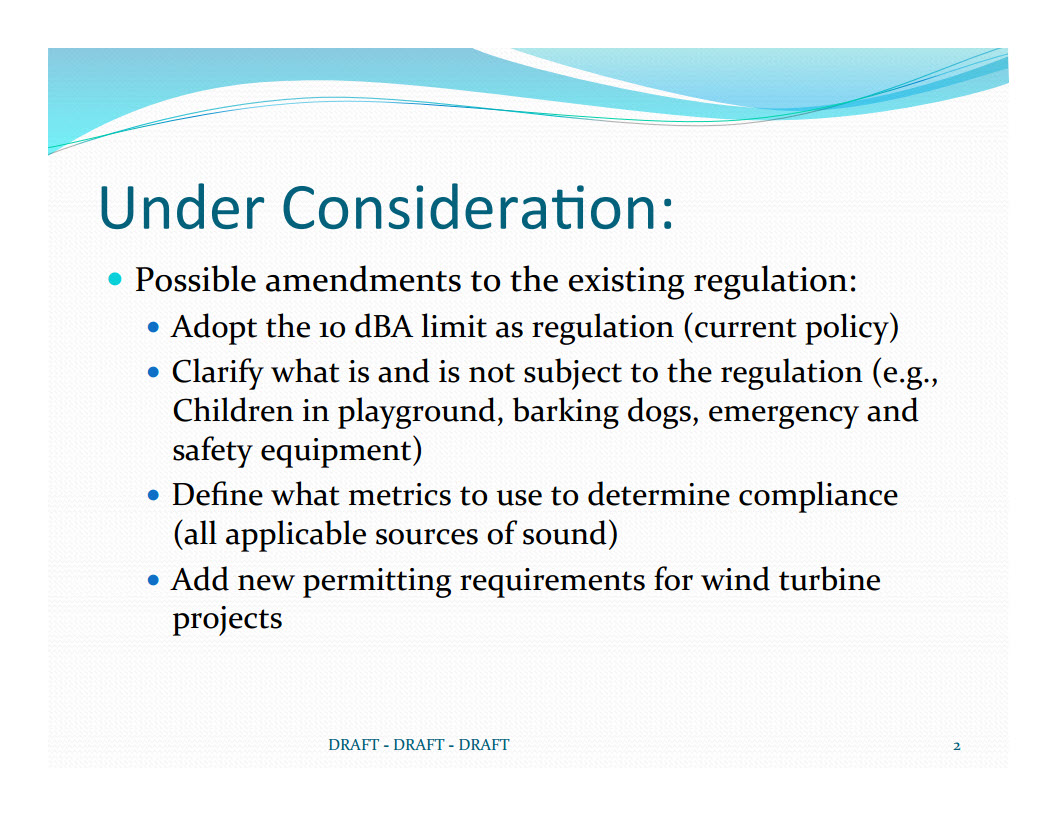
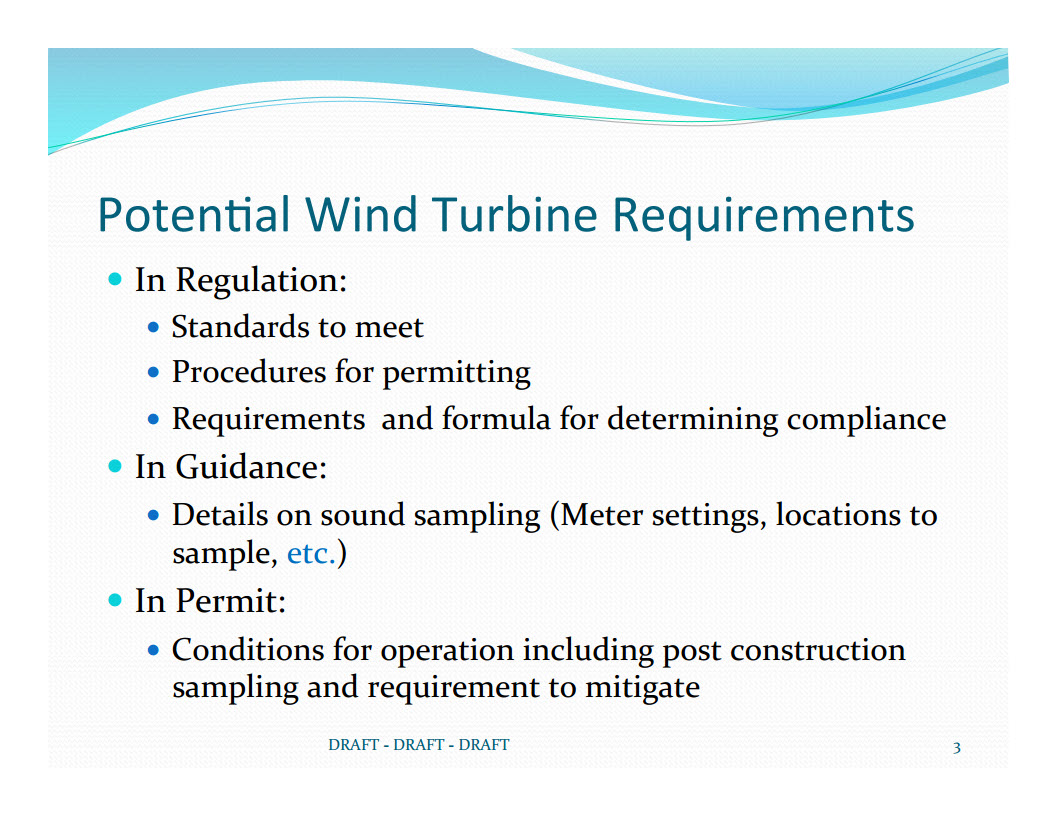
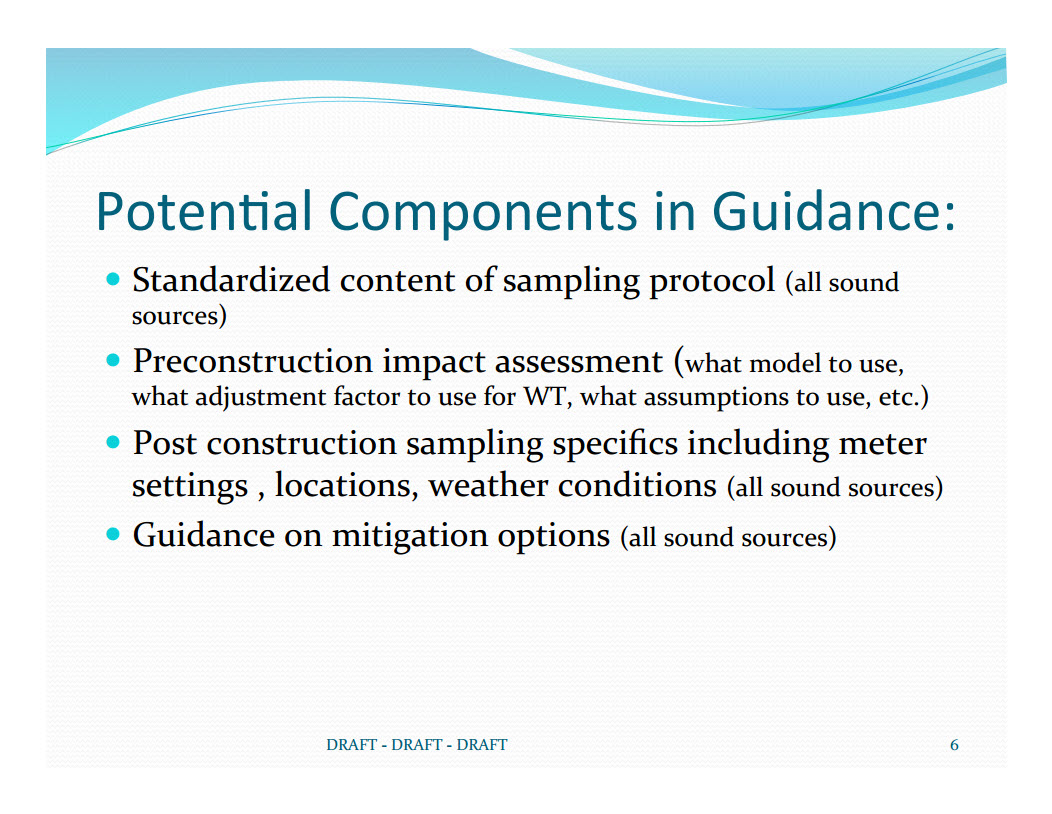
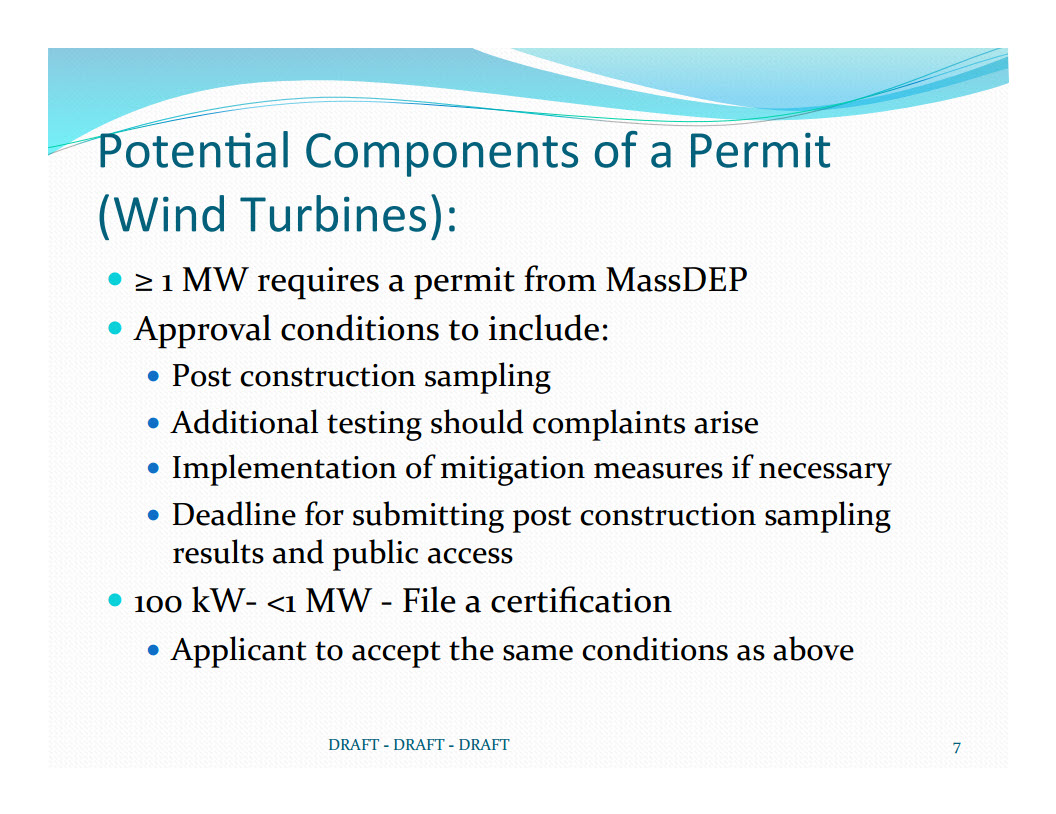
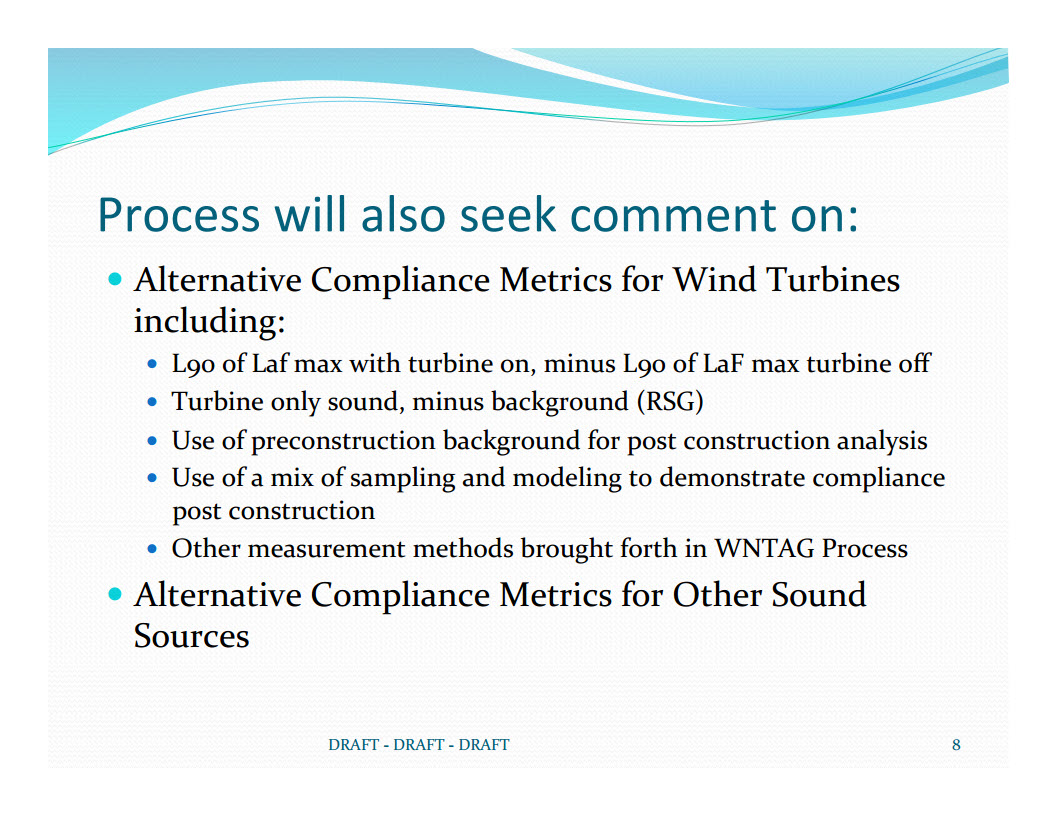
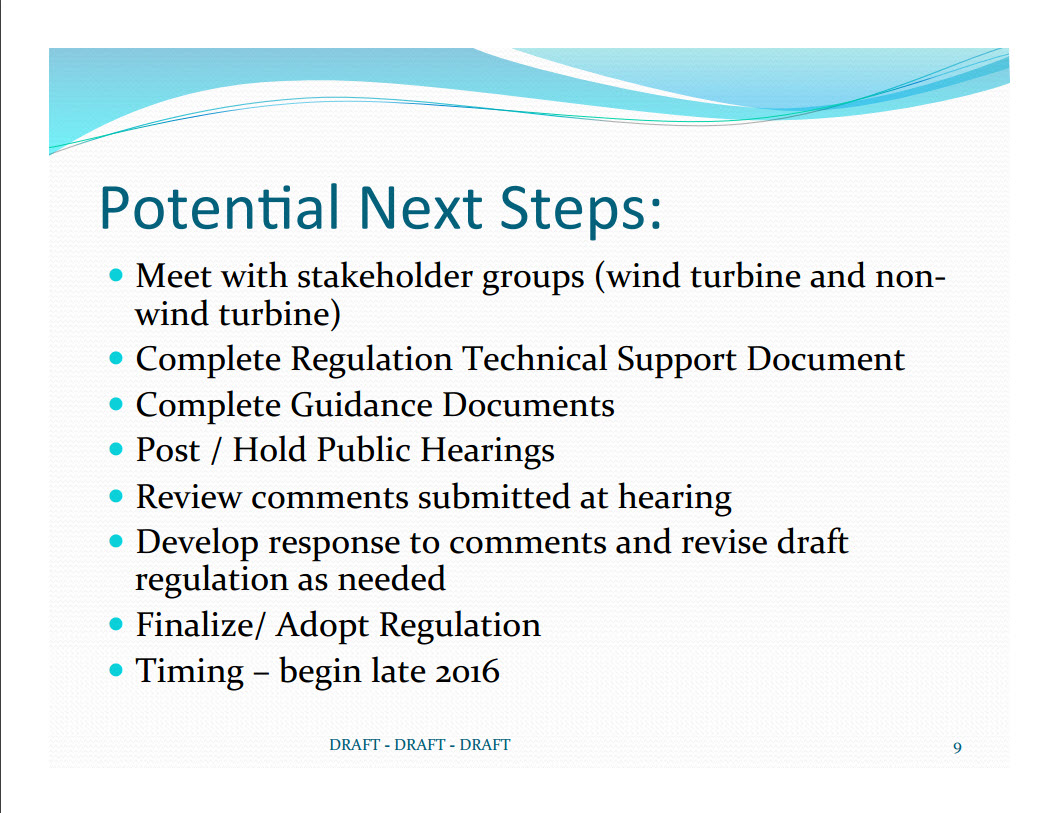
As a result of the series of meetings held with the Wind and Noise Turbine Advisory Group (WNTAG), new regulations, guidelines, or policies may be in the cards. And while the deck has been largely stacked against wind neighbors, this is an opportunity to throw down the aces: include infrasound, set L-90 low, use fast meter settings, recognize amplitude modulation. Play the wild card, too: anticipate wind shear.
Public comments are due April 8, 2016. Send them to the MassDEP’s Deputy Regional Director Laurel Carlson (Laurel.Carlson@state.ma.us) and to the Consensus Building Institute’s Senior Mediator Stacie Smith (stacie@cbuilding.org).
This table shows the relevant slides on potential regulation and guidelines. Click on a slide to view it or access the whole draft at Scope of Possible Noise Regulation and Policy.
Australia’s National Health and Medical Research Council long ago disqualified itself as a body fit, willing, or even able to investigate and report on the known and obvious consequences to human health and well-being caused by incessant turbine generated low-frequency noise and infrasound.
From the get go, it’s been infiltrated by wind industry consultants, such as Norm Broner and Renzo Tonin; and wind industry advocates like Liz Hanna, who continue to direct traffic at, what is supposed to be, an independent medical research body, designed to protect public health at enormous taxpayer expense (see our post here).
In early 2015, the NHMRC pumped out yet another politically inspired piece of propaganda, asserting that there was “no consistent evidence” of wind farms causing adverse health effects.
The inclusion of the weasel word “consistent” in the NHMRC’s puffy press piece was telling; and it’s a theme we’ve visited a few times…
The wind-cult are all for it – just as long it’s speared into someone else’s backyard & somebody else is forced to pay for their smugness.
****
In their sillier moments, the wind industry, its parasites and spruikers pitch the line that their pointless product is not only getting cheaper all the time, but go so far as to claim that wind power is already cheaper than gas and coal-fired power. Risible PR antics aside, the wind industry has always had a troubled relationship with the facts.
In 2016 – with disastrous results of attempting to rely on a Medieval technology unfolding daily (like Germany, South Australia and Ontario) – it takes real audacity to run the line about the wind being ‘free’: requiring the reality of hundreds of $billions in seemingly endless subsidies to be ignored, as with the fact that, at an economic level, power…
The Germans went into wind power harder and faster than anyone else – and the cost of doing so is catching up with a vengeance.
The subsidies have been colossal and the impacts on the electricity market chaotic.
Some 800,000 German homes have been disconnected from the grid – victims of what is euphemistically called “fuel poverty”. Power starved Germans, instead of freezing, grabbed their axes and tramped into their forests to improve their sense of energy security – although foresters apparently take the view that this self-help measure is nothing more than blatant timber theft (see our post here).
German manufacturers – and other energy intensive industries – faced with escalating power bills are packing up and heading to the USA – where power prices are 1/3 of Germany’s (see our posts here and here and here). And the “green” dream of…
The Competitive Enterprise Institute has won a case against the White House, forcing the release of documents pertaining a climate video created by White House Science AdvisorJohn Holdren. When the content of Holdren’s climate video challenged under the federal Information Quality Act, the White House claimed the video was the “personal opinion” of John Holdren, not an official communication, and therefore not subject to the Act. The newly released emails allegedly cast doubt on this assertion.
On January 8, 2014, the White House posted a controversial video claiming that global warming causes more severe winter cold. Called “The Polar Vortex Explained in 2 Minutes,” it featured the director of the White House Office of Science & Technology Policy (OSTP), John Holdren, claiming that a “growing body of evidence” showed that the “extreme cold being experienced by much of the United States” at the time was “a pattern that we can expect to see with increasing frequency as global warming continues.”
This claim was questioned by many scientists and commentators. (See, e.g., Jason Samenow, Scientists: Don’t make “extreme cold” centerpiece of global warming argument, Washington Post, Feb. 20, 2014 (linking to objection by five well-known climate scientists in the Feb. 14, 2014 issue of Science magazine); Patrick J. Michaels, Hot Air About Cold Air, Jan. 16, 2014 (former state climatologist of Virginia rejected Holdren’s claim.))
In April 2014, the Competitive Enterprise Institute (CEI) sent a request for correction of this statement under the federal Information Quality Act, citing peer-reviewed scientific articles debunking it. In June 2014, OSTP rejectedthis request, claiming that Holdren’s statement was his “personal opinion,” not the agency’s position, and that it thus did not constitute “information” subject to the Information Quality Act, which excludes “subjective opinions” from its reach.
…
When OSTP produced the records on March 4, 2016 (they are at this link), they showed inconsistency in OSTP’s position over time. Although OSTP told CEI in June 2014 that Holdren’s claim was just his personal “opinion,” not “information” that is subject to the Information Quality Act (IQA), this was not the position it originally took in its draft response to CEI’s request back in Spring 2014.
Instead, OSTP described Holdren’s claim in these drafts as “information provided by the government [that] meet[s] ‘basic standards of quality, including objectivity, utility, and integrity,” and constituted “communications from the White House about climate science.” (see pages 1 and 5 of each draft). Accordingly, OSTP argued it complied with the IQA’s standards for the quality of official information.
The following is the video at the centre of this controversy.
If President Obama and John Holdren genuinely think the evidence supports their position, that Climate Change is a serious threat, why don’t they simply stand by the evidence which they believe supports their case? Why did John Holdren, in my opinion, attempt to hide behind legal technicalities, and do everything in his power to obstruct transparency, when challenged about the defensibility of alarmist statements he made about climate change?
Analysis of Low Frequency and Infrasound at the Shirley Wind Farm
A Cooperative Measurement Survey and Analysis of Low Frequency and Infrasound at the Shirley Wind Farm in Brown County, Wisconsin
“What you can’t hear, can hurt you”
The purpose was to determine whether infrasound was present in the homes of three families in the footprint of the Shirley Wind project (owned by Duke Energy). These families have reported adverse health effects since the wind turbine utility commenced operation. Two have been forced out of their homes. They report experiencing symptoms of the type associated with wind turbine syndrome. These families are my clients and they offered to act as intervener’s in another Wisconsin case, Highland Wind which is in the application hearing phase. 50 affidavits were filed by them and other residents near the utility describing adverse health effects and home abandonment for the eight turbine Shirley Wind project (click here for video) using Nordex N100 2.5 MW wind turbines.
The above graph shows that wind turbine noise is present outside and inside the residence. The SPL – dB (Sound Pressure Level – decibel) scale on the left hand side of the graph shows low frequency noise levels approaching 80. This is considered a noise level similar to an alarm clock or hair dryer.
Initially the PSC was going to have the study conducted by George and Dave Hessler. This posed a major problem for credibility with the interveners and others who know their position from other projects. The Wis. PSC staffers have a long relationship with them because they have done numerous studies for wind utilities in the state and have always given the utilities’ a clean bill of health claiming that sound levels at complainant’s homes met the state limits and that infrasound and low frequency sound was not a problem. The attorneys for the citizen’s group, Anne Bensky and Peter McKeever for Forest Voice, and Glenn Reynolds, the attorney for the Town of Forest which also opposes the project, wanted the tests to be conducted but were concerned that the Hessler’s would produce a biased study. It was decided that they would push for a study that included four acoustics experts, some on the wind industry side (Hesslers), independents (Schomer and Walker) and one who has demonstrated the ability to find infrasound inside homes (Rob Rand). I was not available on the proposed test dates so I could not participate but Rob Rand was a very good alternative. This also leaves me free to do my own evaluation of the study and collected data and audio files. The participation of the Hesslers and Clean Wisconsin make it much harder for the wind industry trade associations to claim that this work is biased.
The four investigating firms are of the opinion that enough evidence and hypotheses have been given herein to classify LFN and infrasound as a serious issue, possibly affecting the future of the industry. It should be addressed beyond the present practice of showing that wind turbine levels are magnitudes below the threshold of hearing at low frequencies.
That infra and low frequency sound is a primary characteristic of wind turbine acoustic emissions was established by the team. The argument that infrasound produced by modern upwind wind turbines does not have sufficient amplitude to reach the threshold of hearing (set for steady pure tones, not the complex mix of tones emitted by wind turbines) raised by the wind industry through its experts like Dr. Leventhall and the many acousticians and others who parrot his opinion is now discredited. View full report here, pdf file
Paul Schomer, PHD, P.E. letter to Public Service Commission of Wisconsin
First, the Wind Industry has continually denied that wind turbines produce any LFN. This study showed that it does. At R-2 it was measured as clearly as if the turbine had left a fingerprint on the inside of the house.
Second, the Shirley study fully and completely corroborates Falmouth and fills the knowledge gap suggested by the MA study which was a literature review, not a hands-on field study. There is no reason to corroborate it again.
Third, the measurement of ultra low frequencies produced by mega turbines such as those at Shirley and proposed for Highland are the key to avoiding significant impacts to human health from wind turbines. As the Minnesota study concludes, the low frequencies must be studied further as part of the project planning. In the case of Forest, this study of the low frequency isopleths must be a part of an in-depth EIS, or the project must be redesigned with smaller turbines that are not likely to precipitate such severe health problems that people have no choice but to abandon their homes. These are precisely the studies that we recommended in our Shirley report and the EIS is a perfect way to obtain the information before the project is built; and
Fourth, the record as a whole in this case as well as the literature and case studies all over the world have suggested that people are leaving their homes because they are being exposed to significant levels of pulsating ultra low frequency sound produced by wind turbines.
Sincerely, Paul Schomer, PHD, P.E. Member; Board Certified, Institute of Noise Control
NHMRC awards funding into wind farms and human health
The National Health and Medical Research Council (NHMRC) has awarded two grants totalling $3.3 million to enrich the evidence-based understanding of the effects of wind farms on human health.
NHMRC CEO Professor Anne Kelso
NHMRC CEO Professor Anne Kelso noted that further research is needed to explore the relationships between wind farms and human health.
“Existing research in this area is of poor quality and targeted funding is warranted to support high quality, independent research on this issue.
“To address this, we need well designed studies conducted by excellent researchers in Australian conditions.
“These grants directly support the Australian Government’s commitment to determine any actual or potential effects of wind farms,” Professor Kelso said.
NHMRC funded research at the Flinders University of South Australia will explore relationships between noise from wind farms and effects such as annoyances and reduced sleep and quality of life.
Research at the University of New South Wales will investigate the broader social and environmental circumstances that may influence the health of people living near wind farms.
The outcomes of this research will assist in developing policy and public health recommendations regarding wind turbine development and operations in Australia.
Professor Kelso said it was important to note that the funding will support only high quality, well designed research proposals.
“NHMRC supports only the most outstanding research. Each application for this funding underwent the same stringent independent review process we apply to all NHMRC grant applications,” Professor Kelso said.
These grants are awarded in response to the 2015 Targeted Call for Research into Wind Farms and Human Health, following the release of the NHMRC Statement: Evidence on Wind Farms and Human Health.
Information relating to the individual grants is available on the NHMRC website –nhmrc.gov.au
Associate Professor Peter Catcheside, Flinders University of South Australia $1,357,652
Good sleep is essential for normal daytime functioning and health. Wind farm noise includes audible and unusually low frequency sound components, including infrasound, which could potentially disturb sleep through chronic sleep disruption and/or insomnia. This project will, for the first time, directly evaluate the sleep and physiological disturbance characteristics of wind farm noise compared to traffic noise reproduced in a specialised and carefully controlled laboratory environment.
Professor Guy Marks, University of New South Wales $1,943,934
The human health impact of infrasound that comes from wind turbines has not been well researched. This project will assemble a team of researchers with a broad range of expertise to run a short term and longer term study to investigate whether exposure to infrasound causes health problems. The short term study will be laboratory-based and run for three one week periods. The longer term study will be community based and run for six months. Sleep quality, balance, mood, and cardiovascular health will all be measured.
County Health Officer Admits Feeling Ill When Near Duke’s Shirley Wind Turbines DENMARK, WI – Brown County appears to be digging a deeper and deeper hole for itself as more facts come to light surrounding Duke Energy’s Shirley Windpower. After an unusually long almost 3 month delay in satisfying a resident’s open records request, the records ultimately provided expose that former Brown County Health Officer Chua Xiong feels ill when visiting the Shirley Wind facility. In an email to her intern Carolyn Harvey she states: “Carolyn the times I have been out there by the Wind Turbines, l get such migraine headaches. I think I should take some preventative Tylenol before I head out there.” Despite this admission, approximately one month later Ms. Xiong went on to make her declaration that “Currently there is insufficient scientific evidence-based research to support the relationship between wind turbines and health concerns.” She then went further in saying that this was her “final decision” and that she would only monitor the situation “on an annual basis”. In this decision she completely ignored the real world health impact of Duke Energy’s wind turbines on Brown County families as evidenced through their sworn affidavits and their documentation of past and continued suffering, not to mention her own repeated migraines when in proximity to Duke’s turbines. So what has happened between Ms. Xiong’s declaration and the March 18th release of the open records showing that Brown County’s Health Officer Chua Xiong suffers migraines when she is by the Shirley Wind turbines? On March 4th, Ms. Xiong submitted her resignation to County Executive Troy Streckenbach. He did not share this with County department heads until just two days prior to March 18th, Ms. Xiong’s last day. This date also coincides with Executive Streckenbach’s announcement of Brown County Corporation Counsel Juliana Ruenzel’s resignation. It is high time that Brown County and its Health Director follow the lead of its own Board of Health who unanimously declared Duke’s wind turbines in Glenmore a “Human Health Hazard”. They need to recognize that residents are sick, homes have been abandoned, that outsiders (even the County’s own Health Director) feel ill while in the project area, and FINALLY do whatever is necessary to protect the health and safety of southern Brown County residents. Brown County does not need Shirley Wind to become its Flint, Michigan. Until the County does the right thing and takes action, families will continue to suffer, the County’s inaction will escalate their legal liability, and this issue will not go away.
When lawyers, and after them, historians, write up the story of how graft and corruption paved the way for the willful ignorance (by then viewed as malign acquiescence) of the political enablers of the great wind power fraud, whole chapters will be devoted to their deliberate efforts to prevent the evidence being gathered, that ultimately resulted in legal claims running into the hundreds of $millions.
Those claims will have been successfully made in negligence – against public officials, developers’ acoustic consultants; and for noise nuisance against developers and their turbine hosts – with injunctions ordered to prevent further harm, and substantial damages awarded for depriving thousands of the right to sleep, live in and otherwise use and enjoy their very own homes and properties, due to turbine generated incessant low-frequency noise and infrasound (see our post here).