Novelty Energy Like Wind Turbines, NOT Fit for “Prime Time”!

Disintegrating Wind Turbines & Mass ‘Planned’ Blackouts in Germany: What’s Not to Like About Wind Power?

claudia schiffer

****

The wind industry, its parasites and spruikers, around the globe, hail Germany as THE wind power ‘Super Model’. Trouble is, in Germany – as elsewhere – the ‘gloss’ has well-and-truly worn off – and the ‘Model’ is looking more than just a little worse for wear.

The Germans went into wind power harder and faster than anyone else – and the cost of doing so is catching up with a vengeance. The subsidies have been colossal, the impacts on the electricity market chaotic and – contrary to the environmental purpose of the policy – CO2 emissions are rising fast: if “saving” the planet is – as we are repeatedly told – all about reducing man-made emissions of an odourless, colourless, naturally occurring trace gas, essential for all life on earth – then German energy/environmental policy has manifestly failed (see our post here).

Some 800,000 German homes have been disconnected from the grid – victims of what is euphemistically called “fuel poverty”. In response, Germans picked up their axes and headed into their forests in order to improve their sense of energy security – although foresters apparently take the view that this self-help measure is nothing more than blatant timber theft (see our post here).

And the economics are so bizarre, that you’d think its “Energiewende” policy had been put together by the GDR’s ‘brains trust’, before the Berlin Wall took its tumble in 1989.

In Germany, around €100 billion has already been burnt on renewable subsidies; currently the green energy levy costs €56 million every day. And, the level of subsidy for wind and solar sees Germans paying €20 billion a year for power that gets sold on the power exchange for around €2 billion.

Squandering €18 billion on power – which Germans have in abundance from meaningful sources – has them asking the fair and reasonable question: just how much power are they getting for the €billions that they’ve thrown – and continue to throw at wind and solar?

The answer at 3.3% is – NOT MUCH.

But beyond the economy destroying costs of subsidising a meaningless power source, with NO commercial value – apart from the subsidies it attracts – there’s also the (not insignificant) issue of turbines flinging their 10 tonne blades to the four winds and/or yielding to gravity and allowing their entire 290 tonne bulk to crash back to Earth.

The increasing number of self-destructing turbines and ‘component liberation’ events might almost be forgiven if the power produced were even a tad reliable. But, that source of potential mitigation has dried up in Germany, too.

Due the intermittent and chaotic delivery of wind power, the Germans are now coming to terms with deliberate ‘targeted blackouts’ – where grid mangers are chopping power to major consumers and even whole cities in response to wild and unpredictable wind power collapses (just like Adelaide, in South Australia).

Catastrophic Turbine Failures, Targeted Blackouts Plague German Power As Wind, Solar Energy Increase
NoTricksZone
Pierre Gosselin
31 December 2015

Thanks in large part to wind and solar energy, not only have German electricity prices paid by consumers skyrocketed over the past years, thus casting a large number of homes into home fuel poverty, but also the supply itself is rapidly becoming precarious and unreliable.

One problem is the stabilization of the power grid in the face of wildly fluctuating wind and solar energy feed-in. The other problem is the mechanical integrity associated the wind turbines themselves.

Catastrophic wind turbine failures

Increasingly it is becoming apparent that wind turbines have a way of just collapsing – often without notice – due to mysterious causes. One might suspect mechanical fatigue due to the complex cyclic loading that wind turbines are subjected to.

Consequently wind parks are becoming hazardous zones for persons and property in the vicinity – never mind the proven detrimental health effects of infrasound.

One example (of many) of a recent catastrophic turbine failure is reported by the North German Ostesee Zeitung here. According to the article, just 2 days ago, the blade of a wind turbine snapped off unexpectedly, boring itself into the ground.

turbine blade germany

****

The Ostsee Zeitung writes that local residents were “shocked” and the reason for the collapse is unknown. The online news site writes:

“At the time of the accident there was neither a storm nor unusual weather conditions. ‘We are baffled as well,’ says Carlo Schmidt, Managing Director of Windprojekt company, which operates the turbine in question.”

Luckily no one was injured, or killed.

Wind turbine in Sweden fails with “incredible bang”
vestas v112

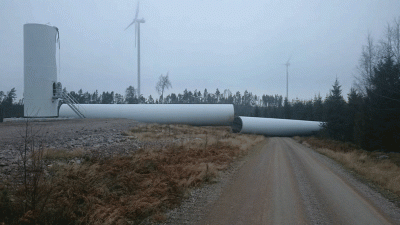
Another recent catastrophic failure occurred in Sweden, so reports the Swedish online svt.se news site here.

Forestry machinery operator Erik Karlsson of the Vetlanda municipality heard an “incredible bang” while working on Christmas Eve, but thought nothing of it. Later as went home he discovered that a nearby wind turbine had fallen to the ground across the road.

Vestas_V112-Collapse-1_preview

The huge turbine mast had snapped some 15 meters up and the unit came crashing down, the SVT writes. Authorities quickly cordoned off the wind park area. Here as well the cause of the failure is unknown. The wind park has since been designated as a hazardous area: “The public has been asked to keep away.”

Vestas_V112-Collapse_preview

These are just two recent examples of many of wind turbine collapses.

Blackouts to prevent blackouts

studying candle

****

In addition to catastrophic mechanical failures, wind and solar energy are wreaking havoc on power grid stability, so writes the German onlinemittelhessen.de here.

The online newssite reports that the future for the residents of Wetzlar may be looking bleak. Why?

“If in the future the power goes out, the reason maybe rooted in the energy management act. In order to eliminate the possibility of widespread blackouts, grid operators such as Enwag are obligated to switch off consumers or even entire parts of the city.”

These targeted blackouts are necessary, mittelhessen.de writes, because it is the only way left to keep the power grid from over or under-loading. The site tells readers:

“The probability of large blackouts is increasing with the strongly growing power generation from wind and sun. Experts have long seen the power grid threatened by this.”

Unfortunately grid operators will have to react very quickly to the power grid fluctuations. The mittelhessen.de reports that “there won’t be any time for operators to make long calculations” and that “there will be only an hour to react”. Just how vulnerable is the power grid in the Wetzlar region? Mittelhessen.de writes:

“A chain of seemingly harmless single incidents can in the worst case lead to a domino effect and lead to outages in all connected power networks.”

In plain English: one small problem could lead to a widespread blackout.

To keep this from happening, the solution is now to conduct targeted blackouts in an attempt to keep the grid balanced. If you are running a company, or merely working on an important document at your PC, then it’ll just be tough luck. Just use paper and pen, and light up a candle.

Junk energy at a high price. Other countries may wish to think twice before copying the model.
NoTricksZone

divine

Wind Turbines and Human Rights

Residents in All Countries, Must Fight for Protection from Windpushers…

Neil van Dokkum's avatarThe Law is my Oyster

scream at turbine

Many people harp on about their human rights but I am always amazed that most people do not know of the extent of their rights or where they come from.

.

If you are an Irish citizen then a lot of your human rights should come from our Constitution, the so-called ‘fundamental rights’:
Right to a fair trial (Article 38.1)
Equality before the law (Article 40.1)
Right to life (Article 40.3)
Right to liberty (Article 40.4)
Right to freedom of expression, assembly and association (Article 40.6.1)
Protection of the family (Article 41),

.

In addition, the Irish Courts have interpreted the Constitution as including certain human rights. These are referred to as ‘unenumerated rights’, which means that although they are not specifically set out in so many words, it is possible to find them ‘between the lines’ of the Constitution. These include:

Right to bodily integrity
Right to freedom from…

View original post 1,821 more words

Why Industrial Wind Turbines, are a Waste of Time & Money!

11 Fatal Flaws with Wind Power

Facts

The wind industry is copping a flogging all over the World. Increasingly, as the industry’s lies and propaganda are replaced by facts, more and more are coming to the obvious conclusion: THESE THINGS DON’T WORK – on any level.

Getting there was only a matter of time.

What has surprised STT is not that journos, pundits and even Global Warming hysterics have sussed the wind power fraud for what it is; it’s that those that previously championed wind power have, instead, joined a chorus calling for serious investment in nuclear power.

Here’s a little ‘paint-by-numbers’ breakdown that reaches that very same conclusion, for much the same reasons.

Top 11 Problems Plaguing Solar And Wind Power
Daily Caller
Andrew Follett
25 December 2015

Despite President Barack Obama’s pocket veto Saturday of attempts to repeal the Clean Power Plan and recent increases in taxpayer support, solar and wind energy are in a tough spot, requiring an estimated $90 trillion of investment to meet carbon dioxide reduction goals.

The fundamental issues of solar and wind power are numerous, so let’s review the top 11.

1: Power Storage Is Incredibly Expensive On A Large Scale

It is currently impossible to economically store power for times when the sun isn’t shining and the wind isn’t blowing. Purchasing enough batteries to provide just three days of storage for an average American household costs about $15,000, and those batteries only last for about five years and are very difficult to recycle.

This is true for home power storage as well, even with the latest batteries. A Tesla power-wall capable of powering a home costs $7,340 to buy. A conservative analysis estimates that a power-wall can save its owner a maximum of $1.06 a day. Such a system would take approximately 25 years to pay for itself, according to the same analysis.

One of the world’s largest and most powerful batteries, located in Fairbanks, Ala., weighs 1,300-metric tons and is larger than a football field. It can only provide enough electricity for about 12,000 residents, or 38 percent of Fairbanks’ population, for seven minutes. That’s useful for short outages, which happen a lot in Alaska, but isn’t effective enough to act as a reserve for solar and wind.

The best way we have of “storing” power is pumping water up a hill, which actually accounts for 99 percent of all global energy storage.

2: The U.S. Power Grid Is Older, And Has Trouble Handling Solar And Wind

“Our power grid works well today. Some complain, but blackouts are rare and large-scale blackout are really rare. The power grid was set up for the [electrical] generation we have. Building a lot of new wind and solar requires much greater expenditure on the grid,” Vice President for Policy of the Institute for Energy Research Daniel Simmons told The Daily Caller News Foundation.

According to the Department of Energy, 70 percent of the transmission lines and power transformers in the country are at least 25 years old.

In order for the power grid to function, demand for energy must exactly match supply. Power demand is relatively predictable and conventional power plans, like nuclear plants and natural gas, can adjust output accordingly. Solar and wind power, however, cannot easily adjust output. They also provide power unpredictably relative to conventional power sources.

On an especially cloudy or windless day, the electrical grid can’t supply enough power from solar or wind alone. Wind and solar also run the risk of producing too much power which can overload and fry the power grid. This is why electrical companies will occasionally pay consumers to take electricity.

3: Rebuilding The Power Grid To Handle Solar And Wind Is Absurdly Expensive

The three power grids that supply the United States with energy are massive and expensive pieces of infrastructure. The power grids are valued at trillions of dollars and can’t be replaced in a timely manner. It takes more than a year to manufacture a new transformer, and transformers aren’t interchangeable, as each one must be individually built specifically for its location. At a time when the U.S. government is more than $18 trillion in debt, building power grids that can handle solar and wind may not be feasible.

Merely building a 3,000-mile network of transmission lines capable of moving power from wind-rich West Texas to market in East Texas proved to be a $6.8 billion effort that began in 2008 and still isn’t entirely finished. Building the infrastructure to move large amounts of solar or wind power from the best places to generate it to the places where power is needed would be incredibly expensive and could cost many times the price of generating the power.

4: Solar and Wind Don’t Provide Power At Useful Times

“Solar is better than wind for providing electricity when electricity is used,” says Simmons. “But during much of the year in, for example, peak electricity demand comes after dark. For example, [on December 17] in California peak electricity demand was at 6pm. But peak solar was at 12:36 and by 6pm, solar production was a zero.”

Power demand is relatively predictable. The output of a solar or wind power plant is quite variable over time and generally doesn’t coincide with the times when power is most needed. Peak power demand also occurs in the evenings, when solar power is going offline. Adding power plants which only provide power at intermittent and unpredictable times makes the power grid more fragile.

5: Solar And Wind Can’t Keep the Lights On By Themselves

Solar and wind power systems require conventional backups to provide power when they cannot. Since the output of solar and wind plants cannot be predicted with high accuracy by forecasts, grid operators have to keep excess reserve running just in case.

But natural gas, coal-fired, or nuclear plants are not simple machines. They can require days to fully turn on from a dead stop. This means that solar and wind power require conventional sources in “stand-by” mode, which means they’re still generating electricity.

Despite this, environmental groups like The Sierra Club still call for “100 percent” solar and wind power.

6: The Best Places For Solar And Wind Are Usually Far Away From Consumers

The places with the highest potential for generating solar or wind power are typically relatively far away from the people who will consume power, according to the Department of Energy. The government agency even maintains maps of how unfeasible long-range transmission can become.

The vast majority of people who use power do not live in deserts or consistently windy areas. The kind of high voltage power lines needed to transport even relatively small amounts of power cost $1.9 to 3.1 million per mile built. Additionally, the kind of “smarter” power systems which can be adjusted to varying energy production created by wind and solar power can cost up to 50 percent more.

7: Solar And Wind Are A Very Small Percent Of The Power Grid Despite Years of Subsidies

“The first 8 months of 2015 wind and solar combined to produce 2.3% of the energy the U.S. consumed. Also wind production is down this year compared to last year,” says Simmons.

Solar and wind have been heavily subsidized since at least the 1970s. In 2010, wind power alone received $5 billion in subsidies, swamping the $654 million oil and gas received in subsides. One in four wind suppliers have gone out of business in the past two years.

In 2014, solar and wind power accounted for only 0.4 and 4.4 percent of electricity generated in the United States, respectively, according to the Energy Information Administration. The total amount of energy created by solar and wind is relatively small even though both systems are heavily subsidized.

8: The Solar And Wind “Low-Hanging Fruit” Have Already Been Taken

The locations where solar and wind power make the most economic sense generally already have a solar or wind power system. Since solar and wind power are only effective in a limited number of locations, “green” power sources are difficult to expand and are simply not practical in some areas.

9: Natural Gas Prices Are Very Low In The United States

Natural gas prices are currently incredibly low in the United States, making it much more difficult for solar and wind power to become cost competitive. Natural gas is already passing coal power as the most used source of electricity. Additionally, natural gas is quite environmentally friendly.

The Department of Energy agrees with research organization Berkeley Earth that “the transition from coal to natural gas for electricity generation has probably been the single largest contributor to the … largely unexpected decline in US CO2 emissions.”

10: Nuclear Energy Has Enormous Potential

The United States just approved its first new nuclear reactor in 20 years. New nuclear reactor designs are much safer and emit less radiation than the coal plants they replace. Nuclear plants take up far less space than wind or solar and do not emit any carbon dioxide.

Recent breakthroughs in fusion could also potentially restart the atomic age when nuclear progress was lauded as a pinnacle of human achievement. Operational fusion power will put most other forms of electricity generation permanently out of business and could occur very soon. Fusion power could easily be “too cheap to meter,” meaning that the cost of generating new power would be below the cost of determining how much power an individual was using, effectively making electricity generation nearly free.

11: Encouraging Wind And Solar Creates Incentives For Massive Corruption

Attempts by governments to encourage solar and wind power have created incentives for corruption even environmentalists acknowledge. The recent Volkswagen scandal illustrates that regulatory attempts to force a specific technology, in this case the adoption of cleaner diesel engines, create incentives that lead to sophisticated cheating by companies. The main incentive of the regulatory agencies is to make rules while avoiding bad publicity, not to actually solve the problem.

The push to encourage “green” systems has already led to serious corruption, such as the Solyndra scandal. Such corruption “crowds out” investment dollars that could be better spent on more workable solutions.
Daily Caller

turbine fire 3

vestas v112

eagle 1

Illinois Appeals Board Slams 127 Turbine Wind Farm Proposal Due to Excess Noise Health Effects & Loss of Neighbours’ Property Values

Illinois Wind Turbine Project Refused because of NOISE!!

stopthesethings's avatarSTOP THESE THINGS

lake winds Whatever could it be that’s killing their ability to sleep??

****

It doesn’t usually take the law long to catch up with good old common sense, as this decision by Illinois’ Bureau County Zoning Board of Appeals attests.

Zoning board denies wind turbines applications
Bureau County Republican
Barb Amrein
30 December 2015

Bureau County Zoning Board of Appeals finds application to build 127 industrial wind turbines should be denied as it endangers the public health and will cause property value loss to neighbors

After 40 days of hearings, the Bureau County Zoning Board of Appeals (ZBA) recommended denial of all of the 127 applications of Walnut Ridge Wind LLC (WRW) to build industrial wind turbines. The ZBA considered the testimony of dozens of witnesses and experts on the impacts of such turbines. Six different people who live near projects in Illinois and Wisconsin testified the turbines cause extreme noise, flickering…

View original post 642 more words

Government Corruption Involved in Falmouth Wind Turbine Issues!

Falmouth Turbines 6 Yrs 110 Db Noise Still Not Inputted In Studies

FALMOUTH TOWN OWNED VESTAS WIND TURBINE 110 DECIBELS OF NOISE HAS NEVER BEEN INPUT INTO A NOISE STUDY -WHY ARE THEY HIDING INFORMATION ?
Falmouth Turbines 6 Yrs 110 Db  Noise Still Not Inputted In Studies

The simple fact is the Town of Falmouth hid a noise warning letter, August 2010, from Vestas wind company that the turbines are 7 decibels over the original studies. The 7 decibels has never been inputted in any studies even now six years later !

The town hid the letter 6 years ago because they would not be able to get Special Permit 240 – 166 to build the turbines. The permit process would require additional studies and notifcations to the residents around the turbines.

The Town of Falmouth has applied for Special Permits for the two turbines that break state noise regulations.

In the following letter Vestas wind company reiterates in writing that the Town of Falmouth had been previously warned the turbine generates up to 110 decibels

The Vestas letter warning to the town in 2010 :

‘The Town has previously been provided with the Octave Band Data / Sound performance for the V82 turbine. This shows that the turbine normally operates at 103.2dB but the manufacturer has also stated that it may produce up to 110dB ‘

More from Falmouth Patch


August 3, 2010
Mr. Gerald Potamis
WasteWater Superintendent
Town of Falmouth Public Works
59 Town Hall Square
Falmouth, MA 02540

RE: Falmouth WWTF Wind Energy Facility II “Wind II”, Falmouth, MA
Contract No. #3297

Dear Mr. Potamis,

Due to the sound concerns regarding the first wind turbine installed at the wastewater treatment facility, the manufacturer of the turbines, Vestas, is keen for the Town of Falmouth to understand the possible noise and other risks associated with the installation of the second wind turbine.

The Town has previously been provided with the Octave Band Data / Sound performance for the V82 turbine. This shows that the turbine normally operates at 103.2dB but the manufacturer has also stated that it may produce up to 110dB under certain circumstances. These measurements are based on IEC standards for sound measurement which is calculated at a height of 10m above of the base of the turbine.

We understand that a sound study is being performed to determine what, if any, Impacts the second turbine will have to the nearest residences. Please be advised that should noise concerns arise with this turbine, the only option to mitigate normal operating sound from the V82 is to shut down the machine at certain wind speeds and directions. Naturally this would detrimentally affect power production.

The manufacturer also needs confirmation that the Town of Falmouth understands they are fully responsible for the site selection of the turbine and bear all responsibilities to address any mitigation needs of the neighbors.

Finally, the manufacturer has raised the possibility of ice throw concerns. Since Route 28 is relatively close to the turbine, precautions should be taken in weather that may cause icing.

To date on this project we have been unable to move forward with signing the contract with Vestas. The inability to release the turbine for shipment to the project site has caused significant [SIC] delays in our project schedule. In order to move forward the manufacturer requires your understanding and acknowledgement of these risks. We kindly request for this acknowledgement to be sent to us by August 4, 2010, as we have scheduled a coordination meeting with Vestas to discuss the project schedule and steps forward for completion of the project.

Please sign in the space provided below to indicate your understanding and acknowledgement of this letter. If you have any questions, please do not hesitate to call me.

Sincerely,

(Bruce Mabbott’s signature)
_____________________
Bruce Mabbott Gerald Potamis
Project Manager Town of Falmouth

CC: Sumul Shah, Lumus Construction, Inc.
(Town of Falmouth’s Wind-1 and Wind-2 Construction contractor)

Stephen Wiehe, Weston & Sampson
(Town of Falmouth’s contract engineers)

Brian Hopkins, Vestas
(Wind-1, Wind-2’s turbine manufacturer, and also Webb/NOTUS turbine)

More from Barnstable-Hyannis Patch
10 Amazon Deals On Accessories For Your New Smartphone
Fire Torches Car, Damages Building in Hyannis
MA Patch’s Top Stories of 2015
This May Be The Best Cape Cod Photo Ever

Click on link to download file

http://www.windaction.org/posts/41357-vestas-raises-concerns-about-turbine-noise-letter#.VDCRCrlMvIU

Scotts Finally Waking Up to the Wind Scam?

Scots Demand an End to Government’s ‘Un-Democratic Fixation’ with Unreliable, Insecure & Unaffordable Wind Power

Wind turbines near Stirling, in Scotland

****

It took a little under a decade, but the message is finally getting out: THESE THINGS DON’T WORK – on any level.

There are 3 electricity essentials – that the power source and its delivery to homes and businesses be: 1) reliable; 2) secure; and 3) affordable.

Try to skimp on any one or more of those essential elements and you’re no longer talking about an energy ‘system’, you’re condemning your economy to social and economic ‘chaos’.

Reliability and security mean that power is delivered precisely when and where it’s needed; without exception – satisfying those critical requirements means the supplier doesn’t get off the hook by glibly claiming the wind didn’t blow, the Sun didn’t shine, or the dog ate my homework.

As to affordability, you can have the most reliable and secure system on Earth, but if the cost of what’s to be delivered is beyond the reach of households; or puts power hungry businesses to the wall, then reliability and security become irrelevant: suppliers without customers don’t last for very long, before they too are out of business.

June 2015 National

Passing the ‘reliability’ ruler over wind power draws an obvious blank; so too with the idea that a wholly weather dependent power source could, somehow, earn the tag ‘secure’.

Then, on the totally unpredictable occasions when some of its capacity might become available, the cost to Australian retailers sits at over $110 per MWh (AGL, in its capacity as retailer, locked in a fixed price for all of the wind power produced by its suppliers at $112 per MWh, for which it collects a REC as part of the bargain, currently worth $72). That figure (the whole of which is added to retail power bills) compares with an average wholesale price of $35-40 per MWh.

In South Australia – Australia’s ‘wind power capital’, futures contracts on the ASX Energy market for electricity delivered in 2016-18 are between $86 and $90 a MWh. That compares to between just $37 and $41 MWh in Victoria and between $43 and $48 per MWh in NSW. Both NSW and Victoria draw the vast bulk of their power from coal-fired plant. And South Australia draws heavily on Victoria’s and NSW’s coal-fired plant via the Heywood and Murraylink interconnectors. Heywood has a notional capacity of 460MW and Murrylink a notional capacity of 220MW. A recent wind power collapse in SA overloaded the interconnectors, which shut down to avoid a thermal melt-down, and resulted in an almost State-wide blackout (see our post here).

Australia’s Large-Scale RET will add a further $45 billion to retail power bills in wind power subsidies and/or retailer fines between now and 2031 – all designed to be directed to wind power outfits (see our post here).

Already, tens of thousands of Australian households can no longer afford power (see our post here).

In SA, the number of permanently disconnected homes exceeds 50,000 (see our post here).

And one of its biggest employers, Port Pirie’s Nyrstar Smelter is considering its future, due to the phenomenal cost of wind power and the insane cost of running banks of highly inefficient Open Cycle Gas Turbines to cover wind power output collapses: when the wind drops out, on a totally unpredictable basis, the spot price rockets from around $50-70 per MWh (on average) to over $2,000 and often hits the regulated cap of $13,800 per MWh – all borne by power consumers, of course (see our post here).

Nystrar’s completely justified complaint about South Australia’s energy debacle is directed at all 3 of the fundamentals – thanks to its 17 wind farms and the haphazard delivery of any fraction of their notional capacity of 1,477MW – SA’s power supply is no longer reliable, secure or affordable.

And it’s the same 3 essential rules for a meaningful power supply that has Scots demanding an end to its government’s bizarre fixation on wind power; and, instead, has them pushing for reliable, secure and affordable nuclear power.

Former Dana oil chief urges Scot-Govt. to build new nuclear stations for baseload power and end its ‘fixation’ with wind power
Scottish Energy News
30 December 2015

A former North Sea oil company boss and now independent energy advisor has called on the Government to curtail its ‘fixation’ with wind power and to drop its moratorium on building new Scottish nuclear power stations to provide carbon-free baseload electricity generation.

Stuart Paton, former chief executive of Dana Petroleum, publishes his ‘new Scottish energy policy’ in a pamphlet due to be issued in January 2016 by the pro-market Edinburgh-based think-tank, Reform Scotland, where board members include a former Tory MSP.

In his chapter for “Reforming Scotland”, Paton says: “Scotland has to develop its energy policy beyond a fixation on wind power and point scoring with Westminster.

“The challenge of climate change does require a de-carbonisation of energy, but support for nuclear power, unconventional gas, and increased emphasis on reducing energy usage, are all required to meet the challenges of the coming decades”.

Paton is explicitly critical of the Scottish Government’s ‘un-democratic’ policy of continued expansion of wind power, stating that:

“The increase in wind generation is essentially increasing the amount of electricity that will be exported from Scotland.

“Although local campaigners against wind farms often use the ‘we are already generating more than we use locally’ argument, the national question of should we be building more windfarms in Scotland, with the impact on the natural environment, to export power to England has not been asked.

“This is a major energy policy that has been progressed without an explicitly democratic mandate.”

Geoff Mawdsley, Director of Reform Scotland, welcomed Paton’s contribution. He said: “With the challenges we face to our North Sea oil industry, as well as recent substantial changes to UK government support to the renewable sector, this is an ideal time to stand back and consider new approaches to our energy policy.

“Stuart Paton is a recognised expert in his field who makes a powerful argument for a new approach. His contribution to “Reforming Scotland” is a real challenge to this generation of energy policy-makers.

Paton recommends a four-pronged approach to strengthening Scotland’s energy policy, with a focus on alleviating climate change, reducing fuel poverty, establishing security of supply and continuing technological development.

The following policies are extracts from the forthcoming Reforming Scotland pamphlet.

Climate change

First and foremost there should be a focus on achieving the target on carbon free electricity production.

However the Scottish government’s current approach which relies on onshore and, to a lesser extent, offshore wind farms is far too narrow. This does not provide base load capacity, is expensive and is re-distributive to wealthy land-owners.

Further, the huge pressure there is now on any new onshore wind farm development, both from an economic point of view given the removal of Renewable Obligations and local pressure, means this cannot be a significant further contributor to electricity generation.

The government should change its stance and support the construction of new nuclear power stations, most likely at the existing sites at Torness and Hunterston.

This will likely have to follow the British government’s approach and largely be dependent on foreign investment. However, the necessity of providing base load capacity makes support for nuclear electricity generation essential.

Continued use of gas for electricity generation and domestic heating is likely to be inevitable as a ‘bridging’ technology until alternative sources are found. However, support for carbon capture and storage (CCS) development in Scotland for the country’s own use and also as a basis for international leadership is important.

Given the removal of the UK government’s support for the CCS project at Peterhead, the Scottish government should step in with its support.

As discussed above, the challenge of climate change requires changes in domestic heating, domestic insulation and transportation as well as electricity generation. The Scottish government is already playing an active role in this area, through support for local generation, domestic heat generation and improved insulation.

This should be extended. These initiatives will also play a significant role in dealing with fuel poverty both through providing cheaper sources of power and allowing households to use less energy.

Fuel Poverty is a key issue for Scotland, particularly in rural areas where households often rely on oil for heating. Fuel poverty can be alleviated through some of the same approaches as for reducing carbon emissions.

Security of supply

Many of the issues and proposals identified above not only target the challenges of climate change and address fuel poverty, but also address issues of security of supply. Building two new nuclear power stations and the development of shale gas improve security of supply both in terms if reducing requirement for importing power but also in terms of base load supply.

Technological development

Within the framework outlined above, there should be three focus areas for technological focus. Onshore unconventional development and CCS development can benefit from existing expertise in the offshore oil and gas industry and the existing supply chain. In addition to the local impact, both technologies could generate significant export earnings. Thirdly, the construction of nuclear power stations in Scotland could invigorate the expertise already existing at Dounreay”.

Scottish Energy News

anti-wind1

A TOWN’S RETALIATION AGAINST RESIDENTS FOR GOING AGAINST THE WIND

Wind weasels are Despicable People. No Concern for Residents.

mjoecool's avatarFalmouth's Firetower Wind

2015 YEAR END REVIEW

Entering-Falmouth-sign-4-990x250FEB 8
http://www.capenews.net/falmouth/news/falmouth-finance-committee-begins-annual-budget-work/article_72859d38-ae2a-11e4-8f2d-6724180a1b18.html?_dc=261837522033.602
Falmouth Finance Committee Begins Annual Budget Work

“Ms. Petit said the special counsel budget has not been funded realistically, having exceeded its appropriations because of… paying for wind turbine litigation the last few years. “As long as the windmills are alive and well, that line item is not going to decrease,” she said.

The FY2015 budget included $125,000 to special counsel. In November[2014], the town appropriated $278,000 MORE to cover wind turbine litigation projected to cost $175,000. To date, $154,000 has been spent. Ms. Petit said this year’s line item was increased by $25,000.”

Mar 4
http://capecodtimes.com/article/20150304/NEWS/150309749
Falmouth selectmen have two weeks to appeal turbine ruling
The Town of Falmouth has been found by the Massachusetts Court of Appeals to have exceeded its ‘by-right’ authority in permitting the town’s Wind Energy Project. The Court has upheld the appeal citing that the project’s permitting…

View original post 1,870 more words

Merry Christmas To All of You & Happy Third Birthday to STT

My Favourite Anti-Wind Website

stopthesethings's avatarSTOP THESE THINGS

Father Christmas Spreading cheer where it belongs: Australia’s Rural Heartland.

****

Merry Christmas and Season’s Greetings to all of our dedicated band of followers, all around the World.

And it’s Happy Birthday to STT: Boxing Day 2015 marks 3 years of giving the beleaguered wind industry and its dwindling band of parasites and spruikers hell.

We’ve clocked over 1,177,000 views and given our loyal readers 1,180 posts – which spell out – in clear and simple terms – the economic and environmental nonsense that is wind power – and the harm caused to communities around the world by these things.

And, we keep picking up dedicated followers – more than 27,000 so far, from all corners of the globe, including a bunch of canny Scots, Canadians, Americans, English, Welsh, Irish, Cornish, Finns, Danes, Germans, Greeks and plenty from Downunder.

Those that watch us include lots of political staffers and journos. STT’s posts…

View original post 2,235 more words

Irish Gunmen Raise Arms & Kill Off Threatened Ulster Wind Farm

Victims Fighting Back… Windweasels Wonder Why?

stopthesethings's avatarSTOP THESE THINGS

alexandersite Ulster Wind Developer cuts hasty retreat …

****

The six counties that comprise what’s referred to as Northern Ireland have had what might be described as a ‘colourful’ history.

A little like the Middle East – where the past is never past – protagonists and antagonists have sought to lay blame and fault on each other – in an endless cycle of “no, you started it”; “NO, YOU started it” – tit-for-tat – accusations and admonitions, for centuries.

Many Nationalists (who are mostly Catholics) view the Battle of the Boyne in 1690 as ‘the end of days’; whereas Loyalists (mostly Protestants) still regard it as a cause for celebration; banging drums and marching down the streets of Belfast and Derry; much to the annoyance of Nationalists – noisy summertime parades that have often ended in violent riots.

Paramilitary forces, of both persuasions, grew up quickly (in both numerical strength and…

View original post 1,313 more words

Frauds, Crooks and Criminals

Demonstrating daily that diversity is not strength!

Family Hype

All Things Related To The Family

DeFrock

defrock.org's principal concern is the environmental and human damage of industrial wind turbines on rural communities

Gerold's Blog

The truth shall set you free but first it will make you miserable

Politisite

Breaking Political News, Election Results, Commentary and Analysis

Canadian Common Sense

Canadian Common Sense - A Unique Perspective from Grassroots Canadians

Falmouth's Firetower Wind

a wind energy debacle

The Law is my Oyster

The Law and its Place in Society

Illinois Leaks

Edgar County Watchdogs

stubbornlyme.

My thoughts...my life...my own way.

Oppose! Swanton Wind

Proposed Wind Project on Rocky Ridge

Climate Audit

by Steve McIntyre

4TimesAYear's Blog

Trying to stop climate change is like trying to stop the seasons from changing. We don't control the climate; IT controls US.

Wolsten

Wandering Words

Patti Kellar

WIND WARRIOR

John Coleman's Blog

Global Warming/Climate Change is not a problem