Thanks to STT for Almost 3 Years of Educating the Public About the Wind Scam!

Costly & Pointless Wind Power Subsidies Slammed by Australia’s National Party

turbine fire 6

****

When STT cranked into gear in December 2012, hammering the wind industry was a fairly lonely occupation: hardly fashionable; a bit like wearing yellow to a funeral, really.

Back then, openly questioning the “wonders” of wind power was a guaranteed dinner party showstopper. Nervous hosts – choking on their organic pinot gris – would seek to segue to another less contentious topic – the joys of dancing cat videos, say; tempers might flare, among raised voices one of the more passionate would shout something about: “the science is settled man”.

The protagonist asserting that dreaded CO2 gas was an obvious planet killing “problem”; to which the only “solution” was carpeting the world in an endless sea of bat-chomping, bird slicing, blade-chucking, pyrotechnic,sonic-torture devices – not that the wound-up wind power advocate would have ever presented, let alone dealt with, minor issues like those, as part of his “we’ve gotta save the planet” manifesto.

But that was then, this is now.

Now, people with a modicum of intelligence – anything like an inquisitive nature; and gifted with a shred of logic – are able to unpick the fraud in several easy steps. Indeed, in discourse among those with an adult’s mental capacity it’s no longer a mortal sin these days to express the bleeding obvious: THESE THINGS DON’T WORK.

On the contrary, calling the great wind power fraud for what it is has become fashionable: for want of a better phrase it’s “the new black”.

For another look at the latest fashion trend, we’ll cross to a report on a motion to support the greatest economic and environmental fraud of all time – foolishly pitched to members of Australia’s National Party (the minority Party that forms the Federal Coalition government).

Nats Reject Renewables
The Land
Colin Bettles
17 September 2015

THE Federal National party’s weekend conference rejected a controversial motion calling for support of the renewable energy sector and the federal government to back related projects based in regional centres.

The motion was moved and spoken for strongly mostly by delegates from Western Australia who raised concerns about excessive costs and access to power generation in regional areas.

The WA delegation also expressed concerns the party must be progressive through a statement of support for renewable energy projects and seeking to capture future economic opportunities.

But a rear-guard action – spearheaded by former long-serving Queensland Senator Ron Boswell and current Queensland Hinkler MP Keith Pitt – saw the motion eventually defeated by a 43-34 vote.

Opponents of the motion, including Queensland National Party Womens’ president Theresa Craig, argued that renewable energy projects like wind farms were heavily subsidised by taxpayer funds which they opposed.

Ms Craig said, as a scientist and a regional person “I’d love to support this but I can’t because the facts do not add up”.

“Unfortunately the Green propaganda has not given us the facts,” she said.

“Today, 5 per cent of clean energy adds an extra 15pc to our utility bill; reference Queensland University of Technology.”

Ms Craig said research by the Heartland Institute had also said that every job created by the renewable energy sector meant two to three jobs were lost.

“Renewable energies are the way of the future but right at the moment it’s being subsidised,” she said.

“What we need to do is put the support into getting renewable energies that can stand on their-own two feet.

“We as farmers, don’t we have to stand on our own two feet?

“We have to do it by ourselves, so this needs to be done the same way for the renewable energy people.”

Young WA Nationals president Lachlan Hunter said he majored in agricultural science studies at UWA and believed the conference should “get over the semantics” and consider the motion’s intent.

Mr Hunter said the motion wasn’t saying coal should be “cut out” or remove the way energy is traditionally produced in Australia.

He said it was “simply saying we support the renewable energy sector and to have those projects based in regional centres”.

“Don’t get hung up on the words ‘renewable energy’ just because it’s related to the Greens,” he said.

“I think we can be proactive in this space and actually support it if the science does prove that it’s out there and it’s a sustainable industry.”

Newly elected WA Nationals president James Hayward also spoke strongly for the motion saying its critics had strayed “well beyond what it’s about”.

He said the reality was, “sustainable energy is something that we need to embrace in some form”.

“Windmills that chop up birds are perhaps not the answer,” he said.

“This motion does not say (renewable energy) is the answer; it says this space needs to be part of who we are and what we do.

“We cannot allow the Greens or Labor to take responsibility for looking after our space, our environment.

“We’ve got a generation of younger people growing up and those people, for whatever reason, are simply more connected to the idea of looking after the environment and we need to grasp and get hold of that.

“This motion doesn’t talk about offering financial incentives.

“It just says it’s on the radar for us and we know that technology is out there and part of the future and we need to embrace it.”

But Mr Boswell returned fire with an impassioned plea saying he was “vehemently” against the motion.

“Whichever way you cut and dice this motion the motion goes out that says you support renewable energy,” he said.

Mr Boswell said his advice to Mr Hayward, gained by serving a number of years in federal parliament, was “don’t ever try and be a Green”.

“Don’t ever try and be one (a Green) because you are neither the Nationals or a Green and you just lose everyone so let’s be distinct about what we stand for,” he said.

Mr Boswell said subsidies on renewable energy were impacting energy prices and adding to agricultural production or processing costs in areas like beef, grains and dairy.

“You are paying through the nose for this renewable energy,” he said.

“Rural Australia is probably paying more than anyone else for it.

“It will only work if it’s subsidised and who’s going to pay for it, you are.”

WA Mining and Pastoral Region MLC Dave Grills said those in favour of the motion were asking the Nationals Australia to support renewable energy and were not asking for billions and billions of dollars in taxpayer dollars.

“We’re asking for your support to do it because economically, it suits regional WA,” he said.

Another speaker, representing Wide Bay in Queensland said, “I’m totally over it with my tax dollars paying for subsidies for renewable energy windmills”.

“I resent my birds in this nation being chopped sliced and diced by these devices.”

Mr Pitt said there was a place for renewables for remote power generation but that decision should be made by those who distribute it.

He said under the current agreed, Renewable Energy Target ET of 33,000 gigawatt hours, as much capacity as has been produced in last 15 years, will need to be built in five years.

Mr Pitt said renewable energy certificates on an average of $47 would, over the next 15 years, cost electricity users $24 billion – but could go as high as $93 costing $43 billion.

“Every single job in renewables is subsidised to the tune of $200,000,” he said.

Queensland LNP speaker Rohan McPhee said the purpose of the motion had been misconstrued.

“We’re not calling for the federal government to go out and start paying for wind farms in regional towns,” he said.

“This is just encouraging innovation and investment in renewable energy.

“Whether or not you believe in climate change – and we can debate that for days – but the fact of the matter is the world consensus is it’s here and whether we like it or not we have to get with the program.

“We’re going to be left behind.

“Australia has such a great landscape for innovation in this area we’ve got so much space – we’ve got sun and wind and we’ve got so much potential to develop new technologies in the renewable energy sector.

“It’s a global market and the renewable energy market is growing every day for new technology.

“The fear I have is that if we don’t support this motion we don’t send a message to potential businesses that can grow and innovate new technology and we get left behind.”
The Land

An obvious battle for common sense there, but, thankfully they got there in the end. STT always cringes when arguments are peppered with nineties-inanities like “proactive” and “sustainable”. It’s a sign that the protagonist hasn’t really got anything to say, but is keen to be heard, just the same.

Ron Boswell

****

The ‘meat and potatoes’, was helpfully dished up by long-time STT Champion, Ron Boswell and relative new-comer, Keith Pitt.

Ron targeting the cost of the wind power debacle to real, productive industries; and Keith Pitt ripping into the insane cost of the single largest corporate welfare scheme ever devised.

Keith Pitt – an electrical engineer – gets it. His speech to Parliament back in June is clearly worth a re-run. Here it is.

Mr PITT (Hinkler) (18:34): I will not be supporting the Renewable Energy (Electricity) Amendment Bill 2015 that is currently before the Australian parliament. In my view, the renewable energy target—the RET, the deal the coalition has been forced into with Labor—will achieve only three things. It will increase the cost of electricity for those who can least afford it, Australian taxpayers will have spent billions of dollars subsidising private enterprise, and, come 2020, environmentalists will have little more to show for it than a warm and fuzzy feeling.

Let me explain. When I entered parliament in 2013 I was still a registered professional electrical engineer in the state of Queensland, and I promised to be a common-sense voice for the people of Hinkler and regional Australia. Over the past 18 months the issue raised most often with my office has been the spiralling cost of electricity—and for good reason. The median personal income in Hinkler is just $411 a week—just $411. A substantial number of pensioners call Hinkler home, and we have one of the highest unemployment rates in the country. Unfortunately, many of Hinkler’s major employers are making workforce decisions based on the cost of energy—local foundries, farmers and manufacturers all say their overheads are rising at an unsustainable rate. Any relief businesses and households might have felt with the repeal of Labor’s carbon tax quickly turned to dismay when Queensland electricity retailers substantially increased their tariffs. The end result was a net price increase of about five per cent. It is no coincidence that in 2013-14 the number of households in regional Queensland disconnected for debt or non-payment rose 87 per cent to 12,454. The Fraser Coast Chronicle last week reported that the local Meals on Wheels electricity bill jumped from $5,700 to $12,200 in just one year. The not-for-profit organisation says it has only two choices if it is to remain viable: to either increase the price of the meals or find $85,000 to buy solar panels.

What is the solution? I have heard politicians on both sides tell people to shop around for the best rate. That might be possible in the capital cities, but there is generally only one retailer in most regional communities. The lack of market competition will only worsen if the Queensland Labor government proceeds with its plan to merge state-owned corporations Ergon, Energex and Powerlink. The merger, combined with already high electricity prices, falling energy consumption and the renewable energy target, will result in substantial job losses in the energy sector. We heard a lot from the Electrical Trades Union during the January 2015 state election, but why aren’t they out there actively fighting for their members’ jobs right now?

In his second reading speech to this bill, the Minister for the Environment, Greg Hunt, said the renewable energy target introduced by the Rudd government resulted in:

… new subsidised capacity … being forced into an oversupplied electricity market …

I appreciate the government is trying to put the RET on a sustainable footing, but, in my view, this current legislation will still result in an increase in power prices, paid for by the people who can least afford it. Australians are using less electricity now than they were 10 years ago. The AEMO Electricity statement of opportunities report in August 2014 stated:

More than 7,500 MW would need to be removed from the market to affect supply-adequacy in 2014-15.

There is potentially between 7,650 MW and 8,950 MW of surplus capacity across the NEM in 2014-15.

Under any risk scenario, no additional capacity is required for at least 10 years. It also states that approximately 90 per cent of this excess is in New South Wales, Queensland and Victoria. Furthermore: As operational consumption grows, the level of surplus capacity decreases. However, even with 10 years of consumption growth, by 2023-24 between 1,100 MW and 3,100 MW of capacity could still be withdrawn from each of New South Wales, Queensland, and Victoria without breaching the reliability standard.

The problem is that forecast consumption is expected to fall by 1.1 per cent per year at a minimum.

Current renewable technologies like wind and solar do not reliably generate power on a constant basis, and so the baseload coal or gas fired power stations still have to maintain capacity for peak use times when the sun is not shining and the wind is not blowing. Most of that peak occurs in the evening, after dark and, in many locations, when it is calm. Without some type of affordable storage system, there is no option but to maintain baseload power, and that will continue to force up the price of electricity. Put simply, if your running costs remain the same and you are selling less product, the next logical step is to increase the price of the product to be able to maintain your operations.

However, the Australian Energy Regulator, the AER, has advised of its plans to restrict Ergon Energy’s proposed revenue by 27 per cent over the next five years, well below the $8.24 billion that Ergon requested. The measure is expected to save Ergon customers between $16 and $44 in network charges on their bills each year. The savings would have been substantially higher if not for the exorbitant feed-in tariff offered to solar users by the former Queensland Labor government. In very simple terms, the AER makes its decisions based on how much the businesses need to spend delivering electricity prudently through the distribution network, putting an end to the so-called ‘gold-plating’ that occurred in the Beattie years. The AER says any costs above efficient levels are to be funded by the network owners and not the customers. On the one hand, federally we are trying to keep power prices down for consumers by reducing the operating expenses and revenue of electricity companies; but, on the other hand, our current environmental policies are inflating the price of electricity because, without baseload power, you have to start turning the lights off.

The public expects coal fired energy companies to maintain the same availability and readiness, but the renewable energy target encourages people to use more renewables in an already oversupplied market. To give you a simple example, I spoke with a pensioner in my electorate last week. He gets up in the middle of the night, each and every night, to turn off his refrigerator so he does not use as much electricity. He relies on his rooftop solar to power the fridge during the day, and he would rather risk food poisoning than run up an electricity bill that he cannot afford to pay.

I would support the move towards renewable energy if wind, solar and battery technology actually worked—meaning if it were capable of reliably supplying electricity during peak periods to replace traditional baseload power generators. Plus, the cost at this point in time is astronomical.

Under this bill, $15 billion will be spent over the next five years on infrastructure that will run concurrently with coal fired generators, supplying into a market that is excessively supplied. Broad estimates by the department indicate that renewable energy certificates from 2015 to 2030, at an average of $47 per certificate, will cost $24 billion. If the RECs are allowed to reach penalty at $93, the cost to users will be $43 billion. Can you imagine the response if we went to the Australian people and said they needed to contribute an additional $43 billion through their electricity pricing as a surcharge? To meet the target, Australia will need to build as many renewable generators in five years as we have built over the past 15—all of which will need to be replaced in the short to medium term, when the technology outdates and the equipment deteriorates. Putting aside the cost of building the infrastructure, renewable energy is extremely expensive to generate. Coal fired power costs about $36 per megawatt hour to produce, compared to $190 per megawatt hour for solar and up to $120 for wind. If renewable energy were a sound investment, governments would not need to subsidise private businesses with renewable energy certificates.

I find it absurd that we on the conservative side of politics have abandoned the stated belief in the free market to reach a deal with Labor. Labor’s recalcitrance will only hurt the very people they always purport to represent, and that is the poor. The Coalition’s Direct Action Plan costs around $14.50 per tonne of carbon abated at its first auction. That is compared to $25 under Labor’s carbon tax and a whopping $95 to $175 per tonne of carbon abated through the renewable energy target for the small systems scheme. Rather than subsidising jobs in private renewable energy businesses to the tune of almost $200,000 each over the period 2015 to 2030, we should be spending taxpayers’ funds on research to advance renewable technologies that have real promise—growing our fuel, finding cheap and effective storage sources and ensuring ongoing jobs in Australian manufacturing through competitive energy pricing. The enormous buckets of money thrown at renewable research by Labor was haphazard and predominantly unsuccessful in large-scale trials.

I have personally worked in hydro power stations that have been operational for more than 50 years and they will continue to work into the future. These plants provide a multiplying effect into the local economy, providing water storage, generating capacity and long-term infrastructure with real benefits. They are a true renewable, with their energy source replenished every time it rains. The greatest of these installations is, of course, the Snowy hydro scheme. Hydros can be used as peakers. They are flexible and can be run up quickly, and at night, when there is no wind or sun, they still work.

If you really want to do something about emissions, we need to be having a proper debate about zero-emission next-generation nuclear technology. If you want renewables, we should consider growing the fuel source. Spend money on research for natural fuel sources such as biomass, where every year 100 per cent of the fuel supply can be regrown, providing long-term jobs. There is a proposal floating around for loans for irrigators to install solar pumps. Unfortunately, they will only be able to irrigate when the sun is shining—and it is back to the bad old days of watering in the middle of the day, when evaporation is at its highest. All of those years of water-use efficiency and capital installation down the drain. Typically, irrigation only occurs during times of low rainfall and drought, when water is scarce, but it is either be killed by electricity bills or invest in capital.

The public perception is that we have not done enough with respect to renewable energy. In fact, there was a large amount of capacity before the target was even set. The price of installing rooftop PV solar has fallen substantially. In terms of installed capacity, that is, gigawatts, rather than generation, that is, gigawatt hours, coal is currently only providing around 50 per cent of the energy mix. To even come close to meeting the target set in this bill, around 1,500 to 2,000 wind turbines would need to be built. Wind turbines are intrusive, ineffectual and always best placed in your neighbour’s property, and out of view of your own. The remaining sites capable of having any chance of even 30 per cent utilisation for wind turbines are very limited, because you need a location where the wind blows consistently, of which there are not that many. And it should be close to where the energy is used.

Do I honestly think they can install the capacity needed to meet the reduced target? My answer is no. We will be back having this debate again in two or three years’ time, when it becomes apparent that even huge subsidies will not be enough to get sufficient facilities built. If you want to subsidise businesses, subsidise exporters that create long-term jobs. Do not subsidise businesses that devalue and destroy assets already predominantly owned by the taxpayer.

Every business owner in my electorate would like to have the upper hand against their competitors. They would love to receive a guaranteed price for the products they produce, regardless of need, subsidised by someone else. If—and I say if—Australia meets its 2020 renewable energy target, it will not be because we have created an economically self-sustaining, reliable source of renewable energy. People will be using less coal-fired electricity for one reason only: they simply cannot afford it.

Hansard, 2 June 2015

keith pitt

Climate Change Money Should be Spent on Adaptation, not Eradication….

Help vulnerable adapt to climate change

A tragedy is unfolding because of the overconfidence of groups like Dr. Claire Herrick’s Citizens’ Climate Lobby (‘Harmful to your health,’ Daily Sun, Sept. 17) that we know the future of climate change and that we can control it merely by regulating our carbon dioxide emissions. Across the world people suffer due to climate change. Yet aid agencies are unable to secure sufficient funds to help them because, of the $1 billion spent globally every day on climate finance, only 6 percent of it is goes to helping vulnerable people adapt to climate change today. The remaining 94 percent is poured into mitigation, trying to stop phenomena that might someday happen.

This is immoral, valuing the lives of people yet to be born more than those in need today. Reports such as those of the Nongovernmental International Panel on Climate Change illustrate that there is no known consensus among scientists about what caused the past century’s modest warming or even whether warming or cooling lie ahead. Experts do agree, however, that climate always changes and people need help now. Let’s help them to the degree we can afford and stop pretending we have a crystal ball to the future.

TOM HARRIS

Executive Director

International Climate Science Coalition

Good News for Ontario!!!

TSP shuts Ontario tower plant

TSP shuts Ontario tower plant image

Chinese wind tower manufacturer TSP Canada Towers has closed its doors in Ontario.

TSP invested C$25m in a 450,000-square-foot facility in Thorold in the Niagara Region, which opened in June 2012.

The plant employed about 120 people, Thorold chief administrative officer Frank Fabiano told reNEWS. “It’s a tremendous loss for the community,” he said.

The company was a joint venture between Shanghai Taisheng Wind Power Equipment and British Columbia-based Top Renergy however the partnership dissolved about six months ago, said Fabiano. The most recent production run ended at the turn of the year and the staff have now been let go.

TSP has established its own team to look at options for restructuring the business. It is not known if the factory will reopen.

“Management hasn’t closed any door nor have they committed to anything,” said Fabiano. TSP could not be reached for comment.

The company was attracted to Ontario by the province’s Green Energy Act and feed-in tariff program. Wind projects were required to meet up to 50% domestic content, prompting several international manufacturers to establish plants and build local supply chains.

However several countries challenged the buy-local requirements and the World Trade Organization ruled they violated global trade rules. Ontario scrapped the requirement in 2013.

The province has scaled back its clean energy ambitions and replaced the FiT with a competitive large renewable procurement program.

Novelty Wind Energy….Not Enough Power to Keep the Lights ON!

UK’s Wind Power Debacle to Dish Up Another ‘Winter of Discontent’

blackout_2360833b

***

Electricity network in ‘uncharted territory’ as blackouts loom
The Telegraph
Andrew Critchlow
5 September 2015

As Britain loses one more power station, experts argue the grid has been left too exposed.

Picture a cold and dark wintery evening in November and millions of householders across the country are switching on their kettles at the same time after a long day at work but suddenly there is a big problem.

Another creaking coal-fired power station has been shut down and with barely a breeze blowing to fire up the thousands of wind turbinesthat Britain has increasingly relied upon to keep the lights turned on, the entire electricity network has become overloaded.

Suddenly, the doomsday scenario of a nationwide energy blackout and power curfews on a scale not seen since the bleak winter of enforced economic hardship of 1979 becomes reality.

This is the fear of experts like Anthony Price, director of Electricity Storage Network, who argues that policymakers have allowed the system to become too vulnerable to outages, which could cost the economy billions of pounds in lost output and productivity.

“As a society we run the risk of paying the price eventually for running everything with the very minimum of spare capacity available,” said Mr Price. “If something does go wrong with the existing generating system we really have no where to run to meet demand.”

His concerns were brought into sharper focus last week with the announcement that the Eggborough power station in Yorkshire would close in March 2016. The plant generates around 4pc of the UK’s electricity and its shutdown at the end of the winter will place a further squeeze on the safety cushion for avoiding a blackout across large areas of the country.

Conventional fossil-fuel burning power stations like Eggborough and the Longannet coal-fired plant in Fife that is also due to close in March are still the most reliable means to produce electricity for the grid, despite the dramatic shift over the last decade towards renewables such as wind or solar.

However, there are growing concerns that such a change to generating more of the country’s 85 gigawatts of power from renewables has left the grid dangerously exposed.

According to analysts at the investment bank Jefferies, the closure of Eggborough will mean that over 16 gigawatts of coal-fired capacity – which is enough to provide electricity for a dozen large cities – will have been shut down over the last four years. At the same time, Britain has installed only 6,000 megawatts of new easily “dispatchable” generation capacity to meet any potential shortfalls that may arise.

Although renewables accounted for a record 22.3pc of the UK’s total electricity generation in the first quarter of this year, conventional coal, gas-fired and nuclear plants remain the backbone of the country’s energy supply infrastructure. Coal burning plants still provide around 40pc of the UK’s electricity. Unlike wind turbines, fossil-fuel burning plants like Eggborough, which the government appears so keen to see phased out, can be turned on or off with the flick of a switch.

“Things are moving into uncharted territory in terms of security of supply,” said Peter Atherton, utilities equity analyst at Jefferies. “We have never had such a low ratio of conventional power plant capacity compared with renewables and the problem is going to get worse.”

The announcement in May by SSE that it would be closing the giant Ferrybridge power station in Yorkshire by March 2016 has also raised the stakes for regulators who are duty bound to ensure Britain has enough power. Based on the recent closures, power supply levels published by Ofgem show that Britain will be perilously close to blackouts by the winter of 2016 if wind levels prove to be too low to generate adequate electricity for the grid.

According to Mr Atherton the problem started with the Labour government under the former Prime Minister Tony Blair which committed Britain to unachievable targets for building renewable energy capacity.

The suspicion is that Mr Blair went into European climate talks in 2007 not even knowing the difference between energy – which covered everything from transportation to home insulation – and electricity. Almost a decade later, this possible schoolboy error by Mr Blair and his negotiating team could lead to blackouts for the “first time in living memory”, Mr Atherton believes.

“Germany and Spain for example don’t have the same security of supply problem as we do. We are unique in that we have a problem with supply and affordability of power,” he said.

The Coalition and the new Conservative Government have essentially continued along with the same unrealistic policy which has committed Britain to generating around 80pc of its power from renewables and nuclear by 2030. Another problem according to Mr Atherton is the need to build more latency into the renewable network.

He estimates that to replace 1 gigawatt of conventional coal or gas generated power capacity it requires the equivalent of around 3.5 gigawatts of renewables.

“The problem is that the closure programme for conventional plants like Eggborough is running to time but the new build programme is now about four years behind schedule. There is a big mismatch between what is getting shut down and what is getting built to replace it,” said Mr Atherton.

With conventional fossil-fuel burning plants expected to simply serve as back up for renewables and nuclear from 2030 onwards, the cost of construction is also an issue, according to John Feddersen, chief executive officer of Aurora Energy Research based in Oxford. He estimates that the cost of constructing a new combined-cycle gas turbine electricity plant capable of producing around 1,000 megawatts of power is around £700m in the UK, which is expensive given that these plants will increasingly be used as standby facilities.

“There has been less construction than expected because of this,” he said. Mr Feddersen questions whether it is economically feasible to maintain a 5pc capacity buffer to ensure the security of supply given the cost of construction and maintenance.

Further uncertainty is being caused by the potential delay of the landmark £24.5bn Hinkley Point nuclear plant. Originally earmarked to start producing electricity by 2023 its developer EDF has recently rowed back on the date for when the plant will actually open. Construction work on the nuclear facility is being held up by delays to taking a final investment decision on the project, which is vital to meeting the UK’s power needs beyond 2020.

***

illustration_2016020b

***

EDF and its Chinese investment partners have so far failed to secure additional funding for the project from investors. The scheme is also being bogged down by negotiations with the Government over potential subsidies and a protracted EU enquiry into state aid.

Ultimately, National Grid is responsible for ensuring that the country has enough power to meet demand in any eventuality. It has been mandated to buy what it describes as “balancing services” from suppliers. As of July the grid had procured at a cost of £36m an additional 2.56 gigawatts of power, which means it will have a margin of 5.1pc spare capacity with which to balance the network.

Although this should be enough of a buffer to avoid a shortfall, or the imposition of emergency measures such as requiring some industrial users to shutdown during peak load periods, the system remains vulnerable to unforeseen plant shutdowns and adverse winter weather conditions. Nuclear plant operator EDF was forced at the end of last year to take its reactors at Haysham and Hartlepool down for safety reasons.

The grid is currently in the final stages of conducting a public consultation before it published its closely-watched winter outlook report, which will provide the latest figures on the state of supply and demand. Although few experts expect a shortfall this winter there is growing concern that blackouts could be unavoidable by the end of 2016. “There is never a 100pc guarantee of keeping the lights on but the margins are manageable this winter,” said a spokesperson for National Grid.

Of course any blackouts can be avoided by the National Grid and the Government by paying suppliers to keep plants open that were scheduled to be shutdown. Eggborough’s owners have already said that the plant will need £200m in fresh funding to remain open for another few years but that is unlikely to be forthcoming.

Mr Atherton said: “The National Grid has a legal duty to make sure the lights stay on in the winter.”

A DECC spokesman said: “Our number one priority is to ensure that hardworking families and businesses have access to secure, affordable energy supplies they can rely on. In the short term, we have ensured that National Grid have everything they need to manage the system and meet sudden increases in demand.

“In the longer term, we are investing in infrastructure and sensible policies to improve energy security. The UK Government and EDF are continuing to work together to finalise Hinkley Point C project. The deal must represent value for money and is subject to approval by Ministers.”
The Telegraph

Fear has a habit of focussing the mind, but where it’s the direct result of a policy drawn up by certifiable lunatics, it usually manifests as a form of panic, bordering on hysteria.

Before we deal with Britain’s pending – self-inflicted – gloom, we feel obliged to cover the suggestion by Peter Atherton, that Germany doesn’t have “the same security of supply problem as” Brits do.

Not so. The chaos delivered by wind power (or rather arising from the total, and totally unpredictable, failure of wind power to deliver at all) has German grid managers tearing their hair out, too:

Germany’s Wind Power Chaos to Leave them Freezing in the Dark

Germany’s Wind Power Debacle Escalates: Nation’s Grid on the Brink of Collapse

Britain’s insane wind power policy has been accompanied with all the usual stuff: an unstable grid, with increased risk of widespread blackouts; subsidy-soaked, institutional corruption; spiralling power costs;splattered birds and bats; and divided and angry rural communities.

With the previous government, Brits were lumbered with the lunatics from the Department of Energy and Climate Change – headed up by Lib-Dem, Ed Davey – who couldn’t tell a reliable Megawatt from his elbow; a ‘team’ wedded to the delusion that Britain could run on millions of these things and a whole lot of luck (see our post here).

After the Tories’ thumping win, Britain’s power policy is finally being restored to some kind of sanity. But, the scale of the damage already done will, no doubt, see Britons stocking up on candles and blankets this coming winter:

Wind Power Goes AWOL Right When Freezing Brits Need It Most

UK’s Wind Power Debacle Deepens: Widespread Winter Blackouts Forecast

Like Dad, after an all-night bender; or kids coming down from a chocolate-infused sugar-rush, the consequences of momentary lapses of reason tend to punish the silly and willful.  And, so it is, with backing the greatest economic and environmental fraud of all time.

Notwithstanding David Cameron’s brilliant efforts to kill the rort, so far, its side-effects are going to see Britain experience more Winters of Discontent – for years to come.

now-is-the-winter-of-our-discontent

We Must Fight Back Against Government-Induced Climaphobia! Our lives depend upon it…

OP/Ed: The climate scare’s ‘useful idiots’

firefighters-fire
Industry leaders must stop feeding the fires that are burning down their homes

By Tom Harris

A useful idiot is someone who supports one side of a philosophical debate while unaware of the overarching agenda driving the ideology they promote.

The term was used during the Cold War to describe communist sympathizers in the West. They were accused of viewing themselves as standing for benign socialism and allies of the Soviet Union, when they were actually scorned by the Soviets who used them as tools to help weaken democratic nations.

Climate activists undoubtedly regard many industry leaders as useful idiots on the climate front. Although seriously threatened by the global warming movement, most energy and manufacturing organizations try to appease campaigners by using biased and misleading language that unwittingly supports climate alarmism, destroys jobs, and impairs the well-being of millions.

Here are some examples.

The U.S. Chamber of Commerce, the world’s largest business federation, sensibly opposes the Obama administration’s Clean Power Plan (CPP). Yet the Chamber inadvertently promotes it on its website, asserting, “We support efforts to reduce greenhouse gas [GHG] emissions through a comprehensive legislative solution that does not harm the economy, recogniz[ing] that the problem is international in scope…”

The Chamber cites findings by Cato Institute climate experts Chip Knappenberger and Patrick J. Michaels that the new EPA rule would result in “an estimated 0.018 degrees Centigrade reduction by the year 2100.” The Chamber correctly concludes, “it’s essentially undetectable.”

So why would it advocate “a comprehensive legislative solution” to GHG emissions? The CPP will have no discernible impact on climate and yet, according to Chamber President and CEO Thomas J. Donohue, will “impose tens of billions in annual compliance costs, and reduce our nation’s global competitiveness.” That means any carbon dioxide (CO2) reduction plan that might have significant climatic impact would almost certainly destroy the U.S. economy. A “solution that does not harm the economy” undoubtedly does not exist.

The Chamber’s contention that the “the problem is international in scope” is true only if climate change is being driven by humanity’s GHG emissions. If it isn’t—and the Chamber should do nothing to promote the idea that it is—then climate change is obviously a regional problem, and each region should adapt to whatever is happening in their area, independent of global trends.

Similarly, the 35,000-member United Mine Workers of America (UMWA) officially opposes the CPP but unintentionally supports it in the points they suggest mine workers bring up in their own letters to newspapers and government representatives. For example, the union suggests workers write, “No one can deny that greenhouse gas emissions represent a problem that needs to be addressed.”

The reports of the Nongovernmental International Panel on Climate Change demonstrate that thousands of climate experts dispute the idea that CO2 emissions are a serious problem. UMWA executives are not qualified to judge these scientists wrong, and it clearly sabotages their members’ interests to do so.

Duke Energy, the largest electric power company in the United States, says on its website that it is “committed to finding new ways to confront one of our industry’s biggest challenges – global climate change.” While regulations to restrict CO2 emissions present serious challenges to the industry, trends in an imaginary “global” climate have no impact on the sector.

Yet Lynn Good, Duke’s President and CEO, promised to work with state officials to keep moving toward “a lower carbon future” and said in her April 15 open letter to stakeholders that the company is “advocating for climate change policies that reduce emissions.”

While all corporations must follow applicable government regulations, they are under no obligation to encourage them. Considering that a significant fraction of the power Duke generates comes from natural gas and coal, both significant CO2 sources, it makes no sense for the company to urge tighter CO2 controls. While coal is the primary target of the EPA right now, gas will undoubtedly come under increasing attack as the new rules eliminate coal power.

Arch Coal, one of the world’s largest coal producers and marketers, also has clear reasons to fear the consequences of the global warming scare. Yet in its August 3 press release Senior Vice President of Strategy and Public Policy Deck Slone said, “To truly address the threat of climate change, these [developing] countries will need low-cost, low-carbon mitigation tools for fossil fuels.” Talk about shooting yourself in the foot.

While these groups have obviously decided that it is not in their interests to contest the official excuse for the CPP—the supposed threat of CO2 emissions—it is a serious strategic mistake for them to promote it. Effective leaders know that you can never satisfy those whose ultimate agenda includes eliminating you.

Industry must stop acting as useful idiots who feed the fires burning down their homes.


Tom Harris is executive director of the Ottawa, Canada-based International Climate Science Coalition.

– See more at: http://westmorelandtimes.com/news/17081/17/oped-the-climate-scares-useful-idiots/#sthash.WxjlfBS0.dpuf

Wind Turbines….Nothing More than “Novelty Energy”!

Wind Power: Just an Ugly ‘Hood Ornament’ on the Conventional Power System

hood ornament

****

As time marches on, the ability of the wind industry to ‘hood’-wink power punters is running into a deluge of ‘unhelpful’ facts: here’s some more from Michigan Capitol Confidential’s Jack Spencer.

Renewables Just a Hood Ornament on Fossil Fuel Power System
You can’t have renewable energy without fossil fuels backing it up
CapCon
Jack Spencer
4 September 2015

General Electric Co. and the Environmental Protection Agency know better than most that renewable energy sources — which are the recipients of billions of dollars of taxpayer largesse in many forms — are in the end dependent on fossil fuels. In a document submitted to the EPA on June 25, 2012, GE urged the agency to keep this fossil fuel dependency in mind when considering emissions standards:

“However, if flexible generation assets, such as gas turbines, are not available, these renewable technologies will not be deployed. In other words, gas turbines are an essential component of renewable energy sources’ ability to penetrate the market.”

Nevertheless, the public remains mostly unaware of the degree to which the heavily subsidized or mandated renewable energy sources, including wind and solar, rely on fossil fuels. More than half the electric generation nominally credited to wind power is actually produced by fossil fuels, mostly natural gas. And on the rare occasions when renewable energy advocates are forced to admit the fossil fuel dependency, they refer to it as only “backing up” the renewable source.

GE, the huge multinational corporation, has been described as President Barack Obama’s “favorite corporation.” It has contributed heavily to Obama’s political campaigns. And like all other large corporations it is vulnerable to the administration’s regulatory arms. So it is not a company one would expect to state so unambiguously facts that the administration would prefer to downplay, such as descriptions of why renewables are dependent on fossil fuels.

Nevertheless, here’s another example from the GE document:

“Renewable power, especially from wind and solar, will be expected to fluctuate hourly and even minute-to-minute with changes in wind speed, cloud cover, and other environmental factors. With this generation mix, electric supply must be available to quickly compensate for the combined variability of demand and fluctuation in the renewable supply.”

The GE document is titled: “Comments of the General Electric Company: Proposed standards of performance for greenhouse gas emissions for new stationary sources: Electric utility generating units.” The document includes a great deal of technical information and is available for public viewing.

However, as is typical of such documents, it omits the percentage of electricity attributed to the “renewables” that is actually generated by the fossil fuel component. When this information is repeatedly denied to the public it is fair to ask: “What are they trying to hide?”
CapCon

Jack Spencer is on the right track, but the missing answer as to GE’s love of wind power is staring him in the face – as his following pieces detail.

GE isn’t backing the wind power fraud to sell wind turbines – these things are being slapped together in workshops in China and India at a fraction of the cost of the American built GE units.

GE’s real interest in wind power is about selling thousands of fast-start-up Open Cycle Gas Turbines (OCGTs) – which are being rolled out any where that there is any significant wind power capacity.

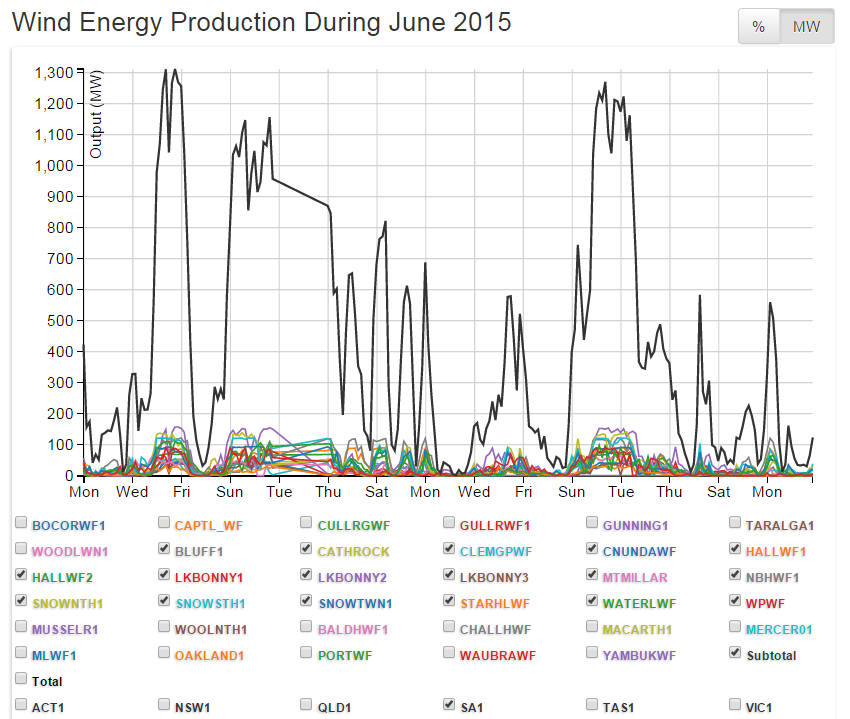
OCGT peaking plants are essential to covering the inevitable, but wholly unpredictable collapses in wind power output that occur almost every day, and for days on end (see our posts here and here).

Whether or not GE sells wind turbines (and it hasn’t sold many in Australia) – as long as these things are being speared into rural communities, GE still gets to sell OCGTs – a market in which it dominates.

In an effort to flog its gas turbines, GE advertised heavily in The Guardian – under the banner “Powering People” and in The Australian – where, earlier this year, GE “sponsored” numerous “features” under its banner “Powering Australia” (see our post here).

OCGTs are used – along with gazillions of gallons of gas, diesel or kerosene that run them – to plug the ‘gaps’ in wind power output around the globe: they’re a daily occurrence; total; and totally unpredictable.

June 2015 SA

We’ll let Jack off the leash again, as he homes in on the fact that wind power’s really just a ‘gas’.

How Wind Energy Creates More Dependence on Fossil Fuels
‘Any informed student of wind energy … understands that’
CapCon
Jack Spencer
2 March 2015

Truth has a habit of emerging from unexpected places. An article in the Daily Kos about the desire to end dependence on fossil fuels for energy needs reveals a “nasty little secret” about wind energy: It relies on fossil fuels. That’s a message wind energy opponents in Michigan have been trying to get across to the news media and the public over the past few years.

The article is part of a series titled “Getting to Zero,” by Keith Pickering, and is written with the premise that global warming is a dire and immediate threat. It states, “If civilization is to survive, we need to get to zero emission of fossil carbon, and we need to get there rapidly.” Overall it paints a pessimistic portrait of efforts to reduce carbon emissions from human sources.

A major aspect of the article’s pessimism about actually “getting to zero” pertains to wind energy. The following paragraphs serve as an example:

Wind farms are dependent on the weather to work, and most of the time they’re sitting idle or underperforming because the wind isn’t strong enough to turn the blades. The capacity factor (CF) for wind varies by location, but Iowa is pretty good, so let’s assume a CF of 35 [percent]. Nuclear has no such dependency and can operate around the clock.

In the [U.S.], nuclear plants have an average CF of 90 [percent].

So when we factor CF into those prices … most of wind’s advantage is wiped out by just that factor alone.

Over the long term it gets even worse for wind, because nuclear plants today are engineered for a 60-year lifetime, and wind generators are engineered for a 20 or 25 year lifetime. … That means that wind is cheaper than nuclear in the short term, but more expensive in the long term. Then there’s the backup problem. … When the wind dies, the lights still have to stay on. Right now that’s done with natural gas. …”

According to Kevon Martis, director of the Interstate Informed Citizens Coalition, a non-profit organization concerned about the construction of wind turbines in the region, what the Daily Kos article shows is that people knowledgeable about the technology understand that wind energy depends more on fossil fuels than on wind, no matter their views on contentious issues like global warming.

“Any informed student of wind energy, regardless of whether they are on the left or the right politically, understands that, far from freeing Michigan ratepayers from fossil-fueled electricity, wind energy actually binds us to fossil fuels at roughly a two-parts-fossil one-part-wind ratio,” Martis said. “Properly understood, wind energy should always be called ‘fossil-wind.’ What’s sad is that the vast majority of Michigan residents and probably members of the news media as well are not aware of this information. That situation needs to be remedied.”

In its assessment of wind energy, the Daily Kos article states: “Wind-plus-gas-backup is certainly better than gas alone, but it’s not the endpoint of a fossil-free grid, and it never will be.”

One of the strongest arguments against wind energy is the assertion that “natural gas alone” would produce fewer emissions than when it is combined with wind. That’s because having to switch natural gas generation on and off, literally at the whim of the way the wind blows, is less efficient and therefore less clean.

However, a news media and public that mistakenly believe wind energy is just wind, rather than two-thirds fossil fuels, cannot be expected to comprehend or participate in such a debate. Restricting important facts or (as some still insist) “alleged facts” about wind energy to the province of “experts only” is an affront to transparency and an obstacle to open public discourse. The Legislature owes the people of Michigan a hearing or series of hearings on this issue.

David Wand, deputy director of strategic communications with the American Wind Energy Association, did not return a phone call offering him the opportunity to comment.
CapCon

coal-seam-gas

****

Natural Gas to Wind Energy: You’re Nothing Without Me
Energy from windmills is mostly backed up by fossil fuels
CapCon
Jack Spencer
11 April 2015

Wind energy in Michigan is approximately two-thirds fossil fuels (predominantly natural gas) used in a less than efficient way, coupled with one-third wind. Most people are unaware of that reality and misinformation flourishes as a result.

Case in point: a new study claims to provide comparisons between wind and natural gas by treating them as if they were two totally separate and distinct forms of energy generation.

The University of Michigan and Lansing-based consulting firm 5 Lakes Energy are touting a joint study based on a “model” produced at the university. The stated purpose of the study is to provide policymakers with a “tool” to help them choose between wind and natural gas. Unfortunately the model upon which the study was based is so flawed that the only “tool” it brings to mind is a toy hammer used in an attempt to force a square peg into the proverbial round hole.

The outputs of the model and resulting study attempt to justify the expansion of wind energy (the term “renewables” is used — but that means wind) in Michigan to meet energy demands resulting from the impending closure of coal plants. Its main argument is that wind energy would be a wise choice because natural gas prices are likely to fluctuate.

The idea here is that wind energy should be seen as a hedge against the possibility that natural gas prices could increase. It is basically an attempt to use the old “don’t put all your eggs in one basket” analogy. This is persuasive only when one ignores the fact that wind energy is 65 percent natural gas, which is precisely what the model does.

For those who understand that a dependable blend which includes wind energy must contain mostly natural gas, the analogy of “not putting all your eggs in one basket” used to promote the study is ludicrous.

“The operative word is ‘or,’” said Tom Stacy, an electricity generation analyst and independent regulatory and policy consultant who signs his correspondence “Ohioan for Afford Electricity.” He explains that the “eggs in one basket” warning doesn’t make sense. “There is no ‘or.’ It is either 100 percent gas or 65 percent gas plus 35 percent wind.”

“The catch,” he continued, “is that compared to the cost of the natural gas basket, consumers are forced to pay triple for baskets because the wind basket costs twice what the gas basket does, yet the gas basket is still required to hold 65 percent of the eggs.” He continued, “The end result: For our dozen eggs, we pay for three baskets when we could have paid for one. In exchange we get four free eggs. The problem is the extra baskets cost far more than the eggs.”

Although fortified with the usual officious-sounding phrases and sprinkled with expert-speak acronyms, the 5 Lakes study is rooted in the popular, but inaccurate, fantasy that wind energy is what wind supporters wish it could be, rather than what it actually is. At one point the study report reveals its imaginary basis with the following statement: “If we choose the natural gas path and natural gas prices rise, we may regret that we are stuck using expensive natural gas when we could have had free wind or solar fuel.”

Free wind? That phrase alone seems contrived to deceive the uninitiated and validate the green faithful. Again, since wind is so unreliable, wind energy has to be backed up by natural gas 65 percent of the time. Under that circumstance — obviously — the cost of wind energy will always largely reflect the price of natural gas. What’s more, the impact of any natural gas price change on wind energy is really more that 65 percent, because natural gas, when hooked up to wind energy, is put to a less efficient use. This is due to the requirement that it be constantly adjusted for when the wind is or is not blowing or not blowing enough. It is exactly the same dynamic that takes place with an automobile’s use of gasoline when driving in city traffic as compared to coasting down the open highway.

In the real “power pool,” wind is not physically paired with just natural gas; it is also paired with coal. The example used in this article gives wind the benefit of the doubt by only using natural gas, and not coal, as the balancing source in the hybrid. The average emissions intensity of coal plus wind is far higher than for gas plus wind. In other words, coal gets terrible “city mileage MPG” compared to natural gas and the pairing of wind with coal results in the excessive inefficiency of stop and go traffic.

The flawed and dishonest premise of the 5 Lakes Energy Study marks it as just the latest attempt by wind energy advocates to promote their product by masking wind energy’s true nature. Wind energy is a less than 30 percent add-on to natural gas. Its effect on emissions, as compared to just natural gas alone, is debatable and at best minimal. The failure of the study to acknowledge this spoils all of its conclusions and suggestions.

A glance at a list of 5 Lakes Energy principle founders reveals more than one official from the administration of former Gov. Jennifer Granholm. Michigan Capitol Confidential emailed the following questions to Douglas Jester, the author of the report on the study, and later to other 5 Lakes Energy officials. They were: Are you denying that wind energy is primarily fueled by natural gas? Why does your study appear to have not accounted for this reality? Is there something we are missing here that you should make us aware of?

Thus far, there has been no response to these questions.
CapCon

yacht

Eric Jelinski – A Canadian Energy Engineer, Tells the Truth About Wind Turbines….

Top Canadian Energy Engineer – Eric Jelinski – Slams the Great Wind Power Fraud

engineering-image-4

Provided they haven’t got their trotters in the wind industry subsidy trough, engineers are quicker than most, when it comes to rumbling the great wind power fraud.

Practically minded, and with heads for real numbers, engineers are able to pick apart the complete pointlessness of trying to rely on an energy source that will NEVER be available on demand (can’t be stored) – is entirely dependent upon the weather – and is, therefore, not a generation “system” at all: “chaos” and “system” are words that come from completely different paddocks; and which mean completely different things (see our post here).

And engineers, who build “systems”, don’t like “chaos”.

Google’s top engineers – Stanford PhDs, Ross Koningstein and David Fork – came out and recently tipped a bucket on the nonsense of attempting to run 21st Century economies using a ‘technology’ that was dumped way back in the 19th Century (see our post here).

Now, one of Canada’s leading energy engineers, Eric Jelinski has come out swinging too.

An Engineer Speaks
Windfarm Action
27 January 2015

The following was written by Eric Jelinski, P. Eng., a Canadian engineer who specializes in energy production. Gas plants. Nuclear plants. Wind & solar energy. He explains to his township (Clearview Township, Ontario) why wind energy is folly.

Jelinski

I am writing to express my objections to the installation of Industrial Wind Turbines in Clearview Township, Ontario, Canada.

My wife and I moved here to retire on 50 acres, building a house, market garden, as well as taking many other initiatives to become part of the vital social fabric.

It is bad enough that under Ontario Premier McGuinty, the social fabric in big cities like Toronto is in need of repair, as it happens, in part because those “50,000 jobs” in renewable energy have not materialized, and there is little productive activity for many of the youth in the cities. Guns and drugs are very much part of the social fabric in some neighbourhoods.

What gives McGuinty, with his Toronto constituent Members of the Provincial Parliament (MPP’s), the moral right to tell us in Clearview that we must accept wind turbines “or else”?

One way to stop the wasted energy and environmental impact of urban sprawl is for big city MPP’s to clean up their own yard and make cities safer and more habitable. While they listen to those who object to new gas plants, and cook up a new “plan of the month” for public transport, why do they ignore the issues with wind turbines?

My background is nuclear and chemical engineering, with over 30 years combined working at each of the nuclear plants in Ontario. I teach nuclear engineering at University of Toronto and Georgian College (Power Engineering) in Owen Sound for the purpose of training the next generation of staff who will design plants and work them safely.

I know nuclear reactors and how e=mc2 gets us the energy. I know chemical reactors, e.g. to make gasoline from crude oil, and refining metals. I know solar and wind energy going back to the 1970’s, as energy and exergy are my major fields of study.

The application of Ontario’s “Green Energy Act” is in violation of principles in engineering, where we teach engineers to anticipate unintended consequences and not proceed with implementation until consequences and risks are taken into account.

The Green Energy Act is an abomination that is creating a living hell for almost everybody in rural Ontario, and the provincial government is ignoring the data of emerging health issues, property value issues, setbacks and zoning, impacts on fowl, fauna, and fish, impacts on local weather such as the dew point and foliar uptake by plants that is important in particular to alleviate heat stress on biota.

I have seen firsthand one of my neighbours from the 1980’s near Ripley forced out of his farm home due to wind turbines in Huron Township. Others are putting up with the impacts.

The energy available from wind in Ontario is borderline minimal compared to other countries and areas of the world. 25% to 30% is the capacity factor.

The wind is not available when we need energy the most, i.e. summer air-conditioning and winter heating. The shoulder seasons have the most wind here, yet this is when air-conditioning and heating demands are minimal.

The power equation for wind results in 8 times the energy for a doubling of wind speed, and the excess energy has to be “dumped.” Storage systems are available, but prohibitively expensive. Hythanation is possible, but wind turbines are not economic for hydrogen production given the added infrastructure relative to the cost of natural gas.

Wind turbines use 5 to 7 times the amount of concrete and steel vs. say a nuclear plant on a per Megawatt basis. It will require some 10,000 wind turbines to replace the ~ 6000 MW of coal generation at 25% CF (capacity factor). Back-up gas fired plants have to be added like plug-ins everywhere because the wind is not reliable.

The pastoral scene of a field of wind turbines slowly turning in almost still air has environmentalists dreaming in technicolour.

The truth is that these wind turbines need about 8 km/hour of wind before they will start generating electricity. Any rotation of the blades at wind speeds below 8 km/hour is accomplished by taking power from the grid to get the wind turbine started in anticipation that the wind may pick up.

The economy of scale that has historically brought competitive energy prices in Ontario is not available, given the thousands of wind turbines, and that will also become a maintenance nightmare as machines and contracts approach end of life. Why do we not refuel Nanticoke, Lakeview, Lambton, Lennox and complete Wesleyville to run on natural gas?

What makes McGuinty et al. think they can impose industrial wind turbines on Clearview and all of rural Ontario? Is Clearview thinking of becoming part of this scheme of waste?

This scheme of waste is happening not just by government order, but it is happening because of the salacious relationship between government and the developers.

The most telling example is the head of the Federal Liberal Party is a wind developer. The activity surrounding the recent cancelled “gas plant” in order to preserve seats, and thus preserve the Green Energy Act, is also telling.

We also have the government using engineers from wind developers making recommendations on health impacts. As a P. Eng. I can say that engineers are not the authority on health. The conflict of interest between the engineer being paid for engineering work, vs. the same engineer as proponent and key advisor to the government is quite apparent.

The set-back of 550 meters has no scientific basis. Noise from wind turbines has been measured up to 10 kilometers away in some locations. Medical doctors have noted the health impacts, yet they are being ignored by the Ontario government.

The Feed-in Tariff takes billions of dollars out of communities, out of the province, and out of the country. This is money that is very much needed for healthcare, for schools and teachers, and to replace aging infrastructure and to build much needed new infrastructure such as public transit.

For the first time in decades (I don’t think it ever took place), Ontario is taking equalization payments from the Federal Government, and this points to not only the unsustainability of Ontario as an economy, it is dragging down the rest of the country. It would be different if we owned everything, did local planning, and used a process that garnered respect.

The Ontario government is following the advice of foreign countries and foreign companies to give our money away to them irrespective of the advice of many MP’s. It is most interesting to note that one of the political parties with a labour platform appears in complete agreement with giving away the work and the money and the surplus electricity.

Japan is restarting its nuclear fleet. Russia, China, India, Britain, the US, and even the United Arab Emirates are building or planning to nuclear reactors for electric generation. What is the purpose and value of Ontario energy policy? Every product we buy in Ontario that is made someplace else (most items, can you name one thing that is made here?) has a nuclear energy component in that product.

It is time to stop being altruistic or hypocritical about our energy. There is no rational reason for the 50% cap on nuclear in Ontario. Are we on some unwitting “race to the bottom” being orchestrated by some competitor countries wanting to control us? Having ample low cost energy is crucial to sovereignty, internal peace, and security.

As such, there is no respecting McGuinty, Bentley et al. for this indictment. There is also no need to respect any wind developers as they have already indicated their respect for us. I commented last year on WPD, and sent comments to their consultant as requested, and they have not replied, and their silence speaks volumes. I have sent many an e-mail to the government recommending a moratorium and have not been given the courtesy of any reply.

The purpose of the developer is to make money, i.e. take our money as allowed for by the government, and with minimum effort on their part. This speaks to the quality of the public meetings and their answers to our concerns. The public meetings are a sham.

There are quite a number of lawsuits already taking place and others pending. I thank the Federal government for the recent announcement on the health study. It is also pivotal to learn today that the Ministry of Health is being forced to testify.

My recommendation is for Clearview to take the high road and avoid complicity in matters that are before the courts, and who knows, but it is quite possible (I hope) that the renewed call for a moratorium may take hold for good reasons posted here.

A moratorium in Clearview is very appropriate.

While the WPD wind turbines west of Stayner are quite a few km from our place, they are likely the thin edge of the wedge planned for coming into Clearview. Let me remind you, we came here because this is a good place to live with good opportunities for business. All of that changes if wind turbines are allowed to disrupt the neighbourhood. And 10,000 wind turbines and solar farms are not the answer to Ontario’s energy needs.

As I said before, a province-wide moratorium is needed, and I believe this will come as a matter of time because the inconvenient truth about wind turbines is too big for McGuinty’s carpet. The track record for dictatorial governments throughout history is that all dictatorships eventually capitulate. A moratorium in Clearview would be a “made in Clearview” solution to stop the waste sooner than later.

Eric Jelinski, P. Eng.

What is interesting is that this is not only a UK or European problem and the US and Canada predates much of our wind fleet. But the problems are endemic in the industry and the political myopia of the issues and problems of wind a mystery to the other 97% of the population!
Windfarmaction

wind turbine Screggah-wind-turbine-Padraig-McNulty-2-460x345

WINDWEASELS….and How They Intend to Steal Your Home & Your Property Rights….

How Wind Farm Subsidies are Used to Steal People’s Homes

money pit

***

In two well-drawn pieces, Jamin Hübner throws light on the greatest economic and environmental fraud of all time. His insight and clarity of expression are notable; and so is his particular focus on the fact that the massive and endless subsidies being thrown at wind power outfits (to make ‘possible’, the otherwise impossible) has the insidious and unjustified result of destroying the value of neighbours’ properties; or as Jamin puts it – “wind energy is one of the most efficient ways of depreciating land“.

Some might call it ‘appropriation by stealth’, we call it ‘state-sponsored theft’.

Wind farms the worst idea since Cash for Clunkers
The Daily Republic
Jamin Hübner
29 April 2015

Remember Cash for Clunkers? That 2009 government program that spent $6 billion to save $1 billion? Imagine walking up to a person and saying, “I want to save some money; I’ll give you six dollars if you give me one dollar back.” Genius. Leave it to Congress to devise (and enact) such brilliance.

There are dozens of government programs like these — all failures. The reason why is easy to understand: the government has no money of its own. It can only take from others and “give” some of it back. A full return is impossible, since this process of organized theft costs money itself. The end result is a net loss — regardless of how many jobs were temporarily created.

Wind farms is another such program. I didn’t realize this at first when witnessing their construction near Tripp (and soon to be Bon Homme County, where I was raised).

I used to think wind farms were about electricity … until I realized:

  1. Few, if any, wind farms bring electricity to an area that does not already have it. It’s too much work and money to build an entire electrical grid from the ground up. Wind energy is “supplemental,” not essential.
  2. Wind farms are subsidized by the government precisely because they generate a loss. Wind farms have to be paid to operate. People, uncoerced and unbribed, do not want wind farms because if they did, they would build them on their own like any other product in the free market.
  3. Wind farms function as a tax deduction for the wealthy — which is why they are built in the first place. Warren Buffett says it best: “I will do anything that is basically covered by the law to reduce Berkshire’s tax rate … on wind energy, we get a tax credit if we build a lot of wind farms. That’s the only reason to build them. They don’t make sense without the tax credit.” Exactly. Wind energy is a siphoning mechanism that offsets taxes and puts federal money into political and corporate pockets. Electricity and lease-agreement royalties are only a byproduct (and a great public cover). Proof of this is that wind farm production nearly stops every time the production credit gets suspended or canceled by Congress.

I use to think wind farms were “green energy” … until I realized:

  1. Hundreds of thousands of birds (and even more bats) die each year from wind turbines.
  2. At 450 to 500 feet tall, wind farms are a pilot’s nightmare (recall the death of four air passengers near Highmore last year). Crop dusting has now become a risky and complicated agricultural venture.
  3. Wind turbines are made of heavy gauge metal and concrete — transported across the nation with the heaviest gas-guzzlers of machinery. While not as bad as Al Gore’s private jet, the carbon footprint is anything but green.
  4. Local soils are depleted because of underground vibrations, audible and inaudible low-frequency noise (“infrasound”) and electromagnetic radiation from power cables that drive away earthworms and other local organisms, the same way loud marine motors drive away fish.
  5. Wind energy cannot be stored (e.g., batteries) and can only harness wind speeds within a tight range.
  6. Chances are, there will be no incentive to remove the turbines once the temporary government funds disappear. Massive steel towers rusting over decades in agricultural fields are not very “green.”

I used to think wind farms supported local energy … until I realized:

  1. A substantial percentage of wind farms are owned by overseas investors/corporations. This is not evident until the initial developers literally “sell the farm” after having built it.
  2. Wind turbines are typically not built by local construction workers and materials.
  3. Because of noise, adverse health effects (e.g., loss of sleep), visual pollution (bright red lights at night and shadow-flicker during mornings/evenings) and all other related liabilities (e.g., shoddy 30- and 65-year wind right contracts), wind energy is one of the most efficient ways of depreciating land.
  4. Small communities are divided, not united, over wind farm projects. One only has to read the Avon Clarion editorials for March and April to witness such intensity and strife. This isn’t to mention the deceptive methods of obtaining wind rights (wind developers put snake-oil salesmen to shame).

At the end of the day, it is not politics or science that determine how wind farms should develop. It is the right to private property. If some people don’t care about the noise, shadows and flashing lights, no problem. But for those who do, they should be justly compensated to the extent that their rights are violated. As Supreme Court Justice Andrew Napolitano observed in “It’s Dangerous to Be Right When the Government is Wrong,” “If you lived in a very crowded area, would the government be justified in preventing you from blaring extraordinarily loud music at midnight, or at least requiring you to pay “damages” to your neighbors for doing so?

“Certainly, by playing obnoxious music, you are diminishing your neighbors’ natural right to the use and enjoyment of their property. And over time, if you were habitually noisy, then most likely would decrease the market value of their property. Thus, although the government could not criminalize this kind of expression, it would be more than justified in making it actionable, or in other words, the basis for lawsuit.”
The Daily Republic

Dr Jamin Hubner

***

Let’s talk about money and wind farms
The Daily Republic
Jamin Hübner
14 August 2015

On April 29, The Daily Republic published my column, “Wind Farms: The Worst Idea Since Cash for Clunkers.” Since then, there have been several local responses to both my article and to criticism of wind energy in general. Allow me to briefly focus on two items.

I reminded readers that (all things considered) government programs cost greater than what such programs “produce.” Subsidies equal (inherently inefficient) income redistribution. The government cannot “pull a rabbit out of a hat.” In a May 14 column for The Daily Republic, Anthony Rezac essentially reached into a hat and proclaimed, “oh yes it can.” I will leave him to that imaginary world.

By June 8, the CEO of American Wind Association finished crafting a remarkably misleading piece of political prose for the Sioux Falls Argus Leader. Like Rezac and others, the majority of anti-wind concerns were casually dismissed while strings of dollar bills were lowered into readers’ faces and swung repeatedly (perhaps this would silence the critics). But, no—no fires were put out, and I might suggest that waving a dismissive hand at South Dakotans as if they were too gullible to care is not a particularly good strategy.

So, since all that pro-wind advocates seem capable of consistently conversing about is money, let’s talk about money and wind farms.

First, to repeat, wind farms have to be subsidized because they generate such a huge financial loss, and no one in the free market is silly enough to build them from their own resources. In Buffett’s words, “they don’t make sense without the tax credit.” It is precisely because of this monetary loss that pro-wind advocates have to resign to exaggerated estimates, numerical figures, and macro-level statistics (absent of micro-level realities) in the first place. They are on the defensive for good reasons.

Second, by comparison, wind energy is the most financially wasteful government-sponsored energy program in existence. This was ably demonstrated in a 2010 study conducted by Simmons et. al. for Utah State University. One key finding was, “In 2010 the wind energy sector received 42 percent of total federal subsidies while producing only 2 percent of the nation’s total electricity. By comparison, coal receives 10 percent of all subsidies and generates 45 percent and nuclear is about even at about 20 percent.”

These figures have not significantly improved today. And yet we are supposed to believe Tom Kiernan’s claim that wind energy will soon “compete” with other sources of energy? Like a tricycle in Nascar.

Third, claiming American wind energy helps the American economy by being distinctively “local” is absurd. Between 75-90 percent of wind farms are owned by foreign corporations/investors, and more than 60 percent of wind turbines are manufactured by foreign companies, according to Choma. American wind energy is as American as a pair of shoes labeled “Made in China.”

Fourth, property owners who have sold their wind rights may never earn their royalties fast enough to cover the loss in property values from owning them. In other words, those who are supposed to be making millions, don’t. (You can find this out yourself simply by asking around.) None of the financial figures produced by the AWA or — to my knowledge, by any pro-wind advocate — takes into full account this central negative factor: depreciation of land. This is significant not only because of the amount of depreciation for land near and under wind farms (which is high), but because of the ever-increasing value of land (amplifying the losses).

More than a half-dozen independent studies conducted by appraisers and university-sponsored groups in the last decade found a 15-59 percent decrease in property values on or near wind farms (see McCann Appraisal LLC, summaries). (Predictably, pro-wind studies creatively generate data with lower estimates).

Combined with 30-40 percent income tax on earnings from wind royalties, shoddy contracts often not inflation-adjusted and dependent on Washington’s empty wallet (and irrational politics), certain land-owners with wind farms ultimately earn pennies instead of millions over the long haul. (This is what you won’t hear when signing a 30- or 60-year contract.) Even for the lucky few in better situations, the profits still don’t add up to the glorious estimates because of these losses.

Fifth, because of this liability, investors will go elsewhere to invest their money (as will families in local communities). Few want to live on or near a wind farm, and no investor wants to invest in land that has any potential for significant depreciation. (And this is true whether land actually depreciates or not; ambiguity is enough to stop investors).

Sixth, as mentioned above, wind-farm developers’ numbers (whether royalty estimates, long term sales, “bringing money to the community,” etc.) are so out of touch with reality that it’s hard to even keep a straight face. Speaking of, Kiernan in his article even claims wind energy will contribute to the prevention of “a total of 22,000 premature deaths by mid-century” via cleaner air. What’s next? The vibration from turbines will cure constipation? Happy day, Farmer Joe.

Space does not allow for seventh, eighth, etc. But, wind energy advocates should at least pause before mindlessly regurgitating monetary figures in public and proclaiming everyone a financial winner with wind farms. Nothing is free, and the monstrous costs of wind energy are coming to the light year after year.
The Daily Republic

thief

Climate Change Rhetoric is Nothing More Than a Cover for Wealth Redistribution.

Nine Experts Slam EPA Administrator Gina McCarthy’s ‘Clean Power Plan’ Speech
Like a river in Colorado, the EPA is poisoning the climate debate.
by Tom Harris
August 24, 2015
Anyone trying to understand why the climate change debate has become so toxic need look no further than the August 11 speech by U.S. Environmental Protection Agency Administrator Gina McCarthy.

In her presentation at the Resources for the Future (RFF) Policy Leadership Forum, her first public appearance since the August 3 release of the EPA’s “Clean Power Plan“ (CPP), McCarthy demonstrated everything that is wrong with the Obama administration’s approach to the issue. The EPA employs error-riddled interpretations of climate science and economics, and couples this with language designed to trick the public and the press into thinking the plan is something it is not.
————-

A Biased Host

The forum started with an introduction by Dr. Raymond Kopp, RFF’s Energy & Climate Economics co-director, who told the audience:

As many of you know, we’re not an advocacy organization. We’re not cheerleaders for any particular policy or point of view. Our goal is really to provide the best scholarly research to the policy community so it can develop the most efficient, efficacious, affordable, and best public policies possible.

Laudable goals indeed … but Kopp immediately betrayed RFF’s supposed objectives when he next said:

The Clean Power Plan in its current form as a final rule is likely the most significant development in U.S. history with respect to climate change. I don’t think any of us believe otherwise. It is a tremendously substantial rule and one that will have significant impact.

[Developing the rule] took a lot of hard work by many people inside and outside of government and it took an awful lot of leadership and luckily Gina McCarthy was available, ready, and willing to undertake that leadership role and for that we are most thankful.

Addressing McCarthy directly, Kopp concluded:

Thank you for getting the job done, for doing it exceedingly well, and shepherding the Clean Power Plan through all of these hurdles that were necessary to bring it to a final rule today. And, I think, thank you for doing it in an environment where the politics and the rhetoric really make this job as difficult as possible.

Considering Kopp’s remarks, it is not surprising that, according to RFF Forum attendee Dr. Alan Carlin — former EPA senior analyst and manager, and past chairman of the Angeles Chapter of the Sierra Club — “RFF went all out to prevent me from handing out my comments and to keep out any skeptical comments from the Q&A.”

So much for RFF’s claim to not be “cheerleaders for any particular policy or point of view.”

—————

EPA Misrepresents Climate Science

McCarthy started the climate change part of her presentation with a politically correct assertion:

Climate change is one of the most important issues that we face. It is a global challenge but, in many ways, it’s also very personal to all of us because it affects everything and everyone we know and we love.

Climate change is, of course, a regional challenge, not a global one.

There is no super being straddling the planet, experiencing global trends. All that matters is what is happening — increases or decreases in the incidence of floods and droughts, heat waves and cold spells, and so on — in regions where people, plants, and animals are found. For example, what sense would it make for a community to prepare for a global sea level rise if, in that particular region, sea level was falling?

New Zealand-based renewable energy consultant Bryan Leyland pointed out:

Climate change has been a problem to mankind for hundreds of thousands of years. But we survived the last ice age, compared with which, the recent change in climate is but a minor wiggle. The greatest climate risk we face at the moment is a high probability that we are entering a period of cooling comparable to the Little Ice Age.

Many scientists agree with Leyland. For example, Dr. Howard Hayden, emeritus professor of physics at the University of Connecticut, explained:

The Earth is on a descent into the next 100,000-year ice age. For the moment, the glaciers seem to be in retreat, but they are not remnants of the last ice age. They have been growing during the last 8,000 years.

High-resolution spectroscopy specialist Dr. John Nicol, former senior lecturer of physics and dean of science at James Cook University in Australia, elaborated:

Since 1997, the Earth has not warmed but has, in fact, very slightly cooled even though atmospheric CO2 levels have been increasing. McCarthy’s assertion that climate change is “very personal to all of us” clearly demonstrates her emotional rather than the scientific approach to this non-issue.

————–

Gina McCarthy next said:

By now we all know that climate change is driven in large part by carbon pollution and it leads to more extreme heat, cold, storms, fires, and floods.

Referring to carbon dioxide (CO2) as “carbon pollution” is one of the most common rhetorical tricks employed by the Obama administration. In the EPA’s news release announcing the CPP, they referenced “carbon pollution” five times in the release’s first four sentences.

Calling the gas “carbon” encourages the public to think of it as something dirty, like graphite or soot — which really are carbon.

Calling CO2 by its proper name would help the public remember that it is a non-toxic, odorless, invisible gas essential to plant photosynthesis. It is no more pollution than is water vapor, by far the principal greenhouse gas in the atmosphere. The EPA website is riddled with this “carbon” deception.

Leyland replied to the EPA chief:

It is shocking that McCarthy does not understand the difference between carbon dioxide — a harmless gas that benefits agriculture — and genuine pollutants like particulates, sulphur dioxide and the like emitted from old obsolete power stations. Modern coal-fired stations do not emit these pollutants.

McCarthy is not fit to head the EPA if she doesn’t know such basic science. Regardless, neither theory nor observations support the EPA chief’s claim that CO2 rise causes “more extreme heat, cold, storms, fires and floods.” Hyderabad, India-based Dr. S. Jeevananda Reddy — formerly chief technical advisor for the UN World Meteorological Organization and author of Climate Change – Myths & Realities — said that McCarthy’s statement is “not true”:

Extreme heat, cold, storms and floods are part of natural variation. These are modified by local general circulation patterns existing over different parts of the globe over different seasons.

Nicol also contested McCarthy’s assertion:

Not only is the claim that CO2 is to blame [for increases in extreme weather] wrong, but the contradictory statements regarding these weather events, which are NO different from those of 200 years ago, demonstrates the desperation of lobby groups trying to maintain this myth.

If the world were to warm appreciably due to increasing CO2 emissions, temperatures at high latitudes are forecast to rise the most, reducing the difference between arctic and tropical temperatures. Since this differential drives weather, we should see weaker midlatitude cyclones in a warmer world — and thus fewer extremes in weather, not more.

Indeed, the lack of extreme weather increase with global warming is one of the few areas of agreement between the United Nations Intergovernmental Panel on Climate Change (IPCC) and the Nongovernmental International Panel on Climate Change (NIPCC). In 2012, the IPCC asserted that a relationship between global warming and wildfires, rainfall, storms, hurricanes, and other extreme weather events has not been demonstrated. In their latest assessment report (Sep 2013), IPCC scientists concluded that they had only “low confidence” that “damaging increases will occur in either drought or tropical cyclone activity” as a result of global warming.

The Sep 2013 NIPCC report concluded the same, asserting:

In no case has a convincing relationship been established between warming over the past 100 years and increases in any of these extreme events.

NIPCC report chapter lead author Dr. Timothy Ball, environmental consultant and former climatology professor at the University of Winnipeg, explained that the EPA is taking the approach that American journalist Farhad Manjoo identified in his book True Enough: Learning To Live in a Post-Fact Society:

You create your theory then hire experts. The EPA agenda is political, not scientific.

Climate Change Is Normal

McCarthy then told the RFF Forum:

For farmers who are strained by the drought, for families with homes in the path of a wildfire, for small businesses along our coastlines, climate change is indeed very personal.

Nicol labeled these comments “utter rubbish,” writing:

Farmers do not believe in Global Warming or Climate Change as spruced by the human-caused global warming industry. Farmers have mostly been on their properties since they were children and have also been given detailed accounts of the weather and the seasons from when their great-grandfathers began farming.

This fact upsets those who try to claim that there are obvious changes. Farmers will tell you that the seasons come in cycles and any season we have now has been seen in the past — possibly 100 years ago.

Reddy also replied to McCarthy:

These [phenomena McCarthy lists] are associated with human actions on nature — land use and land cover changes, pollution (air, water, soil, and food) and adulterated foods, etc. For example, recent devastations in Jammu & Kashmir and Himalayan states of India were associated with occupation/building houses on river banks.

—————

McCarthy continued:

We all know that climate change is impacting us today and will continue to get worse if we don’t take action.

The EPA chief knows full well that this is not true.

After intense questioning from Representative Mike Pompeo (R-KS) at the September 18, 2013 hearing of the House Subcommittee on Energy and Power, McCarthy admitted that the CPP will have essentially no impact on climate. Hayden agreed:

Even if the restrictions were enacted, the effect on worldwide temperature would be too tiny to measure.

——————

McCarthy Suppresses Open Scientific Debate

McCarthy said:

We are way past any further discussion or debate.

Scientists are as sure that humans are causing climate change as they are that cigarette smoke causes lung cancer. So, unless you want to debate that point, don’t debate about climate change any longer because it is our moral responsibility to act.

Comparing the science linking cigarette smoke and cancer with the science of climate change is ridiculous. Climate science is becoming more uncertain as the field advances — we don’t even know if warming or cooling lies ahead.

University of Western Ontario applied mathematician Dr. Chris Essex, an expert in the mathematical models that are the basis of the climate scare, explained:

Climate is one of the most challenging open problems in modern science. Some knowledgeable scientists believe that the climate problem can never be solved.

The NIPCC reports list hundreds of peer-reviewed science papers that show that much of what we thought we knew about climate is wrong or highly debatable. In particular, the lack of global warming over the past 18 years, a period during which CO2 concentration in the atmosphere has risen 10%, shows there is something seriously wrong with the human-caused warming theory.

Reddy responded to McCarthy’s statement:

We still need to discuss global warming science since the IPCC is not sure of the correct sensitivity factor that relates anthropogenic greenhouse gas increases to temperature rise.

This is illustrated by the fact that they changed the sensitivity factor [the temperature rise in degrees Celsius forecast to occur due to a doubling of CO2], from 1.95 in the IPCC Fourth Assessment Report (2007) to 1.55 in their Fifth Assessment Report (2013).

They are merely employing trial and error, and not physical process paths.

Ball points out what the IPCC itself admitted in its Third Assessment Report (2001):

In climate research and modeling, we should recognize that we are dealing with a coupled non-linear chaotic system, and therefore that the long-term prediction of future climate states is not possible.

John Nicol said of the scientists who support McCarthy’s position:

They are mistaken since they do not have a proper understanding of the spectroscopic behavior of carbon dioxide or its interactions in a mixture of other gases — oxygen and nitrogen.

—————

McCarthy next told the audience that Obama:

… reminded us that, while we are the first generation to feel the impacts of climate change, we are the last that can effectively do something about it.

Nicol answered:

We are not the first people to experience climate change. The Navajo in America, civilizations in the Middle East, and many others moved across continents to escape climate change-related events which were totally the responsibility of Nature and caused huge upheaval.

The changes claimed to be perceived today are, by comparison, trivial.

Carbon dioxide is not causing changes to the climate — Nature causes changes and always has, always will.

Ball asked:

How on Earth did we ever survive the climate change that has gone on for five billion years?

Of course, the idea that we can do something about it speaks to the arrogant godlessness of Obama and the environmentalists. If you get rid of God, you have to play God, and Obama’s angels are the bureaucrats like McCarthy. It’s interesting that another McCarthy, Mary, said: “Bureaucracy, the rule of no one, [is] the modern form of despotism.”

————

McCarthy concluded her comments:

Science has spoken on this. A low-carbon future is inevitable. We’re sending exactly the right signals on what, at least EPA believes to be, a future of lower pollution that is essential for public health and the environment.

Nicol replied:

Advocates for the destruction of society and world control of our societies are the actual offenders who have spoken on this.

Real and demonstrable science shows that a low carbon future will have no influence on the world’s climate and will destroy our ability to care for the world’s poor.

Energy is essential for the distribution of health and wealth to the poorer nations. This means that coal-fired power is essential, as recognized by the world’s largest economies, China and India.

Who are we to dictate the living standards of these and other nations?

Leyland added:

The main effect of the drive for a low carbon future is that energy will become more and more expensive and more and more people will die in the winter from the cold and in summer because they cannot afford to run the air conditioning.

The health effects would be seriously negative. The environmental effects will be a reduction in plant growth that could cost the agricultural economy trillions of dollars.

CPP’s Fictitious Health and Financial Benefits

McCarthy made numerous excited claims about the health impacts of the new climate rule:

As a result [of the CPP], in 2030, we are going to be avoiding thousands of premature deaths and hospital admissions, tens of thousands of asthma attacks and hundreds of thousands of missed school days and missed work days.

But the CPP does not regulate pollution. It regulates CO2, which has no detrimental impact on human health.

Only by assuming that enabling the CPP will force the closure of coal-fired electricity stations – and that that will reduce pollution emissions – can one claim the health benefits claimed by McCarthy. As explained by William Yeatman, environmental policy expert and editor of the Cooler Heads Coalition:

[This is] an EPA scam, known as “co-benefits,” by which the agency has justified a number of recent highly politicized regulations.

[T]here are entire sections of the Clean Air Act given to the regulation of particulate matter and nitrogen oxides. There is, therefore, neither a public health purpose nor a need for EPA to use a climate plan to regulate particulate matter and nitrogen oxides emissions under the Clean Air Act.

Furthermore, Yeatman demonstrates that the EPA’s methodology for estimating health benefits of the Clean Air Act “is based almost entirely on controversial, ‘secret’ science.” Not only do their forecasts of lives saved make no sense, but the agency refuses to release the data used to make these calculations. Carlin labeled the supposed health benefits of the CPP “dubious if not imaginary,” and asked:

If these benefits actually exist, why has EPA not already obtained them directly and more efficiently using “conventional” pollutant regulations?

McCarthy concluded her presentation by claiming that in 2030, as a result of the CPP:

The average American family will start seeing $85 in annual savings on their utility bills.

This is lunacy. Independent climate researcher Willis Eschenbach demonstrated on Watts Up With That that the CPP will almost quadruple U.S. electricity prices by 2030 if the Obama administration’s latest CO2 rule is fully implemented. As seen in Figure 1 below, Eschenbach calculated that “renewable” capacity per capita accounts for 84% of electricity cost variations between European countries (about €1 trillion has been spent so far in Europe on the installation of renewable energy technologies for electricity generation).

Figure 1: Electricity costs as a function of per capita installed renewable capacity. Wind and solar only, excludes hydropower.

Eschenbach explained:

We get about 4% of our electricity from wind and solar. He [Obama] wants to jack it to 28%, meaning we need seven times the installed capacity. Currently we have about 231 kW/capita of installed wind and solar (see Figure 1).

So Obama’s plan will require that we have a little less than seven times that, 1537 kW/capita. And assuming that we can extend the relationship we see in Figure 1, this means that the average price of electricity in the U.S. will perforce go up to no less than 43 cents per kilowatt-hour [the current average U.S. price of electricity is about 12 cents per kilowatt-hour] (This includes the hidden 1.4 cents/kW cost due to the five cents per kilowatt-hour subsidy paid to the solar/wind producers).

In January 2008, Obama, then a candidate for the Democratic Party’s nomination for president, told the San Francisco Chronicle that under his energy plan “electricity rates would necessarily skyrocket.”

Eschenbach and other analysts (for example, here and here) show that the CPP will finally allow the president to fulfill this promise.

Climate Hoax Must Be Confronted

Dr. Jay Lehr, science director at The Heartland Institute, summed up the situation well:

There is no science behind the idea that man controls the climate. Yet, billions of dollars are being diverted from our taxes to scam artists for renewable energy, fallacious mathematical model research, and political rewards.

It is a scam that dwarfs all others that have come before. And this will continue unabated for years to come until the public rises up in dissent.

Rather than just go with the flow or try to game the system to their advantage, industry leaders, scientists, and ordinary citizens must speak out against the climate scare that threatens America. If they do not, operatives such as Gina McCarthy will have free rein to enable the president’s disastrous climate plans.

More Proof that Climate Change Hysteria is a HOAX!

Realities Of Climate Change, Politics And Public Knowledge.

Guest Opinion: Dr. Tim Ball

The minute a small cabal hijacked climate for a political agenda it determined that setting the record straight required political answers. Naomi Klein admitted it wasn’t about the science directly. That fighting climate change was necessary to combat capitalism. This was the objective all along and expressed in 1993 when Senator Wirth admitted,

“We’ve got to ride the global warming issue. Even if the theory of global warming is wrong, we will be doing the right thing …” 


The “right thing” is achieving Maurice Strong’s objective of getting rid of the industrialized nations.

Too many skeptics continue to think that scientific points are going to change the public understanding. Most of the public don’t understand, but, more important, don’t want to understand. I doubt the 75% who failed the Yale Education Climate Change test lost any sleep. Polls, such as those of the Pew Center and overall analysis of trends indicate global warming or climate change are not a concern for most people. I suspect they don’t care because they don’t understand or want to understand. They also know how about the unreliability of weather forecasts, and that is all the science they need. One Pew pollconfirms that the public believes global warming is a political issue. Because of this, politicians and environmentalists with political agendas continue to control the story.James Delingpole puts the amount of money wasted because of this control at $4 billion a day.

Because science is ideally amoral and apolitical most scientists avoid politics, which results in a failure to provide necessary information to open-minded politicians and media. They need this to counter the pseudo-science of the IPCC proponents. They knew what to do from the start. Stephen Schneider set it out succinctly in Discover magazine a year after Hansen appeared before Wirth’s Senate committee and put the entire issue into the political realm.

On the one hand we are ethically bound to the scientific method, in effect promising to tell the truth, the whole truth, and nothing but& which means that we must include all the doubts, caveats, ifs and buts. On the other hand, we are not just scientists, but human beings as well. And like most people, we’d like to see the world a better place, which in this context translates into our working to reduce the risk of potentially disastrous climate change. To do that we have to get some broad-based support, to capture the public’s imagination. That, of course, entails getting loads of media coverage. So we have to offer up scary scenarios, make simplified, dramatic statements, and make little mention of any doubts we might have. This double ethical bind which we frequently find ourselves in cannot be solved by any formula. Each of us has to decide what the right balance is between being effective and being honest. I hope that means being both.

If this sounds familiar today, it is because it summarizes the words in the recent Encyclical of Pope Francis. Schneider is wrong. There is no decision about right and wrong, which is why the Pope’s connection with climate deceivers contradicts his central role as upholder of truth and is so deeply troubling. It is the rationale Naomi Klein and other use, which is why they brought her on board. It is basic Alinsky; the end justifies the means.

I spoke about the need to counter the false science from a political and social perspective, in my presentation at the First Heartland Conference in New York ten years ago. I pointed out that Gore’s movie was a brilliant piece of propaganda. A view supported by Justice Burton the UK judge who ruled on its use in the classroom.

It is now common ground that it is not simply a science film – although it is clear that it is based substantially on scientific research and opinion – but that it is a political film, albeit of course not party political.

Justice Burton recommended teachers provide balance by also showing The Great Global Warming Swindle. I proudly advised producer Martin Durkin and appeared in the movie. I also warned him that the US media would not run it, as proved the case, although it is now generally available. The problem is that only a small percentage of people watch documentaries on television. Gore bypassed that by using Hollywood to make the movie but also to market it through all their traditional venues. They knew how to achieve Schneider’s goal of getting “broad-based support” and “capturing the public’s imagination.”

Skeptics have, for a variety of reasons, avoided the “Hollywood” approach. It is a major error. We need to realize that tactics are tactics, and that the adage that you fight fire with fire is true. The first thing to do in any strategy is define the problem and the second is to determine the target and thirdly use tactics appropriate to the situation.

The problem is a failure to explain climate science and its abuse in a way a majority can understand. The following points are gleaned from my experience with media interviews, school visits, questions after a presentation, and questions via email. They represent the issues I confront every day. They are the real challenges anybody trying to offset the misinformation about climate and climate change must consider. They are the political dynamics that influence how you help people understand and deal with science issues.

1. People can’t believe a small group of people could mislead the world. Nowadays, the explosion of conspiracy theories because of the Internet, make the idea even more remote and unpalatable. They need to heed world-renowned anthropologist Margaret Mead’s observation.

“Never doubt that a small group of thoughtful, committed citizens can change the world. Indeed, it is the only thing that ever has.”

This comment implies that “thoughtful” and “committed” are pursuing positive changes. History indicates they are never positive as power centralizes and corrupts and people lose freedoms.

2. People can’t believe scientists would distort, manipulate, or do anything other than proper science. They accept the view that science and scientists are amoral and apolitical. As Mary McCarthy said,

“In science, all facts, no matter how trivial or banal, enjoy democratic equality.”

This is reinforced by the practice of most scientists to avoid politics. The public assumes the silence is a tacit agreement with what is in the media about global warming.

3. It is mostly the politicians who talk about the 97% manufactured consensus. The public asks as happened to me twice on radio this week,

“How come thousands of scientists believe there is global warming and climate change?”

The simple answer is, very few are familiar with the science. They, like most of the public, assume other scientists would not distort, manipulate, or do anything other than proper science. When scientists find out, they are shocked as exemplified in Klaus-Eckert Pulscomment.

Ten years ago I simply parroted what the IPCC told us. One day I started checking the facts and data—first I started with a sense of doubt but then I became outraged when I discovered that much of

what the IPCC and the media were telling us was sheer nonsense and was not even supported by any scientific facts and measurements. To this day I still feel shame that as a scientist I made presentations of their science without first checking it.

IPCC proponents promoted and perpetuated this deception through science societies as I explained.

A particularly egregious exploitation was carried out through science societies and professional scientific groups. They were given the climate science of the IPCC and urged to support it on behalf of their members. Certainly a few were part of the exploitation, but a majority, including most of the members simply assumed that the rigorous methods of research and publication in their science were used. Lord May of the UK Royal Society was influential in the manipulation of public perception through national scientific societies. They persuaded other national societies to become involved by making public statements. The Russian Academy of Science, under its President Yuri Israel, refused to participate.

4. To paraphrase Winston Churchill, “Never in the history of mankind have so many been deceived by so few, with so few facts.” The more you try to counteract what the public knows using scientific facts, the more you lose the battle. If you use scientific facts you must couch them in terms and analogies everybody understands. I know this from 25 years of teaching a compulsory science credit course for Arts students. The abilities and techniques I developed there of explaining climate in ways the public understand made me a double threat to IPCC proponents because I was also qualified.

5. Most people don’t know what is “normal” or “natural” in nature. This made it easy to imply or infer that they were abnormal or unnatural. It works well with the modern practice of “sound bites” in which information is presented without context. Climate change is innately historical and demands context. There are two basic options to counter the problem. Publish the context for each story as soon as possible after it appears. Publish stories of true facts that are outside of people’s comprehension using analogies. For example, alarmists add human scale to stories with analogies. One year they reported Arctic sea ice melted more by an area the size of Texas than the previous year. Texas is 695,662 km2, which is approximately 4.6% of the total Arctic ice of 15 million km2. The change is within the natural annual variability, but Texas is big so it must be a problem.

6. We tell people CO2 isn’t causing the warming but fail to explain why. This is for people who don’t know what a greenhouse gas is or that water vapor is far more important. (Figure 1)

clip_image002

Figure 1 Source: Yale Education Climate Change Test.

We then fail to explain what is the most likely cause. As politicians learn to their peril, you can’t just be against something.

Today they push the global warming claims with increasing deception because the 21stParis Conference of the Parties on climate is scheduled for 7-8 December 2015. They consider it imperative to pass a Kyoto type set of policies. Ironically, one thing that diminishes their chances is continued economic decline, the very objective of Wirth, Klein and the gang. It is ironic because politicians will reset their priorities to promote development, growth, and job creation because they don’t want angry voters. What they will get is angry global warming activists with a political agenda.